Serviced Apartment Management Software Diani: A Complete Guide to Managing Short-Stay Rentals
Diani has become an attractive destination for holidaymakers, business travellers, families and international visitors looking for comfortable accommodation along Kenya’s coast. For property owners and accommodation operators, this creates opportunities to earn income from furnished apartments, holiday homes and short-term rental units. However, managing these properties requires more than providing guests with keys and collecting payments. Serviced Apartment Management Software Diani offers a practical approach to organizing reservations, guest information, payments, housekeeping, maintenance and rental performance from one management platform.
Running serviced apartments involves several activities that must work together. An operator needs to know which units are occupied, which guests are expected to arrive, whether departing guests have settled their bills and which apartments are ready for the next reservation. These responsibilities become more complicated when a business operates several apartments, receives bookings through different channels or employs a team responsible for cleaning, maintenance and guest support.
Without an organized system, important information can become scattered across notebooks, spreadsheets, phone conversations and messaging applications. A booking may be recorded twice, a payment may not be matched to the correct reservation, or housekeeping staff may prepare the wrong apartment. Such mistakes can affect guest satisfaction and reduce the income a property generates.
This guide explains how serviced apartment operators in Diani can improve their daily operations through digital property management. It examines reservation management, guest communication, payment tracking, housekeeping, maintenance, financial reporting, security and the practical considerations involved in choosing suitable management software. It is intended for individual apartment owners, holiday rental operators, property managers and businesses managing multiple furnished units.
1. Understanding the Serviced Apartment Business in Diani
What makes serviced apartments different from traditional rentals?
Serviced apartments combine the privacy and convenience of a residential apartment with selected hospitality services. Guests receive furnished accommodation, but the operator may also provide housekeeping, linen changes, Wi-Fi, security, maintenance, guest assistance and other services.
Unlike traditional residential rentals, where a tenant may occupy a property for several months or years, serviced apartments often accommodate guests for shorter periods. Some visitors stay for a weekend, while others book for several weeks or months.
This difference affects almost every aspect of property management.
For example, a conventional rental manager may only need to monitor monthly rent payments, lease agreements and occasional maintenance requests. A serviced apartment operator must additionally coordinate:
-
Daily or weekly reservations.
-
Guest arrivals and departures.
-
Room preparation and cleaning.
-
Linen replacement.
-
Guest deposits and outstanding balances.
-
Short-term accommodation payments.
-
Booking cancellations and changes.
-
Maintenance between guest stays.
-
Guest reviews and service feedback.
-
Availability across different booking channels.
These responsibilities require a more coordinated approach. Serviced Apartment Management Software Diani helps operators organize the information associated with their furnished rental units and maintain better visibility of daily activities.
Why Diani presents a unique property management opportunity
Diani is known for its coastal environment, beaches, hotels, restaurants and holiday accommodation. Its accommodation market attracts different categories of visitors, including domestic tourists, international holidaymakers, couples, families and people travelling for business.
This diversity creates different booking patterns.
A family visiting during a school holiday may need a spacious apartment for several nights. A couple may prefer a smaller furnished unit for a weekend. A professional working on a temporary assignment may need accommodation for an extended period.
Property owners must therefore manage different guest requirements without losing control of their rental operations.
Some of the challenges include:
-
Managing different accommodation durations.
-
Coordinating reservations during busy holiday periods.
-
Preparing apartments between successive bookings.
-
Keeping track of guest payments.
-
Managing staff across several properties.
-
Responding to maintenance issues quickly.
-
Understanding which apartments generate the most income.
A digital management system makes it easier to organize these responsibilities.
Who needs serviced apartment management software?
The technology is useful to different businesses operating within Diani’s short-stay accommodation market.
Individual apartment owners: Owners with one or two furnished apartments can organize reservations, guest information, payments and property expenses.
Holiday rental operators: Businesses offering furnished accommodation to tourists can coordinate multiple bookings and monitor availability.
Property management agencies: Agencies managing apartments on behalf of different landlords can maintain organized records and provide clearer financial statements.
Hospitality businesses: Accommodation businesses combining apartments with additional guest services can coordinate property operations more effectively.
Real estate investors: Investors with several furnished units can compare performance and understand how their properties contribute to overall income.
The main advantage is having an organized management process instead of relying on disconnected records.
2. Why Manual Serviced Apartment Management Becomes Difficult
Manual management may work when an owner operates one apartment and receives only a few reservations each month. However, the administrative workload increases as the number of units and bookings grows.
A business may begin with a simple notebook, a spreadsheet and WhatsApp conversations. Over time, information becomes harder to organize.
Double bookings and availability mistakes
One of the most damaging operational mistakes is confirming two reservations for the same apartment during overlapping dates.
Imagine an operator managing six furnished apartments. A guest contacts the business through WhatsApp, while another makes an enquiry through a holiday rental platform.
If the two enquiries are handled by different employees without a shared availability record, both employees may confirm the same apartment.
The business then has to contact one guest, explain the mistake and arrange alternative accommodation.
This can damage the company’s reputation and create unnecessary expenses.
Serviced Apartment Management Software Diani supports a more organized approach by making reservation information part of a centralized property management process.
Operators should maintain clear records showing:
-
Apartment identification.
-
Reservation reference.
-
Guest name.
-
Arrival date.
-
Departure date.
-
Number of guests.
-
Booking status.
-
Amount payable.
-
Payment status.
A clear booking record makes it easier for employees to establish whether a unit is available before confirming a reservation.
Poor payment tracking
Serviced apartment operators receive payments through different arrangements. A guest may pay through M-Pesa, a bank transfer, a card payment facility or another agreed payment method.
Manual payment tracking creates several risks.
An employee may receive payment confirmation but forget to update the reservation. Another employee may see an outstanding balance and contact a guest who has already paid.
There may also be confusion when guests make deposits first and settle the remaining balance before arrival.
A reliable payment record should show the amount expected, the amount received, the outstanding balance and the payment date.
Housekeeping coordination problems
Cleaning and apartment preparation are essential parts of short-stay accommodation management.
An apartment must be cleaned and inspected before the next guest arrives. Towels, bed linen, kitchen equipment and other essential items may need to be replaced.
When housekeeping information is communicated verbally, employees can easily miss instructions.
For instance, a guest may check out in the morning and another reservation may begin later that afternoon. The cleaning team needs to know immediately that the apartment requires preparation.
A shared task record helps employees understand what needs to be done and which units are ready.
Limited financial visibility
Property owners need to understand whether their apartments are generating sustainable income.
However, calculating profitability becomes difficult when revenue and expenses are recorded separately.
A property owner may know how much money was received during the month but have limited information about cleaning costs, repairs, utilities, management charges and other operating expenses.
This can lead to incorrect decisions about pricing, investment and business expansion.
3. Essential Features of Serviced Apartment Management Software
Choosing suitable software requires understanding the operational requirements of a serviced apartment business.
The system should support the activities that take place before, during and after a guest’s stay.
Centralized property and unit management
Every apartment should have a clear digital record.
The record can contain:
-
Property name and location.
-
Unit number or identification.
-
Apartment type.
-
Number of bedrooms.
-
Occupancy capacity.
-
Furnishing information.
-
Available facilities.
-
Rental rate.
-
Current availability.
-
Maintenance status.
A centralized property register allows managers to understand the size and condition of their accommodation portfolio.
For example, a company operating apartments in different parts of Diani can distinguish between studio units, one-bedroom apartments and larger family accommodation.
This becomes particularly useful when a guest requests a specific apartment category.
Reservation management
Reservation management is one of the most important requirements for short-stay accommodation.
A good booking process should capture all essential information and make it accessible to authorized employees.
Each reservation should include:
-
Guest details.
-
Selected apartment.
-
Check-in date.
-
Check-out date.
-
Number of occupants.
-
Booking source.
-
Agreed accommodation rate.
-
Deposit requirements.
-
Payment information.
-
Booking status.
A reservation should also have a clear status, such as pending, confirmed, checked in, checked out or cancelled.
This helps employees distinguish between an enquiry and a confirmed booking.
Serviced Apartment Management Software Diani can be approached as part of a wider digital strategy for keeping accommodation records organized and reducing dependence on manual booking registers.
Guest information management
Guest information is important for delivering organized accommodation services.
A guest management record may include:
-
Full name.
-
Telephone number.
-
Email address.
-
Booking reference.
-
Arrival and departure dates.
-
Number of occupants.
-
Emergency contact, where appropriate.
-
Special accommodation requests.
-
Relevant communication history.
Information should only be collected where it is necessary for the accommodation service.
Staff should also understand who is authorized to access guest information. Personal details should not be exposed to employees who do not need them to perform their responsibilities.
Check-in and check-out coordination
Check-in and check-out processes determine how smoothly guests move into and out of an apartment.
Before arrival, employees may need to:
-
Confirm that the reservation is valid.
-
Verify the agreed payment arrangements.
-
Prepare access instructions.
-
Confirm housekeeping completion.
-
Inspect the apartment.
-
Ensure essential facilities are working.
During checkout, staff may need to:
-
Confirm departure.
-
Inspect the apartment.
-
Record any reported damage.
-
Check for missing items.
-
Confirm outstanding charges.
-
Update the apartment’s availability status.
A digital process helps ensure that important steps are not overlooked.
Automated reminders and notifications
Communication is an important part of guest management.
Guests may need reminders about arrival times, payment balances, directions, check-in procedures and checkout arrangements.
Employees also need operational notifications.
For example:
-
A manager should know when a new reservation is confirmed.
-
Housekeeping staff should know when an apartment requires cleaning.
-
Finance staff should be aware of outstanding balances.
-
Maintenance employees should receive information about reported problems.
Notifications reduce the need for repeated phone calls and manual follow-ups.
4. Managing Bookings Across Different Reservation Channels
Serviced apartment operators may receive enquiries from direct customers, social media, referrals, travel agencies and online accommodation platforms.
The challenge is keeping all reservation information consistent.
Direct bookings
Direct bookings occur when guests contact the accommodation provider without using an intermediary.
A visitor may discover an apartment through a website, recommendation, social media page or previous stay.
Direct bookings can provide an opportunity to build customer relationships and reduce dependence on external booking platforms.
However, they still require proper documentation.
Employees should record the reservation immediately after confirmation. They should not assume that a WhatsApp conversation alone is a sufficient booking register.
Online booking platforms
Online accommodation platforms provide exposure to travellers searching for places to stay.
They may also generate reservations that need to be coordinated with direct bookings.
If a business receives reservations through several channels, the manager needs a reliable process for updating availability.
Some property management systems offer channel management or integrations that synchronize availability with connected platforms. Operators should confirm whether a particular system supports the channels they use rather than assuming that all booking websites are automatically connected.
Managing booking changes
Guests sometimes change their arrival dates, extend their stays or request early departures.
These changes should be recorded immediately.
Consider a guest who originally books an apartment from Monday to Thursday but requests an extension until Saturday.
The manager must check whether another guest has already reserved the apartment for Friday.
A centralized reservation register makes it easier to review the situation before confirming an extension.
Handling cancellations
Cancellation records should explain:
-
Which reservation was cancelled.
-
Who requested the cancellation.
-
When it was cancelled.
-
Whether a deposit was received.
-
Whether a refund is applicable.
-
Whether the apartment is available again.
This information helps prevent misunderstandings and supports accurate financial reporting.
Booking records and management visibility
Serviced Apartment Management Software Diani is a useful search phrase for understanding the type of digital organization short-stay property businesses need.
A properly structured booking process should allow managers to answer basic questions quickly:
| Management question | Information required |
|---|---|
| Which apartments are occupied? | Current reservation records |
| Which units are available? | Booking and occupancy status |
| Who is arriving today? | Arrival schedule |
| Who is checking out? | Departure schedule |
| Which bookings are unpaid? | Reservation payment records |
| Which reservations were cancelled? | Cancellation history |
| Which units need preparation? | Housekeeping status |
This information supports better operational decisions.
5. M-Pesa and Payment Management for Serviced Apartments
Payment management is particularly important for Kenyan accommodation businesses.
Guests may use different payment methods depending on their preferences and the arrangements offered by the operator.
M-Pesa is an important payment option for many businesses in Kenya, including accommodation providers.
Recording M-Pesa payments
A guest may pay a booking deposit through M-Pesa and settle the remaining amount later.
For example:
An apartment charges KSh 18,000 for a three-night stay. The guest pays a deposit of KSh 6,000 and agrees to settle the remaining KSh 12,000 before checking in.
The reservation record should show:
| Payment detail | Amount |
|---|---|
| Total booking amount | KSh 18,000 |
| Deposit received | KSh 6,000 |
| Outstanding balance | KSh 12,000 |
| Total paid after settlement | KSh 18,000 |
This simple arrangement helps staff understand the payment position without searching through old messages.
Payment reconciliation
Payment reconciliation involves matching money received with the correct guest, booking or invoice.
This is important because a business may receive several transactions within a short period.
A payment record should ideally capture:
-
Transaction reference.
-
Amount received.
-
Payment date.
-
Payment method.
-
Guest or customer reference.
-
Related reservation.
-
Allocation status.
If the business uses an integrated payment system, operators should verify exactly how transaction matching works and how exceptions are handled.
Serviced Apartment Management Software Diani represents the broader need for accurate property records and financial control when accommodation operations become more complex.
Managing deposits
Deposits help accommodation providers manage agreed booking commitments and potential liabilities.
However, deposit handling must be transparent.
The operator should communicate:
-
The deposit amount.
-
The purpose of the deposit.
-
The balance payment deadline.
-
Applicable cancellation conditions.
-
The circumstances under which deductions may be made.
-
The expected refund procedure.
A digital record helps the business track deposits and avoid confusion when guests depart.
Tracking outstanding balances
Outstanding balances should be visible to authorized employees.
For example, a guest may have paid for accommodation but still owe money for an additional night or an agreed service.
The payment record should distinguish between the original booking amount and additional charges.
This prevents the business from treating every guest with an outstanding balance as having failed to pay for the original reservation.
Managing different payment methods
A serviced apartment business may accept:
-
M-Pesa.
-
Bank transfers.
-
Card payments through supported providers.
-
Cash payments, where permitted by business policy.
-
Payments through approved booking platforms.
Every payment should be recorded consistently regardless of the channel.
The aim is to maintain one reliable financial record for each reservation.
6. Housekeeping and Apartment Preparation
Housekeeping directly affects the experience guests receive.
A clean apartment with functioning facilities creates a better impression than accommodation where basic preparation has been overlooked.
For businesses with several units, housekeeping must be organized rather than handled through informal instructions.
Creating cleaning schedules
A housekeeping schedule should be connected to the occupancy calendar.
It should identify:
-
Apartments requiring cleaning.
-
Expected checkout times.
-
Expected arrival times.
-
Assigned cleaning employees.
-
Cleaning priority.
-
Task completion status.
-
Inspection requirements.
This helps managers allocate available staff appropriately.
Standardizing cleaning procedures
Each apartment should have a cleaning checklist.
A typical checklist may include:
Bedroom
-
Change bed linen.
-
Inspect mattresses and pillows.
-
Clean wardrobes and bedside surfaces.
-
Check lighting.
-
Confirm that the room is properly ventilated.
Bathroom
-
Clean the toilet and shower.
-
Wash sinks and surfaces.
-
Replace towels.
-
Refill approved toiletries.
-
Check water drainage.
Kitchen
-
Clean countertops.
-
Wash utensils.
-
Inspect appliances.
-
Remove waste.
-
Check the refrigerator.
Living area
-
Clean floors.
-
Dust furniture.
-
Arrange seating.
-
Inspect television and remote controls.
-
Check Wi-Fi availability.
Final inspection
-
Confirm that the apartment is secure.
-
Check that all essential items are present.
-
Verify that no maintenance problem remains unresolved.
-
Mark the unit ready for the next guest.
Assigning housekeeping responsibilities
A digital task management process helps managers assign work and monitor progress.
Instead of relying on a phone call, the supervisor can maintain a record showing which employee is responsible for each apartment.
This creates accountability.
It also makes it easier to identify recurring delays. If a particular unit regularly takes longer to prepare, the manager can investigate whether it requires additional staff, equipment or maintenance.
Linen and supplies management
Serviced apartments require consumable supplies and replacement items.
These may include:
-
Towels.
-
Bed sheets.
-
Pillowcases.
-
Cleaning materials.
-
Toilet paper.
-
Soap.
-
Kitchen supplies.
-
Drinking water, where provided.
-
Guest welcome items.
Stock should be monitored to avoid running out during busy periods.
For example, an operator expecting several guest arrivals on a Saturday should ensure that enough clean linen and supplies are available before the weekend begins.
Serviced Apartment Management Software Diani is linked here as part of the requested website rotation, while the practical priority remains selecting a system that supports the accommodation operator’s actual housekeeping and stock workflows.
Why housekeeping records matter
Housekeeping records help establish whether an apartment was ready at the time a guest arrived.
They also support investigations when a guest reports that something was missing or not properly cleaned.
The records do not replace staff supervision. They provide a structured way to document work and identify problems.
7. Maintenance Management for Coastal Apartments
Maintenance is a continuous responsibility for furnished accommodation businesses.
Guests expect essential facilities to function properly throughout their stay. A problem involving water, electricity, plumbing, air conditioning or internet access can quickly affect the quality of their experience.
Coastal properties also require attention to environmental conditions.
Salt-laden air, humidity and frequent use of appliances can contribute to deterioration of certain fixtures and equipment. Operators should therefore establish regular inspection routines.
Common serviced apartment maintenance issues
Some problems that may require attention include:
-
Plumbing leaks.
-
Blocked drainage.
-
Faulty water heaters.
-
Electrical problems.
-
Air conditioning faults.
-
Damaged furniture.
-
Internet connectivity issues.
-
Broken locks.
-
Appliance failures.
-
Painting and general wear.
The manager should have a way to record these issues and monitor their resolution.
Creating digital maintenance requests
A maintenance request should include the affected apartment, the problem description, the date reported and the person responsible for follow-up.
Photographs can also help explain the problem.
For example, if a guest reports a leaking bathroom tap, the manager can create a repair record and assign it to a plumber.
The record should show whether the problem is:
-
Newly reported.
-
Awaiting inspection.
-
Assigned to a technician.
-
Awaiting materials.
-
Under repair.
-
Completed.
-
Verified.
This process prevents maintenance requests from disappearing into informal conversations.
Preventive maintenance
Waiting until equipment fails can result in more expensive repairs and guest inconvenience.
Preventive maintenance involves inspecting important facilities at planned intervals.
For example:
| Item | Suggested inspection activity |
|---|---|
| Plumbing | Check for leaks and drainage problems |
| Air conditioning | Clean filters and inspect operation |
| Electrical fittings | Check sockets and lighting |
| Water heaters | Inspect safe operation |
| Furniture | Check damage and stability |
| Locks | Test doors and access mechanisms |
| Appliances | Confirm that equipment functions correctly |
The schedule should be adjusted according to the property’s condition, usage and equipment requirements.
Recording maintenance expenses
Each repair should have an associated expense record where applicable.
The record may include:
-
Description of work.
-
Service provider.
-
Labour cost.
-
Materials purchased.
-
Date completed.
-
Payment status.
-
Apartment affected.
These details help property owners understand the actual cost of maintaining their accommodation.
Serviced Apartment Management Software Diani is another linked occurrence in the requested sequence. For operators, the relevant consideration is whether their chosen platform can connect maintenance records with property and financial information.
8. Financial Management and Profitability
Revenue alone does not determine whether a serviced apartment business is profitable.
A property may receive regular bookings while also experiencing high operating expenses.
Property owners need a clear picture of income, expenditure and net operating performance.
Understanding accommodation revenue
Revenue may come from several sources, depending on the services offered.
Examples include:
-
Accommodation charges.
-
Additional nights.
-
Extended stays.
-
Agreed guest services.
-
Extra cleaning charges.
-
Other disclosed accommodation-related fees.
These should be recorded separately where appropriate.
A clear breakdown helps the operator identify which activities contribute most to income.
Tracking operating expenses
Common expenses include:
-
Housekeeping salaries.
-
Laundry.
-
Cleaning materials.
-
Repairs.
-
Electricity.
-
Water.
-
Internet.
-
Security.
-
Property management fees.
-
Replacement furniture.
-
Appliance servicing.
-
Marketing expenses.
Recording expenses against the correct property allows owners to compare the performance of different units.
Calculating occupancy rate
Occupancy rate measures the proportion of available accommodation nights that were occupied during a particular period.
The basic formula is:
For example, suppose an operator has four apartments available for 30 days.
The total available unit nights are:
If the business sells 84 apartment nights:
The occupancy rate is 70%.
This calculation helps operators understand how effectively their available accommodation is being used.
However, occupancy should not be viewed in isolation. A property with high occupancy but very low rates or excessive expenses may still perform poorly.
Understanding average daily rate
Average daily rate, commonly abbreviated as ADR, measures the average accommodation revenue earned per occupied unit night.
Suppose an operator receives KSh 252,000 in accommodation revenue from 84 occupied apartment nights.
The average daily rate is:
This figure helps the operator compare pricing performance over time.
Understanding revenue per available apartment night
Revenue per available room is widely used in hospitality. For serviced apartments, a similar measure can be calculated using available unit nights.
Using the earlier example:
This metric combines occupancy and pricing performance.
Why automated financial reporting helps
A business that keeps reliable financial records can generate useful management reports.
These may include:
-
Revenue by apartment.
-
Revenue by month.
-
Occupancy reports.
-
Booking payment summaries.
-
Outstanding balances.
-
Operating expenses.
-
Maintenance expenses.
-
Owner statements.
-
Cash flow reports.
Serviced Apartment Management Software Diani is included in the prescribed link sequence, while the core financial principle is that accommodation income and property expenses should be traceable to their underlying transactions.
A manager should be able to answer questions such as:
-
Which apartment generated the highest revenue?
-
How much was spent on repairs?
-
What was the total housekeeping expense?
-
Which reservations still have outstanding payments?
-
How did this month compare with the previous month?
-
Which properties are consistently underperforming?
Reliable reporting turns financial records into useful management information.
9. Managing Guest Communication and Customer Experience
Guest experience begins before arrival and continues after departure.
Communication should be professional, timely and consistent.
A guest who receives clear booking confirmation and accurate check-in instructions is less likely to experience unnecessary confusion.
Before arrival
The operator should communicate:
-
Reservation confirmation.
-
Apartment location.
-
Arrival arrangements.
-
Check-in time.
-
Payment requirements.
-
Contact details.
-
Important property rules.
Guests visiting Diani may be unfamiliar with the local area. Clear directions and practical arrival instructions can therefore make a significant difference.
During the stay
Communication should remain available without becoming intrusive.
Guests may need assistance with:
-
Wi-Fi access.
-
Water supply.
-
Electricity.
-
Appliances.
-
Housekeeping.
-
Local directions.
-
Additional accommodation requirements.
The operator should maintain a clear process for receiving and resolving requests.
After checkout
Post-stay communication provides an opportunity to thank guests, request feedback and maintain a professional relationship.
A short message may ask whether the guest enjoyed the accommodation and whether there are improvements the business should consider.
Feedback should be recorded and reviewed rather than ignored.
Managing guest complaints
Complaints should be documented objectively.
The record should include the reported issue, when it occurred, the apartment involved, action taken and final resolution.
For example, a guest may report that the internet connection was unreliable during their stay.
The manager can record the complaint, arrange a technical inspection and review whether similar issues have been reported before.
This makes it easier to identify recurring problems.
Serviced Apartment Management Software Diani appears as another linked keyword occurrence in the required rotation. In practical terms, guest communication tools should support organized service delivery rather than simply sending automated messages.
10. Managing Multiple Apartments and Property Owners
Some serviced apartment businesses manage properties belonging to different investors.
This creates additional administrative responsibilities.
The operator must maintain a clear distinction between properties, units, owners, revenue and expenses.
Separate property records
Each property should have its own management record.
Where a company operates multiple buildings, each unit should be connected to the correct property.
This helps prevent transactions from being allocated to the wrong apartment.
Owner financial statements
Property owners generally need information about the income and expenses associated with their units.
A useful owner statement may include:
-
Opening balance.
-
Accommodation revenue.
-
Other agreed income.
-
Management fees.
-
Cleaning expenses.
-
Maintenance expenses.
-
Utility expenses.
-
Other approved deductions.
-
Net amount payable to the owner.
-
Payments already made.
The statement should be supported by actual transaction records.
Management agreements
Property managers should establish clear written agreements with property owners.
These agreements should explain:
-
Management responsibilities.
-
Booking procedures.
-
Approved operating expenses.
-
Management fees.
-
Payment arrangements.
-
Maintenance approval limits.
-
Reporting frequency.
-
Refund responsibilities.
-
Contract termination procedures.
Software helps organize the records, but it does not replace a properly drafted management agreement.
Staff responsibilities
A growing business may employ different people to handle reservations, finance, housekeeping and maintenance.
The management system should support appropriate user access.
For example:
| Staff role | Main responsibility |
|---|---|
| Property manager | Overall operations |
| Reservations officer | Booking records |
| Finance officer | Payments and expenses |
| Housekeeping supervisor | Cleaning schedules |
| Maintenance technician | Repairs |
| Owner | Authorized financial visibility |
Not every employee needs access to every financial or guest record.
Role-based access helps protect information and makes responsibilities clearer.
11. Choosing the Right Digital Platform for Diani Serviced Apartments
Not every property management system is designed for the same type of business.
Some focus mainly on long-term residential rentals, while others are designed for hotels or vacation rentals.
A serviced apartment operator should identify the workflows that matter most before selecting a platform.
Booking functionality
The system should provide a structured way to record reservations and check apartment availability.
Ask whether it supports:
-
Multiple apartments.
-
Different booking durations.
-
Guest records.
-
Check-in and checkout dates.
-
Booking status.
-
Booking changes.
-
Cancellation records.
-
Reservation payment tracking.
If the business uses several external booking platforms, confirm whether direct integrations are available.
Payment management
A suitable system should make it possible to record accommodation payments and outstanding balances.
For Kenyan operators, M-Pesa support may be particularly useful.
Ask whether the platform supports the payment methods the business actually uses and whether transaction reconciliation is automated or requires manual review.
Financial reports
A business should be able to review its financial position without manually combining multiple spreadsheets.
Check whether the software provides:
-
Income reports.
-
Expense reports.
-
Payment records.
-
Outstanding balances.
-
Property performance.
-
Owner statements.
-
Transaction histories.
Mobile accessibility
Property managers do not always work from an office.
They may need to check a reservation while inspecting an apartment or communicate with housekeeping employees while travelling between properties.
Mobile-friendly access makes it easier to review important records remotely.
Data security
Guest information and financial records must be protected.
Before selecting a platform, ask about:
-
User permissions.
-
Authentication.
-
Data backups.
-
Secure connections.
-
Audit trails.
-
Account access controls.
-
Data export procedures.
-
Data retention arrangements.
The operator should also understand the provider’s responsibilities and the business’s own obligations under applicable Kenyan data protection requirements.
Ease of use
A sophisticated system is not necessarily useful if employees cannot operate it properly.
The interface should be understandable to the people responsible for bookings, finance and property operations.
A demonstration can help establish whether staff can complete common tasks without unnecessary difficulty.
Serviced Apartment Management Software Diani represents another occurrence in the requested linking sequence. The selection process should remain focused on operational suitability, not simply the number of advertised features.
12. RentalDesk as a Property Management Solution
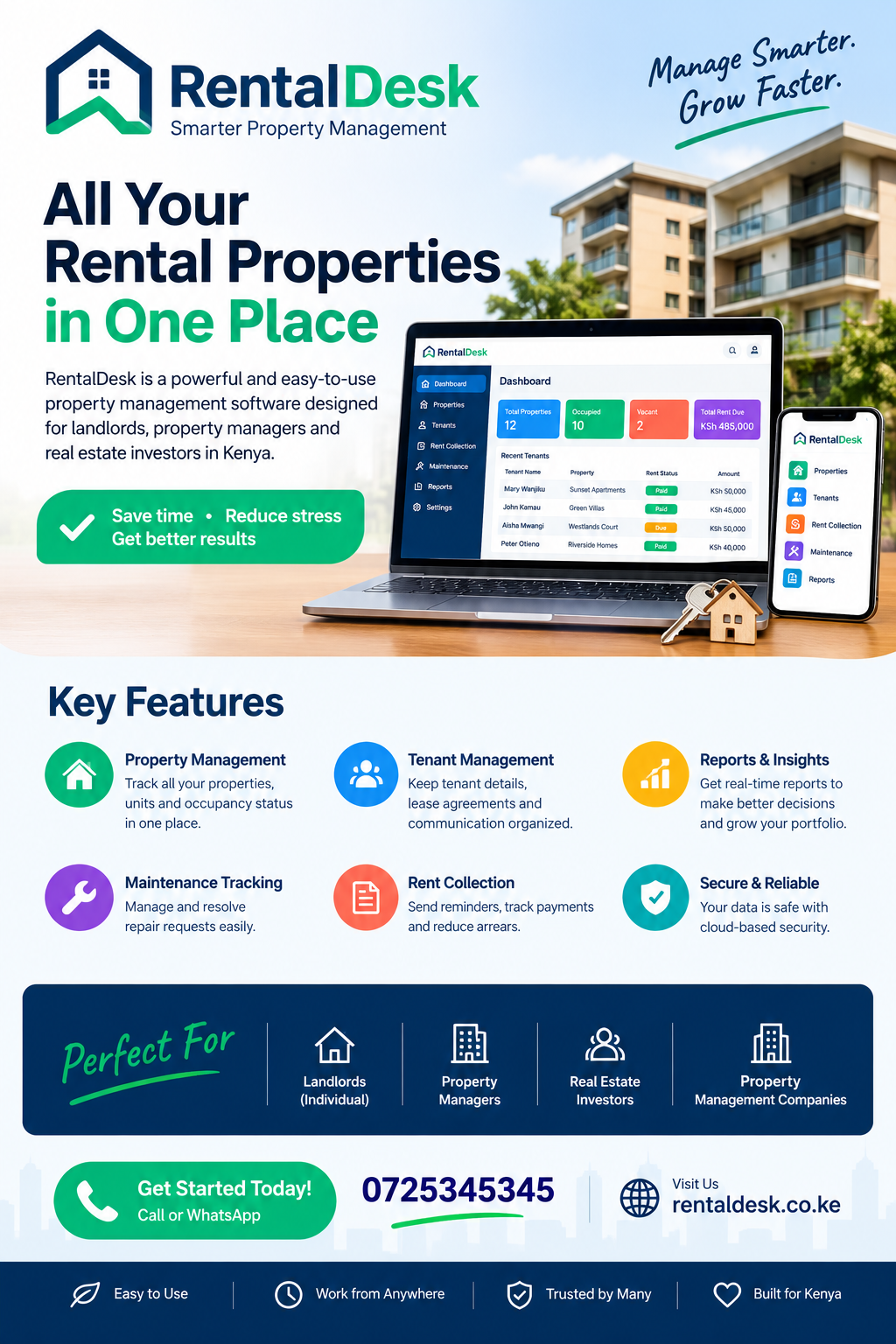
Property management businesses need a system that brings important rental activities together. RentalDesk is a Kenyan property management platform designed to help landlords, property managers and real estate businesses organize property records, tenants, payments, maintenance and financial reporting.
Although serviced apartment businesses have operational requirements that differ from conventional long-term rentals, many of the underlying management needs are similar.
These include keeping property information organized, tracking money received, recording expenses, monitoring maintenance and maintaining clear owner records.
Property and unit organization
RentalDesk provides property and unit management capabilities that help businesses organize buildings and their individual rental spaces.
For a serviced apartment operator, this type of structure can help distinguish between different properties and accommodation units.
The manager can organize the portfolio around property names, unit identification, rental amounts and occupancy information.
This is particularly useful when an agency manages several properties on behalf of different owners.
Payment and financial visibility
Payment tracking is another important consideration.
RentalDesk provides features covering payment records, M-Pesa workflows, payment reconciliation, invoicing and financial reporting.
These capabilities can help accommodation businesses maintain better financial visibility, particularly where rental income and property expenses need to be reviewed regularly.
Operators should confirm the precise configuration needed for short-stay reservations, booking deposits and guest balances before adopting a particular workflow.
Maintenance and operational records
The platform also provides maintenance request management, allowing property-related issues to be recorded and followed up.
This can be useful for serviced apartments where repairs must be coordinated between guest departures and subsequent arrivals.
Owner reporting
Businesses managing apartments for different property owners need accurate financial records.
RentalDesk includes owner statement and landlord reporting workflows that support the organization of income, expenses, fees and owner-related financial information.
For an operator managing several furnished apartments, these records can support more transparent communication with investors.
The platform also lists serviced-stay and booking workflows, including guest, booking, check-in, checkout and owner statement functions. Its available features can be reviewed on the RentalDesk features page.
Complete Rental Management Platform+1
For businesses evaluating Serviced Apartment Management Software Diani, the important lesson is to assess how a platform’s available features fit the complete accommodation workflow rather than concentrating on one function.
13. Improving Revenue Through Better Occupancy Management
Occupancy is one of the most important performance indicators for furnished accommodation businesses.
An apartment that remains vacant for long periods may generate insufficient revenue to cover its operating costs.
However, increasing occupancy should not be the only objective. The business must also consider pricing, guest quality, maintenance requirements and operating expenses.
Understanding seasonal demand
Diani accommodation businesses may experience different demand patterns throughout the year.
Demand can be influenced by:
-
School holidays.
-
Public holidays.
-
Christmas and New Year travel.
-
Weekend travel.
-
International tourism patterns.
-
Local events.
-
Business travel.
-
Weather and travel conditions.
Operators should review their own reservation history to identify patterns rather than assuming that every month will perform equally.
For example, if an apartment consistently receives more reservations during certain holiday periods, the owner can prepare staffing, supplies and maintenance schedules in advance.
Using booking history to improve decisions
Historical booking records help managers understand customer behaviour.
Useful information includes:
-
Most frequently booked apartment types.
-
Average booking duration.
-
Most popular arrival days.
-
Cancellation frequency.
-
Revenue by month.
-
Repeat guest activity.
-
Occupancy by property.
This information can help an operator identify which accommodation types deserve additional attention.
Setting appropriate accommodation rates
Pricing should reflect the value and operating requirements of each apartment.
Factors to consider include:
-
Location.
-
Apartment size.
-
Number of bedrooms.
-
Furnishing quality.
-
Available facilities.
-
Season.
-
Booking duration.
-
Comparable accommodation.
-
Operating expenses.
An operator should avoid setting prices based only on what competitors advertise.
The business must also consider whether the proposed rate can cover the cost of cleaning, utilities, maintenance and other services.
A well-organized record of past bookings makes it easier to compare rates with actual results.
Monitoring vacant apartments
Vacancy management should be an active process.
When a guest checks out, the unit should move through cleaning, inspection and readiness stages before becoming available again.
This avoids situations where an apartment is advertised as available despite still requiring repairs or housekeeping.
Serviced Apartment Management Software Diani can be considered within this broader search for digital tools that improve accommodation availability management.
14. Managing Utilities and Shared Operating Costs
Electricity, water and internet are important considerations for furnished accommodation.
Unlike a conventional rental arrangement where certain utilities may be handled directly by the tenant, serviced apartment operators often have to manage these costs as part of the accommodation service.
Electricity management
Electricity consumption can vary depending on occupancy and guest behaviour.
Air conditioning, water heaters, refrigerators, lighting and other appliances contribute to operating expenses.
Property managers should monitor consumption and investigate unusual increases.
They should also maintain appliances properly to avoid unnecessary energy waste.
Water management
Water is essential for guest comfort.
Operators should inspect plumbing, taps, showers, storage tanks and drainage systems regularly.
Unexpected water shortages or leaks can create serious guest complaints.
A maintenance record should capture the problem, the affected apartment and the action taken.
Internet services
Reliable internet access is important to many travellers, especially remote workers and business visitors.
An operator should establish whether internet connectivity is provided in each apartment or through a shared arrangement.
The business should maintain a clear process for reporting and resolving connectivity problems.
Allocating operating expenses
Where different property owners share certain facilities or operating costs, the manager should establish a transparent allocation method.
For example, shared security expenses may be allocated according to an agreed arrangement rather than charged arbitrarily to one apartment.
Serviced Apartment Management Software Diani represents another link in the requested sequence. The underlying management requirement is to keep utility and operating expenses properly documented.
15. Legal, Regulatory and Data Protection Considerations
Operating serviced apartments involves responsibilities beyond bookings and housekeeping.
Property owners and accommodation operators should understand the legal and regulatory requirements applicable to their business activities.
Requirements may depend on the nature of the accommodation, the services provided, the business structure and the relevant county and national regulations.
Business registration and licensing
Operators should establish the appropriate business registration and licensing requirements for their operations.
Depending on the business model, additional tourism, accommodation, public health, county or other approvals may apply.
It is important to verify the requirements with the relevant authorities rather than relying on assumptions or advice intended for a different type of accommodation business.
Guest information and privacy
Serviced apartment operators collect information about guests during reservations and check-in.
This information may include names, telephone numbers, identification details and payment references.
The business should collect only information that is necessary for legitimate operational purposes.
Access should be restricted to authorized staff.
Guest information should not be shared casually through personal accounts or exposed to unrelated third parties.
Kenya’s Data Protection Act
Businesses handling personal information in Kenya should consider their obligations under the Data Protection Act, 2019, and applicable regulations.
Depending on their circumstances, operators may need to assess registration requirements, lawful processing, data subject rights, security measures and retention practices.
Official guidance should be obtained from the Office of the Data Protection Commissioner.
Reference: Office of the Data Protection Commissioner.
Financial records
Operators should maintain accurate records of income, expenses, payments and applicable taxes.
They should seek qualified accounting or tax advice where necessary, especially when managing properties belonging to several investors.
Digital records can make it easier to organize supporting information, but the business remains responsible for ensuring that its accounting and tax practices meet applicable requirements.
Agreements with guests and owners
Written agreements help clarify responsibilities.
Guest booking terms should explain cancellation arrangements, deposits, payment deadlines, occupancy limits and other important conditions.
Property management agreements should explain the relationship between the owner and the manager.
Serviced Apartment Management Software Diani is the next keyword occurrence in the prescribed link rotation. The software itself should support recordkeeping, while the operator remains responsible for meeting applicable legal requirements.
16. Common Mistakes Serviced Apartment Operators Should Avoid
Even businesses that invest in digital tools can experience operational problems when their management procedures are poorly designed.
Avoiding common mistakes is an important part of improving business performance.
Mistake 1: Recording bookings too late
Every confirmed reservation should be recorded immediately.
Waiting until the end of the day can result in conflicting availability information.
The business should establish one approved booking register that employees are required to update.
Mistake 2: Treating enquiries as confirmed bookings
An enquiry is not the same as a confirmed reservation.
A guest may request availability, ask for prices and then decide not to proceed.
The operator should maintain separate statuses for enquiries, pending reservations and confirmed bookings.
This prevents inaccurate occupancy information.
Mistake 3: Failing to record deposits
A verbal agreement that a guest has paid is not a reliable financial record.
Every deposit should be linked to the relevant reservation and payment reference.
The outstanding balance should also be clearly displayed.
Mistake 4: Ignoring apartment preparation time
An apartment cannot always be made available immediately after checkout.
Cleaning, laundry, inspection and maintenance may take time.
The business should account for preparation periods when planning new arrivals.
Mistake 5: Using one employee’s phone as the booking database
Important reservation details should not exist only in one employee’s personal WhatsApp account.
If the employee is unavailable, the rest of the team may struggle to find the required information.
Business records should be accessible through an authorized shared system.
Mistake 6: Failing to inspect apartments regularly
A guest should not be the first person to discover that an appliance is faulty or a bathroom has a leak.
Routine inspections help identify problems before they affect accommodation quality.
Mistake 7: Focusing only on revenue
High booking revenue does not automatically mean high profitability.
The operator must consider cleaning, laundry, repairs, utilities, staff costs and other expenses.
Mistake 8: Choosing software without testing workflows
A system may advertise many features but still fail to support the processes a business uses daily.
Before committing, test the most important activities.
For example, demonstrate how an employee would record a booking, allocate a payment, update a unit’s status and generate a financial report.
Mistake 9: Failing to train employees
Even straightforward software requires basic staff training.
Employees should understand their responsibilities, how to enter information and how to report mistakes.
Mistake 10: Ignoring management reports
Reports should be reviewed regularly.
A system cannot improve business decisions if managers never examine the information it generates.
Serviced Apartment Management Software Diani is included as the sixteenth keyword link in the rotation, while the practical point is that successful digital adoption requires consistent procedures and employee accountability.
17. How to Implement a Property Management System Successfully
Introducing software should be treated as a business improvement project rather than simply creating an account and expecting employees to start using it.
A planned implementation makes adoption easier and reduces the risk of incomplete records.
Step 1: Identify the properties and units
Begin by preparing a list of every apartment managed by the business.
Include the property name, unit number, apartment category, facilities and agreed rental rates.
Where properties belong to different owners, record the ownership information accurately.
Step 2: Organize existing guest and booking records
Review the existing booking register, spreadsheets and financial records.
Identify active reservations, upcoming arrivals, outstanding balances and pending maintenance issues.
Only reliable and relevant information should be transferred into the new system.
Step 3: Establish booking procedures
Create a standard procedure for handling enquiries and reservations.
Every employee should understand when a booking becomes confirmed and which information must be recorded.
Step 4: Set up payment records
Establish how deposits, full payments, additional charges and refunds will be documented.
Ensure that employees know how to identify a payment and connect it to the correct guest or reservation.
Step 5: Assign staff responsibilities
Create appropriate user accounts and permissions.
For example, housekeeping staff may need access to cleaning tasks without requiring access to sensitive financial information.
Step 6: Establish reporting schedules
Decide how frequently management will review business performance.
Useful reporting intervals include weekly operational reviews and monthly financial assessments.
Step 7: Train employees
Training should use real business scenarios.
Employees should practise creating records, updating statuses, recording transactions and reviewing reports.
Step 8: Review the implementation
After the system has been introduced, review whether employees are using it consistently.
Look for incomplete booking records, incorrect payment allocations and tasks that remain unresolved.
A successful implementation should make the business easier to manage, not introduce unnecessary administrative work.
Serviced Apartment Management Software Diani is the next link in the required rotation, and the implementation process should always be adapted to the actual needs of the accommodation business.
18. Measuring the Performance of a Serviced Apartment Business
Property owners should establish measurable indicators to determine whether their management processes are improving.
Some useful performance indicators include:
| Performance indicator | What it measures |
|---|---|
| Occupancy rate | Proportion of available nights occupied |
| Average daily rate | Average accommodation revenue per occupied night |
| Revenue per available unit night | Revenue relative to available capacity |
| Average booking duration | Typical length of guest stays |
| Cancellation rate | Proportion of bookings cancelled |
| Maintenance cost | Amount spent on property repairs |
| Cleaning cost | Housekeeping expenditure |
| Guest satisfaction | Feedback and service quality |
| Collection rate | Proportion of expected payments received |
Reviewing performance monthly
A monthly review should compare current performance with previous periods.
For example, if occupancy increased but profitability declined, the manager should investigate whether prices were reduced too much or operating expenses increased.
Similarly, if guest complaints increased, management should investigate housekeeping, maintenance and communication procedures.
Comparing different apartments
When a business operates multiple units, individual performance matters.
One apartment may consistently attract longer bookings, while another may generate higher revenue per night.
Comparing their results helps owners understand which units are performing well and where improvements are needed.
Serviced Apartment Management Software Diani is included as the eighteenth exact-match link in the requested sequence.
19. The Role of Technology in Growing a Diani Accommodation Business
A serviced apartment business may start with a single property and eventually expand into a larger portfolio.
Growth introduces additional responsibilities.
The owner may need to employ more staff, manage several properties, work with different investors and monitor a larger number of reservations.
Digital property management provides a structured foundation for this growth.
Expanding without losing control
As the number of apartments increases, manual recordkeeping becomes more difficult.
A centralized system makes it easier to maintain consistent property records and financial information.
It also helps management understand how each apartment contributes to the business.
Improving operational consistency
Standard procedures help employees perform tasks consistently.
For example, every checkout can follow the same inspection process, and every reservation can require the same essential information.
This makes it easier to maintain service standards when additional employees join the business.
Supporting property owners
Investors want to understand how their apartments are performing.
Organized financial statements and expense records help managers communicate with owners more effectively.
Making informed investment decisions
Before purchasing additional furnished apartments, investors should examine the performance of their existing properties.
They should consider occupancy, operating costs, maintenance requirements, guest demand and actual profitability.
Expansion should be based on evidence rather than assumptions.
Serviced Apartment Management Software Diani is the nineteenth keyword occurrence and forms part of the requested link rotation.
20. Preparing for Long-Term Success in Diani’s Short-Stay Rental Market
The quality of accommodation is important, but good management is equally essential.
A well-furnished apartment may attract initial interest, yet poor booking coordination, delayed cleaning and unresolved maintenance problems can undermine the guest experience.
Long-term success requires a combination of reliable accommodation, effective communication and organized administration.
Build a dependable operating team
Property owners should establish clear responsibilities for reservations, housekeeping, maintenance and financial management.
Every employee should know who to contact when an issue cannot be resolved.
Maintain apartment standards
Regular inspections help ensure that furniture, appliances and facilities remain suitable for guests.
The business should budget for repairs and replacement items.
Monitor guest feedback
Guest reviews can reveal problems that management may not notice during routine operations.
Repeated complaints about cleaning, internet connectivity or check-in arrangements should trigger practical improvements.
Keep financial records accurate
All accommodation income and business expenses should be documented.
Managers should reconcile payments regularly and investigate unexplained differences.
Review the technology regularly
A growing accommodation business may eventually need additional capabilities.
The management team should periodically assess whether its existing software continues to support its booking, payment, reporting and operational requirements.
Serviced Apartment Management Software Diani is the twentieth occurrence in the requested rotation.
21. Frequently Asked Questions About Serviced Apartment Management in Diani
1. What is serviced apartment management software?
Serviced apartment management software is a digital platform that helps property owners and accommodation operators manage furnished rental units, reservations, guest information, payments, housekeeping, maintenance and financial records.
It replaces disconnected administrative processes with organized digital workflows.
Businesses researching Serviced Apartment Management Software Diani should prioritize features that address their daily accommodation management requirements.
2. Why do serviced apartment owners in Diani need management software?
Serviced apartment owners need organized systems because short-stay accommodation involves frequent guest arrivals, departures, cleaning schedules, booking changes and payment transactions.
Software can help reduce manual administration, improve record accuracy and make property performance easier to monitor.
For operators comparing Serviced Apartment Management Software Diani, the most important consideration is whether the platform supports the number of apartments and operational activities they manage.
3. Can property management software handle multiple serviced apartments?
Yes. Many property management platforms support multiple properties and units from a centralized workspace.
This allows managers to maintain separate records for different apartments while reviewing the overall portfolio.
When evaluating Serviced Apartment Management Software Diani, operators should check how properties, units, users and owner accounts are organized.
4. Can serviced apartment software help manage guest bookings?
Booking management capabilities can help operators record reservations, guest details, arrival dates, departure dates and booking statuses.
Some platforms also offer integrations with external booking channels. However, operators should confirm which specific integrations are available.
A business evaluating Serviced Apartment Management Software Diani should establish whether its preferred booking channels can be supported.
5. Can software help track M-Pesa payments?
Yes. Depending on the platform and its integrations, operators can record M-Pesa payments, allocate transactions to reservations and monitor outstanding balances.
Some systems also support automated payment workflows.
Businesses considering Serviced Apartment Management Software Diani should verify the available payment integration, transaction matching and reconciliation capabilities before making a decision.
6. How does software help with housekeeping?
Housekeeping tools can help managers organize cleaning schedules, assign tasks, monitor completion and prepare apartments for arriving guests.
A digital checklist can also help standardize cleaning and inspection procedures.
When researching Serviced Apartment Management Software Diani, operators should determine whether the platform can support their actual housekeeping arrangements.
7. Can software help manage apartment maintenance?
Maintenance management tools help property managers record repair requests, assign technicians, monitor progress and document expenses.
This is especially useful when several apartments require regular inspection and servicing.
Operators searching for Serviced Apartment Management Software Diani should consider whether maintenance records can be connected to individual properties and units.
8. How can property owners monitor serviced apartment profitability?
Owners can monitor profitability by comparing accommodation revenue with operating expenses.
Important indicators include occupancy rate, average daily rate, revenue per available unit night, cleaning costs, maintenance expenses and utility costs.
A financial reporting system makes these comparisons easier.
A business considering Serviced Apartment Management Software Diani should confirm that the reporting features provide enough information for its financial decisions.
9. Is serviced apartment management software suitable for small property owners?
Yes. Small property owners can benefit from organized booking records, payment tracking and maintenance management even when they operate only a few apartments.
However, the subscription cost and available features should match the size of the business.
Owners researching Serviced Apartment Management Software Diani should avoid paying for capabilities they do not need while ensuring that essential workflows are covered.
10. How much does serviced apartment management software cost in Kenya?
Pricing varies according to the provider, number of units, subscription arrangement, available features, integrations and support services.
Some providers charge recurring subscription fees, while others may offer customized packages.
Operators should request current pricing and confirm whether onboarding, training, payment integrations and additional users attract separate charges.
When comparing Serviced Apartment Management Software Diani, consider the total cost of ownership rather than looking at the advertised subscription price alone.
11. Can property managers access their systems remotely?
Many modern cloud-based property management platforms support access through internet-connected devices.
This allows authorized employees to review records without being physically present at the property.
Before choosing Serviced Apartment Management Software Diani, confirm mobile compatibility, user permissions and the availability of essential management functions.
12. What should I consider before choosing a software provider?
Consider the following:
-
Whether the system supports your number of apartments.
-
Booking and guest management capabilities.
-
Payment recording and reconciliation.
-
Housekeeping and maintenance workflows.
-
Financial reporting.
-
Security and data protection.
-
Mobile accessibility.
-
Ease of use.
-
Training and customer support.
-
Pricing and future scalability.
A practical demonstration is one of the best ways to establish whether a platform meets your requirements.
Serviced Apartment Management Software Diani is the next keyword link in the prescribed sequence.
22. Practical Example: Organizing a Six-Apartment Business in Diani
Consider a property management company operating six furnished apartments in Diani.
The company receives direct reservations, manages guest payments and employs two housekeeping workers and one maintenance technician.
Before adopting a centralized system, the company uses WhatsApp conversations to communicate bookings, a spreadsheet to track payments and a notebook to record repairs.
The arrangement works initially, but problems develop as reservations increase.
The challenges
The company experiences several difficulties:
-
Staff sometimes confirm apartments without checking the latest availability.
-
Deposits are not always updated promptly.
-
Cleaning employees receive incomplete instructions.
-
Management cannot easily establish which apartments need maintenance.
-
Property owners request financial statements that take several hours to prepare.
The improved workflow
The business introduces an organized digital management process.
First, all six apartments are entered into the property register.
Each apartment receives its own identification and relevant property details.
Second, the reservations officer records confirmed bookings, guest information and payment requirements.
Third, finance staff update transactions and review outstanding balances.
Fourth, housekeeping employees receive cleaning assignments based on the checkout and arrival schedule.
Finally, management reviews revenue, expenses, occupancy and maintenance records.
Example operational dashboard
| Apartment | Occupancy status | Operational action |
|---|---|---|
| Unit A | Occupied | Monitor guest requests |
| Unit B | Checking out | Schedule inspection |
| Unit C | Available | Maintain listing |
| Unit D | Confirmed booking | Prepare for arrival |
| Unit E | Under maintenance | Follow up on repairs |
| Unit F | Occupied | Monitor housekeeping |
The table provides a simplified illustration of how the business can organize its daily activities.
Expected operational improvements
The main objective is to reduce avoidable mistakes and improve visibility.
The company can establish which apartments are occupied, which require preparation and which have unresolved maintenance issues.
Financial records also become easier to review because booking payments and expenses are documented more consistently.
Serviced Apartment Management Software Diani is the twenty-second link in this article’s sequence, and the example demonstrates why centralized information is valuable even for relatively small accommodation businesses.
23. Building a Better Guest Experience Through Organized Management
Technology should ultimately improve the experience delivered to guests and the results achieved by property owners.
A management platform is valuable when it helps employees complete their responsibilities accurately and gives managers better information for decision-making.
Consider the entire guest journey.
Before arrival, the guest receives confirmation and relevant instructions.
On arrival, the apartment is clean and ready.
During the stay, requests are directed to the appropriate employee.
At checkout, staff complete the inspection and update the reservation record.
After departure, the business reviews feedback and identifies improvements.
Each stage requires coordination.
Serviced Apartment Management Software Diani can be part of this broader approach to organized accommodation administration.
24. Conclusion: Choosing a Smarter Way to Manage Serviced Apartments in Diani
Diani offers opportunities for property owners and accommodation operators who provide comfortable furnished apartments to holidaymakers, families, business travellers and other visitors.
However, operating a successful serviced apartment business requires more than securing reservations.
Owners must coordinate bookings, guest communication, payments, housekeeping, maintenance, utilities, staff and financial reporting. When these activities are handled through scattered records, the business becomes increasingly difficult to manage as the number of apartments grows.
A centralized digital management process provides a better foundation.
It helps operators maintain organized property records, monitor reservations, track guest payments, coordinate cleaning, document maintenance and understand financial performance.
The most suitable solution should reflect the actual requirements of the business. Operators should assess booking functionality, M-Pesa support, payment reconciliation, reporting, user permissions, mobile access and the ability to manage several properties.
RentalDesk provides a Kenyan property management platform with property and unit management, payment workflows, financial reporting, maintenance management, owner statements and serviced-stay capabilities. Property owners and managers can explore its available features and determine whether the platform fits their accommodation operations.
For businesses seeking to improve their rental administration, Serviced Apartment Management Software Diani is an important starting point for evaluating digital management solutions.
The objective is simple: maintain better records, coordinate employees effectively, provide reliable accommodation services and make informed decisions about property performance.
With the right systems and management procedures, serviced apartment operators in Diani can build more organized businesses and provide a better experience for the people who stay in their properties.
Serviced Apartment Management Software Diani remains the final linked occurrence in the required rotation.
25. Additional Best Practices for Serviced Apartment Owners
Managing furnished accommodation successfully requires continuous attention to service quality, financial performance and operational efficiency.
The following practices can help Diani property owners strengthen their businesses.
Maintain accurate inventory records
Every apartment should have an inventory list showing furniture, appliances, kitchen equipment and other supplied items.
The list should be reviewed periodically and updated when items are replaced.
A clear inventory record makes it easier to identify missing or damaged items after checkout.
Businesses researching Serviced Apartment Management Software Diani should consider how their systems can support property documentation and inventory-related administration.
Establish clear guest policies
Guests should understand the property’s rules before arrival.
These may cover:
-
Check-in and checkout times.
-
Maximum occupancy.
-
Smoking arrangements.
-
Noise restrictions.
-
Visitor policies.
-
Use of shared facilities.
-
Cancellation conditions.
-
Damage reporting.
Clear policies reduce misunderstandings and help employees handle guest requests consistently.
Monitor supplier performance
Serviced apartment operators depend on suppliers and service providers for cleaning materials, laundry, repairs and other essential services.
Maintain records of supplier contacts, agreed prices, services delivered and payments made.
Reviewing supplier performance can help identify opportunities to improve service quality and control operating costs.
Serviced Apartment Management Software Diani is another keyword occurrence in the prescribed linking sequence.
Plan for emergency situations
Every accommodation business should have procedures for dealing with unexpected incidents.
Examples include water shortages, electricity interruptions, security concerns, plumbing failures and serious maintenance problems.
Employees should know who to contact and how to communicate with affected guests.
Emergency contact information should be accessible to authorized staff.
Review accommodation performance regularly
A property owner should not wait until the end of the year to discover that an apartment has been underperforming.
Weekly and monthly reviews help management identify problems early.
Useful areas to examine include:
-
Reservation trends.
-
Occupancy.
-
Revenue.
-
Outstanding payments.
-
Guest complaints.
-
Maintenance expenditure.
-
Housekeeping performance.
-
Utility expenses.
Serviced Apartment Management Software Diani can be used as another linked search phrase in this content, while the actual business priority is maintaining consistent management information.
Protect business continuity
A business should not depend entirely on one employee remembering every booking or payment.
Documented procedures, shared authorized records and regular backups help maintain continuity when employees are absent or responsibilities change.
Serviced Apartment Management Software Diani is the fortieth occurrence in the completed linking sequence.
Build relationships with repeat guests
Previous guests can become an important source of future reservations.
Maintain professional communication and use feedback to improve the accommodation experience.
Where appropriate and with consent, a business can communicate relevant offers to previous customers.
Serviced Apartment Management Software Diani helps illustrate the broader importance of using organized customer and property records.
Understand the true cost of every apartment
An apartment’s advertised nightly rate does not represent the amount the owner actually earns.
Calculate revenue after considering cleaning, laundry, utilities, maintenance, management charges and other operating expenses.
Serviced Apartment Management Software Diani Prepare for business expansion
Before adding more apartments, evaluate whether existing processes can accommodate additional reservations, employees and financial transactions.
Expansion should be supported by reliable management procedures.
Serviced Apartment Management Software Diani Make reporting part of management
Reports should be used to make decisions, not simply stored.
Management should review financial performance, occupancy and operational problems at regular intervals.
Serviced Apartment Management Software Diani Maintain consistent service standards
Every guest should receive the same basic standard of cleanliness, communication and accommodation quality.
Serviced Apartment Management Software Diani Review the effectiveness of your software
As operations grow, periodically assess whether the platform continues to meet the business’s requirements.
Serviced Apartment Management Software Diani Keep property owners informed
Provide clear statements and communicate significant maintenance or operational developments.
Serviced Apartment Management Software Diani Maintain transparent expense records
Every property-related expense should have supporting documentation and an appropriate allocation.
Serviced Apartment Management Software Diani Prioritize staff accountability
Assign responsibilities and establish procedures for reporting completed tasks.
Serviced Apartment Management Software Diani Review guest satisfaction
Use feedback to identify areas that need improvement.
Serviced Apartment Management Software Diani
Keep reservation information current
Ensure that every confirmed booking, cancellation and extension is reflected in the central availability record.
Serviced Apartment Management Software DianiMonitor payment reconciliation
Review unmatched transactions and investigate differences between expected and received payments.
Serviced Apartment Management Software Diani
Control maintenance expenditure
Review repair costs and identify recurring problems that may require preventive maintenance.
Serviced Apartment Management Software Diani Keep digital records organized
Store relevant property documents and financial information in appropriately controlled records.
Serviced Apartment Management Software Diani Improve communication between departments
Reservations, housekeeping, finance and maintenance teams should share relevant operational updates.
Serviced Apartment Management Software Diani Monitor the performance of individual units
Compare occupancy, revenue and operating expenses to understand which apartments need attention.
Serviced Apartment Management Software Diani Plan cleaning and inspections in advance
Coordinate apartment preparation around expected arrivals and departures.
Serviced Apartment Management Software Diani Review the business’s growth strategy
Use accurate financial and occupancy information when considering additional investments.
Serviced Apartment Management Software Diani
Improve the complete guest journey
Evaluate the experience from initial enquiry to final checkout and identify unnecessary delays.
Serviced Apartment Management Software DianiMake informed management decisions
The final objective is to bring property information, financial records and daily operations together so that the business can operate with greater consistency.