
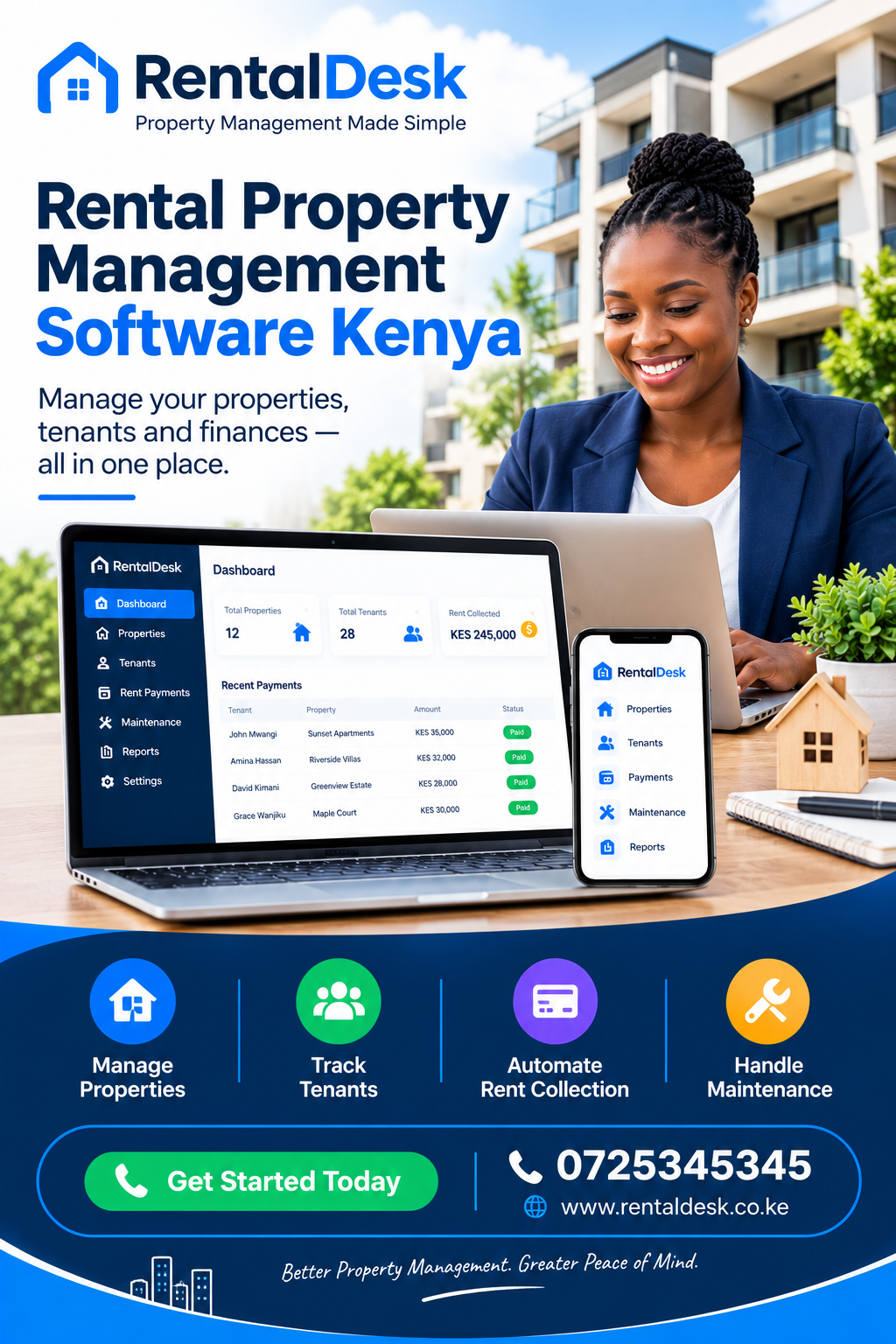
Managing rental units in Kenya involves much more than collecting rent at the beginning of each month. A landlord or property manager may need to track tenants, monitor vacancies, issue invoices, reconcile M-Pesa payments, follow up on arrears, record expenses, handle maintenance requests and prepare reports for property owners. Rental Property Management Software Kenya brings these activities into one organized workflow, making it easier to understand what has been paid, what remains outstanding and what requires attention. This guide explains how rental management software works, the features worth considering, the benefits for Kenyan property owners and how to choose a system that fits your portfolio.
For a small landlord with a handful of units, a notebook or spreadsheet may initially appear sufficient. The difficulty usually comes when the number of tenants increases. More units mean more payment references, more invoices, more conversations and more opportunities for information to become scattered. A structured digital system can help bring those records together.
A property management platform is therefore not simply an alternative to Excel. It can become the central operating system for a rental business.
Table of Contents
ToggleWhat Is Rental Property Management Software?
At its simplest, Rental Property Management Software Kenya is a digital platform used to organize rental properties, units, tenants, payments and related administrative activities.
Instead of maintaining separate spreadsheets for each building, a manager can store property information in a centralized system. The same environment can connect units with tenants, rent amounts, invoices, payment histories and outstanding balances.
A useful rental management platform can cover areas such as:
- Property and unit records
- Tenant information
- Lease-related information
- Rent invoicing
- Payment tracking
- M-Pesa reconciliation
- Arrears monitoring
- Tenant statements
- Maintenance requests
- Utility billing
- Expense records
- Owner reporting
- Occupancy monitoring
- Staff access and permissions
The exact features differ between software providers, so property owners should examine the workflow rather than selecting a system simply because it has a long feature list.
For example, Rental Property Management Software Kenya should ideally help a manager answer practical questions quickly:
- Which tenants have paid today?
- Who has an outstanding balance?
- Which units are vacant?
- How much rent was collected this month?
- Which properties generated the most income?
- Which maintenance issues remain unresolved?
- Which owner needs a statement?
- Which tenants need a payment reminder?
When information is readily available, management becomes less dependent on memory and manually maintained records.
Why Kenyan Landlords Are Moving Away From Manual Rental Management
Manual rental management is not automatically wrong. It can work for very small portfolios. However, the administrative burden increases as the portfolio grows.
Consider a landlord managing 10 units. If each tenant pays through a different transaction reference, the landlord must identify each payment and connect it to the correct tenant. If some tenants pay partially, others pay late and another tenant changes units, the spreadsheet becomes harder to maintain accurately.
A manager handling 100 or more units faces a much larger administrative challenge.
Rental Property Management Software Kenya can reduce this complexity by creating a single source of information for the portfolio.
RentalDesk, for example, describes its platform around tenant visibility, rent collection, billing automation and reporting, with workflows designed for Kenyan rental operations. Its published features include M-Pesa-related collection processes, tenant records, arrears tracking and multi-property management.
The problem with disconnected spreadsheets
Spreadsheets are flexible, but they often depend heavily on manual data entry. A property manager may have one spreadsheet for tenants, another for expenses and another for payments.
That creates several risks:
- Information can become duplicated.
- Different versions of the same file may exist.
- Payment records can be difficult to reconcile.
- Arrears follow-up can depend on manual checks.
- Reporting may require significant preparation.
- Staff may struggle to know which file is current.
Rental Property Management Software Kenya can bring these workflows together so that the property, tenant, billing and payment records are connected.
The goal is not to eliminate every spreadsheet from a business. The goal is to reduce dependence on spreadsheets for processes that need consistent, repeatable records.
Rent Collection and M-Pesa Management
Rent collection is one of the most important areas for any rental business in Kenya.
A property manager may receive payments through M-Pesa, bank transfers, cash or other channels. The challenge is not only receiving the money. The challenge is identifying the payer, matching the payment to the correct tenant and updating the tenant’s outstanding balance.
A strong Rental Property Management Software Kenya solution should make payment tracking easier and more transparent.
M-Pesa reconciliation
M-Pesa is central to many Kenyan business payment workflows. A rental platform designed for the local market should therefore consider how M-Pesa transactions fit into the rent ledger.
RentalDesk states that its Kenyan rental workflow supports M-Pesa collection and reconciliation, allowing payment activity to be connected to tenant records and balances.
For a property manager, this can make daily work more manageable.
Instead of manually asking, “Who sent this payment?”, the system should provide enough information to connect the transaction to the appropriate account.
Rental Property Management Software Kenya can also help establish clearer payment records by keeping invoices, receipts and balances within one workflow.
Partial rent payments
Not every tenant pays the full amount at once.
For example, a tenant owing KES 25,000 may initially pay KES 15,000 and clear the remaining KES 10,000 later. A useful system should not simply classify the tenant as either “paid” or “unpaid.”
It should show the remaining balance.
This is important because partial payments are common in real-world rental operations. Managers need to know exactly what has been received and what remains outstanding.
Rental Property Management Software Kenya can support more accurate follow-up when payment status is visible at tenant level.
Tenant Management
Tenant records are another core component of rental administration.
A tenant record may contain:
- Full name
- Contact details
- Assigned unit
- Rent amount
- Deposit information
- Lease dates
- Payment history
- Outstanding balance
- Previous transactions
- Communication history
- Maintenance requests
When these details are scattered across notebooks, WhatsApp messages and spreadsheets, finding information can take time.
A centralized Rental Property Management Software Kenya platform provides a structured place for tenant information.
Tenant onboarding
A good onboarding process should establish the tenant’s details before billing begins.
The manager can create the property, add the relevant unit, register the tenant, establish the rent amount and begin tracking payments.
This creates a logical relationship between:
Property → Unit → Tenant → Invoice → Payment → Balance
That relationship becomes especially useful when a manager handles several buildings.
Rental Property Management Software Kenya can make this structure easier to maintain because the information is organized around the rental operation rather than separate documents.
Tenant statements
Tenants sometimes need clarification about their accounts.
A tenant may ask:
“How much have I paid?”
or:
“Why is there still a balance?”
A clear tenant statement can show invoices, payments and outstanding amounts.
This improves communication because both parties can refer to the same financial record.
Rental Property Management Software Kenya can therefore contribute to more organized tenant communication, particularly where many accounts must be managed simultaneously.
Arrears Management
Arrears are one of the biggest administrative challenges in rental property management.
A landlord may know that several tenants have not paid, but the more useful question is: who owes what, and what action is required?
An effective system should provide visibility into:
- Current arrears
- Previous arrears
- Partial payments
- Overdue invoices
- Payment dates
- Outstanding balances
- Tenant payment history
Rental Property Management Software Kenya can help transform arrears management from a memory-based process into a structured workflow.
Why early visibility matters
Suppose a building has 80 tenants.
If the manager waits until the end of the month to review payment records, several days may pass before overdue accounts are identified.
With daily visibility, the manager can identify outstanding accounts earlier.
That does not automatically guarantee payment, but it makes follow-up more organized.
Rental Property Management Software Kenya can be particularly useful where managers need to monitor many tenant accounts without reviewing each one manually.
Arrears reports
A good arrears report should answer questions such as:
- Total amount outstanding
- Number of tenants in arrears
- Amount owed by each tenant
- Property-level arrears
- Aging of outstanding balances
- Recent payment activity
This gives management a clearer view of the financial position of the rental portfolio.
Property and Unit Management
Rental businesses are built around physical units.
A manager may have apartments, shops, offices, bedsitters, maisonettes, student rooms or other rental spaces.
A structured Rental Property Management Software Kenya system should allow these units to be categorized and monitored.
RentalDesk’s property and unit management feature describes the ability to organize properties and units by portfolio, landlord, type, location and status. It also supports occupancy information and links unit records with leases, invoices and reports.
Occupancy tracking
Vacant units represent potential lost rental income.
A property manager should therefore know which units are:
- Occupied
- Vacant
- Listed
- Inactive
- Under maintenance
Rental Property Management Software Kenya can provide a centralized view of occupancy, making it easier to identify units that require marketing or operational attention.
Multi-property management
A landlord may own several buildings in different parts of Nairobi or other counties.
Managing each property independently creates unnecessary administrative work.
A multi-property system allows the manager to switch between properties while retaining a consolidated view of the entire portfolio.
Rental Property Management Software Kenya can be particularly useful for agencies managing properties on behalf of several owners.
Automated Invoicing
Rent invoices provide structure to the payment process.
Rather than creating invoices manually every month, property management software can use tenant and rent information to generate recurring billing records.
A typical process might look like this:
- Tenant is assigned to a unit.
- Monthly rent is defined.
- Invoice is generated.
- Tenant receives a notification or statement.
- Payment is received.
- Payment is reconciled.
- Balance is updated.
- Receipt or payment record becomes available.
Rental Property Management Software Kenya can help make this workflow more repeatable.
Automation is particularly valuable when managing dozens or hundreds of units.
Maintenance Management
Rental management is not only about rent.
Buildings require regular maintenance. Tenants may report plumbing problems, electrical faults, broken doors, water issues or other repairs.
If maintenance requests are managed entirely through phone calls and WhatsApp messages, it can be difficult to establish which requests are still pending.
A Rental Property Management Software Kenya platform with maintenance functionality can provide a more structured process.
A simple maintenance workflow
A useful workflow might be:
Tenant reports issue → Manager records request → Technician assigned → Work completed → Cost recorded → Request closed
This creates an operational history.
It can also help answer questions such as:
- How many repairs occurred this month?
- Which property has the highest maintenance costs?
- Which requests are still open?
- How much was spent on a particular unit?
Maintenance records can become valuable when reviewing property performance.
Utility Billing
Some rental properties require landlords to manage more than rent.
Depending on the property, tenants may be billed for:
- Water
- Electricity
- Garbage collection
- Security
- Internet
- Service charges
- Other shared services
The challenge is ensuring that these charges are applied consistently.
Rental Property Management Software Kenya can help bring additional charges into the same tenant account instead of managing them through unrelated records.
Why utility billing needs structure
Suppose a building has individual water meters.
The manager needs to capture meter readings, calculate charges and include the amount in the tenant’s account.
If this process is handled manually for 100 tenants, errors can easily occur.
A centralized billing workflow reduces unnecessary duplication and makes it easier to trace how a balance was calculated.
Financial Reporting
Property owners need more than payment receipts.
They need information that helps them understand how their properties are performing.
A useful Rental Property Management Software Kenya platform can provide reports covering rent collections, tenant balances, property income and other operational information.
Common property management reports
Useful reports may include:
| Report | What it helps you understand |
|---|---|
| Rent collection report | Amount collected during a selected period |
| Arrears report | Outstanding tenant balances |
| Tenant statement | Individual tenant account activity |
| Occupancy report | Vacant and occupied units |
| Property performance report | Income and activity by property |
| Expense report | Costs incurred during operations |
| Payment report | Transactions received and recorded |
| Owner statement | Financial activity for a property owner |
Reports become especially important when a property manager is accountable to property owners.
Rental Property Management Software Kenya can support a more organized reporting process by reducing the need to compile information manually from several sources.
Owner Reporting
Property managers often manage properties on behalf of other people.
An owner may want to know:
- How much rent was collected?
- Which tenants have arrears?
- What expenses were incurred?
- Which units are vacant?
- What maintenance work was completed?
- What amount is available for payout?
A property management system should make these questions easier to answer.
Rental Property Management Software Kenya can help create a more structured relationship between property managers and owners by keeping relevant operational information organized.
The quality of owner reporting can also influence how professional a property management company appears.
Instead of sending a collection of screenshots and spreadsheet extracts, a manager can work from standardized reports.
Why Rental Management Software Matters for Growing Portfolios
A landlord with five units may manage everything personally.
At 50 units, the workload changes.
At 200 units, manual processes become even harder to maintain consistently.
At larger portfolio sizes, managers may have different staff members responsible for:
- Collections
- Tenant support
- Finance
- Maintenance
- Leasing
- Owner communication
A centralized Rental Property Management Software Kenya system gives these activities a common information base.
RentalDesk’s published workflow is structured around adding properties, creating units, adding tenants and tracking rent, with features for payment tracking, reporting and multi-property operations.
Benefits for Small Landlords
Software is not only for large property management companies.
A small landlord can benefit from digital organization too.
Rental Property Management Software Kenya can help a landlord maintain records even when the portfolio is relatively small.
Benefit 1: Better financial visibility
The landlord can quickly see rent received and balances outstanding.
Benefit 2: Less manual record keeping
Recurring processes can be standardized.
Benefit 3: Easier tenant management
Tenant details remain organized.
Benefit 4: Better reporting
Monthly information can be generated without rebuilding everything from scratch.
Benefit 5: Easier growth
A system established early can reduce the disruption that occurs when the portfolio expands.
Benefits for Property Management Companies
Property agencies have different requirements because they may manage properties for multiple owners.
A Rental Property Management Software Kenya platform can help separate properties, tenants and financial activity while maintaining a broader portfolio view.
For an agency, important capabilities may include:
- Multiple property management
- Multiple landlord accounts
- Staff access
- Permission controls
- Automated billing
- Payment reconciliation
- Arrears reporting
- Owner statements
- Maintenance tracking
- Data exports
RentalDesk’s larger portfolio offering includes multi-property operations, role controls, analytics and exports according to its published pricing information.
Choosing the Right Software
Choosing a property management platform requires more than looking at screenshots.
The right choice depends on your portfolio, processes and staff.
Start by documenting your current workflow.
Ask:
- How many properties do we manage?
- How many units are active?
- How do tenants currently pay?
- How are M-Pesa payments reconciled?
- How are arrears tracked?
- How are invoices created?
- How are maintenance requests recorded?
- How are owner reports prepared?
- How many people need system access?
- What reports are required each month?
Once these questions are answered, it becomes easier to compare platforms.
Rental Property Management Software Kenya should solve real operational problems rather than simply provide impressive-looking features.
Features to Prioritize
1. Tenant management
Tenant records should be easy to create, update and search.
2. Rent billing
Recurring rent charges should be structured and easy to monitor.
3. Payment tracking
The system should show whether a tenant has paid, partially paid or remains outstanding.
4. M-Pesa integration
For Kenyan rental operations, M-Pesa support can be an important consideration.
5. Arrears management
Managers should be able to identify overdue balances quickly.
6. Reporting
Reports should support both daily operations and monthly management reviews.
7. Property management
The system should support multiple buildings and units when required.
8. Maintenance
Operational requests should be trackable rather than disappearing into informal conversations.
9. User permissions
Different employees may require different levels of access.
10. Data export
Businesses should consider how easily information can be exported for accounting, analysis or other legitimate business needs.
Rental Property Management Software Kenya becomes more useful when these features work together instead of operating as isolated modules.
Cloud-Based Access
Cloud software can be accessed through an internet-connected device rather than being tied to a single office computer.
This can be useful for property managers who work from different locations.
A manager may be visiting a building in Nairobi while the finance team works from an office elsewhere.
With a cloud-based Rental Property Management Software Kenya platform, authorized users can work from the same centralized data environment.
RentalDesk describes its platform as cloud-based and accessible through secure web browsers and a mobile-responsive interface.
The important consideration is not simply whether software is cloud-based. Businesses should also ask about user permissions, backups, security practices and support.
Data Security and Access Control
Rental management systems can contain sensitive information.
Examples include:
- Tenant contact information
- Payment records
- Property financial information
- Lease details
- Staff accounts
- Owner information
Access should therefore be controlled.
Rental Property Management Software Kenya should provide appropriate access controls for the people using the system.
A receptionist may need access to tenant information without needing access to every financial report. A finance employee may require broader access to payments and reports.
Role-based permissions can help separate responsibilities.
Businesses should also ask prospective software providers how data is protected, how accounts are secured and what happens if an employee leaves.
Pricing Considerations
Price is an important part of selecting rental software, but the cheapest subscription is not necessarily the lowest-cost option.
The better question is:
What does the software replace or improve?
Consider the time currently spent on:
- Preparing invoices
- Reconciling payments
- Calling tenants
- Checking arrears
- Preparing reports
- Updating spreadsheets
- Searching for tenant information
- Following up on maintenance
If software reduces administrative effort and improves visibility, the business should consider that operational value when comparing plans.
RentalDesk currently publishes a Free Lite option for small portfolios, a Starter plan priced at KES 5,000 per month and an Estate Manager plan priced at KES 9,500 per month, with features and unit limits varying by plan. Businesses should confirm current pricing directly before making a purchasing decision.
A Rental Property Management Software Kenya solution should therefore be assessed against the size and complexity of the portfolio rather than subscription price alone.
Common Mistakes When Buying Property Management Software
Choosing based only on price
A low subscription may become expensive if the software does not support important workflows.
Choosing too many features
A platform can have dozens of features while still being difficult to use.
Ignoring payment reconciliation
Rent collection is central to rental operations, so payment workflows deserve careful attention.
Failing to test reports
A system should be tested using realistic reporting requirements.
Ignoring user permissions
If several employees use the platform, access control matters.
Not checking support
When a business depends on software for rent collection and reporting, support becomes part of the overall solution.
Rental Property Management Software Kenya should be evaluated through a practical demonstration rather than a feature checklist alone.
How to Implement Rental Management Software
Buying software is only the first step.
The implementation process determines whether the system becomes useful.
Step 1: Clean your existing records
Before importing information, remove duplicate or outdated records.
Step 2: Organize properties
Create each property and its units.
Step 3: Add tenants
Enter current tenant details and connect each tenant to the correct unit.
Step 4: Verify balances
Check outstanding rent before going live.
Step 5: Configure billing
Set rent amounts, billing dates and applicable charges.
Step 6: Configure payment workflows
Connect the appropriate payment process.
Step 7: Train staff
Every user should understand the tasks relevant to their role.
Step 8: Test reports
Generate sample reports before relying on them for month-end processes.
Step 9: Go live
Move the day-to-day workflow into the system.
Step 10: Review after the first month
Identify areas where staff need additional training or process changes.
Rental Property Management Software Kenya becomes most valuable when the business treats implementation as a process improvement project rather than simply installing software.
Practical Example: Managing a 100-Unit Apartment
Imagine a property manager overseeing a 100-unit apartment building.
Before adopting software, the manager uses:
- Excel for tenants
- WhatsApp for maintenance
- M-Pesa messages for payment confirmation
- Paper receipts for some transactions
- Another spreadsheet for expenses
At the beginning of the month, the manager creates invoices manually.
During the month, tenants send payment screenshots.
At month-end, the manager checks M-Pesa messages and updates the spreadsheet.
Then the owner asks for a report.
This workflow can consume significant administrative time.
With a centralized system, the workflow can instead be structured around property records, tenant accounts, billing, payment reconciliation and reports.
Rental Property Management Software Kenya can give the manager one operational view instead of several disconnected sources.
The result is not simply “automation.” The bigger improvement is visibility.
The manager can identify what needs attention without reconstructing the portfolio’s financial position from multiple files.
Practical Example: Managing Multiple Properties
Now consider a property agency managing five apartment blocks for different owners.
Each building has different rent amounts, tenants and expenses.
The agency needs to produce separate owner statements while also monitoring the overall business.
A multi-property platform can allow the agency to organize each building separately while maintaining centralized administration.
Rental Property Management Software Kenya can be especially relevant to agencies that need property-level information as well as portfolio-level reporting.
This structure also makes staff coordination easier.
A collections employee can focus on payments, while another employee handles maintenance and another prepares owner reports.
Using Software to Improve Tenant Communication
Good rental management depends partly on clear communication.
Tenants need to know:
- What they owe
- When payment is due
- Whether their payment has been recorded
- Whether a maintenance request has been received
- Whether an outstanding balance remains
A Rental Property Management Software Kenya platform can provide structured records that support these conversations.
For example, instead of telling a tenant that “the system shows you still owe something,” the manager can review the specific invoice and payment history.
This creates a clearer basis for resolving questions.
The Role of Notifications and Reminders
Payment reminders can help managers avoid relying entirely on manual calls.
A structured notification workflow may include reminders before the due date and follow-up communication after an account becomes overdue.
The exact functionality depends on the software and subscription plan.
RentalDesk’s published plans include SMS reminders in its Starter offering.
Rental Property Management Software Kenya can therefore be evaluated partly on how effectively it supports routine tenant communication.
Using Data for Better Property Decisions
Once rental information is organized, it becomes possible to analyze trends more consistently.
A manager can examine:
- Collection performance
- Vacancy levels
- Arrears
- Maintenance costs
- Property income
- Tenant turnover
- Payment patterns
This information can support business planning.
For example, if one building repeatedly has higher arrears than another, the manager can investigate the reasons.
If one property has frequent maintenance expenses, management can examine whether a recurring infrastructure issue exists.
Rental Property Management Software Kenya can therefore serve not only as an administrative tool but also as a source of operational information.
Supporting Portfolio Growth
Growth creates administrative pressure.
A landlord who starts with 10 units may eventually acquire another apartment building.
If the original management process relies on notebooks and independent spreadsheets, adding another property may require additional manual work.
A scalable system allows new properties, units and tenants to be added without rebuilding the entire process.
Rental Property Management Software Kenya can support that transition when the software’s structure matches the way the rental business is growing.
The key is scalability without unnecessary complexity.
Questions to Ask Before Buying
Before committing to any platform, ask the provider:
- Is the software designed for Kenyan rental operations?
- Does it support M-Pesa workflows?
- Can it manage multiple properties?
- Can tenants make partial payments?
- How are arrears displayed?
- Can invoices be generated automatically?
- Can owner statements be produced?
- Is maintenance tracking available?
- Can staff have separate accounts?
- What permissions are available?
- Can data be exported?
- What support is provided during setup?
- How is customer data protected?
- What happens if the subscription changes?
- What are the current unit limits?
These questions can reveal differences that are not obvious from a marketing page.
Rental Property Management Software Kenya should ultimately be judged by how well it fits your actual rental workflow.
Why Local Context Matters
A property management system built for another market may not reflect the way Kenyan landlords operate.
Kenyan rental businesses may rely heavily on M-Pesa, KES-denominated billing, local communication practices and specific approaches to property administration.
RentalDesk positions itself as a Kenya-first rental platform and highlights M-Pesa, bank transfers, cash receipts, utility billing and KES pricing as part of its local workflow.
That local focus can be important when evaluating software.
Rental Property Management Software Kenya should make sense within the payment and administrative environment in which Kenyan property managers actually operate.
Rental Management in Nairobi
Nairobi has a wide variety of rental properties, from small residential blocks to large apartment developments and commercial buildings.
Different areas can have very different rental structures.
A manager might oversee apartments in Kilimani, residential units in Embakasi, student accommodation around Juja or commercial property in the CBD.
The underlying management principles remain similar: know the units, know the tenants, track billing, record payments and monitor outstanding balances.
Rental Property Management Software Kenya can provide a common operational structure across different property types.
RentalDesk’s Nairobi-focused material highlights use cases involving apartments, commercial properties, student hostels, estates and other rental environments.
Rental Management Beyond Nairobi
The need for organized rental management is not limited to Nairobi.
Landlords and property managers operate across Kenya, including cities and towns such as Mombasa, Kisumu, Nakuru, Eldoret, Thika and other growing urban areas.
The important factor is the operational workflow rather than the specific location.
A Rental Property Management Software Kenya platform can help standardize records across properties when a landlord has units in different locations.
This becomes increasingly useful for investors who build geographically distributed portfolios.
Accounting and Property Management
Property management and accounting are connected, but they are not exactly the same function.
The rental system should maintain accurate transaction information, while accounting processes may require broader financial treatment.
A property manager should therefore determine whether the chosen platform integrates with accounting tools, supports exports or provides the reports required by their accountant.
Rental Property Management Software Kenya can be evaluated based on how well financial information can move between property operations and accounting processes.
The important point is to avoid treating property management software as a complete replacement for every financial system without first checking the actual capabilities.
How Software Can Reduce Administrative Work
Administrative work is often made up of many small tasks.
One tenant requires a reminder.
Another needs a statement.
A payment needs reconciliation.
An owner requests a report.
A technician needs a maintenance request.
A vacant unit needs an update.
Each task is manageable on its own. The difficulty comes from handling hundreds of similar tasks every month.
A Rental Property Management Software Kenya platform can create repeatable workflows around these activities.
The goal is to reduce the number of times staff need to manually recreate information that already exists somewhere else.
Measuring Whether the Software Is Working
After implementation, property managers should measure practical outcomes.
Useful indicators can include:
- Time spent preparing monthly reports
- Time spent reconciling payments
- Number of unresolved tenant balances
- Number of missing payment records
- Time taken to identify arrears
- Number of unresolved maintenance requests
- Time required to prepare owner statements
These measurements help determine whether the software is producing operational improvements.
Rental Property Management Software Kenya should be considered successful when it improves real workflows, not simply when employees have logged into it.
What a Good Monthly Workflow Can Look Like
A structured monthly process might look like this:
Beginning of the month
- Generate recurring invoices.
- Review occupancy.
- Check tenant records.
- Send relevant reminders.
During the month
- Monitor incoming payments.
- Reconcile M-Pesa and other transactions.
- Follow up on overdue balances.
- Record maintenance issues.
- Update property records.
Mid-month review
- Review collection progress.
- Identify high-value arrears.
- Review unresolved maintenance.
- Check vacant units.
End of the month
- Reconcile all payments.
- Review expenses.
- Generate reports.
- Prepare owner statements.
- Review outstanding balances.
A Rental Property Management Software Kenya platform can provide the central records needed throughout this cycle.
Is Property Management Software Worth It?
The answer depends on the portfolio and the current management process.
For a landlord with one unit and very few transactions, sophisticated software may not be necessary.
For a landlord with dozens of units, the calculation changes.
For an agency managing hundreds of units, structured software can become an important operational requirement.
The relevant question is not whether every landlord needs software.
It is whether the current management method provides enough accuracy, visibility and efficiency for the size of the business.
Rental Property Management Software Kenya can be particularly valuable when the volume of transactions makes manual tracking increasingly difficult.
FAQs About Rental Property Management Software
1. What does rental property management software do?
Rental Property Management Software Kenya helps landlords and property managers organize properties, units, tenants, billing, payments, arrears, maintenance and reports in a centralized system.
The exact features vary by provider, so businesses should compare actual workflows rather than assume that every platform offers the same capabilities.
2. Can rental software track M-Pesa payments?
Yes, some systems support M-Pesa collection and reconciliation. RentalDesk specifically describes M-Pesa collection and reconciliation as part of its Kenyan rental workflow.
Rental Property Management Software Kenya can be useful for landlords who want payment information connected to tenant balances instead of relying entirely on manual confirmation.
3. Can the system manage multiple properties?
Many property management platforms support multiple properties and units.
This is important for agencies and landlords with growing portfolios.
Rental Property Management Software Kenya can help centralize multiple buildings while maintaining property-level records.
Before subscribing, confirm the maximum number of properties and units supported by the specific plan.
4. Can software track tenants who pay partially?
A suitable rental system should be able to reflect partial payments and the remaining balance.
This is more useful than simply marking an account as paid or unpaid.
Rental Property Management Software Kenya should therefore be tested with realistic payment scenarios before purchase.
Ask the provider to demonstrate what happens when a tenant pays half the monthly rent, pays the remainder later or carries an existing balance into the next billing cycle.
5. Is property management software useful for small landlords?
Yes, although the level of software required depends on the portfolio.
A small landlord may primarily need tenant records, rent tracking and basic reporting, while a large agency may require multi-property dashboards, role-based permissions and advanced reports.
Rental Property Management Software Kenya can be assessed according to the landlord’s current portfolio and expected growth.
6. Does property management software replace accounting software?
Not necessarily.
Property management software focuses on rental operations, while accounting systems may cover broader business accounting.
Rental Property Management Software Kenya should therefore be evaluated for its reporting, export and integration capabilities if the business already uses an accounting platform.
7. How much does rental management software cost in Kenya?
Pricing varies significantly according to the provider, number of units, users and features.
RentalDesk currently publishes plans ranging from a free option for a small portfolio to paid plans for larger operations. Its published pricing should be checked directly because software plans can change over time.
Rental Property Management Software Kenya should be compared based on total value, not only the monthly subscription.
8. Is cloud-based property management software secure?
Security depends on the provider’s technical and operational practices.
When evaluating a system, ask about account security, permissions, backups, access controls, data handling and support procedures.
Rental Property Management Software Kenya should be assessed using these questions before sensitive rental records are moved into the platform.
9. Can property managers use software from a phone?
Many modern cloud-based systems provide mobile-responsive interfaces, although the exact mobile experience varies.
This can be useful for property managers who spend time visiting buildings rather than sitting at a desk.
Rental Property Management Software Kenya can be tested on the devices your team actually uses before implementation.
10. How should I choose rental management software?
Start with your workflow.
List your properties, units, tenants, payment methods, reports and recurring administrative tasks.
Then identify the processes that consume the most time or create the most errors.
Rental Property Management Software Kenya should be selected based on how effectively it addresses those practical needs.
Final Checklist for Kenyan Landlords and Property Managers
Before choosing a rental management platform, use this checklist:
Property management
- Can I create multiple properties?
- Can I create and categorize individual units?
- Can I track occupancy?
- Can I identify vacant units quickly?
Tenant management
- Can I maintain complete tenant records?
- Can I see payment history?
- Can I track balances?
- Can I manage tenant changes?
Rent collection
- Can I generate invoices?
- Can I track payments?
- Can I reconcile M-Pesa?
- Can I identify partial payments?
- Can I monitor arrears?
Reporting
- Can I generate collection reports?
- Can I produce tenant statements?
- Can I prepare owner reports?
- Can I review property performance?
Operations
- Can I track maintenance?
- Can I manage utility billing?
- Can multiple staff members use the system?
- Can permissions be assigned by role?
Business continuity
- Is the platform cloud-based?
- How is data protected?
- What support is available?
- Can data be exported?
- Is there an onboarding process?
Rental Property Management Software Kenya becomes a practical investment when the answers to these questions align with the business’s actual requirements.
Conclusion
Managing rental property successfully requires accurate records, consistent follow-up and clear financial visibility. As the number of units increases, manual processes can become harder to maintain, particularly when payments, tenant records, invoices, arrears, maintenance and owner reporting are spread across different tools.
The right Rental Property Management Software Kenya can bring these activities into a more organized workflow. For Kenyan landlords and property managers, features such as M-Pesa payment tracking, tenant management, automated billing, arrears monitoring, property records and reporting can address some of the most common administrative challenges.
The best approach is to begin with the problems your rental business actually faces. If payment reconciliation consumes hours every month, prioritize collection and reconciliation features. If owner reporting is difficult, focus on financial reports and statements. If the portfolio is growing, prioritize multi-property capabilities and user permissions.
RentalDesk’s published platform is built around Kenyan rental workflows, including property and unit management, tenant records, rent collection, M-Pesa-related processes, arrears tracking and reporting.
Ultimately, Rental Property Management Software Kenya should make the rental business easier to understand and easier to operate. The objective is not simply to replace paper or spreadsheets. It is to create a reliable system where landlords and property managers can see what has happened, identify what needs attention and manage their portfolios with greater consistency.