
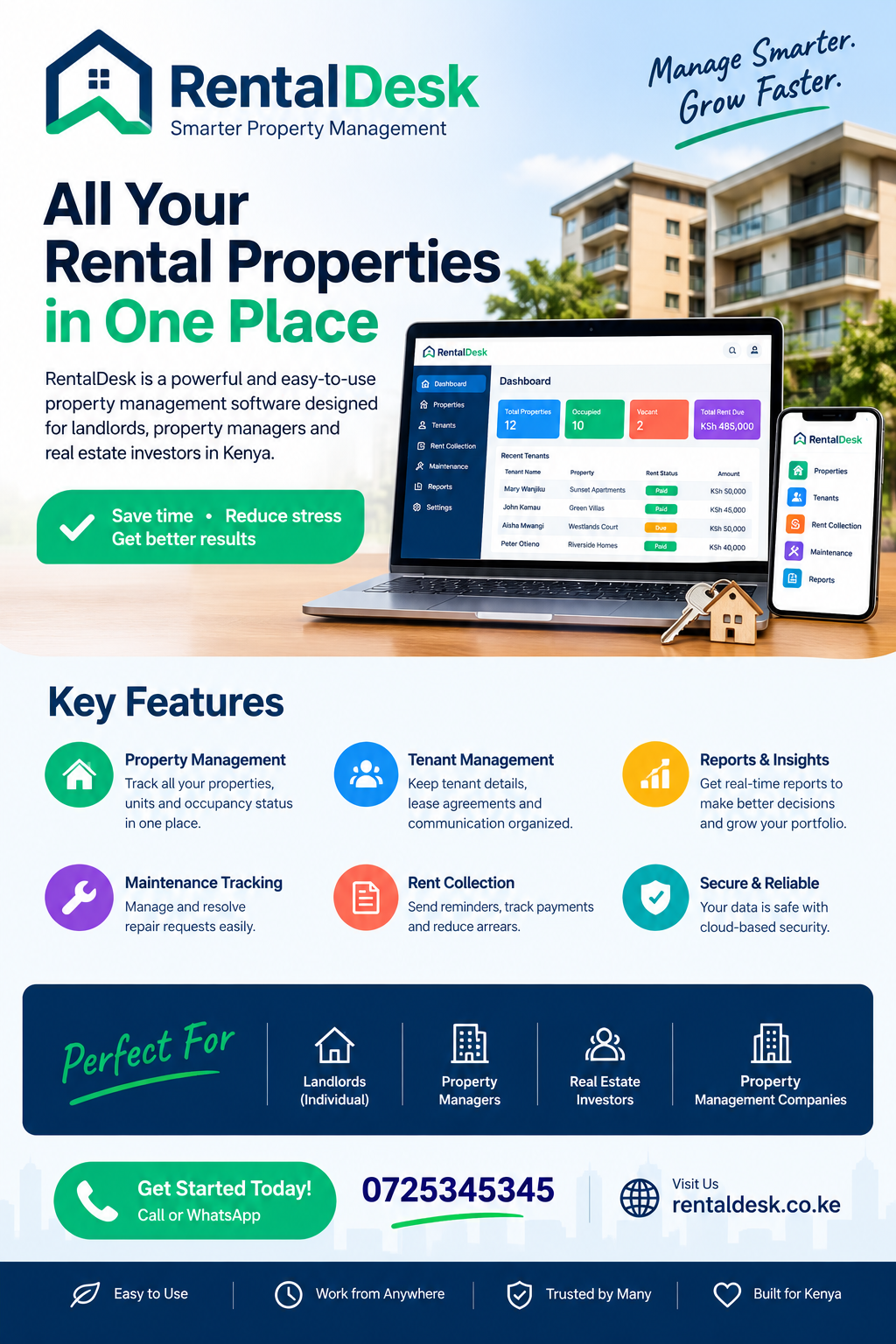
Rental Property Caretaker Management Software Kenya: A Complete Guide for Landlords and Property Managers
Managing rental properties requires more than finding tenants and collecting rent. Landlords and property managers must supervise caretakers, monitor repairs, handle tenant complaints, maintain accurate records and ensure that buildings remain safe and presentable. For owners managing several apartments or rental blocks, these responsibilities can quickly become difficult to coordinate manually. Rental Property Caretaker Management Software Kenya provides a useful starting point for understanding how digital property-management systems can organise these responsibilities and improve accountability.
Caretakers are often the first people tenants contact when they need assistance. They may report plumbing problems, oversee cleaning, monitor shared facilities, follow up on maintenance requests and help property managers communicate important information. When these duties are not documented properly, landlords can struggle to establish what happened, when it happened and whether the responsible person completed the task.
A well-organised digital workflow helps property owners assign duties, monitor progress and retain records of important activities. This is particularly useful for Kenyan landlords managing residential apartments, bedsitters, maisonettes, commercial premises and multi-unit rental buildings.
This guide explains the role of caretaker-management software, the problems it can solve, the features worth considering and how landlords can introduce digital systems without disrupting their daily operations.
1. Understanding Caretaker Management in the Kenyan Rental Market
Caretaker management involves coordinating the people responsible for the day-to-day running of rental buildings. Depending on the property, caretakers may work independently or report to a supervisor, property manager, landlord or management company.
Their responsibilities commonly include:
- Receiving and reporting tenant complaints.
- Identifying maintenance issues in apartments and common areas.
- Coordinating cleaning and waste collection.
- Monitoring water supply and shared facilities.
- Reporting security concerns.
- Following up on repair work.
- Communicating approved notices to tenants.
- Keeping records of incidents and completed duties.
- Helping contractors access areas that require repairs.
- Reporting damaged equipment and property infrastructure.
The responsibilities vary according to the building’s size, tenancy arrangements and employment structure. A caretaker working in a small block of six apartments may handle several tasks personally, while a caretaker at a large estate may coordinate with cleaners, security guards, plumbers and electricians.
Digital management becomes increasingly valuable as these responsibilities grow. Rental Property Caretaker Management Software Kenya can be used as a reference point when exploring how software-based workflows may help property teams coordinate assignments and retain information.
Why manual supervision can become difficult
Many landlords rely on phone calls, notebooks, WhatsApp messages and occasional site visits to supervise caretakers. These methods can work for a small property, but they often become difficult to manage when several buildings are involved.
For example, a tenant may report a leaking pipe to the caretaker on Monday. The caretaker might call a plumber but forget to inform the property manager that the repair has been delayed. The landlord then receives another complaint on Wednesday without knowing what action was taken earlier.
A centralised system can record the original complaint, assign responsibility, document follow-up and show whether the issue has been resolved.
The difference between caretaker supervision and property management
Caretaker supervision focuses on daily duties, inspections, incidents and maintenance coordination. Property management covers a broader range of responsibilities, including tenancy records, rent administration, financial reporting, lease management and communication with property owners.
The two functions overlap. A maintenance problem reported by a caretaker may affect a tenant’s satisfaction, maintenance expenditure and the landlord’s financial records.
A comprehensive property-management platform may connect these workflows, although the exact features depend on the provider and subscription.
2. What Is Caretaker Management Software?
Caretaker management software is a digital system that helps property owners and managers organise, assign and monitor the duties performed by caretakers and other property staff.
Depending on its capabilities, it may include task assignment, maintenance tracking, inspection checklists, incident reporting, staff records, reminders, communication tools and performance reports.
Rather than relying entirely on conversations and handwritten notes, authorised users can access relevant records through a central platform.
When comparing solutions, Rental Property Caretaker Management Software Kenya is a useful keyword-led reference for considering how digital tools fit into the wider Kenyan property-services market. Buyers should still confirm each provider’s actual functionality before making a purchasing decision.
How the software works
A typical caretaker-management workflow follows these steps:
- The property manager creates a task, inspection or maintenance request.
- The task is assigned to the appropriate caretaker or staff member.
- The responsible person receives the instructions.
- Progress is recorded as work begins.
- Supporting notes, photographs or other evidence may be attached if the platform supports them.
- The manager reviews the completed work.
- The record is retained for future reference and reporting.
Not every platform supports every step. Some systems specialise in maintenance requests, while others offer wider property-management functionality.
The important objective is to establish a consistent process that makes responsibilities visible and reduces the likelihood of forgotten assignments.
Who benefits from this type of software?
Potential users include:
- Individual landlords with several rental units.
- Apartment owners who employ on-site caretakers.
- Property management companies overseeing multiple buildings.
- Estate administrators coordinating maintenance teams.
- Owners of student accommodation.
- Managers of commercial buildings.
- Residential estate supervisors.
- Organisations responsible for staff housing.
The best solution depends on the number of properties, staffing arrangements, operational complexity and budget.
3. Common Challenges Faced by Kenyan Landlords and Caretakers
Property owners often face operational difficulties that have little to do with finding tenants. Even a building with good occupancy can experience poor service when daily responsibilities are not coordinated.
Poor communication between landlords and caretakers
A caretaker may know about a broken gate, water shortage or damaged staircase before the landlord does. If there is no reliable reporting process, the information may arrive late or remain undocumented.
This creates uncertainty. The landlord cannot easily determine whether a problem was reported, whether approval was requested or whether repairs were completed.
A digital reporting procedure creates a clearer record of communication and responsibility.
Delayed maintenance
Minor defects can become expensive when they are ignored. A small roof leak, for example, may damage ceilings, electrical fittings or tenants’ belongings if nobody follows up.
A maintenance workflow allows staff to report issues promptly, prioritise urgent work and monitor outstanding requests.
Inconsistent inspections
Some caretakers inspect buildings regularly, while others respond only when someone complains. Without a standard checklist, important areas may be overlooked.
Scheduled inspections can help teams check staircases, lighting, drainage, water tanks, waste-disposal areas, gates and shared facilities.
Unclear staff responsibilities
Problems arise when several employees assume that someone else will complete a task. A cleaner may expect the caretaker to report a blocked drain, while the caretaker assumes the property manager already knows.
Assigning one responsible person and setting a clear deadline reduces ambiguity.
Difficulty preparing reports
A landlord may ask for a monthly summary of maintenance issues, incidents and completed work. If the caretaker’s records are scattered across notebooks and messages, preparing the report can take hours.
A digital system can make relevant information easier to retrieve, provided staff update records consistently.
These challenges explain why some landlords investigate Rental Property Caretaker Management Software Kenya when looking for better ways to organise building operations. The practical value comes from improving daily processes, not simply purchasing software.
4. Essential Features to Look For
Not every property-management system offers the same tools. Before choosing a platform, landlords should identify the tasks they need to manage and verify that the software supports them.
Task assignment and tracking
The platform should make it possible to assign duties to specific employees and monitor their status.
Useful task fields may include:
- Task description.
- Property or building location.
- Assigned employee.
- Priority level.
- Due date.
- Current status.
- Completion notes.
- Verification or approval.
For example, a caretaker may receive an assignment to inspect faulty corridor lighting by Friday. The property manager should be able to see whether the inspection is pending, underway or completed.
Maintenance request management
Maintenance tracking helps staff record defects, allocate repairs and follow up on contractors.
A useful workflow separates the initial report from the repair process. It should show what was reported, who is responsible, what action was approved and whether the problem remains unresolved.
Inspection checklists
Inspection checklists help caretakers follow a consistent routine. Depending on the building, a checklist could cover:
- Cleanliness of shared areas.
- Functionality of corridor lights.
- Condition of staircases and handrails.
- Drainage and visible leaks.
- Water storage and supply concerns.
- Gate and access-control equipment.
- Waste collection.
- Damage to shared property.
A system with recurring task functionality can reduce the need to create the same inspection manually every week.
Staff records and accountability
Some property-management platforms include staff records, duty assignments and performance reporting. Others require a separate workforce-management tool.
Before buying, determine whether the system records attendance, leave, shift schedules or only property-related duties. These are different functions and should not be assumed to exist together.
A suitable Rental Property Caretaker Management Software Kenya search can help frame the requirements to discuss with prospective vendors, but feature availability must be confirmed directly.
Notifications and reminders
Reminders can alert staff to overdue maintenance, upcoming inspections and unresolved incidents.
Notifications are most effective when they reach the person who needs to act. Too many unnecessary alerts may cause staff to ignore important messages, so configure reminders around operational priorities.
Reporting and dashboards
Managers benefit from a summary of open tasks, completed inspections, unresolved repairs and recurring building problems.
Reports should answer practical questions: Which issues remain outstanding? Which property has the most maintenance requests? Are inspections being completed on time? What requires management approval?
Mobile accessibility
Caretakers may spend much of their working day moving around the property rather than sitting at a desk. Mobile-friendly software can help them enter reports from the location where an issue occurs.
Check whether the system works comfortably on the devices available to staff, what internet access it requires and whether it supports offline work if connectivity is interrupted.
5. Improving Caretaker Accountability Without Micromanagement
Accountability does not mean watching every movement an employee makes. It means establishing clear expectations, providing the tools needed to complete work and checking whether agreed responsibilities are fulfilled.
A good system helps managers evaluate results rather than relying entirely on personal impressions.
Define duties clearly
Every caretaker should understand the tasks they are responsible for, the tasks requiring approval and the situations that must be escalated immediately.
A written duty schedule may include morning inspections, waste-management checks, reporting faults and communicating approved notices.
Set reasonable deadlines
Not every maintenance issue has the same urgency. A major security concern should receive faster attention than a minor cosmetic defect.
Managers should establish response expectations based on the type of problem, the availability of contractors and the property’s operational requirements.
Record completion evidence
Where appropriate, caretakers can submit notes or photographs to show that work was completed. This is especially helpful for inspections and repairs involving common areas.
Evidence should be relevant, proportionate and collected respectfully. Avoid unnecessary photographs of tenants, private living spaces or personal belongings.
Review patterns rather than isolated incidents
A single delayed task may result from an unavailable contractor or an emergency elsewhere in the building. Repeated delays may indicate a process problem, inadequate staffing or unclear instructions.
Reports help managers identify patterns and discuss improvements fairly.
Using Rental Property Caretaker Management Software Kenya as a search reference can support a wider evaluation of digital property administration, particularly where caretaker duties connect with estate-level reporting.
6. Maintenance Management for Apartments and Rental Estates
Maintenance is one of the most important areas where structured caretaker workflows can improve the tenant experience.
A rental building contains many components that require attention over time. Plumbing, electrical installations, drainage, roofing, security equipment and shared facilities all need appropriate inspection and maintenance.
Create a central maintenance register
A maintenance register should record each reported issue and its progress.
| Information | Example |
|---|---|
| Property | Block B, Apartment 12 |
| Problem | Leaking kitchen pipe |
| Report date | Date the issue was received |
| Priority | Normal or urgent |
| Responsible person | Assigned caretaker or technician |
| Action | Inspection and repair |
| Status | Pending, in progress or completed |
| Verification | Confirmation that the issue is resolved |
This register provides a useful history when the same defect appears again.
Prioritise maintenance requests
A practical classification might include:
- Emergency: Issues posing immediate risks to people, security or essential services.
- High priority: Problems that significantly affect a tenant’s use of the property.
- Routine: Ordinary repairs that can be scheduled within an agreed timeframe.
- Preventive: Planned inspections and servicing intended to reduce future failures.
The classification should reflect the building’s risks and the landlord’s procedures.
Use preventive maintenance
Preventive maintenance focuses on identifying problems before they lead to expensive repairs.
Examples include scheduling checks of drainage, inspecting visible plumbing, testing common-area lighting and arranging professional servicing for relevant equipment.
Caretakers can identify visible problems, but specialised electrical, structural or mechanical work should be handled by appropriately qualified professionals.
Keep a record of repeat faults
Repeated faults may indicate that an earlier repair was incomplete or that a component needs replacement.
Digital records help managers compare dates, contractor reports and previous interventions. This makes it easier to decide whether to authorise another repair or investigate the underlying cause.
For landlords exploring Rental Property Caretaker Management Software Kenya, the key operational question is whether the proposed workflow can connect maintenance requests with inspection records and management approvals.
7. Supporting Rent Collection and Tenant Administration
Caretaker management is not the same as rent collection, but the two activities often intersect.
Tenants may ask caretakers about payment procedures, balances, receipts or tenancy issues. Without clear boundaries, staff may provide inaccurate information or make commitments they are not authorised to make.
Separate operational duties from financial authority
A caretaker can direct a tenant to the approved payment channel or report that a payment query has been raised. However, access to financial records and authority to adjust balances should be limited to designated personnel.
The software should reflect these responsibilities through suitable permissions.
Keep payment records accurate
Landlords should maintain reliable records of rent charged, payments received, balances outstanding and receipts issued.
If M-Pesa or bank payments are used, verify how the property-management platform records transactions and whether any integration is available. Do not assume that a system automatically connects to a payment provider.
Handle rent-related complaints consistently
A tenant who disputes a balance should be directed to the authorised person who can examine the ledger. The caretaker should not be expected to resolve complex accounting questions without access to verified information.
The wider property-management workflow may be relevant when evaluating Rental Property Caretaker Management Software Kenya alongside systems designed for tenant administration.
Protect tenants from unnecessary disclosure
Rent balances, contact details, identification information and tenancy records should not be shared with unauthorised staff or other tenants.
A well-configured system limits access according to each person’s role and helps the organisation handle information responsibly.
8. Improving Tenant Communication and Complaint Resolution
Tenants value prompt, respectful communication. Even when a repair cannot be completed immediately, a clear update helps them understand what is happening.
Establish one recognised reporting process
Tenants should know how to report maintenance problems, security concerns and other property-related issues.
Depending on the property’s arrangements, the process may involve a designated telephone number, a tenant portal, an email address or a management office.
The aim is to reduce the likelihood that complaints become lost in private conversations.
Acknowledge complaints promptly
The first response does not have to contain the final solution. It should confirm that the report was received and explain the next step when possible.
For example, a caretaker might confirm that a plumber has been contacted and that the property manager will provide an update after the inspection.
Document recurring complaints
If several tenants report poor water pressure or unreliable corridor lighting, the issue may affect an entire building rather than a single apartment.
A shared record helps managers recognise patterns and prioritise work that benefits multiple occupants.
Communicate delays honestly
Repairs may be delayed by parts shortages, contractor availability or approval requirements. Tenants should receive accurate updates rather than promises that cannot be fulfilled.
When evaluating Rental Property Caretaker Management Software Kenya as a search phrase, consider whether your required solution can record communication alongside maintenance and task history.
9. Managing Multiple Properties from One System
Landlords who own several buildings may face a different challenge from owners of a single apartment block. Their caretakers work at different locations, and the manager may not be able to visit every property daily.
A multi-property workflow helps centralise oversight while preserving property-specific responsibilities.
Organise records by building
Each property should have its own relevant records, staff assignments, inspections and maintenance history.
Where a building has multiple blocks or shared facilities, the software should support a structure that makes the location of each issue easy to identify.
Compare operational performance
Managers may review indicators such as:
- Number of outstanding maintenance requests.
- Time taken to acknowledge reported issues.
- Percentage of scheduled inspections completed.
- Number of repeat maintenance problems.
- Tasks overdue for completion.
- Repairs awaiting approval.
These indicators should be interpreted in context. A building with older infrastructure may naturally generate more maintenance requests than a newly completed property.
Standardise procedures across properties
A common checklist ensures that caretakers follow consistent standards. Managers can then adapt the checklist for differences between residential apartments, commercial buildings and estates.
Rental Property Caretaker Management Software Kenya is one of the keyword references in the specified link rotation; when selecting an actual property tool, verify its suitability for multi-building operations rather than relying on the keyword alone.
Give each employee appropriate access
A caretaker should generally see the tasks and property information needed to perform assigned duties, not unrestricted records for every building.
Role-based access reduces confusion and helps protect confidential information.
10. Data Security and Responsible Information Management
Property-management systems may hold tenant contacts, staff details, maintenance photographs, payment records and other sensitive operational information.
Convenience should not come at the expense of privacy.
Use individual accounts
Where possible, give each authorised employee an individual login. Shared accounts make it difficult to establish who changed a record or completed a task.
Apply role-based permissions
Permissions should reflect job responsibilities. Caretakers may need access to work orders and inspection schedules, while financial reports may be reserved for landlords or authorised administrators.
Review backups and recovery procedures
Ask the vendor how data is backed up, how it can be recovered and what happens if an account is compromised or the service becomes unavailable.
A landlord should understand the process for exporting important records before committing to a platform.
Consider Kenyan data-protection requirements
Organisations handling personal data in Kenya should assess their obligations under applicable data-protection law, including the Data Protection Act, 2019, where relevant. The precise requirements depend on the organisation’s activities and circumstances.
Practical measures include limiting unnecessary data collection, controlling access, documenting appropriate procedures and understanding how service providers process information.
A search for Rental Property Caretaker Management Software Kenya can form part of the initial research process, but security and compliance questions must be addressed directly with the software provider.
11. Choosing Software That Fits Your Property
Selecting software should begin with an assessment of operational needs, not a long list of features that may never be used.
Step 1: Identify current problems
List the problems that occur most frequently. They might include missed inspections, unresolved repairs, poor communication, incomplete staff records or difficulty preparing reports.
Prioritise the issues that cause the greatest disruption.
Step 2: Define essential requirements
Separate must-have features from optional ones.
For a small apartment block, maintenance requests, task assignment and inspection checklists may be sufficient. A larger management company may need multi-property reporting, staff permissions and integrations with existing systems.
Step 3: Request a demonstration
Ask the vendor to demonstrate realistic tasks using a sample property.
For example, request a walkthrough showing how a caretaker reports a broken water pump, how the manager assigns a technician and how the completed repair is documented.
A demonstration is more useful than a generic presentation because it reveals how the system supports actual working procedures.
Step 4: Confirm costs and limitations
Ask about subscription charges, setup fees, training, user limits, data migration, support and any additional charges for integrations.
Request the total expected cost for the period you intend to use the software. Do not assume that a low introductory price includes every feature.
Step 5: Test ease of use
Caretakers should be able to complete routine tasks without extensive technical training.
A system that is difficult to use may produce incomplete records, even when its feature list looks impressive.
When researching Rental Property Caretaker Management Software Kenya, use the same evaluation criteria across vendors so that comparisons remain fair and practical.
12. Understanding Pricing and Return on Investment
Software costs vary according to the provider, functionality, number of users, number of properties and support arrangements. A reliable comparison requires current quotations rather than assumptions about market prices.
Common pricing considerations
Potential costs include:
- Monthly or annual subscriptions.
- Initial setup and configuration.
- Training for caretakers and administrators.
- Importing existing property records.
- Additional user accounts.
- Optional payment or accounting integrations.
- Technical support and maintenance.
Some systems charge per property, while others charge per user or offer tiered plans. Ask which pricing model applies.
Calculate the value of time saved
Suppose a property manager spends several hours each month collecting updates from caretakers, checking notebooks and preparing reports. If a central system reduces this administrative work, the saved time may justify part of the subscription cost.
The calculation should use the landlord’s actual figures rather than an assumed industry average.
Include maintenance and operational benefits
Other potential benefits include faster identification of defects, fewer missed inspections, better contractor follow-up and more reliable documentation.
These improvements can be difficult to quantify precisely, but they are worth considering alongside direct financial savings.
Avoid paying for unused features
A small landlord may not need complex enterprise reporting or extensive integrations. Start with the functionality that solves current problems and expand only when operational needs justify the expense.
Rental Property Caretaker Management Software Kenya can be used as a search reference during research, but any real purchase decision should be based on verified features, transparent pricing and a demonstration.
13. Implementing the System Successfully
Introducing software is a change in how people work. The system will be useful only if staff understand the process and maintain accurate records.
Start with one property
A pilot project allows the landlord to test the workflow before introducing it across every building.
Choose a property with manageable operations and staff who can provide practical feedback.
Train caretakers using real tasks
Training should demonstrate how to report a defect, update a task, complete an inspection and escalate an urgent problem.
Simple written instructions can support employees after the initial session.
Establish reporting standards
Agree on what must be recorded, when a task is considered complete and which problems require immediate escalation.
For example, a caretaker might be required to document the location of a leak, the time it was reported and the action taken.
Review the process regularly
After the pilot, ask staff which steps are confusing, which notifications are unnecessary and which reports are genuinely useful.
Make adjustments before expanding to other properties.
Keep a fallback procedure
Internet interruptions, device problems and service outages can disrupt digital work. Maintain a practical method for recording urgent incidents temporarily and entering them into the system once service resumes.
The suitability of Rental Property Caretaker Management Software Kenya as a search phrase does not establish the capabilities of any particular provider; implementation planning should focus on demonstrated functionality and staff needs.
14. Common Mistakes to Avoid
Even a capable platform can fail to improve operations when it is introduced without clear procedures.
Buying software before defining the problem
A landlord who purchases a system without identifying the main operational difficulties may pay for unnecessary features while continuing to rely on old habits.
Begin with a problem list and use it to assess vendors.
Assigning tasks without deadlines
A task description alone may not explain when the work must be completed. Include a reasonable deadline and a priority level.
Failing to update records
If caretakers continue to communicate exclusively through informal channels, the digital record will become incomplete.
Explain which communication methods are approved for ordinary tasks and which channels should be used for emergencies.
Ignoring staff feedback
A workflow that looks efficient to management may be difficult for the employee performing the task. Ask caretakers to identify practical obstacles and provide suitable training.
Giving everyone unrestricted access
Excessive permissions increase the risk of accidental changes and unnecessary disclosure. Limit access to what each role requires.
Expecting software to replace good management
Software can organise information, but it cannot automatically resolve every dispute, assess every building defect or ensure that employees act responsibly.
Managers must still make decisions, inspect results, authorise expenditure and maintain professional working relationships.
For property owners researching Rental Property Caretaker Management Software Kenya, the most important principle is to assess practical workflows and verified provider capabilities rather than assuming every linked website offers the same service.
15. Practical Example: Managing a Water Leak in an Apartment Building
Consider a residential block in Nairobi with several floors and a shared water system. One morning, a tenant reports water leaking into a corridor.
Under an informal process, the caretaker may call the landlord, send a photograph through a messaging application and contact a plumber. If the landlord is unavailable, approval may be delayed. Later, the manager may struggle to establish whether the repair was completed.
A structured workflow provides a clearer sequence.
First, record the incident. The caretaker enters the location, description, time reported and apparent urgency.
Second, assess the risk. If the leak creates an immediate electrical or safety hazard, the caretaker follows the property’s emergency procedure and contacts the appropriate professionals.
Third, assign responsibility. The manager appoints an authorised person or contractor to investigate the problem.
Fourth, document the repair. The responsible person records the work performed, any parts required and whether further action is necessary.
Fifth, verify completion. The caretaker or manager checks that the leak has stopped and that the affected area is safe.
Finally, retain the record. If the same pipe develops another fault, the earlier incident can help the manager decide what to investigate.
This example shows how a simple reporting process can improve coordination without requiring every employee to have extensive technical knowledge.
A property manager assessing Rental Property Caretaker Management Software Kenya should therefore focus on whether the proposed platform can support the required maintenance workflow, rather than assuming that a particular product includes these features.
16. Measuring Caretaker Performance Fairly
Performance measurement should help staff improve their work while giving landlords a reliable view of building operations.
Use relevant indicators
Useful measures may include the proportion of scheduled inspections completed, the number of overdue tasks, the time taken to acknowledge requests and the percentage of maintenance jobs verified as complete.
These measures should be interpreted alongside the complexity of the property and the resources available to staff.
Distinguish responsibility from circumstances
A caretaker may report a problem immediately but remain unable to resolve it because the landlord has not approved the repair or a contractor is unavailable.
Reports should distinguish the caretaker’s actions from decisions or delays outside their control.
Conduct regular reviews
A monthly review can highlight recurring problems, training needs and improvements in the maintenance process.
Managers should recognise good performance, explain concerns clearly and agree on reasonable corrective actions.
Use records to improve operations
If inspections are repeatedly delayed because a caretaker handles too many buildings, the appropriate solution may involve changing the schedule or allocating additional support.
The purpose of measurement is to improve property operations, not to punish employees for circumstances beyond their control.
17. The Role of Digital Records in Long-Term Property Maintenance
Buildings require ongoing care. A landlord who keeps reliable maintenance records can make better-informed decisions about repairs, budgeting and future improvements.
Build a history of building defects
Records show when faults were reported, how often they recur and what action was taken. Over time, this can reveal components that need more attention.
Plan maintenance expenditure
A record of past repairs can help property owners identify recurring costs and plan inspections or replacement work.
The information should be reviewed alongside invoices, contractor assessments and financial records.
Support contractor management
Property managers can retain records of assignments, approvals, completion dates and relevant feedback. This provides a useful reference when coordinating future work.
Improve handovers
When a caretaker leaves or a new property manager takes over, documented procedures and maintenance histories reduce dependence on one person’s memory.
A structured handover should cover outstanding issues, scheduled inspections, contractor contacts and any urgent concerns.
Rental Property Caretaker Management Software Kenya is another occurrence in the requested link sequence. For a real-world software evaluation, use a demonstration to confirm whether the required recordkeeping functions are available.
18. Questions Landlords Should Ask Software Vendors
Before committing to a system, prepare questions that reveal how it works in everyday situations.
- Can the system manage more than one property?
- Can tasks be assigned to individual caretakers?
- Are recurring inspections supported?
- Can users record maintenance issues and update their status?
- Are photographs or documents supported where appropriate?
- Can managers generate task and maintenance reports?
- Does the platform work on the devices caretakers already use?
- Is an internet connection required for every task?
- How are user permissions configured?
- How are records backed up and exported?
- What training and support are included?
- What are the full subscription and setup costs?
- Are there extra charges for additional users?
- Can the system integrate with existing accounting or payment tools?
- How does the vendor handle customer information and security incidents?
Request clear answers to these questions and test important workflows before signing a contract.
When comparing Rental Property Caretaker Management Software Kenya with other search results, treat the phrase as a research reference rather than proof that the linked website provides a specific software product.
19. Frequently Asked Questions
1. What is caretaker management software?
Caretaker management software helps landlords and property managers assign duties, track inspections, document incidents and coordinate maintenance. Its exact capabilities depend on the provider and the selected plan.
2. Can small landlords benefit from caretaker software?
Yes. A landlord managing one apartment block may benefit from digital task lists, maintenance records and inspection reminders. The important consideration is whether the time saved and improved organisation justify the cost.
3. Does caretaker software automatically collect rent?
Not necessarily. Some broader property-management platforms include rent administration or payment integrations, while others focus on maintenance and staff duties. Confirm the available functions before purchasing.
4. Can the system help manage maintenance requests?
Many platforms offer maintenance-request workflows, including recording reported defects, assigning work and tracking progress. Buyers should verify whether the system supports their preferred reporting and approval process.
5. Is caretaker management software useful for multiple buildings?
It can be particularly useful where managers supervise caretakers across different locations. Look for property-specific records, staff assignments, consolidated reporting and suitable access permissions.
6. Does the software need internet access?
Requirements vary. Some platforms depend on an internet connection, while others may offer limited offline functionality. Ask the vendor how users should handle work during connectivity interruptions.
7. How much does caretaker management software cost in Kenya?
There is no single price that applies to every provider. Costs depend on functionality, property numbers, users, support and subscription terms. Obtain a quotation that includes setup, training and additional charges.
8. How can landlords protect tenant information?
Landlords should limit access to authorised users, collect only necessary information, use appropriate security controls and assess applicable Kenyan data-protection obligations. Vendor security practices should be reviewed before adoption.
9. Can caretaker software replace a property manager?
No. It can improve coordination and recordkeeping, but people must still make decisions, manage contractors, respond to emergencies and address tenant concerns.
10. How should a landlord introduce a new system?
Start by identifying operational problems, selecting essential features, testing the platform on one property and training staff. Review feedback before rolling it out across additional buildings.
20. Making a Practical Decision for Your Rental Properties
The best property-management process is one that staff can follow consistently and landlords can review without unnecessary administrative work.
Start by examining how caretaker duties are currently assigned, how maintenance complaints are recorded and how managers confirm that tasks have been completed. Identify where information is lost, delays occur or responsibilities become unclear.
Then compare software options using the same criteria: usability, task management, inspection schedules, maintenance records, reporting, security, support and total cost. Test the most important workflows before making a commitment.
For a landlord overseeing several buildings, centralised records may improve visibility across properties. For a smaller landlord, a straightforward task and inspection system may be sufficient. The appropriate solution depends on the actual work that needs to be managed.
Rental Property Caretaker Management Software Kenya can serve as another keyword-linked reference in the prescribed sequence, but landlords should verify the destination, the provider’s offering and all relevant features independently.
A successful implementation also requires clear staff responsibilities, reasonable deadlines, appropriate training and regular reviews. Software should support good management practices rather than substitute for them.
21. Final Recommendations for Kenyan Property Owners
Caretaker management is an important part of protecting rental property, maintaining shared facilities and providing tenants with a reliable service. When staff duties are poorly documented, landlords may struggle to identify delays, follow up on repairs and maintain consistent standards across their buildings.
Digital workflows can address many of these problems by making assignments visible, keeping maintenance histories and creating a more reliable record of daily activities. They can also help managers prepare reports, plan inspections and coordinate teams working at different properties.
Before selecting a platform, define your requirements, compare verified features and ask for a practical demonstration. Consider the experience of the people who will use the system every day, particularly caretakers who may rely on mobile devices while moving around a building.
Start with the tasks that cause the greatest difficulties. Establish clear reporting procedures, provide training and review the results after implementation. Expand the system only when it delivers practical value.
A carefully selected and consistently used digital solution can help landlords improve accountability, support maintenance planning and organise rental operations more effectively. The objective is straightforward: fewer missed tasks, clearer records, better coordination and a property that remains well managed for both owners and tenants.
Rental Property Caretaker Management Software Kenya
Rental Property Caretaker Management Software Kenya
Rental Property Caretaker Management Software Kenya
Rental Property Caretaker Management Software Kenya
Rental Property Caretaker Management Software Kenya
Rental Property Caretaker Management Software Kenya
Rental Property Caretaker Management Software Kenya
Rental Property Caretaker Management Software Kenya
Rental Property Caretaker Management Software Kenya
Rental Property Caretaker Management Software Kenya
Rental Property Caretaker Management Software Kenya
Rental Property Caretaker Management Software Kenya
Rental Property Caretaker Management Software Kenya
Rental Property Caretaker Management Software Kenya
Rental Property Caretaker Management Software Kenya
Rental Property Caretaker Management Software Kenya
Rental Property Caretaker Management Software Kenya
Rental Property Caretaker Management Software Kenya
Rental Property Caretaker Management Software Kenya
Rental Property Caretaker Management Software Kenya
Rental Property Caretaker Management Software Kenya
Rental Property Caretaker Management Software Kenya
Rental Property Caretaker Management Software Kenya
Rental Property Caretaker Management Software Kenya
Rental Property Caretaker Management Software Kenya
Rental Property Caretaker Management Software Kenya
Rental Property Caretaker Management Software Kenya
Rental Property Caretaker Management Software Kenya
Rental Property Caretaker Management Software Kenya
Rental Property Caretaker Management Software Kenya
Rental Property Caretaker Management Software Kenya
Rental Property Caretaker Management Software Kenya
Rental Property Caretaker Management Software Kenya
Rental Property Caretaker Management Software Kenya
Rental Property Caretaker Management Software Kenya
Rental Property Caretaker Management Software Kenya
Rental Property Caretaker Management Software Kenya
Rental Property Caretaker Management Software Kenya
Rental Property Caretaker Management Software Kenya
Rental Property Caretaker Management Software Kenya
Rental Property Caretaker Management Software Kenya
Rental Property Caretaker Management Software Kenya
Rental Property Caretaker Management Software Kenya
Rental Property Caretaker Management Software Kenya
Rental Property Caretaker Management Software Kenya