
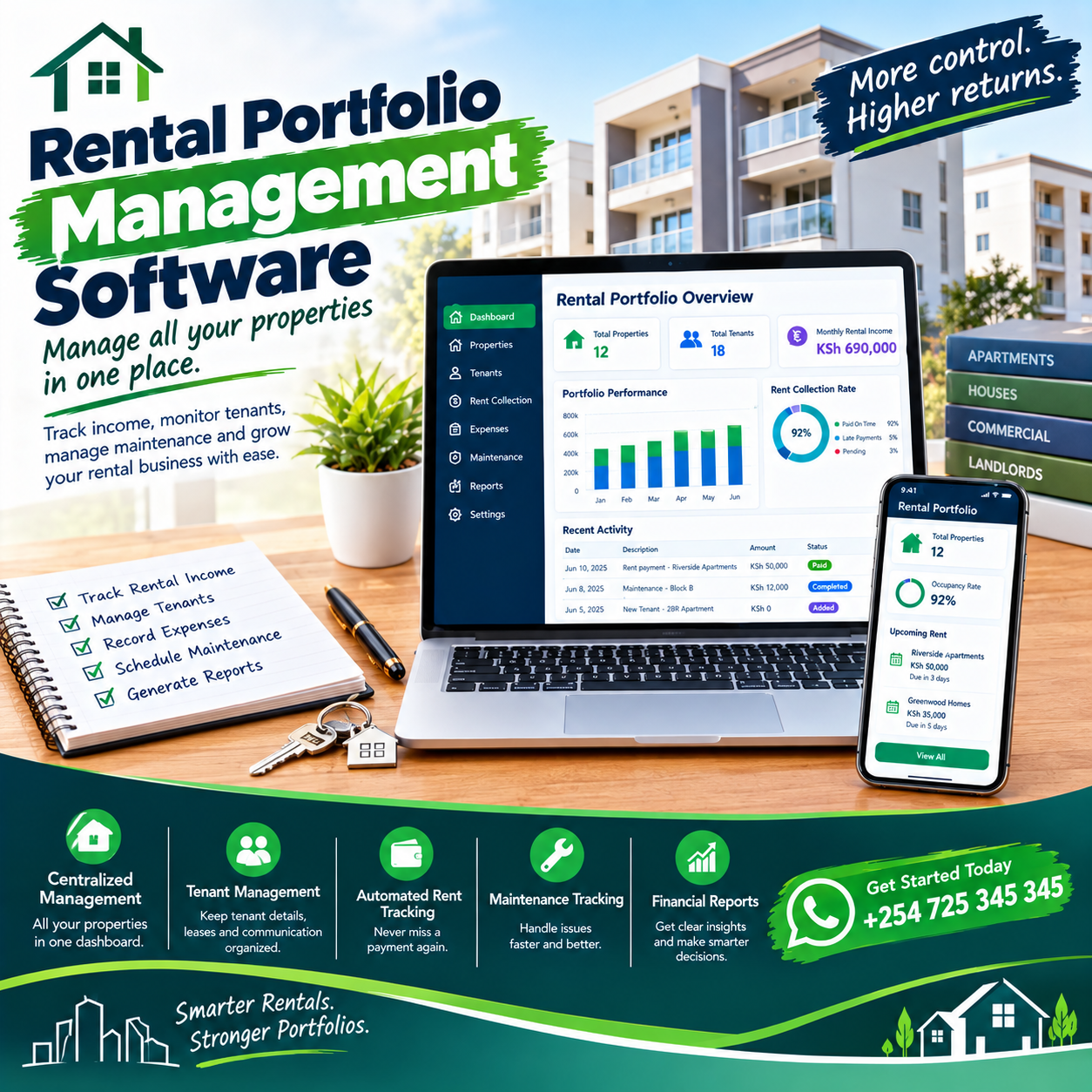
Rental portfolio management software is the command center that lets landlords and managers see, run, and grow every property they own from a single screen. One building is a project; ten buildings are a business; and a business needs systems that scale.
That is the gap rental portfolio management software fills — replacing a patchwork of notebooks, spreadsheets, and scattered chats with one connected view of your entire holdings. The moment a landlord adds a second or third property, a quiet problem begins.
Records live in different places, standards drift between caretakers, and answering simple questions — which unit is vacant, which building performs best, what is due this week — takes digging instead of glancing. Rental portfolio management software exists to make the whole portfolio answer like one building does.
This guide walks you through everything the category offers in 2026. We cover what portfolio-grade software actually is, how it differs from the single-property tools most landlords start with, and the breaking points where those tools fail.
We also cover teams at scale, multi-owner reporting, acquisitions, the features worth demanding, and what it all costs. By the end, you will be able to evaluate any rental portfolio management software like a professional operator.
Whether you hold three walk-ups in Rongai, a mix of residential and commercial units across Nairobi, or client properties as a managing agent, the principles are identical. Scale punishes improvisation and rewards systems.
And nothing rewards good systems more visibly than well-chosen rental portfolio management software running beneath an entire portfolio.
What Is Rental Portfolio Management Software?
Rental portfolio management software is a platform that manages multiple properties, units, tenants, and owners as one integrated operation. Where single-property tools track one building’s rent and tenants, portfolio software unifies everything — every unit, every balance, every lease date, every maintenance ticket — into one dashboard.
Think of it as the difference between a notebook per building and a head office for all of them. The defining capability is the consolidated view. One screen shows occupancy across every property, arrears across every unit, and upcoming expiries across the whole calendar.
That single pane of glass is the signature of genuine rental portfolio management software. Beneath the dashboard sits the deeper promise: shared standards. When every property runs on the same workflows — same receipting, same notices, same inspection routines — quality stops depending on which caretaker happens to be on duty.
Standardization at that level is what separates real rental portfolio management software from a folder of separate spreadsheets.
The category also understands roles. Owners see their portfolio, managers see their client portfolios, caretakers see their assigned buildings, and accountants see exports. That role-based architecture is the operational heart of mature rental portfolio management software.
It helps to position this against the tools covered in our earlier guides. Rent tracking follows payments, tenant management follows people, and bookkeeping follows money. Portfolio management is the layer that binds them across many properties — the integration fabric of a multi-building rental portfolio management software setup.
The Scaling Problem: Where Single-Property Habits Break
Every landlord’s systems break at predictable thresholds, and knowing them helps you prepare before they arrive. The breaking points are remarkably consistent across the market. Each one is a signal that rental portfolio management software is becoming a need rather than a nice-to-have.
The first threshold sits around three to five properties.
Below that, memory and a spreadsheet still hold; above it, records start fragmenting and questions start taking evenings to answer. Most owners begin researching rental portfolio management software somewhere in this band.
The second threshold sits around ten to thirty units, when teams arrive.
Once caretakers, agents, and assistants touch the operation, informal coordination collapses into missed handoffs and disputed collections. Team visibility is the capability that rental portfolio management software provides precisely at this stage.
The third threshold arrives with mixed portfolios — residential plus commercial, owned plus managed, Nairobi plus the diaspora corridor.
Different unit types, different owners, and different obligations make separate records impossible to reconcile. Consolidation across that diversity is the core promise of rental portfolio management software. The unifying symptom at every threshold is the same: answers take too long.
How many vacancies exist across the portfolio, what is collected month-to-date, which buildings trend down — these should be glances, not archaeology. Speed of answers is the everyday dividend of consolidated rental portfolio management software.
Why 2026 Is the Breakout Year
Three forces are converging to make 2026 the year portfolio-level management becomes standard across Kenya.
Each removes an old barrier. Together, they move rental portfolio management software from enterprise privilege to mainstream practice.
First, the building blocks are finally connected.
Payment rails, communication channels, and listing platforms now integrate cleanly, so portfolio software can orchestrate the whole journey instead of duplicating it. Integration depth is what makes modern rental portfolio management software genuinely unified rather than a bundle of tabs.
Second, portfolios have grown across the market.
A decade of investment has left thousands of Kenyan owners holding multiple buildings, and informal systems have reached their natural limits. That structural growth is the demand engine behind rental portfolio management software adoption.
Third, the professional services layer has matured.
More owners than ever delegate to managers, and more managers than ever compete on transparency and reporting. Both sides of that relationship now expect the capabilities that rental portfolio management software delivers.
Who Needs It Most
Growing landlords are the first and largest audience. Anyone adding a second or third building is effectively choosing between becoming a systems operator and drowning in fragments. The moment of adding property number two is the natural entry point for rental portfolio management software.
Property managers and agencies are the second audience. They run many owners’ portfolios simultaneously, where one missed report or unexplained shortfall damages hard-won trust. For them, rental portfolio management software is not an upgrade but the operating system of the business.
Diaspora and absentee owners form the third audience. Distance multiplies the value of consolidation, because the dashboard replaces the drive-by inspection. Owners abroad running several buildings depend on rental portfolio management software as their eyes and memory. Investors planning to grow form the fourth audience.
Anyone intending to acquire more units should build on scalable foundations from the start, because migrating records later is expensive. Future-proofing is the strategic argument for adopting rental portfolio management software early.
The Unified Dashboard: Your Portfolio at a Glance
The dashboard is where portfolio software earns its keep daily. Occupancy across every property appears in one view — occupied, vacant, and turning-over, with the vacancy days counted. That instant portfolio truth is the headline feature of rental portfolio management software.
Arrears roll up the same way. Every outstanding balance across every unit, ranked by age and amount, replaces a dozen separate ledgers. Collection health becomes visible portfolio-wide, which is the financial heartbeat of rental portfolio management software.
The lease calendar completes the picture. Every expiry, every renewal window, and every notice deadline across the entire portfolio sits in one chronological view. Nothing lapses unnoticed under a proper rental portfolio management software dashboard.
The deeper value is comparative. Which building fills fastest, which loses the most to arrears, which units sit longest — comparisons across properties are where real management insight begins. That analytical layer is what elevates rental portfolio management software from record-keeping to strategy.
Standardized Workflows: One Way of Doing Everything
Consistency is the quiet superpower of portfolio management. When every building follows the same tenant onboarding, the same inspection routine, and the same receipting standard, quality becomes structural rather than personal.
That uniformity is the process backbone of rental portfolio management software. Onboarding standardizes first. Every new tenancy follows the same documented path — agreement, deposit receipt, condition photos, meter readings — regardless of which building or caretaker is involved.
Standardized onboarding is what eliminates the majority of downstream disputes under rental portfolio management software. Maintenance standardizes next. Every request follows the same ticket path — logged, assigned, evidenced, and closed — with photos before and after as the norm.
Consistent maintenance handling protects both buildings and budgets across the whole portfolio. Notices and receipts standardize last. Templates carry the same professional language and the same legal completeness across every property. A portfolio that speaks with one voice is the outward signature of rental portfolio management software.
Managing Teams at Scale
People are the hardest part of scaling, and software is what makes teams work. Role-based access puts every person exactly where they belong — full view for you, assigned buildings for caretakers, read-only for accountants. That controlled visibility is the security architecture of rental portfolio management software.
Task assignment replaces improvised coordination. Viewings, inspections, and repairs get assigned to named people with deadlines, and completion is visible to everyone who needs it. Accountability by design is what keeps field teams aligned under rental portfolio management software.
Attribution protects your people as much as your money. Collections and actions logged under each person’s name cannot be falsely questioned later, which shields honest staff from suspicion. That mutual protection is why good caretakers become advocates of rental portfolio management software.
Communication consolidates too. Property-level chat threads, broadcast announcements, and logged messages replace scattered WhatsApp groups whose histories vanish. One communication trail per property is the record-keeping gift of rental portfolio management software.
Multi-Owner Reporting: The Manager’s Trust Engine
For managing agents, reporting is the product. Owners stay with managers who make their portfolios legible — collections, expenses, vacancies, and plans, delivered on schedule. Automated owner reporting is the client-retention engine inside rental portfolio management software.
Per-owner views sit beneath the portfolio view. Each client sees their properties, their numbers, and their trends, while the agency sees everything consolidated. That layered visibility is the structural advantage of rental portfolio management software for agencies.
Statements, vacancy updates, and maintenance summaries generate from live data. No end-of-quarter reconstruction, no spreadsheet archaeology, no defensiveness when questions come. Calm, documented reporting is what turns clients into referrers of rental portfolio management software powered agencies.
The same layer serves group ownership. Families and investment chamas holding property together see one shared truth, which removes the disagreements that unmonitored co-ownership invites. Shared clarity is the partnership dividend of rental portfolio management software.
Financial Consolidation Across the Portfolio
Money is where fragmentation costs most, and consolidation is where portfolio software pays most. Collections, arrears, and expenses roll up per building, per owner, and per portfolio, with drill-down to any single unit. That financial depth is the analytical core of rental portfolio management software.
Per-property profit becomes visible at last. Which building earns its keep, which one drains repairs, and which unit underperforms its rent — the answers drive pricing, budgeting, and buying decisions. Portfolio-level financial truth is the strategic value of rental portfolio management software.
Cash-flow forecasting completes the layer. Expected collections, known obligations, and seasonal patterns combine into forward views that support planning rather than surprise. Owners who forecast through rental portfolio management software commit to expansions and renovations with evidence instead of optimism.
The export door matters here too. Accountant-ready summaries per property and per portfolio turn tax season from a project into a handoff. That compliance readiness is the quiet dividend of consolidated rental portfolio management software records.
Vacancy Management at Scale
Vacancies are the portfolio’s loudest expense, and they deserve systematic treatment. One dashboard tracks every vacant unit, its days empty, and its asking rent against the market. Centralized vacancy tracking is the income-protection layer of rental portfolio management software.
Marketing standardizes across units. Every vacancy publishes to the same channels with the same quality photos and complete details, because inconsistency in advertising is inconsistency in income. Uniform marketing is how rental portfolio management software compresses days-on-market across a whole portfolio.
Leads flow into one pipeline regardless of which unit they concern. Inquiries route to the right viewing, follow up on schedule, and convert with the same discipline everywhere. That unified funnel is the leasing engine of rental portfolio management software.
The analytics close the loop. Which unit types move fastest, which price points stall, and which channels actually produce tenants — the data compounds into sharper decisions every cycle. Learning portfolios beat guessing portfolios, and rental portfolio management software is what makes the learning possible.
Maintenance at Scale
Maintenance multiplies with every building, and unmanaged maintenance multiplies cost with it. One system captures every request from every property, assigns it, and tracks it to closure. Centralized maintenance is the asset-protection layer of rental portfolio management software.
History accumulates per building and per unit. Recurring failures reveal themselves — the pump that dies annually, the unit that consumes repairs — and renovation budgets follow evidence instead of memory. That institutional memory is the long-term value inside rental portfolio management software.
Costs consolidate for leverage too. Portfolio-level spending reveals which fundis deliver, which categories balloon, and where preventive spending would save reactive money. Strategic maintenance budgeting is the financial gift of rental portfolio management software.
The Acquisition Angle: Onboarding New Properties Fast
Growth is the whole point of a portfolio, and growth means onboarding new buildings repeatedly. Good software makes that onboarding fast and repeatable — units loaded, standards applied, and reporting live within days.
Rapid, consistent property onboarding is the expansion capability of rental portfolio management software. The same discipline serves due diligence. Before acquiring, a buyer can review how a building performs inside the system — collections, arrears, costs — rather than relying on the seller’s summary.
Evidence-based acquisition is the investor’s edge that rental portfolio management software enables. Integration with the listing side completes the loop. Verified listings feed vacancies, and vacancies feed performance data, connecting marketing to management in one flow. That end-to-end connection is the full-circle promise of rental portfolio management software.
Must-Have Features to Demand in 2026
The category is maturing quickly, and buyers should evaluate against a demanding checklist. the best rental portfolio management software platforms share a clear set of core capabilities. Use this section as your scorecard when comparing providers.
First, demand true multi-property architecture. Units, buildings, and owners should be native structures — not properties faked through folders and tags. Native hierarchy is the foundation of genuine rental portfolio management software.
Second, insist on the consolidated dashboard: occupancy, arrears, and lease calendar across everything.
Third, expect role-based access for teams, with attribution on every action.
Fourth, look for automated owner reporting per client and per property. Those three capabilities together define mature rental portfolio management software.
Fifth, demand financial consolidation with per-property drill-down and accountant-ready exports.
Sixth, check the vacancy and lead pipeline that works across units.
Seventh, confirm maintenance workflows with evidence requirements and per-unit history. Breadth like this is what separates real rental portfolio management software from single-property tools with a new label.
Eighth, verify integrations — M-Pesa reconciliation, WhatsApp and SMS delivery, and listing feeds.
Ninth, confirm export and data ownership in full, because your portfolio’s history must always be portable. Data sovereignty is non-negotiable in any rental portfolio management software you adopt.
Tenth, mind the practical basics: affordable phones, weak networks, and a short learning curve for every role on the team. Usability across the whole team decides whether the platform becomes infrastructure or shelfware. That team-wide test is the final gate for any rental portfolio management software purchase.
Portfolio Software vs. the Single-Property Tools
Readers of our earlier guides often ask how this category relates to everything covered before. The honest answer is that portfolio software is not a replacement — it is the layer above. Rent tracking, tenant management, bookkeeping, and statements remain the organs; rental portfolio management software is the nervous system connecting them.
In practice, the categories are converging. Modern platforms increasingly bundle the single-property tools inside portfolio architecture from the start. That convergence means the practical choice is often which platform to standardize on, not whether to add a layer.
The selection question becomes simpler as a result. Choose the platform whose portfolio view, team model, and integrations fit your growth path — then let its bundled tools carry the daily work. That platform-first thinking is how professional operators approach rental portfolio management software today.
Choosing the Right Platform
A structured selection process prevents expensive regret at portfolio scale. Start by mapping your reality: how many properties, how many people, how many owners, and where your current system hurts most. The right rental portfolio management software fits your operation, not the loudest advert.
Trial with your real portfolio, without exception. Load your actual buildings, run one full month — collections, a vacancy, a repair, a report — and watch how the system behaves across properties.
One honest cycle reveals more than any rental portfolio management software demonstration ever will. Test the team experience deliberately. Have a caretaker and an accountant use their own views, because a platform the field resists is a platform that fails.
Adoption across roles is the true test of rental portfolio management software. Ask about the growth path too. Confirm pricing as you scale, migration support as you onboard buildings, and the roadmap for features you will need next year.
A platform that grows with you is worth more than one that is cheaper today. That forward fit is the deciding frame for rental portfolio management software investments.
What It Costs in 2026
Pricing in this category remains friendlier than the capability suggests. Competition among Kenyan providers has kept portfolio-grade software within reach of ordinary owners. Against one prevented vacancy month or one retained management client, rental portfolio management software repays itself quickly. Typical pricing structures heading into 2026 look like this:
- Free tiers: suitable for small portfolios testing the discipline
- Per-unit plans: commonly KSh 30–100 per unit monthly
- Flat monthly plans: roughly KSh 1,500–6,000 depending on features and team size
- Manager/agency plans: tiered by units under management, often KSh 5,000–15,000 monthly
- Annual plans: usually 10–20 percent cheaper than monthly billing
Weigh the price against the full value stack: compressed vacancies, recovered arrears, retained clients, lower accounting fees, and sharper acquisition decisions.
Viewed that way, the true cost of good rental portfolio management software approaches zero. The real question is how long you can afford to run a multi-building business on single-building habits.
Getting Started the Right Way
Adoption succeeds or fails in onboarding, so begin deliberately. Load one building completely first — units, tenants, leases, and true balances — and run it properly before adding the rest.
A clean pilot building is the foundation of successful rental portfolio management software rollouts. Then migrate the portfolio building by building. Rushing everything in one weekend produces half-migrated records that undermine trust in the entire system.
Disciplined migration is what makes rental portfolio management software trustworthy from the first month. Brief every role as their access arrives. Caretakers, agents, and accountants each need a short, warm explanation of what the system does for them specifically.
Buy-in across roles is what turns rental portfolio management software into the way the business actually runs. Set the review rhythm last.
Weekly portfolio glance, monthly consolidated review, quarterly per-building deep dive — three speeds that keep the whole operation inside your peripheral vision. That rhythm is the operating habit of owners who get full value from rental portfolio management software.
Common Mistakes to Avoid
The most common mistake is buying portfolio software and running it per property. Separate workflows defeat the entire consolidation benefit, so standardize from day one. Uniform process is the whole point of rental portfolio management software.
The second mistake is skipping the pilot. Rolling everything out at once multiplies errors across every building simultaneously. The one-building-first approach is the proven path into rental portfolio management software.
The third mistake is ignoring the team layer. Software without field adoption produces beautiful dashboards over rotten data. Investing in the people side is what makes rental portfolio management software real on the ground. One bonus mistake deserves a warning: treating the dashboard as the finish line.
The dashboard is the starting point — decisions, standardization, and follow-through are what convert visibility into income.
Acting on the numbers is the discipline that separates users of rental portfolio management software from subscribers to it.
Real Scenarios from Real Portfolios
Picture a landlord in Nakuru who grew from six units to forty across four buildings in three years. Her old per-building spreadsheets collapsed somewhere around the second building, and consolidation became her most profitable decision of the decade.
Occupancy, arrears, and expenses now answer in one glance — the everyday reality of rental portfolio management software. Picture an agency in Kilimani managing nine owner portfolios under one roof. Automated per-owner reporting replaced end-of-quarter reconstructions, and every client query now ends with a forwarded document instead of a debate.
Client retention and referrals both climbed — the trust dividend of rental portfolio management software. Picture an investor in Kitengela preparing to buy his fifth plot. His portfolio’s clean records — cash flow, expenses, occupancy history — doubled as his evidence pack at the bank, and the loan came through on better terms than his first purchase.
Growth feeding growth is the compounding promise of rental portfolio management software. Picture a diaspora owner in Minneapolis with buildings in Kasarani and Kitengela. One dashboard, one team, one set of standards across two towns — and the numbers on her screen matching the ground for the first time in years.
Confidence at a distance is the quiet export of well-run rental portfolio management software.
The Road Ahead: 2027 and Beyond
The trajectory points toward portfolios that increasingly manage themselves. Vacancies will advertise, follow up, and report automatically; maintenance will predict; and owner statements will compile without a human touch.
The rental portfolio management software of 2027 will feel less like a tool and more like a head office. Intelligence is arriving just behind. Systems are learning portfolio patterns — forecasting collections, flagging underperforming buildings, and suggesting where the next shilling of renovation earns most.
Advisory-grade insight is the next frontier of rental portfolio management software. The message for today’s owner is simple. The capability that was once reserved for institutions is now affordable, local, and proven across thousands of Kenyan portfolios.
There has never been a better moment — in 2026 or beyond — to run your properties as one business through rental portfolio management software.
Frequently Asked Questions
What does rental portfolio management software actually do?
It manages multiple properties, units, tenants, and owners as one operation — with a consolidated dashboard, standardized workflows, role-based team access, and financial reporting across the whole portfolio. Think of it as the head office for everything you own or manage. The multi-property architecture is what defines genuine rental portfolio management software.
How many properties do I need before it makes sense?
The honest signal is not a number but a symptom — when answering portfolio questions starts taking evenings instead of glances. Most owners feel it between three and five buildings, and teams accelerate the need. Whenever it arrives, rental portfolio management software is the cure.
Is it different from the single-property tools I already use?
Yes — those tools track payments, tenants, or documents for one property; portfolio software connects everything across all of them. Modern platforms increasingly bundle the single-property tools inside portfolio architecture.
That layered design is the strength of mature rental portfolio management software.
Can property managers use it for multiple clients?
Yes — multi-owner reporting is a core feature, giving each client a private view of their portfolio while the agency sees everything consolidated.Automated owner statements and updates are the retention engine of the category. Client transparency is what rental portfolio management software was built for.
Will my caretakers and staff actually use it?
They will, when their views are simple, their tasks are clear, and the system protects them with attribution. Brief each role warmly on what the platform does for them specifically. Team adoption is the deciding factor in every rental portfolio management software rollout.
Does it work with M-Pesa and WhatsApp?
The leading Kenyan platforms reconcile M-Pesa payments automatically and deliver messages through WhatsApp and SMS natively. Confirm both during your trial, because integration depth varies widely. Native connectivity is the plumbing of effective rental portfolio management software.
What happens to my existing records when I adopt?
You migrate them building by building — starting with one pilot property, confirming balances, and standardizing before scaling. Most platforms support imports, and clean migration is worth the patience. A truthful starting point is what makes every report inside your rental portfolio management software trustworthy.
Is my portfolio data safe?
Reputable providers use encryption, continuous backups, role-based access, and controls comparable to banking standards. Confirm the provider’s practices and your export rights before committing. Security is a baseline requirement of professional rental portfolio management software, never an optional extra.
Where can I find verified tenants and landlord tools together?
Start with platforms that combine verified listings with landlord-friendly technology, such as rentaldesk.co.ke. Pairing the right tenants with consolidated management takes you from owning scattered buildings to running one connected business — property by property, year after year.