
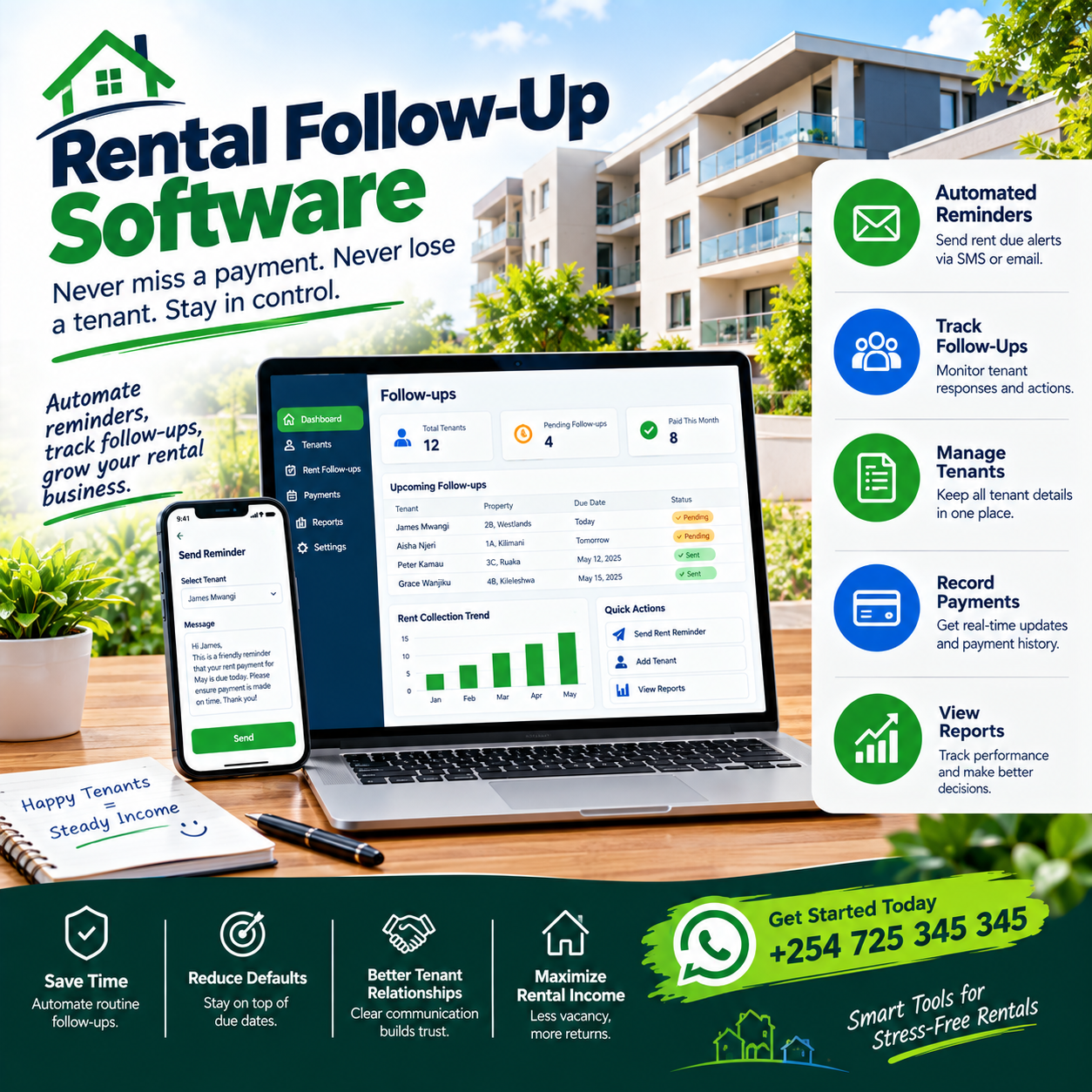
Rental follow-up software is the quiet difference between landlords who fill vacancies in days and those who watch good tenants slip away in silence.
Every week across Kenya, inquiries arrive, viewings get promised, and applications go pending — and then everything stalls.
Not because the property was wrong, but because nobody followed up at the right moment.
That lost momentum is the most invisible expense in property, and it is exactly what rental follow-up software was built to end.
Instead of relying on memory, sticky notes, and good intentions, the system tracks every inquiry, viewing, application, and renewal — then prompts the next move automatically.
The result is faster lettings, warmer tenant relationships, and a business that no longer leaks money through forgotten conversations.
This guide walks you through everything the category offers in 2026.
We cover what the software actually does, where follow-up fails, the features worth demanding, what it costs, and how to roll it out properly.
By the end, you will be able to choose and run rental follow-up software like a professional operator.
Whether you manage three units in Rongai or three hundred across Nairobi, the principle never changes.
Every tenant relationship — and every shilling of occupancy — is won or lost in the follow-up.
And nothing protects the follow-up better than purpose-built rental follow-up software doing the remembering for you.
What Is Rental Follow-Up Software?
Rental follow-up software is a digital system that tracks every conversation and commitment in your rental business, then makes sure the next step actually happens.
It remembers who inquired about your vacant unit, when the viewing was promised, which application is pending, and which lease expires next month.
Where ordinary tools store information, follow-up software acts on it — nudging you, your team, or the tenant at exactly the right moment.
Think of it as the memory and conscience of your rental operation.
You handle the conversations; the system guarantees none of them quietly die.
That guarantee is the core promise of every serious rental follow-up software platform.
The category covers several distinct follow-up loops.
Lead follow-up tracks prospective tenants from first inquiry to signed lease.
Tenant follow-up keeps communication flowing during active tenancies.
Renewal follow-up catches leases before they lapse, and arrears follow-up manages the polite pursuit of balances.
Together, these loops make rental follow-up software the connective tissue of the entire rental journey.
It helps to distinguish this category from its neighbors.
Rent tracking follows money, tenant management stores records, and reminder apps send scheduled nudges.
Follow-up software specializes in momentum — the discipline of moving every relationship to its next step, which is what defines true rental follow-up software.
Why Follow-Up Is Where the Money Actually Leaks
Most landlords obsess over rent collection while losing far more to unfinished conversations.
The leak has several names, and each one is measurable.
Every one of them closes permanently under rental follow-up software.
The first leak is the unanswered inquiry.
A prospective tenant messages about your vacant bedsitter at 8 p.m.; by the time you reply the next afternoon, they have signed elsewhere.
Industry experience is blunt on this point: the first responder usually wins the tenant, and speed is a decision, not a personality trait — one that rental follow-up software makes automatic.
The second leak is the unconfirmed viewing.
A viewing gets arranged casually, nobody confirms, and both parties wait for the other while the unit sits empty another week.
Confirmed, reminded viewings are the difference between a full calendar and a guessing game.
The third leak is the cold application.
A promising applicant goes quiet, you feel awkward chasing, and the file dies of politeness.
Structured follow-up through rental follow-up software converts exactly these almost-tenants into signed leases.
The fourth leak is the silent renewal lapse.
A lease expires, nobody noticed, and the tenant drifts into month-to-month uncertainty — or leaves without you ever making a case to stay.
Renewal follow-up is among the most profitable features inside rental follow-up software, because keeping a tenant is always cheaper than finding one.
Add these leaks together across a year, and the total is often larger than the entire rent of a vacant unit.
Follow-up is not administrative softness; it is revenue protection.
That arithmetic is the business case behind every adoption of rental follow-up software.
Why 2026 Is the Breakout Year
Three forces are converging to make 2026 the year follow-up discipline goes digital nationwide.
Each one removes an old excuse.
Together, they move rental follow-up software from optional to obvious.
First, the communication rails are already in place.
WhatsApp and SMS reach every tenant and prospect in the country, and modern platforms automate through them natively.
The delivery problem that once limited follow-up simply no longer exists for rental follow-up software.
Second, the rental market has professionalized.
Tenants compare responsiveness across landlords the way they compare prices, and the organized operator visibly wins.
In that environment, rental follow-up software is becoming a competitive requirement rather than a convenience.
Third, the tools have become radically affordable.
Capabilities that once belonged to big agencies now cost less per month than a single day of vacancy.
The economics of rental follow-up software now favor adoption at every portfolio size.
Who Needs It Most
Landlords with vacancies to fill benefit immediately.
Every empty unit is a countdown of lost income, and speed-to-tenant is the variable they control most.
Vacancy-driven owners feel the value of rental follow-up software in the very first lettings cycle.
Letting agents and caretakers benefit even more sharply.
They juggle dozens of inquiries across multiple properties, where one dropped conversation damages both income and reputation.
For them, follow-up software is not a tool but a professional operating system — the reason serious agencies standardize on rental follow-up software.
Property managers serving absentee owners gain a trust multiplier.
Automated follow-up logs create reporting that shows owners exactly how their vacancies are being worked.
That transparency is what retains management clients on rental follow-up software for years.
Even small landlords with a single unit benefit.
One inquiry mishandled is proportionally enormous when you only have one unit to let.
Scale changes the stakes of follow-up, never the principle — which is why rental follow-up software serves every size well.
The Lead Loop: From Inquiry to Signed Lease
The first and most valuable loop is lead follow-up.
It starts the moment an inquiry arrives and ends only when keys change hands.
Here is how the loop runs under proper rental follow-up software.
First, every inquiry — WhatsApp, call, platform message — is captured into one pipeline, so nothing lives only in your memory.
Second, the system prompts an instant response, often through a saved template that answers price, availability, and viewing options in seconds.
Third, promised viewings are scheduled, confirmed, and reminded automatically, which is where the no-show problem quietly disappears.
Fourth, after each viewing, the system prompts the follow-up conversation while the property is still fresh in the prospect’s mind.
Fifth, interested prospects move into an application stage with tracked documents and status, so nobody wonders what is pending.
Sixth, every stalled lead gets a gentle, automated nudge — the “still interested?” message that revives half of cold pipelines.
Seventh, the lease is signed, and the lead converts into a tenant record inside the same rental follow-up software.
That end-to-end visibility is what turns letting from luck into process.
Agents who run the full loop report filling vacancies in half the time of memory-driven competitors.
Speed, consistency, and zero dropped leads are the triple payoff of disciplined rental follow-up software.
The Tenant Loop: Communication During the Tenancy
Follow-up does not end at move-in; that is where a different loop begins.
Active tenancies thrive on small, consistent touchpoints that keep issues surfaced and relationships warm.
This is the quieter, equally profitable half of rental follow-up software.
Monthly check-ins get scheduled and prompted, so every tenant hears from you regularly — not only when rent is due.
Maintenance requests get follow-up status messages, closing the loop from “reported” to “fixed” with the tenant informed at each step.
Receipts, statements, and notices flow on schedule, building the documentation habit that protects everyone.
The effect compounds quietly.
Tenants who feel followed up with report issues earlier, pay more predictably, and renew more willingly.
That relationship dividend is the hidden return on rental follow-up software over a full tenancy lifecycle.
The Renewal Loop: Keeping Good Tenants
Renewals are where follow-up pays its largest single dividends.
A renewal conversation that starts sixty days early has room for discussion; one that starts at expiry has only pressure.
Early, structured renewal follow-up is a signature strength of rental follow-up software.
The system tracks every lease expiry date across your portfolio.
At your chosen runway, it prompts the renewal conversation and can even send the offer automatically.
Nothing lapses unnoticed, which is the entire point of renewal-focused rental follow-up software.
The financial logic is straightforward.
Every retained tenant saves a vacancy cycle, advertising cost, vetting effort, and repainting budget.
Even a modest renewal rate improvement repays rental follow-up software subscriptions many times over within a single year.
The Arrears Loop: Follow-Up That Protects Income
When rent goes unpaid, follow-up becomes income protection.
The same discipline that fills vacancies also chases balances — politely, consistently, and on record.
This loop makes rental follow-up software a two-sided asset: occupancy on the front end, collections on the back end.
Unpaid accounts trigger a graduated follow-up sequence: a friendly reminder, then a firmer notice, then a flagged escalation to a human conversation.
Every touch is logged, so the file builds itself as the follow-up runs.
By the time any dispute needs evidence, your rental follow-up software history already contains the complete story.
Consistency is the secret ingredient here.
Follow-up that never skips a month, never varies by mood, and never forgets is exactly what software delivers and humans cannot.
That reliability is why arrears shrink fastest under systematic rental follow-up software.
Must-Have Features to Demand in 2026
The market is growing quickly, and 2026 buyers should evaluate options against a demanding checklist.
The best rental follow-up software platforms share a clear set of core capabilities.
Use this section as your scorecard when comparing providers.
First, demand a unified inquiry inbox.
WhatsApp, SMS, calls, and platform messages should land in one pipeline, because scattered conversations are how leads get lost.
Central capture is the foundation of all rental follow-up software.
Second, insist on automated reminders and follow-up sequences.
The system should prompt or send the next message on its own — for viewings, applications, renewals, and arrears alike.
Hands-free momentum is the defining trait of genuine rental follow-up software.
Third, look for templates in English and Kiswahili that keep every message professional and warm.
Consistency of tone builds the trust that makes follow-up welcome rather than intrusive.
Fourth, expect status pipelines — new, contacted, viewing booked, applied, approved, leased — so any lead’s position is visible at a glance.
Fifth, check for task and team assignment, so a caretaker or agent knows exactly who owns the next step on each lead.
Accountability by design is what separates professional rental follow-up software from a chat group with good intentions.
Sixth, demand integration with the records layer.
Follow-up should connect to tenant files, rent balances, and lease dates, because isolated follow-up is half-blind.
Connected data is the intelligence inside mature rental follow-up software.
Finally, mind the practical basics: affordable phones, weak networks, and a short learning curve.
Usability decides whether your rental follow-up software runs all year or dies by March.
WhatsApp and SMS: The Channels That Make It Work
In Kenya, follow-up lives where people actually read.
That makes WhatsApp and SMS the twin engines of any rental follow-up software deployment.
WhatsApp carries the rich conversations — photos of the unit, viewing details, documents, and quick confirmations.
Its delivery and read statuses double as proof of contact, a quiet evidentiary bonus.
Automated WhatsApp sequences are the workhorse of modern rental follow-up software.
SMS remains the universal fallback, reaching every phone in the country regardless of internet or app.
Good platforms treat SMS as the safety net that guarantees no follow-up ever fails to arrive.
That dual-channel reliability is a hallmark of serious rental follow-up software.
The channel strategy should also respect boundaries.
Messages should be professional, well-timed, and purposeful — never flooding the thread that tenants have learned to trust.
Restraint is what keeps automated follow-up effective for years of rental follow-up software use.
Follow-Up Software vs. Full Property Management Platforms
Readers of our earlier guides often ask how this category relates to the wider software family.
The distinction is focus.
Full management platforms run the entire business — payments, documents, maintenance, accounting — while rental follow-up software specializes in one discipline: keeping every relationship moving.
That focus is a strength, especially for teams whose pain is visible in their pipelines.
Empty units lingering, applications going cold, and renewals slipping by unnoticed are all follow-up failures first.
Diagnosing your actual bottleneck tells you whether to start with dedicated rental follow-up software or a broader platform.
Many owners eventually run both layers, with follow-up feeding the records system.
The good news is that modern platforms increasingly bundle the loops together.
Whichever shape you choose, the discipline of consistent rental follow-up software matters more than the logo on the dashboard.
Choosing the Right Platform
A structured selection process prevents regret in this fast-growing market.
Start by listing your realities: portfolio size, inquiry volume, team structure, and which loop leaks most in your business today.
The right rental follow-up software fits your operation, not the loudest advert.
Trial with real data, without exception.
Run your actual current vacancy through the system — capture the next five inquiries, book the next three viewings, and watch the automation work.
One honest letting cycle reveals more than any rental follow-up software demonstration ever will.
Test support deliberately.
Send a pre-sale question and judge the speed and warmth of the reply, because the provider’s own follow-up predicts the quality of theirs.
Responsive support is what kees rental follow-up software serving you long after purchase.
Confirm the exit door as always.
Your lead histories and communications should export anytime in formats you control.
Data ownership is non-negotiable when adopting any rental follow-up software.
What It Costs in 2026
Pricing in this category is friendlier than most operators expect.
Competition among Kenyan providers has kept costs low even as features multiply.
Against a single filled vacancy, rental follow-up software typically repays itself within the first month.
Typical pricing structures heading into 2026 look like this:
- Free tiers: suitable for very small portfolios testing the discipline
- Per-user or per-unit plans: commonly KSh 30–100 per unit monthly
- Flat monthly plans: roughly KSh 1,000–4,000 depending on features
- SMS bundles: often a few shillings per message beyond included volumes
- Annual plans: usually 10–20 percent cheaper than monthly billing
Weigh the price against the full value stack: faster lettings, higher renewals, recovered arrears, and reclaimed hours.
Viewed that way, the true cost of good rental follow-up software approaches zero.
The real question is how long you can afford to lose tenants to silence.
Getting Started the Right Way
Adoption succeeds or fails in the first two weeks, so begin deliberately.
Capture every existing lead and pending application into the system on day one, because the backlog is where the earliest wins hide.
Clean migration is the foundation of successful rental follow-up software usage.
Set your sequences next.
Define what happens after an inquiry, after a viewing, after an application, and before a lease expiry — then let the automation carry them.
Clear sequences are what turn rental follow-up software from storage into momentum.
Brief your team warmly.
Caretakers and agents should understand the system protects their work and credits their conversions, not polices their day.
Buy-in from the front line is what makes rental follow-up software live in the field.
Then review weekly at first.
Watch conversion through the pipeline, adjust templates, and celebrate the first revived lead and the first early renewal.
Habits formed in month one determine whether rental follow-up software becomes your business’s heartbeat.
Common Mistakes to Avoid
The most common mistake is capturing leads but ignoring the prompts.
The system nudges, but a human must act — technology supports momentum, it does not replace it. Passive users get half the value of rental follow-up software; active users get all of it.
The second mistake is over-messaging.
Automated does not mean relentless, and prospects who feel hunted go quiet permanently. Courteous pacing is the etiquette that keeps rental follow-up software effective.
The third mistake is dirty data.
Wrong numbers, outdated availability, and stale prices produce follow-up that embarrasses instead of converts.
Five minutes of weekly housekeeping keeps every rental follow-up software message accurate.
One bonus mistake deserves a warning: running the software only when vacancies exist.
Renewals and tenant check-ins generate their returns quietly all year, and neglecting them forfeits the largest dividends of rental follow-up software.
Real Scenarios from Real Portfolios
Picture an agent in Kilimani handling twenty listings and a phone that never stopped ringing.
With a unified pipeline, every inquiry is captured, every viewing confirmed, and every cold lead revived by an automatic nudge.
Her average days-to-lease dropped by half within one quarter of adopting rental follow-up software.
Picture a landlord in Nakuru with six units who always lost renewals to silence.
Renewal prompts now fire sixty days ahead, and four of six tenants signed early terms last year.
The retained occupancy alone covered years of rental follow-up software subscription fees.
Picture a caretaker in Embakasi managing viewings for an absentee owner.
Confirmed, reminded viewings mean no more wasted afternoons, and every conversion is credited to his name in the system.
Recognition and results arrived together — the human dividend of rental follow-up software done right.
The Road Ahead: 2027 and Beyond
The trajectory of follow-up technology points toward intelligence.
Systems are learning response patterns and optimizing send times, channels, and wording per prospect.
Predictive follow-up will make the rental follow-up software of 2027 feel like a dedicated leasing assistant.
Integration is deepening alongside it.
Listings, leads, viewings, leases, and payments are converging into single flows where a unit advertises itself, follows up on itself, and reports on itself.
The message for today’s operator is simple.
The discipline that fills vacancies and keeps tenants is now affordable, automated, and proven across thousands of Kenyan portfolios.
There has never been a better moment — in 2026 or beyond — to make rental follow-up software part of how you earn.
Frequently Asked Questions
What does rental follow-up software actually do?
It tracks every inquiry, viewing, application, renewal, and arrears conversation in one place, then prompts or sends the next step automatically.
Think of it as the memory and momentum engine of your rental business.
The automation of next actions is what defines genuine rental follow-up software.
Is it only for big agencies?
No — small landlords arguably benefit most, because one lost inquiry is proportionally painful when you have few units.
Free and low-cost tiers make adoption easy at any size.
Habits built on rental follow-up software small scale beautifully as you grow.
Does it work with WhatsApp?
Yes — WhatsApp automation is the backbone of the category in Kenya, with SMS as the universal fallback for every phone.
Confirm both channels during your trial, because reach decides results.
Dual-channel delivery is the standard for serious rental follow-up software.
How is it different from a reminder app?
Reminder apps send scheduled nudges about rent dates; follow-up software manages entire relationship pipelines — leads, viewings, applications, renewals, and collections.
The scope is broader and the logic is conversational rather than calendrical.
Choose based on whether your pain is scheduled dates or dropped conversations, or adopt rental follow-up software that covers both.
Can it help with rent arrears too?
Yes — unpaid balances trigger graduated, logged follow-up sequences that protect your position and recover money politely.
The same discipline that fills vacancies also defends income.
That dual value is the strongest economic argument for rental follow-up software.
Will prospects find automated messages impersonal?
Not when templates are warm, timing is sensible, and humans handle the meaningful moments.
Most prospects appreciate fast, clear answers far more than they notice the automation behind them.
Well-configured rental follow-up software feels like attentiveness, not machinery.
How soon will I see results?
Faster than most technology purchases — revived leads and confirmed viewings appear within the first captured cycle.
Renewal and arrears benefits compound over the following months.
Early wins are exactly what make rental follow-up software stick as a habit.
Where can I find verified tenants and landlord tools together?
Start with platforms that combine verified listings with landlord-friendly technology, such as rentaldesk.co.ke.
Pairing the right prospects with disciplined rental follow-up software takes you from missed opportunities to full occupancy — inquiry by inquiry, lease by lease.