
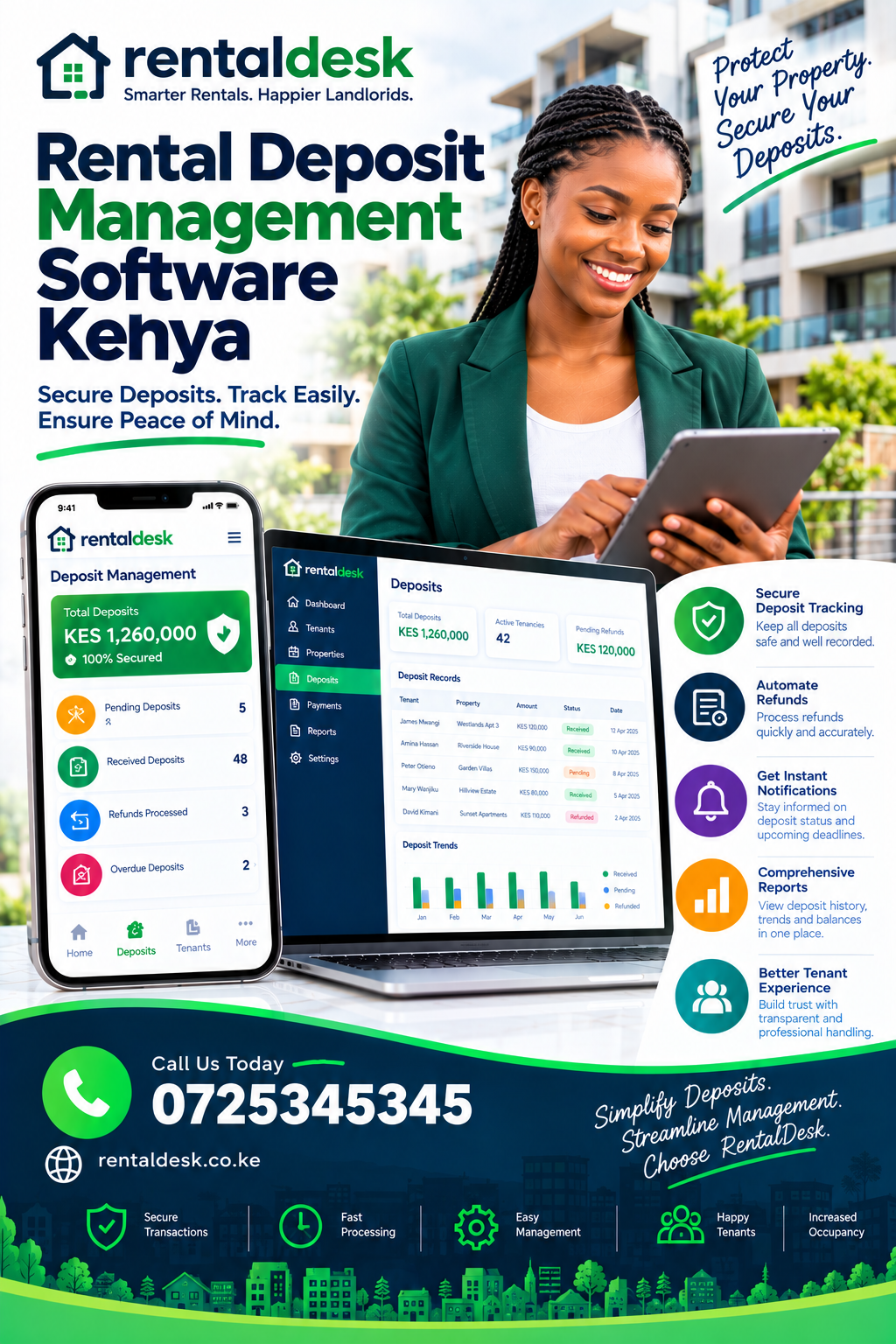
Rental Deposit Management Software Kenya: A Complete Guide for Landlords and Property Managers
Managing rental deposits can become complicated when landlords and property managers handle many tenants, properties, and transactions. Rental Deposit Management Software Kenya provides a structured way to record deposits, connect them to tenant accounts, track deposit balances, manage deductions, document refunds, and maintain accurate rental records. This guide explains what rental deposit management involves, why proper deposit records matter, the features landlords should look for, and how Kenyan property managers can use digital systems to make deposit administration more organized and transparent.
What Is a Rental Deposit?
A rental deposit is an amount paid by a tenant in connection with a tenancy arrangement. The terms governing the deposit, including its purpose, treatment, deductions, and refund, should be clearly established in the relevant tenancy agreement and handled in accordance with applicable requirements.
For landlords, deposits need to be recorded separately and accurately because they are connected to individual tenant accounts.
Rental Deposit Management Software Kenya can help organize this information by connecting each deposit to the relevant tenant, property, and unit.
A basic tenant record might contain:
- Tenant name
- Property name
- Unit number
- Monthly rent
- Deposit amount
- Deposit payment date
- Payment method
- Deposit balance
- Relevant deductions
- Refund information
- Tenancy status
Keeping these details together makes it easier to understand the financial position of each tenancy.
Why Rental Deposit Management Matters
Deposits can remain on a tenant account throughout a tenancy and may need to be reviewed when the tenancy ends.
Rental Deposit Management Software Kenya helps landlords maintain records throughout this lifecycle rather than waiting until move-out to reconstruct what happened.
Imagine a property manager handling 150 units. If deposit information is stored across notebooks, spreadsheets, receipts, bank statements, and WhatsApp conversations, determining the correct amount associated with a particular tenant can take considerable time.
A centralized system can make the process more manageable.
The manager should be able to answer questions such as:
- How much deposit did the tenant pay?
- When was it paid?
- Which unit does it relate to?
- Has any amount been deducted?
- Why was a deduction made?
- What amount remains?
- Has the deposit been refunded?
- When was the refund processed?
These questions become particularly important when tenants move out.
Problems With Manual Deposit Records
Manual records are not automatically wrong. A small landlord with one or two properties may successfully manage deposits using a spreadsheet or physical records.
The difficulty usually appears when the portfolio grows.
Rental Deposit Management Software Kenya can help reduce some of the administrative problems associated with fragmented records.
Common challenges include:
Lost or Incomplete Information
A receipt may be misplaced, or an old spreadsheet may not contain the latest update.
Incorrect Balances
A deposit amount may be entered incorrectly or a deduction may not be reflected.
Difficulty Tracking Multiple Tenants
When dozens of tenants have different deposit amounts, manual calculations become increasingly difficult.
Poor Move-Out Records
If the landlord did not document the original deposit correctly, determining the final amount can become complicated.
Delayed Refund Processing
A manager may need to search through several records before determining the amount to be returned.
Lack of Clear Audit Trails
It can be difficult to establish who entered or changed information when records are maintained manually.
A digital system can bring greater structure to the process.
How Rental Deposit Management Software Works
Rental Deposit Management Software Kenya is designed to organize deposit information within a broader rental-management system.
A typical process can begin when a new tenant is registered.
The manager enters the tenant’s information and records the agreed deposit. Once payment is received, the transaction is recorded against the tenant’s account.
Throughout the tenancy, the deposit remains visible as part of the tenant’s records.
When the tenant moves out, the property can be inspected and any legitimate deductions can be recorded according to the applicable agreement and requirements.
The system can then show:
Original deposit → Approved deductions → Remaining balance → Refund
This creates a clear trail from the initial payment to the final account settlement.
Recording Deposit Payments
Accurate recording begins when the deposit is received.
Rental Deposit Management Software Kenya can help property managers record deposit transactions against the correct tenant.
Useful details may include:
- Payment date
- Amount
- Tenant
- Property
- Unit
- Payment reference
- Payment method
- Transaction description
This information becomes valuable later when the tenancy ends.
For example, if a tenant disputes the amount originally paid, the landlord can refer to the recorded transaction rather than relying on memory.
Connecting Deposits With Tenant Accounts
A deposit should not exist as an isolated figure.
Rental Deposit Management Software Kenya can help connect deposit records with the tenant’s broader account.
The tenant account may include:
- Rent charges
- Rent payments
- Arrears
- Deposit
- Other applicable charges
- Credits
- Adjustments
- Refunds
This provides a more complete picture of the tenancy.
It also reduces the likelihood of confusing one tenant’s deposit with another’s, particularly in large apartment buildings.
Managing Deposits Across Multiple Properties
Property managers often handle several buildings at the same time.
Rental Deposit Management Software Kenya can help organize deposit information according to property and unit.
For example, a management company may have properties in Nairobi, Kiambu, Thika, Nakuru, or other areas.
Each building may have different:
- Unit numbers
- Tenants
- Rent amounts
- Deposit amounts
- Move-in dates
- Move-out dates
Centralizing the information makes it easier to manage the portfolio.
A manager can review a specific property without sorting through records belonging to other buildings.
Rental Deposit Tracking for Kenyan Landlords
Kenyan landlords deal with a wide variety of rental arrangements.
Residential properties can include bedsitters, studios, apartments, maisonettes, standalone houses, student accommodation, and other housing types.
Commercial properties may include shops, offices, warehouses, and business premises.
Rental Deposit Management Software Kenya can help property managers maintain records for different types of rental units, provided the system supports the required property structures.
The key is flexibility.
A landlord should be able to organize deposits according to the actual way the rental business operates.
Deposit Management and M-Pesa
Mobile money is an important part of Kenya’s payment environment.
Rental Deposit Management Software Kenya can be useful when landlords need to maintain organized records of deposits received through different payment channels.
The exact M-Pesa integration available will depend on the software provider.
Regardless of the payment method, the important principle is reconciliation.
If a tenant pays a deposit, the transaction should be matched to the correct tenant and property account.
For example:
| Transaction | Amount | Status |
|---|---|---|
| Required deposit | KSh 30,000 | Due |
| Payment received | KSh 30,000 | Paid |
| Deposit balance | KSh 30,000 | Recorded |
If only part of the deposit is paid, the outstanding amount should remain visible.
Managing Partial Deposit Payments
Tenants may sometimes make payments in installments where the tenancy arrangement allows it.
Rental Deposit Management Software Kenya can help managers distinguish between the required deposit and the amount already received.
Suppose the agreed deposit is KSh 40,000.
A tenant pays:
- KSh 20,000 initially
- KSh 10,000 later
- KSh 10,000 afterward
The system should make it clear that the full KSh 40,000 has eventually been received.
This is much easier to verify when every transaction is recorded.
Deposit Receipts
Documentation is an important part of financial administration.
Rental Deposit Management Software Kenya can work alongside receipt and payment-recording functions where these are provided by the platform.
A deposit receipt or transaction record should make it possible to identify:
- Who paid
- How much was paid
- When it was paid
- What the payment was for
- Which property or unit it relates to
Good documentation protects both the landlord and tenant from unnecessary confusion.
Managing Deposit Deductions
Deposit deductions can be one of the most sensitive parts of the move-out process.
Rental Deposit Management Software Kenya can help property managers record deductions in an organized manner.
A deduction might relate to a legitimate charge under the tenancy agreement or applicable rules.
The manager should document:
- Reason for deduction
- Amount deducted
- Supporting information
- Date
- Relevant property or unit
- Remaining deposit balance
The system should make the calculation visible.
For example:
Deposit received: KSh 50,000
Approved deduction: KSh 8,000
Remaining balance: KSh 42,000
Clear calculations reduce ambiguity.
Move-Out Inspection and Deposit Management
The move-out inspection is an important stage in the rental lifecycle.
Rental Deposit Management Software Kenya can help connect inspection information with tenant records where the platform supports maintenance or inspection functions.
Before finalizing a deposit account, the property manager may need to review:
- Condition of the property
- Outstanding rent
- Unresolved charges
- Damage or repair issues
- Utility-related matters
- Keys or access devices
- Other obligations under the tenancy agreement
The exact treatment of each item should follow the tenancy agreement and applicable Kenyan requirements.
Documenting Property Condition
Good documentation can make deposit administration easier.
Rental Deposit Management Software Kenya can form part of a wider property-management process that records information about the condition of rental units.
Property managers may use inspection reports, photographs, checklists, and maintenance records as appropriate.
The purpose is to establish a reliable record.
A documented move-in condition can later be compared with the condition at move-out.
This can help distinguish normal use from issues requiring attention, subject to the terms of the tenancy and applicable requirements.
Deposit Refund Management
When a tenancy ends and the final account is settled, the remaining deposit may need to be refunded according to the applicable agreement and requirements.
Rental Deposit Management Software Kenya can help managers record refund information.
A refund record can include:
- Tenant
- Property
- Original deposit
- Deductions
- Final balance
- Refund date
- Payment method
- Transaction reference
This creates a clear record that the account was reviewed and settled.
Why Accurate Refund Records Matter
Refunds can become a source of disputes when tenants and landlords have different records.
Rental Deposit Management Software Kenya can help managers maintain a consistent financial record.
Suppose a tenant paid a KSh 60,000 deposit.
At move-out:
- KSh 60,000 original deposit
- KSh 5,000 agreed deduction
- KSh 55,000 remaining
If KSh 55,000 is refunded, the account should clearly show the transaction.
This makes it easier to answer questions later.
Rental Deposits and Outstanding Rent
Sometimes a tenant may leave while owing rent.
Rental Deposit Management Software Kenya can help managers see the tenant’s wider financial account before final settlement.
However, landlords should not automatically assume that every outstanding amount can be deducted from a deposit. The correct treatment depends on the tenancy agreement, the nature of the amount, and applicable legal requirements.
A good software system should therefore support documentation rather than encourage arbitrary deductions.
Handling Multiple Deposit Records
A property manager may have hundreds of deposit transactions.
Rental Deposit Management Software Kenya can make it easier to search and review records according to tenant, property, unit, date, or transaction.
This is particularly useful during audits or when responding to tenant inquiries.
Instead of searching through physical files, the manager can retrieve the relevant digital account.
Deposit Management Reports
Reports can provide a high-level view of deposit-related information.
Rental Deposit Management Software Kenya can support reporting functions where these are included in the platform.
Useful reports may include:
- Total deposits recorded
- Deposits by property
- Deposits by tenant
- Recent deposits
- Pending deposit balances
- Refunds processed
- Deductions recorded
- Outstanding tenant accounts
These reports can help property managers monitor the financial side of their portfolios.
Benefits for Property Management Companies
Professional property managers often manage deposits on behalf of property owners.
Rental Deposit Management Software Kenya can help organize records that need to be reported to owners.
A property owner may want to know:
- How many tenants occupy the property?
- How much deposit has been received?
- Which tenants have moved out?
- Which refunds have been processed?
- What deductions were recorded?
- Are there unresolved accounts?
Centralized records make these questions easier to answer.
Benefits for Individual Landlords
Individual landlords can also benefit from structured deposit management.
Rental Deposit Management Software Kenya can reduce the need to manually calculate tenant deposit balances.
Even a landlord with five units may have different:
- Deposit amounts
- Tenancy dates
- Payment histories
- Move-out dates
- Deductions
- Refund dates
A digital record keeps these details organized.
Managing Deposit Information During Tenant Turnover
Tenant turnover creates administrative work.
A tenant leaves, another tenant is selected, and the property may need inspection, cleaning, repairs, and preparation.
Rental Deposit Management Software Kenya can help property managers maintain a record of the outgoing tenant’s final account while setting up the incoming tenant’s information.
This creates a clear separation between two tenancies.
The outgoing tenant’s deposit account can be closed after final settlement, while the new tenant’s deposit can be recorded independently.
Improving Financial Accuracy
Financial errors can damage trust.
Rental Deposit Management Software Kenya can help reduce manual calculations by keeping transaction records in one place.
For example, a property manager should not have to calculate the same tenant’s deposit balance repeatedly using different spreadsheets.
A centralized account can show the transaction history and current balance.
This is particularly valuable when several staff members are involved.
User Permissions and Access Control
Not every staff member should necessarily be able to modify financial information.
Rental Deposit Management Software Kenya should be evaluated for user permissions and access controls.
A rental-management company might have:
- Property managers
- Accountants
- Leasing agents
- Maintenance staff
- Administrators
- Senior management
Each role may require different levels of access.
Financial records should be protected from unauthorized changes.
Data Security
Rental systems contain information about tenants and properties.
Rental Deposit Management Software Kenya should therefore be evaluated for security features such as account controls, backups, permissions, and secure access.
Landlords should also establish internal policies covering who can access tenant financial information.
Good software security works together with good organizational practices.
Deposit Management and Accounting
Rental deposits are connected to the financial administration of a property business.
Rental Deposit Management Software Kenya can support the organization of deposit information alongside other rental transactions.
However, landlords should distinguish between rental income, tenant deposits, expenses, and other financial categories according to appropriate accounting practices.
Where accounting treatment is complex, professional accounting advice may be appropriate.
The software should support accurate records rather than replace professional judgment.
Managing Deposits Across Large Portfolios
Large portfolios create additional administrative challenges.
Rental Deposit Management Software Kenya can help property managers organize deposit information across multiple buildings and units.
A manager may need to quickly identify all tenants who:
- Recently paid deposits
- Are approaching move-out
- Have completed move-out
- Are awaiting final settlement
- Have received refunds
This type of visibility becomes harder when records are scattered.
Using Dashboards for Better Visibility
A dashboard can give managers a quick overview of important information.
Rental Deposit Management Software Kenya may provide dashboards that summarize tenant accounts and deposit information, depending on the features of the selected platform.
A dashboard could potentially show:
Total deposits recorded
Deposits by property
Pending settlements
Recent refunds
Outstanding tenant balances
The purpose is to reduce the amount of time spent searching for information.
Rental Deposit Management and Tenant Experience
Deposit administration affects the tenant experience.
Rental Deposit Management Software Kenya can help landlords maintain clearer records, which can support more professional communication.
When tenants ask questions about their deposit, the manager should be able to provide accurate information.
For example:
“Your recorded deposit was KSh 40,000. A documented deduction of KSh 3,000 was applied, leaving KSh 37,000.”
Clear records are more useful than vague explanations.
Preventing Deposit Disputes
No software can eliminate every disagreement between landlords and tenants.
However, Rental Deposit Management Software Kenya can help create better documentation.
Useful practices include:
- Recording the original deposit
- Issuing payment documentation
- Maintaining tenant account records
- Conducting property inspections
- Recording relevant maintenance issues
- Documenting deductions
- Recording refunds
- Keeping communication records
These steps make the process easier to understand.
Standardizing Deposit Processes
Property managers often benefit from having the same procedure for every tenant.
Rental Deposit Management Software Kenya can help standardize the administrative workflow.
A basic process could be:
- Register tenant.
- Record agreed deposit.
- Receive payment.
- Reconcile payment.
- Maintain deposit balance.
- Record tenancy changes.
- Schedule move-out inspection.
- Review final account.
- Record legitimate deductions.
- Calculate remaining balance.
- Process refund where applicable.
- Close the account.
Standardization reduces inconsistency.
Why Spreadsheets Become Difficult as Portfolios Grow
A spreadsheet may initially appear sufficient.
Rental Deposit Management Software Kenya becomes more valuable when landlords need to manage many connected records rather than isolated figures.
Imagine a spreadsheet with 300 tenants.
Each tenant has:
- Rent
- Deposit
- Payment history
- Arrears
- Property
- Unit
- Tenancy dates
- Move-out information
As the number of columns and formulas increases, the risk of accidental changes and inconsistent records also increases.
Dedicated rental software is designed around these types of relationships.
Rental Deposit Management for Nairobi Properties
Nairobi’s rental market contains a wide range of residential and commercial properties.
Rental Deposit Management Software Kenya can help property managers organize deposit records across different buildings and unit types.
A manager handling apartments in areas such as Westlands, Kilimani, Kasarani, Embakasi, Ruaka, or other parts of the wider Nairobi metropolitan area may need to manage numerous tenants with different tenancy timelines.
Centralized records can make portfolio administration more manageable.
Supporting Property Managers Outside Nairobi
Rental businesses operate throughout Kenya.
Rental Deposit Management Software Kenya can be useful for property managers handling properties in towns and cities outside Nairobi as well.
Whether a landlord has properties in Mombasa, Kisumu, Nakuru, Kiambu, Machakos, Thika, or another location, the fundamental need remains similar: accurate tenant and financial records.
The software should be selected according to the actual portfolio and operational requirements.
Common Rental Deposit Management Mistakes
Technology works best when paired with good management practices.
Rental Deposit Management Software Kenya can help organize information, but landlords still need clear procedures.
Mistake 1: Not Recording the Original Deposit
If the original amount is unclear, final settlement becomes difficult.
Mistake 2: Mixing Deposits With Other Transactions
Deposit records should be clearly identified.
Mistake 3: Failing to Document Deductions
A deduction should have a clear reason and supporting information.
Mistake 4: Poor Move-In Records
Without a record of the property’s initial condition, move-out assessments can become harder.
Mistake 5: Delaying Account Reconciliation
Tenant accounts should be reviewed regularly.
Mistake 6: Giving Staff Uncontrolled Access
Financial information should be protected.
Mistake 7: Relying on Memory
Important deposit information should be documented rather than remembered.
How to Choose Rental Deposit Software
Selecting software requires consideration of the entire rental operation.
Rental Deposit Management Software Kenya should be evaluated based on practical needs rather than the number of features advertised.
Ask whether the system can:
- Create tenant accounts
- Record deposits
- Track payment history
- Handle partial payments
- Record deductions
- Manage refunds
- Generate reports
- Manage multiple properties
- Provide user permissions
- Support rent collection
- Support invoicing
- Maintain property records
A platform that connects these functions can be more useful than a system that manages deposits in isolation.
Questions to Ask a Software Provider
Before purchasing or subscribing to a rental-management system, ask practical questions.
Rental Deposit Management Software Kenya should fit the way your business operates.
Consider asking:
- Can I record individual tenant deposits?
- Can I track partial deposit payments?
- Can I connect deposits to specific units?
- Can I record deductions?
- Can I document deposit refunds?
- Can I generate deposit reports?
- Can multiple properties be managed?
- Can different staff members have different permissions?
- Does the platform support M-Pesa-related workflows?
- Can deposit information connect with rent records?
- Is the system accessible remotely?
- What support is provided?
The answers can help determine whether the platform is appropriate.
Rental Deposits and Property Inspections
Inspections provide important context during tenant turnover.
Rental Deposit Management Software Kenya can complement inspection and maintenance workflows where the software provides these capabilities.
An inspection can identify issues that need attention before a property is handed over to another tenant.
The manager can then distinguish between:
- Routine maintenance
- Repairs
- Tenant-related issues
- Existing problems
- New problems
The exact financial treatment should follow the tenancy agreement and applicable requirements.
The Importance of Consistent Documentation
Documentation is one of the strongest tools available to a property manager.
Rental Deposit Management Software Kenya can help maintain a consistent record throughout the tenancy.
A complete tenant history can show:
Move-in → Deposit payment → Rent payments → Maintenance → Move-out inspection → Deductions → Final settlement
This gives managers a timeline instead of isolated transactions.
Improving Property Management Efficiency
Rental management involves many administrative tasks.
Rental Deposit Management Software Kenya can help reduce the amount of manual work involved in maintaining deposit records.
Instead of checking separate files, a manager can access a tenant’s account and review the relevant information.
The result can be a more organized workflow.
Why Centralized Rental Records Matter
Centralization is especially useful when multiple employees manage the same portfolio.
Rental Deposit Management Software Kenya allows managers to work from a common source of information where the platform supports multi-user access.
For example, an accountant can update payment information while a property manager reviews tenant accounts.
The exact permissions should be configured according to each employee’s role.
Deposit Management and Property Owner Reporting
Owners often want clear financial information about their properties.
Rental Deposit Management Software Kenya can help managers prepare organized reports where reporting features are available.
An owner may want information about:
- Total tenant deposits
- Deposits received during a period
- Refunds processed
- Pending settlements
- Deductions
- Property-level figures
Good reporting makes property management more transparent.
Scaling Rental Operations
A landlord may begin with a few units and gradually expand.
Rental Deposit Management Software Kenya can provide a scalable way to organize rental information as the portfolio grows, depending on the system’s capacity.
The earlier a landlord establishes consistent records, the easier it can be to maintain them as the business becomes larger.
The Relationship Between Deposits and Tenant Management
Deposit management should be connected to the tenant lifecycle.
Rental Deposit Management Software Kenya can form part of a broader rental-management process.
The tenant lifecycle may look like:
Inquiry → Application → Approval → Move-in → Rent collection → Maintenance → Move-out → Final account → Deposit settlement
This is why a dedicated rental-management system can be more effective than a standalone spreadsheet.
Frequently Asked Questions
What is Rental Deposit Management Software Kenya?
Rental Deposit Management Software Kenya is a digital solution designed to help landlords and property managers record tenant deposits, track balances, manage deductions, document refunds, and organize related rental financial information.
Why is rental deposit management important?
Rental Deposit Management Software Kenya helps landlords maintain accurate records of money received from tenants and the transactions associated with those accounts. Good records can reduce confusion during tenancy and move-out.
Can rental software track deposit payments?
Yes. Rental Deposit Management Software Kenya can support deposit-payment tracking where the selected platform provides the relevant functionality.
Can I manage deposits for multiple properties?
Many rental-management systems are designed for multiple properties and units. Rental Deposit Management Software Kenya can help centralize records across a portfolio, depending on the platform’s capabilities.
Can rental software manage partial deposit payments?
Where supported, Rental Deposit Management Software Kenya can help managers record multiple payments against a required deposit and identify the remaining amount.
Can deposit deductions be recorded?
Yes, where the platform provides deduction functionality. Rental Deposit Management Software Kenya can help maintain a record of deductions, their amounts, and the remaining tenant balance.
Can rental software manage deposit refunds?
A rental-management platform may provide refund-recording functionality. Rental Deposit Management Software Kenya can help document refund amounts, dates, and transaction details where those features are available.
Can rental deposit software work with M-Pesa?
Some platforms support M-Pesa-related payment workflows or integrations. Rental Deposit Management Software Kenya should be evaluated based on the specific integrations offered by the provider.
Is rental deposit software useful for small landlords?
Yes. Rental Deposit Management Software Kenya can help small landlords organize tenant deposit information even when they manage only a few properties.
What should landlords consider before choosing software?
Landlords should consider deposit tracking, tenant accounts, payment reconciliation, deductions, refunds, reporting, property management, user permissions, security, ease of use, and support. Rental Deposit Management Software Kenya should fit the actual requirements of the rental business.
Conclusion
Rental deposits are an important part of tenancy administration, and poor record keeping can create unnecessary confusion for both landlords and tenants. From the initial deposit payment to the final move-out settlement, every transaction should be documented accurately.
Rental Deposit Management Software Kenya gives landlords and property managers a structured way to organize deposit information, tenant accounts, payments, deductions, refunds, and related records.
The value of a digital system goes beyond simply storing a deposit amount. A good rental-management process connects the deposit with the tenant, property, unit, payment history, inspection records, and final account settlement.
Rental Deposit Management Software Kenya can also help property managers handle larger portfolios where manual records become increasingly difficult to maintain.
For Kenyan landlords, payment reconciliation is another important consideration. Since tenants may use different payment methods, managers need a reliable way to connect payments with the correct tenant accounts.
Rental Deposit Management Software Kenya can form part of a broader property-management workflow that includes rent collection, tenant management, maintenance, invoicing, reporting, and vacancy management.
The most effective approach is to establish a consistent process from the beginning of every tenancy. Record the agreed deposit, confirm payment, maintain accurate account information, document relevant property conditions, record legitimate deductions, and complete the final settlement carefully.
Rental Deposit Management Software Kenya can make this process more organized by reducing reliance on scattered spreadsheets, notebooks, messages, and manually calculated balances.
For landlords and professional property managers, the practical objective is straightforward: know how much was received, know which tenant it belongs to, maintain a clear record throughout the tenancy, and ensure that the final account is properly documented.
Rental Deposit Management Software Kenya can help make that objective easier to achieve while giving rental businesses better visibility over their financial and tenant records.