
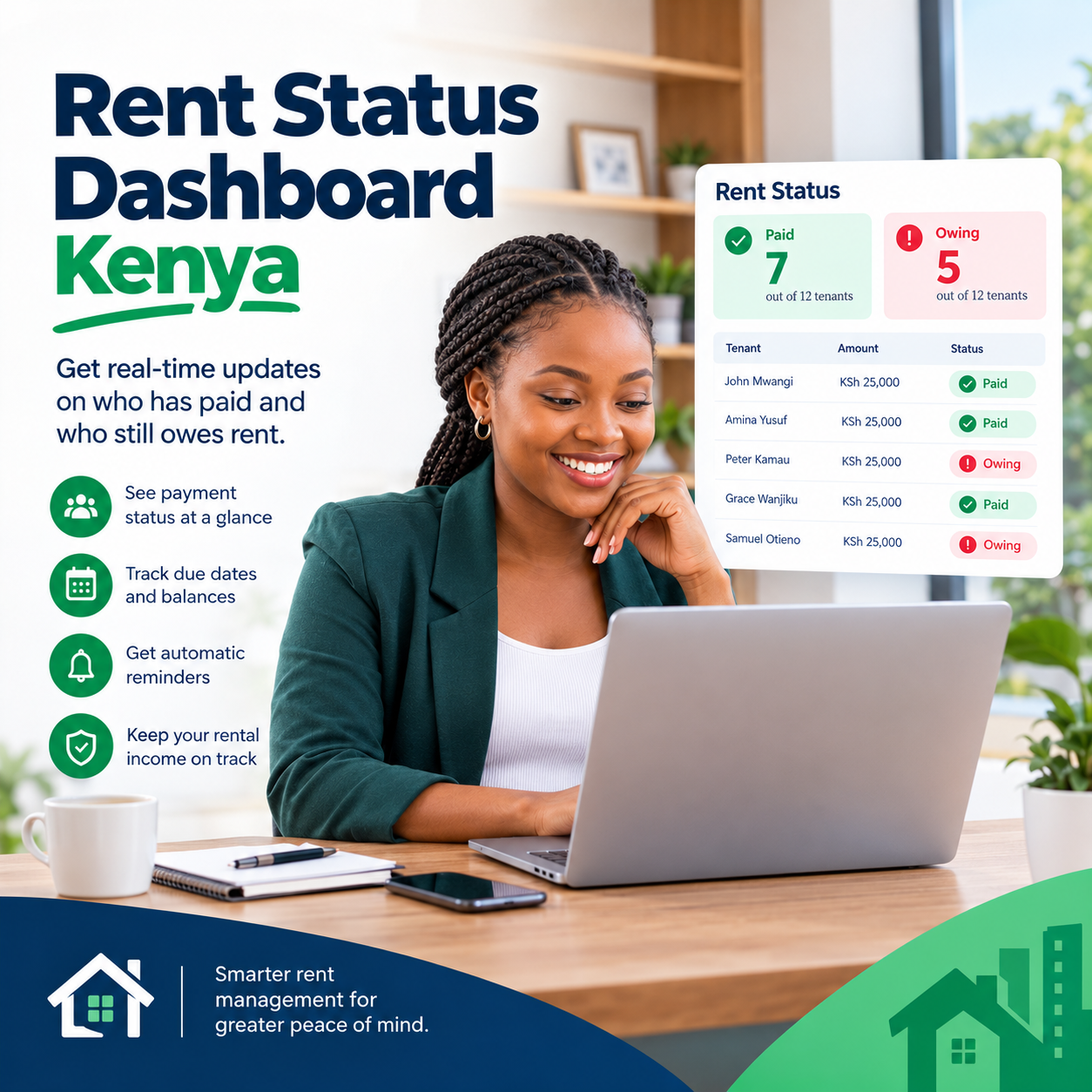
Rent status dashboard Kenya is the phrase capturing the biggest shift in how landlords see their business — the move from scattered notebooks and monthly surprises to one live screen showing every unit, every balance, and every payment as it happens.
Where owners once pieced together their position from caretaker texts and bank alerts, the modern dashboard answers everything at a glance: who has paid, who owes, what is vacant, and what needs attention today.
That single-screen clarity is why demand for a rent status dashboard Kenya keeps rising every month.
The shift matters because visibility is the landlord’s real product.
Rent you cannot see is rent you cannot chase, plan around, or protect, and most income problems begin as simple blindness.
A purpose-built rent status dashboard Kenya ends that blindness permanently, turning your entire portfolio into numbers you can read in two minutes.
This guide walks you through the complete picture in 2026.
We cover what a rent status dashboard actually shows, the two-minute reading routine that makes it powerful, and the metrics every good dashboard must display.
We also cover how to build one — from notebook to spreadsheet to full software — and the features worth demanding before you commit.
By the end, you will be able to choose, build, and run a rent status dashboard Kenya that fits your portfolio exactly.
Whether you own four units in Rongai or forty across the city, the principle never changes.
Income you can see on one screen is income you can manage from anywhere — the everyday promise of a well-built rent status dashboard Kenya.
The timing could not be better, because the pieces have finally converged.
M-Pesa digitized the payments, platforms digitized the records, and dashboards now assemble themselves from data you are already generating.
Everything needed to run a professional rent status dashboard Kenya is affordable, local, and proven — this guide simply shows you how to put it together.
What Is a Rent Status Dashboard?
A rent status dashboard Kenya is a single, continuously updated view that displays the payment status of every unit in your portfolio.
It answers, at a glance, the four questions that define rental income: who has paid, who owes, what is vacant, and what needs action today.
Think of it as the control room of your rental business, with every unit represented and every number current.
The dashboard is distinct from the reports and documents covered across our other guides.
Statements explain one tenant’s account, daily reports narrate one day’s collections, and invoices demand one month’s payment.
The rent status dashboard Kenya is the layer above them all — the summary view where every unit’s position lives simultaneously.
Its power comes from aggregation
Individual records tell you about one tenant, while the dashboard tells you about the portfolio, the month, and the trend all at once.
That aggregated perspective is what makes a rent status dashboard Kenya genuinely strategic rather than merely convenient.
Consider what one glance can now accomplish.
You can see the tenant in Unit 3 who paid on the second, the tenant in Unit 7 who is five days late, and the unit at the back that has been empty since January.
Each of those is a separate problem, yet the rent status dashboard Kenya presents all three as one readable picture.
What it is not matters just as much.
It is not a bookkeeping system, not a lease manager, and not a replacement for records underneath it.
A rent status dashboard Kenya is only ever as honest as the data feeding it — which is why the build section of this guide matters so much.
The best dashboards also live where you live: on your phone.
Kenyan landlords check their screens between errands, during commutes, and across time zones, so mobile-first design is the practical standard.
That pocketability is the defining experience of a modern rent status dashboard Kenya.
Why a Dashboard Beats Every Other Way of Knowing
The traditional way of knowing rent status was conversation.
You asked a caretaker, waited for a summary, and hoped the numbers were complete — a system built on trust and missing exactly the entries that matter.
A rent status dashboard Kenya replaces that chain with direct, independent sight of every account.
The problems with the conversational method compound quietly.
Summaries arrive rounded, memories bend toward the convenient version, and the units nobody asks about are the ones that drift.
Each of those gaps is invisible individually and expensive collectively — which is the case for a rent status dashboard Kenya built on records instead of reports.
The comparison becomes sharper at scale.
Below five units, memory can roughly hold the register; above ten, it cannot, and the gaps grow precisely as the stakes do.
The threshold where owners typically adopt a rent status dashboard Kenya is the threshold where the register outgrows the mind.
Dashboards also change the speed of knowing.
Problems surface in days instead of month-end discoveries, and a unit that stops paying becomes visible while a friendly message still fixes it.
That compressed reaction time is the compounding advantage of running a rent status dashboard Kenya daily.
Speed also changes the nature of every conversation you have.
A tenant contacted on day five receives a reminder; a tenant contacted on day thirty-five receives a confrontation.
Timing like that is the human dividend of checking a rent status dashboard Kenya each morning.
Finally, dashboards change the feeling of ownership.
Anxiety comes from uncertainty, and certainty — even when the news is imperfect — restores calm and better decisions.
Owners consistently describe their rent status dashboard Kenya as the moment property stopped feeling like a worry and started feeling like a business.
The Core Metrics: What Every Dashboard Must Show
Not all dashboards deserve your attention, so know exactly which metrics separate the useful from the decorative.
The best rent status dashboard Kenya designs share a clear set of core displays, and this section is your checklist.
Demand every one of them before you commit.
The paid-versus-outstanding split comes first.
Every unit should appear as paid, partial, or unpaid for the current period, with color coding that reads in seconds. That tri-state view is the heartbeat of any rent status dashboard Kenya.
The month-to-date collection figure belongs beside it.
Collected so far, expected for the month, and the percentage between them — three numbers that summarize your income health instantly. Context of that kind is what elevates a rent status dashboard Kenya from a list into an instrument.
The arrears view must be live and ranked.
Who owes, how much, and for how long, sorted so the oldest and largest balances lead the list. A dashboard without a ranked arrears view is only half a dashboard — the full picture defines a complete rent status dashboard Kenya.
Vacancy status completes the portfolio layer.
Every empty unit should appear with its days-empty count and daily cost, because unoccupied units are income problems wearing a different name. Portfolio-wide truth like that is the signature of a professional rent status dashboard Kenya.
Trends close the core set.
This month against last month, and this month against the same month last year, so improvement or erosion is visible rather than felt. Trend lines are the strategic layer that turns a rent status dashboard Kenya into a decision-making tool.
Expected collections for the coming weeks complete the forward view.
Leases approaching renewal, notices received, and units under notice should all appear ahead of their impact. A forward-looking rent status dashboard Kenya lets you manage the month before it arrives instead of reacting to it after.
The Two-Minute Reading Routine
A dashboard only delivers when someone actually reads it, and the reading works best as a tiny daily ritual.
Two minutes each morning replaces the low-grade anxiety of not knowing, and it survives even your busiest weeks. Here is the routine that turns a rent status dashboard Kenya into a working habit.
Read the three headline numbers first.
Collected this month, outstanding now, and units vacant — together they summarize everything. That opening glance is the core of the daily rent status dashboard Kenya ritual.
Scan the color grid second.
Red units demand today’s attention, amber units are entering your window, and green units need nothing at all. Color-first reading is the fastest way a rent status dashboard Kenya turns into action.
Act on anything that surfaced
A courteous message to one red unit takes a minute today and prevents a difficult conversation in three weeks. Responding promptly is the entire deal — the discipline that makes a rent status dashboard Kenya pay for itself every single month.
The routine compounds over weeks.
Months of daily checks build an intuitive feel for your portfolio’s rhythm that no annual report can teach. That pattern sense is the hidden skill developed by every disciplined rent status dashboard Kenya user.
Building Yours: Three Levels
You do not need to buy anything to begin, and this section gives you the build path at every level.
Each level trades effort for automation, and the honest rule is to start where you are and upgrade only when the method strains. Every rent status dashboard Kenya in the country, however sophisticated, rests on the same foundations below.
Level one is the paper board.
A page listing every unit, updated by hand with paid, partial, or unpaid, is a genuine dashboard for a small portfolio. Discipline makes even the humblest rent status dashboard Kenya equivalent work — the tool matters less than the daily habit.
Give the paper board its own simple structure. List units down the side, months across the top, and mark each cell paid, partial, or unpaid as money moves. A board kept that way can honestly serve as your rent status dashboard Kenya for a portfolio of five or six units.
Level two is the spreadsheet.
One row per unit, columns for rent due, amount paid, balance, and status, with the summary computing itself at the top. For portfolios up to twenty units, a well-built sheet is the most practical rent status dashboard Kenya available at zero cost.
The spreadsheet’s advantages compound with small formulas. A balance column that subtracts itself, a status dropdown you can filter, and a totals row that never miscounts make the sheet self-maintaining. Those small automations are what let a spreadsheet rent status dashboard Kenya stay accurate through an entire year of entries.
Level three is the platform.
Software reconciles M-Pesa payments automatically, updates the board in real time, and pushes alerts without you opening anything. At that level, the rent status dashboard Kenya maintains itself — and your role shifts from record-keeper to decision-maker.
The upgrade from sheet to platform follows a predictable trigger. When manual entry starts eating real evenings, or when a single missed entry costs a disputed month, the subscription has earned itself.That threshold — not the sales page — is the correct moment to move your rent status dashboard Kenya onto a full platform.
Connecting the Dashboard to Payment Reality
A dashboard is only as honest as the payments feeding it, so the connection to real money deserves its own attention. The gold standard is automatic M-Pesa reconciliation, where each payment matches itself to the right unit the moment it lands.
That live link is the technical heart of a trustworthy rent status dashboard Kenya. Reconciliation works even better when it closes the loop. Payments that arrive should generate receipts automatically, and receipts should reflect on the dashboard within minutes.
That closed circuit is what makes a rent status dashboard Kenya continuously credible to you and your tenants alike. Cash entries deserve an equally honest protocol. Where cash is unavoidable, it should be logged same-day with amounts and references, marked clearly for verification.
Honest cash handling is what keeps the green, amber, and red on your rent status dashboard Kenya truthful. Reconciliation closes the loop monthly. Compare the dashboard’s figures against your statements until everything agrees, and investigate any gap the same week.
That habit is the hygiene that keeps a rent status dashboard Kenya permanently credible.
Multi-Property Dashboards
At portfolio scale, the dashboard transforms from convenience into command cener.
Every building rolls up into the same view, with drill-down to any unit in two taps.
That consolidated reach is what defines a rent status dashboard Kenya at scale.
Comparison arrives with the roll-up.
Which building collects fastest, which lags, and which units drag the averages — the answers drive pricing and management decisions.
Cross-property insight is the analytical gift of a rent status dashboard Kenya running across several buildings.
The roll-up also serves managing agents directly.
Per-owner dashboards, generated automatically, replace fragile spreadsheets and anxious client calls.
Client trust compounds on the transparency a rent status dashboard Kenya delivers every single day.
Family and group ownership benefit from the same structure.
Co-owners watching one shared board argue less and decide faster, because everyone reads the same numbers.
Shared sight like that is the partnership dividend of a rent status dashboard Kenya held in common.
Features to Demand in 2026
The market is growing quickly, so evaluate against a demanding checklist.
First, demand real-time M-Pesa reconciliation, because a dashboard that updates itself beats one you must update.
That automation is the baseline of any serious rent status dashboard Kenya.
Second, expect the full metric set — tri-state status, month-to-date figures, ranked arrears, vacancy view, and trends.
Third, confirm mobile-first design that works on affordable phones and weak networks.
Those capabilities together define a professional rent status dashboard Kenya worth your subscription.
Fourth, look for alerts that find you.
SMS, WhatsApp, or push notifications should surface red units and unusual activity without you opening anything.
A rent status dashboard Kenya that comes to you is worth ten that wait to be checked.
Fifth, verify export and data ownership, because your records must always be portable.
Sixth, check that drill-down works — every headline number should open into the details behind it.
Transparency from summary to source is the mark of a genuinely professional rent status dashboard Kenya.
Choosing Your Platform
Selection starts from your realities rather than the loudest advert.
Portfolio size, payment mix, and where your current blindness hurts most should shape the choice.
The right rent status dashboard Kenya fits your operation exactly.
Trial with real data, without exception.
Load your actual units and run one full month through the dashboard — real payments, real gaps, real alerts.
One honest cycle reveals more than any demonstration of a rent status dashboard Kenya ever will.
Test the reading experience deliberately too.
Ask whether you can understand your portfolio in two minutes on your actual phone, on your actual network, at the hour you would actually check.
That real-world test is the fairest evaluation any rent status dashboard Kenya can receive.
What It Costs in 2026
The price ladder remains the friendliest part of the subject.
Notebooks cost hundreds of shillings, spreadsheets cost nothing, and free platform tiers cover small portfolios completely.
Any serious rent status dashboard Kenya can therefore begin today at effectively zero cost.
Paid software arrives only when automation earns it.
Plans across the market run from free tiers to roughly KSh 3,500 monthly depending on portfolio size, with annual billing typically trimming the rate.
Against one recovered arrears month, any tool that powers your rent status dashboard Kenya repays itself within the first cycle.
Weigh the price against the full value stack honestly.
Earlier problem detection, fewer disputes, better decisions, and reclaimed evenings all flow from the same screen.
Viewed that way, the true cost of a good rent status dashboard Kenya approaches zero — and the cost of blindness keeps rising every month you delay.
Common Mistakes to Avoid
The most common mistake is building a dashboard and not reading it.
A screen that opens weekly provides a fraction of its value, because the advantage lives in daily sight.
The two-minute ritual is the entire deal in running a rent status dashboard Kenya well.
The second mistake is feeding it unverified data.Guessed balances and unconfirmed cash entries poison every color on the board, and the dashboard then lies with confidence.
Truth-first setup is the foundational rule for anyone building a rent status dashboard Kenya from an imperfect past.
The third mistake is ignoring the alerts.
The system flags, but a human must respond — technology supports judgment, it never replaces it.
Active owners extract the full value of a rent status dashboard Kenya; passive ones get half.
Real Scenarios from Real Landlords
Picture a landlord in Nakuru with fifteen units whose status once lived in a caretaker’s memory.
Her dashboard revealed two units marked occupied that had quietly emptied weeks earlier, and both were re-let within the month.
The recovered income paid for years of her rent status dashboard Kenya subscription.
Picture a diaspora owner in Birmingham whose Kitengela block once ran on monthly verbal summaries.
His dashboard now updates in real time, and the numbers on his screen match the ground for the first time in years.
Confidence at that distance is the everyday export of a rent status dashboard Kenya run properly.
Picture a caretaker in Embakasi coordinating collections for an absentee owner.
The shared board tells him exactly which units need follow-up, and his reliability is now provable rather than presumed.
Clear shared sight is the human dividend of a rent status dashboard Kenya adopted respectfully.
Picture a young landlord in Kasarani with six bedsitters and a spreadsheet that finally strained.
She moved to a platform when a single missed entry cost her a disputed month, and the subscription paid for itself that same cycle.
Her story is the standard upgrade path behind every rent status dashboard Kenya in serious use today.
The Road Ahead: 2027 and Beyond
The trajectory points toward dashboards that increasingly act on what they show.
Prediction is arriving — systems learning each unit’s pattern and flagging likely shortfalls before due dates.
The rent status dashboard Kenya of 2027 will feel less like a screen and more like an analyst.
Integration is deepening alongside it.
Dashboards, reminders, one-tap payments, and statements are converging into single flows where seeing and doing live together.
The connected future is already visible across the rent status dashboard Kenya market, and it will accelerate.
Frequently Asked Questions
What is a rent status dashboard, in simple terms?
It is one continuously updated screen showing every unit’s payment status — paid, partial, or unpaid — alongside arrears, vacancies, and month-to-date totals.Think of it as the control room of your rental business, readable in two minutes.That single-view role defines a genuine rent status dashboard Kenya.
Do I need special software, or can I build one myself?
You can absolutely start free — a disciplined spreadsheet with one row per unit and a computing summary is a genuine dashboard for portfolios up to about twenty units.Software earns its place when you want automatic M-Pesa updates, alerts, and zero manual entry. That three-level path is the standard journey behind every professional rent status dashboard Kenya.
How often should I check my dashboard?
Daily is ideal during the first week of the month when payments arrive or fail to, and two to three times weekly is acceptable for the rest of the cycle.The ritual takes two minutes, and consistency — not intensity — is what creates the advantage.That habit is what turns a rent status dashboard Kenya into a compounding asset.
Can one dashboard cover several buildings and even different owners?
Yes — portfolio dashboards roll every property into one view with drill-down to any unit, and per-owner views serve managing agents and family co-owners alike.
Consolidated truth across buildings is one of the strongest arguments for a professional rent status dashboard Kenya.
How do I keep the dashboard accurate?
Automatic M-Pesa reconciliation where possible, same-day logging of cash with references, and a monthly reconciliation against your statements.
A dashboard inherits the honesty of its inputs, so truth-first setup matters more than any feature.
That discipline is the maintenance behind every trustworthy rent status dashboard Kenya.
What is the single most important metric on the dashboard?
The tri-state status view — every unit marked paid, partial, or unpaid — because it converts your whole portfolio into one readable picture.
Everything else, from arrears rankings to trends, hangs beneath that headline.
Any rent status dashboard Kenya that buries it is working against you.
Where should I start if I want everything in one place?
Start with a platform that combines verified listings with a live rent dashboard, such as rentaldesk.co.ke.
Pairing the right tenants with a disciplined rent status dashboard Kenya takes you from wondering about your income to seeing it — every unit, every month, from anywhere.