
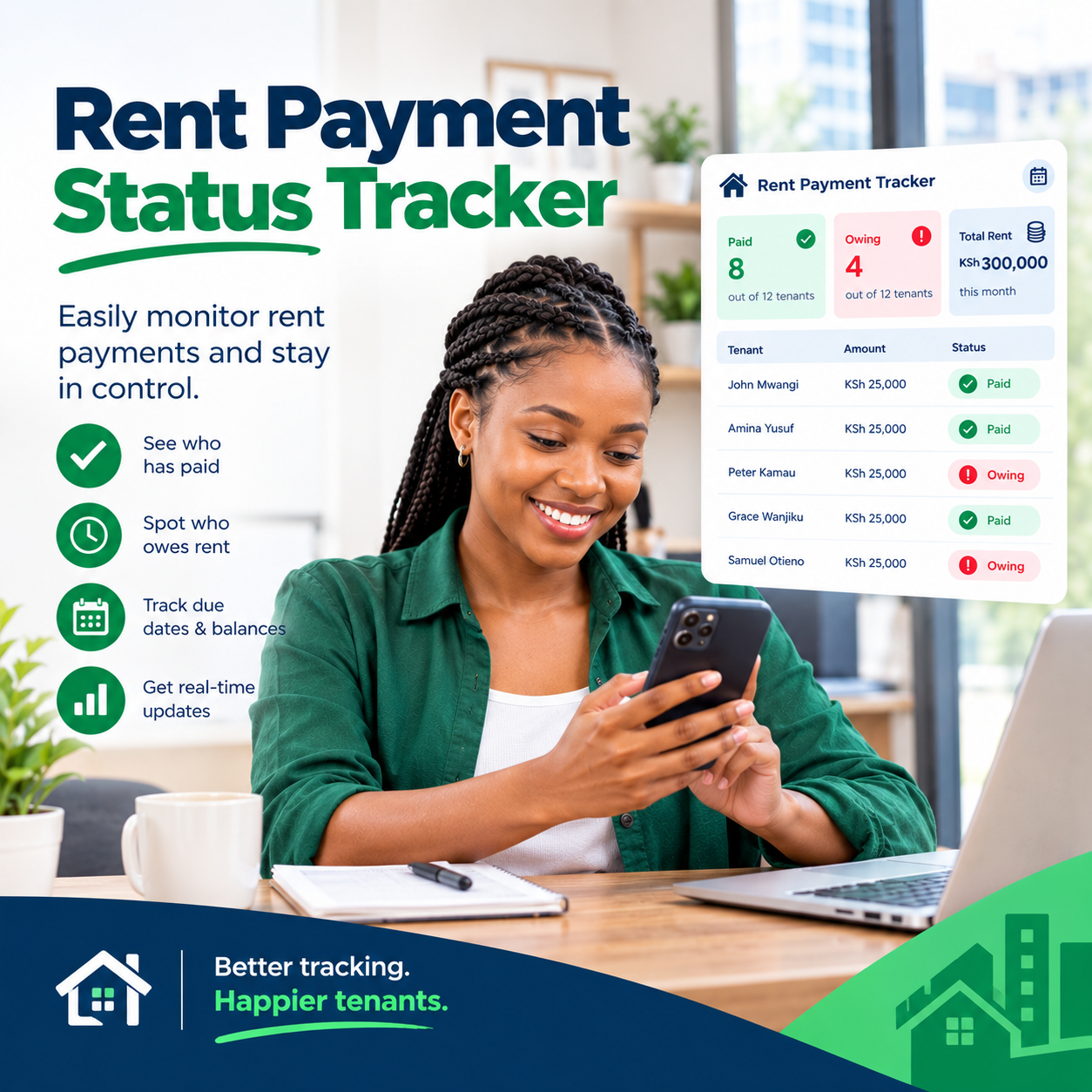
A rent payment status tracker is the tool that follows every rent payment through its complete life — from the moment it falls due, through partial payments and confirmations, to the day it is receipted, reconciled, and finally closed. Most landlords collapse that journey into two states, paid or unpaid, and the collapses are where disputes quietly begin. Tracking every stage end to end is what turns rent from a monthly guessing game into a process you can prove.
The idea sounds simple because it is. Every rent month has a status, every payment has a trail, and every tenant deserves to know exactly where they stand at any moment. A rent payment status tracker makes all three true automatically, updating itself as money moves.
This guide walks you through the complete picture in 2026. We cover the five statuses every payment passes through, why granularity between them matters, and the two-minute board that displays them all. We also cover real-time M-Pesa transitions, tenant-shared visibility, dispute handling, and the features worth demanding before you spend a shilling.
By the end, you will be able to choose and run a rent payment status tracker that fits your portfolio exactly. Whether you collect from four bedsitters in Rongai or forty apartments across Nairobi, the principle never changes. A payment whose status you can see is a payment you never have to argue about — the everyday promise of a well-run rent payment status tracker.
The timing matters, because the pieces have finally converged. M-Pesa digitized the payments, platforms digitized the records, and status updates now happen the moment money lands rather than when someone gets around to it. Everything needed to run a professional rent payment status tracker is affordable, local, and proven — this guide shows you how to assemble it.
What Is a Rent Payment Status Tracker?
A rent payment status tracker is a system that assigns and maintains a live status for every rent charge and every payment across your portfolio. It knows which months are due, which are partially covered, which are fully paid, which are receipted, and which are reconciled and closed. Think of it as a passport control desk for rent — nothing enters or exits an account without its status being stamped.
The tracker is distinct from the neighbors in your toolkit. Balance trackers show totals, dashboards show portfolios, and reminder apps send nudges. A rent payment status tracker specializes in the lifecycle itself — the journey each payment takes from due to done.
Its power comes from granularity. “Paid” and “paid and receipted” are different facts, and the difference matters the moment a tenant says nobody confirmed their money. Precision of that kind is the defining trait of a genuine rent payment status tracker.
The tool also holds history. Every status change is dated, so you can reconstruct any account’s story months later in seconds. That dated trail is the evidentiary layer inside every serious rent payment status tracker.
What it is not matters too. It is not an accounting system, not a lease manager, and not a replacement for the records beneath it. It is the lifecycle engine of your rent collection — and that focused role defines every rent payment status tracker worth adopting.
The Five Statuses Every Rent Payment Passes Through
Status one is due. The rent month has begun, the charge has posted, and the account awaits payment. Seeing due dates cleanly across a portfolio is the first service of a rent payment status tracker.
Status two is partially paid. Money has arrived against the charge, the remainder is still outstanding, and both figures stay visible. Part-payments handled this way stop being arguments, which is the first dispute a rent payment status tracker prevents.
Status three is paid. The full amount has landed against the charge, and the account shows zero for the period. That moment of satisfaction is only safe to declare when a rent payment status tracker has verified it against real money.
Status four is confirmed and receipted. The payment has been acknowledged to the tenant, and official proof now exists on both sides. This stage is the most skipped in informal systems, and skipping it is where the classic “I paid but you never confirmed” dispute is born — which is why confirmation is a formal status inside a rent payment status tracker.
Status five is reconciled. The payment has been matched against your M-Pesa or bank statements, verified independently, and archived into the closed record. A payment is only truly done when it reaches this state, and the discipline of reaching it is what separates a complete rent payment status tracker from a simple ledger.
Five statuses, one journey, and a portfolio where nothing is ambiguous. Every unit shows exactly where each month stands, and every tenant knows their position at any moment. That shared clarity is the working outcome of running a proper rent payment status tracker.
Why Status Granularity Matters
The first reason is the double-asking problem. When “paid” and “confirmed” are collapsed into one state, tenants who paid get reminded anyway, and reminders to people who already paid are the fastest way to erode goodwill. Separating the statuses inside a rent payment status tracker means reminders only ever reach the right accounts.
The second reason is the confirmation gap. Money that arrived but was never acknowledged leaves the tenant anxious and the record incomplete, and anxiety at that stage curdles into accusations. Making receipting a formal stage means every payment in your rent payment status tracker gets its proof automatically.
The third reason is the month-end surprise. Entries that were recorded but never reconciled against statements can be wrong in ways nobody notices until the figures matter. The reconciled status exists precisely so that nothing in your rent payment status tracker is ever assumed rather than verified.
Why 2026 Is the Breakout Year
Three forces have converged to make this the year status tracking goes mainstream. First, the payments are digital by default: every M-Pesa transaction arrives with an amount, a date, and a reference that software can read instantly. The raw material a rent payment status tracker needs now exists without any extra collection work.
Second, the transitions can be automatic. Payments reconcile themselves to the right unit, receipts issue themselves, and statuses update in real time without a human touch. That hands-free lifecycle is the defining upgrade of the modern rent payment status tracker.
Third, expectations have risen on both sides of the lease. Tenants expect instant confirmation and visible status, while owners compare portfolios on organization before they sign or renew. In that market, running a rent payment status tracker has become a visible marker of a professional operator.
Who Needs It Most
Landlords with growing portfolios benefit first. Below five units, a disciplined notebook can approximate the lifecycle; above ten, the statuses multiply faster than memory can hold them. Scale is the natural entry point for a rent payment status tracker.
Landlords with part-paying tenants need it even more. Partial payments, installments, and payment plans are exactly where collapsed statuses create disputes. Handling remainders honestly is the specialty of a rent payment status tracker.
Diaspora owners form the third audience. Distance leaves no room for verbal confirmations, and every status must travel home as evidence. Ownership from abroad becomes calm when a rent payment status tracker keeps every stage visible across time zones.
The Status Board: What You Should See
The board is where the tracker earns its keep, so know exactly what to demand. Every unit should appear with its current period status, color-coded for instant reading. That single view is the operating heart of a rent payment status tracker.
Drill-down belongs beside the board. Tapping any status should reveal the payments, dates, and receipts behind it, so no number is ever a mystery. Transparency from summary to source is the credibility layer of a rent payment status tracker.
The period view matters as much as the unit view. Flipping between “this month across all units” and “this unit across all months” should take one tap. Both dimensions live inside a complete rent payment status tracker.
Counts complete the picture. How many units are paid, partial, unpaid, and unreconciled this month — four numbers that summarize the whole portfolio instantly. Those headline counts are the signature of a professional rent payment status tracker.
Real-Time Updates: M-Pesa and the Automatic Transition
The magic of a modern tracker is that statuses change themselves. When a tenant pays through M-Pesa, the payment matches to the right unit, the status flips from due to paid, and the receipt issues within minutes. That automatic transition is the technical heart of a rent payment status tracker.
Speed matters because status is most valuable when it is fresh. A payment confirmed in minutes prevents the anxious follow-up call that would otherwise arrive the same evening. Responsiveness of that kind is the everyday experience of a rent payment status tracker running live.
The tracker also watches the transitions that do not happen. A unit still sitting on due three days after payday surfaces immediately, with a courteous reminder queued. Early sight of stuck statuses is the collections advantage of a rent payment status tracker.
Tenant Visibility: Shared Status
The newest generation of trackers is two-sided, and that changes everything. Tenants see the same status their landlord sees — what is due, what was received, and what was receipted — from their own phones. Shared visibility like that is the trust engine inside a modern rent payment status tracker.
The “did my payment land?” message simply disappears. Tenants check their own status instead of asking, and the answer they find is the same one the records show. That self-service calm is the quiet gift of a rent payment status tracker.
Shared status also protects tenants at deposit time. A complete, visible history of every payment and receipt ends move-out disputes before they can begin. Protection of that kind is why savvy renters increasingly choose landlords who run a rent payment status tracker.
Disputes and the Receipted Status
Disputes are where status granularity proves its worth most dramatically. When a tenant claims a payment the record does not show, the tracker settles it in one message with the dated status trail attached. That speed of resolution is the protective core of a rent payment status tracker.
The reverse dispute is just as common and just as solvable. A landlord unsure whether a confirmation was ever sent checks the receipted status and answers with certainty instead of apology. Both directions of clarity are built into a proper rent payment status tracker.
Even genuine hardship lands better on a tracked account. Agreed installments post as partial statuses, each one checkable on its promised day, and both parties watch the same progress. That fairness at speed is the human standard of a rent payment status tracker.
Multi-Property and Multi-Period Views
At portfolio scale, the tracker becomes a command center. Every building rolls into the same status view, with drill-down to any unit and any month in two taps. That consolidated reach defines a rent payment status tracker at scale.
Comparison arrives with the roll-up. Which building reaches “paid” fastest each month, and which units linger in partial — the answers drive management decisions. Cross-property insight is the analytical gift of a rent payment status tracker.
The archive completes the layer. Every closed period stays searchable, so last March’s positions are as retrievable as this month’s. That depth of history is the compounding asset inside a rent payment status tracker.
Features to Demand in 2026
The market is growing quickly, so evaluate against a demanding checklist.
First, demand the full five-status lifecycle — due, partial, paid, receipted, reconciled — because anything less collapses the distinctions this guide exists to protect. That completeness is the baseline of a genuine rent payment status tracker.
Second, expect automatic M-Pesa reconciliation with instant status transitions and self-issuing receipts.
Third, look for two-sided visibility, so tenants see the same statuses from their own phones. Those capabilities together define a mature rent payment status tracker.
Fourth, confirm drill-down from every status to its underlying evidence.
Fifth, check export and data ownership, because your lifecycle history must always be portable. Breadth of that kind separates a real rent payment status tracker from a checklist with a logo.
Finally, mind the practical basics. The tool must work on affordable phones and weak networks, and it must be simple enough that you actually check it daily. Usability decides whether your rent payment status tracker becomes infrastructure or shelfware.
Choosing the Right Tracker
Selection starts from your realities rather than the loudest advert. Portfolio size, payment mix, and how many part-payers you carry should shape the choice. The right rent payment status tracker fits your operation exactly.
Trial with real data, without exception. Run one actual rent month through the tracker — a real payment, a real partial, a real reconciliation — and judge it on honest use. One true cycle reveals more than any demonstration of a rent payment status tracker ever will.
What It Costs
The price ladder is friendly at every level. Free tiers cover small portfolios completely, per-unit plans commonly run KSh 20–80 monthly, and flat plans range from roughly KSh 500–3,500 depending on features. Against one prevented dispute, any tool that powers your rent payment status tracker repays itself immediately.
Weigh the price against the full value honestly. Faster confirmations, fewer arguments, cleaner month-ends, and evidence that lasts for years all flow from the same lifecycle. Viewed that way, the true cost of a good rent payment status tracker approaches zero.
Getting Started the Right Way
Begin with your true current positions. List every tenant, assign honest statuses to every open month, and start the tracker from that confirmed baseline. A truthful opening is what makes every status inside your rent payment status tracker trustworthy from day one.
Then set the rhythm. A daily glance at the board, same-day confirmation of every new payment, and a monthly reconciliation that closes each period properly. Within one full cycle, the rent payment status tracker becomes the quiet heartbeat of your collection routine.
Common Mistakes to Avoid
The most common mistake is declaring “paid” without reaching “receipted.” Money that lands without acknowledgment leaves the tenant anxious and the record incomplete, and the anxiety always finds its way back to you. Confirmation is a stage, not a courtesy — the rule that makes a rent payment status tracker complete.
The second mistake is skipping the reconciled status. Entries that feel right but were never verified against statements are the month-end surprises of tomorrow. Closing every period properly is the discipline that keeps a rent payment status tracker permanently credible.
Real Scenarios from Real Landlords
Picture a landlord in Nakuru with sixteen units and a habit of confirming payments only when she remembered. After adopting a tracker, every payment receipted itself within minutes, and the “did you get my money” calls stopped within a month. The reclaimed evenings alone covered years of her rent payment status tracker subscription.
Picture a diaspora owner in Birmingham whose Kilimani units once ran on monthly summaries. His tracker now shows every status as it changes, and his tenants confirm receipts from Nairobi while he sleeps. Service at that distance is the everyday export of a rent payment status tracker.
Picture a young landlord in Kitengela facing a move-out dispute after two years of tenancy. Her dated status trail — every due, every partial, every receipt — settled the conversation in one meeting with both parties reading the same story. That clean ending is the compounding reward of running a rent payment status tracker from the first month.
The Road Ahead: 2027 and Beyond
The trajectory points toward lifecycles that increasingly close themselves. Prediction is arriving — systems that flag units likely to stall on due, and nudge them before the status ever turns red. The rent payment status tracker of 2027 will feel less like a board and more like an assistant.
Integration is deepening alongside it. Statuses, receipts, statements, and one-tap payments are converging into single flows where every stage of the lifecycle happens in one place. The connected future is already visible across the rent payment status tracker market, and it will accelerate.
Frequently Asked Questions
What is a rent payment status tracker, in simple terms?
It is a system that gives every rent charge and payment a live status — due, partially paid, paid, receipted, and reconciled — and follows each one to its conclusion. Think of it as a passport desk for rent, where nothing closes without its stamp. That lifecycle role defines a genuine rent payment status tracker.
Why do I need five statuses when “paid or not paid” feels simpler?
Because the collapses are where disputes live — tenants who paid get reminded, confirmations never get sent, and unreconciled entries hide errors until they matter. The extra statuses are not complexity; they are the exact facts that end arguments. Granularity of that kind is the entire value of a rent payment status tracker.
Can tenants see their own payment status?
On modern two-sided platforms, yes — tenants view the same statuses, receipts, and history from their own phones, which removes the anxious “did my payment land” message entirely. Shared visibility builds trust in both directions. That self-service layer is standard in the newest rent payment status tracker generation.
How is this different from a rent status dashboard?
The dashboard is the whole-portfolio screen — every unit at a glance — while the status tracker follows each individual payment through its complete lifecycle. The strongest setups run both, with the tracker feeding the dashboard its live numbers. Choose based on whether your blind spot is the portfolio view or the payment journey, or adopt a rent payment status tracker with a strong built-in board.
Where should I start if I want everything in one place?
Start with a platform that combines verified listings with live rent lifecycle tools, such as rentaldesk.co.ke. Pairing the right tenants with a disciplined rent payment status tracker takes you from chasing confirmations to watching every payment close itself — status by status, month after month.