
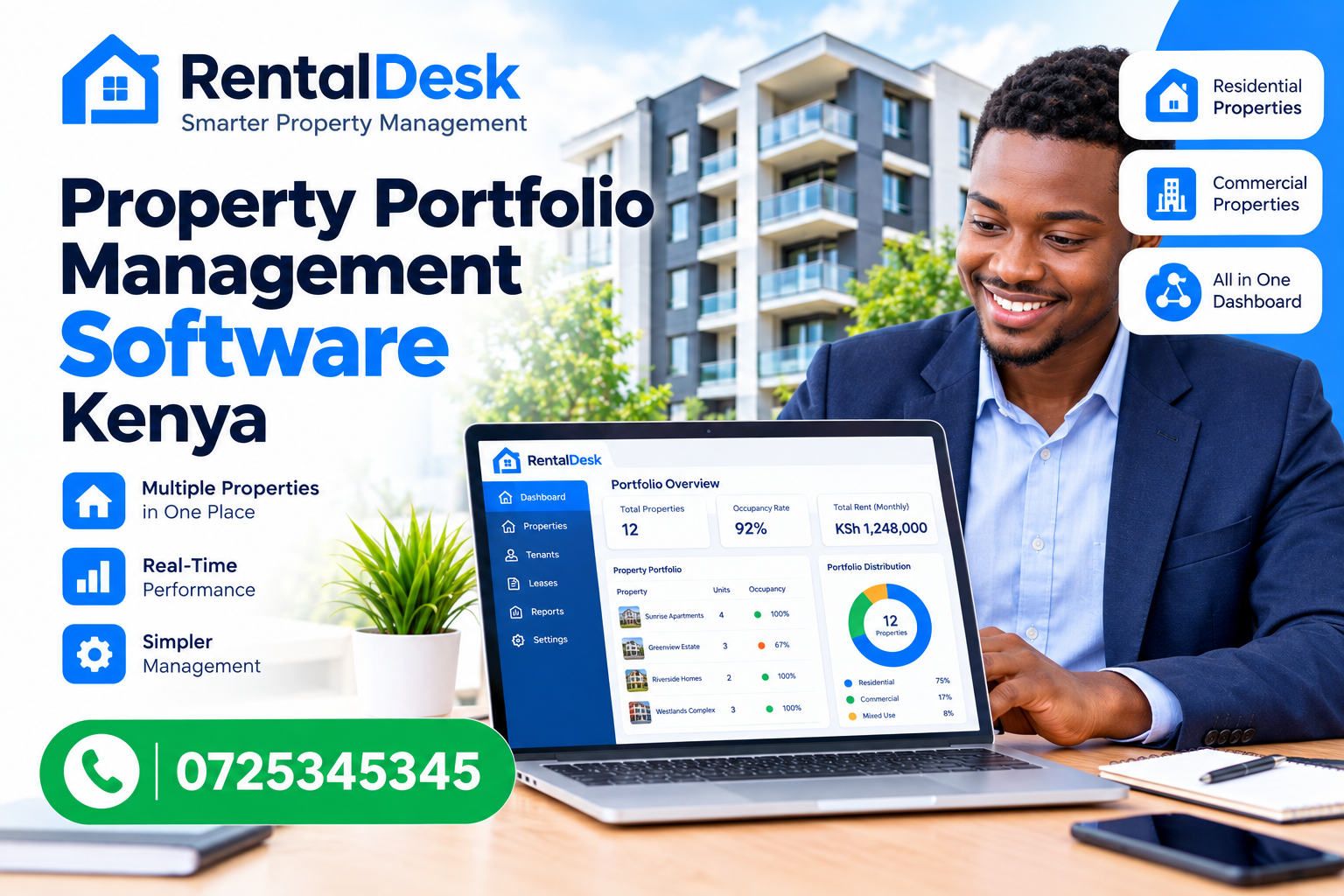
Property Portfolio Management Software Kenya: A Practical Guide for Managing Multiple Properties
Managing several rental properties is very different from managing one house or a small building. As the portfolio grows, the landlord or property manager has to keep track of tenants, rent, vacancies, inspections, maintenance requests, invoices, expenses, documents, and performance reports at the same time. Property Portfolio Management Software Kenya is designed to bring these activities into one organized system so property owners and managers can work with better visibility and fewer manual tasks.
For a landlord in Nairobi, Mombasa, Kisumu, Nakuru, Eldoret, or another Kenyan market, portfolio management becomes more demanding as the number of units increases. A spreadsheet may work for a handful of properties, but it can become difficult to maintain when information changes every day. This guide explains what Property Portfolio Management Software Kenya means in practical terms, the problems it can solve, the features to look for, and how to choose a solution that fits the way your rental business operates.
What Is Property Portfolio Management Software?
Property Portfolio Management Software Kenya is a digital system that helps landlords, real estate investors, and property managers organize information and daily activities across multiple properties from one place. Instead of keeping separate notebooks, spreadsheets, payment records, tenant files, and maintenance logs, the user can manage those workflows through a connected platform.
A portfolio can contain residential apartments, commercial spaces, bedsitters, houses, offices, shops, or a mixture of property types. The software should make it possible to see each property individually while also giving the owner a broader portfolio-level view.
The most useful systems connect related activities. For example, a rent payment can be associated with a tenant and a unit, an expense can be associated with a property, a maintenance request can be attached to a unit, and a report can summarize activity across a selected group of properties.
That structure is important because portfolio management is not simply about storing property names. It is about connecting operational information so that the person responsible for the portfolio can answer questions quickly.
A practical Property Portfolio Management Software Kenya setup should help answer questions such as:
- Which units are occupied?
- Which units are vacant?
- Which tenants have outstanding balances?
- How much rent was collected during a selected period?
- Which properties generated the most income?
- What expenses were recorded against each property?
- Which maintenance issues are still open?
- Which leases are approaching important dates?
- How is each property performing compared with the wider portfolio?
Why Managing a Property Portfolio Manually Becomes Difficult
Manual management often starts simply. A landlord may use an Excel sheet for rent, a notebook for maintenance, WhatsApp messages for tenant communication, and bank or M-Pesa statements for payment checking. Each tool may work on its own, but the information is scattered.
As the portfolio expands, this creates several risks.
Information becomes fragmented
When tenant details are in one file and payment records are in another, the manager has to cross-check information manually. A change made in one place may not be reflected elsewhere.
Follow-ups become harder
A property manager may remember that a tenant reported a plumbing issue but forget whether the repair was completed. A spreadsheet can record a task, but without a structured workflow it may still be easy to miss.
Reporting takes longer
Owners often need summaries for rent collection, expenses, occupancy, arrears, and property performance. Producing these reports manually can take hours, particularly when figures come from multiple properties.
Errors are easier to introduce
Manual data entry can lead to duplicated records, incorrect balances, missing transactions, or outdated tenant information. A structured system does not remove every possibility of error, but it can reduce unnecessary duplication.
This is where Property Portfolio Management Software Kenya can become useful. By keeping related portfolio information in one system, a manager can reduce the amount of repetitive reconciliation and searching required during ordinary operations.
Who Can Use Property Portfolio Management Software?
Property Portfolio Management Software Kenya can support different types of property businesses. The ideal setup depends on portfolio size, property type, staffing, and management processes.
Individual landlords
A landlord with several rental houses or apartment units can use a portfolio system to organize rent records, tenant information, expenses, vacancies, and maintenance.
Property management companies
A property management company may manage buildings owned by different clients. A suitable platform can separate properties while still allowing managers to monitor the entire managed portfolio.
Real estate investors
Investors may want to compare income and expenses across properties. Centralized records can make it easier to prepare reports for internal decision-making.
Developers with completed units
After units become occupied, developers may need a structured system for ongoing tenant and property operations. A portfolio platform can support the transition from development activity to day-to-day management.
Owners of mixed-use property
A portfolio may include shops, offices, apartments, or other spaces. A flexible system can help keep records organized according to the type of unit and agreement involved.
The key point is that Property Portfolio Management Software Kenya is not limited to a particular ownership model. Its value comes from bringing property operations into a structured workflow that matches the user’s portfolio.
Key Features to Look For
Choosing software based only on a long feature list can be misleading. What matters is whether the features actually support your daily processes.
Here are the capabilities worth examining when evaluating Property Portfolio Management Software Kenya.
Property and unit management
The foundation of Property Portfolio Management Software Kenya is a clear property database. Each property should be identifiable, with its units, occupancy information, tenant details, and relevant records connected to it.
A useful structure can include:
- Property name or reference
- Location
- Unit numbers
- Unit type
- Occupancy status
- Tenant assignment
- Rent amount
- Lease information
- Property-related expenses
- Maintenance history
- Documents and notes
This helps a manager move from a portfolio overview to a specific property and then to an individual unit without losing context.
Tenant management
Tenant information should be easy to find and update. A manager may need contact details, tenancy dates, payment records, outstanding balances, correspondence notes, and other relevant information.
When tenant records are linked to units, it becomes easier to understand who occupies each space and what transactions belong to that tenancy.
Rent collection tracking
Rent is central to rental property operations, and Property Portfolio Management Software Kenya can help organize the related records. The system should make it easy to record and monitor payments, identify outstanding balances, and review collection activity.
For Kenyan property managers, payment workflows may include M-Pesa and other local payment channels. A software platform should be evaluated on how well it supports the actual payment process used by the business.
Property Portfolio Management Software Kenya can be particularly useful when rent information is organized against the correct tenant and property rather than maintained in disconnected payment lists.
Arrears monitoring
Late payments require timely follow-up. A portfolio platform should make outstanding amounts visible and provide a clear way to identify affected tenants.
Instead of opening multiple spreadsheets, a manager should be able to review outstanding balances and determine which accounts require attention.
Arrears reports can also help owners understand whether delayed payments are concentrated in a particular building, unit type, or period.
Vacancy tracking
Vacant units generate no rental income while costs can continue. A vacancy workflow helps managers identify empty units and keep their availability information current.
A useful system can show occupied, vacant, reserved, or other relevant statuses. The exact labels should match the business’s operating model.
Lease management
Leases contain important dates and obligations. A portfolio system should allow managers to record lease start dates, end dates, rent terms, deposits, and other relevant information.
When lease data is structured, managers can plan renewals and follow-ups rather than relying entirely on memory or calendar notes.
Maintenance management
Maintenance requests are a regular part of property operations. A good workflow should allow managers to record the issue, identify the affected unit, assign responsibility, track progress, and document completion.
For example, a tenant might report a leaking pipe. The manager can record the request, assign a plumber, note the cost, and update the status when the work is completed.
This creates a maintenance history that can later support budgeting and property performance analysis.
Expense tracking
Property expenses can include repairs, cleaning, utilities, service costs, management expenses, and other operating items. Recording them against the correct property is important for understanding profitability.
Property Portfolio Management Software Kenya should make it easier to classify expenses and connect them with the relevant property or unit.
Invoicing and statements
Some property businesses need invoices, receipts, tenant statements, owner statements, or other financial documents. A system that connects documents to the underlying transaction can reduce duplicate work.
The exact documents required will depend on the type of tenancy and the company’s processes.
Reporting and dashboards
Reports turn stored information into something useful for management. A dashboard can provide a quick overview, while detailed reports can support deeper analysis.
Common portfolio reports include:
- Rent collection reports
- Arrears reports
- Vacancy reports
- Income reports
- Expense reports
- Maintenance reports
- Tenant reports
- Property performance summaries
- Transaction histories
How Property Portfolio Management Software Improves Visibility
A portfolio manager needs two views: the detail view and the portfolio view.
The detail view answers questions about one property or unit. The portfolio view helps the owner understand the bigger picture.
Property Portfolio Management Software Kenya can connect these two perspectives. A manager may start by looking at total rent collected and then drill down into a particular building. From there, they may review a unit, inspect its tenant account, and check related transactions.
This reduces the need to compile information manually every time an owner asks for an update.
For example, imagine a landlord owns four apartment buildings in Nairobi. Each building has different occupancy levels, rent amounts, and maintenance needs. A portfolio dashboard can provide a summary, while property-level records retain the details.
The benefit is not simply convenience. Better visibility can help managers notice operational issues earlier and organize their work around actual records.
Using Property Portfolio Management Software for Rent Collection
Rent collection requires consistency. A property manager needs to know what was expected, what was received, what remains outstanding, and which tenant account each transaction belongs to.
A properly configured Property Portfolio Management Software Kenya workflow can help organize those stages.
Record expected rent
Each unit can have its expected rent amount and tenancy information recorded.
Record received payments
Payments can be entered or integrated according to the available system capabilities and business process.
Match payments to tenants
Correct allocation is important. A payment should be associated with the right tenant, unit, and period.
Identify balances
After payments are recorded, outstanding amounts can be reviewed.
Follow up on arrears
Managers can use the available reports or account information to prioritize follow-up.
This structure is particularly useful for businesses handling many tenants because the manager does not have to reconstruct the position of each account from separate records.
M-Pesa and Kenyan Payment Workflows
M-Pesa is an important consideration for many Kenyan rental businesses. However, the exact integration options differ between software products and payment arrangements.
When evaluating Property Portfolio Management Software Kenya, ask practical questions about how payments are captured and reconciled. Does the platform support the payment method you already use? Can transactions be matched to tenants? Can the system produce useful payment reports? Are there controls for correcting mistakes?
Do not select software simply because it mentions M-Pesa. Test how the actual workflow operates from payment receipt through reconciliation and reporting.
For a Kenyan property manager, this practical fit can matter more than a long list of general features.
Managing Property Expenses More Effectively
Revenue is only one side of portfolio management. Expenses affect the financial performance of each property.
A manager may need to record:
- Repairs
- Plumbing
- Electrical work
- Cleaning
- Security-related costs
- Landscaping
- Common-area services
- Utilities
- Administrative costs
- Contractor payments
- Other operating expenses
If these costs are recorded without property references, it becomes difficult to understand where money is being spent.
Property Portfolio Management Software Kenya can provide a structured way to associate expenses with properties and units, depending on the platform’s configuration.
Consider a building that repeatedly incurs plumbing expenses. A maintenance and expense history can help the manager see the pattern. This does not automatically determine the correct action, but it gives the manager better information for investigating the underlying issue.
Property Portfolio Reporting
Reporting is one of the most important areas to consider when choosing Property Portfolio Management Software Kenya.
A report should answer a specific management question. For example:
Income: How much rental income was recorded during the month?
Arrears: Which tenant accounts have outstanding balances?
Occupancy: How many units are occupied or vacant?
Expenses: What operating costs were recorded for each property?
Maintenance: Which work orders are open, completed, or overdue?
Performance: How does the income and expense position of one property compare with another?
With Property Portfolio Management Software Kenya, reports can be more useful when the underlying data is consistently recorded.
Monthly reporting example
Suppose a property manager oversees 100 units. At month-end, the owner wants a report showing rent collected, outstanding rent, expenses, vacancies, and maintenance activity.
A manual process might require gathering figures from several spreadsheets and messages. A centralized system can make the reporting process more structured by drawing from the same records used during daily operations.
Choosing Software for a Growing Portfolio
The right platform should fit the business today while leaving room for growth.
Before choosing Property Portfolio Management Software Kenya, create a simple checklist of operational requirements.
1. Count the properties and units
Know the approximate number of properties and units that need to be managed. A small portfolio and a large management company may have very different requirements.
2. Identify current pain points
List the problems that consume the most time. They may include rent tracking, arrears, reporting, maintenance, tenant records, or payment reconciliation.
3. Map your workflow
Write down what happens when:
- A tenant signs a lease.
- Rent becomes due.
- Payment is received.
- Payment is reconciled.
- A tenant reports maintenance.
- An expense is incurred.
- A lease approaches renewal.
- A report is prepared.
The software should support this real process rather than forcing the business into an unnecessarily complicated workflow.
4. Check reporting requirements
Ask which reports owners, accountants, managers, or staff need regularly.
5. Consider user access
If several staff members use the system, check how accounts, permissions, and responsibilities are handled.
6. Review data security
Property systems can contain sensitive tenant, financial, and business information. Ask about authentication, access controls, backups, and data protection practices.
7. Consider support and training
A system only creates value when staff can use it correctly. Check what onboarding, training, and customer support are available.
Common Mistakes When Selecting Property Software
Buying software because it looks impressive during a demonstration can create problems later.
One common mistake is focusing on features instead of workflows. A platform can have dozens of features but still be difficult to use for the tasks that matter most to your business.
Another mistake is failing to test reports. Ask for sample reports and determine whether they answer the questions you actually need to answer.
A third mistake is ignoring data migration. If you already have years of tenant and transaction records, find out how those records can be transferred into the new system.
Another issue is staff adoption. If employees find the system confusing, they may continue using spreadsheets and informal records, which defeats the purpose of centralization.
When evaluating Property Portfolio Management Software Kenya, use real examples from your business rather than relying only on a feature list.
Property Portfolio Management Software for Kenyan SMEs
Small and medium-sized property businesses often need practical tools rather than complicated enterprise systems.
An SME may have a small team where one person handles several responsibilities. The same employee might deal with tenant communication, rent follow-up, maintenance coordination, and reporting.
For such businesses, Property Portfolio Management Software Kenya can be valuable when it reduces repetitive administrative work and makes important information easier to access.
The goal is not to digitize every activity simply because technology is available. The goal is to improve the processes that consume time and create avoidable errors.
A small property company should therefore look for:
- Straightforward navigation
- Clear tenant records
- Simple rent tracking
- Useful reports
- Easy maintenance workflows
- Appropriate user access
- Reliable support
- A pricing structure that fits the business
Using Data to Understand Portfolio Performance
A portfolio manager needs more than a list of properties. They need information that helps them understand how the portfolio is operating.
Property Portfolio Management Software Kenya can support this by organizing data around income, expenses, occupancy, arrears, maintenance, and other operational measures.
For example, a manager may notice that one property has a higher vacancy level than the rest. The system does not explain the cause automatically. The manager can then investigate factors such as pricing, location, unit condition, marketing, or tenant turnover.
Similarly, an expense report may reveal that a particular property has unusually frequent maintenance costs. That information can lead to a deeper review.
This is where good reporting becomes valuable: it provides evidence for questions that management needs to investigate.
Improving Tenant Service
Property management is also a customer-service function, and Property Portfolio Management Software Kenya can help keep the supporting records organized. Tenants expect clear communication, timely responses, accurate statements, and proper handling of maintenance issues.
A structured system can help managers maintain consistent records.
For example, when a tenant contacts the office about a repair, the request can be recorded against the relevant unit. Staff can then see the issue, update its status, and retain a record of the work.
Property Portfolio Management Software Kenya can support this type of organization when its tenant and maintenance features are configured around the business workflow.
Good records can also reduce misunderstandings. If a tenant asks about a payment, the manager can refer to the account record rather than relying on memory or searching through multiple messages.
Supporting Maintenance Planning
Reactive maintenance is unavoidable in property management, but property owners also need to think about recurring and preventive work.
A maintenance history can show which assets or areas experience repeated problems.
A manager might use records to track:
- Plumbing repairs
- Electrical work
- Painting
- Roofing issues
- Appliance repairs
- Common-area maintenance
- Cleaning
- Security-related repairs
With Property Portfolio Management Software Kenya, these records can be organized so that managers have a clearer history of what has been done and what remains open.
That information can also support budgeting. Historical expenses do not guarantee future costs, but they provide useful background when planning maintenance spending.
Managing Multiple Property Owners
Property managers who work for different owners need clear separation between portfolios.
A system should make it possible to identify which property belongs to which owner and generate appropriate records or reports.
This becomes increasingly important as a management company grows. Without clear separation, it is easy to mix information between properties.
When reviewing Property Portfolio Management Software Kenya, property managers should ask how owner records, properties, transactions, statements, and reports are organized.
The objective is straightforward: every financial and operational record should be traceable to the correct property and ownership context.
Data Accuracy and Record Keeping
Automation cannot compensate for poor data. If tenant names, rent amounts, unit references, or transactions are entered incorrectly, reports may also be inaccurate.
That is why implementation matters.
Before moving to Property Portfolio Management Software Kenya, clean existing data where possible. Remove duplicates, standardize property names, verify tenant records, and check outstanding balances.
Then establish simple rules for ongoing data entry.
For example:
- Use consistent property names.
- Record payments promptly.
- Assign expenses to the correct property.
- Update tenancy status when changes occur.
- Close maintenance tasks when work is completed.
- Review reports regularly.
These habits help the software remain a reliable source of information.
Security and Access Controls
Property management systems may contain tenant contacts, payment information, contracts, financial records, and business documents.
A property manager should therefore ask how the platform protects information.
Useful questions include:
- How are user accounts authenticated?
- Can access be restricted by role?
- Are backups performed?
- How are former staff accounts handled?
- What happens if a password is compromised?
- How is sensitive information stored?
- What support is available if an account problem occurs?
These questions should be part of the buying process rather than an afterthought.
Cloud-Based Property Management
Many modern property platforms are accessed through the internet, allowing authorized users to work from different locations.
For managers who move between properties, this can be useful. A staff member may need to check a tenant record while visiting a building, while an owner may need a report without being physically present in the office.
However, cloud access should be evaluated alongside security, reliability, connectivity requirements, user permissions, and support.
Property Portfolio Management Software Kenya can be particularly practical for distributed property teams when the system provides secure access and the necessary workflows.
Mobile Access and Field Work
Property management includes work outside the office. Staff may inspect units, meet tenants, check repairs, or visit contractors.
A system that works well on suitable mobile devices can reduce the need to carry printed records.
For example, during an inspection, a manager may need to confirm the unit, review a previous maintenance issue, or update a task.
The precise mobile capabilities of any platform should be confirmed before purchase. Do not assume that every browser-based system provides the same mobile experience.
Cost Considerations
Software pricing varies by provider and configuration. Avoid making purchasing decisions based on a headline price alone.
When assessing Property Portfolio Management Software Kenya, consider the total cost of using the system.
Potential cost factors can include:
- Subscription fees
- Number of properties or units
- Number of users
- Setup or onboarding
- Data migration
- Training
- Payment integrations
- Additional modules
- Support arrangements
- Reporting features
Also consider the operational cost of continuing with manual processes. Staff time spent compiling reports, correcting records, following up on missing information, and reconciling transactions has a business cost even when no software invoice is involved.
A sensible comparison should therefore look at both monetary cost and operational value.
How to Implement Property Portfolio Management Software
Implementation of Property Portfolio Management Software Kenya works best when it is planned rather than rushed.
Step 1: Document the current process
Write down how rent, expenses, tenants, maintenance, and reporting are currently handled.
Step 2: Clean the data
Review existing records and correct obvious duplicates or inconsistencies.
Step 3: Set up properties and units
Create the property structure before importing detailed transactions.
Step 4: Add tenant information
Enter current tenant records and connect them to the appropriate units.
Step 5: Configure financial information
Set up rent amounts, payment records, expense categories, and other required financial fields.
Step 6: Train users
Show staff how to complete the tasks they perform most frequently.
Step 7: Test reports
Run sample reports and check whether the figures match the source records.
Step 8: Review after launch
After several weeks, identify where users are struggling and adjust the workflow or training.
A controlled implementation helps prevent the common mistake of moving poor records into a new system without fixing the underlying process.
A Practical Example for a Nairobi Property Manager
Consider a manager handling several apartment blocks in Nairobi. Each building has multiple units, different tenants, varying rent amounts, maintenance requests, and recurring expenses.
Before adopting a structured platform, the manager may keep rent information in one spreadsheet, maintenance requests in WhatsApp conversations, and expense receipts in email or paper files.
With Property Portfolio Management Software Kenya, the manager can structure the portfolio around properties and units. Tenant records can be associated with units, payments can be recorded against accounts, maintenance requests can be tracked, and reports can be generated from the information stored in the system.
The important change is not simply replacing paper with software. It is creating a consistent information structure.
At month-end, the manager can work from the same records used during the month rather than rebuilding the portfolio report from scratch.
Questions to Ask Before Buying
Before committing to any system, prepare a short list of questions.
- Can the system manage all my properties in one account?
- Can I separate properties by owner or portfolio?
- Can I track individual units?
- Can I record tenant information?
- How are rent payments recorded?
- How does payment reconciliation work?
- Can I monitor arrears?
- Can I track vacancies?
- Can I manage maintenance requests?
- Can I record property expenses?
- What reports are available?
- Can users have different access permissions?
- How is data backed up?
- What support is provided?
- Can I export my data?
- What are the full costs?
- Does the system work well on mobile devices?
- Can it support the number of properties and users I expect to have?
A vendor that can clearly answer these questions gives you a better basis for evaluating fit.
Benefits of Centralizing Property Information
Centralization is one of the strongest reasons to adopt Property Portfolio Management Software Kenya.
Instead of searching across multiple systems, a manager can work from a shared record structure.
Property Portfolio Management Software Kenya can help bring together property, tenant, payment, expense, maintenance, and reporting information.
This can improve several areas:
- Faster access to records
- More consistent reporting
- Better visibility of outstanding work
- Easier tenant account reviews
- Clearer property histories
- Less duplication
- More organized portfolio administration
These benefits depend on correct setup and consistent use. Software does not replace management discipline; it gives that discipline a structured environment.
When Should a Landlord Consider Software?
There is no single property count at which every landlord must adopt software.
A better question is whether the current management process is becoming difficult to control.
Signs may include:
- Increasing tenant numbers
- More frequent rent follow-ups
- Growing arrears
- More maintenance requests
- Multiple properties
- Frequent reporting requests
- Difficulty finding records
- Duplicate spreadsheets
- Missed reminders
- Increasing administrative workload
If several of these problems are present, it may be worth evaluating Property Portfolio Management Software Kenya and similar systems.
Frequently Asked Questions
What is Property Portfolio Management Software Kenya used for?
Property Portfolio Management Software Kenya is used to organize multiple rental properties, tenants, units, payments, expenses, maintenance activities, vacancies, and reports in a structured system. The exact functions depend on the provider.
Can Property Portfolio Management Software Kenya track rent payments?
Yes, portfolio management systems can include rent payment tracking. Before choosing a platform, confirm how payments are entered, allocated to tenants, reconciled, and reported.
Does Property Portfolio Management Software Kenya support M-Pesa?
Some systems support M-Pesa-related workflows or integrations, but capabilities vary. Ask the provider to demonstrate the exact payment and reconciliation process used by your business.
Can Property Portfolio Management Software Kenya manage several properties?
Yes. Multi-property organization is a core purpose of portfolio management platforms. The important consideration is how properties, units, tenants, owners, transactions, and reports are separated and connected.
Is Property Portfolio Management Software Kenya useful for small landlords?
It can be useful when a landlord has enough properties or administrative activity to make manual management difficult. A small landlord should still compare features, usability, cost, and support before adopting a system.
Can Property Portfolio Management Software Kenya help with maintenance?
A suitable platform can record maintenance requests, assign tasks, track progress, and retain repair histories. The exact workflow depends on the software.
How does Property Portfolio Management Software Kenya help with reporting?
It can organize transaction and operational records so managers can produce reports covering income, expenses, arrears, vacancies, maintenance, and other portfolio information supported by the platform.
What should I check before buying Property Portfolio Management Software Kenya?
Check the platform’s property and tenant management, payment tracking, reporting, maintenance, user access, security, mobile usability, support, implementation process, data export options, and total cost.
Final Thoughts
Managing a growing rental portfolio requires more than keeping a list of properties. Owners and managers need a reliable way to connect units, tenants, payments, expenses, maintenance, vacancies, documents, and reports.
Property Portfolio Management Software Kenya can provide that structure when it matches the business’s actual workflow. The strongest approach is to begin with the problems you need to solve, then evaluate the features that address those problems.
For Kenyan landlords and property managers, practical considerations such as rent collection, M-Pesa workflows, tenant records, maintenance, reporting, mobile access, and data security deserve particular attention.
Before choosing a platform, test realistic scenarios. Enter a sample property, add a tenant, record a payment, create an expense, log a maintenance request, and generate a report. This gives you a much clearer understanding of whether the system fits your operations than a feature list alone.
A well-organized portfolio management process can make day-to-day administration easier, improve access to information, and give property owners a clearer view of what is happening across their investments. Property Portfolio Management Software Kenya is most useful when it becomes part of that consistent process rather than simply another place to store information.
For a property business that is growing, the right software should make management more organized without making everyday work unnecessarily complicated. Start with your current needs, plan for future growth, and choose a system that gives your team the information and workflows required to manage the portfolio with confidence.
Property Portfolio Management Software Kenya
Property Portfolio Management Software Kenya
Property Portfolio Management Software Kenya
Property Portfolio Management Software Kenya