
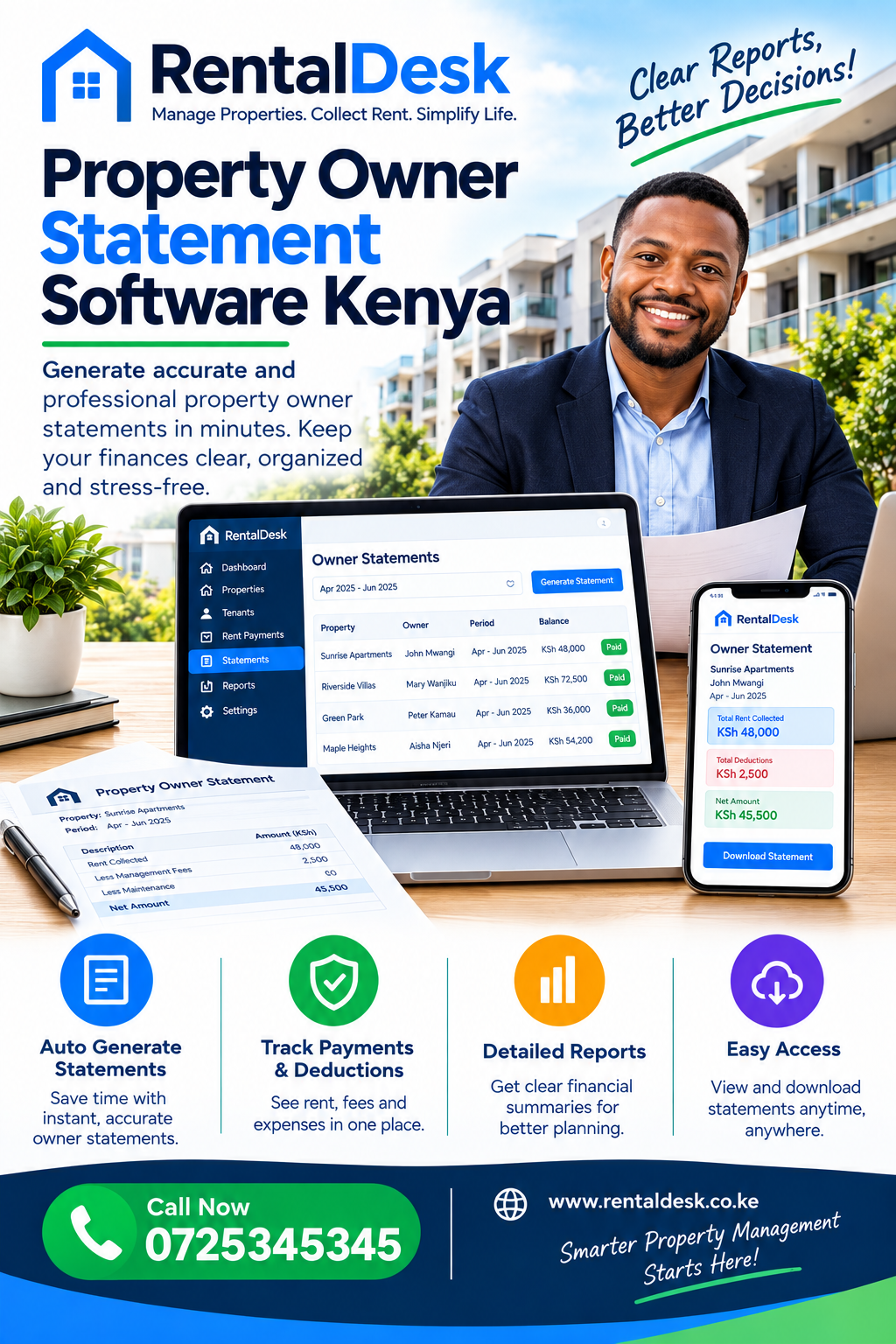
Property Owner Statement Software Kenya: A Complete Guide to Better Rental Financial Reporting
Managing rental property is not simply about collecting rent at the end of the month. Property owners also need clear records showing what was collected, what was spent, which units contributed to the income, what deductions were made, and how much money is actually payable to the owner. For landlords and property managers handling several units, Property Owner Statement Software Kenya provides a practical way to organize this information and turn property transactions into understandable financial statements.
A good owner statement should answer straightforward questions. How much rent was collected? Which tenants paid? Were there arrears? What maintenance costs were incurred? Were management fees deducted? Were utility charges included? What amount should the property owner receive? When these questions are answered manually using notebooks, spreadsheets, receipts and separate payment records, mistakes become easier to make.
This guide explains how Property Owner Statement Software Kenya can support landlords, property managers, letting agencies and real estate businesses that need better financial visibility. It covers owner statements, rental income tracking, expense management, reconciliation, reporting, M-Pesa-related workflows, tenant records, maintenance deductions, owner communication, automation and practical considerations when selecting rental management software.
The goal is not merely to introduce another software category. It is to explain how better reporting can improve the relationship between property managers and property owners while reducing the administrative workload involved in managing rental properties.
What Is Property Owner Statement Software?
At its simplest, Property Owner Statement Software Kenya is a digital system designed to help property managers prepare accurate financial statements for property owners.
An owner statement brings together financial activity related to a property or portfolio over a particular period. Depending on how the property is managed, the statement may contain:
- Rental income collected
- Outstanding rent
- Tenant payments
- Maintenance expenses
- Utility-related charges
- Management fees
- Property expenses
- Adjustments
- Other income
- Deductions
- Net amount payable to the owner
Instead of preparing this information from several disconnected sources, software can centralize the records and make reporting more consistent.
For example, suppose a property has twenty rental units. During the month, eighteen tenants pay rent, one makes a partial payment and one remains in arrears. At the same time, the manager pays for plumbing repairs, cleaning, security-related expenses and common-area maintenance.
A manual process would require the manager to gather all those records before preparing the owner’s statement.
With Property Owner Statement Software Kenya, the underlying transactions can be organized within the same property management workflow. The manager can then review the income and deductions before generating the relevant statement.
Why Owner Statements Matter
An owner statement is more than a financial document. It is also a communication tool.
Property owners who have delegated day-to-day management still need confidence that their property is being handled responsibly. A clear statement allows them to see the financial outcome without having to inspect every tenant record individually.
For the property manager, accurate reporting demonstrates professionalism.
For the owner, it provides visibility.
For both parties, it reduces unnecessary questions.
That is why Property Owner Statement Software Kenya can be particularly useful for businesses managing properties on behalf of multiple landlords.
Why Rental Property Financial Reporting Can Become Difficult
Property management involves many transactions that happen at different times and through different channels.
A tenant may pay rent through a mobile payment method. Another tenant may make a bank transfer. A third may pay through an alternative arrangement. Maintenance costs may be paid to contractors. Utility expenses may be recorded separately. Management fees may be calculated at the end of the month.
When these transactions are stored in different places, the process of preparing a statement becomes increasingly complicated.
Multiple Properties Create More Work
A landlord with one property may be able to maintain basic records using a spreadsheet.
The situation changes when a property manager handles:
- Multiple apartment blocks
- Residential estates
- Commercial units
- Mixed-use buildings
- Several landlords
- Dozens or hundreds of tenants
At that point, the number of transactions grows rapidly.
Property Owner Statement Software Kenya can help structure the financial information so that managers are not relying entirely on manually maintained spreadsheets.
Manual Calculations Increase the Risk of Errors
A small calculation error can affect the amount shown as payable to an owner.
For example, imagine a property generates KSh 500,000 in rent during a month. There are maintenance expenses, management charges and other deductions. If one expense is entered twice, omitted or assigned to the wrong property, the final statement may not balance.
The problem may not be obvious until the owner compares the statement with their own bank records.
Software does not eliminate the need for human review, but Property Owner Statement Software Kenya can reduce repetitive calculations and provide a more structured process for recording transactions.
Key Features to Look for in Owner Statement Software
Not every property management system offers the same reporting capabilities. Before selecting a solution, property managers should examine the features that directly affect financial reporting.
1. Property and Unit Records
The system should allow the manager to organize properties and their individual units.
This may include:
- Property name
- Property location
- Unit number
- Tenant details
- Rent amount
- Lease information
- Payment history
- Occupancy status
When the property structure is accurate, financial reports become easier to interpret.
2. Rental Income Tracking
The software should make it possible to identify how much rent has been billed and how much has actually been collected.
This distinction matters.
A property may have KSh 800,000 in expected rent but only KSh 720,000 collected. Treating the two figures as identical could give the owner a misleading impression of the property’s performance.
Property Owner Statement Software Kenya can be part of a wider workflow where managers distinguish billed rent, collected rent and outstanding balances.
3. Expense Tracking
Owner statements often include deductions for expenses incurred while operating the property.
Common examples include:
- Plumbing repairs
- Electrical repairs
- Painting
- Cleaning
- Landscaping
- Security-related expenses
- Common-area repairs
- Equipment servicing
- Contractor payments
A useful system should allow expenses to be associated with the correct property.
4. Management Fee Calculations
Property managers may charge owners a management fee based on an agreed arrangement.
The software should make it possible to record or calculate the applicable fee and show it clearly in the statement.
Transparency matters because owners should be able to understand why the amount they receive differs from gross rental collections.
5. Statement Generation
A major advantage of Property Owner Statement Software Kenya is the ability to turn stored transactions into a structured report.
Rather than manually formatting a spreadsheet every month, the manager can generate a statement using the information already stored in the system.
What Should a Good Property Owner Statement Contain?
A useful owner statement should be easy to understand even when the owner is not involved in daily property management.
The exact layout will vary depending on the business, but a comprehensive statement may include the following:
| Statement Item | Purpose |
|---|---|
| Property details | Identifies the property covered |
| Reporting period | Shows the month or period being reported |
| Rental income | Shows rent collected |
| Other income | Captures additional property income |
| Arrears | Shows outstanding tenant balances |
| Maintenance | Records property-related repairs |
| Utilities | Records relevant utility expenses |
| Management fee | Shows management charges |
| Other deductions | Records approved expenses |
| Net owner amount | Shows the final amount payable |
A well-organized statement gives the owner a financial story rather than a collection of unexplained figures.
For managers dealing with multiple landlords, Property Owner Statement Software Kenya can support a broader digital approach where property records, financial activity and reporting are handled through a structured system.
The Role of M-Pesa in Rental Property Reporting
Mobile money is an important part of everyday business transactions in Kenya. Rental payments may also be made through mobile payment channels.
The important issue for a property manager is not simply receiving the money. It is correctly associating each payment with the right tenant, unit and property.
For example, consider an apartment building with 80 units. If several tenants pay around the same time, the manager needs a reliable process for determining:
- Who made the payment?
- Which unit does the tenant occupy?
- Which rental invoice does the payment settle?
- Was the full amount paid?
- Is there an outstanding balance?
- Which owner should receive the income?
- Were any deductions applied?
Property Owner Statement Software Kenya can form part of a wider digital property management workflow that makes transaction records easier to organize.
Why Payment Reconciliation Matters
Receiving a payment and recording a payment are not necessarily the same thing.
A property manager needs to reconcile transactions against tenant accounts and property records. If a payment is assigned incorrectly, the tenant ledger may show a false balance and the owner’s statement may also become inaccurate.
This is one reason automated or semi-automated reconciliation features are valuable.
Reducing Spreadsheet Dependency
Spreadsheets are useful tools, especially for small businesses. They become less convenient when the volume of data increases.
A spreadsheet-based rental operation might contain separate tabs for:
- Tenants
- Rent collections
- Expenses
- Maintenance
- Owners
- Properties
- Arrears
- Statements
As the number of properties grows, maintaining relationships between those sheets can become difficult.
Property Owner Statement Software Kenya can help property managers move toward a centralized system where information is connected rather than scattered across multiple files.
Problems Commonly Associated With Manual Reporting
Manual processes can create several challenges:
- Duplicate entries
- Missing transactions
- Incorrect calculations
- Outdated tenant information
- Misclassified expenses
- Delayed statements
- Difficulty tracing adjustments
- Inconsistent reporting formats
A digital workflow can make these processes more repeatable.
How Owner Statements Improve Landlord Transparency
Trust is important in property management.
An owner may live in another county or outside Kenya and depend entirely on a property manager to handle collections, maintenance and tenant-related matters.
In such situations, reporting becomes particularly important.
A detailed statement allows the owner to review the financial activity without needing constant calls or messages.
For example, a statement could show that:
- Gross rent collected: KSh 450,000
- Maintenance expense: KSh 20,000
- Other approved expense: KSh 5,000
- Management fee: KSh 22,500
- Net amount: KSh 402,500
The figures above are simply an illustrative example, not a standard pricing or fee structure.
Property Owner Statement Software Kenya can support the kind of structured reporting that makes these calculations easier to review.
The more transparent the reporting process is, the easier it becomes for a landlord and property manager to discuss discrepancies.
Tracking Property Expenses More Effectively
Rental properties generate expenses throughout the year.
Some expenses are predictable. Others happen unexpectedly.
A leaking pipe, broken electrical fitting or damaged door can require immediate attention. If the cost is paid on behalf of the owner, it should eventually appear in the appropriate financial records.
A strong expense management process should answer:
- What was purchased?
- Why was it purchased?
- Which property benefited?
- Which unit was affected?
- How much did it cost?
- When was it paid?
- Was the cost deducted from the owner’s income?
This is where Property Owner Statement Software Kenya can fit into a larger property accounting and management process.
Maintenance and Owner Statements
Maintenance is especially important because it can affect the owner’s net income.
Suppose a property collects KSh 300,000 in rent but incurs KSh 35,000 in approved repairs. The owner needs to see that deduction clearly.
Hiding expenses inside a single final figure creates unnecessary confusion.
A better approach is to show the income and deductions separately.
Managing Arrears and Their Effect on Owner Reporting
Rent arrears are one of the most important figures in rental management.
A property can appear profitable based on scheduled rent even when a significant portion has not actually been collected.
For that reason, managers should distinguish between:
- Rent due
- Rent collected
- Partial payments
- Outstanding balances
- Previous arrears
- Current-period arrears
Property Owner Statement Software Kenya can be used within the broader rotation of digital systems, while a dedicated rental management platform should remain the central source for property-specific records.
The key principle is simple: an owner statement should reflect actual financial activity, not assumptions about what tenants were supposed to pay.
Why Arrears Should Be Visible
If an owner receives less money than expected, the statement should help explain why.
For instance, if expected rent was KSh 600,000 and only KSh 540,000 was collected, the statement should make the difference understandable.
This helps the owner distinguish between a management problem and a tenant payment problem.
Owner Statements and Tenant Records Should Be Connected
A property owner should not need a separate document to understand where rental income came from.
Ideally, the property management system should connect the owner statement to tenant records.
That means the manager can move from a property-level financial figure to supporting information when investigating an issue.
For example:
Owner statement → property → unit → tenant → invoice → payment
This chain is useful when investigating discrepancies.
Property Owner Statement Software Kenya can illustrate the broader value of connected business records, although property managers should select software based on the actual requirements of their rental operation.
Automating Monthly Owner Reporting
Preparing owner statements every month can become one of the most repetitive responsibilities in property management.
The manager may need to:
- Check rent collections.
- Review tenant balances.
- Record expenses.
- Verify maintenance costs.
- Calculate management charges.
- Check adjustments.
- Reconcile payments.
- Prepare the statement.
- Review the figures.
- Send the statement to the owner.
When the underlying data is already organized, Property Owner Statement Software Kenya can help demonstrate the broader principle of using software to reduce repetitive administrative work.
Automation should not mean removing human oversight. The manager should still review statements before they are finalized.
The goal is to reduce unnecessary manual work while keeping financial controls in place.
Reports Property Managers Should Consider
An owner statement is important, but it should not be the only report available.
A property management business may benefit from reports covering:
Rent Collection Report
Shows what was billed, collected and remains outstanding.
Arrears Report
Highlights tenants with unpaid balances.
Expense Report
Summarizes property-related expenses.
Maintenance Report
Shows maintenance requests, work performed and associated costs.
Occupancy Report
Shows occupied and vacant units.
Owner Income Report
Provides a summary of income associated with each property owner.
Property Performance Report
Combines important information into a broader overview.
Having these reports in one system can make monthly management meetings more productive.
**** is particularly useful when owner reporting is connected to these other operational reports.
Why Property Managers Need Accurate Financial Records
A property manager is responsible for more than collecting rent.
The manager may also need to coordinate repairs, maintain tenant records, communicate with owners, monitor arrears and provide financial information.
When financial records are inaccurate, several problems can follow.
The manager may spend time investigating avoidable discrepancies. Owners may lose confidence in the management service. Tenants may receive incorrect balances. Internal bookkeeping may also become more difficult.
That makes accurate reporting a business requirement rather than simply an administrative convenience.
Property Owner Statement Software Kenya can support the general move toward structured digital records, while property businesses should ensure their selected software handles the specific requirements of rental accounting.
What Makes Owner Reporting Professional?
Professional reporting is not necessarily about making the statement complicated.
In fact, the best statements are often simple.
A good report should have:
- Clear headings
- Consistent terminology
- Correct figures
- Reporting dates
- Property identification
- Income breakdown
- Expense breakdown
- Net amount
- Easy-to-understand totals
Avoid filling an owner statement with unnecessary technical information.
The owner wants to understand the financial position of the property.
That is the purpose of Property Owner Statement Software Kenya within a broader rental management workflow: turning operational data into information that property owners can actually use.
Security and Access Control
Property management systems contain sensitive business information.
Depending on the setup, the system may contain tenant information, rental amounts, payment records, owner details, expense records and financial reports.
Managers should therefore consider:
- User permissions
- Password security
- Account access
- Data backups
- Audit trails
- Device security
- Controlled report access
Not every employee needs access to every financial record.
A receptionist may need tenant information but not owner financial reports. An accountant may need access to payment and expense records. A property manager may need broader access.
**** should therefore be evaluated not only for reporting features but also for how access to information is managed.
How to Choose the Right Software for a Kenyan Property Business
Choosing property management software should begin with the business’s actual workflow.
Do not select a system simply because it has a long list of features.
Instead, ask whether it solves the problems your team faces every month.
Consider the Number of Properties
A landlord managing one building may have different requirements from an agency managing dozens of properties for different owners.
Consider the Number of Units
More units mean more tenant records, payment transactions and reporting requirements.
Consider Your Payment Methods
If tenants commonly use mobile money, bank transfers or other payment channels, determine how those transactions will be recorded and reconciled.
Consider Owner Reporting
If landlords expect monthly statements, confirm exactly how those statements are generated.
Consider Maintenance
If repair costs are common, check whether expenses can be connected to properties and units.
Consider Ease of Use
A sophisticated system that employees struggle to use may create new administrative problems.
**** should ultimately make the team’s workflow easier rather than adding unnecessary complexity.
Questions to Ask a Software Provider
Before adopting a system, ask practical questions.
- Can the software manage multiple properties?
- Can it manage multiple landlords?
- Can it track individual units?
- Can it record tenant payments?
- Can it show outstanding rent?
- Can it record maintenance expenses?
- Can it generate owner statements?
- Can reports be filtered by property and date?
- Can users have different access levels?
- Can statements be reviewed before being finalized?
- Can financial records be exported where necessary?
- How is data backed up?
- What support is available when users encounter problems?
These questions are more useful than choosing a platform based purely on appearance.
Common Mistakes in Owner Statement Management
Even with software, poor processes can produce poor reports.
Mistake 1: Recording Transactions Late
Delaying transaction entry makes reconciliation harder.
Mistake 2: Mixing Properties
Expenses and income should be associated with the correct property.
Mistake 3: Ignoring Partial Payments
A tenant who pays part of the rent should not automatically appear as fully paid.
Mistake 4: Hiding Deductions
Owners should be able to understand why the net payment differs from gross collections.
Mistake 5: Failing to Reconcile
A statement should be checked against the underlying transactions.
Mistake 6: Using Inconsistent Categories
If one month an expense is called “repairs” and another month the same expense is recorded under an unrelated category, reporting becomes harder to analyze.
Mistake 7: Sending Reports Without Review
Automation can speed up reporting, but a manager should still review the final figures.
A disciplined workflow supported by **** can reduce these common reporting problems.
A Practical Monthly Reporting Workflow
A simple monthly process can make owner reporting much easier.
Step 1: Close the Reporting Period
Choose the reporting dates and ensure all relevant transactions have been captured.
Step 2: Review Tenant Accounts
Check rent payments, partial payments and outstanding balances.
Step 3: Reconcile Collections
Compare recorded payments with the available payment records.
Step 4: Review Expenses
Check maintenance and other property expenses.
Step 5: Verify Deductions
Ensure every deduction is legitimate and associated with the correct property.
Step 6: Generate the Statement
Create the owner statement from the finalized records.
Step 7: Review the Statement
Look for unusual figures, duplicate entries or missing transactions.
Step 8: Send the Report
Share the finalized statement through the business’s preferred communication method.
Step 9: Keep the Records
Maintain the supporting records so that future questions can be answered efficiently.
**** becomes most valuable when it supports this complete workflow rather than being used only to create a document at the end of the month.
The Value of Real-Time Property Information
Property managers increasingly need access to information without waiting for the end of the month.
A manager may receive a call from an owner asking:
“How much rent has been collected so far?”
If the answer requires searching through several spreadsheets, payment messages and receipts, the manager may need significant time to respond.
A centralized system can make the information easier to access.
This is one reason **** should be viewed as part of property management operations rather than merely a reporting tool.
The same underlying information can support day-to-day decisions and month-end reporting.
Supporting Multiple Property Owners
Property management businesses often manage properties for different owners.
Each owner may have different:
- Properties
- Units
- Management arrangements
- Expense responsibilities
- Reporting expectations
- Payment arrangements
Keeping these records separated is essential.
The manager should be able to identify which income and expenses belong to which owner.
**** can help establish a structured reporting process where property-level financial information remains organized.
This is particularly valuable when a management company grows. A process that works for five properties may become difficult at fifty properties unless the underlying system scales with the business.
Owner Communication Becomes Easier
Financial conversations become easier when both parties are looking at the same information.
Instead of telling an owner, “There were several expenses this month,” the manager can provide a statement showing the individual deductions.
Instead of saying, “Some tenants have not paid,” the manager can provide the outstanding balances.
Instead of saying, “The property generated less this month,” the manager can show the collection figures and explain the difference.
**** supports this shift from informal explanations toward documented reporting.
How Software Can Help Small Property Managers
Digital property management is not only for large real estate companies.
A small property manager may initially handle records using notebooks and spreadsheets. As the portfolio grows, however, administrative work can start consuming more time.
For a small team, time savings can be especially valuable.
Instead of hiring additional administrative staff simply to maintain repetitive records, the business can first examine which tasks can be standardized or automated.
**** can support that transition when the system fits the company’s actual scale and processes.
How Software Can Help Larger Property Portfolios
Larger portfolios create a different challenge.
The main problem is often not whether a transaction can be recorded. It is whether hundreds or thousands of transactions can remain organized and traceable.
A larger property operation needs consistency.
Every property should follow an understandable process for:
- Tenant onboarding
- Rent billing
- Payment recording
- Arrears monitoring
- Maintenance
- Expense recording
- Owner reporting
A structured system such as **** can help establish repeatable workflows across the portfolio.
Frequently Asked Questions
1. What is Property Owner Statement Software Kenya?
**** refers to software used to organize rental income, expenses, deductions and other financial information into statements that can be reviewed by property owners and managers.
The exact features vary between systems, so property managers should evaluate whether a platform supports their particular property, tenant, payment and reporting requirements.
2. Why do property managers need owner statements?
Owner statements provide landlords with a clear summary of financial activity relating to their properties. They can show rental collections, expenses, deductions, arrears and the net amount payable.
This creates greater transparency between property managers and owners.
3. Can rental software track maintenance expenses?
Many property management systems provide expense or maintenance functionality. When selecting software, property managers should confirm whether maintenance costs can be assigned to the correct property or unit and included appropriately in owner reporting.
4. Can owner statements show rent arrears?
A good rental reporting workflow should distinguish between rent expected, rent collected and rent outstanding. This makes it easier for owners to understand why the amount collected may differ from the amount billed.
5. Does Property Owner Statement Software Kenya support M-Pesa payments?
This depends on the particular software and its integrations. Businesses that receive rental payments through M-Pesa should specifically ask the software provider how mobile-money transactions are recorded, reconciled and associated with tenant accounts.
6. Can the software manage several properties?
Property management software is commonly designed to organize multiple properties and units, but capabilities vary. A business managing several landlords should confirm that the platform can separate properties, owners, tenants, income and expenses appropriately.
7. Is property management software useful for small landlords?
Yes. Even a landlord with a relatively small portfolio can benefit from structured records, particularly when there are multiple tenants, regular maintenance expenses or frequent payment transactions.
However, the software should match the landlord’s actual needs and budget.
8. How often should an owner statement be prepared?
Many property management businesses prepare statements monthly because rental income and expenses are commonly reviewed on a monthly basis. The appropriate frequency depends on the agreement between the property manager and owner.
9. What should I check before choosing property management software?
Look at property and tenant management, rent collection, arrears tracking, expense management, owner statements, reporting, payment workflows, user permissions, support and ease of use.
Do not choose software solely because it has many features. Choose a system that fits the way your property business actually operates.
Final Thoughts
Reliable rental reporting is one of the foundations of professional property management. Landlords need to understand how their properties are performing, while managers need an efficient way to record and explain financial activity.
**** can help bring rental collections, expenses, deductions and owner reporting into a more structured workflow. The real value, however, comes from using accurate underlying records and maintaining a consistent reporting process.
For Kenyan property managers, the right system should work with the realities of local rental operations. That includes handling tenant records, monitoring rent collections, tracking arrears, recording maintenance expenses and accommodating common payment methods such as M-Pesa where supported.
A strong system should also make owner communication easier. When every figure on a statement can be traced back to a transaction, managers spend less time explaining unexplained totals and more time managing properties.
As a property portfolio grows, the importance of organized reporting grows with it. A process that depends on memory, scattered receipts and multiple spreadsheets may become increasingly difficult to maintain. Centralized property management software provides an opportunity to create repeatable workflows that are easier to review and scale.
For property managers evaluating ****, the most important question is therefore not simply whether the software can generate a statement. The better question is whether the system can reliably support the entire process behind that statement—from tenant records and rent collection to expense tracking, reconciliation and final owner reporting.
When those processes are connected, owner statements become more than monthly paperwork. They become useful management tools that help landlords understand their properties, help managers demonstrate accountability and help rental businesses operate with greater organization and confidence.
**** is ultimately about making property financial information clearer, more accessible and easier to manage. For a growing rental business in Kenya, that can make a meaningful difference in everyday administration and long-term operational efficiency.
Property Owner Statement Software Kenya
Property Owner Statement Software Kenya
Property Owner Statement Software Kenya
Property Owner Statement Software Kenya
Property Owner Statement Software Kenya
Property Owner Statement Software Kenya
Property Owner Statement Software Kenya
Property Owner Statement Software Kenya
Property Owner Statement Software Kenya
Property Owner Statement Software Kenya
Property Owner Statement Software Kenya
Property Owner Statement Software Kenya
Property Owner Statement Software Kenya
Property Owner Statement Software Kenya
Property Owner Statement Software Kenya
Property Owner Statement Software Kenya
Property Owner Statement Software Kenya
Property Owner Statement Software Kenya
Property Owner Statement Software Kenya
Property Owner Statement Software Kenya
Property Owner Statement Software Kenya
Property Owner Statement Software Kenya
Property Owner Statement Software Kenya
Property Owner Statement Software Kenya
Property Owner Statement Software Kenya
Property Owner Statement Software Kenya
Property Owner Statement Software Kenya
Property Owner Statement Software Kenya