
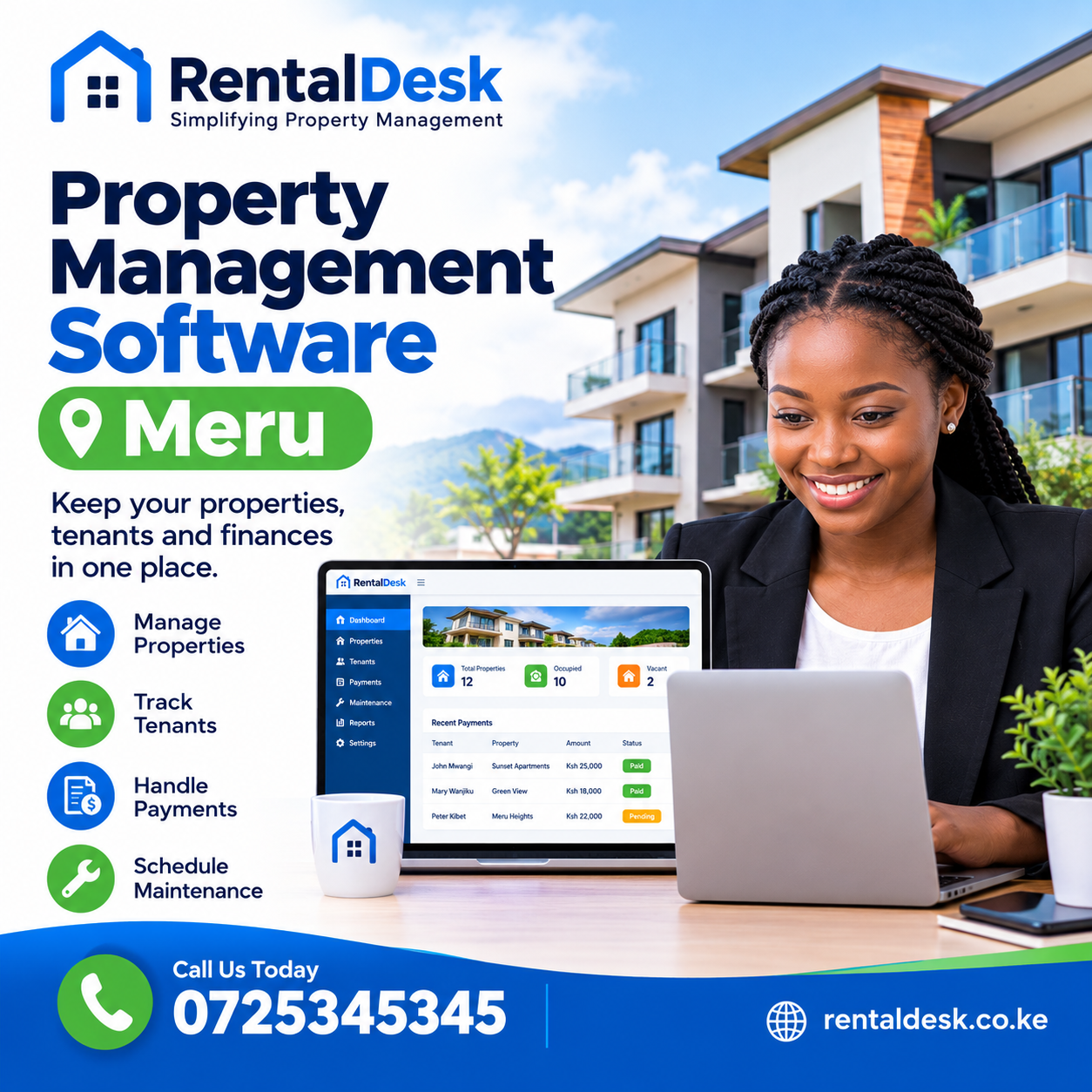
Property Management Software Meru: A Complete Guide for Landlords and Property Managers
Managing rental properties in Meru involves much more than collecting rent at the end of every month. A landlord or property manager may have to track tenants, leases, deposits, rent balances, repairs, utility charges, expenses, receipts and property records at the same time. Property Management Software Meru gives property owners and managers a structured way to bring these activities into one system instead of relying on notebooks, spreadsheets, WhatsApp conversations and scattered payment records.
This guide explains how property management technology can support landlords, property managers, caretakers and real-estate businesses operating in Meru. It covers rent collection, tenant management, maintenance, accounting, reporting, vacancy management, communication, security and portfolio growth. It also explains what to look for when choosing software and how to introduce it without disrupting existing rental operations.
Meru has several important urban centres and trading centres, with Meru Town being the largest urban centre. The county’s planning documents identify Meru Town, Nkubu, Laare, Timau and Maua among its major urban centres. This creates different management requirements for property owners depending on whether they operate apartments, residential houses, student accommodation, commercial premises or mixed-use buildings.
What Is Property Management Software?
Property Management Software Meru refers to a digital system that helps property owners and managers organize the day-to-day activities involved in operating rental properties.
Instead of keeping tenant information in separate files, a property management platform can bring important records together. Depending on the system selected, a landlord may be able to maintain:
- Property and unit records
- Tenant profiles
- Lease information
- Rent charges
- Payment records
- Outstanding balances
- Receipts
- Maintenance requests
- Property expenses
- Utility charges
- Vacancy information
- Communication records
- Financial reports
The main purpose is organization. A landlord with ten units may manage records manually without too much difficulty. As the portfolio grows to dozens or hundreds of units, however, manual administration becomes increasingly difficult.
Property Management Software Meru can help turn a collection of individual records into a structured property database. Each property can have its units, tenants, charges and transactions recorded systematically.
This does not mean that software replaces the landlord or property manager. Instead, it gives the person responsible for the property better tools for completing routine administrative work and finding information quickly.
Why Property Management Has Become More Complex
Rental property management often involves many small tasks that must be completed consistently.
For example, a manager may need to know:
- Which tenants have paid?
- Which tenants have outstanding balances?
- Which leases are approaching expiry?
- Which units are vacant?
- Which maintenance issues are unresolved?
- How much was collected this month?
- How much was spent on repairs?
- Which tenants have outstanding utility charges?
- Which properties generate the most income?
- Which expenses need attention?
Property Management Software Meru can make these questions easier to answer because information is stored in an organized environment rather than spread across several documents.
For a growing rental business, the value is not simply having a computerised record. The greater benefit comes from being able to connect tenants, units, payments, expenses and reports into one workflow.
Why Landlords in Meru Need Better Property Records
Good records are fundamental to effective property management. A landlord cannot properly evaluate a property if the rental income, expenses and tenant information are incomplete.
Property Management Software Meru can support better record keeping by creating a central location for information about properties and tenants.
Consider a landlord who owns several rental units around Meru Town. If tenant details are kept in a notebook, rent payments are confirmed through M-Pesa messages and repair requests arrive through WhatsApp, important information may be difficult to retrieve later.
A digital system can organize these activities around individual properties and units.
Managing Properties From One Dashboard
A dashboard can provide a quick overview of the portfolio.
A manager may be able to see:
- Total properties
- Number of units
- Occupied units
- Vacant units
- Expected rent
- Collected rent
- Outstanding balances
- Maintenance requests
- Recent transactions
Property Management Software Meru can therefore reduce the amount of time spent looking through individual records.
This is particularly useful for landlords who live outside Meru but own property within the county. Instead of depending entirely on physical visits, the owner can use digital reports and records to maintain visibility over operations.
Rent Collection and Payment Tracking
Rent collection is one of the most important responsibilities in rental property management.
In Kenya, mobile money is a major part of everyday payments. Safaricom’s official information describes Paybill as a service that allows organizations to collect money regularly from customers through M-PESA.
Property Management Software Meru can help a landlord organize payment information after rent is received.
A good rental system should make it easy to answer questions such as:
- How much rent was charged?
- How much has been paid?
- What amount remains outstanding?
- Which unit made the payment?
- When was the payment made?
- Has a receipt been issued?
- Is the tenant in arrears?
Reducing Manual Payment Reconciliation
Manual reconciliation can consume considerable administrative time.
Suppose a building has 60 tenants. Each month, the manager may receive many payment notifications. The challenge is connecting each payment to the correct tenant and unit, recording it correctly and updating the outstanding balance.
Property Management Software Meru can help structure this process by maintaining tenant ledgers and payment records.
The software should still be configured carefully. A landlord needs to verify the payment channels, account references, tenant information and reconciliation rules used by the system.
M-Pesa and Rental Operations
M-Pesa is particularly relevant to Kenyan property businesses because tenants can use mobile payment channels to make recurring payments. Safaricom documents several M-PESA business channels, including Paybill, Till and web-based business management tools.
Property Management Software Meru can complement these payment processes by organizing the resulting rental records.
The important point is that payment collection and record keeping should work together. Receiving money is only one part of the process. The landlord also needs a clear record showing which tenant paid, what the payment covered and whether a balance remains.
Tenant Management
Tenant information can become difficult to manage when it is stored in different places.
A tenant profile may contain:
- Full name
- Telephone number
- Email address
- Identification details
- Unit number
- Lease start date
- Lease end date
- Deposit information
- Monthly rent
- Payment history
- Maintenance history
- Communication records
Property Management Software Meru can provide a central tenant database where authorized users can access relevant information.
Tenant Onboarding
When a new tenant moves into a property, the manager may need to record the agreement, deposit, rent amount, move-in date and other details.
A standardized digital onboarding process can reduce missing information.
Property Management Software Meru can also help create consistency when multiple staff members are responsible for tenant administration.
For example, a property management company managing several buildings should ideally use the same basic onboarding workflow across its portfolio. That makes it easier for another team member to understand a tenant’s record.
Tenant Statements
Tenants may occasionally ask for payment statements or clarification about outstanding balances.
Instead of searching through old messages and receipts, the manager can retrieve the tenant’s transaction history from the system.
Property Management Software Meru can make statement preparation easier by organizing charges and payments chronologically.
A clear statement can show:
| Item | Example |
|---|---|
| Monthly rent | KSh 20,000 |
| Water charge | KSh 800 |
| Previous balance | KSh 2,000 |
| Payment received | KSh 20,000 |
| Current balance | KSh 2,800 |
The figures above are only an example. Actual rent and utility charges depend on the property and tenancy agreement.
Lease and Occupancy Management
A rental property is more than a collection of payment records. Each occupied unit has a tenancy relationship that needs to be monitored.
Property Management Software Meru can help property managers maintain lease information and monitor important dates.
A system may provide reminders for:
- Lease expiry
- Rent review dates
- Deposit records
- Move-in dates
- Move-out dates
- Inspection dates
- Renewal discussions
This reduces dependence on memory.
Managing Vacant Units
Vacancy affects rental income. A vacant unit may generate no rent while still creating expenses such as security, utilities, maintenance and cleaning.
Property Management Software Meru can help managers maintain a current record of available units.
A vacancy workflow may include:
- Mark the unit as becoming vacant.
- Record the expected move-out date.
- Schedule inspection.
- Record necessary repairs.
- Clean and prepare the unit.
- Update the availability status.
- Advertise the unit.
- Record viewing appointments.
- Select a suitable tenant.
- Complete onboarding.
A structured process prevents vacant units from being forgotten.
Maintenance Management
Maintenance is one of the most visible parts of property management from the tenant’s perspective.
A leaking pipe, faulty electrical fitting, blocked drain or broken door can quickly become a source of frustration if it is not handled properly.
Property Management Software Meru can help property managers record maintenance requests and monitor their progress.
Creating Maintenance Requests
A useful maintenance workflow should capture:
- Tenant name
- Property
- Unit
- Problem description
- Date reported
- Priority
- Assigned technician
- Estimated cost
- Actual cost
- Completion date
- Status
This creates a history for every maintenance issue.
Why Maintenance Records Matter
Maintenance records can reveal patterns.
Suppose the same water system repeatedly requires repairs. The manager can review the history and consider whether a larger replacement or improvement is more practical than repeated small repairs.
Property Management Software Meru can also help separate routine repairs from major maintenance projects.
A property owner can use historical information when planning future budgets.
Expense Tracking
Rental income alone does not show whether a property is performing well.
Landlords may have expenses related to:
- Repairs
- Cleaning
- Security
- Landscaping
- Plumbing
- Electrical work
- Management
- Utilities
- Insurance
- Property improvements
- Service providers
Property Management Software Meru can help categorize these expenses and connect them to specific properties.
Understanding Net Property Income
A simple example illustrates why expense tracking matters.
Assume a property generates KSh 300,000 in monthly rental income.
If operating expenses total KSh 75,000, the property does not have KSh 300,000 available as net operating income. The relevant amount before other considerations would be KSh 225,000.
A system that records only rent collections can hide the true operating picture.
Property Management Software Meru can therefore be useful for landlords who want to monitor both revenue and expenses.
Financial Reporting
Reports help transform individual transactions into useful business information.
A property manager may need reports covering:
- Rent collected
- Rent outstanding
- Tenant balances
- Property expenses
- Maintenance costs
- Occupancy
- Vacancies
- Revenue by property
- Collections by month
- Expense categories
Property Management Software Meru can help organize these reports in a format that makes trends easier to understand.
Monthly Property Reports
A monthly report might include:
| Metric | What it tells you |
|---|---|
| Expected rent | Amount billed |
| Collected rent | Amount received |
| Arrears | Amount still outstanding |
| Expenses | Operating costs |
| Occupancy | Units currently occupied |
| Vacancies | Units available |
| Maintenance | Repair activity |
| Net income | Income after selected expenses |
These figures can help the owner decide where further attention is required.
Comparing Properties
Owners with several buildings may want to compare their performance.
For example, a landlord may operate:
- Apartment Block A in Meru Town
- Shops in Nkubu
- Residential units in Maua
- Rental houses in Timau
Property Management Software Meru can make portfolio-level reporting easier if the system supports multiple properties.
Meru County’s official information identifies several major urban centres and numerous trading centres, meaning property operations can be spread across different locations rather than concentrated in one town.
Service Charge and Utility Management
Some properties involve charges beyond basic rent.
These may include:
- Water
- Garbage collection
- Security
- Common-area electricity
- Cleaning
- Internet
- Shared facility costs
Property Management Software Meru can help landlords keep additional charges separate from basic rent where the tenancy arrangement requires it.
For multi-unit buildings, utility management becomes especially important when costs need to be allocated across tenants.
Meter-Based Charges
Where water or another utility is metered, the manager may record:
- Previous reading
- Current reading
- Consumption
- Rate
- Amount charged
- Payment status
The software should allow the manager to explain how charges were calculated.
This improves transparency and can reduce disputes.
Communication With Tenants
Good communication is an important part of property management.
Tenants may need reminders about:
- Rent due dates
- Outstanding balances
- Maintenance visits
- Water interruptions
- Security notices
- Inspections
- Lease matters
- Building announcements
Property Management Software Meru can support more organized communication when messages and tenant information are connected to the property records.
Moving Away From Scattered WhatsApp Messages
WhatsApp can be useful for everyday communication, but it is not necessarily a complete property record.
A message such as “the kitchen tap is leaking” may disappear among hundreds of other messages.
If the request is recorded as a maintenance ticket, the manager can later see:
- When it was reported
- Who reported it
- What action was taken
- Who handled it
- What it cost
- Whether it was completed
Property Management Software Meru can therefore help convert informal communication into structured operational records.
Managing Property Inspections
Regular inspections help property owners understand the condition of their buildings.
An inspection process may cover:
- Walls
- Doors
- Windows
- Plumbing
- Electrical fittings
- Floors
- Roofs
- Common areas
- Water systems
- Security features
Property Management Software Meru can help maintain inspection records that can be referenced later.
A useful inspection record should include the date, property, unit, observations and recommended action.
Photographs can also be valuable where the software supports attachments.
Managing Multiple Properties
Managing one property and managing twenty properties are very different tasks.
With multiple buildings, the manager needs to distinguish between properties, units, tenants, payments and expenses.
Property Management Software Meru can support multi-property administration when the platform is designed for portfolios.
A central dashboard can help the manager move from a portfolio view to a specific building and then to an individual unit.
For example:
Portfolio → Meru Town Apartments → Block B → Unit B12 → Tenant Account
That structure makes information easier to locate.
Why Cloud-Based Access Can Help
Cloud-based systems can allow authorized users to access property records from different locations.
This can be useful when:
- The landlord travels frequently.
- The property manager works from an office.
- A caretaker needs limited access.
- An accountant needs financial records.
- Multiple properties are located in different towns.
Property Management Software Meru can provide a centralized approach where the software supports secure remote access.
The actual security and availability of any platform depend on the provider’s infrastructure, account controls, backups and security practices, so these should be evaluated before implementation.
Staff and Role Management
A property management company may have several people involved in daily operations.
For example:
- Property owner
- Property manager
- Accountant
- Caretaker
- Maintenance worker
- Reception or office staff
Not everyone should necessarily have access to every financial or tenant record.
Property Management Software Meru can be particularly useful when a platform supports role-based access.
A manager might have broad access while a maintenance worker only sees assigned repair requests.
This principle reduces unnecessary access to sensitive information.
Data Security and Backups
Rental management systems contain valuable information.
A property database may include tenant contact information, transaction history, lease details and financial records.
Property Management Software Meru should therefore be evaluated not only on features but also on how data is protected.
When comparing providers, ask about:
- Password security
- User permissions
- Data backups
- Account recovery
- Access logs
- Data export
- Server security
- Privacy practices
- Support procedures
Do not assume that every software product provides the same level of protection.
How Software Can Save Administrative Time
One of the strongest reasons to adopt rental management software is to reduce repetitive administrative work.
Consider a manager who has to prepare monthly rent statements manually.
The process might involve:
- Opening a spreadsheet.
- Checking previous balances.
- Searching for payments.
- Updating each tenant.
- Calculating balances.
- Preparing statements.
- Sending them individually.
Property Management Software Meru can simplify this workflow if statements are generated from the property’s existing transaction records.
The same principle applies to reminders, reports, maintenance tracking and vacancy records.
Automation should not eliminate oversight. Instead, it should allow staff to spend more time on decisions and tenant service rather than repetitive data entry.
How to Choose the Right Software for a Meru Property
Choosing a property management platform requires more than looking at a list of features.
The system should match the actual needs of the property.
Property Management Software Meru should be assessed against questions such as:
1. How many units do you manage?
A landlord with ten units may have different requirements from a property company managing hundreds.
2. How do tenants pay?
Check whether the software supports the payment methods commonly used by your tenants.
3. Do you manage multiple properties?
If yes, verify that the system can separate properties while providing a consolidated portfolio view.
4. Do you need accounting reports?
If financial reporting is important, ask for a demonstration of actual reports rather than relying on a feature name.
5. Do tenants need self-service access?
Some landlords may want tenants to view balances, statements or maintenance requests directly.
6. Who will use the system?
Consider whether the software supports different user roles.
7. What happens if you leave the provider?
Ask whether your property records can be exported in a usable format.
Features to Prioritize
A practical evaluation checklist can help.
Property Management Software Meru should ideally support the workflows that matter most to your business.
| Feature | Why it matters |
|---|---|
| Tenant management | Keeps tenant records organized |
| Rent tracking | Shows paid and outstanding amounts |
| Payment records | Maintains transaction history |
| Lease management | Tracks important tenancy dates |
| Maintenance | Records repair requests |
| Expense tracking | Shows operating costs |
| Reporting | Supports financial decisions |
| Multi-property management | Handles growing portfolios |
| Communication | Organizes tenant notices |
| User permissions | Controls staff access |
| Data export | Supports record portability |
| Mobile access | Helps managers work remotely |
The exact feature set varies between providers, so ask for a practical demonstration.
Common Mistakes When Choosing Rental Software
A landlord can still make a poor software decision even when the product has many features.
Choosing Based Only on Price
A low subscription cost may look attractive, but a system that does not support your workflows can create additional manual work.
Property Management Software Meru should be evaluated according to the total value it provides, including support, reporting and ease of use.
Buying Features You Do Not Need
A small landlord does not necessarily need every advanced feature.
Choose according to the actual requirements of the property.
Ignoring User Experience
If staff find the software confusing, they may avoid using it.
The best system for a particular organization is one that users can understand and operate consistently.
Failing to Plan Data Migration
Moving from spreadsheets or notebooks requires planning.
Property Management Software Meru can only be useful if the underlying property and tenant data is accurate.
Before migration, review:
- Duplicate tenants
- Incorrect balances
- Missing phone numbers
- Old tenants
- Vacant units
- Incorrect rent amounts
- Outdated leases
Clean data makes implementation easier.
A Practical Implementation Plan
Property owners do not have to digitize everything in one afternoon.
A phased approach can be more manageable.
Property Management Software Meru can be introduced through the following process:
Step 1: List Your Properties
Create a master list of buildings, units and property locations.
Step 2: Review Tenant Records
Confirm names, contacts, units, rent amounts and tenancy status.
Step 3: Record Opening Balances
Make sure outstanding balances are correctly captured.
Step 4: Configure Payment Methods
Confirm how rent and other charges are received.
Step 5: Train Staff
Show employees how to perform common tasks.
Step 6: Test the Workflow
Enter sample records and test rent collection, statements, reports and maintenance.
Step 7: Go Live
Start using the system for actual transactions after verification.
Step 8: Review Results
After the first month, identify missing information and process improvements.
Supporting Property Growth in Meru
Property management software is not only about handling today’s administrative tasks.
It can also help a property owner build a clearer operational foundation for future growth.
Property Management Software Meru can help a landlord maintain historical records as the portfolio expands.
Suppose an owner starts with 12 units and later develops another apartment block. Without a structured system, the owner may create separate spreadsheets and processes for each building.
With a suitable platform, the additional property can potentially be added to the same portfolio.
Using Reports for Business Planning
Historical records can support practical decisions.
For example, an owner can examine:
- Average occupancy
- Rental income
- Maintenance spending
- Expense trends
- Arrears
- Vacancy periods
Property Management Software Meru can make this information easier to organize.
The software does not make investment decisions automatically. It provides records that the property owner can use when making those decisions.
Managing Properties Across Meru County
Property operations in Meru can vary considerably by location.
A property in Meru Town may have different tenant profiles and operating requirements from a property in Maua, Nkubu or Timau.
Property Management Software Meru can help owners maintain separate records for different locations while keeping them under one portfolio where supported.
Meru County’s planning documents identify a number of urban and trading centres, and its urban planning strategy emphasizes continued development of its urban areas.
This makes organized property records increasingly useful for landlords who operate across more than one location.
Property Management for Apartments
Apartment buildings often require more structured management than a single rental house.
An apartment manager may need to coordinate:
- Many tenants
- Multiple units
- Shared facilities
- Water charges
- Security
- Cleaning
- Common-area maintenance
- Rent collection
- Tenant communication
Property Management Software Meru can provide a central system for coordinating these activities.
A property manager can also create recurring processes so that routine monthly tasks are not forgotten.
Property Management for Commercial Buildings
Commercial properties may have different lease structures and payment schedules.
A manager might need to track:
- Shops
- Offices
- Storage spaces
- Service charges
- Lease terms
- Deposits
- Utility charges
- Business tenants
Property Management Software Meru can help maintain records for different types of rental units if the software supports flexible property structures.
For commercial buildings, lease tracking can be particularly important because agreements may contain terms that differ from standard residential rentals.
Property Management for Student Housing
Where rental properties serve students, managers may experience seasonal demand and frequent tenant turnover.
The system should make it easy to:
- Register tenants
- Track deposits
- Record room assignments
- Monitor payments
- Manage move-ins
- Manage move-outs
- Track maintenance
Property Management Software Meru can help organize these processes.
The exact requirements depend on the property model and tenancy arrangements.
Improving Arrears Management
Outstanding rent requires timely follow-up.
A property manager should know not only the total amount owed but also who owes it, how long it has been outstanding and what communication has already taken place.
Property Management Software Meru can help create clearer arrears records.
A simple arrears workflow could be:
- Rent becomes due.
- Payment is recorded.
- Unpaid accounts are identified.
- Reminder is sent.
- Follow-up is recorded.
- Partial payments are updated.
- Outstanding balances remain visible.
- Further action follows the tenancy agreement and applicable law.
The system should support documentation rather than encourage aggressive or inappropriate collection practices.
Improving Owner Visibility
Some property owners are not involved in daily management.
They may live in another town, another county or outside Kenya.
Property Management Software Meru can be useful when the owner needs periodic reports without personally visiting every property.
For example, a monthly owner report might show:
- Rent billed
- Rent collected
- Outstanding rent
- Expenses
- Maintenance
- Occupancy
- Net operating figures
- Important notes
This creates a clearer communication channel between the property manager and owner.
The Role of Automation
Automation should be applied to repetitive tasks rather than important decisions that require human judgment.
Property Management Software Meru may support automated reminders, recurring charges, scheduled reports or other workflows depending on the product.
Useful automation examples include:
- Monthly rent invoices
- Payment reminders
- Lease expiry alerts
- Maintenance status notifications
- Recurring expense entries
- Monthly reports
Automation reduces the chance that a routine task is forgotten.
However, managers should still review automated records regularly.
Integrating Property Management With Business Operations
A growing property company may have additional business requirements.
It may need to connect property records with:
- Accounting
- Procurement
- Maintenance suppliers
- Banking
- Mobile payments
- Customer communication
- Document storage
Property Management Software Meru becomes more valuable when it fits into the wider business workflow rather than operating as an isolated application.
Before choosing integrations, identify the systems already used by the business.
Questions to Ask a Software Provider
Before purchasing or subscribing to a property management platform, ask direct questions.
Property Management Software Meru should be evaluated through a practical demonstration rather than a marketing description alone.
Ask:
- Can I manage multiple properties?
- Can I separate units within each property?
- Can I track tenant balances?
- Can I record M-Pesa payments?
- Can I issue receipts?
- Can I generate tenant statements?
- Can I track maintenance?
- Can I record expenses?
- Can I generate financial reports?
- Can staff have different permissions?
- Can I access the system from a phone?
- Can I export my data?
- What support is available?
- What happens if I need to cancel?
- How frequently is data backed up?
The answers should be specific rather than vague.
Cost Considerations
Pricing is an important part of software selection, but the cheapest product is not automatically the most suitable.
Property Management Software Meru should be assessed based on the actual cost of running the property business.
Potential costs may include:
- Subscription fees
- Setup charges
- Data migration
- SMS charges
- Payment processing
- Additional users
- Additional units
- Premium reports
- Support
Ask the provider for a complete pricing explanation before signing up.
Calculating the Value of Software
Suppose a manager spends several hours each week updating spreadsheets, preparing statements and checking payment records.
If software reduces repetitive administrative work, the saved time can be considered part of its value.
There may also be less obvious benefits:
- Better records
- Faster reporting
- Fewer duplicate entries
- Easier tenant follow-up
- Better visibility
- More consistent processes
Property Management Software Meru should therefore be evaluated as an operational tool rather than simply another monthly expense.
What Makes a Property Management System User-Friendly?
Good software should make common tasks straightforward.
A property manager should not need advanced technical knowledge to:
- Add a tenant
- Add a unit
- Record rent
- View an outstanding balance
- Create a statement
- Record maintenance
- Generate a report
Property Management Software Meru should be easy enough for the people who will actually use it every day.
A demo can reveal whether the system is intuitive.
Ask the provider to demonstrate a real workflow from tenant onboarding through rent payment and reporting.
The Importance of Local Relevance
A property management platform should reflect the environment in which the rental business operates.
For Kenyan landlords, this can include support for Kenyan currency, mobile payments, local phone formats and workflows familiar to property managers.
Property Management Software Meru should also fit the realities of the particular property rather than forcing every landlord into an unsuitable workflow.
Local context matters because rental operations are shaped by how tenants pay, communicate and interact with property managers.
Preparing for Digital Property Management
A successful transition begins with preparation.
Before implementing software, make a list of your current processes.
For example:
Rent collection: How are payments received and recorded?
Tenant records: Where are tenant details stored?
Maintenance: How are repair requests reported?
Expenses: Where are supplier payments recorded?
Reporting: How are monthly reports prepared?
Communication: Which channels are used for tenant notices?
Property Management Software Meru can then be selected according to the gaps identified during this review.
This approach is better than choosing software first and trying to change the entire business around it.
Benefits for Property Managers
Property managers often have to balance owner expectations with tenant needs.
A structured digital system can support that responsibility by making information easier to access.
Property Management Software Meru can help property managers:
- Monitor collections
- Track arrears
- Manage tenants
- Coordinate maintenance
- Record expenses
- Prepare reports
- Monitor vacancies
- Keep property records organized
The result is a more systematic operating process.
Benefits for Landlords
For landlords, the main benefit is visibility.
Property Management Software Meru can help owners understand what is happening across their rental portfolio without depending entirely on handwritten records or verbal updates.
A landlord can review reports and then discuss specific issues with the manager or caretaker.
This creates a more documented relationship between ownership and property operations.
Benefits for Tenants
Tenants also benefit when rental administration is organized.
A well-managed system can make it easier to:
- Confirm payments
- Obtain statements
- Receive reminders
- Report maintenance issues
- Receive property notices
- Track requests
Property Management Software Meru can therefore contribute to a more consistent tenant experience when the landlord uses the system effectively.
Technology alone does not guarantee good service. The quality of service still depends on how the property manager responds to tenants.
Frequently Asked Questions
1. What does Property Management Software Meru help landlords manage?
Property Management Software Meru can help landlords manage property records, tenants, rent, payments, leases, maintenance, expenses, vacancies and reports. The exact capabilities depend on the software provider.
2. Can Property Management Software Meru support M-Pesa rent collection?
Property Management Software Meru can support M-Pesa-related rental workflows when the selected platform provides the necessary payment integration or payment-recording features. Safaricom provides business payment channels including Paybill and other M-PESA services.
3. Is Property Management Software Meru suitable for small landlords?
Property Management Software Meru can be suitable for small landlords if the system’s pricing and features match the size of the portfolio. A landlord should avoid paying for unnecessary features while ensuring the platform handles essential tasks.
4. Can Property Management Software Meru manage multiple properties?
Property Management Software Meru can manage multiple properties if the provider offers multi-property functionality. Before subscribing, confirm the maximum number of properties and units supported by the chosen plan.
5. Can Property Management Software Meru track tenant arrears?
Property Management Software Meru can track arrears when rent charges, payments and balances are recorded in the system. A manager can then use the records to identify outstanding accounts and follow the appropriate collection process.
6. Can Property Management Software Meru manage maintenance requests?
Property Management Software Meru can support maintenance management where the software includes maintenance or work-order functionality. Useful records include the tenant, unit, problem, date reported, assigned worker, cost and completion status.
7. Is Property Management Software Meru useful for properties outside Meru Town?
Property Management Software Meru can be useful for properties located across different parts of Meru County, provided the platform supports multiple properties and locations. Meru County includes several major urban centres and many trading centres.
8. How much does Property Management Software Meru cost?
Property Management Software Meru does not have one universal price. Different providers may charge according to units, properties, users, features or usage. Request current pricing directly from the provider before making a decision.
9. Can Property Management Software Meru generate financial reports?
Property Management Software Meru can generate financial reports when reporting tools are included. Before choosing a platform, ask to see examples of rent collection, expense, arrears and property performance reports.
10. What should I check before choosing Property Management Software Meru?
Property Management Software Meru should be evaluated according to your portfolio size, payment methods, tenant management needs, maintenance workflow, reporting requirements, user permissions, data security, support and overall cost.
Final Thoughts
Managing rental properties successfully requires reliable information, consistent processes and timely follow-up. As a portfolio grows, relying entirely on notebooks, spreadsheets and scattered messages can make it harder to maintain a clear picture of income, expenses, tenants and maintenance.
Property Management Software Meru provides a structured approach to organizing these activities. The right system can help a landlord keep property records together, monitor payments, track tenants, manage maintenance and prepare useful reports.
The value is particularly clear when several properties or many rental units are involved. Instead of treating every unit as a separate administrative task, a property manager can build a connected portfolio where properties, tenants, payments and expenses are easier to follow.
Property Management Software Meru can also help owners improve visibility over rental operations. M-Pesa and other digital payment channels have made electronic rent payments practical for Kenyan businesses, but payment collection still needs accurate record keeping and reconciliation. Safaricom’s documentation confirms the availability of Paybill and other business payment channels for collecting and managing payments.
For landlords in Meru, the most important step is not simply choosing software with the longest feature list. It is choosing a system that matches the property’s actual workflow.
Property Management Software Meru should make everyday activities easier, not more complicated.
Before committing to a platform, review your current processes, identify the tasks that consume the most time, determine which records are difficult to maintain and establish the reports you need. Then compare software based on those requirements.
Property Management Software Meru can become a useful operational foundation when it is implemented carefully, used consistently and supported by accurate property data.
A landlord who begins with clean tenant records, clear payment procedures and defined responsibilities will have an easier time adopting a digital system.
Property Management Software Meru is therefore best viewed as part of a wider property management strategy. The software provides the tools, while the landlord or property manager remains responsible for making sound operational decisions, communicating professionally with tenants and maintaining the property properly.
For a growing rental portfolio, that combination of organized information and disciplined management can make everyday administration more manageable.
Property Management Software Meru can help bring the different parts of rental administration into one organized workflow, giving property owners a clearer view of their properties and helping managers spend less time searching for information.
The next step is to assess your portfolio and identify what you actually need from a property management system. Start with your number of units, tenant records, payment process, maintenance workflow and reporting requirements. Use those needs as the basis for comparing available solutions.
Property Management Software Meru can then be evaluated not simply as software, but as a practical tool for improving the way your rental business operates.
A well-organized property operation begins with accurate information. When that information is accessible, current and properly structured, landlords and property managers can respond to issues faster, maintain better records and make more informed decisions about their rental properties.
Property Management Software Meru is ultimately about bringing those everyday property management activities into a more organized system so that landlords and managers can focus on running their properties effectively.
Property Management Software Meru can support this transition by giving rental businesses a central place for the records and workflows that matter most.
Property Management Software Meru can also be considered by owners who expect their portfolios to expand and want their property administration to become more structured as the number of units increases.
Property Management Software Meru should therefore be selected with both current needs and future operational requirements in mind.
Property Management Software Meru can be especially useful when the goal is to replace fragmented records with a clearer, more consistent management process.
Property Management Software Meru can support the daily work of tracking rent, tenants, maintenance and expenses, provided the chosen platform includes those capabilities.
Property Management Software Meru can help turn property data into practical reports that support regular monitoring.
Property Management Software Meru can also help create a central record for properties spread across different locations.
Property Management Software Meru can support organized tenant and payment administration when implemented with accurate data.
Property Management Software Meru can make routine rental records easier to access and review.
Property Management Software Meru can support a more consistent process for property managers and staff.
Property Management Software Meru can help landlords maintain clearer tenant histories and payment information.
Property Management Software Meru can support better organization of property operations as portfolios grow.
Property Management Software Meru can make it easier to keep important rental records together.
The most important consideration is whether the software solves real operational problems for the property owner or manager.
Property Management Software Meru should reduce unnecessary administrative effort while improving visibility over the rental business.
Property Management Software Meru can provide a structured foundation for monitoring properties, tenants, payments and expenses.
Property Management Software Meru can support more organized property administration when the platform’s features match the landlord’s needs.
Property Management Software Meru can help property managers keep maintenance, tenant and payment information in a more accessible format.
Property Management Software Meru can support landlords who want to move from fragmented records toward a more centralized rental management process.
Property Management Software Meru can help create clearer visibility into property performance.
Property Management Software Meru can support structured property records and reporting when the selected workflows are configured correctly.
Property Management Software Meru can be part of a broader strategy for improving rental administration.
Property Management Software Meru can help property managers organize day-to-day activities and keep important information easier to retrieve.
Property Management Software Meru can support a more systematic approach to tenant communication and property records.
Property Management Software Meru can help landlords and property managers centralize the information required to operate rental properties efficiently.
Property Management Software Meru can support property management workflows when its features align with the requirements of the portfolio.
Property Management Software Meru can help growing property businesses establish repeatable administrative processes.
Property Management Software Meru can support a structured approach to managing multiple units and properties.
Property Management Software Meru can help landlords reduce dependence on scattered records.
Property Management Software Meru can support more organized payment and tenant administration.
Property Management Software Meru can help property managers maintain records that are easier to review.
Property Management Software Meru can support reporting and portfolio visibility.
Property Management Software Meru can help centralize operational information.
Property Management Software Meru can support more efficient day-to-day property administration.
Property Management Software Meru can help managers maintain consistent records across rental units.
Property Management Software Meru can support organized tenant and lease information.
Property Management Software Meru can help landlords maintain clearer records as their portfolios expand.
Property Management Software Meru can support a more structured approach to rental property administration.