
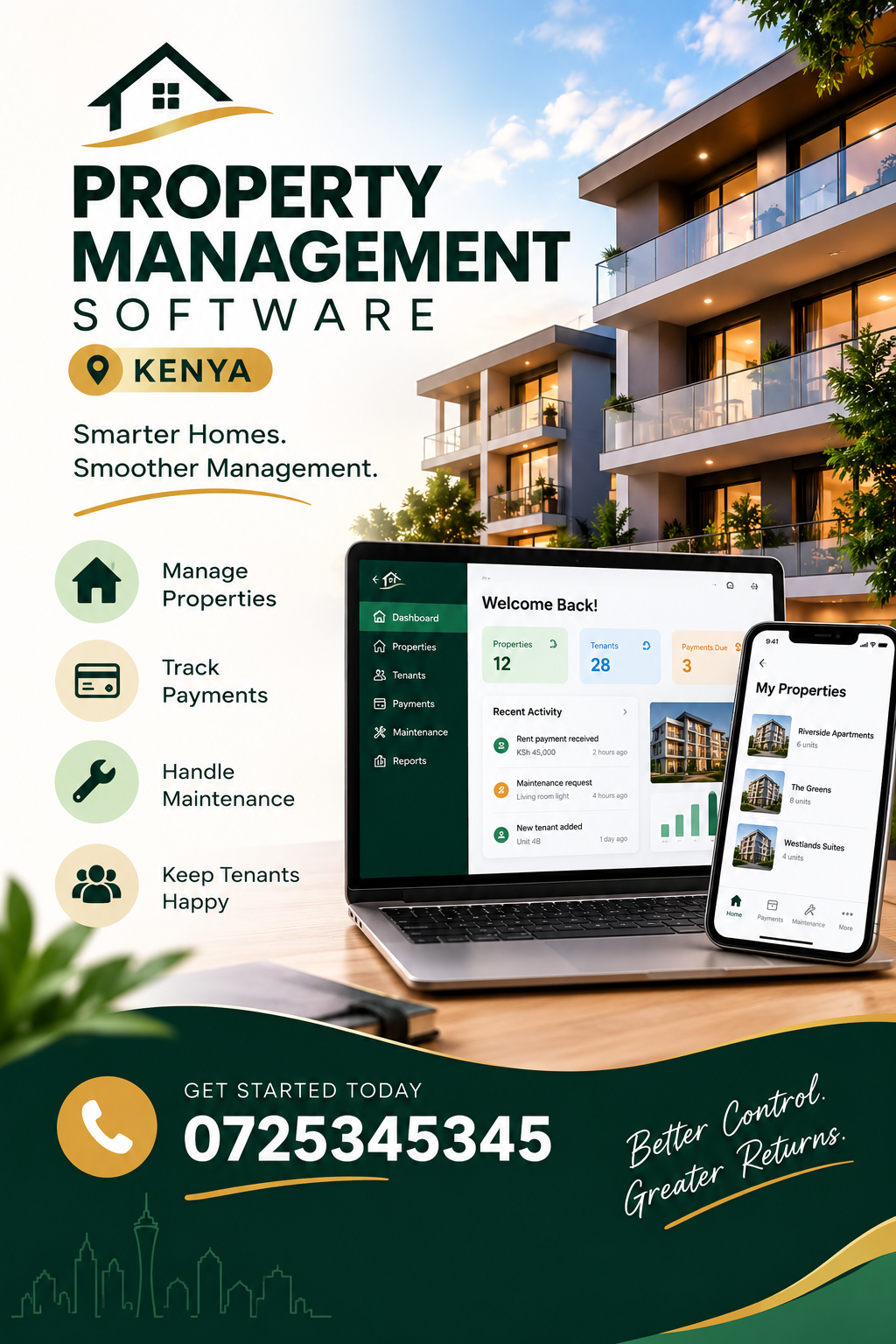
Property Management Software Kenya: A Practical Guide for Property Owners and Managers
Managing rental property involves much more than collecting rent every month. Property owners and managers have to keep tenant records, monitor vacancies, follow up on arrears, coordinate repairs, issue receipts, track expenses and keep financial information organized. The right Property Management Software Kenya solution can bring these activities into one organized system, making daily property operations easier to manage. This guide explains how property management software works, the features to look for, how it can support landlords and property managers in Kenya, and what to consider before choosing a solution.
What Is Property Management Software?
Property Management Software Kenya refers to a digital system designed to help landlords, property managers, estate agents and property management companies organize and automate the day-to-day activities associated with rental properties.
Instead of maintaining separate notebooks, spreadsheets, payment messages and paper files, a property manager can use one platform to manage information about properties, units, tenants, leases, rent payments, maintenance requests and expenses.
The exact capabilities differ from one platform to another, but a comprehensive property management system can help with:
- Property and unit records
- Tenant registration
- Lease information
- Rent billing
- Payment tracking
- Arrears monitoring
- Receipts
- Expense management
- Maintenance requests
- Vacancy management
- Property reports
- Communication records
- User access and permissions
- Financial summaries
This is particularly useful for landlords with several rental units. As the number of properties increases, manually tracking every transaction becomes increasingly difficult.
A system also gives property owners better visibility. Instead of waiting until the end of the month to calculate income and outstanding balances, they can review relevant information from organized records.
Why Kenyan Property Managers Need Better Digital Systems
Property management in Kenya has its own operational realities. Rent payments may come through M-Pesa, bank transfers or other channels. Tenants may occupy units under different agreements, and landlords may manage residential apartments, commercial premises, bedsitters, shops or mixed-use developments.
Property Management Software Kenya can help bring these different activities into a structured workflow.
Consider a landlord managing 30 units. Every month, the landlord may need to determine:
- Which tenants have paid?
- Which tenants have partial balances?
- Which tenants have not paid?
- Which units are vacant?
- Which maintenance issues remain unresolved?
- How much rent was collected?
- How much was spent on repairs?
- Which expenses are still outstanding?
- Which leases are approaching renewal?
- What is the property’s overall financial position?
Trying to answer these questions using several spreadsheets and WhatsApp conversations can consume significant time.
A centralized system reduces the need to search through different sources of information.
Moving Beyond Spreadsheets
Spreadsheets are useful for many small businesses, and a landlord with a handful of units may initially find them sufficient. Problems often emerge when the portfolio grows.
A spreadsheet may record rent received, but it does not necessarily provide a complete workflow for maintenance requests, tenant communication, automated reminders and property-level reporting.
Property Management Software Kenya can provide a more structured approach by connecting different operational activities.
For example, a tenant’s profile can contain relevant information such as:
- Name
- Contact details
- Assigned property
- Unit number
- Lease dates
- Rent amount
- Deposit information
- Payment history
- Outstanding balance
- Maintenance requests
Having these details together makes it easier to understand the tenant’s account without searching through multiple files.
Spreadsheets can still be useful as supporting tools, but a dedicated platform becomes increasingly valuable when the property portfolio requires regular monitoring and multiple people are involved in management.
Centralized Property Records
One of the most basic but important functions of a digital property management system is record organization.
Property Management Software Kenya can allow managers to create structured records for buildings, properties, blocks, floors and individual units.
For example, an apartment development could be organized as:
| Level | Information |
|---|---|
| Property | Apartment building |
| Block | Block A |
| Floor | Third floor |
| Unit | 3B |
| Tenant | Assigned occupant |
| Rent | Monthly amount |
| Status | Occupied |
| Balance | Current outstanding amount |
This structure makes it easier to retrieve information when a tenant calls, when an owner requests a report or when management needs to review occupancy.
A property database can also reduce duplication. Instead of entering the same property details repeatedly in separate spreadsheets, managers can maintain one central record.
Tenant Management
Tenants are at the center of rental operations. Good tenant management requires accurate records from the beginning of a tenancy through move-out.
Property Management Software Kenya can help managers organize tenant information and associate each tenant with the correct property and unit.
A tenant management module may contain:
- Tenant names
- Phone numbers
- Email addresses
- Identification references
- Lease information
- Rent amount
- Deposit
- Payment history
- Outstanding balances
- Move-in date
- Lease expiry date
- Maintenance history
This information becomes especially valuable when managing dozens or hundreds of tenants.
A manager can quickly identify which tenant occupies a particular unit without searching through paper files.
Why Accurate Tenant Records Matter
Incomplete records can create avoidable problems.
For example, if a property manager does not know when a lease expires, renewal discussions may happen too late. If a payment is recorded against the wrong unit, the tenant account may show an incorrect balance.
A centralized tenant database helps reduce these administrative errors.
Rent Collection and Payment Tracking
Rent collection is one of the most important responsibilities in property management.
Property Management Software Kenya can help managers record expected rent and compare it with payments received.
A basic rent workflow might look like this:
Rent billed → Tenant notified → Payment received → Payment recorded → Receipt generated → Balance updated
The system can also help managers identify unpaid balances.
For example, if a tenant owes KSh 25,000 and pays KSh 15,000, the system should be able to reflect the remaining KSh 10,000 rather than treating the account as fully settled.
This type of visibility is useful when managing many units because small unpaid balances can accumulate across a large portfolio.
M-Pesa and Digital Payments
M-Pesa is an important payment channel for many Kenyan businesses and consumers. Property managers therefore need systems that can fit naturally into local payment workflows.
Property Management Software Kenya may support payment recording and, depending on the platform, integration with digital payment channels.
A property manager should check exactly how a software solution handles M-Pesa before purchasing it. Important questions include:
- Can payments be matched to specific tenants?
- Can the system record transaction references?
- Are receipts generated automatically?
- Can payment information be reconciled?
- Can managers see partial payments?
- Can the system identify outstanding balances?
- Is payment information reflected in reports?
The objective is not simply to accept money. The objective is to maintain accurate records after money has been received.
Automated Rent Reminders
Following up on rent manually can become exhausting when a manager handles a large number of tenants.
Property Management Software Kenya can help automate reminders where the platform provides notification functionality.
Instead of individually contacting every tenant, a manager may be able to configure reminders for:
- Upcoming rent due dates
- Overdue balances
- Payment confirmations
- Lease renewals
- Maintenance updates
Automation does not eliminate the need for communication. It reduces repetitive administrative work so that managers can focus on situations requiring personal attention.
Managing Rent Arrears
Rent arrears require consistent monitoring. A tenant who misses one payment can quickly become several months behind if the account is not followed up.
Property Management Software Kenya can provide an arrears view that helps managers identify outstanding balances.
A useful arrears report might show:
| Tenant | Unit | Expected Rent | Paid | Balance |
|---|---|---|---|---|
| Tenant A | A101 | KSh 20,000 | KSh 20,000 | KSh 0 |
| Tenant B | A102 | KSh 20,000 | KSh 15,000 | KSh 5,000 |
| Tenant C | A103 | KSh 25,000 | KSh 0 | KSh 25,000 |
Such information allows the manager to prioritize follow-ups.
Instead of checking every tenant manually, management can start with accounts carrying outstanding balances.
Why Arrears Reports Matter
Arrears affect cash flow. A property may have full occupancy but still experience financial pressure if a significant portion of expected rent remains unpaid.
A clear arrears report therefore helps distinguish between occupancy and actual cash collection.
Property Maintenance Management
Maintenance is another major part of rental management.
A tenant may report a leaking tap, broken electrical fitting, damaged door, blocked drain or plumbing problem. Without an organized maintenance process, requests can easily be forgotten.
Property Management Software Kenya can help managers record maintenance requests and track their progress.
A maintenance workflow can include:
- Tenant reports the problem.
- Manager records the request.
- Request is assigned a priority.
- Technician or contractor is contacted.
- Work begins.
- Repair is completed.
- Cost is recorded.
- Request is closed.
This creates an audit trail.
Instead of relying on memory or scattered messages, management can review when the issue was reported, what action was taken and how much the repair cost.
Preventive Maintenance
Not every maintenance activity should begin after something breaks.
Preventive maintenance involves regularly inspecting and servicing property components before they create larger problems.
Examples include:
- Plumbing inspections
- Electrical checks
- Roof inspections
- Water system checks
- Common-area maintenance
- Security equipment checks
- Cleaning schedules
- Generator servicing
- Elevator servicing where applicable
Property Management Software Kenya can support maintenance planning where scheduling functionality is available.
A digital maintenance calendar can help managers see upcoming tasks rather than responding only to emergencies.
Managing Property Expenses
Rental income is only one side of property management. Expenses also need to be tracked carefully.
Common property expenses may include:
- Repairs
- Cleaning
- Security
- Landscaping
- Utilities
- Maintenance contracts
- Property staff
- Management costs
- Insurance
- Equipment
- Professional services
Property Management Software Kenya can help organize expense records by property or category.
For example, if a landlord owns three buildings, management may want to know how much each building costs to maintain.
A property-level expense report can make this comparison easier.
Understanding Property Profitability
Gross rent collection does not necessarily equal profit.
Suppose a building generates KSh 500,000 in monthly rent. If expenses amount to KSh 140,000, the owner needs to consider the remaining amount after operating expenses rather than focusing only on the gross rent figure.
A software system can help organize the numbers needed for this analysis.
Invoicing and Receipts
Professional documentation is important when dealing with tenants.
Property Management Software Kenya can support invoicing and receipt workflows where those functions are included.
A digital receipt can provide a record showing:
- Tenant name
- Unit
- Payment date
- Amount paid
- Payment method
- Transaction reference
- Outstanding balance where applicable
Clear receipts reduce confusion and give both management and tenants documentation of transactions.
Vacancy Management
Empty units represent lost rental income.
A property manager needs to know which units are occupied, vacant, reserved or undergoing preparation.
Property Management Software Kenya can help maintain unit status information.
A simple dashboard might categorize units as:
- Occupied
- Vacant
- Notice given
- Under maintenance
- Reserved
- Awaiting tenant
This allows management to identify vacancies quickly.
For example, if Unit B12 becomes vacant, management can immediately mark it accordingly and begin the process of preparing and marketing the unit.
Lease Management
Lease information should not be left in a filing cabinet where it can be forgotten.
Property Management Software Kenya can help managers organize lease dates and tenant agreements.
Important lease information may include:
- Start date
- Expiry date
- Monthly rent
- Deposit
- Notice period
- Renewal terms
- Tenant information
- Unit details
Lease expiry reminders can help management start renewal discussions before the existing agreement ends.
This is particularly useful for portfolios containing many tenants with different lease dates.
Property Reporting
Good management depends on good information.
Property Management Software Kenya can provide reports that help property owners understand operational performance.
Useful reports may include:
- Rent collection reports
- Arrears reports
- Occupancy reports
- Vacancy reports
- Expense reports
- Tenant statements
- Property income reports
- Maintenance reports
- Payment summaries
Reports should be easy to understand.
A property owner does not necessarily need a complicated financial dashboard. They need information that helps answer practical questions.
For example:
How much rent was expected this month?
How much was collected?
How much remains outstanding?
Which units are vacant?
How much was spent on maintenance?
Owner Statements
Property managers often need to report to property owners.
Property Management Software Kenya can make it easier to compile information about income and expenses for a particular property.
An owner statement may include:
| Category | Amount |
|---|---|
| Gross rent | KSh 400,000 |
| Maintenance | KSh 35,000 |
| Security | KSh 20,000 |
| Cleaning | KSh 12,000 |
| Other expenses | KSh 8,000 |
| Net amount before other adjustments | KSh 325,000 |
The exact calculations will depend on the property and management arrangement.
The important point is that organized records make owner reporting easier to prepare and review.
Managing Multiple Properties
A landlord with one building has different needs from a property management company overseeing several developments.
Property Management Software Kenya becomes increasingly useful when the portfolio contains multiple properties.
A multi-property structure could separate:
Property A
- 40 residential units
Property B
- 15 commercial units
Property C
- 60 residential units
Each property can have its own tenants, income, expenses, vacancies and maintenance records.
This separation makes reporting clearer.
Property Management for Apartments
Apartment buildings often have repeated administrative activities. Each month, management may bill many tenants, record multiple payments, track maintenance and monitor common areas.
Property Management Software Kenya can help structure these recurring activities.
For apartment managers, important features may include:
- Unit management
- Tenant records
- Rent billing
- Payment tracking
- Arrears management
- Maintenance
- Communication
- Reports
- Occupancy tracking
The more units a building contains, the more important organization becomes.
Property Management for Commercial Buildings
Commercial property has additional considerations.
A building may contain shops, offices, restaurants or other businesses with different lease terms and billing arrangements.
Property Management Software Kenya can help organize commercial property information where the software supports the required workflows.
Commercial managers may need to track:
- Business tenant details
- Lease periods
- Rent
- Deposits
- Service charges
- Utility billing
- Maintenance
- Unit availability
- Payment status
The system should be flexible enough to accommodate different tenant agreements.
Service Charge Management
Some developments have service charges covering shared property services.
These may include:
- Security
- Cleaning
- Waste management
- Common-area electricity
- Landscaping
- Repairs
- Shared facilities
Property Management Software Kenya can support organized property administration where service charge functionality is available.
The manager should be able to distinguish rental income from service charge collections and property expenses where appropriate.
Utility Billing
Some properties need to recover costs associated with water, electricity or other utilities.
Property Management Software Kenya can be useful for organizing billing information where the platform supports utility management.
For example, a manager may need to record:
- Previous meter reading
- Current meter reading
- Consumption
- Rate
- Amount billed
- Amount paid
- Outstanding balance
Automating calculations can reduce arithmetic errors.
Security and User Access
Property management systems contain sensitive operational information. Access controls therefore matter.
Property Management Software Kenya can help managers evaluate the importance of user roles and permissions when selecting a system.
A property management company may have:
- Administrators
- Property managers
- Accountants
- Maintenance staff
- Reception staff
- Property owners
Not everyone should necessarily have access to every function.
For example, a maintenance employee may need to see maintenance requests without being able to modify financial records.
Before adopting a system, ask how user permissions work and what information each role can access.
Data Backup and Reliability
Property records should not exist in only one location.
Property Management Software Kenya should be evaluated partly on how the provider handles data storage, backups, system availability and recovery.
Questions to ask include:
- How frequently is data backed up?
- Where is information stored?
- What happens if the system experiences downtime?
- Can records be exported?
- How is account access protected?
- How are user permissions managed?
- What happens if an employee leaves the company?
These questions are important because property data can represent years of operational history.
Mobile Access
Property managers are not always sitting behind a desk.
They may be:
- Inspecting units
- Meeting tenants
- Visiting construction sites
- Checking repairs
- Collecting documents
- Visiting different properties
Property Management Software Kenya with mobile-friendly access can make property information available while managers are away from the office.
A mobile interface can be useful for checking tenant balances, updating maintenance requests or reviewing property information during site visits.
Automation and Administrative Efficiency
One of the biggest reasons businesses adopt specialized software is to reduce repetitive work.
Property Management Software Kenya can automate selected processes depending on the platform’s features.
Automation may include:
- Rent billing
- Payment notifications
- Receipts
- Arrears reminders
- Lease alerts
- Reports
- Maintenance notifications
The value is not simply saving a few minutes on one task. It is reducing the amount of repetitive work across hundreds of transactions.
How Software Can Reduce Human Errors
Manual data entry creates opportunities for mistakes.
A manager may accidentally:
- Enter the wrong rent amount
- Assign payment to the wrong tenant
- Forget a maintenance expense
- Miss a lease renewal
- Miscalculate a balance
- Duplicate a transaction
Property Management Software Kenya can reduce some of these risks by standardizing processes.
However, software does not automatically guarantee accurate records. Users still need proper procedures, training and regular reconciliation.
Choosing the Right Property Management System
Not every property management solution is suitable for every landlord.
Property Management Software Kenya should be evaluated according to the actual requirements of the property portfolio.
Before choosing a system, create a list of your current challenges.
For example:
Problem: Rent payments are difficult to track.
Required feature: Payment tracking and reconciliation.
Problem: Maintenance requests are lost in WhatsApp messages.
Required feature: Maintenance ticket management.
Problem: Owner reports take too long to prepare.
Required feature: Automated property reports.
This approach helps you evaluate software based on real business needs rather than attractive marketing features.
Features to Prioritize
A practical property management system should offer features that directly support daily operations.
Property Management Software Kenya should ideally be assessed against areas such as:
| Feature | Why It Matters |
|---|---|
| Tenant management | Keeps occupant information organized |
| Rent management | Tracks expected and received rent |
| Arrears tracking | Identifies unpaid balances |
| Property records | Organizes units and buildings |
| Maintenance | Tracks repair requests |
| Reporting | Provides operational visibility |
| Invoicing | Creates organized billing records |
| Notifications | Supports timely communication |
| Lease management | Tracks agreements and expiry dates |
| Expense tracking | Helps monitor property costs |
The most important features depend on the type and size of the portfolio.
Pricing Considerations
Software pricing can vary significantly.
Property Management Software Kenya should not be selected purely because it has the lowest subscription cost.
Consider the total value of the system.
For example, ask:
- How many properties can you manage?
- How many units are supported?
- Are there user limits?
- Are payment integrations included?
- Are reports included?
- Is customer support available?
- Are updates included?
- Are there setup charges?
- Are training services available?
A cheaper system may become expensive if it lacks features that your business needs.
Cost Versus Administrative Time
Imagine a property manager spends several hours every month preparing rent reports manually.
If software reduces this workload, the value is not only the subscription price. It also includes the time that staff can use for tenant service, inspections, leasing and other activities.
Property Management Software Kenya should therefore be evaluated according to operational value rather than subscription cost alone.
A simple cost-benefit analysis can compare:
Current administrative costs
versus
Software subscription + implementation + training costs
This provides a more realistic basis for decision-making.
Implementing Property Management Software
Buying software is only the first step.
Property Management Software Kenya becomes useful when it is implemented properly.
A practical implementation process can involve:
Step 1: Clean Existing Records
Before importing information, review existing tenant and property records.
Remove:
- Duplicate tenant profiles
- Old units
- Incorrect phone numbers
- Outdated balances
- Duplicate payments
Step 2: Organize Properties
Create a clear hierarchy for buildings, blocks, floors and units.
Step 3: Add Tenants
Enter current tenant information and associate each tenant with the correct unit.
Step 4: Enter Financial Information
Record rent amounts, deposits, outstanding balances and relevant payment history.
Step 5: Configure Workflows
Set up billing dates, notifications and maintenance procedures.
Step 6: Train Users
Staff should understand how to perform their specific responsibilities.
Step 7: Reconcile Information
Compare the system with bank, M-Pesa and existing financial records.
Staff Training
Even excellent software can fail if employees do not know how to use it.
Property Management Software Kenya should therefore be accompanied by a practical training plan.
Training can cover:
- Adding tenants
- Recording payments
- Creating invoices
- Handling arrears
- Managing maintenance
- Generating reports
- Updating property records
- Using permissions
- Correcting mistakes
Keep procedures simple and document them.
A short internal guide can help new employees learn the system without depending entirely on another staff member.
Common Mistakes to Avoid
Property owners can make several mistakes when introducing software.
One is buying too many features that are never used.
Another is failing to clean existing data before migration.
A third is allowing employees to continue using disconnected spreadsheets indefinitely.
Property Management Software Kenya works best when the organization establishes clear processes around the platform.
Other common mistakes include:
- Not reconciling opening balances
- Giving excessive user permissions
- Failing to back up information
- Ignoring staff training
- Not reviewing reports
- Entering incomplete tenant records
- Treating software as a replacement for management procedures
Software supports management; it does not replace responsible management.
Data Migration
Moving from paper records or spreadsheets to software requires planning.
Property Management Software Kenya can be introduced gradually if the provider allows phased implementation.
Start with core information:
- Properties
- Units
- Tenants
- Rent amounts
- Balances
- Lease dates
After these records are verified, add additional information such as historical payments and maintenance records where necessary.
Do not rush the migration.
Incorrect opening data can create problems that continue into future reports.
Reconciliation Is Essential
When moving to a new system, the opening balances should match reliable financial records.
Property Management Software Kenya should be tested against actual records before becoming the primary source of information.
For example, if the system says a tenant owes KSh 30,000 but the financial records show KSh 20,000, investigate the difference before proceeding.
Possible explanations include:
- Missing payment
- Duplicate invoice
- Incorrect rent amount
- Incorrect opening balance
- Payment assigned to another tenant
Resolving these issues early makes future reporting more reliable.
Improving Tenant Experience
Property management is not only about internal administration.
Tenants also benefit when processes are clear and responsive.
Property Management Software Kenya can support a better tenant experience through timely receipts, organized maintenance requests and clear account information.
For tenants, useful improvements may include:
- Faster payment confirmation
- Clear rent statements
- Easier maintenance reporting
- Timely reminders
- Transparent balances
- Better communication
When tenants know what they owe and can see how their requests are progressing, unnecessary misunderstandings can be reduced.
Handling Maintenance Complaints Professionally
A maintenance complaint should not disappear into a long WhatsApp conversation.
Property Management Software Kenya can help create a formal record of the request.
A good maintenance record should answer:
What is wrong?
Where is the problem?
When was it reported?
Who is handling it?
What action has been taken?
Has it been completed?
What did it cost?
This level of organization is valuable when managing multiple properties.
Using Reports for Better Management
Reports should not be generated simply because the software can generate them.
Property Management Software Kenya becomes more valuable when managers use reports to identify operational issues.
For example, a monthly rent report may reveal that collection rates are falling.
An expense report may reveal that one building has unusually high repair costs.
A vacancy report may show that several units remain empty for extended periods.
A maintenance report may reveal repeated problems in one section of a building.
These patterns can help managers investigate underlying causes.
Monthly Property Management Review
A monthly review can be structured around a few key questions.
Property Management Software Kenya can provide the information needed for this review when the relevant data is entered correctly.
Review:
Income
- Rent billed
- Rent collected
- Outstanding rent
- Other income
Expenses
- Maintenance
- Utilities
- Security
- Cleaning
- Management costs
Occupancy
- Occupied units
- Vacant units
- New tenants
- Move-outs
Maintenance
- Open requests
- Completed requests
- High-cost repairs
- Recurring problems
Leases
- Expiring agreements
- Renewals
- New agreements
This creates a repeatable management routine.
Questions to Ask a Software Provider
Before signing up, ask the provider practical questions.
Property Management Software Kenya should be assessed through a demonstration where possible rather than relying only on a feature list.
Ask:
- Can the system handle my number of units?
- Can I manage multiple properties?
- How are M-Pesa payments recorded?
- Can I track arrears?
- Can I generate tenant statements?
- Does it support maintenance management?
- Can users have different permissions?
- Can I export my data?
- What support is available?
- How frequently are backups performed?
- What happens if I stop using the system?
- Are there additional charges for important features?
The answers can reveal whether the system is suitable for your operation.
Questions About Security
Property management data should be treated as business information that deserves protection.
Property Management Software Kenya should be reviewed for account security, access controls, backups and data management practices.
Ask whether the provider offers:
- Secure authentication
- Password protection
- Role-based permissions
- Audit trails
- Data backups
- Secure data transmission
- Account recovery procedures
Also establish internal policies.
Employees should not share passwords, and access should be removed when a staff member leaves the organization.
Cloud-Based Property Management
Cloud-based systems can allow users to access information through internet-connected devices.
Property Management Software Kenya can be useful for property managers who need information across different locations.
A cloud-based workflow may allow an administrator in Nairobi to review a property record while visiting another building.
However, internet connectivity and account security remain important considerations.
Organizations should also understand how data is stored and what happens if connectivity is temporarily unavailable.
Property Management in Nairobi and Beyond
Property management software is relevant to landlords and managers across Kenya.
Property Management Software Kenya can support property operations in Nairobi as well as other towns where rental portfolios are growing.
Different locations can present different management challenges.
A Nairobi property manager may handle a large apartment complex with hundreds of units. Another landlord may manage several smaller buildings in Kiambu, Nakuru, Mombasa, Kisumu or other locations.
The underlying management principles remain similar: accurate records, timely collection, effective maintenance and clear reporting.
Small Landlords Can Benefit Too
Property software is not only for large property management companies.
Property Management Software Kenya can also be useful for landlords with a smaller portfolio if manual processes are becoming difficult to maintain.
A landlord managing ten or twenty units may already be dealing with:
- Multiple payment records
- Tenant questions
- Maintenance requests
- Vacancies
- Lease renewals
- Arrears
- Expense tracking
The right system can provide structure before administrative problems become overwhelming.
When Is It Time to Switch From Manual Management?
There is no single number of units at which every landlord must adopt software.
Property Management Software Kenya becomes worth considering when manual management begins creating operational problems.
Signs may include:
- Frequent payment reconciliation problems
- Forgotten maintenance requests
- Difficulty tracking arrears
- Repeated spreadsheet errors
- Delayed owner reports
- Missing tenant information
- Difficulty knowing which units are vacant
- Too much time spent preparing monthly reports
If management is becoming dependent on one person’s memory, a centralized system can provide valuable structure.
Property Management Software and Accounting
Property management and accounting are closely connected.
Property Management Software Kenya can organize property-related income and expense information, depending on the platform’s accounting capabilities.
Managers should be able to distinguish between different types of transactions.
For example:
Income
- Rent
- Parking fees
- Service charges
- Utility recovery
- Other property income
Expenses
- Repairs
- Security
- Cleaning
- Utilities
- Management costs
- Contractor payments
This categorization can make financial reporting easier.
Understanding Cash Flow
Property owners should monitor cash flow rather than focusing only on rent amounts.
Property Management Software Kenya can help organize expected income, actual collections and recorded expenses.
For example, a property could have KSh 600,000 in monthly rent billed but only KSh 520,000 collected.
At the same time, expenses could total KSh 180,000.
Management therefore needs to understand both the collection position and expenditure position.
Reports that separate expected and actual amounts can provide greater clarity.
Supporting Better Decision-Making
The purpose of property management software is not simply to digitize paperwork.
Property Management Software Kenya can help turn day-to-day records into information that supports management decisions.
For example, if one property repeatedly records high maintenance expenses, the owner may investigate whether a larger renovation is more practical than repeated repairs.
If one type of unit remains vacant for long periods, management may review its pricing, condition or marketing.
If arrears consistently increase in a particular period, management may review its billing and communication process.
The software provides the information; management still needs to interpret it.
Frequently Asked Questions
What is Property Management Software?
Property Management Software Kenya is a digital platform used to manage rental properties, tenants, rent, payments, maintenance, leases, expenses and reports from an organized system.
It can replace or reduce dependence on disconnected spreadsheets, notebooks and manual records.
Who can use property management software?
Landlords, property managers, estate agents, property management companies and owners of residential or commercial properties can use a suitable system.
The required features depend on portfolio size and property type.
Can property management software track M-Pesa payments?
Property Management Software Kenya may support M-Pesa-related payment tracking or integration depending on the specific platform.
Before subscribing, confirm exactly how M-Pesa transactions are received, matched to tenants, reconciled and reflected in reports.
Can I manage multiple properties with one system?
Many property management platforms support multiple properties, buildings and units.
Property Management Software Kenya can be particularly useful for managers who need to separate information by property while maintaining one central account.
Confirm the provider’s limits on properties, units and users before purchasing.
Can software help with rent arrears?
Yes. A suitable system can record rent due, payments received and outstanding balances.
Property Management Software Kenya can help managers identify tenants with unpaid balances and generate arrears reports where those functions are available.
The software does not replace follow-up procedures, but it can make the information easier to manage.
Can property management software handle maintenance?
Many systems include maintenance request functionality.
Property Management Software Kenya can help managers record maintenance issues, assign tasks, monitor progress and keep a history of completed work where the platform supports these functions.
Is property management software useful for small landlords?
It can be. A small landlord may benefit from centralized tenant records, payment tracking, reminders, maintenance records and reports.
Property Management Software Kenya is particularly useful when manual processes are becoming time-consuming or difficult to maintain.
What should I check before buying property management software?
Review the software’s tenant management, rent collection, payment tracking, arrears, maintenance, reporting, security, user permissions, data backup and customer support capabilities.
Property Management Software Kenya should also be evaluated according to your actual number of properties and units.
How much does property management software cost in Kenya?
Pricing varies by provider, features, number of properties, number of units and user requirements.
Property Management Software Kenya should be evaluated based on total value rather than subscription price alone.
Ask about setup charges, additional users, payment integrations, support and other possible costs.
Can property management software generate reports?
Yes. Reporting is one of the key functions offered by many property management platforms.
Property Management Software Kenya may provide reports covering rent collection, arrears, expenses, occupancy, maintenance and tenant accounts depending on the system.
A Practical Checklist Before Choosing a System
Use the following checklist when comparing solutions:
- Property and unit management
- Tenant database
- Rent billing
- Payment tracking
- M-Pesa support or integration
- Arrears management
- Tenant statements
- Digital receipts
- Maintenance management
- Expense tracking
- Lease management
- Vacancy tracking
- Owner reports
- Financial reports
- User permissions
- Data backups
- Mobile access
- Customer support
- Data export
- Scalable pricing
A property owner should prioritize the functions that solve current operational problems rather than selecting software simply because it has the longest feature list.
Final Practical Considerations
The transition from manual property administration to a digital system should be treated as an operational project rather than simply a software purchase.
Property Management Software Kenya can provide the foundation for organized property administration, but the results depend on how accurately information is entered and how consistently staff use the system.
Start with clean property records. Make sure tenants are assigned to the correct units. Verify opening balances. Establish clear procedures for recording payments. Create a maintenance workflow. Train employees on their responsibilities and review reports regularly.
For landlords and property managers in Kenya, these practices can make the difference between simply storing property information and actually using that information to manage rental operations effectively.
Property Management Software Kenya should ultimately fit the way your properties are managed, the number of units you oversee, the payment methods your tenants use and the reports your business needs.
A practical implementation can begin with the most important processes: tenant records, rent billing, payment tracking, arrears, maintenance and reporting. Once those workflows are stable, additional features can be introduced as the portfolio grows.