
Table of Contents
ToggleProperty Maintenance Software Kenya: A Complete Guide for Landlords and Property Managers
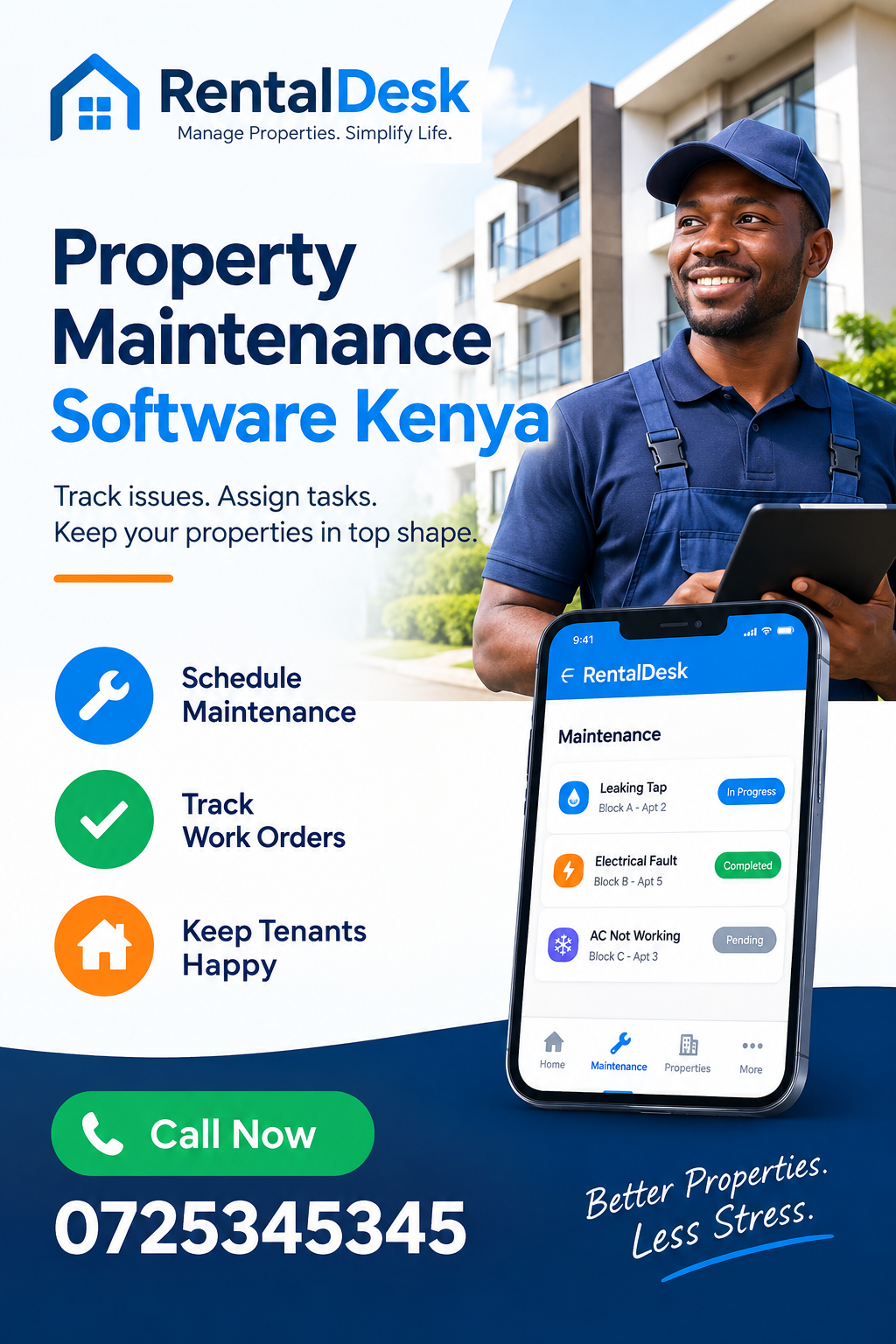
Managing rental properties involves much more than collecting rent. A leaking tap, broken door, electrical fault, blocked drainage system, damaged wall, faulty water heater or other maintenance issue can quickly become a serious problem when it is not reported and resolved on time. Property Maintenance Software Kenya gives landlords, property managers and rental agencies a structured way to record maintenance requests, assign work, monitor repairs and keep property records organised.
For a property owner with only a few units, maintenance may initially be handled through phone calls, WhatsApp messages, notebooks or spreadsheets. As the portfolio grows, however, these methods can become difficult to manage. Requests may be forgotten, technicians may not receive complete information, tenants may repeatedly follow up, and property owners may struggle to understand how much is being spent on repairs.
This guide explains how Property Maintenance Software Kenya can support rental property operations, what features to look for, how maintenance workflows should work, how technology can improve communication, and what Kenyan landlords and property managers should consider before choosing a system.
The goal is not simply to digitise maintenance records. A useful system should help create a clear process from the moment a tenant reports a problem to the time the issue is resolved, documented and closed.
What Is Property Maintenance Software?
Property Maintenance Software Kenya refers to software designed to help landlords, property managers, estate agencies and rental businesses organise maintenance activities across their properties and units.
Instead of keeping repair information in separate notebooks, spreadsheets, emails and messaging conversations, a maintenance system creates a central record for issues affecting a property.
A typical maintenance workflow can include:
- A tenant reports a problem.
- The request is recorded in the system.
- The property manager reviews the issue.
- The request is categorised according to urgency.
- A technician or contractor is assigned.
- The work is scheduled.
- Progress is monitored.
- Costs and supporting documents are recorded.
- The tenant receives an update.
- The issue is marked as resolved.
- The maintenance history remains available for future reference.
This process creates accountability.
For example, imagine a tenant reports that water is leaking from a bathroom ceiling. If the request is simply sent through WhatsApp, the message can become buried beneath other conversations. A property manager may remember the issue several hours later, but the technician may not receive the tenant’s unit number or details about the problem.
With Property Maintenance Software Kenya, the maintenance request can become a structured record containing the property, unit, tenant, issue description, status, priority, assigned worker, costs and resolution details.
That information can then be used for follow-up, reporting and future decision-making.
Why Property Maintenance Management Matters in Kenya
Property maintenance directly affects tenant satisfaction, operating costs and the condition of an investment.
A small problem can become an expensive repair when it is ignored. A minor plumbing leak, for example, may eventually damage ceilings, walls, flooring or fittings. A broken security light may become a safety concern. A faulty electrical socket may require urgent attention.
For landlords managing several properties, keeping track of every issue manually can become difficult.
Property Maintenance Software Kenya can provide a central maintenance workflow that makes it easier to understand which issues are pending, which have been assigned and which have already been resolved.
Kenyan rental businesses also operate in environments where communication frequently happens through mobile phones and messaging applications. Tenants may contact landlords directly, call caretakers or send messages to property managers.
The challenge is not receiving information.
The challenge is turning that information into an organised process.
A good maintenance system helps bridge that gap.
Maintenance affects tenant experience
Tenants expect essential property problems to receive appropriate attention. When a tenant reports an issue and receives no acknowledgement, frustration can develop even before the repair itself is completed.
A structured maintenance workflow can help property teams:
- Acknowledge requests.
- Record important details.
- Assign responsibility.
- Track progress.
- Provide updates.
- Document completion.
- Keep a history of previous repairs.
That creates a more professional experience for both tenants and property managers.
The Problems With Manual Maintenance Tracking
Many landlords begin with simple tools because they are inexpensive and familiar.
A notebook may work for a few properties. A spreadsheet may work for a small portfolio. WhatsApp may work when there are only occasional requests.
The difficulty comes when the number of properties, tenants and maintenance requests increases.
Property Maintenance Software Kenya can help address several of the limitations associated with manual maintenance tracking.
1. Lost maintenance requests
A request sent through a personal WhatsApp conversation can easily be overlooked.
A tenant may send a message in the morning, receive a short acknowledgement and then wait for several days. If the message is not converted into a formal task, there may be no reliable reminder.
2. Unclear responsibility
When several caretakers, technicians and managers are involved, it can become difficult to know who is responsible for a particular repair.
A central system can associate a maintenance task with an assigned person.
3. Poor maintenance history
If repairs are recorded in different places, finding the history of a unit can take considerable time.
A structured record can show previous issues, repair dates, costs and contractors.
4. Difficult cost tracking
Property owners need to understand what they are spending on maintenance.
Manual records can make it difficult to group expenses by:
- Property
- Building
- Unit
- Repair type
- Contractor
- Date
- Maintenance category
5. Repeated problems
A unit that repeatedly experiences plumbing problems may require a different solution from another unit with a one-time issue.
Historical maintenance data can help managers identify recurring problems.
6. Slow follow-up
Without task statuses and reminders, repairs can remain pending longer than expected.
Property Maintenance Software Kenya can give property teams a clearer view of open, assigned, in-progress and completed maintenance tasks.
Key Features to Look For
Not every property management platform handles maintenance in the same way. Before selecting software, landlords should consider the features that will have the greatest effect on daily operations.
Maintenance request management
The system should allow maintenance issues to be recorded clearly.
A request could include:
- Property name
- Unit number
- Tenant name
- Issue category
- Description
- Date reported
- Priority
- Assigned person
- Status
- Estimated cost
- Actual cost
- Completion date
- Notes
This creates a consistent record instead of relying on informal conversations.
Work order management
A work order turns a complaint into an actionable task.
For example:
Issue: Kitchen sink leaking
Property: Apartment Block A
Unit: 2B
Priority: High
Assigned technician: Plumber
Status: Assigned
Estimated cost: Recorded after inspection
This gives everyone involved a common reference point.
Property Maintenance Software Kenya should make it possible for a property team to understand what needs to happen next.
Maintenance status tracking
Useful statuses can include:
- New
- Acknowledged
- Assigned
- Scheduled
- In progress
- Waiting for parts
- Waiting for tenant access
- Completed
- Cancelled
Status tracking reduces ambiguity.
Instead of asking, “Did someone handle this repair?” a manager can check the maintenance record.
Tenant Maintenance Requests
Tenants are usually the first people to notice problems inside rental units.
That makes tenant reporting an important part of maintenance management.
Property Maintenance Software Kenya can support a structured process where tenants submit maintenance requests and property teams manage those requests from a central dashboard.
A tenant reporting a problem should ideally provide enough information for the property team to understand what is happening.
For example, instead of:
“The water is not working.”
A useful request might say:
“There is no water coming from the kitchen tap, but the bathroom tap is working normally.”
The second description gives the property manager more information to work with.
Tenant portals
Some systems provide tenant portals where residents can:
- Submit maintenance requests.
- View request status.
- Review updates.
- Check previous requests.
- Receive communication.
- Access relevant property information.
This can reduce unnecessary phone calls and repeated messages.
Photo attachments
Images can be particularly useful for maintenance.
A tenant may photograph:
- A leaking pipe.
- A cracked window.
- A damaged door.
- A water stain.
- A broken fixture.
- A damaged wall.
- A faulty appliance.
Visual information can help the property manager determine whether the issue requires immediate attention or routine scheduling.
Prioritising Maintenance Requests
Not every maintenance request has the same level of urgency.
A broken decorative fixture is different from a major water leak.
Property Maintenance Software Kenya can help property teams classify maintenance requests according to priority.
A practical classification might look like this:
| Priority | Example | Typical Response |
|---|---|---|
| Emergency | Major water leak or serious electrical issue | Immediate attention |
| High | Broken lock or significant plumbing fault | Prompt scheduling |
| Medium | Faulty fixture | Scheduled repair |
| Low | Cosmetic issue | Planned maintenance |
The exact classification should depend on the property, issue and internal procedures.
The purpose is to ensure that urgent problems do not become buried beneath routine requests.
Why prioritisation matters
Without prioritisation, maintenance teams may simply work through requests in the order they arrive.
That can be inefficient.
A serious plumbing problem reported later could receive attention after several low-priority cosmetic repairs if the system does not distinguish urgency.
A good workflow brings important issues to the manager’s attention.
Assigning Technicians and Contractors
Property managers often work with different service providers.
These may include:
- Plumbers
- Electricians
- Painters
- Carpenters
- Masonry contractors
- Locksmiths
- Appliance technicians
- General maintenance workers
- Cleaning providers
- Security equipment technicians
Property Maintenance Software Kenya can help managers associate maintenance jobs with the appropriate person or contractor.
This is particularly useful for agencies managing several properties.
Instead of searching through old messages to determine who repaired a particular water system, the manager can consult the maintenance record.
Contractor performance records
Over time, maintenance records can also help property managers understand contractor performance.
Useful information can include:
- Number of jobs completed.
- Types of work performed.
- Completion time.
- Cost of jobs.
- Recurring repairs.
- Tenant feedback where applicable.
This information can support better operational decisions without relying entirely on memory.
Tracking Maintenance Costs
Maintenance is an operating expense, so cost tracking should be part of property management.
Property Maintenance Software Kenya can help connect maintenance activities with financial records.
For example, consider a property with ten units.
During one month, the property manager records:
- Plumbing repair: KES 8,000
- Electrical repair: KES 5,500
- Painting: KES 12,000
- Door repair: KES 4,000
- General repairs: KES 6,500
The manager can then review total maintenance spending and determine where costs are concentrated.
Why cost history matters
A single repair cost may not tell the complete story.
Suppose a building repeatedly spends money repairing the same water pump. The cumulative cost may eventually justify replacing the equipment.
Without historical records, recurring expenses can appear as isolated incidents.
With structured data, managers can see patterns.
Preventive Maintenance vs Reactive Maintenance
There are two broad approaches to property maintenance.
Reactive maintenance
Reactive maintenance happens after something breaks.
For example:
A tenant reports that a water heater has stopped working, and the property manager sends a technician to repair it.
Reactive maintenance is unavoidable for some problems, but relying entirely on it can create operational challenges.
Preventive maintenance
Preventive maintenance involves planned inspections and servicing before a failure occurs.
Examples include:
- Checking water systems.
- Inspecting electrical installations.
- Servicing equipment.
- Inspecting roofs.
- Checking drainage.
- Testing security systems.
- Inspecting common areas.
- Reviewing plumbing fixtures.
Property Maintenance Software Kenya can support planned maintenance schedules alongside reactive repair requests.
Why preventive maintenance is useful
Preventive maintenance can help property managers identify potential problems earlier.
It also creates a maintenance calendar.
Instead of waiting for tenants to report every problem, the property team can establish recurring inspections.
Managing Maintenance Across Multiple Properties
Managing one building is very different from managing twenty buildings.
As the portfolio grows, the number of maintenance requests grows as well.
Property Maintenance Software Kenya can help centralise information across multiple properties.
A property manager may oversee:
- Apartment blocks.
- Commercial buildings.
- Student housing.
- Residential estates.
- Mixed-use properties.
- Individual rental houses.
Each property can have different maintenance requirements.
A central system makes it easier to separate records while maintaining a single operational view.
Portfolio-level reporting
Managers may want to know:
- Which property has the most maintenance requests?
- Which building has the highest repair costs?
- Which units have repeated problems?
- Which contractor handles the most work?
- How many requests remain open?
- How long are repairs taking?
- Which maintenance categories occur most frequently?
These questions are difficult to answer from scattered WhatsApp messages and paper records.
Maintenance and Rent Management Should Work Together
Maintenance should not exist completely separately from the rest of rental operations.
Property managers also need to manage:
- Tenants
- Units
- Leases
- Rent
- Invoices
- Payments
- Arrears
- Utilities
- Owner reports
- Expenses
Property Maintenance Software Kenya becomes more useful when maintenance information is connected to the relevant property and unit records.
For example, if a maintenance request is submitted for Unit 12, the manager should be able to identify the property and tenant associated with that unit.
This reduces duplicate data entry.
RentalDesk positions its platform around connected rental workflows, including properties and units, tenants and leases, invoicing, payments, arrears, utilities and maintenance tickets.
M-Pesa and Property Operations in Kenya
M-Pesa is an important part of many Kenyan rental collection workflows.
RentalDesk states that its platform supports M-Pesa-related rent workflows, including capturing payments, matching transactions to tenants and units, updating balances and reviewing unmatched payments.
While maintenance is different from rent collection, both activities belong to the broader property management process.
Property Maintenance Software Kenya can therefore be especially useful when it is part of a wider rental management system rather than an isolated repair tracker.
A manager should be able to understand the property from multiple operational angles.
For example:
Property: Apartment Block A
Units: 40
Occupied units: 37
Open maintenance requests: 6
Overdue tenants: 4
Maintenance spending this month: Recorded
Outstanding repair tasks: Assigned
That gives the manager a much clearer picture of daily operations.
Maintenance Communication
Poor communication can make a straightforward repair feel much worse.
A tenant may be willing to wait for a technician if they know:
- The issue has been received.
- Someone has been assigned.
- The expected repair date.
- Whether access is required.
- Whether replacement parts are being sourced.
Property Maintenance Software Kenya can help structure communication around maintenance records instead of leaving updates inside individual conversations.
Communication should be practical
A useful update might say:
“Your maintenance request has been assigned to a technician. The technician is expected to visit tomorrow between 10:00 a.m. and 12:00 p.m.”
The important point is that the tenant receives actionable information.
Avoiding repeated calls
When tenants cannot see progress, they may call repeatedly.
A transparent maintenance process can reduce unnecessary follow-ups because the status is documented.
Maintenance Records and Property History
A property has a history.
Walls are repainted. Plumbing fixtures are replaced. Electrical components fail. Doors are repaired. Appliances are serviced.
Property Maintenance Software Kenya can help preserve that history.
For each unit or property, managers can potentially maintain records showing:
- Previous repairs.
- Dates of repairs.
- Contractors.
- Costs.
- Materials.
- Notes.
- Photos.
- Recurring problems.
- Completion information.
This becomes valuable when investigating future issues.
For example, if the same bathroom develops a leak three times within a year, the maintenance history may reveal that previous repairs addressed symptoms rather than the underlying problem.
Reports That Property Managers Should Monitor
Reporting turns maintenance records into useful management information.
Property Maintenance Software Kenya can be used as part of a reporting-oriented workflow where managers monitor outstanding work and historical maintenance information.
Useful maintenance reports may include:
Open maintenance requests
Shows all unresolved issues.
Completed maintenance
Shows repairs completed during a selected period.
Maintenance costs
Breaks spending down by property, unit or category.
Contractor report
Shows work assigned to individual service providers.
Recurring issues report
Highlights properties or units with repeated problems.
Average completion time
Shows how long requests generally remain open.
Maintenance category report
Groups requests into plumbing, electrical, structural, appliance and other categories.
Reports help management move from reactive problem-solving to operational planning.
How Maintenance Software Can Help Landlords
A landlord managing several units may not have time to monitor every repair personally.
Property Maintenance Software Kenya can give landlords a central place to review maintenance activity.
The landlord may not need to know every detail of every repair.
Instead, useful summary information could include:
- Current open requests.
- Major maintenance expenses.
- Completed repairs.
- Pending jobs.
- Contractor activity.
- Recurring issues.
This makes it easier to stay informed without becoming involved in every operational task.
Owner visibility
For landlords using a property management agency, maintenance reporting can also improve transparency.
The owner can receive information about repairs carried out on their properties and the associated expenses.
How Property Managers Can Benefit
Property managers deal with the operational side of rental properties every day.
Their responsibilities may include tenant communication, rent collection, inspections, contractor coordination, reporting and issue resolution.
Property Maintenance Software Kenya can help bring maintenance tasks into a more structured workflow.
Benefits can include:
- Better organisation.
- Clearer task ownership.
- Faster access to records.
- Easier follow-up.
- Better expense tracking.
- More consistent tenant communication.
- Improved reporting.
The software does not replace good management.
It gives managers better information with which to perform that management.
Choosing the Right Maintenance Software
Before choosing a system, property owners should identify their actual maintenance problems.
Property Maintenance Software Kenya should be selected based on operational requirements rather than the number of features listed on a marketing page.
Consider the following questions.
Does it support multiple properties?
If you manage several buildings, the system should make it easy to separate properties and units.
Can tenants report problems?
If tenants cannot conveniently submit requests, your team may continue relying on informal channels.
Can managers assign work?
A maintenance request should be capable of becoming an actionable task.
Can you track status?
The system should make it clear whether a repair is new, assigned, in progress or completed.
Can you record costs?
Maintenance spending needs to be visible.
Can you access historical records?
Previous repairs can provide valuable context.
Does it support mobile access?
Property teams frequently work away from desks.
Does it integrate with broader property management?
Maintenance is only one part of property operations.
Mobile Access for Property Teams
Property managers and caretakers may spend much of their working day outside an office.
They may be:
- Inspecting units.
- Visiting construction sites.
- Meeting tenants.
- Checking common areas.
- Meeting contractors.
- Collecting information from buildings.
Property Maintenance Software Kenya should therefore be practical on mobile devices.
Mobile access can make it easier to:
- Create maintenance requests.
- Update task status.
- Upload photos.
- Add notes.
- Review tenant information.
- Check pending work.
- Communicate updates.
RentalDesk describes mobile access among its rental operations features and positions its platform for Kenyan property teams.
Security and Access Control
Maintenance records can contain information about tenants, properties, contractors and expenses.
Property Maintenance Software Kenya should therefore be assessed alongside the platform’s access-control features.
Not every employee needs access to every record.
For example:
- A caretaker may need maintenance requests for assigned buildings.
- A property manager may need broader access.
- An accountant may need financial records.
- A landlord may need reports about their properties.
- An administrator may manage system permissions.
Role-based access can help limit unnecessary access while allowing employees to perform their responsibilities.
RentalDesk states that its system includes role-based access and audit visibility.
Maintenance Data Can Support Better Decisions
One of the biggest long-term benefits of digital maintenance records is the ability to identify patterns.
Property Maintenance Software Kenya can help make maintenance information more structured and easier to analyse when it is incorporated into a wider digital workflow.
Suppose a property manager notices that plumbing expenses have increased steadily.
Instead of assuming the reason, the manager can review the maintenance history.
Possible explanations might include:
- Ageing plumbing infrastructure.
- Frequent tenant-related damage.
- Poor-quality replacement parts.
- Recurring leaks.
- A larger underlying problem.
The data does not automatically provide the answer, but it gives management better evidence for investigating the problem.
Common Maintenance Management Mistakes
Even with software, poor processes can create problems.
Treating every request as routine
A maintenance system is only useful if urgent issues are identified quickly.
Failing to close completed tasks
A job that was completed but remains marked as open makes reports inaccurate.
Not recording costs
A maintenance record without cost information can limit financial analysis.
Ignoring recurring problems
Repeated repairs should trigger further investigation.
Using inconsistent categories
If one employee records “plumbing,” another records “water issue” and another records “pipe,” reporting becomes less consistent.
Not communicating with tenants
Recording a repair is not the same as communicating its progress.
Giving everyone full access
Employees should generally have the level of access required for their responsibilities.
A Practical Maintenance Workflow for Kenyan Rental Properties
A simple workflow can make a major difference.
Step 1: Receive the request
The tenant submits a maintenance issue.
Step 2: Review the request
The property manager checks the description, photos and relevant property details.
Step 3: Set priority
The issue is classified according to urgency.
Step 4: Assign responsibility
A technician, caretaker or contractor receives the task.
Step 5: Schedule the work
The visit is arranged.
Step 6: Update the tenant
The tenant receives relevant information.
Step 7: Complete the repair
The technician performs the work.
Step 8: Record costs
Materials, labour and other applicable expenses are documented.
Step 9: Verify completion
The property team confirms that the issue has been resolved.
Step 10: Close the request
The maintenance record is marked complete.
Step 11: Preserve the history
The record remains available for future reference.
Property Maintenance Software Kenya can support this kind of structured workflow when maintenance is managed digitally.
Maintenance Software for Small Landlords
You do not necessarily need hundreds of units to benefit from organised maintenance records.
A landlord with ten or twenty units can still encounter several repair requests each month.
Property Maintenance Software Kenya can help a smaller landlord move away from scattered records.
For a small portfolio, the most important features may be:
- Tenant maintenance requests.
- Work order tracking.
- Basic cost recording.
- Property and unit records.
- Contractor management.
- Maintenance history.
- Notifications.
- Mobile access.
The objective should be simplicity.
A landlord should not need a complicated enterprise process to record that a plumber has been sent to Unit 4.
Maintenance Software for Property Agencies
Agencies managing properties for multiple landlords have more complex requirements.
They may need to separate maintenance costs by owner while coordinating several contractors and properties.
Property Maintenance Software Kenya can be particularly useful when maintenance needs to be connected to property, tenant and owner records.
An agency may need reports showing:
- Repairs per landlord.
- Expenses per property.
- Outstanding requests.
- Contractor costs.
- Completed work.
- Recurring issues.
This can make owner reporting more transparent.
How Much Should Property Maintenance Software Cost?
There is no single price that applies to every system.
Pricing can depend on:
- Number of units.
- Number of properties.
- Number of users.
- Features.
- Integrations.
- Support.
- Reporting.
- Automation.
- Tenant access.
- Maintenance functionality.
RentalDesk currently lists a free Lite plan and paid plans, with its Starter plan including maintenance tracking and utility billing.
The important question is not simply whether software is cheap.
Instead, consider the operational value.
If a system helps prevent missed requests, reduces manual follow-up and gives managers better visibility, those benefits should be considered alongside the subscription price.
Measuring the Value of Maintenance Software
A property manager can monitor several operational indicators after implementing a maintenance system.
Useful measures include:
Number of open requests
Are outstanding requests increasing or decreasing?
Average completion time
How long does it take to resolve different categories of issues?
Recurring repairs
Which properties have repeated problems?
Maintenance expenditure
How much is being spent by property or category?
Contractor workload
Which contractors are handling the most jobs?
Tenant follow-ups
Are tenants repeatedly asking for updates?
These measures can help management determine whether its maintenance process is improving.
Implementation Tips
Introducing software is easier when the team starts with a clear process.
Start with your current problems
Write down the maintenance issues that currently cause the most frustration.
Standardise categories
Create clear categories for plumbing, electrical, structural, appliances and other common issues.
Define priorities
Agree on what qualifies as an emergency, high-priority or routine request.
Assign responsibilities
Make it clear who reviews requests and who assigns technicians.
Train staff
Caretakers, managers and administrators should understand how the system works.
Communicate with tenants
Tell tenants how and where to report maintenance issues.
Review reports regularly
Use the information collected to identify recurring problems.
Improve the process over time
Software implementation should be treated as an operational improvement rather than a one-time technology purchase.
What Should a Maintenance Dashboard Show?
A useful dashboard should provide information that helps a manager decide what needs attention.
Property Maintenance Software Kenya can be most useful when its dashboard presents practical information rather than unnecessary complexity.
A maintenance dashboard could show:
| Dashboard Item | Why It Matters |
|---|---|
| New requests | Shows issues requiring review |
| High-priority requests | Highlights urgent work |
| Assigned requests | Shows current responsibility |
| In-progress jobs | Tracks ongoing repairs |
| Waiting requests | Identifies delays |
| Completed jobs | Shows work finished |
| Maintenance costs | Supports financial monitoring |
| Recurring issues | Highlights potential underlying problems |
The manager should be able to move from the summary to the underlying maintenance record.
Maintenance, Inspections and Property Condition
Maintenance management works best when combined with regular inspections.
An inspection may reveal problems before a tenant submits a complaint.
For example, a caretaker may notice:
- Peeling paint.
- A damaged roof section.
- Blocked drainage.
- Loose electrical fittings.
- Broken locks.
- Water stains.
- Damaged common-area lighting.
Property Maintenance Software Kenya can provide a place where these findings become documented tasks rather than informal observations.
That makes inspections more actionable.
Frequently Asked Questions
What is Property Maintenance Software?
Property Maintenance Software Kenya is software used to organise property repairs, maintenance requests, work orders, contractors, costs, schedules and maintenance history.
It can help landlords and property managers replace scattered manual processes with a structured workflow.
Is maintenance software useful for landlords with a small number of units?
Yes. A small landlord may have fewer maintenance requests, but organised records can still make it easier to track repairs, costs and recurring problems.
The appropriate solution depends on the size and complexity of the portfolio.
Can tenants submit maintenance requests?
Many property management platforms support tenant maintenance requests. The exact functionality depends on the software.
A useful system should make it easy for tenants to describe issues and for managers to review and assign those requests.
Can maintenance software track repair costs?
Property Maintenance Software Kenya can support cost tracking when the platform includes expense or maintenance cost functionality.
Recording labour, materials and other repair expenses can help property managers understand operating costs.
Can I manage several properties from one system?
Yes, depending on the platform. Multi-property functionality is particularly useful for agencies and professional property managers.
It allows maintenance requests to remain connected to the correct property and unit.
Does property maintenance software replace a property manager?
No. Software supports the management process but does not replace human judgement.
A property manager still needs to assess problems, communicate with tenants, coordinate contractors and make decisions about repairs.
Can maintenance software work alongside rent collection?
Yes. Some property management platforms combine maintenance with rent collection, tenant records, invoicing and reporting.
This can create a more connected view of property operations.
Why should I keep maintenance history?
Maintenance history helps property managers understand recurring problems, previous repairs and expenditure.
It can also help when deciding whether a repeated repair should be replaced with a longer-term solution.
Is mobile access important?
It can be particularly useful for property teams that work away from a desk.
Caretakers and managers can review requests, update statuses and add information while visiting properties.
What should I check before choosing a maintenance system?
Look at the maintenance request process, work orders, tenant access, property and unit management, contractor assignment, cost tracking, reporting, mobile access, security and integration with your wider rental workflow.
The Future of Property Maintenance Management
Property maintenance is gradually becoming more data-driven.
Instead of relying solely on memory and manual records, property teams can use structured information to understand what is happening across their portfolios.
Property Maintenance Software Kenya can form part of this broader shift toward organised property operations.
Future-focused property teams are likely to place greater emphasis on:
- Faster issue reporting.
- Better tenant communication.
- Digital work orders.
- Mobile maintenance management.
- Maintenance analytics.
- Preventive maintenance.
- Contractor accountability.
- Digital property records.
- Integrated financial reporting.
The technology itself is only part of the solution.
The real value comes from combining technology with clear processes and responsible management.
Final Considerations for Kenyan Property Owners
A rental property is an ongoing operation. Tenants move in and out, rent payments are received, bills are generated, inspections take place and maintenance issues appear throughout the year.
When maintenance is managed through scattered messages, spreadsheets and paper notes, important information can easily become difficult to find.
Property Maintenance Software Kenya provides a structured approach to recording, assigning, tracking and reviewing property maintenance work.
For Kenyan landlords and property managers, the ideal system should fit the way they actually operate. It should support mobile workflows, practical communication, multiple properties where necessary, clear maintenance records and integration with the wider rental management process.
RentalDesk, for example, describes maintenance tracking as one of its features and connects it with broader functionality covering properties, tenants, invoicing, M-Pesa collection, utilities, reporting and landlord operations.
The right approach is therefore to start with the operational problem.
If maintenance requests are being missed, identify why.
If contractors are difficult to coordinate, establish a work-order process.
If costs are unclear, introduce structured expense records.
If tenants repeatedly ask for updates, improve communication and request tracking.
If recurring repairs are consuming money, analyse the maintenance history.
Property Maintenance Software Kenya is most valuable when it helps solve those specific problems rather than simply adding another application to the property manager’s daily workload.
For landlords, agencies and property teams that want greater visibility over repairs and property condition, a central maintenance workflow can provide a practical foundation for more organised rental operations.
Property Maintenance Software Kenya
Property Maintenance Software Kenya
Property Maintenance Software Kenya
Property Maintenance Software Kenya
Property Maintenance Software Kenya
Property Maintenance Software Kenya
Property Maintenance Software Kenya
Property Maintenance Software Kenya
Property Maintenance Software Kenya
Property Maintenance Software Kenya
Property Maintenance Software Kenya
Property Maintenance Software Kenya
Property Maintenance Software Kenya
Property Maintenance Software Kenya
Property Maintenance Software Kenya
Property Maintenance Software Kenya