
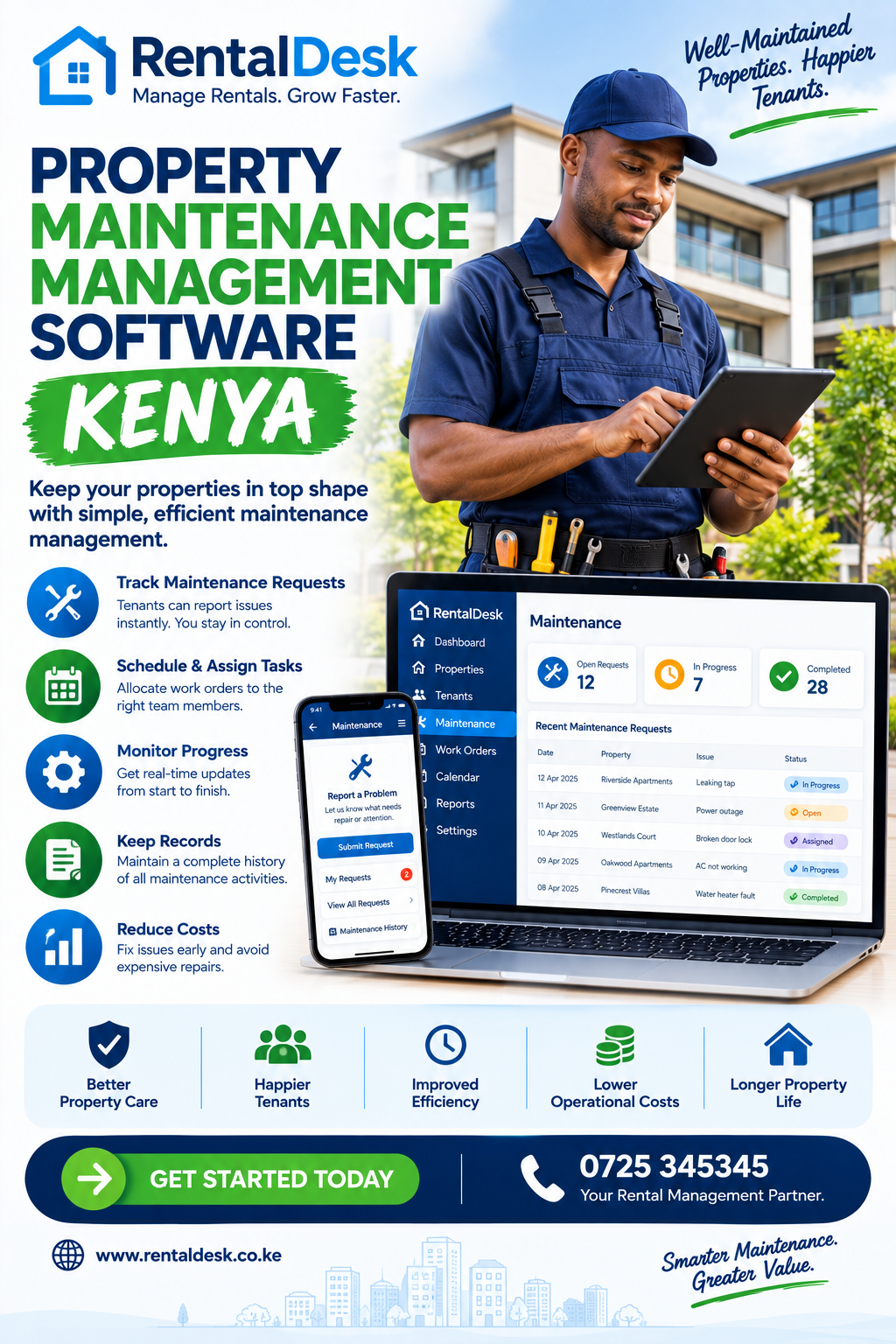
Property Maintenance Management Software Kenya: A Complete Guide for Property Managers
Property maintenance can quickly become one of the most difficult parts of running rental properties, especially when landlords and property managers are handling many units at once. Property Maintenance Management Software Kenya gives property owners and managers a structured way to record maintenance requests, assign work, monitor repairs, communicate with tenants, and keep property records organized. Instead of depending on notebooks, WhatsApp messages, spreadsheets, and scattered phone calls, a centralized system can bring maintenance activities into one manageable workflow. This guide explains how maintenance management software works, the problems it solves, the features to look for, and how Kenyan landlords and property managers can use it to improve day-to-day operations.
Property maintenance is more than fixing broken taps or replacing damaged locks. It includes preventive maintenance, inspections, contractor coordination, emergency repairs, cost tracking, tenant communication, and documentation. When these activities are poorly organized, small problems can become expensive problems.
For a landlord managing a few apartments, this may initially seem manageable through manual processes. However, as the number of units increases, maintenance requests become harder to follow. A tenant may report a leaking pipe today, another may report an electrical problem tomorrow, while a third may require a repair that has already been assigned to a contractor. Without a central system, it becomes easy to lose track of priorities.
This is where Property Maintenance Management Software Kenya can become useful. A digital maintenance system creates a central record for each request and allows the property team to follow the issue from the initial report through assignment, repair, verification, and closure.
What Is Property Maintenance Management Software?
At its simplest, Property Maintenance Management Software Kenya is a digital system designed to help property owners, landlords, estate managers, and property management companies organize maintenance activities.
Instead of keeping maintenance information in separate places, the system brings relevant details together. A maintenance request can contain information about the property, unit, tenant, problem description, priority, assigned technician, expected completion date, costs, notes, and status.
A typical maintenance workflow may look like this:
- A tenant reports a problem.
- The property manager records or receives the maintenance request.
- The issue is categorized and given a priority.
- A technician or contractor is assigned.
- The work is scheduled.
- The repair is completed.
- Costs and materials are recorded.
- The tenant or property manager confirms completion.
- The request is closed.
- The maintenance history remains available for future reference.
With Property Maintenance Management Software Kenya, this process can be standardized rather than handled differently for every property or tenant.
The system can also support preventive maintenance. Instead of waiting for equipment to fail, managers can schedule inspections and routine servicing. This is particularly valuable for properties with shared facilities, plumbing systems, electrical installations, lifts, pumps, generators, gates, security systems, and other assets.
A good system should therefore support both reactive and preventive maintenance.
Reactive maintenance deals with problems after they occur. Preventive maintenance focuses on planned activities intended to reduce failures and extend the useful life of property assets.
Why Property Maintenance Is Difficult to Manage Manually
Many Kenyan landlords start with simple tools because they are inexpensive and familiar. A notebook, spreadsheet, phone calls, SMS messages, and WhatsApp conversations may be sufficient for a small number of units.
The challenge appears when the portfolio grows.
A manager might receive a maintenance request through WhatsApp but forget to record it in the main property records. A contractor might confirm that a repair is complete without providing a clear cost breakdown. A tenant might call again because nobody has updated them. Later, the manager may struggle to determine when the problem was reported, what was done, and how much was spent.
Property Maintenance Management Software Kenya addresses this fragmentation by creating a single maintenance workflow.
Common problems with manual maintenance
Property managers often face challenges such as:
- Lost or forgotten maintenance requests
- Delayed responses to tenants
- Difficulty prioritizing urgent repairs
- Poor contractor coordination
- Missing maintenance histories
- Unclear repair costs
- Difficulty tracking recurring problems
- Limited accountability
- Incomplete property records
- Difficulty generating maintenance reports
Another issue is visibility. If a property owner manages several buildings through different staff members, it can be difficult to know what maintenance work is currently pending.
Property Maintenance Management Software Kenya can provide a dashboard showing open, pending, assigned, completed, and overdue maintenance tasks.
This makes it easier for managers to identify bottlenecks before they become larger operational problems.
Benefits of Using Maintenance Management Software in Kenya
The value of Property Maintenance Management Software Kenya goes beyond simply recording repair requests. The right platform can improve several parts of property operations.
1. Faster response to tenant requests
Tenants generally want maintenance problems acknowledged quickly. A centralized system makes it easier to see new requests and determine which ones require immediate attention.
For example, a blocked drainage system may need faster action than a cosmetic issue such as repainting a wall.
A structured priority system helps the manager distinguish emergency, urgent, normal, and low-priority requests.
2. Better accountability
When a maintenance request is assigned to a specific person or contractor, responsibility becomes clearer.
Property Maintenance Management Software Kenya can show who received a task, when it was assigned, whether work has started, and whether the issue has been resolved.
This reduces situations where everyone assumes someone else is handling a repair.
3. Centralized maintenance history
Every completed maintenance request can become part of the property’s historical record.
This is useful when a similar issue occurs again.
Suppose an apartment repeatedly experiences plumbing problems. Reviewing previous maintenance records may reveal that the same pipe section has required several repairs. The manager can then consider whether replacement would be more practical than repeated temporary repairs.
4. Improved cost tracking
Maintenance expenses can add up quickly.
Property Maintenance Management Software Kenya can help managers record the cost of labor, spare parts, materials, contractor charges, and other expenses associated with individual maintenance jobs.
This makes it easier to understand how much a property is costing to maintain.
5. Better tenant communication
Tenants should not have to repeatedly call the office to ask whether their repair has been handled.
A structured maintenance process makes communication easier because staff can see the current status of every request.
Key Features to Look for in Maintenance Software
Not every property management platform provides the same maintenance capabilities. Before selecting a system, landlords should consider whether it supports their actual workflow.
Property Maintenance Management Software Kenya should ideally provide several core features.
Maintenance request management
The system should make it easy to create a maintenance request.
Useful information may include:
- Property
- Building
- Unit
- Tenant
- Issue category
- Description
- Date reported
- Priority
- Assigned person
- Status
- Expected completion date
- Actual completion date
- Cost
- Notes
The more structured the request, the easier it becomes to manage.
Task assignment
Property Maintenance Management Software Kenya should allow managers to assign jobs to internal maintenance teams or external contractors.
Assignment is important because it creates accountability.
A maintenance manager should be able to see which jobs are assigned, which are waiting for assignment, and which have been completed.
Status tracking
A simple status workflow can significantly improve visibility.
Common statuses include:
- New
- Under review
- Assigned
- Scheduled
- In progress
- Waiting for parts
- Completed
- Closed
A manager can then quickly identify work that is stuck.
Maintenance priorities
Not every repair deserves the same response time.
Property Maintenance Management Software Kenya should support priority levels so managers can distinguish emergencies from routine jobs.
For example:
| Priority | Example |
|---|---|
| Emergency | Major water leak |
| High | Electrical fault |
| Medium | Broken door handle |
| Low | Minor cosmetic repair |
The exact priority definitions can be customized according to the property’s operating procedures.
Preventive Maintenance and Property Inspections
A strong maintenance strategy should not focus only on problems reported by tenants.
Preventive maintenance can help property managers identify potential problems before they become emergencies.
Property Maintenance Management Software Kenya can support scheduled maintenance activities such as inspections, servicing, cleaning, and equipment checks.
For example, a property manager might schedule:
- Water tank inspections
- Pump servicing
- Generator maintenance
- Common-area inspections
- Plumbing checks
- Electrical inspections
- Gate and access-control checks
- Lift servicing
- Roof inspections
- Drainage inspections
The exact maintenance schedule will depend on the property and the equipment involved.
Why inspections matter
A tenant may only report a problem after it becomes noticeable. Regular inspections allow the management team to look for warning signs before that point.
For instance, an inspection may reveal a small water leak, deteriorating paint, damaged roofing, blocked drainage, or a faulty light fitting.
Addressing these issues early can prevent them from developing into larger maintenance jobs.
Property Maintenance Management Software Kenya can also help create an inspection history, making it easier to see when an area was last checked and what was discovered.
Managing Contractors More Effectively
Many Kenyan property managers rely on external plumbers, electricians, painters, technicians, cleaners, security-system specialists, and other service providers.
Contractor coordination can become difficult when information is stored in different places.
Property Maintenance Management Software Kenya can provide a structured way to connect maintenance jobs with contractors.
For example, the manager can record:
- Contractor name
- Type of service
- Assigned jobs
- Job dates
- Work performed
- Cost
- Notes
- Completion status
This creates a useful record of contractor activity.
Comparing recurring repair costs
Suppose a property frequently requires plumbing work. A manager can review previous jobs and determine how much has been spent over time.
If costs are consistently increasing, the manager may investigate whether the underlying problem should be addressed rather than continuing with individual repairs.
This is one reason maintenance history is valuable. Individual jobs may seem inexpensive, but recurring jobs can become significant expenses over a longer period.
Maintenance Costs and Property Financial Management
Maintenance should be connected to the wider financial picture of the property.
Property Maintenance Management Software Kenya can help managers associate maintenance expenses with specific properties, units, assets, or work orders.
This provides better visibility into operational expenses.
A manager could analyze questions such as:
- Which property has the highest maintenance expenses?
- Which type of repair occurs most often?
- Which units generate recurring maintenance costs?
- How much was spent on plumbing?
- How much was spent on electrical repairs?
- Which contractors handled the most jobs?
- Which maintenance tasks remain outstanding?
These questions are difficult to answer accurately when records are scattered.
Property Maintenance Management Software Kenya can make maintenance data easier to organize and review.
Maintenance budgeting
Historical information can also help with future planning.
If a property consistently spends money on particular types of repairs, management can factor those patterns into operational budgets.
The goal is not to predict every repair precisely. Instead, historical records provide better information for planning.
M-Pesa and Kenyan Property Operations
Kenyan property management often involves M-Pesa and other local payment methods. While maintenance management and rent collection are separate functions, they are part of the same broader property operation.
Property Maintenance Management Software Kenya can be particularly useful when maintenance records are integrated into a broader property management workflow.
For example, a property platform may allow managers to manage tenant records, property information, invoices, payments, expenses, and maintenance activities within a centralized system.
The exact payment features available will depend on the software selected.
Why local context matters
Software designed for Kenyan property managers should take into account the realities of local operations.
These may include:
- M-Pesa payments
- Multiple rental units
- Apartment developments
- Estate management
- Local contractors
- Service charges
- Tenant communication
- Local accounting requirements
- Internet and mobile-based workflows
Property Maintenance Management Software Kenya can therefore be evaluated not only for its maintenance features but also for how well it fits the wider property management environment.
Using Maintenance Data to Make Better Decisions
One of the most valuable aspects of digital maintenance management is the data created over time.
Every repair can contribute information that helps management understand the property better.
Property Maintenance Management Software Kenya can make it easier to identify recurring maintenance patterns.
For example, if the same building repeatedly has plumbing problems, the manager can investigate whether there is an underlying issue.
Similarly, if a particular type of equipment repeatedly breaks down, management can evaluate whether repair or replacement makes more financial sense.
Useful maintenance reports
A property manager may want reports showing:
- Open maintenance requests
- Completed maintenance jobs
- Overdue requests
- Maintenance expenses
- Repairs by category
- Repairs by property
- Repairs by unit
- Contractor activity
- Preventive maintenance schedules
- Recurring maintenance issues
Property Maintenance Management Software Kenya can make these reports easier to produce when the system captures maintenance information consistently.
Improving Tenant Satisfaction Through Better Maintenance
Maintenance is closely connected to the tenant experience.
A tenant may tolerate a minor inconvenience if they know the issue has been acknowledged and is being handled. Problems arise when tenants report issues and receive no clear response.
Property Maintenance Management Software Kenya can support a more organized maintenance communication process.
For example, once a request is recorded, the management team can identify its status and provide an update.
Good communication can include:
- Confirmation that the issue was received
- Expected response time
- Contractor appointment information
- Updates when work is delayed
- Confirmation when the repair is completed
This creates a more professional experience.
Handling emergency maintenance
Emergency issues require particularly strong processes.
Examples can include:
- Serious water leaks
- Electrical hazards
- Security-related faults
- Major drainage problems
- Damage affecting the safety of occupants
Property Maintenance Management Software Kenya can help managers prioritize urgent requests, provided the chosen system includes suitable priority and workflow features.
The software does not replace professional judgment or emergency services. It provides an organized way to record and coordinate the management response.
Property Maintenance for Apartment Buildings
Apartment buildings can have hundreds of maintenance-related activities over time.
A single building may include multiple units, shared spaces, water systems, electrical systems, security equipment, parking areas, gates, pumps, lifts, and other facilities.
Property Maintenance Management Software Kenya can help organize these activities according to properties and units.
This is especially useful when several tenants report problems at different times.
Common apartment maintenance categories
A maintenance system can categorize requests such as:
- Plumbing
- Electrical
- Carpentry
- Painting
- Cleaning
- Security
- Appliances
- Water systems
- Drainage
- Common areas
- Structural issues
- Access control
Categorization improves reporting because managers can see which areas generate the most work.
Property Maintenance Management Software Kenya can also help managers keep maintenance records associated with individual units or common areas.
How to Choose the Right Maintenance Management System
Choosing software should start with the property’s actual needs rather than with a list of impressive features.
Property Maintenance Management Software Kenya should be assessed based on usability, workflow, reporting, integration, security, scalability, and support.
1. Define your maintenance workflow
Before choosing software, write down how maintenance currently works.
Ask:
- How do tenants report problems?
- Who receives requests?
- Who assigns technicians?
- How are emergency repairs handled?
- How are costs approved?
- How are contractors selected?
- How is completion confirmed?
- Where are maintenance records stored?
This helps identify which processes need improvement.
2. Consider portfolio size
A landlord with ten units may have different requirements from a property manager handling several apartment blocks.
Property Maintenance Management Software Kenya should be capable of supporting the number of properties and users you expect to manage.
3. Check reporting capabilities
Reports are important because maintenance data should support decision-making.
Look for systems that provide practical reports rather than simply storing information.
4. Evaluate ease of use
A complicated system may fail if staff members avoid using it.
The interface should be understandable enough for managers and maintenance staff to use consistently.
Property Maintenance Management Software Kenya should fit naturally into daily operations.
Questions to Ask Before Buying
Before committing to a platform, property managers can ask vendors several practical questions.
Property Maintenance Management Software Kenya should be evaluated using questions such as:
- Can the system manage multiple properties?
- Can maintenance requests be linked to specific units?
- Can staff assign tasks to contractors?
- Can users track repair status?
- Can the system record maintenance costs?
- Can managers schedule preventive maintenance?
- Are reports available?
- Can tenants submit maintenance requests?
- Is the platform accessible from mobile devices?
- Can it integrate with other property management processes?
- How are user permissions managed?
- What support is provided?
These questions help separate practical functionality from features that may not be relevant to your operation.
Security and Access Control
Property management systems contain business information and tenant-related records, so access control should be considered carefully.
Property Maintenance Management Software Kenya should ideally allow administrators to control what different users can view or modify.
For example, a maintenance technician may need access to assigned work orders but may not need access to sensitive financial information.
Similarly, an accountant may require access to expense records without needing to change maintenance assignments.
Role-based access can help organizations separate responsibilities.
Audit trails
Audit trails can also be useful where available. They can provide a history of important changes, helping management understand who performed a particular action and when.
This can be valuable when resolving disputes or investigating unexpected changes.
Property Maintenance Management Software Kenya can therefore be evaluated not just for maintenance functionality but also for the wider controls surrounding property data.
Mobile Accessibility for Property Teams
Property maintenance rarely happens behind a desk.
Managers may be visiting buildings, inspecting units, meeting contractors, or responding to tenant requests.
Property Maintenance Management Software Kenya should therefore be practical for teams that need access while moving between properties.
Mobile accessibility can help staff:
- Review maintenance requests
- Update job statuses
- Add notes
- Check property information
- Record completed work
- Communicate updates
- Review assigned tasks
This reduces dependence on paper records and helps keep information current.
For Kenyan property managers handling multiple buildings, this can be particularly practical.
Common Maintenance Management Mistakes
Technology alone does not guarantee good maintenance management.
Property Maintenance Management Software Kenya works best when supported by clear processes.
Mistake 1: Recording only major repairs
Small issues should also be documented.
A collection of minor repair records may reveal a recurring problem that would otherwise be missed.
Mistake 2: Failing to prioritize
Treating every request as equally urgent can result in genuinely critical problems being delayed.
Mistake 3: Closing jobs without verification
A contractor may report completion, but management should have an appropriate process for confirming that the work was actually completed.
Mistake 4: Ignoring recurring repairs
Repeated repairs deserve attention because they may indicate a larger issue.
Property Maintenance Management Software Kenya can help managers identify patterns when maintenance records are consistently captured.
Mistake 5: Not recording costs
A maintenance history without financial information gives only part of the picture.
Managers need to understand not only what was repaired but also how much it cost.
Building a Better Maintenance Workflow
A practical maintenance workflow does not need to be complicated.
Property Maintenance Management Software Kenya can support a process based on five basic stages.
Stage 1: Report
The tenant, staff member, or inspector reports the problem.
Stage 2: Assess
Management reviews the request and determines its priority.
Stage 3: Assign
The task is assigned to an appropriate technician or contractor.
Stage 4: Resolve
The repair is completed and relevant costs are recorded.
Stage 5: Verify and close
The result is confirmed and the request is closed.
This simple structure provides visibility from beginning to end.
Property Maintenance Management Software Kenya can make this workflow more consistent across multiple properties.
Maintenance Management for Landlords With Growing Portfolios
A landlord managing one property may be able to remember most maintenance activities. That becomes increasingly difficult as the portfolio grows.
Property Maintenance Management Software Kenya becomes more valuable when there are many units, tenants, contractors, and maintenance requests.
Growth introduces complexity.
A landlord may move from managing ten units to fifty or one hundred units. At that point, relying entirely on memory and informal communication becomes risky.
A digital maintenance system creates repeatable processes.
Instead of asking, “Did someone handle that repair?” the manager can check the request status.
Instead of searching through old WhatsApp messages, the manager can review the maintenance history.
Instead of estimating maintenance costs from memory, the manager can review recorded expenses.
The Role of Automation
Automation can reduce repetitive administrative work.
Property Maintenance Management Software Kenya may support automated notifications, scheduled maintenance reminders, status updates, or other workflow functions depending on the platform.
The purpose of automation is not to remove human oversight.
Rather, it allows property teams to spend less time on repetitive administration and more time dealing with decisions that require judgment.
For example, a system may remind management that scheduled maintenance is due. Staff can then decide whether to proceed, reschedule, or investigate the requirement.
How Maintenance Software Supports Property Managers
Property managers often balance many responsibilities simultaneously.
They may handle tenant communication, rent collection, inspections, service providers, financial reporting, compliance-related administration, and maintenance.
Property Maintenance Management Software Kenya can bring one part of this workload into a structured system.
A good maintenance process allows managers to focus on exceptions.
Instead of manually checking every request, the dashboard can highlight overdue tasks, emergencies, pending assignments, and other items requiring attention.
Property Maintenance Management Software Kenya can therefore become part of a wider property operations strategy.
Practical Example: Managing a Rental Apartment
Consider a property manager responsible for an apartment building in Nairobi.
A tenant reports that water is leaking beneath a kitchen sink.
The manager records the request and classifies it as a plumbing issue. The request is assigned to a plumber.
The plumber investigates and discovers that a pipe connection needs replacement.
The work is completed, the cost is recorded, and the request is marked complete.
Later, another tenant reports a similar issue.
Because previous records are available, management can compare the two cases.
Property Maintenance Management Software Kenya makes this type of historical review more practical when the maintenance records are captured consistently.
The manager may discover that the issue is common across several units and decide to inspect the plumbing connections throughout the building.
That is the difference between simply fixing individual problems and managing maintenance strategically.
Measuring Maintenance Performance
Property managers should consider measuring maintenance performance over time.
Property Maintenance Management Software Kenya can help organize the information needed for useful performance indicators.
Potential measurements include:
- Average response time
- Average completion time
- Number of open requests
- Number of overdue requests
- Recurring maintenance issues
- Maintenance cost by property
- Maintenance cost by category
- Number of preventive tasks completed
- Contractor completion performance
The specific metrics should match the organization’s objectives.
For example, a property manager focused on tenant experience may prioritize response and completion times, while an owner focused on cost control may pay closer attention to maintenance expenses and recurring repairs.
Maintenance Software and Long-Term Property Value
Property maintenance is also connected to the long-term condition of an asset.
Property Maintenance Management Software Kenya can help create a documented history of how a property has been maintained.
This history can be useful when planning major improvements.
Suppose a building has repeated roofing repairs over several years. A maintenance report can provide evidence that the issue is recurring.
Management can then evaluate whether a larger roofing project may be appropriate.
Likewise, recurring electrical, plumbing, or equipment failures can signal that replacement or refurbishment should be considered.
The software does not make the investment decision automatically. It provides organized information that can support better decision-making.
The Future of Property Maintenance Management in Kenya
Kenyan property management is becoming increasingly dependent on organized digital workflows.
Property Maintenance Management Software Kenya fits into this broader shift by giving property managers tools for organizing maintenance activities and records.
The most useful systems will be those that solve real operational problems rather than simply adding complexity.
Property managers should look for platforms that combine usability with practical features.
The ideal system should make it easier to know:
- What needs repair?
- Where is the problem?
- Who is handling it?
- How urgent is it?
- How much will it cost?
- Has the work been completed?
- Has the tenant been updated?
- Has the problem happened before?
Property Maintenance Management Software Kenya can help answer these questions when the software is properly configured and consistently used.
How to Successfully Introduce Maintenance Software
Introducing a new system requires more than creating user accounts.
Property Maintenance Management Software Kenya should be accompanied by a clear implementation process.
Step 1: Map current processes
Document how maintenance is currently reported, assigned, completed, and recorded.
Step 2: Clean existing records
Where possible, organize property, unit, tenant, contractor, and existing maintenance information before importing it.
Step 3: Define priorities
Create clear definitions for emergency, urgent, routine, and low-priority requests.
Step 4: Train users
Staff should understand how and when to create, update, assign, and close maintenance requests.
Step 5: Start with a controlled rollout
Testing the process with a limited group of properties can help identify issues before wider adoption.
Step 6: Review performance
After implementation, management should review whether response times, record keeping, communication, and cost visibility have improved.
Property Maintenance Management Software Kenya is most effective when it becomes part of normal daily operations rather than a system staff use only occasionally.
Frequently Asked Questions
1. What is Property Maintenance Management Software Kenya?
Property Maintenance Management Software Kenya refers to software used by property owners and managers to organize maintenance requests, assign repair tasks, track work progress, record expenses, schedule preventive maintenance, and maintain property maintenance histories.
2. Who can use property maintenance software?
Property Maintenance Management Software Kenya can be useful for individual landlords, property management companies, apartment managers, estate managers, facility teams, and organizations responsible for multiple rental properties.
3. Can maintenance software manage multiple properties?
Yes. Property Maintenance Management Software Kenya can be designed to organize maintenance activities across different buildings, properties, units, and common areas, depending on the platform’s capabilities.
4. Can tenants report maintenance problems?
Some systems allow tenants to submit maintenance requests directly, while others require property staff to record requests received through other communication channels. Property Maintenance Management Software Kenya should therefore be evaluated according to the reporting workflow your property uses.
5. Can the system track maintenance costs?
Maintenance platforms may allow managers to record expenses associated with individual repair jobs, contractors, materials, or properties. Property Maintenance Management Software Kenya can therefore provide better visibility into maintenance spending when financial information is captured consistently.
6. Does maintenance software support preventive maintenance?
Many maintenance systems can support scheduled inspections and recurring maintenance tasks. Property Maintenance Management Software Kenya can be useful for keeping track of activities that need to happen regularly rather than only responding to tenant complaints.
7. Is maintenance software useful for small landlords?
It can be. Property Maintenance Management Software Kenya may help a small landlord establish organized processes before the portfolio becomes difficult to manage manually.
8. Why is maintenance history important?
A maintenance history shows what has been repaired, when it was repaired, who handled the work, and potentially how much it cost. Property Maintenance Management Software Kenya can help keep these records organized for future reference.
9. Can maintenance software help improve tenant service?
Yes. Property Maintenance Management Software Kenya can help property teams track requests and provide clearer updates, which can make maintenance communication more organized.
10. What should I consider when choosing maintenance software?
Property owners should consider usability, property and unit management, maintenance requests, task assignment, priorities, reporting, cost tracking, preventive maintenance, access control, mobile accessibility, integrations, scalability, and support. Property Maintenance Management Software Kenya should ultimately be selected based on the actual workflow and requirements of the property business.
Final Thoughts
Property maintenance becomes harder as the number of tenants, units, contractors, and buildings increases. Manual records may work for a very small operation, but they can make it difficult to maintain visibility as the portfolio grows.
Property Maintenance Management Software Kenya provides a structured approach to recording maintenance requests, assigning work, tracking progress, documenting costs, and maintaining historical records.
The strongest benefit is not simply having another software platform. It is having a repeatable process that makes maintenance easier to manage.
A property manager should be able to see what needs attention, determine which tasks are urgent, assign responsibility, monitor progress, and review completed work without searching through multiple notebooks, spreadsheets, messages, and emails.
Property Maintenance Management Software Kenya can support this approach by bringing maintenance information into one organized workflow.
For landlords and property managers in Kenya, the right solution should also fit local operating realities. This includes managing rental units, communicating with tenants, working with local contractors, monitoring property expenses, and potentially connecting maintenance with broader property management processes.
The best time to organize maintenance is before a portfolio becomes difficult to control. Start by documenting the existing process, identifying recurring problems, setting clear priorities, and selecting software that matches the way your properties actually operate.
Property Maintenance Management Software Kenya can then become a practical tool for moving from reactive repairs toward a more organized and proactive property maintenance strategy.
A well-managed maintenance process protects the property, improves operational visibility, supports better budgeting, and gives tenants a clearer service experience. For growing rental businesses, that combination can make maintenance management far more manageable.