
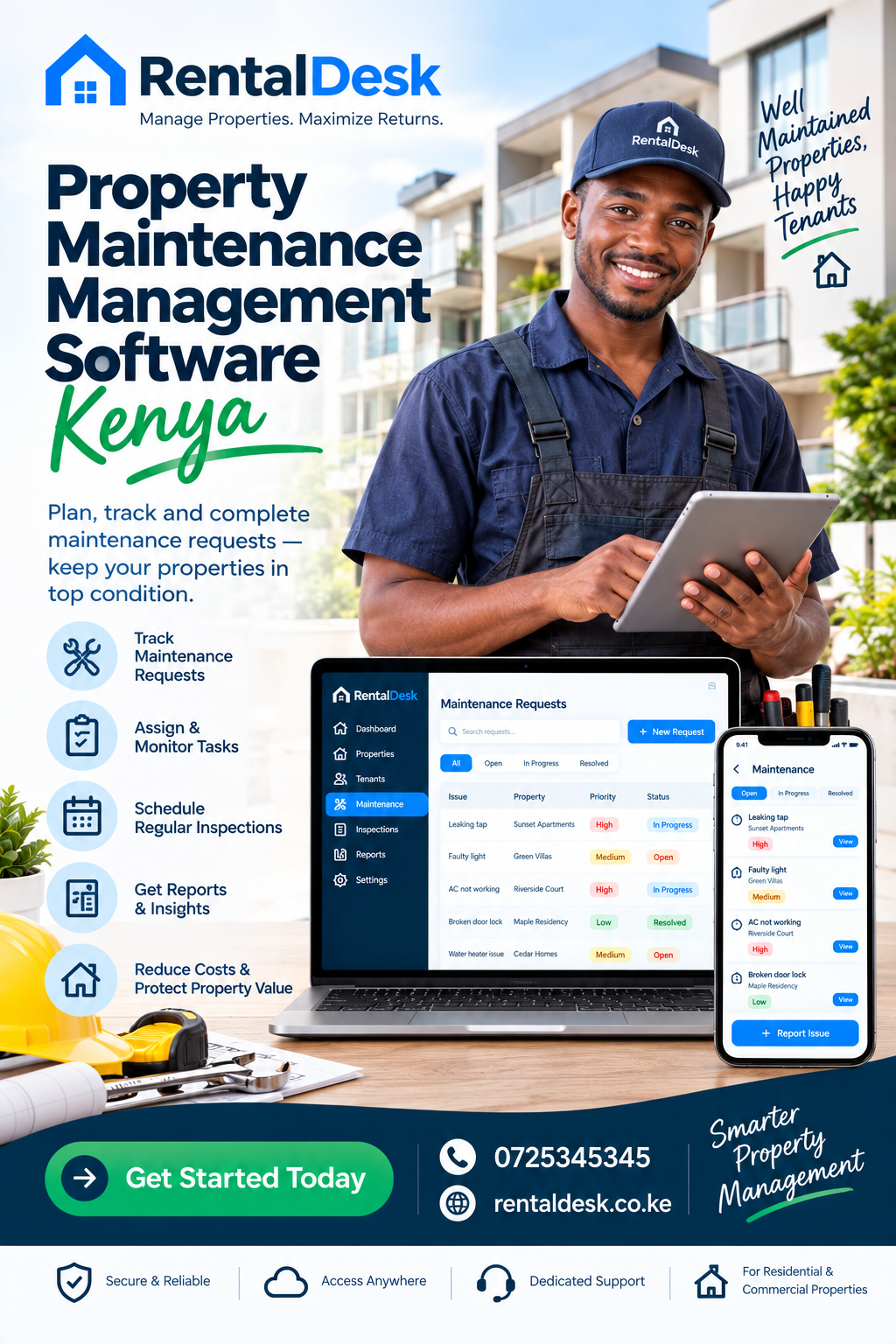
Property Maintenance Management Software Kenya: Complete Guide for Landlords and Property Managers
For landlords, property managers, letting agents, and owners of rental buildings, maintenance is one of the easiest areas to underestimate. A leaking tap, broken gate, faulty electrical fitting, or unresolved tenant request can quickly become a larger cost when it is not recorded and followed up. Property Maintenance Management Software Kenya gives a property team a structured way to receive maintenance requests, assign work, track progress, store service records, and keep tenants informed. Property Maintenance Management Software Kenya is especially useful when several units, technicians, suppliers, or properties are involved because maintenance stops depending on scattered WhatsApp messages, notebooks, and memory. This guide explains how a digital maintenance workflow works, what features matter, how Kenyan property businesses can use it, and what to consider before choosing a system.
A useful maintenance platform should do more than create a list of repairs. Property Maintenance Management Software Kenya should help a manager understand what was reported, when it was reported, who is responsible, what materials may be required, whether the tenant has been updated, and whether the work has actually been completed. With Property Maintenance Management Software Kenya, a manager can move from reactive administration to a repeatable process where requests have clear statuses and responsibilities. This matters in Nairobi apartment blocks, gated estates, student housing, mixed-use developments, and smaller rental portfolios alike. The objective is not to make maintenance complicated; it is to make the existing process visible, accountable, and easier to manage.
Why Property Maintenance Needs Better Management
One of the first benefits of Property Maintenance Management Software Kenya is centralized maintenance information. Instead of checking several notebooks, email threads, phone messages, and spreadsheets, the property team can work from a single record for each issue. Property Maintenance Management Software Kenya can connect a maintenance request to a specific property, building, unit, tenant, contractor, and date. That context makes it easier to understand recurring problems. If the same apartment reports plumbing faults repeatedly, for example, the manager can review previous jobs before approving another temporary repair. Over time, these records become useful operational information rather than forgotten administrative history.
Maintenance requests also need prioritization. A broken light in a common corridor is different from a major water leak, an electrical safety concern, or a blocked drainage line. Property Maintenance Management Software Kenya can support a process where requests are categorized according to urgency, location, and type of work. A well-organized Property Maintenance Management Software Kenya workflow can then help staff focus attention on issues that could cause property damage, safety problems, tenant disruption, or higher repair costs if delayed. Priority levels should be simple enough for staff to use consistently, with clear definitions for emergency, urgent, routine, and planned maintenance.
Improving Tenant Maintenance Requests
Tenant communication is another important part of maintenance. A resident who reports a problem usually wants two things: confirmation that the issue has been received and a reasonable indication of what happens next. Property Maintenance Management Software Kenya can help create a visible trail from the initial complaint to assignment and completion. When Property Maintenance Management Software Kenya is connected to a tenant record, the property manager has the necessary context to respond without asking the resident to repeat basic information. Better communication does not mean promising an immediate repair every time; it means giving residents clearer expectations and reducing the frustration caused by unanswered requests.
Work orders are the bridge between a complaint and an actual repair. Property Maintenance Management Software Kenya can help convert a maintenance request into a work order containing the job description, location, assigned technician, priority, expected date, and completion status. With Property Maintenance Management Software Kenya, managers can separate reported issues from approved jobs and completed work. This distinction is useful because not every complaint should automatically become an expense. Some issues require inspection first, some need owner approval, and others may fall under a tenant’s responsibilities according to the lease. A structured work-order process makes those decisions easier to document.
Managing Contractors and Maintenance Teams
For larger rental portfolios, contractor coordination can become a significant administrative task. Property Maintenance Management Software Kenya can help managers maintain a record of external technicians and suppliers used for plumbing, electrical work, painting, cleaning, landscaping, lifts, generators, security systems, and other services. Property Maintenance Management Software Kenya can also make it easier to see which contractor handled a previous repair, what work was completed, and whether the same issue returned. This history can support more informed procurement and scheduling decisions without relying on someone’s memory. Contractors can also receive clearer instructions when the job description and property details are documented before work begins.
Cost control is closely linked to maintenance records. Property Maintenance Management Software Kenya can give managers a clearer view of repair-related spending by property, unit, maintenance category, or period. When Property Maintenance Management Software Kenya records costs alongside work orders, it becomes easier to distinguish routine expenses from unusually expensive repairs. A manager may notice that a particular building is generating repeated plumbing costs or that a common-area system requires frequent servicing. That information can support budgeting and discussions with property owners. The purpose is not simply to reduce every maintenance expense, because delaying necessary work can create larger costs later; it is to make spending more visible and defensible.
Preventive Maintenance for Rental Properties
Preventive maintenance is often more economical to manage than waiting for equipment or building components to fail. Property Maintenance Management Software Kenya can support scheduled tasks such as water tank checks, pump servicing, generator maintenance, electrical inspections, painting, pest control, roof inspections, and other recurring activities. A strong Property Maintenance Management Software Kenya process helps managers distinguish planned work from tenant-reported repairs. That distinction matters because a property that appears quiet may still require regular maintenance. Scheduling recurring tasks creates a maintenance calendar instead of forcing staff to remember dates manually or react only after something breaks.
Property inspections provide another source of useful maintenance information. During an inspection, a manager may identify cracked tiles, leaking fixtures, damaged doors, poor drainage, worn paint, faulty lights, or other defects that tenants have not reported. Property Maintenance Management Software Kenya can help convert inspection findings into trackable maintenance tasks. When Property Maintenance Management Software Kenya connects inspections with unit and property records, the team can document what was observed, what action was recommended, and whether the issue was resolved. This creates a stronger record for routine inspections, move-in checks, move-out assessments, and common-area reviews.
Mobile Maintenance Management
Mobile access can be particularly useful for teams that are rarely seated at a desk. Property Maintenance Management Software Kenya should make it practical for authorized staff to review requests, update statuses, add notes, and check property information while moving around a building or estate. A mobile-friendly Property Maintenance Management Software Kenya setup can reduce the delay between discovering a problem and recording it. For example, a caretaker who notices a leaking pipe in a common area should not have to wait until the end of the day to write a report. Immediate documentation improves visibility and gives the office a more accurate picture of what is happening on site.
Photographs and attachments can add important context to a maintenance record. A written description such as “wall damaged” may be too vague to guide a contractor, while a dated photograph can show the location and severity of the issue. Property Maintenance Management Software Kenya can provide a place for relevant images, documents, quotations, invoices, or service notes to be associated with a job. With Property Maintenance Management Software Kenya, the property team can build a more complete history of repairs without storing every attachment separately on personal phones. This is especially helpful when a manager changes, a contractor asks for details, or an owner wants an explanation of a maintenance expense.
Maintenance Approvals and Expense Control
Approval workflows become important when maintenance costs exceed routine operating limits. Property Maintenance Management Software Kenya can help a property business separate the reporting, inspection, quotation, approval, assignment, and completion stages of a repair. A clear Property Maintenance Management Software Kenya workflow can reduce situations where a contractor starts work before the responsible person has approved the expense. Approval rules should reflect the organization’s structure: a small landlord may approve everything personally, while a larger company may have property managers, finance staff, supervisors, and owners with different responsibilities. The software should support those roles without creating unnecessary administrative steps.
Maintenance data can also improve budgeting. Instead of estimating future repair needs entirely from intuition, managers can examine historical patterns. Property Maintenance Management Software Kenya can help organize maintenance expenditure by month, property, category, or unit, while Property Maintenance Management Software Kenya can make those records easier to interpret when preparing operating budgets. If a building consistently incurs high costs for plumbing, repainting, or electrical work, the manager can investigate the cause and consider planned improvements. Historical information does not guarantee future costs, but it gives the business a stronger starting point for forecasting and discussions with property owners.
Maintenance Reporting and Performance Tracking
Reporting is one of the areas where digital systems can save significant administrative time. Property Maintenance Management Software Kenya can provide summaries of open requests, completed jobs, overdue work orders, recurring problems, and maintenance spending. A manager using Property Maintenance Management Software Kenya can review the condition of a portfolio without manually combining information from several spreadsheets. Reports can also support owner communication by showing what was reported, what was done, and where money was spent. Useful reporting should remain practical: a manager should be able to identify exceptions quickly rather than sorting through pages of data to find one overdue repair.
A good maintenance system should also help protect service quality. Property Maintenance Management Software Kenya can make response times more visible by recording when an issue was submitted and when it was assigned or completed. With Property Maintenance Management Software Kenya, managers can identify patterns such as repeated delays from a particular supplier, a high volume of requests from one building, or recurring jobs that remain open for too long. These patterns can lead to operational improvements. For example, a property manager might decide to keep certain spare parts on site, establish a preferred contractor list, or schedule routine inspections for a problem that repeatedly generates emergency calls.
Integrating Maintenance With Property Operations
Integrating maintenance with broader property operations can make the workflow more useful. Property Maintenance Management Software Kenya can sit alongside tenant records, rent information, property details, invoices, and other administrative data so the manager does not have to recreate the same information in separate systems. Property Maintenance Management Software Kenya becomes more valuable when a maintenance request can be understood in context: which property is affected, which unit is involved, who occupies it, and whether there are existing notes about the issue. Integration should reduce duplicate data entry while keeping permissions clear so that sensitive financial or tenant information is only visible to authorized users.
M-Pesa and digital payment records are central to many Kenyan rental operations, but maintenance costs need their own clear trail. Property Maintenance Management Software Kenya can help separate maintenance transactions from rent collection while still keeping them connected to the correct property or unit. In a broader Property Maintenance Management Software Kenya workflow, managers can document supplier costs, approved expenses, and related invoices so that payment administration is easier to reconcile. The exact payment features available will depend on the system and its integrations, so property businesses should verify how supplier payments, tenant charges, and financial records are handled before choosing a platform.
Choosing Software for Kenyan Property Businesses
For Kenyan property businesses, connectivity and practical usability matter. Property Maintenance Management Software Kenya should be simple enough for office administrators, caretakers, managers, and authorized technicians to use without extensive technical training. A Property Maintenance Management Software Kenya platform that is difficult to navigate may encourage staff to return to informal channels such as WhatsApp messages or handwritten notes. The best workflow is therefore not necessarily the one with the longest feature list. It is the one employees can follow consistently. Training, clear responsibilities, and a straightforward interface are just as important as the underlying technology.
Data security deserves attention because property systems can contain tenant details, supplier information, financial records, photographs, and internal notes. Property Maintenance Management Software Kenya should use sensible access controls so users only see or edit information relevant to their responsibilities. When evaluating Property Maintenance Management Software Kenya, property managers should ask how user permissions work, how data is backed up, how accounts are protected, and what happens when an employee leaves the organization. Strong security is a combination of software controls and staff practices. Password management, account reviews, device security, and careful handling of attachments remain important even when a platform has built-in protections.
Maintaining Accurate Property Records
Another advantage of structured maintenance records is easier handover between employees. A property business should not lose operational knowledge simply because a caretaker, administrator, or manager leaves. Property Maintenance Management Software Kenya can preserve job histories, supplier details, inspection notes, and outstanding requests in a central system. Property Maintenance Management Software Kenya can therefore reduce dependence on individual employees’ phones or personal spreadsheets. A new team member can review open tasks and previous repairs instead of beginning with a blank page. This continuity becomes especially useful for property companies managing multiple buildings where responsibilities change between sites or teams.
Recurring maintenance deserves a specific strategy because many building problems have predictable cycles. Water pumps, generators, gates, lifts, fire equipment, lighting systems, roofs, drainage, and common-area facilities may require periodic attention. Property Maintenance Management Software Kenya can help create recurring tasks with target dates and responsible staff. A Property Maintenance Management Software Kenya schedule can also make it easier to identify work that is overdue before it becomes an emergency. The exact intervals should follow equipment guidance, professional recommendations, lease obligations, building requirements, and the property’s operating needs rather than being copied from a generic checklist.
Tenant Accountability and Maintenance Documentation
Tenant accountability can sometimes be relevant when damage is caused by misuse or when an issue falls under a tenant’s contractual responsibilities. Property Maintenance Management Software Kenya can provide documentation of the reported problem, inspection findings, photographs, quotations, and final action. With Property Maintenance Management Software Kenya, managers can keep the maintenance record connected to the relevant unit while handling charges according to the lease and applicable business procedures. Documentation is important here because assumptions can create disputes. A clear record of what was observed and what was agreed can help the parties understand why a repair was handled in a particular way.
When comparing maintenance platforms, property managers should start with workflow rather than marketing claims. Property Maintenance Management Software Kenya should fit the way requests are actually received, assessed, approved, assigned, and closed. A Property Maintenance Management Software Kenya solution may look impressive in a demonstration but still be unsuitable if staff cannot easily update jobs or if important records are difficult to retrieve. Create a short list of real maintenance scenarios and test the software against them. Include an emergency repair, a routine request, a recurring service, a contractor job, and a repair that needs owner approval before deciding whether the workflow is practical.
Pricing and Implementation Considerations
Pricing should also be evaluated against the size and complexity of the portfolio. Property Maintenance Management Software Kenya may be offered through different subscription structures, user limits, property limits, modules, or integration packages depending on the provider. Before selecting Property Maintenance Management Software Kenya, ask what is included in the quoted price and which functions may attract additional fees. Consider the total administrative value rather than looking only at the monthly subscription. If a platform reduces missed requests, duplicate work, manual reporting, and avoidable delays, its operational value may extend beyond the software line item itself.
Implementation is easier when the business prepares its data first. Property Maintenance Management Software Kenya works best when property records, units, tenant information, contractors, maintenance categories, and existing open requests are organized before the system goes live. For Property Maintenance Management Software Kenya, managers should decide who receives requests, who approves expenses, who assigns technicians, and who closes completed jobs. Establishing these rules early prevents the software from becoming another place where unclear responsibilities are stored. Start with a manageable set of properties if necessary, learn from the first workflow, and then expand the process across the portfolio.
Staff Adoption and Maintenance Workflows
Staff adoption should be treated as part of the implementation rather than an afterthought. Property Maintenance Management Software Kenya can only improve maintenance management if employees actually use it. A practical Property Maintenance Management Software Kenya rollout should include short training sessions, clear instructions, and simple rules such as recording every request in the system and updating the status after each meaningful action. Managers should also monitor early usage and address obstacles quickly. If staff continue to rely on private messages because the official workflow is too slow, the organization should examine the process rather than simply blaming employees for non-compliance.
Small landlords can benefit from the same principles even when they manage only a handful of units. Property Maintenance Management Software Kenya can help a landlord keep repair information organized as the portfolio grows. A simple Property Maintenance Management Software Kenya workflow might record the unit, issue, date reported, contractor, cost, and completion date. This can be enough to create a useful maintenance history without requiring a large administrative team. As the number of properties increases, additional capabilities such as preventive schedules, approvals, reporting, tenant communication, and contractor management can become increasingly valuable.
Signs Your Maintenance Process Needs Improvement
Property managers should also look for signs that their current maintenance process is struggling. Frequent missed requests, repeated tenant follow-ups, unclear contractor assignments, unexplained repair costs, overdue inspections, and difficulty answering owner questions are all operational warning signs. Property Maintenance Management Software Kenya can address these issues by creating a structured source of information. When Property Maintenance Management Software Kenya is combined with clear internal procedures, managers can see where work is getting stuck instead of discovering problems only after a tenant complains again. The goal is a maintenance process that is predictable enough to manage and flexible enough to handle genuine emergencies.
Before making a final decision, prepare a practical checklist and test each shortlisted system with actual scenarios. Property Maintenance Management Software Kenya should make it possible to record a request, assign responsibility, track progress, attach evidence, record costs, and close the job cleanly. A final Property Maintenance Management Software Kenya review should also consider ease of use, reporting, user permissions, mobile access, integrations, support, scalability, and the quality of the provider’s onboarding process. Asking these questions before implementation helps a property business choose a system that supports its real maintenance workflow instead of purchasing features that staff rarely use.
Maintenance Categories Every Rental Business Should Track
A useful maintenance process becomes easier when requests are grouped into practical categories. The categories should reflect the buildings and services a property business actually manages rather than creating dozens of labels that staff rarely use.
Common categories include:
- Plumbing and water systems
- Electrical faults and lighting
- Doors, locks, gates, and access systems
- Painting, walls, ceilings, and flooring
- Drainage and sanitation
- Roofing and rainwater management
- Lifts and vertical transport
- Generators and backup power
- Water pumps and tanks
- Landscaping and outdoor areas
- Cleaning and common-area repairs
- Security systems and CCTV
- Appliances supplied with rental units
- Fire-safety equipment and related inspections
Categorization makes reporting more meaningful. If plumbing requests account for a large share of maintenance activity, a manager can investigate whether there is an underlying issue rather than treating every repair as an isolated event. Categories can also help with contractor assignment because a plumbing request can be routed to the appropriate service provider instead of being passed around the office.
A Practical Maintenance Workflow for Kenyan Property Managers
A simple workflow can keep responsibilities clear from the moment a tenant reports a problem.
- Receive the request. Record the tenant, property, unit, problem, date, and any supporting image or document.
- Classify the issue. Decide whether it is an emergency, urgent matter, routine repair, inspection item, or planned maintenance task.
- Review responsibility. Check the lease, property rules, previous records, and circumstances before deciding who should handle the cost.
- Inspect when necessary. Some problems can be assigned immediately, while others need an assessment before a quotation is requested.
- Approve the work. Follow the organization’s spending limits and approval rules.
- Assign the technician. Give the contractor enough information to understand the location and expected work.
- Track progress. Keep the request open until the actual work has been completed and documented.
- Verify completion. Confirm the result, collect supporting evidence where appropriate, and record the final cost.
- Close the request. Keep the completed record available for future reference.
This workflow is deliberately straightforward. A maintenance system should support these steps rather than force a property business into an unnecessarily complicated process.
Emergency Versus Routine Maintenance
Not every repair deserves the same response time. A burst pipe that threatens several apartments, exposed electrical wiring, a major security failure, or a serious drainage problem may require immediate action. A loose cupboard handle or minor paint defect can normally be scheduled.
A property business should define its own priority rules. Useful questions include:
- Could the problem cause injury?
- Could it cause significant property damage?
- Does it affect several tenants?
- Does it prevent a unit from being safely occupied?
- Is a critical building service unavailable?
- Could delaying the repair make the eventual cost much higher?
- Is the issue required to be addressed within a contractual or operational deadline?
Clear priorities help staff make consistent decisions. They also make tenant communication easier because employees can explain why one request is being handled immediately while another has been scheduled.
Questions to Ask a Software Provider Before Implementation
A demonstration should focus on real tasks, not just attractive screens. Ask the provider to show exactly how the system handles the scenarios that matter to your business.
Important questions include:
| Area | Question to ask |
|---|---|
| Requests | How are tenant maintenance requests captured? |
| Work orders | Can one request be converted into a trackable work order? |
| Assignment | Can jobs be assigned to specific employees or contractors? |
| Priorities | Can emergency and routine jobs be separated? |
| Attachments | Can photographs, quotations, and documents be stored with a job? |
| Approvals | Can expensive repairs require authorization before assignment? |
| Reporting | Can managers view open, overdue, and completed work? |
| Costs | Can repair expenses be recorded against properties or units? |
| Mobile use | Can authorized staff update jobs away from the office? |
| Permissions | Can access be restricted according to staff responsibilities? |
| History | Can completed repairs be searched later? |
| Support | What onboarding and technical support are included? |
| Scalability | Can the system accommodate additional properties and users? |
The answers should be tested against the company’s real workflow. A provider’s feature list is less useful than seeing an actual maintenance request move from report to closure.
Common Maintenance Management Mistakes
Some maintenance problems are caused by process weaknesses rather than a lack of money or contractors. One common mistake is accepting requests through too many channels without a central record. Tenants may call one employee, send a WhatsApp message to another, and report the same issue at the office. If those reports are not consolidated, duplicate work can occur.
Another mistake is closing a job as soon as a contractor says it is finished without confirming the result. A repair that looks complete from the contractor’s perspective may still leave the tenant with the original problem.
Property businesses can also create unnecessary costs by repeatedly treating symptoms rather than investigating recurring faults. If the same pipe, pump, electrical circuit, or drainage area keeps failing, the team should examine the underlying cause.
Finally, some managers keep maintenance information only in individual phones or personal spreadsheets. This creates a continuity risk. Business records should remain accessible to authorized staff when responsibilities change.
How Maintenance Records Support Property Owners
Owners often want to know whether their property is being maintained responsibly and whether expenses are justified. A clear maintenance history can answer these questions without requiring a manager to reconstruct events from memory.
A useful owner report might show:
- Number of requests received during a period
- Number completed
- Outstanding jobs
- Major repairs
- Preventive maintenance completed
- Maintenance expenses by category
- Recurring issues
- Jobs awaiting approval
- Contractor activity
- Significant property observations
The purpose of reporting is not to produce complicated dashboards for their own sake. It is to give owners enough information to understand what happened, what remains unresolved, and where attention may be needed.
Scaling From a Few Units to a Larger Portfolio
A landlord with five units can often remember most outstanding repairs. That becomes much harder with fifty units, and manual tracking becomes even more demanding when a business manages several buildings with different caretakers and contractors.
Growth creates more variables: more tenants, more requests, more invoices, more suppliers, more inspections, and more recurring tasks. A structured system helps the business preserve consistency as the portfolio expands.
The transition should not require every process to become complicated. Start with the information that matters most, establish responsibility for each stage, and add advanced functions as the portfolio requires them. A good system should support growth without forcing a small operation to behave like a large corporation on day one.
Maintenance KPIs Worth Monitoring
Property managers can use a small set of indicators to understand how well their process is working. Useful measures include average response time, average completion time, number of overdue jobs, repeat repairs, maintenance cost per unit, preventive tasks completed on schedule, and the number of open requests at the end of each reporting period.
These indicators should be interpreted carefully. A high number of requests does not automatically mean poor management; an older building may naturally require more repairs. Similarly, a low maintenance budget may reflect delayed work rather than efficiency.
The value comes from watching trends and asking why they change. If completion times rise, investigate contractor availability, approval delays, spare-part shortages, staffing, or unusually high demand. If repeat repairs rise, investigate whether temporary fixes are replacing proper corrective work.
Building a Maintenance Culture
Software cannot replace good operational habits. The most effective property teams create a culture where maintenance requests are recorded promptly, responsibilities are clear, tenants receive appropriate updates, contractors receive useful instructions, and completed work is verified.
Managers should periodically review whether the process is being followed. A short monthly review can identify open jobs, recurring problems, delayed approvals, supplier issues, and preventive tasks coming due.
It is also useful to ask tenants for practical feedback after significant repairs. Their experience can reveal whether a problem was actually resolved or merely marked complete. Over time, these habits turn maintenance from a collection of emergencies into a managed property function.
FAQ
What does property maintenance management software do?
It helps property teams organize repair requests, work orders, inspections, contractors, preventive tasks, maintenance costs, and completion records. The exact functions vary between providers, so businesses should evaluate systems according to their actual workflow.
Can a small landlord use maintenance management software?
Yes. A small landlord can use a system to keep unit repairs, contractor details, costs, and outstanding tasks organized. The main advantage is creating a reliable record before the portfolio becomes large enough for manual tracking to become difficult.
Can tenants report maintenance issues digitally?
Many modern property platforms provide some form of digital request process, although the exact method varies. Depending on the system, tenants may use a portal, mobile interface, form, or another communication channel. Always confirm the available options with the provider.
How does preventive maintenance differ from repairs?
Repairs respond to faults that have already occurred. Preventive maintenance involves planned inspections, servicing, cleaning, testing, or replacement intended to reduce the likelihood of failures. Both should be tracked because a property needs attention even when tenants have not reported a problem.
Should maintenance costs be connected to individual units?
Where practical, connecting costs to a property, building, unit, or common area creates better financial visibility. It helps managers understand where money is being spent and can support owner reporting, budgeting, and analysis of recurring problems.
What should a maintenance report contain?
A useful report can include the request date, property, unit, issue category, priority, assigned person or contractor, current status, completion date, cost, and relevant notes. The exact fields should match the organization’s operational needs.
How can managers reduce repeated maintenance problems?
Start by identifying recurring requests and reviewing their history. Look for underlying causes, temporary repairs, poor-quality materials, aging equipment, installation issues, or insufficient preventive maintenance. Recurring problems often require a different response from one-off faults.
Is mobile access important for property maintenance?
It can be valuable for caretakers, inspectors, and managers who work across multiple properties. Mobile access allows authorized staff to record observations, review requests, update statuses, and attach evidence while they are on site rather than waiting to return to an office.
What should a property business consider before buying a system?
Consider the request workflow, work orders, contractor management, preventive schedules, reporting, cost tracking, attachments, mobile access, permissions, integrations, support, scalability, and total cost. Test the platform with real scenarios before committing.
How should a business introduce a new maintenance system?
Clean existing records, define responsibilities, configure maintenance categories, train users, migrate relevant open jobs, and begin with a manageable group of properties if appropriate. Review adoption during the first weeks and adjust the workflow where staff encounter unnecessary friction.