
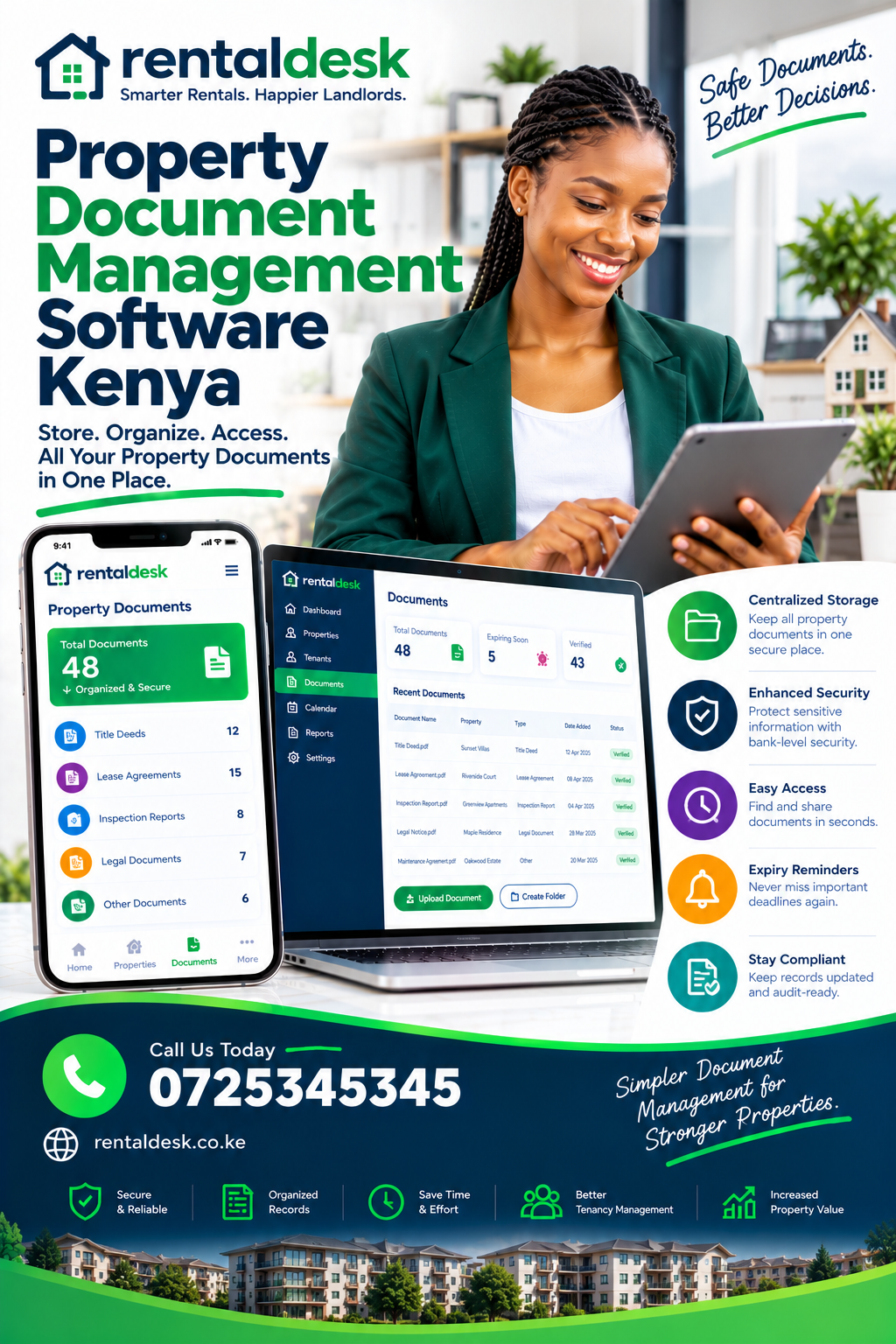
Property Document Management Software Kenya: A Complete Guide for Landlords and Property Managers
Introduction
Property management involves much more than collecting rent and finding tenants. Every rental property generates a large amount of documentation that needs to be created, stored, updated, accessed, and protected.
Landlords and property managers may have to deal with tenancy agreements, lease documents, tenant identification records, inspection reports, payment receipts, invoices, maintenance records, property ownership documents, notices, correspondence, supplier records, and financial reports.
When a portfolio contains several properties and hundreds of tenants, keeping these documents organized can become increasingly difficult. Important files may be stored in physical folders, computers, email inboxes, WhatsApp conversations, cloud storage accounts, or different spreadsheets.
This creates a challenge when a property manager needs to find a particular document quickly.
This is where Property Document Management Software Kenya can provide a more structured approach. Instead of relying on scattered folders and paper files, property managers can organize important property-related information within a centralized digital environment.
For Kenyan landlords, real estate investors, estate managers, and professional property management companies, document organization can improve efficiency, reduce administrative confusion, and make it easier to access information when it is needed.
This guide explains how property document management works, why documentation is important, the problems associated with manual file management, useful software features, security considerations, tenant documentation, lease management, property records, reporting, and how landlords can build a more organized property management operation.
What Is Property Document Management?
Property document management is the process of organizing, storing, retrieving, updating, and managing documents related to rental properties and their tenants.
These documents can include:
- Tenancy agreements
- Lease agreements
- Tenant application forms
- Tenant identification documents
- Property inspection reports
- Rent receipts
- Payment records
- Maintenance records
- Invoices
- Supplier documents
- Property notices
- Correspondence
- Financial reports
- Property inventories
- Move-in documentation
- Move-out documentation
For a landlord managing a single property, storing these documents may seem relatively simple.
However, when the portfolio expands, document management becomes a significant administrative responsibility.
A centralized Property Document Management Software Kenya system can help organize documents according to properties, units, tenants, owners, or other relevant categories.
Why Property Documents Matter
Property documents provide evidence of important transactions and relationships.
A tenancy agreement, for example, establishes important information about the rental arrangement.
An inspection report can provide a record of the condition of a property.
A payment receipt can provide evidence of a rental transaction.
A maintenance invoice can document money spent on a repair.
Without proper documentation, resolving questions about past events can become more difficult.
Using Property Document Management Software Kenya can help property managers maintain better-organized records and make important documents easier to locate.
The Challenges of Manual Document Management
Many landlords still use physical files, email folders, spreadsheets, and personal computers to manage property documents.
While these methods can work for a small number of documents, they become more difficult as the portfolio grows.
Documents Can Become Scattered
A lease might be saved on a laptop, while a payment receipt is stored in email and an inspection report remains in a physical folder.
Documents Can Be Misplaced
Physical paperwork can be lost, damaged, or filed incorrectly.
Searching Takes Time
Finding one document among hundreds of files can consume valuable time.
Duplicate Files Can Appear
Different versions of the same document can create confusion about which file is current.
Access Can Become Difficult
When a manager is away from the office, accessing a physical file may be impossible.
A Property Document Management Software Kenya platform can address some of these challenges by creating a centralized digital document environment.
Centralizing Property Records
One of the biggest benefits of digital document management is centralization.
Instead of storing property information across unrelated locations, a manager can create organized records for each property.
For example:
Property: Riverside Apartments
Units: 40
Documents:
- Tenant agreements
- Inspection reports
- Maintenance records
- Property notices
- Financial documents
- Supplier invoices
This structure makes information easier to organize.
A Property Document Management Software Kenya system can help managers connect documents with the relevant properties and units.
Managing Documents by Property
Property managers may oversee several buildings with different owners, tenants, and operating requirements.
Separating documentation by property helps prevent files from being mixed together.
For example:
Property A
- Lease agreements
- Inspection reports
- Maintenance invoices
Property B
- Lease agreements
- Inspection reports
- Maintenance invoices
Property C
- Lease agreements
- Inspection reports
- Maintenance invoices
A Property Document Management Software Kenya solution can provide a structured way of organizing documents according to individual properties.
Managing Tenant Documents
Tenant records often contain several important documents.
A tenant file may include:
- Application information
- Identification documents
- Tenancy agreement
- Deposit information
- Payment records
- Notices
- Inspection reports
- Correspondence
- Move-out documentation
When these documents are stored in separate places, reviewing a tenant’s history becomes more difficult.
A Property Document Management Software Kenya platform can help property managers organize tenant documentation alongside the relevant tenancy record.
Digital Lease Management
Lease agreements are among the most important documents in rental property management.
A lease may contain information about:
- Tenant
- Property
- Unit
- Rent amount
- Deposit
- Lease period
- Payment terms
- Responsibilities
- Renewal conditions
Keeping track of lease documents becomes increasingly difficult when managing many tenants.
With Property Document Management Software Kenya, property managers can create a more organized process for maintaining lease-related information.
Monitoring Lease Expiry Dates
Lease expiry dates are important because they can affect occupancy and tenant retention.
A manager may need to identify:
- Leases ending this month
- Leases ending next month
- Agreements due for renewal
- Tenants preparing to leave
- Vacant units after lease expiry
Keeping this information visible helps property managers plan ahead.
A Property Document Management Software Kenya system can help organize lease information so managers can more easily monitor tenancy timelines.
Managing Property Inspection Documents
Property inspections generate valuable records.
An inspection may document:
- Walls
- Floors
- Doors
- Windows
- Plumbing
- Electrical fittings
- Fixtures
- Appliances
- General property condition
Inspection documentation can be particularly useful during tenant move-in and move-out.
A Property Document Management Software Kenya platform can help keep inspection records associated with the appropriate property or tenant.
Move-In Documentation
When a tenant moves into a property, documenting the initial condition of the unit can help establish a baseline.
A move-in record may include:
- Inspection checklist
- Photos
- Tenant confirmation
- Meter readings
- Inventory
- Key handover information
Keeping this information organized makes it easier to reference later.
Using Property Document Management Software Kenya can help managers maintain a structured tenant onboarding record.
Move-Out Documentation
The move-out process can generate several important documents.
These may include:
- Final inspection report
- Damage assessment
- Outstanding rent statement
- Utility statement
- Deposit calculation
- Refund documentation
- Handover confirmation
Keeping these documents together can make the process easier to review.
A Property Document Management Software Kenya system can help managers organize the move-out documentation associated with a tenant.
Managing Rental Receipts
Rent receipts are important financial records.
They can provide evidence that a payment was received and help landlords maintain accurate rental histories.
For larger portfolios, keeping physical receipts can become cumbersome.
Digital records can provide easier access and organization.
A Property Document Management Software Kenya platform can help property managers maintain documentation associated with rental transactions.
Organizing Invoices
Property management businesses regularly receive invoices from suppliers and service providers.
Examples include invoices for:
- Plumbing
- Electrical work
- Cleaning
- Security
- Repairs
- Painting
- Landscaping
- Equipment
- Maintenance
Keeping these invoices organized helps managers understand property expenses.
Using Property Document Management Software Kenya can make it easier to maintain records of invoices and connect them with relevant property expenses.
Maintenance Documentation
Every maintenance activity can generate useful documentation.
For example, a repair may involve:
- Tenant reports a problem.
- Manager creates a maintenance request.
- Technician inspects the issue.
- Technician provides a quotation.
- Repair is approved.
- Work is completed.
- Invoice is received.
- Payment is made.
Keeping these documents together creates a useful maintenance history.
A Property Document Management Software Kenya platform can help property managers maintain more organized maintenance records.
Why Maintenance Records Are Valuable
Maintenance records can reveal patterns.
Suppose the same plumbing problem appears repeatedly in a particular building.
A manager reviewing historical documentation may discover that the issue has occurred several times.
This could indicate the need for a more permanent solution rather than repeated repairs.
With Property Document Management Software Kenya, property managers can maintain historical documentation that supports better maintenance decisions.
Managing Property Ownership Documents
Property owners may also need to maintain documents related to their properties.
Depending on the circumstances, these may include:
- Property purchase documentation
- Ownership records
- Property-related correspondence
- Insurance documents
- Valuation reports
- Regulatory documentation
- Financing documents
These documents should be handled carefully because they can contain important financial and legal information.
A Property Document Management Software Kenya system can help create a structured digital environment for relevant property records.
Organizing Documents for Multiple Owners
Professional property managers may manage properties belonging to different clients.
This means documentation needs to be clearly separated.
For example:
Owner A
- Property 1
- Property 2
Owner B
- Property 3
- Property 4
Owner C
- Property 5
Each owner may have different reports, agreements, expenses, and correspondence.
A Property Document Management Software Kenya platform can help property managers organize documents according to ownership and property structures.
Improving Document Retrieval
One of the biggest advantages of digital document management is easier retrieval.
Instead of searching through physical cabinets, a manager can search for information using categories such as:
- Property
- Unit
- Tenant
- Document type
- Date
- Agreement
- Transaction
This can significantly reduce the time required to locate information.
Using Property Document Management Software Kenya can help property managers create a more searchable and organized document environment.
Reducing Paperwork
Paper documentation has traditionally been part of property management.
However, maintaining large quantities of physical paperwork can create several challenges.
Paper files require:
- Storage space
- Filing systems
- Physical organization
- Regular maintenance
- Protection from damage
Digital documentation can reduce dependence on physical storage.
A Property Document Management Software Kenya solution can help property businesses move toward more organized digital records.
Protecting Important Documents
Property documents can contain sensitive business and tenant information.
Examples include:
- Personal details
- Identification information
- Financial records
- Contracts
- Payment histories
- Ownership documents
Security should therefore be an important consideration when choosing document management software.
Managers should evaluate how the system handles authentication, user access, backups, and data protection.
A Property Document Management Software Kenya platform should be selected with appropriate attention to information security.
User Access and Permissions
Not every employee needs access to every document.
For example:
- A property manager may need broad access.
- An accountant may need financial documents.
- A maintenance employee may only need maintenance-related information.
- An administrator may need tenant records.
User permissions can help limit unnecessary access.
When evaluating Property Document Management Software Kenya, property managers should consider whether the system provides suitable access controls.
Preventing Document Duplication
Duplicate documents can create confusion.
For example, a lease may exist as:
- Lease-final.pdf
- Lease-final2.pdf
- Lease-new.pdf
- Lease-updated.pdf
Without a clear document management process, employees may not know which version is current.
A centralized Property Document Management Software Kenya system can support more consistent document organization.
Managing Document Versions
Property documents sometimes need to be updated.
For example, a lease may be renewed or amended.
A property manager should be able to distinguish between the previous agreement and the current one.
Version management can help maintain a clear history.
Using Property Document Management Software Kenya can support more organized document administration where records are updated over time.
Supporting Property Management Teams
Property management companies may have multiple employees handling different responsibilities.
Without centralized records, employees may keep their own copies of important documents.
This can result in:
- Duplicate files
- Conflicting information
- Missing documents
- Communication delays
A shared digital document environment can improve collaboration.
A Property Document Management Software Kenya solution can help teams work from a more consistent set of property records.
Document Management for Property Managers Working Remotely
Property managers may not always be physically present at their offices.
They may need access to information while:
- Visiting a property
- Meeting a tenant
- Inspecting a unit
- Supervising repairs
- Meeting an owner
Digital systems can make important information more accessible when properly configured.
With Property Document Management Software Kenya, managers can work toward a more flexible document management process.
Managing Tenant Correspondence
Tenant communication can generate important records.
Examples include:
- Rent notices
- Maintenance communication
- Lease renewal discussions
- Move-out notices
- Property notices
- Payment-related correspondence
Keeping important correspondence organized can help create a more complete tenant history.
A Property Document Management Software Kenya platform can support better organization of tenant-related documentation.
Documenting Property Maintenance History
A property may undergo hundreds of maintenance activities over several years.
Without historical records, it can be difficult to understand:
- What was repaired
- When it was repaired
- Who performed the work
- How much it cost
- Whether the same problem occurred before
A centralized documentation system provides a historical reference.
Using Property Document Management Software Kenya can help managers build a more complete property maintenance history.
Improving Financial Documentation
Financial documentation should be organized alongside property information.
This can include:
- Rent receipts
- Invoices
- Expense records
- Payment confirmations
- Statements
- Owner reports
Having these documents organized makes financial review easier.
A Property Document Management Software Kenya solution can support better financial documentation processes within property management operations.
Supporting Owner Reporting
Property owners may request evidence behind financial reports.
For example, an owner may want to understand why maintenance expenses increased during a particular month.
If invoices and maintenance records are properly organized, the property manager can reference the relevant documentation.
With Property Document Management Software Kenya, property managers can build more organized documentation around owner reporting.
Preparing for Audits and Reviews
Property businesses may occasionally need to review historical records.
This could happen because of:
- Internal financial reviews
- Ownership changes
- Management changes
- Disputes
- Tax preparation
- Business assessments
Having documents organized can make these processes less stressful.
A Property Document Management Software Kenya platform can help businesses maintain accessible records for future reference.
Reducing Administrative Errors
Manual filing creates opportunities for mistakes.
A document might be:
- Filed under the wrong property
- Saved under the wrong tenant
- Given the wrong date
- Accidentally duplicated
- Deleted
- Forgotten
A structured digital process can reduce some of these administrative problems.
Using Property Document Management Software Kenya can help property managers establish standardized document workflows.
Standardizing Document Management
Different employees may have different approaches to filing documents.
One employee may use tenant names, another may use unit numbers, while another may use property names.
This creates inconsistency.
A centralized platform allows a company to establish standardized procedures.
A Property Document Management Software Kenya system can support consistent organization across the property management team.
Managing Documents as the Portfolio Grows
The number of documents generally increases with the number of properties and tenants.
A portfolio with 20 tenants may generate a manageable number of documents.
A portfolio with 500 tenants can generate thousands of records.
A property company should therefore consider scalability when choosing software.
A Property Document Management Software Kenya platform can help create a document management structure that grows alongside the rental portfolio.
Improving Tenant Onboarding
Tenant onboarding involves several administrative steps.
A property manager may need to collect:
- Tenant details
- Application documents
- Identification
- Agreement
- Deposit information
- Inspection records
Having a standardized process can reduce delays.
A Property Document Management Software Kenya system can help property managers organize onboarding documents and associate them with the correct tenant.
Managing Document Expiry Dates
Some property documents may have expiry dates.
Examples can include:
- Lease agreements
- Insurance documents
- Licences
- Service contracts
- Certain certificates
Missing an expiry date can create unnecessary administrative problems.
A Property Document Management Software Kenya platform that supports reminders or date tracking can help managers stay aware of upcoming document deadlines.
Managing Supplier Documentation
Property managers work with many suppliers.
These may include:
- Plumbers
- Electricians
- Cleaners
- Security companies
- Contractors
- Landscapers
- Repair technicians
Keeping supplier agreements, quotations, invoices, and payment records organized can improve administration.
Using Property Document Management Software Kenya can help create a more organized supplier documentation process.
Supporting Better Decision-Making
Good decisions require good information.
If a property owner is considering whether to renovate a building, historical documents may provide useful information.
For example, maintenance records may reveal recurring problems.
Financial documents may show whether the property generates enough income to support an investment.
A Property Document Management Software Kenya platform can make relevant historical information easier to organize and review.
Improving Business Continuity
A property management business should not depend entirely on one employee’s personal filing system.
If that employee leaves, takes leave, or loses access to their computer, important information may become difficult to retrieve.
Centralized documentation can reduce this dependency.
With Property Document Management Software Kenya, businesses can work toward a more structured information-management process.
Why Cloud-Based Access Can Be Useful
Cloud-based systems can provide advantages for businesses that need access to information from different locations.
A manager may need to review a lease while away from the office or check a maintenance record while visiting a property.
Depending on the platform and configuration, digital access can make this more convenient.
A Property Document Management Software Kenya solution with suitable remote access capabilities can support more flexible property management.
Document Management and Tenant Disputes
Disagreements can sometimes arise between landlords and tenants.
Questions may concern:
- Rent payments
- Deposits
- Property condition
- Repairs
- Lease terms
- Notices
Clear documentation can help establish what happened.
For example, a move-in inspection report can provide a record of the property’s initial condition.
A Property Document Management Software Kenya platform can help property managers maintain organized records that may be useful when reviewing historical events.
Managing Rental Agreements Efficiently
Rental agreements should be easy to retrieve when needed.
A manager should ideally be able to identify the tenant, property, unit, agreement date, and relevant tenancy information without searching through multiple physical folders.
A centralized Property Document Management Software Kenya system can make agreement management more systematic.
Document Management for Commercial Properties
Document management is not limited to residential rentals.
Commercial property managers may handle:
- Office leases
- Shop agreements
- Service contracts
- Maintenance documents
- Insurance records
- Tenant correspondence
- Invoices
Commercial leases can also involve more complex terms and longer documentation histories.
A Property Document Management Software Kenya platform can help commercial property managers organize these records more efficiently.
Document Management for Residential Properties
Residential property managers may handle large numbers of similar tenancy records.
This makes consistency particularly important.
Every tenant may require a similar set of documents, including:
- Application
- Agreement
- Identification
- Deposit record
- Inspection
- Payment history
- Move-out documentation
A Property Document Management Software Kenya solution can help standardize the way these records are organized.
Choosing Property Document Management Software
Before selecting a platform, property managers should evaluate their specific requirements.
Consider:
- How many properties need to be managed?
- How many tenants are currently active?
- How many employees need access?
- What types of documents need to be stored?
- Does the system support document organization?
- Can documents be associated with properties and tenants?
- Are access permissions available?
- Are backups provided?
- Can the platform grow with the business?
- Is the system easy for staff to use?
These questions can help landlords identify suitable Property Document Management Software Kenya for their operations.
Important Features to Look For
A useful property document management system should provide practical features.
Property Organization
Documents should be associated with the correct property.
Unit Management
Managers should be able to connect records to specific units.
Tenant Records
Tenant-related documents should be easy to access.
Search
Users should be able to find documents without unnecessary manual searching.
Access Controls
Different employees should have appropriate permissions.
Document History
Updated records should be distinguishable from older versions.
Reporting
The system should support broader property management reporting.
A Property Document Management Software Kenya solution offering these capabilities can help create a more organized property administration process.
How to Transition From Paper to Digital Records
Moving from physical files to digital management should be done carefully.
Step 1: Inventory Existing Documents
Identify the types of documents currently being stored.
Step 2: Remove Unnecessary Duplicates
Avoid transferring multiple copies of the same document.
Step 3: Organize Files
Group documents by property, unit, tenant, or document type.
Step 4: Digitize Important Paper Documents
Where appropriate, scan important records.
Step 5: Establish Naming Standards
Use consistent document names.
Step 6: Upload and Categorize
Store documents under the appropriate property or tenant.
Step 7: Establish Access Rules
Determine who can access different types of records.
Step 8: Train Staff
Make sure employees understand the new process.
Implementing Property Document Management Software Kenya systematically can make the transition easier and reduce confusion.
Training Employees on Document Management
Software alone does not guarantee organized records.
Employees need clear procedures.
Training should cover:
- Where documents should be stored
- How files should be named
- How to update records
- How to search
- How to manage permissions
- How to handle sensitive information
- How to avoid duplicate records
A Property Document Management Software Kenya system becomes more effective when employees follow consistent procedures.
Measuring the Benefits of Digital Document Management
After implementing software, managers can evaluate improvements using practical indicators.
For example:
- Time required to locate documents
- Number of missing files
- Number of duplicate records
- Speed of tenant onboarding
- Time spent preparing reports
- Staff productivity
- Ease of retrieving historical records
A Property Document Management Software Kenya solution should ultimately help make property administration more efficient and organized.
Property Document Management for Growing Investors
Real estate investors often begin with a small portfolio.
As they acquire more properties, administrative complexity increases.
A landlord may eventually manage:
- Multiple buildings
- Hundreds of tenants
- Several employees
- Different contractors
- Multiple bank accounts
- Large quantities of documentation
Establishing organized systems early can make future growth easier.
Using Property Document Management Software Kenya can help create a stronger administrative foundation for a growing rental business.
The Role of Documentation in Professional Property Management
Professional property management requires accountability.
Managers should be able to explain what happened with a property, tenant, payment, repair, or agreement.
Documentation provides the historical record needed to support that accountability.
A Property Document Management Software Kenya platform can help property managers maintain organized evidence of day-to-day property activities.
Frequently Asked Questions
What is property document management software?
Property document management software is a digital solution that helps landlords and property managers organize, store, retrieve, and manage documents associated with properties, tenants, leases, maintenance, payments, and other rental activities.
Who needs property document management software?
It can benefit individual landlords, property investors, estate managers, real estate companies, and professional property management firms.
What types of documents can property managers organize?
Depending on the platform, managers may organize tenancy agreements, lease documents, tenant records, inspection reports, invoices, receipts, maintenance records, notices, financial reports, and other property-related files.
Can it manage tenant documents?
Yes. A property document management system can help organize tenant-related information and documents alongside the relevant property and unit.
Can it help manage lease agreements?
Yes. Digital systems can help property managers organize lease agreements, monitor tenancy information, and retrieve documents more efficiently.
Why is digital document management better than physical files?
Digital systems can reduce dependence on physical storage and make documents easier to search, organize, access, and share according to the system’s available capabilities.
Is property document management useful for small landlords?
Yes. Even landlords with a relatively small portfolio can benefit from establishing organized documentation processes before the number of properties and tenants increases.
Can property management companies use it?
Yes. Professional property management companies can use centralized documentation to organize records across multiple owners, properties, units, and tenants.
How secure are digital property documents?
Security depends on the software provider and how the system is configured. Property managers should evaluate authentication, user permissions, backups, encryption, and other relevant security controls before selecting a platform.
Can documents be accessed remotely?
Some systems provide online access, allowing authorized users to work with property information from different locations. The exact capabilities depend on the platform.
Can document management help with tenant disputes?
Organized records can make it easier to review historical agreements, inspections, payments, notices, and other documentation when questions or disagreements arise.
Can software replace property managers?
No. Document management software supports administrative work but does not replace the human responsibilities involved in property inspections, tenant relationships, maintenance supervision, decision-making, and overall property management.
Conclusion
Property documentation is one of the foundations of effective rental management. Every property generates information, and every tenant relationship can produce multiple documents throughout its lifecycle.
As a rental portfolio grows, relying on paper files, scattered computer folders, email attachments, WhatsApp messages, and disconnected spreadsheets can make document retrieval increasingly difficult.
A centralized Property Document Management Software Kenya solution can provide a more structured way to organize property and tenant documentation.
From lease agreements and tenant records to inspection reports, maintenance invoices, payment documentation, ownership records, and property correspondence, digital organization can help landlords and property managers maintain better control over their information.
The value of document management is not simply about storing files. It is about ensuring that the right information can be found when it is needed, associated with the correct property or tenant, protected from unnecessary access, and maintained in an organized manner.
For landlords and property management companies looking to improve efficiency, support better record keeping, and prepare their businesses for portfolio growth, Property Document Management Software Kenya can form an important part of a modern property management strategy.