
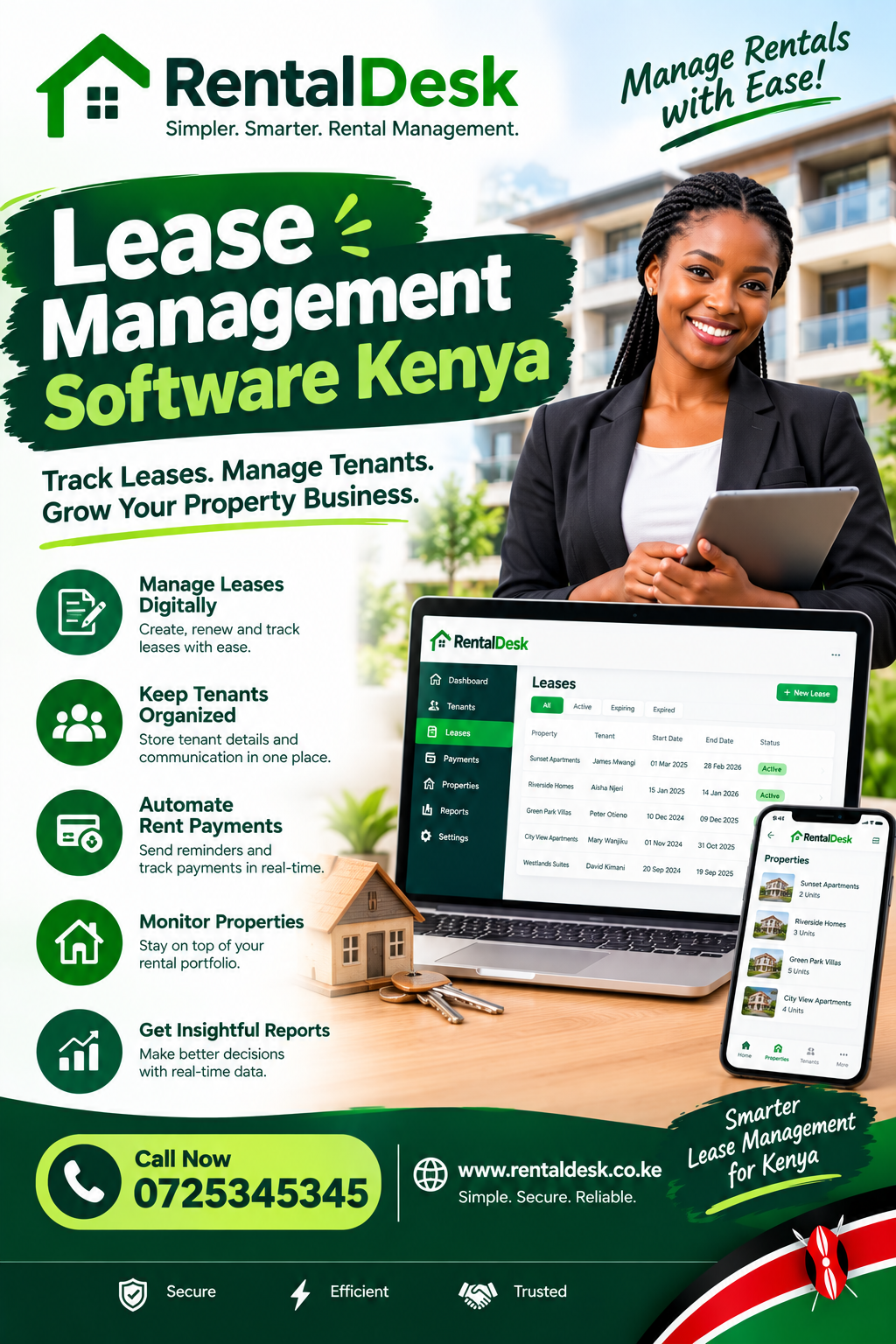
Lease Management Software Kenya: Complete Guide for Landlords and Property Managers
Managing leases manually can become difficult as a property portfolio grows. A landlord may have to track lease agreements, renewal dates, tenant information, rent obligations, deposits, inspections and payment records across spreadsheets, paper files and messaging applications. For property managers handling several buildings, the challenge is even greater. Lease Management Software Kenya provides a structured way to bring these activities together, giving landlords, agents and property management teams better visibility over their leases and day-to-day operations.
A good lease management platform is more than a digital filing cabinet. It can help organise tenancy information, monitor important dates, support rent administration, maintain property records and make reporting easier. For Kenyan landlords and property managers, the right solution can also make it easier to manage growing portfolios without relying heavily on disconnected manual processes.
This guide explains what lease management software does, why it matters in Kenya, the features to consider, how it can improve landlord-tenant administration, how to evaluate different solutions and what businesses should consider before implementation.
What Is Lease Management Software?
Lease Management Software Kenya refers to software designed to help landlords, property owners, real estate companies and property managers organise and manage lease-related activities from a central system.
A lease contains important information that should remain accessible throughout the tenancy. This can include:
- Tenant names and contact information
- Property and unit details
- Lease start and expiry dates
- Rent amounts
- Security deposit information
- Payment schedules
- Renewal conditions
- Notice periods
- Maintenance responsibilities
- Lease documents
- Tenant communication records
- Outstanding balances
- Property-related notes
When these details are stored in different places, it becomes easy to miss important dates or lose track of information. Lease Management Software Kenya gives property teams a central location where lease information can be recorded, updated and reviewed.
Instead of searching through folders whenever a tenant asks about an agreement, a manager can access the relevant property and tenant record. The result is a more organised approach to property administration.
Why Lease Management Matters in Kenya
The Kenyan property market includes residential apartments, commercial offices, retail spaces, warehouses, mixed-use developments, student accommodation and other rental properties. Each category has different management requirements.
A landlord with two rental units may be able to manage information using a notebook or spreadsheet. That approach becomes much harder when the portfolio reaches dozens or hundreds of tenants.
Lease Management Software Kenya can be particularly useful when a business needs to manage multiple leases simultaneously. Rather than treating every tenancy as an isolated record, the software creates a structured portfolio view.
Consider a property manager responsible for several apartment blocks in Nairobi. Each building may have dozens of units, and each unit may have a different tenant, rent amount, lease period and payment history. Manually monitoring all the information creates administrative pressure.
A digital system helps the manager answer questions such as:
- Which leases are approaching expiry?
- Which tenants have outstanding balances?
- Which units are occupied?
- Which agreements have been renewed?
- What rent applies to a particular unit?
- Which properties generate the highest rental income?
- Which tenant records need updating?
- Which documents are associated with a specific tenancy?
Lease Management Software Kenya can therefore become an important operational tool rather than simply another piece of office software.
The Problems Caused by Manual Lease Management
Manual processes are not automatically wrong. For a very small portfolio, they may work reasonably well. Problems usually arise when the volume of information increases.
1. Missed Lease Expiry Dates
Lease expiry is an important event. If a manager does not know that an agreement is approaching its end date, there may not be enough time to communicate with the tenant and plan the next steps.
Lease Management Software Kenya can help teams monitor lease dates and create a more structured renewal process.
A lease calendar or reminder system can reduce dependence on memory. Managers can review upcoming expiries and decide which tenants require communication.
2. Scattered Documents
Paper agreements can be difficult to organise. Digital documents can also become scattered across computers, email inboxes and messaging platforms.
A central property management platform can associate documents with the appropriate property or tenant record.
Lease Management Software Kenya makes it easier for authorised users to find information without searching through unrelated folders.
3. Spreadsheet Errors
Spreadsheets are useful for many business tasks, but they can become difficult to control when several people edit them or when formulas become complicated.
A small mistake in a rent amount, date or tenant record can affect subsequent calculations and reports.
Lease Management Software Kenya can provide a more structured database environment where information is organised according to properties, units, tenants and leases.
4. Poor Visibility
When information is kept in separate documents, management may struggle to obtain a complete picture of the portfolio.
A property owner may want to know how many units are occupied, which leases are expiring, how much rent is expected and where outstanding balances exist.
Lease Management Software Kenya can help consolidate operational information into a central platform.
Key Features to Look For
Not every software product has the same capabilities. Before selecting a solution, landlords and property managers should identify the features that matter most to their operations.
Tenant Management
Tenant management is one of the foundations of lease administration.
A system should make it possible to maintain relevant tenant information in an organised record. Depending on the platform, this may include contact details, tenancy history, unit allocation and other administrative information.
Lease Management Software Kenya can help property managers connect tenant information with the relevant lease and property.
This reduces the need to maintain separate tenant lists and property schedules.
Lease Records
Lease information should be easy to retrieve.
A manager may need to confirm when an agreement started, when it expires, what rent applies and which unit is associated with the tenant.
Lease Management Software Kenya can help keep these details accessible from a central system.
A structured lease record also makes it easier to maintain consistency across a portfolio.
Lease Expiry Monitoring
Expiry tracking is one of the most valuable functions for a lease management system.
Instead of manually reviewing every agreement each month, a property manager can use the software to identify leases approaching their expiry dates.
Lease Management Software Kenya can support a more proactive approach to renewals by making upcoming lease events easier to identify.
A practical workflow might look like this:
- Record the lease start date.
- Record the expiry date.
- Review upcoming expiries regularly.
- Contact tenants where renewal discussions are required.
- Record the outcome.
- Update the tenancy record.
- Maintain the new agreement or relevant documentation.
Rent Administration
Rent administration is closely connected to lease management.
The software should make it easier to associate rent obligations with the appropriate tenant and unit. A manager should be able to identify expected payments and review outstanding amounts.
Lease Management Software Kenya can help create a clearer connection between tenancy records and financial administration.
This is especially useful when a property manager has different rental rates across multiple buildings.
Payment Tracking
A lease platform can help record payment information and provide a clearer view of tenant accounts.
For Kenyan businesses, payment administration may involve channels such as M-Pesa, bank transfers and other accepted payment methods. The exact payment integrations available will depend on the software provider.
Lease Management Software Kenya can support better organisation of payment-related information when financial records are connected to tenant and lease records.
Document Management
Lease agreements are important business records. Keeping them organised is therefore essential.
A suitable platform should make it practical to associate documents with the correct tenant, property or unit.
Lease Management Software Kenya can make document retrieval easier when lease information is maintained in a structured environment.
Property managers should also consider user permissions, backups and access controls when evaluating document functionality.
How Software Helps Landlords
Landlords often have to balance property investment with administration. If rental management consumes too much time, the owner may struggle to focus on other priorities.
Lease Management Software Kenya can help reduce repetitive administrative work by centralising important property information.
For an individual landlord, useful capabilities may include:
- Tenant records
- Lease tracking
- Rent records
- Payment monitoring
- Property records
- Lease expiry reminders
- Document storage
- Financial reports
- Occupancy information
The exact value depends on the landlord’s portfolio and the functionality of the selected system.
For example, imagine a landlord owns twenty apartments. Ten leases expire at different times during the year. Without a central system, the landlord may need to review separate documents to identify renewal dates.
With a structured platform, the landlord can review lease information from one place.
Lease Management Software Kenya can therefore help transform lease administration from a reactive task into a more organised management process.
How Software Helps Property Managers
Property managers have a more complex challenge because they often manage properties on behalf of owners.
They may need to coordinate tenant information, rent administration, property maintenance, owner reporting and lease activities across different buildings.
Lease Management Software Kenya can provide a central operational record that supports these responsibilities.
A property manager may use the system to:
- Register properties.
- Add units.
- Create tenant records.
- Record lease agreements.
- Monitor rent.
- Track outstanding balances.
- Monitor lease expiry dates.
- Maintain property records.
- Generate reports.
- Keep information available for authorised staff.
Centralisation is particularly valuable when multiple employees need access to the same information.
M-Pesa and Kenyan Rental Administration
Payment methods are an important consideration for Kenyan rental businesses.
M-Pesa is widely used in Kenya, and many tenants prefer convenient electronic payment options. A property management solution may support payment-related workflows depending on its available integrations.
Lease Management Software Kenya can help property teams organise payment records alongside tenancy information.
However, businesses should distinguish between software that merely records payments and software that actually integrates with a payment service. These are different capabilities.
When evaluating a platform, ask:
- Does it support the payment methods used by our tenants?
- Can payments be matched to tenant accounts?
- Are payment records easy to reconcile?
- Can the system identify outstanding balances?
- Are reports available for management?
- Does the system provide payment notifications?
- Is an integration available, or is information entered manually?
Understanding these differences helps businesses select software based on actual requirements rather than marketing terminology.
Lease Renewal Management
Lease renewals deserve special attention because they can affect occupancy and rental continuity.
A renewal process should begin before the existing agreement expires. The exact timing depends on the agreement and the landlord’s operating practices.
Lease Management Software Kenya can help managers identify agreements that need attention.
A simple renewal workflow can include:
Step 1: Identify Expiring Leases
Create a list of agreements approaching expiry.
Step 2: Review Tenant History
Check relevant tenancy and payment information.
Step 3: Decide on the Next Action
The landlord may intend to renew, renegotiate, change the terms or prepare for vacancy.
Step 4: Communicate With the Tenant
Start the appropriate discussion according to the agreement and business process.
Step 5: Update Records
Record the outcome in the management system.
Lease Management Software Kenya can make this process easier to monitor because renewal-related information remains associated with the relevant tenancy.
Managing Multiple Properties
Property portfolios can quickly become complicated when every building has different units and tenants.
A centralised system should allow managers to organise information by property.
For example, a company may manage:
| Property | Units | Property Type | Management Need |
|---|---|---|---|
| Building A | 40 | Residential | Rent and leases |
| Building B | 24 | Commercial | Lease administration |
| Building C | 60 | Residential | Tenant and payment management |
| Building D | 15 | Mixed-use | Portfolio reporting |
Lease Management Software Kenya can help organise these different records within a single operational framework.
The objective is not simply to store more information. The objective is to make the information easier to use.
Reporting and Decision-Making
Good reporting helps property owners understand what is happening across their portfolio.
Instead of relying entirely on manually prepared spreadsheets, management software may provide reports covering areas such as:
- Occupancy
- Rent collections
- Outstanding balances
- Lease expiries
- Tenant information
- Property performance
- Payment activity
- Unit status
Lease Management Software Kenya can help make operational information more accessible for management review.
Reports can be especially useful during monthly property reviews.
For example, a manager could review:
- Leases expiring within the next 30 days
- Tenants with overdue balances
- Vacant units
- Recently renewed agreements
- Expected rental income
- Outstanding tenant accounts
This gives management a clearer basis for deciding where attention is needed.
Improving Tenant Service
Lease management is also about communication and service.
Tenants expect property managers to answer questions accurately. If a tenant asks about their lease, rent balance or unit details, the manager should be able to access the relevant information quickly.
Lease Management Software Kenya can support better service by giving staff access to organised tenant and property records.
Consider a tenant who asks whether their lease is still active. A manager using paper files may need to search for the agreement. A manager using a central system can locate the tenant record and review the relevant information.
Speed is valuable, but accuracy is even more important.
Maintenance and Lease Administration
Property maintenance may not always be considered part of lease management, but the two functions are closely connected.
Tenants occupy physical spaces, and those spaces require maintenance.
A property platform that connects tenant records with units and properties can provide useful operational context for maintenance activities.
Lease Management Software Kenya can complement lease administration when property information is maintained alongside tenant records.
For example, a maintenance issue can be associated with a particular unit. Management can then understand:
- Which property is affected?
- Which tenant occupies the unit?
- What issue was reported?
- When was it reported?
- What action was taken?
- Is the issue resolved?
The exact maintenance capabilities depend on the software selected.
Lease Management for Commercial Properties
Commercial property leases can involve more complex requirements than simple residential arrangements.
A commercial portfolio may include offices, shops, warehouses or other business premises. Agreements may have different terms, rental structures and renewal arrangements.
Lease Management Software Kenya can provide a central record for commercial tenancy information.
Managers should consider whether the software can accommodate the fields and workflows relevant to their agreements.
For commercial properties, useful areas may include:
- Lease dates
- Tenant details
- Premises details
- Rental amounts
- Payment schedules
- Renewal dates
- Documentation
- Outstanding balances
- Occupancy information
- Management reports
A solution should be evaluated according to the complexity of the business rather than simply the number of properties.
Lease Management for Residential Properties
Residential landlords may have many similar units, but managing them can still require considerable administration.
Apartment blocks often involve multiple tenants paying different amounts and having different lease dates.
Lease Management Software Kenya can help landlords organise residential tenancy information in one place.
A residential property manager should look for functionality that supports:
- Unit management
- Tenant registration
- Lease records
- Rent tracking
- Payment records
- Arrears monitoring
- Lease expiry tracking
- Document management
- Reports
Automation can become especially valuable as the number of units increases.
Security and Access Control
Property records contain important business information. Security should therefore be considered before choosing a lease platform.
Lease Management Software Kenya should be evaluated not only on features but also on how it protects information.
Important questions include:
- Who can access tenant information?
- Can administrators control user permissions?
- Are different staff members assigned different access levels?
- How are passwords protected?
- Are backups performed?
- How is data recovered if something goes wrong?
- Does the provider explain its security practices?
Businesses should avoid assuming that every cloud application has the same security controls.
Security requirements should be discussed with the software provider before implementation.
Cloud-Based Lease Management
Cloud software allows users to access systems through internet-connected devices, depending on the platform.
This can be convenient for property managers who are frequently moving between offices, properties and tenant meetings.
Lease Management Software Kenya can support a more flexible workflow when the selected platform is accessible remotely.
However, cloud access should not be confused with unlimited access. Businesses should understand user permissions, supported devices, internet requirements and account security.
A property manager working from Nairobi may need to access tenant information while visiting a building in another part of the city. Remote access can reduce dependence on files stored on a single office computer.
Automation and Productivity
One of the biggest reasons to adopt management software is to reduce repetitive work.
A manual workflow may involve entering information several times, checking spreadsheets, preparing reports and searching through documents.
Lease Management Software Kenya can help streamline repetitive administrative processes when automation features are available.
Automation can potentially support:
- Reminders
- Recurring charges
- Payment records
- Reports
- Tenant notifications
- Lease expiry monitoring
- Data organisation
The goal should not be to automate everything. Some decisions still require human judgment.
Instead, software should handle predictable administrative tasks so staff can spend more time on activities that require attention.
How to Choose the Right Software
Selecting software should begin with business requirements.
Before comparing products, create a simple list of current problems.
For example:
Current problem: Lease expiry dates are difficult to monitor.
Desired capability: A lease calendar and reminders.
Current problem: Tenant records are stored in different spreadsheets.
Desired capability: Centralised tenant management.
Current problem: Management reports take several hours to prepare.
Desired capability: Automated or easily generated reports.
Lease Management Software Kenya should therefore be assessed against specific operational needs rather than general feature lists.
Consider Portfolio Size
A small landlord may not need the same functionality as a large property management company.
Ask how many properties, units and tenants the business currently manages and how much it expects to grow.
Consider Ease of Use
A system can have many features and still be difficult to use.
The interface should be understandable to the employees who will use it every day.
Consider Local Requirements
Kenyan businesses may have requirements related to local payment methods, communication channels and business practices.
Lease Management Software Kenya should be evaluated based on how well it fits the company’s actual environment.
Consider Support
Technical support matters when software becomes part of daily operations.
Ask:
- What support channels are available?
- What are the support hours?
- How are technical issues handled?
- Is training available?
- Is documentation provided?
Questions to Ask Before Buying
Before committing to a platform, prepare a list of questions.
Lease Management Software Kenya should be able to fit the operational needs of the business rather than forcing the business to redesign every process around the software.
Useful questions include:
- What property types does the system support?
- How many users can access it?
- Can different users have different permissions?
- How are lease documents stored?
- Can lease expiry dates be monitored?
- Does the system support rent tracking?
- Can it manage tenant balances?
- Are reports available?
- Can data be exported?
- How is data backed up?
- What happens if the business stops using the system?
- What customer support is provided?
- Can the system scale as the portfolio grows?
- What integrations are available?
- What are the total costs?
These questions can reveal limitations that may not be obvious during a sales demonstration.
Common Mistakes When Implementing Software
Buying software does not automatically solve administrative problems.
Implementation also matters.
Lease Management Software Kenya is most useful when the business establishes clear procedures for using it.
Mistake 1: Entering Incomplete Data
If tenant or lease information is incomplete, reports and reminders may not be reliable.
Before going live, review existing records and identify missing information.
Mistake 2: Giving Everyone the Same Access
Not every employee needs access to every piece of information.
Use appropriate user roles where the software supports them.
Mistake 3: Ignoring Staff Training
Employees need to understand how and when information should be entered.
Lease Management Software Kenya can only provide reliable information when users maintain accurate records.
Mistake 4: Keeping Multiple Conflicting Systems
If one employee updates the software while another continues maintaining an outdated spreadsheet, discrepancies can appear.
Establish a clear source of truth.
Mistake 5: Focusing Only on Price
The cheapest product may not be the most affordable option over time.
Consider the cost of:
- Manual administration
- Errors
- Missed renewals
- Delayed reporting
- Staff time
- Poor tenant service
- System migration
Lease Management Software Kenya should be evaluated on total business value rather than subscription price alone.
Understanding Software Costs
Pricing varies between software providers, and businesses should avoid assuming that one pricing model fits every product.
Some platforms may charge based on users, properties, units, features or subscription plans. Others may have implementation or support charges.
Lease Management Software Kenya should be assessed by looking at the complete cost of ownership.
When comparing prices, ask whether the quoted amount includes:
- Setup
- Data migration
- Training
- Customer support
- Updates
- Additional users
- Additional properties
- Storage
- Integrations
- Reporting features
A transparent pricing discussion makes comparison easier.
Moving From Spreadsheets to Software
Many landlords begin with spreadsheets because they are inexpensive and familiar.
The transition to dedicated software does not have to happen all at once.
Lease Management Software Kenya can be introduced through a structured migration process.
A practical approach is:
Phase 1: Audit Existing Information
Identify all spreadsheets, documents and tenant records.
Phase 2: Clean the Data
Remove duplicates and correct obvious administrative errors.
Phase 3: Categorise Records
Group information by property, unit, tenant and lease.
Phase 4: Import or Enter Information
Move verified information into the new platform.
Phase 5: Test
Check several tenant records, lease dates, balances and reports.
Phase 6: Train Staff
Make sure employees know how to use the system.
Phase 7: Establish a New Workflow
Decide where new information will be recorded going forward.
Lease Management Software Kenya can become the central record once the business has completed this transition.
Measuring the Benefits
After implementing software, management should measure whether it is actually improving operations.
Useful indicators include:
- Time spent preparing reports
- Time spent searching for lease documents
- Number of missed lease dates
- Accuracy of tenant records
- Speed of responding to tenant queries
- Time required to identify arrears
- Staff adoption
- Number of manual spreadsheets still in use
Lease Management Software Kenya should ultimately make the business easier to manage.
If staff still perform the same manual work in multiple systems, the business may not be receiving the full benefit.
A Practical Example for a Nairobi Property Manager
Consider a property management company handling three apartment buildings in Nairobi.
Each building has multiple units. Tenants have different lease dates, rent amounts and payment histories.
Before adopting a central system, the company keeps tenant information in spreadsheets and stores agreements in physical folders. One employee maintains a rent spreadsheet while another keeps a separate list of lease expiry dates.
The arrangement works initially, but several problems develop.
The manager spends significant time reconciling records. Lease renewal dates are sometimes discovered late. Tenant queries require staff to search through different records.
Lease Management Software Kenya could provide a central system for these activities.
The company can structure the information around properties, units, tenants and leases. Staff can then review relevant information from one platform.
The manager can also use reports to identify areas requiring attention.
The software does not remove the need for staff. Instead, it gives staff better information with which to perform their jobs.
Benefits for Property Owners
Property owners are often interested in visibility.
They want to understand whether their assets are occupied, whether rent is being collected and whether important leases are being managed properly.
Lease Management Software Kenya can support owner reporting when the system provides appropriate reporting functions.
For owners who do not manage properties themselves, centralised information can also make discussions with property managers more productive.
Instead of asking broad questions about portfolio performance, an owner can review specific reports and discuss exceptions.
Benefits for Property Management Companies
Property management companies benefit from consistency.
When multiple staff members manage different properties, standardised processes help reduce confusion.
Lease Management Software Kenya can help create a common structure for property and tenant records.
This can be useful when a company grows.
For example, a business that manages ten buildings today may eventually manage thirty. A process that works manually at ten buildings may become difficult at thirty.
Software provides an opportunity to standardise operations before growth makes manual processes unmanageable.
Benefits for Tenants
Tenants may never interact directly with the software, but they can still benefit from better internal administration.
A well-organised property team can respond faster to questions, locate records more easily and keep more accurate information.
Lease Management Software Kenya can support better tenant service when property managers use the information consistently.
For tenants, practical benefits may include:
- Faster responses
- Clearer payment records
- Better communication
- Easier document retrieval
- More organised property administration
The quality of the tenant experience still depends heavily on the people managing the property.
Preparing for Portfolio Growth
A software decision should consider future requirements.
A landlord may start with ten units and eventually acquire another building. A property manager may add new clients.
Lease Management Software Kenya should therefore be scalable enough to support the organisation’s expected growth.
Ask whether adding properties, users and tenants is straightforward.
Also consider whether the software can support additional workflows later.
A platform that solves today’s problem but creates a major limitation next year may require another migration.
Digital Transformation for Kenyan Property Businesses
Property management is becoming increasingly data-driven.
Managers need accurate information to understand occupancy, collections, lease status and operational issues.
Lease Management Software Kenya can form part of a broader digital transformation strategy for property businesses.
Digital transformation does not mean replacing every human process. It means using appropriate technology to make information more accessible and workflows more consistent.
For a Kenyan property company, this can start with a simple goal: make every important property and tenancy record easy to find and maintain.
From there, the organisation can improve reporting, payments, communication and operational workflows.
What Makes a Good Lease Management System?
A strong solution should combine functionality with usability.
Lease Management Software Kenya should make routine property administration easier rather than creating another complicated process for employees.
Look for these qualities:
- Easy navigation
- Reliable record keeping
- Clear lease information
- Useful reporting
- Tenant management
- Payment tracking
- Lease expiry monitoring
- Document organisation
- Appropriate security
- Scalable functionality
- Responsive support
No single feature should determine the entire purchase decision.
The best choice is the platform that solves the most important problems for the specific business.
Frequently Asked Questions
What is lease management software used for?
Lease Management Software Kenya is used to organise lease records, tenant information, property details, rent administration, expiry dates, documents and related property management activities.
It can help landlords and property managers reduce dependence on paper files and disconnected spreadsheets.
Is lease management software suitable for small landlords?
Yes. A small landlord can benefit from centralised tenant and lease records, especially if the portfolio is expected to grow.
However, the required feature set should match the size and complexity of the portfolio. A landlord with a few units may not need every advanced feature offered by an enterprise platform.
Can software track lease expiry dates?
Lease expiry tracking is a common feature to look for when evaluating Lease Management Software Kenya.
The exact reminder and notification capabilities depend on the individual platform. Businesses should confirm how reminders work before purchasing.
Can lease management software track rent?
Many property management platforms provide rent tracking or related financial administration capabilities.
Lease Management Software Kenya may help property teams associate rental obligations and payment records with the appropriate tenants, depending on the functionality provided.
Businesses should distinguish between payment recording and direct payment integration.
Does lease management software support M-Pesa?
Some property platforms may support M-Pesa-related workflows or integrations, but capabilities vary by provider.
When considering Lease Management Software Kenya, ask the provider whether M-Pesa is directly integrated, whether transactions can be imported or matched, and how reconciliation works.
Is cloud-based software better than spreadsheets?
Cloud software and spreadsheets serve different purposes.
A spreadsheet may be adequate for a small portfolio. A dedicated system becomes more attractive when a business needs structured tenant records, lease tracking, permissions, reporting and automation.
Lease Management Software Kenya can be particularly useful when several staff members need access to the same central records.
How secure is lease management software?
Security depends on the software provider and its technical architecture.
Businesses should ask about user permissions, authentication, backups, encryption, data recovery and other relevant security controls.
Lease Management Software Kenya should be evaluated as carefully for security and reliability as it is for features.
How long does implementation take?
Implementation time depends on the number of properties, units, tenants and historical records being migrated.
A small portfolio can generally be simpler to set up than a large property management company with years of historical data.
Lease Management Software Kenya should be introduced with a clear migration, testing and training plan.
Can property managers use software for multiple properties?
Yes, multi-property management is one of the main reasons businesses adopt dedicated property management systems.
Lease Management Software Kenya can help organise information by property, unit and tenant when the platform supports multi-property management.
What should I consider before choosing a system?
Start with your current challenges.
Identify whether your biggest problems involve lease expiry tracking, tenant records, rent administration, reporting, documents, payments or portfolio visibility.
Then compare software based on those requirements.
Lease Management Software Kenya should be assessed for usability, functionality, security, scalability, support and total cost.
Final Thoughts
Lease administration becomes increasingly demanding as a property portfolio grows. Paper files, spreadsheets and disconnected records may work for a small operation, but they can become difficult to maintain as the number of properties and tenants increases.
A well-designed digital platform can bring tenant records, lease information, property data, payment administration, reporting and important dates into a more structured workflow.
Lease Management Software Kenya can help Kenyan landlords and property managers gain better visibility over their rental operations while reducing repetitive administrative work.
The most important step is to select software based on actual business needs. Before making a decision, identify the processes that consume the most time, the information that is hardest to track and the reports management needs most frequently.
A good implementation should also include clean data, staff training, clear user permissions and a consistent process for maintaining records.
Lease Management Software Kenya is therefore best viewed as an operational investment rather than simply a digital replacement for a filing cabinet.
For landlords managing a handful of units, the immediate benefit may be better organisation. For professional property managers, the benefits can extend to portfolio visibility, reporting, tenant administration and scalability.
The right system should make it easier to know what is happening across the portfolio and where management attention is required.
Lease Management Software Kenya can be part of that transition when it is selected carefully and implemented around clear business processes.
For a growing Kenyan property business, the practical goal is simple: keep property and lease information organised, make important dates visible, improve access to records and give managers the information they need to make timely decisions.
That is where dedicated lease administration technology can provide lasting value.
Lease Management Software Kenya can help businesses move toward a more structured approach to rental property administration while creating a foundation for future growth.
The next step is to review your current lease management process, identify its biggest weaknesses and compare those requirements against the capabilities of an appropriate property management platform.