
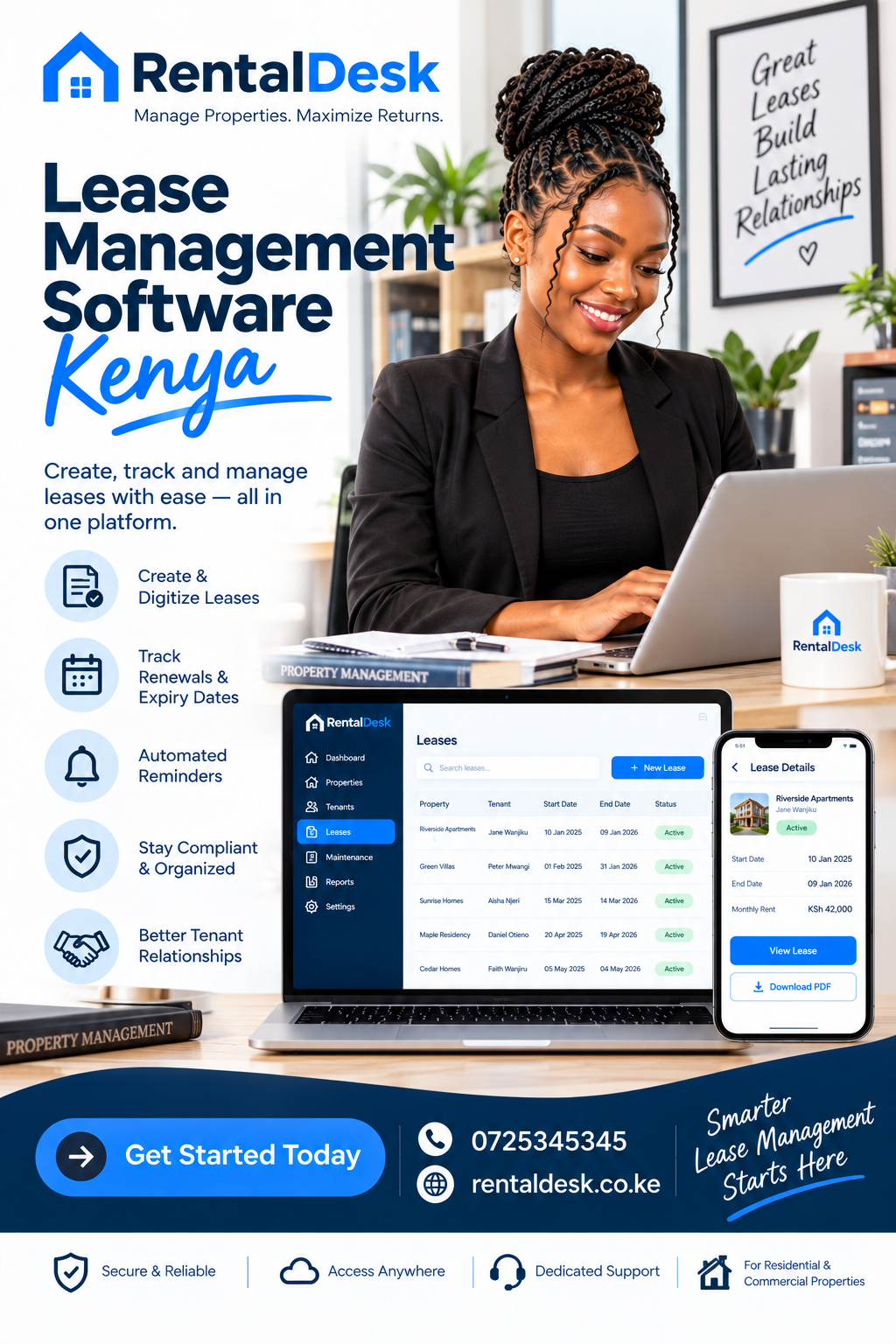
Lease Management Software Kenya: Complete Guide for Landlords and Property Managers
Managing leases manually can become difficult when a property portfolio grows. Landlords and property managers may have to track lease start dates, expiry dates, renewal terms, tenant information, rent amounts, deposits, documents, notices, and payment records across different files and spreadsheets. Lease Management Software Kenya provides a structured way to organize these processes, making lease administration easier for residential properties, commercial buildings, apartments, offices, and mixed-use developments. This guide explains what lease management software does, the problems it solves, the features to look for, how it can support Kenyan property businesses, and how to evaluate a solution before adopting it.
What Is Lease Management Software?
Lease management software is a digital system designed to help landlords, property managers, real estate companies, and property administrators organize and manage lease agreements.
Instead of relying on paper files, spreadsheets, emails, WhatsApp messages, and separate calendars, a centralized system brings important lease information together.
A typical lease management platform can help users record:
- Tenant details
- Property and unit information
- Lease start and end dates
- Monthly rent
- Security deposits
- Renewal terms
- Notice periods
- Lease documents
- Payment information
- Outstanding balances
- Maintenance information
- Communication records
For Kenyan landlords managing several units, Lease Management Software Kenya can make it easier to see what is happening across a property portfolio without searching through multiple files.
The main purpose is not simply to store lease agreements. A useful system should help property managers act on information at the right time.
For example, knowing that a lease expires in 90 days is useful. Receiving a reminder early enough to contact the tenant, review the rental terms, prepare a renewal agreement, and update the records is much more valuable.
Why Lease Administration Becomes Difficult as a Portfolio Grows
A landlord managing one or two properties may be able to remember important dates without sophisticated systems. The situation changes when the number of units increases.
Consider a property manager responsible for 150 apartments. Each tenant may have a different lease date, rent amount, deposit, renewal period, and payment history.
A spreadsheet might initially seem sufficient. Over time, however, several problems can appear.
Missed Lease Expiry Dates
Lease expiry dates are important because they can affect occupancy, renewal discussions, rental income, and planning.
When dates are tracked manually, an important renewal opportunity can be overlooked.
With Lease Management Software Kenya, property managers can maintain lease dates in one centralized system and use reminders to reduce the likelihood of missing important deadlines.
Scattered Tenant Records
Tenant information may exist in different locations. One file may contain contact details, another may contain the signed agreement, while payment records sit somewhere else.
This creates unnecessary administrative work.
A centralized system gives the property team a single source of information.
Manual Renewal Processes
Lease renewal can involve several steps:
- Identifying leases approaching expiry.
- Contacting tenants.
- Reviewing current rental terms.
- Discussing proposed changes.
- Preparing renewal documentation.
- Recording the new agreement.
- Updating the tenant’s records.
When these tasks are handled manually, they can consume significant time.
Limited Portfolio Visibility
Property owners often want straightforward answers to questions such as:
- Which leases expire this month?
- Which tenants have leases expiring within 90 days?
- Which units are occupied?
- Which leases have been renewed?
- Which tenants have outstanding balances?
- Which properties generate the most rental income?
A digital platform can make these questions easier to answer.
Key Benefits of Using Lease Management Software
The value of Lease Management Software Kenya extends beyond simply storing contracts. It can improve organization, visibility, consistency, and administrative efficiency.
1. Centralized Lease Information
A property manager can keep lease information in one organized environment.
Instead of searching through folders for individual agreements, staff can search for a tenant, property, unit, or lease record.
Important details can be easier to access when they are needed.
2. Better Lease Expiry Tracking
Lease dates should not be treated as information that is recorded once and forgotten.
They need ongoing attention.
A useful lease management system can provide reminders for upcoming expiries, renewal periods, and other important dates.
This can help property managers start renewal conversations early instead of reacting after a lease has already expired.
3. Improved Tenant Administration
Tenant management and lease administration are closely connected.
A tenant record can contain information such as:
- Full name
- Phone number
- Email address
- Unit number
- Lease period
- Monthly rent
- Deposit
- Occupancy status
- Payment history
- Relevant documents
By keeping these details organized, Lease Management Software Kenya can reduce repetitive administrative work.
4. Easier Document Management
Lease agreements are important legal and operational documents.
A digital system can help property teams associate documents with the correct tenant and property.
Depending on the platform, users may also be able to store supporting documents such as:
- Signed agreements
- Renewal documents
- Notices
- Identification records
- Inspection reports
- Correspondence
- Property documents
This reduces dependence on physical files.
5. Better Operational Planning
Lease data can support planning.
For example, if several commercial leases expire during the same quarter, a property manager can identify that concentration early and plan renewal activity accordingly.
This type of visibility becomes increasingly useful as a portfolio expands.
Important Features to Look For
Not every property software platform provides the same functionality. Before choosing a solution, landlords and property managers should identify the features that matter most to their operations.
Lease Creation and Recording
The system should allow users to create or record lease agreements accurately.
Relevant fields may include:
- Tenant
- Property
- Unit
- Lease commencement date
- Expiry date
- Rent
- Deposit
- Payment frequency
- Notice period
- Renewal terms
For growing property businesses, Lease Management Software Kenya should make this information easy to update when circumstances change.
Lease Expiry Alerts
Automated reminders are one of the most practical features.
A property manager should be able to identify upcoming lease expiries without manually checking every agreement.
Useful reminder periods may include:
- 180 days before expiry
- 120 days before expiry
- 90 days before expiry
- 60 days before expiry
- 30 days before expiry
The exact periods should depend on the landlord’s leasing process and property type.
Renewal Management
Lease renewal should be treated as an ongoing workflow rather than a single administrative event.
The system should help users identify upcoming renewals, contact tenants, record decisions, and update lease details.
A good renewal workflow can reduce the risk of outdated records.
Rent Information
Lease records are closely linked to rent.
A platform should allow property managers to see the agreed rental amount and relevant changes.
For example, if a tenant’s monthly rent increases after renewal, the updated amount should be reflected in the tenant’s record.
Deposit Tracking
Security deposits are another important part of lease administration.
Property managers should be able to record the deposit amount associated with each tenant and maintain clear records of the relevant transaction.
Search and Filtering
A property management team should not have to manually browse hundreds of records.
Search and filters can help users locate leases according to:
- Property
- Tenant
- Unit
- Expiry date
- Occupancy status
- Lease status
- Rent amount
These features become especially valuable for large portfolios.
Reporting
Reports can help property owners understand their leasing position.
For example, a report could show leases expiring during a particular month or quarter.
With Lease Management Software Kenya, property managers can potentially turn raw lease information into practical management reports, depending on the platform’s reporting capabilities.
Lease Renewal Management
Renewals deserve particular attention because they directly affect occupancy and revenue continuity.
A property manager should ideally begin preparing for renewal before the lease expiry date.
Start Early
Waiting until the final weeks of a lease can create unnecessary pressure.
Starting early gives both the landlord and tenant time to discuss:
- New rent
- Lease duration
- Payment terms
- Property improvements
- Maintenance concerns
- Notice periods
- Other contractual conditions
Track Tenant Decisions
Not every tenant will renew.
A useful system should allow managers to distinguish between:
- Renewal pending
- Renewal accepted
- Renewal declined
- Negotiation ongoing
- Notice given
- Lease expired
This helps the property team plan ahead.
Update Records Immediately
Once a renewal is completed, the tenant’s lease information should be updated.
Old dates and rental amounts should not remain active if the agreement has changed.
Accurate records are important for billing, reporting, communication, and future decision-making.
Managing Commercial and Residential Leases
Lease requirements differ depending on the property.
Residential landlords may manage apartments, houses, bedsitters, student accommodation, or other rental homes.
Commercial property managers may manage:
- Offices
- Shops
- Retail units
- Warehouses
- Industrial spaces
- Business premises
Lease Management Software Kenya can be useful across different property categories when the system allows users to configure relevant lease details.
Residential Property
Residential lease management often focuses on:
- Tenant records
- Monthly rent
- Deposits
- Lease periods
- Renewals
- Rent arrears
- Notices
- Maintenance
Commercial Property
Commercial leasing can involve additional complexity.
Commercial agreements may include:
- Longer lease periods
- Rent reviews
- Service charges
- Multiple payment components
- Specific business-use conditions
- Renewal options
- More detailed documentation
For these properties, having structured records can make lease administration easier.
M-Pesa and Digital Payment Considerations in Kenya
Payment management is closely connected to lease administration in Kenya.
M-Pesa is widely used for everyday transactions, including rental payments. A property management system that supports digital payment workflows can make it easier to associate incoming payments with tenant accounts.
However, lease management and payment processing are not exactly the same thing.
A lease record answers questions such as:
- What rent was agreed?
- When did the lease begin?
- When does it expire?
- What deposit was required?
A payment system answers questions such as:
- What has been paid?
- When was it paid?
- What remains outstanding?
Combining these functions can provide a clearer picture of each tenant account.
When evaluating Lease Management Software Kenya, Kenyan landlords should therefore consider whether the software can integrate lease information with rent collection and payment records.
Lease Management and Rent Arrears
Lease administration should not be separated completely from rent tracking.
A tenant may have a valid lease but still have an outstanding balance.
A property management system can help users connect the tenant’s agreement with the financial account associated with the unit.
For example:
| Information | Example |
|---|---|
| Tenant | Tenant A |
| Unit | Apartment B12 |
| Monthly rent | KSh 35,000 |
| Lease start | January |
| Lease expiry | December |
| Deposit | KSh 70,000 |
| Current balance | KSh 35,000 |
This type of overview can make follow-up easier.
Lease Management Software Kenya can also support better visibility when lease data and financial records are managed together, provided the selected platform offers those functions.
Lease Documents and Digital Records
Paper contracts can be difficult to manage when a property portfolio grows.
Physical files can be misplaced, damaged, duplicated, or stored in different offices.
Digital document management provides another approach.
A property manager may create a folder or record for each tenant containing:
- Original lease
- Renewal agreement
- Notice letters
- Inspection reports
- Relevant correspondence
- Payment-related documentation
Why Document Organization Matters
Good document organization makes it easier to respond when information is requested.
For example, an owner may ask for a copy of a tenant’s agreement.
Instead of searching through filing cabinets, staff can locate the relevant tenant record and retrieve the document.
With Lease Management Software Kenya, document organization can become part of the wider property management workflow rather than a completely separate process.
Automated Lease Alerts
One of the strongest reasons to digitize lease administration is automation.
Without automated alerts, a manager may need to maintain a separate spreadsheet or calendar.
A software system can help consolidate reminders.
Possible alerts include:
- Lease approaching expiry
- Renewal deadline
- Rent review date
- Notice period
- Insurance-related date
- Important document expiry
- Payment due date
The specific alerts available depend on the software.
The goal is simple: important dates should not depend entirely on someone’s memory.
How Lease Management Supports Property Owners
Property owners may not handle daily tenant administration themselves.
They may depend on property managers, agents, accountants, or administrative staff.
A centralized system can give owners greater visibility into the portfolio.
For example, an owner could review:
- Number of occupied units
- Upcoming lease expiries
- Renewals
- Rental income
- Outstanding balances
- Property performance
- Tenant activity
Lease Management Software Kenya can therefore support communication between property owners and the teams responsible for daily operations.
How Lease Management Supports Property Managers
Property managers typically deal with several responsibilities simultaneously.
They may need to:
- Collect rent
- Respond to tenants
- Manage repairs
- Monitor vacancies
- Prepare reports
- Handle lease renewals
- Maintain documents
- Follow up on arrears
A centralized platform can reduce the need to move between disconnected tools.
Reducing Repetitive Work
Administrative work can consume a large part of a property manager’s day.
Automation can help with repetitive activities such as reminders, reports, and record searches.
This allows staff to spend more time on tasks that require direct attention.
Improving Consistency
When multiple employees manage the same portfolio, consistency becomes important.
A standardized digital workflow means everyone can work from the same records.
That can reduce situations where one employee has updated information while another is working with an outdated spreadsheet.
Choosing the Right System for a Kenyan Property Business
Selecting software should begin with business requirements rather than features alone.
A platform can have many functions and still be unsuitable if those functions do not match the way the property business operates.
Assess Portfolio Size
Consider:
- Number of properties
- Number of units
- Number of tenants
- Number of employees
- Expected portfolio growth
A system suitable for 20 units may not be ideal for 2,000 units.
Consider Property Types
Identify whether the business manages:
- Residential units
- Commercial properties
- Mixed-use buildings
- Student accommodation
- Short-term rentals
- Offices
- Retail spaces
The system should accommodate the property’s actual leasing structure.
Review User Access
Property companies often have multiple users.
For example:
- Property manager
- Accountant
- Administrator
- Property owner
- Maintenance staff
Role-based access can help ensure users only see or change information relevant to their responsibilities.
When comparing Lease Management Software Kenya, ask whether the platform supports appropriate user roles and permissions.
Data Security and Access Control
Property records can contain sensitive information.
Examples include:
- Tenant contact details
- Identification information
- Lease documents
- Payment records
- Property information
- Owner information
Security should therefore be part of the software selection process.
Questions to Ask a Vendor
Before subscribing, ask:
- How is user access controlled?
- Are different roles available?
- How is data backed up?
- What happens if an employee leaves?
- Can access be revoked immediately?
- How are documents protected?
- Is there an audit trail?
- How often is data backed up?
The exact answers will vary by provider.
Reporting and Portfolio Insights
A good property system should make information easier to understand.
Reports may include:
- Lease expiry reports
- Occupancy reports
- Rent reports
- Arrears reports
- Tenant reports
- Property reports
- Renewal reports
- Income reports
Lease Management Software Kenya can be particularly useful when managers need to turn large amounts of property data into organized information.
Lease Expiry Report
This report could show all leases ending within a selected period.
For example:
| Lease Status | Number |
|---|---|
| Expiring within 30 days | 8 |
| Expiring within 60 days | 12 |
| Expiring within 90 days | 19 |
| Expiring after 90 days | 76 |
The exact figures will depend on the property portfolio.
The important point is that a manager can identify upcoming work quickly.
Common Lease Management Mistakes
Technology cannot solve every property management problem. Poor processes can still create issues.
Mistake 1: Entering Inaccurate Data
If the original lease information is entered incorrectly, reminders and reports may also be inaccurate.
Always verify:
- Tenant name
- Lease dates
- Rent amount
- Deposit
- Unit
- Notice period
Mistake 2: Failing to Update Renewals
Renewing a lease but leaving the old expiry date in the system creates confusion.
The record should be updated promptly.
Mistake 3: Keeping Duplicate Records
Duplicate tenant records can create conflicting information.
Property teams should have clear procedures for creating and updating records.
Mistake 4: Ignoring Data Backups
Important lease documents should not depend on one device.
A property business should understand the provider’s backup and recovery procedures.
Mistake 5: Buying More Software Than Needed
More features do not automatically mean better results.
A small landlord may need a straightforward system, while a large property company may require more advanced workflows.
Lease Management for Growing Property Portfolios
A portfolio may begin with a few units and grow over time.
This growth changes administrative requirements.
At 10 units, manual records may seem manageable.
At 100 units, spreadsheets may become harder to maintain.
At 500 units, manual processes can become increasingly difficult to coordinate.
At 1,000 or more units, centralized property management becomes especially important.
Lease Management Software Kenya can help a growing landlord establish more structured processes before administrative complexity becomes overwhelming.
Integrating Lease Management With Property Management
Lease management should ideally form part of a broader property management workflow.
Property management can involve:
- Tenant management
- Rent collection
- Accounting
- Maintenance
- Inspections
- Lease administration
- Reporting
- Communication
These activities affect one another.
For example, a lease renewal can change the rent amount. The new rent should then appear in billing records.
A tenant moving out can trigger an inspection, deposit review, maintenance work, and vacancy management.
When these processes are connected, the property team has better visibility.
The Role of Automation
Automation is valuable when it reduces repetitive work without removing necessary human oversight.
A property manager may automate reminders while still deciding how to handle each tenant.
For example, software can flag a lease that will expire in 90 days.
The property manager can then review the tenant’s history and decide whether to begin renewal discussions.
This distinction is important.
Automation should support decision-making rather than replace professional judgment.
With Lease Management Software Kenya, automated workflows can potentially help property teams stay on top of recurring administrative activities.
Lease Management for Property Agents
Property agents may manage properties on behalf of multiple owners.
This creates another layer of complexity because the agent needs to keep different portfolios separate.
A good system should make it possible to organize properties by:
- Owner
- Building
- Property
- Unit
- Tenant
This makes reporting easier.
For example, an agent could prepare information for one owner without mixing that owner’s properties with another client’s portfolio.
Lease Management for Commercial Buildings
Commercial leases can require careful monitoring because the financial and contractual details may be more complex than those of a basic residential tenancy.
A commercial property manager may need to monitor:
- Lease expiry
- Rent reviews
- Renewal options
- Security deposits
- Service charges
- Occupancy
- Tenant obligations
- Notices
A centralized system can help ensure these details are not scattered across unrelated documents.
When assessing Lease Management Software Kenya for commercial use, property managers should confirm that the platform can accommodate their specific lease structures rather than assuming that every system works the same way.
Lease Management and Tenant Communication
Lease administration involves communication.
Tenants may need reminders about:
- Lease expiry
- Renewal
- Rent changes
- Documentation
- Notices
- Property inspections
A system can help property managers know which tenants need attention.
However, automated communication should still be accurate and appropriate.
Before sending a notice, staff should confirm the relevant tenant details and contractual terms.
Lease Management and Property Maintenance
Maintenance may appear separate from leasing, but the two processes often overlap.
A tenant approaching renewal may have outstanding maintenance concerns.
A property manager may want to review unresolved issues before discussing renewal.
Similarly, when a tenant gives notice, the property may require an inspection and preparation for the next occupant.
Lease Management Software Kenya can be part of a wider workflow when lease information is connected with maintenance and tenant records.
Evaluating Software Pricing
Pricing varies between software providers, so landlords should compare actual business value rather than looking only at the subscription amount.
Possible pricing structures include:
- Per property
- Per unit
- Per user
- Monthly subscription
- Annual subscription
- Tiered plans
- Custom enterprise pricing
Before committing, ask about additional costs.
These could include:
- Setup fees
- Data migration
- Additional users
- SMS charges
- Payment integration fees
- Support fees
- Custom development
The cheapest plan may not always be the most appropriate if it lacks essential features.
Questions to Ask Before Buying
Before selecting Lease Management Software Kenya, prepare a list of questions for the provider.
Functionality
- Can I manage multiple properties?
- Can I track lease expiry?
- Can I record renewals?
- Can I store documents?
- Can I track deposits?
- Can I manage tenants?
- Can I generate reports?
Payments
- Can rent payments be recorded?
- Does the system support M-Pesa workflows?
- Can arrears be tracked?
- Can payment records be reconciled?
Users
- Can multiple staff members access the system?
- Are user permissions available?
- Can different roles be assigned?
Support
- Is customer support available?
- How is onboarding handled?
- Is training available?
- How are technical issues reported?
Data
- How is data backed up?
- Can records be exported?
- How is access controlled?
- What happens if the subscription ends?
These questions can reveal important differences between providers.
Moving From Spreadsheets to Software
Many landlords begin with Excel or Google Sheets.
Spreadsheets can be useful for basic tracking, but they require manual maintenance.
A spreadsheet may contain columns for:
- Tenant name
- Unit
- Rent
- Lease start
- Lease expiry
- Deposit
As the portfolio grows, additional sheets may be created for payments, maintenance, expenses, and documents.
This can eventually make information harder to manage.
Migrating to Lease Management Software Kenya can provide a more structured environment for property records.
Plan the Migration
Before moving data, clean the existing records.
Remove:
- Duplicate tenants
- Old records
- Incorrect dates
- Incomplete information
- Duplicate properties
Then verify the information before importing it.
Training Property Management Staff
Software adoption depends heavily on the people using the system.
Even a well-designed platform can fail to deliver value if staff do not understand how to use it.
Training should cover:
- Logging in securely.
- Creating tenant records.
- Recording leases.
- Updating lease information.
- Uploading documents.
- Recording payments.
- Generating reports.
- Handling renewals.
- Managing user access.
Staff should also understand why accurate data matters.
A system only becomes useful when the information inside it remains reliable.
Measuring the Value of Lease Management Software
After implementation, property businesses can monitor practical outcomes.
Useful measures may include:
- Time spent locating lease documents
- Number of missed renewal dates
- Number of overdue lease updates
- Time required to prepare reports
- Number of duplicate records
- Speed of tenant information retrieval
Lease Management Software Kenya should be evaluated based on how well it improves the actual workflow, not simply how many features appear on a product page.
Lease Compliance and Record Keeping
Lease agreements create important obligations for both landlords and tenants.
A property manager should understand the contractual terms applicable to each agreement.
Software can help organize records, but it does not replace legal advice.
Where a lease dispute, eviction matter, rent review, or contractual interpretation requires professional legal guidance, property owners should consult a qualified professional.
The value of digital records is that relevant documents and dates can be easier to locate when they are needed.
Using Lease Data for Better Decisions
Lease records contain information that can support broader property decisions.
For example, a landlord may identify:
- Buildings with frequent tenant turnover
- Units with long vacancies
- Properties with many upcoming renewals
- Rental income trends
- Lease concentration by month
- Tenants approaching renewal
These insights can support planning.
Lease Management Software Kenya can therefore be more than an administrative tool when the reporting capabilities allow property owners to analyze their portfolio.
Improving Tenant Retention Through Better Administration
Tenant retention is influenced by many factors, including property condition, pricing, location, communication, and service quality.
Lease administration is one part of the overall tenant experience.
Poor administration can create frustration when tenants receive incorrect information or renewal communication too late.
Clear records help property managers communicate more accurately.
For example, a tenant approaching lease expiry can be contacted with the correct unit information, current lease period, and relevant renewal details.
Lease Management in Nairobi and Other Kenyan Markets
Kenyan property businesses operate in different markets.
Nairobi has a wide range of apartments, offices, retail spaces, commercial buildings, and mixed-use developments.
Other towns and cities have their own rental markets and property management requirements.
A suitable platform should therefore support the way the individual business operates rather than assuming that every landlord has the same portfolio.
For property managers handling multiple locations, Lease Management Software Kenya can help provide a centralized view of lease information across the portfolio.
A Practical Lease Management Workflow
A simple digital workflow can look like this:
Step 1: Create the Property
Record the building and relevant property information.
Step 2: Create the Unit
Add the individual apartment, office, shop, or other rental unit.
Step 3: Add the Tenant
Enter the tenant’s contact and identification details required by the business.
Step 4: Record the Lease
Add the commencement date, expiry date, rent, deposit, and other relevant terms.
Step 5: Upload Documents
Attach the signed lease and supporting documents.
Step 6: Set Reminders
Create reminders for important dates.
Step 7: Monitor Payments
Track rent and outstanding balances where the platform supports financial management.
Step 8: Start Renewal Discussions
Contact tenants before expiry based on the property’s renewal process.
Step 9: Update the Agreement
Record the new lease terms once renewal is completed.
Step 10: Report
Use portfolio reports to monitor upcoming expiries, occupancy, renewals, and other relevant information.
This process gives property teams a repeatable structure.
How to Make Lease Administration More Efficient
Technology works best when combined with clear procedures.
Property businesses can improve efficiency by establishing standard processes for:
- Creating tenant records
- Uploading agreements
- Naming documents
- Updating lease renewals
- Recording payments
- Following up on arrears
- Managing notices
- Closing tenant accounts
A standardized process means employees are less likely to handle the same task in completely different ways.
Lease Management Software Kenya can support these processes when configured around the business’s actual operating procedures.
What Small Landlords Should Consider
Small landlords do not necessarily need a complicated enterprise platform.
If you manage a relatively small portfolio, focus on the features you will actually use.
These may include:
- Tenant records
- Lease tracking
- Expiry reminders
- Rent tracking
- Document storage
- Basic reporting
Avoid paying for functionality that does not solve a real problem.
At the same time, consider future growth.
If you expect to expand from 10 units to 100 units, the software should ideally be able to grow with you.
What Large Property Managers Should Consider
Larger property management businesses have different priorities.
They may need:
- Multiple users
- Role-based permissions
- Bulk operations
- Advanced reporting
- Automated notifications
- Multiple properties
- Tenant portals
- Payment integrations
- Accounting features
- Maintenance workflows
- Data export
Lease Management Software Kenya should therefore be assessed against the complexity of the portfolio rather than selected based on a generic feature list.
Future-Proofing Your Property Management Process
Choosing software is a longer-term business decision.
A platform should ideally support future growth and changing operational requirements.
Before adopting a system, consider where the property business could be in three to five years.
Ask:
- Will the number of units increase?
- Will more staff need access?
- Will additional properties be added?
- Will payment automation become important?
- Will owners require better reports?
- Will tenants expect digital communication?
- Will the business expand into commercial property?
These questions help prevent choosing a platform that becomes restrictive after a short period.
Questions Landlords Frequently Ask
What does lease management software do?
Lease management software organizes lease agreements, tenant information, important dates, renewals, documents, and related property records in one digital system. Depending on the platform, it may also connect leasing with rent collection, accounting, maintenance, and reporting.
Can software remind me when a lease expires?
Yes, many lease management systems provide alerts for upcoming expiry dates and renewal periods. The available reminder settings vary by provider.
Can I manage multiple properties?
Many property management platforms are designed for multiple properties and units. Before subscribing, confirm the number of properties and units supported by the plan you are considering.
Can lease management software track rent?
Some platforms combine lease administration with rent collection and financial tracking. Others focus mainly on lease records. Property managers should confirm which financial features are included.
Can it support M-Pesa payments?
Some Kenyan property management systems support M-Pesa-related payment workflows or integrations. Because functionality varies, confirm the specific payment capabilities directly with the provider.
Is lease management software suitable for commercial properties?
It can be, provided the platform supports the specific requirements of commercial leasing. Managers should check whether it can handle rent reviews, longer lease periods, service charges, renewal options, and other relevant terms.
Can I store signed lease agreements?
Many systems include document storage or attachment functionality. Check the provider’s storage limits, security measures, backup procedures, and document access controls.
Is lease management software useful for a small landlord?
Yes, provided the software matches the landlord’s needs and budget. A small landlord may benefit from basic tenant records, lease expiry reminders, rent tracking, and document organization without requiring a complex enterprise system.
How should I choose between different platforms?
Compare the software based on your portfolio size, property type, lease workflow, payment requirements, reporting needs, user access, document management, support, security, and total cost.
Does software replace a property manager?
No. Software organizes information and automates certain administrative activities, but property managers still make decisions, communicate with tenants, inspect properties, resolve issues, manage relationships, and handle situations requiring human judgment.
Final Checklist Before Choosing a Lease Management Platform
Before signing up for a system, use this checklist:
- Can it manage all my properties?
- Can it manage individual units?
- Can I create tenant records?
- Can I record lease start and expiry dates?
- Can I receive expiry reminders?
- Can I manage renewals?
- Can I store lease documents?
- Can I track deposits?
- Can I track rent?
- Can I monitor arrears?
- Does it support relevant Kenyan payment workflows?
- Can I generate reports?
- Can multiple staff members use it?
- Are user permissions available?
- Is data backed up?
- Can information be exported?
- Is customer support available?
- Does the pricing match my portfolio?
- Can the system scale as the business grows?
A careful evaluation makes it easier to select software that fits the actual needs of the property business.
For landlords and property managers who want a more organized approach to lease administration, Lease Management Software Kenya can form part of a broader digital property management strategy. The most useful solution is one that keeps lease records accurate, makes important dates visible, reduces repetitive administrative work, and connects leasing information with the other activities required to run a rental property portfolio effectively.
Lease Management Software Kenya should ultimately be evaluated according to the workflow it creates for your team: how easily leases can be recorded, how reliably expiry dates can be monitored, how quickly documents can be retrieved, how efficiently renewals can be handled, and how clearly property owners can understand the status of their portfolio.
Lease Management Software Kenya becomes particularly valuable when lease information is no longer treated as isolated paperwork but as part of the wider tenant, payment, maintenance, accounting, and reporting process.
Lease Management Software Kenya can also help establish a more consistent process for growing property portfolios, where multiple employees need access to the same information and property owners need timely reports.
Lease Management Software Kenya should be selected with attention to security, usability, scalability, integrations, support, and the actual requirements of the properties being managed.
Lease Management Software Kenya can support a structured approach to lease administration when it is implemented alongside clear internal procedures for data entry, document management, renewal follow-up, payment recording, and reporting.
Lease Management Software Kenya is most effective when property teams keep records current and use the system consistently rather than maintaining multiple disconnected sources of information.
Lease Management Software Kenya can help landlords and property managers move away from scattered lease records toward a centralized approach that makes important information easier to find and act upon.
Lease Management Software Kenya is also relevant for businesses that want to build repeatable leasing processes as their number of properties, tenants, and staff increases.
Lease Management Software Kenya can contribute to better portfolio visibility by bringing lease dates, tenant records, rental information, and related documentation into a more organized workflow.
Lease Management Software Kenya should be considered as one component of a complete property management process rather than as an isolated solution for storing contracts.
Lease Management Software Kenya can help property teams identify upcoming administrative tasks and keep lease information accessible when decisions need to be made.
Lease Management Software Kenya may also reduce the amount of time spent manually checking spreadsheets, searching physical files, and maintaining separate calendars for different properties.
Lease Management Software Kenya can form part of a broader digital system when landlords want lease information, tenant administration, payments, and reporting to work together.
Lease Management Software Kenya should be compared based on actual business requirements, including portfolio size, property type, number of users, payment workflows, reporting, security, and customer support.
Lease Management Software Kenya can help create a central reference point for lease information, reducing the risk that important dates and documents remain hidden in disconnected files.
Lease Management Software Kenya can be included in a structured evaluation process where property owners compare how different systems handle leases, renewals, tenants, documents, payments, and reporting.
Lease Management Software Kenya can support more organized property administration when the implementation is accompanied by accurate data and clearly defined internal procedures.
Lease Management Software Kenya may be useful to property businesses that want to reduce manual administrative work and improve access to important rental information.
Lease Management Software Kenya can contribute to a more connected property workflow when lease records are integrated with other operational activities.
Lease Management Software Kenya gives landlords and property managers a practical framework for thinking about lease administration as an ongoing process rather than a one-time documentation exercise.
Lease Management Software Kenya can be valuable when a property business needs better visibility into upcoming expiries, renewals, tenant records, and portfolio activity.
Lease Management Software Kenya should be assessed against the specific operational needs of the business before implementation.
Lease Management Software Kenya can help property teams organize important lease information and build more consistent administrative workflows.
Lease Management Software Kenya can support the transition from manual tracking toward a centralized digital process.
Lease Management Software Kenya can be useful when property managers need a clearer view of lease status across multiple units.
Lease Management Software Kenya can help teams monitor renewal timelines and keep lease records aligned with current tenancy arrangements.
Lease Management Software Kenya can support document organization when lease agreements and related records need to remain accessible.
Lease Management Software Kenya can contribute to more structured property administration when used consistently across the portfolio.
Lease Management Software Kenya can make it easier to identify leases that require attention without manually reviewing every tenant file.
Lease Management Software Kenya can support landlords who want to organize lease dates, tenant information, and rental records within one workflow.
Lease Management Software Kenya can help property managers create repeatable procedures for lease creation, renewal, documentation, and reporting.
Lease Management Software Kenya can provide a foundation for more systematic lease administration as property portfolios expand.
Lease Management Software Kenya can be evaluated alongside broader property management capabilities to determine whether it fits the business’s operational requirements.
Lease Management Software Kenya can support better organization when property teams need to monitor multiple lease periods and tenant records.
Lease Management Software Kenya can reduce dependence on scattered paperwork when digital records are maintained accurately.
Lease Management Software Kenya can complement digital payment and property administration workflows where the selected platform supports the required integrations.
Lease Management Software Kenya can help property managers establish a central location for lease-related information and administrative tasks.
Lease Management Software Kenya can support better visibility into lease expiry dates, renewals, and tenant status.
Lease Management Software Kenya can be part of a broader effort to digitize rental property administration and improve access to portfolio information.
Lease Management Software Kenya can support property teams that need a structured way to organize lease documentation and related records.
Lease Management Software Kenya can help make lease administration more systematic when combined with clear procedures and accurate data.
Lease Management Software Kenya can support landlords and property managers looking to connect leasing information with other property operations.
Lease Management Software Kenya can help bring lease records, tenant information, and property workflows into a centralized management environment.
Lease Management Software Kenya can assist property teams in keeping track of important lease-related activities across multiple units.
Lease Management Software Kenya can be considered as part of a wider evaluation of digital property management tools.
Lease Management Software Kenya can help businesses move toward more organized lease administration as their property portfolios grow.
Lease Management Software Kenya can support property managers who want fewer manual processes around lease dates and tenant records.
Lease Management Software Kenya can contribute to centralized portfolio management when lease information is maintained accurately.
Lease Management Software Kenya can support more consistent tracking of leases, renewals, and associated property information.
Lease Management Software Kenya can help property teams keep important records organized and easier to retrieve.
Lease Management Software Kenya can contribute to a structured lease administration process for landlords and property managers handling multiple tenants.
Lease Management Software Kenya can help reduce the administrative burden associated with manually monitoring large numbers of lease dates.
Lease Management Software Kenya can support clearer organization of tenancy information and lease-related activities.
Lease Management Software Kenya can help property businesses create a more consistent process for managing lease records and renewals.
Lease Management Software Kenya can contribute to improved visibility across rental property portfolios when the system is used as the central source of lease information.
Lease Management Software Kenya can support property managers who want to organize lease administration alongside broader tenant and property management activities.
Lease Management Software Kenya can provide a structured approach to monitoring lease information, upcoming renewals, and tenant records.