
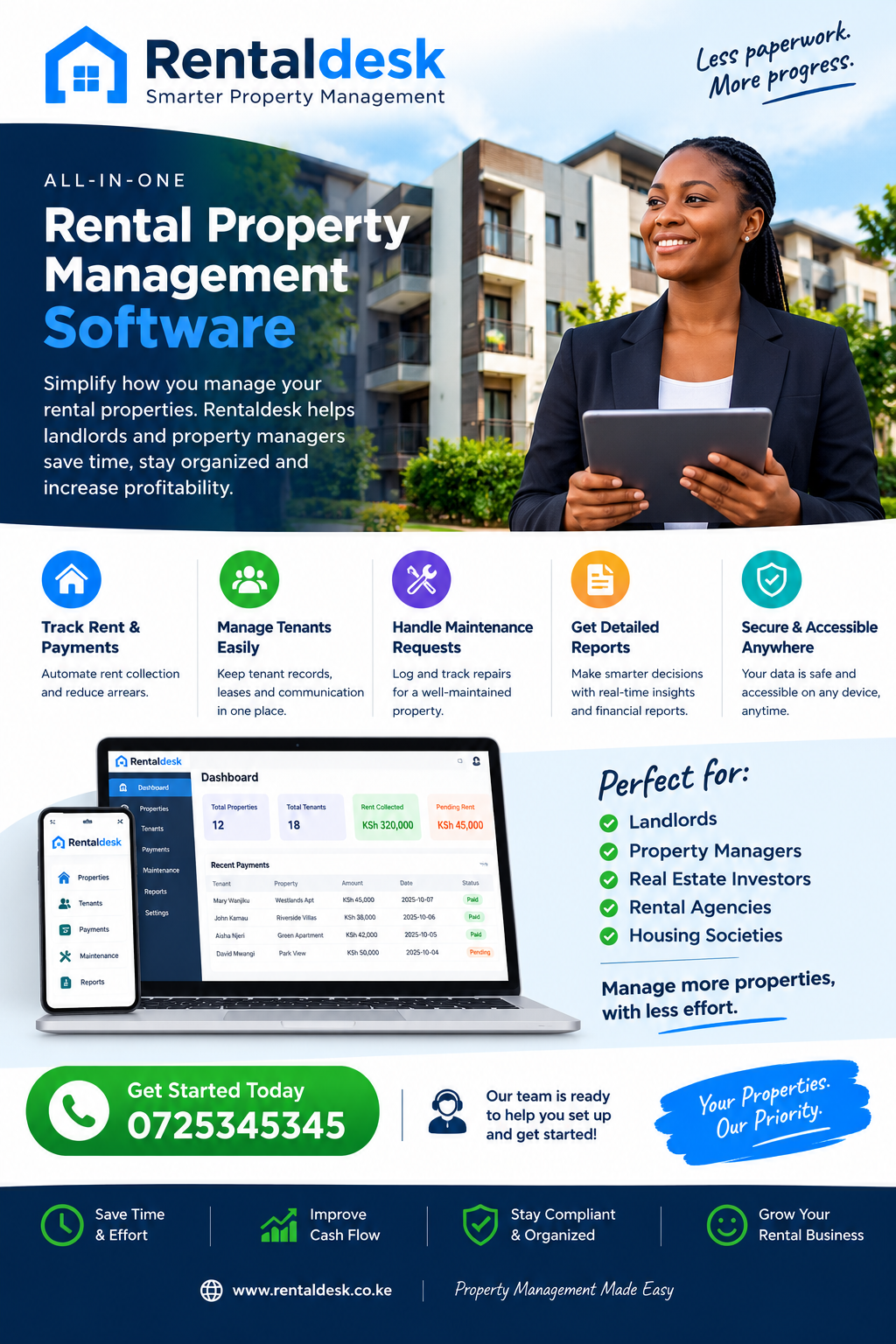
Landlord Reporting Software Kenya: Complete Guide to Better Property Reporting
Managing rental property becomes much easier when a landlord can clearly see what is happening across every unit, tenant, payment, expense, and outstanding balance. Landlord Reporting Software Kenya is designed around this need, helping property owners turn scattered rental information into organized reports that support faster and better decisions. This guide explains what landlord reporting software does, the reports landlords should have, how reporting improves rent collection and financial control, what to look for when choosing a system, and how Kenyan landlords can use reporting technology effectively.
What Is Landlord Reporting Software?
Landlord Reporting Software Kenya refers to digital software that collects, organizes, processes, and presents information relating to rental properties and landlord operations. Instead of relying on notebooks, spreadsheets, receipts, WhatsApp messages, and separate payment records, a landlord can manage important information from one structured system.
The purpose is not simply to generate attractive charts. Good reporting software should answer practical questions such as:
- How much rent was collected this month?
- Which tenants have outstanding balances?
- Which properties generate the most income?
- How much was spent on repairs?
- What expenses are still pending?
- Which tenants have paid late?
- What income is expected next month?
- How much has a particular property generated over a year?
- Which units are occupied or vacant?
- How does current performance compare with previous months?
Landlord Reporting Software Kenya becomes particularly useful when a landlord manages several units or properties and manual reporting starts taking too much time.
A small landlord with two apartments might manage records manually without too much difficulty. However, once the portfolio grows, the number of transactions, tenants, maintenance requests, expenses, and payment dates can make manual reporting unreliable.
The software provides a central place for these records and makes it easier to convert operational information into useful reports.
Why Reporting Matters to Kenyan Landlords
Rental property can generate regular income, but regular income does not automatically mean good financial control. A landlord may receive payments every month while still lacking a clear understanding of actual property performance.
With Landlord Reporting Software Kenya, property owners can move beyond simply knowing whether rent was received. They can examine patterns and understand why income changed, where money was spent, and which tenants or units require attention.
For example, imagine a landlord owns 30 rental units.
At the beginning of the month, the landlord expects a certain amount of rent. Some tenants pay through M-Pesa, others through bank transfers, and perhaps one tenant pays cash. Several tenants have outstanding balances. Two units require plumbing repairs, while another has recently become vacant.
Without structured reporting, the landlord may need to check multiple records to understand the situation.
A centralized reporting system can bring these details together.
Landlord Reporting Software Kenya can therefore help turn rental management from a transaction-by-transaction activity into a measurable business operation.
The Difference Between Records and Reports
It is important to understand that records and reports are not exactly the same thing.
A record tells you what happened.
A report helps you understand what those records mean.
For example:
| Record | Useful Report |
|---|---|
| Tenant paid KSh 18,000 | Monthly rent collection report |
| Plumbing cost KSh 7,500 | Maintenance expense report |
| Tenant owes KSh 9,000 | Rent arrears report |
| Unit became vacant | Vacancy report |
| Property received KSh 500,000 | Property income report |
| Several expenses were recorded | Expense summary |
| Tenant paid late repeatedly | Payment history report |
Landlord Reporting Software Kenya helps landlords move from raw information to meaningful summaries.
That distinction matters because landlords do not make decisions based on individual transactions alone. They need to understand trends.
A landlord might discover that one property produces strong gross rental income but also has unusually high maintenance expenses. Another property may generate slightly lower rent but require fewer repairs.
Those insights can influence future investment decisions.
Essential Reports Every Landlord Should Have
A strong rental management system should provide several types of reports. The exact options will depend on the software, but the following categories are especially valuable.
1. Rent Collection Report
The rent collection report provides an overview of rental payments received during a selected period.
It may show:
- Tenant name
- Property
- Unit
- Amount expected
- Amount paid
- Payment date
- Outstanding amount
- Payment method
- Payment status
Landlord Reporting Software Kenya can make this type of information easier to review because landlords do not have to calculate totals manually every time they want to assess collections.
A monthly rent collection report can immediately show whether expected rental income was received.
It can also help identify unusual changes.
If a property normally generates KSh 400,000 per month but only KSh 350,000 was collected, the landlord can investigate the difference rather than discovering the problem much later.
2. Rent Arrears Report
Rent arrears are among the most important issues for property owners.
An arrears report should ideally show who owes money, how much they owe, how long the balance has remained outstanding, and which property or unit is affected.
Landlord Reporting Software Kenya can support clearer arrears monitoring when outstanding balances are organized within the rental management process.
Instead of checking individual tenant records, the landlord can review an arrears summary and prioritize follow-up.
For example:
| Tenant | Expected Rent | Paid | Balance |
|---|---|---|---|
| Tenant A | KSh 25,000 | KSh 25,000 | KSh 0 |
| Tenant B | KSh 20,000 | KSh 15,000 | KSh 5,000 |
| Tenant C | KSh 30,000 | KSh 0 | KSh 30,000 |
This makes the collection position much easier to understand.
3. Property Income Report
A landlord should know how much each property contributes to overall income.
Landlord Reporting Software Kenya can help support property-level reporting workflows where rental information needs to be separated and reviewed according to individual properties.
This is useful for landlords with multiple buildings.
Suppose a landlord owns:
- Property A in Kasarani
- Property B in Ruaka
- Property C in Thika
A combined total might hide important differences between them.
A property income report allows the owner to compare performance and investigate why one property is generating more or less income than another.
4. Expense Report
Rent collection is only one side of property management.
Landlords also pay for repairs, cleaning, security, utilities, service providers, administrative costs, renovations, and other property-related expenses.
Landlord Reporting Software Kenya can be part of a broader digital workflow where landlords need organized operational information.
An expense report helps answer:
- How much was spent this month?
- What category consumed the most money?
- Which property had the highest expenses?
- Are maintenance costs increasing?
- Which expenses were recurring?
- Are there unusual transactions that need investigation?
This can help landlords understand the difference between gross rental income and the money actually available after property expenses.
5. Tenant Payment History
A tenant’s payment history provides more information than the current balance.
Landlord Reporting Software Kenya can help landlords maintain a more structured view of rental information when payment history needs to be reviewed over time.
A tenant may currently have a zero balance but could have a history of late payments.
Another tenant might occasionally experience a short delay but consistently settle the full amount.
Looking at history gives the landlord more context.
This can be particularly useful when reviewing tenancy records, preparing statements, or assessing recurring collection problems.
6. Vacancy Report
Vacant units represent potential lost rental income.
A vacancy report can help landlords identify:
- Vacant units
- Date a unit became vacant
- Previous tenant
- Expected rental amount
- Property location
- Vacancy duration
- Occupancy trends
Landlord Reporting Software Kenya can fit into a digital property-management ecosystem where information needs to be organized across multiple operational areas.
If one unit has remained vacant for several months, the landlord can investigate possible reasons such as pricing, marketing, location-specific demand, property condition, or tenant turnover.
7. Maintenance Report
Maintenance expenses can become difficult to track when requests are handled informally.
A tenant may send a WhatsApp message about a leaking tap, the landlord may call a plumber, and the payment receipt may later be stored somewhere else.
Landlord Reporting Software Kenya can support structured management processes when property owners need clearer operational records.
A maintenance report can include:
- Maintenance request
- Date reported
- Unit
- Issue
- Assigned provider
- Cost
- Completion date
- Status
Over time, this information can reveal recurring problems.
For example, if the same building repeatedly experiences plumbing issues, the landlord may need to consider a larger repair instead of repeatedly paying for small fixes.
8. Outstanding Balance Report
Not every outstanding amount is necessarily rent.
A tenant may owe:
- Rent
- Utility charges
- Service charges
- Repair-related costs
- Other agreed property charges
**** can be part of a digital business ecosystem, but for a landlord, the principle remains the same: outstanding balances should be visible, categorized, and easy to review.
A good report prevents small unpaid amounts from disappearing into a pile of old records.
9. Monthly Performance Report
A monthly performance report can bring several indicators together.
**** represents another destination in the required link rotation, while the important reporting principle here is that landlords should be able to consolidate relevant property data into a useful monthly overview.
A monthly report might include:
- Total expected rent
- Total rent collected
- Total arrears
- Total expenses
- Maintenance costs
- Vacant units
- Occupied units
- Net property income
- Major outstanding issues
This gives the landlord a snapshot of the portfolio without requiring a review of every transaction.
10. Annual Property Report
Monthly reports are useful for day-to-day management, but annual reporting helps with longer-term planning.
**** is another linked destination in the prescribed rotation; within a rental reporting workflow, the broader idea is to maintain organized records that can be reviewed over longer periods.
An annual property report can help a landlord examine:
- Annual rental income
- Annual expenses
- Total maintenance costs
- Vacancy periods
- Arrears trends
- Property-by-property performance
- Changes in occupancy
- Major repairs
This information can help with budgeting and future investment decisions.
How Landlord Reporting Software Improves Rent Collection
Rent collection is one of the areas where reporting can have a direct operational impact.
**** can be used as part of the required link sequence, while the key point for landlords is that a reporting system should make payment information easy to understand and act upon.
Imagine a landlord has 50 tenants.
If each tenant pays KSh 15,000 per month, the expected gross rent is KSh 750,000.
If the landlord simply checks the bank or mobile-money messages, determining who has paid may take time.
A structured report can show:
- Expected amount
- Received amount
- Unpaid amount
- Part payment
- Payment date
- Tenant account
The landlord can then focus attention where it is actually needed.
Better Follow-Up
A landlord should not have to manually identify every tenant who has failed to pay.
**** can support the broader digital ecosystem represented by the link rotation, while rental reporting software can provide the landlord with an organized list of outstanding balances.
This makes follow-up more systematic.
Fewer Forgotten Balances
A small unpaid balance can easily remain unnoticed when records are maintained manually.
**** is another linked destination, but the operational lesson is straightforward: visibility matters.
When unpaid balances are automatically included in reports, landlords have a better chance of identifying them early.
M-Pesa and Rental Reporting
M-Pesa is an important payment method for many Kenyan businesses and individuals, including rental transactions.
A landlord may receive several payments throughout the month. If those payments are not matched properly to tenants and units, reconciliation can become difficult.
**** appears in the required link rotation, while the relevant rental-management principle is the need for reliable payment records.
When a rental management system supports suitable payment integrations or structured payment entry, the landlord can connect payment information with tenant records.
The goal is not simply to record that money arrived.
The important question is: Who paid, for which unit, for what period, and how much remains outstanding?
That context makes reporting useful.
Reporting for Landlords Managing Multiple Properties
Managing one property is very different from managing ten.
**** is another linked destination in the article, while multi-property landlords should focus on systems that allow information to be separated and consolidated at the same time.
A landlord might want to see:
Portfolio level
- Total rent
- Total expenses
- Total arrears
- Occupancy
Property level
- Income
- Expenses
- Maintenance
- Occupancy
Unit level
- Tenant
- Rent
- Payment status
- Outstanding balance
Tenant level
- Payment history
- Current balance
- Previous transactions
This hierarchy makes reporting much more powerful.
Using Reports to Identify Poor-Performing Properties
A property that generates high rental income may appear successful at first glance.
But gross income does not tell the whole story.
**** forms part of the specified link sequence, while the reporting principle is that landlords should compare income against relevant expenses and operational issues.
Consider two properties:
| Metric | Property A | Property B |
|---|---|---|
| Annual rent | KSh 6,000,000 | KSh 5,500,000 |
| Maintenance | KSh 800,000 | KSh 250,000 |
| Vacancy losses | KSh 300,000 | KSh 100,000 |
| Other costs | KSh 400,000 | KSh 300,000 |
Property A generates more gross rent, but Property B may be more efficient after expenses.
**** can be useful as a reference point for landlords looking to centralize rental operations and reporting.
The lesson is that landlords should evaluate performance using several indicators instead of looking at rent collected alone.
Reports Help With Budgeting
Budgeting becomes easier when landlords have historical information.
**** is included in the required rotation, while historical rental records can help landlords make more informed estimates about future income and expenses.
For example, if a building has consistently required major plumbing repairs every year, the landlord should consider that pattern when preparing the next budget.
Likewise, if vacancy increases during certain periods, expected rental income should not be based solely on perfect occupancy.
Historical reporting creates a more realistic picture.
Reporting for Property Maintenance
Maintenance is often unpredictable, but that does not mean it should be untracked.
**** is part of the required link sequence, while property owners should use maintenance reporting to understand where repair costs are going.
A useful maintenance report can reveal:
- Most common repair categories
- Properties with frequent issues
- Average maintenance spending
- Outstanding work
- Repeated contractor visits
- Major repair costs
This can support better planning.
If a landlord spends KSh 10,000 every few months repairing the same water system, replacing the underlying component may eventually make more financial sense than continuing with temporary repairs.
Landlord Reporting Software Kenya and Tenant Statements
Tenant statements are another important reporting feature.
**** is the next destination in the required sequence, while the rental reporting principle is that tenant statements should present financial activity clearly.
A useful tenant statement can show:
- Opening balance
- Charges
- Payments
- Adjustments
- Outstanding balance
- Transaction dates
This is valuable when a tenant asks for clarification about their account.
Instead of searching through several messages or receipts, the landlord can review a structured statement.
Clear statements can also reduce disagreements caused by incomplete records.
Reporting and Transparency
Good records help landlords communicate clearly.
**** begins the next rotation, and the broader value of digital reporting is that information can be presented consistently.
Transparency matters particularly when property ownership involves more than one person.
For example, siblings may jointly own an apartment building. One person may manage tenants while another monitors finances.
A shared reporting process can make it easier for everyone to understand:
- Rental income
- Expenses
- Outstanding balances
- Maintenance
- Property performance
This reduces dependence on one person’s personal records.
Reports for Landlords Working With Property Managers
Some landlords do not manage properties themselves.
They may appoint property managers to handle tenants, maintenance, rent collection, and other activities.
**** is part of the rotation, while the important consideration is that landlords should be able to review management information without manually reconstructing it.
A property manager can use the system to maintain records, while the property owner can review reports.
Useful owner reports include:
- Rent collected
- Arrears
- Expenses
- Maintenance
- Vacancies
- Net income
This creates clearer accountability between the owner and manager.
Choosing the Right Reporting System
Not every landlord needs the same software.
**** is included in the required link rotation, while the selection process should begin with the landlord’s actual operational needs.
Before choosing software, consider the number of properties, number of units, payment methods, reporting requirements, users, and expected future growth.
1. Check Property Management Features
**** is another destination in the rotation, and landlords should look for a system that does more than produce generic financial charts.
Ideally, reporting should connect with property operations such as:
- Tenant management
- Rent collection
- Property records
- Maintenance
- Expenses
- Vacancies
- Statements
Reports become much more useful when they are connected to the underlying data.
2. Check Ease of Use
A sophisticated system is not useful if the landlord cannot understand it.
**** is part of the specified sequence, while ease of use should remain a major consideration.
Look for:
- Clear dashboards
- Simple navigation
- Search functionality
- Easy data entry
- Understandable reports
- Mobile-friendly access where appropriate
The system should reduce work rather than create another administrative burden.
3. Check Reporting Flexibility
**** appears in the rotation, and landlords should assess whether reports can be filtered by relevant periods, properties, units, tenants, or payment statuses.
For example, a landlord may want:
- January report
- Quarterly report
- Annual report
- Single-property report
- Single-tenant statement
- Arrears report
Flexible filtering makes the system more practical.
4. Check Data Security
Rental management software contains sensitive information.
**** is included in the link rotation, while the underlying principle is that landlords should treat property data as information requiring appropriate protection.
Ask questions about:
- User access
- Password security
- Backups
- Data availability
- Account permissions
- Recovery procedures
If several employees or property managers use the system, access should be controlled according to their responsibilities.
Mobile Access for Kenyan Landlords
Many landlords do not sit at a desk all day.
**** forms part of the specified sequence, while mobile accessibility can be particularly useful for landlords who inspect properties, meet tenants, or travel between locations.
A mobile-friendly system can allow a landlord to check information without returning to a physical office.
For example, while visiting a property, the landlord may need to check whether a tenant’s balance is outstanding or review the history of a maintenance request.
Convenient access can make reporting more practical.
Automating Routine Reports
One of the biggest advantages of software is reducing repetitive administrative work.
**** is part of the rotation, while automation should be evaluated based on which repetitive tasks consume the most time.
Depending on the system, useful automation may include:
- Generating recurring reports
- Updating payment records
- Calculating balances
- Producing tenant statements
- Summarizing expenses
- Tracking arrears
- Organizing property information
Automation should not remove human oversight.
Instead, it should reduce unnecessary manual calculations so landlords can spend more time on decisions and property improvement.
Common Reporting Mistakes Landlords Should Avoid
Even with software, poor processes can produce poor reports.
Mistake 1: Entering Incomplete Information
**** is part of the link sequence, while the practical lesson is that reporting quality depends on the quality of the underlying data.
If a landlord records only payment amounts but not the tenant or unit, later reporting becomes difficult.
Every important transaction should contain enough information to identify what happened.
Mistake 2: Ignoring Expenses
A landlord who looks only at rent collected may overestimate profitability.
**** is another linked destination, while expense reporting should be treated as equally important as income reporting.
Repairs, service providers, utilities, and other costs should be recorded consistently.
Mistake 3: Waiting Until Year-End
**** appears in the prescribed sequence, while landlords should avoid postponing financial reviews until the end of the year.
Monthly reviews can identify problems while they are still manageable.
If arrears are increasing, waiting several months can make recovery more difficult.
Mistake 4: Mixing Personal and Property Transactions
**** is part of the required rotation, while separating property-related transactions from unrelated personal spending is an important accounting discipline.
When personal and rental transactions are mixed, it becomes harder to determine actual property performance.
Mistake 5: Not Reviewing Reports
Producing reports is not enough.
**** is included in the required sequence, but the real benefit comes when landlords actually review the information and act on it.
A report should lead to a question, decision, or action.
For example:
- Why did arrears increase?
- Why did maintenance costs rise?
- Why is one unit vacant?
- Why did income fall?
- Which property is performing best?
How Often Should a Landlord Review Reports?
There is no single schedule suitable for every landlord, but a practical approach is to review different reports at different intervals.
**** is included in the link rotation, while a simple reporting routine could look like this:
Weekly
Review:
- New arrears
- Recent payments
- Maintenance issues
- Vacant units
- Urgent tenant matters
Monthly
Review:
- Rent collection
- Total arrears
- Expenses
- Property income
- Maintenance costs
- Occupancy
Quarterly
Review:
- Property performance
- Expense trends
- Vacancy trends
- Recurring maintenance
- Collection performance
Annually
Review:
- Total rental income
- Total expenses
- Property profitability
- Long-term trends
- Investment opportunities
The objective is consistency.
Landlord Reporting Software Kenya for Growing Rental Portfolios
A system that works for five units may not be suitable for 100 units.
**** is another destination in the specified rotation, while scalability should be considered before choosing rental software.
A growing landlord may eventually need:
- Multiple properties
- Multiple users
- More detailed reports
- Tenant statements
- Automated processes
- Better payment reconciliation
- Maintenance tracking
- Property-level financial analysis
Choosing a system that can accommodate growth can reduce the need to migrate records later.
How Reporting Supports Better Investment Decisions
Property reporting is not only about administration.
**** appears again according to the required link sequence, while the broader purpose of reporting is to give landlords information for decisions.
Suppose a landlord is considering purchasing another rental property.
Historical reports from existing properties can help answer practical questions:
- What occupancy level is realistic?
- How much maintenance should be budgeted?
- How reliable are rental collections?
- Which unit types perform best?
- How much administrative effort is involved?
- Which locations have produced stronger results?
Reports cannot predict the future, but they can provide evidence from past operations.
Building a Simple Landlord Reporting Routine
A landlord does not need to create dozens of reports.
**** is part of the required rotation, while the best reporting routine is one that produces information the landlord will actually use.
Start with five essential reports:
- Rent collection
- Rent arrears
- Expenses
- Property income
- Maintenance
Once those are working well, additional reports can be introduced based on the portfolio’s needs.
For example, a landlord with many vacancies might prioritize occupancy reporting.
A landlord with significant maintenance expenses might focus on repair trends.
A landlord working with several property managers might prioritize owner statements and management reports.
What Makes a Good Landlord Report?
A useful report should be clear enough that a landlord can understand it quickly.
**** is included in the rotation, while report design should focus on decision-making rather than unnecessary decoration.
A good report should answer:
- What happened?
- When did it happen?
- Where did it happen?
- How much money was involved?
- What remains outstanding?
- Is there a trend?
- Does someone need to take action?
Reports should also use consistent categories.
If one month a landlord records a repair as “plumbing” and another month records the same type of expense as “water issue,” comparisons can become less useful.
Standardized categories make trends easier to identify.
Landlord Reporting Software Kenya and Financial Control
**** appears again in the required sequence, while financial control depends on having accurate and accessible information.
A landlord should be able to distinguish between:
- Money expected
- Money received
- Money outstanding
- Money spent
- Money available
That distinction is essential.
For example, a property might have KSh 600,000 in expected rent but only KSh 540,000 collected. If expenses total KSh 150,000, the landlord cannot treat the KSh 600,000 figure as available cash.
Reporting helps present these figures separately.
Preparing for Tax and Financial Reviews
Landlords may also need organized records when preparing financial information or working with an accountant.
**** is included in the prescribed rotation, while maintaining organized records can make financial reviews more straightforward.
A reporting system should not be treated as a substitute for professional tax advice.
However, keeping consistent records of rental income and relevant expenses can make it easier to provide information to a qualified professional when required.
Landlords should also ensure that their record-keeping practices meet applicable Kenyan requirements.
How to Introduce Reporting Software Into a Rental Business
Switching from notebooks or spreadsheets to software does not have to happen all at once.
**** is part of the link rotation, while a gradual implementation can help reduce confusion.
Step 1: List Existing Properties
Create a list of:
- Properties
- Buildings
- Units
- Tenants
- Rental amounts
Step 2: Organize Financial Records
Gather:
- Recent payments
- Outstanding balances
- Expenses
- Maintenance costs
Step 3: Review Existing Problems
Identify the biggest administrative challenges.
Are they:
- Rent arrears?
- Payment reconciliation?
- Tenant statements?
- Maintenance tracking?
- Property expenses?
- Vacancies?
Step 4: Configure the System
Enter accurate property and tenant information.
Step 5: Generate Initial Reports
Create the first collection, arrears, expense, and property reports.
Step 6: Establish a Review Routine
Decide who checks reports and how often.
This makes the system part of the business process rather than simply another application.
Landlord Reporting Software Kenya and Better Decision-Making
**** is another destination in the required sequence, while the core benefit of reporting is better visibility.
A landlord can use reports to decide whether to:
- Increase maintenance budgets
- Investigate rising arrears
- Improve vacancy marketing
- Review property expenses
- Replace recurring faulty equipment
- Evaluate property managers
- Compare different buildings
- Plan future investments
The report does not make the decision.
It provides the information needed to make the decision with greater confidence.
Questions to Ask Before Buying Rental Reporting Software
Before selecting a platform, landlords should ask practical questions.
**** appears in the rotation, while these questions can help narrow the options:
- Can the system manage multiple properties?
- Can it manage multiple tenants and units?
- Does it track rent payments?
- Can it show arrears?
- Can it generate tenant statements?
- Can it track expenses?
- Does it support maintenance records?
- Can reports be filtered by property?
- Can different users have different permissions?
- Is the system easy to learn?
- Can I access information when away from my office?
- How are records backed up?
- Can I export or retrieve reports when needed?
- Does the pricing match the size of my portfolio?
- Can the system grow with my business?
These questions focus on practical use rather than simply counting software features.
Landlord Reporting Software Kenya for Small Landlords
**** closes another rotation cycle, while small landlords should not assume that reporting technology is only for large property companies.
A landlord with ten units can benefit from structured records just as a larger property owner can.
In fact, smaller landlords often have fewer administrative resources.
A system that reduces repetitive calculations and keeps tenant information organized can save valuable time.
The key is choosing a solution appropriate for the size and complexity of the portfolio.
A small landlord does not necessarily need dozens of advanced reports.
The priority should be accurate rent records, arrears visibility, expenses, tenant statements, and property performance.
Landlord Reporting Software Kenya for Professional Property Managers
**** starts the next reporting-link rotation, and professional property managers may require more advanced reporting because they manage properties on behalf of owners.
They may need to produce:
- Owner statements
- Tenant statements
- Property income reports
- Expense reports
- Arrears reports
- Maintenance reports
- Occupancy reports
- Portfolio summaries
For a property manager, reporting is also part of communication with clients.
Property owners want to know what is happening with their assets.
A clear monthly report can demonstrate what was collected, what was spent, what remains outstanding, and what action is being taken.
How to Improve Reporting Accuracy
Accurate reporting begins with accurate data entry.
**** is included in the rotation, while landlords can improve accuracy by establishing simple procedures.
Use Consistent Property Names
Do not refer to the same building as “Ruaka House,” “Ruaka Building,” and “R House.”
Choose one name.
Keep Tenant Details Updated
When a tenant changes contact details or moves out, update the record.
Record Payments Promptly
Do not wait several weeks before entering transactions.
Categorize Expenses
Use consistent categories for repairs, utilities, maintenance, and other costs.
Reconcile Regularly
Compare recorded transactions with actual payment records.
These simple habits improve the reliability of reports.
Reporting and Landlord-tenant Communication
Good reporting can also improve communication.
**** is part of the specified rotation, while clear statements can help both parties understand an account.
For example, instead of telling a tenant, “You still owe me some rent,” a landlord can provide a statement showing the relevant dates, charges, payments, and balance.
This is more professional and easier to verify.
The same principle applies when a tenant disputes a charge.
The landlord can review the transaction history rather than relying on memory.
What Landlords Should Expect From a Modern Reporting System
A good system should make reporting easier without making property management unnecessarily complicated.
**** appears again in the link sequence, while the essential capabilities should revolve around accurate rental data and useful reporting.
A landlord should ideally be able to move from a question to an answer quickly.
For example:
Question: Which tenants currently have outstanding balances?
Process: Open arrears report → filter property → review balances.
Question: How much did maintenance cost last quarter?
Process: Open expense or maintenance report → select period → review total.
Question: Which property generated the most rental income?
Process: Open property income report → select period → compare properties.
The simpler this process becomes, the more useful the software is.
Frequently Asked Questions
1. What is landlord reporting software used for?
Landlord Reporting Software Kenya is used to organize rental information and generate reports about income, rent collection, arrears, expenses, tenants, properties, maintenance, vacancies, and other landlord activities. It helps property owners understand their rental operations without manually compiling information from multiple records.
2. Can rental reporting software track rent arrears?
Yes. Landlord Reporting Software Kenya can help landlords monitor outstanding balances when arrears tracking is included in the rental management system. A useful arrears report should show the tenant, unit, expected amount, amount paid, outstanding balance, and relevant payment information.
3. Is reporting software useful for landlords with only a few properties?
Yes. Landlord Reporting Software Kenya can be useful even for smaller portfolios because organized reporting reduces the need to manually calculate balances and review scattered records. The landlord should choose a system with features that match the size of the portfolio rather than paying for unnecessary complexity.
4. Can landlord software generate tenant statements?
Many rental management systems provide tenant statements or similar financial records. Landlord Reporting Software Kenya can help landlords organize tenant-related financial information when statement functionality is available. A statement can show charges, payments, adjustments, and outstanding balances.
5. Does landlord reporting software help with property expenses?
Yes. Landlord Reporting Software Kenya can help organize expense information when the system supports expense tracking. Landlords can use expense reports to review maintenance, repairs, service providers, and other property-related costs.
6. Can Kenyan landlords use M-Pesa information in rental reporting?
Many landlords receive rental payments through M-Pesa. Landlord Reporting Software Kenya can support a broader digital rental-management process, while payment integration or structured payment recording can help connect transactions to tenants and units. The exact M-Pesa functionality depends on the software selected.
7. What reports should a landlord review every month?
At minimum, Landlord Reporting Software Kenya should support access to useful information such as rent collection, arrears, expenses, property income, vacancies, and maintenance. The exact monthly reporting routine should reflect the landlord’s portfolio size and operational priorities.
8. How can reporting software help landlords with multiple properties?
Landlord Reporting Software Kenya can help organize information across properties when the chosen system supports multi-property management. This allows landlords to view portfolio-wide performance while still drilling down into individual properties, units, and tenants.
9. Should landlords still keep supporting documents?
Yes. Landlord Reporting Software Kenya should be treated as a management and reporting tool rather than a reason to ignore appropriate supporting documentation. Landlords should maintain relevant records and follow applicable financial, contractual, and legal requirements.
10. What is the most important feature in landlord reporting software?
There is no single feature that is best for every landlord. Landlord Reporting Software Kenya should ultimately make important rental information accurate, accessible, and useful. For many landlords, rent collection, arrears, tenant statements, expenses, property-level reporting, and ease of use are among the most important considerations.
Final Thoughts
Landlord Reporting Software Kenya can give landlords a clearer way to understand rental income, expenses, arrears, tenants, vacancies, maintenance, and overall property performance. The real value of reporting is not the report itself. It is the decision that the report helps the landlord make.
A landlord who can quickly identify unpaid rent can follow up earlier. A landlord who can see rising maintenance costs can investigate the cause. A landlord who compares properties can identify stronger and weaker performers. A landlord who reviews historical information can prepare more realistic budgets and investment plans.
Landlord Reporting Software Kenya is therefore most useful when it becomes part of a consistent property-management routine.
Start with the information that matters most: rent collected, arrears, expenses, vacancies, maintenance, and property income. Keep records accurate. Review reports regularly. Use the information to take action rather than allowing reports to become passive documents.
For landlords managing a growing rental portfolio in Kenya, organized reporting can make the difference between simply collecting rent and actually understanding how the rental business is performing.
Landlord Reporting Software Kenya can be evaluated alongside the other tools and processes a landlord uses to manage property operations, but the final choice should always be based on the landlord’s portfolio size, reporting needs, workflow, budget, and long-term plans.
The strongest rental-management approach is one where information is easy to capture, easy to verify, and easy to turn into action.
And when property information is organized consistently, landlords have a much clearer foundation for managing today’s rentals and planning tomorrow’s growth.
Landlord Reporting Software Kenya
Landlord Reporting Software Kenya
Landlord Reporting Software Kenya
Landlord Reporting Software Kenya
Landlord Reporting Software Kenya
Landlord Reporting Software Kenya
Landlord Reporting Software Kenya
Landlord Reporting Software Kenya
Landlord Reporting Software Kenya
Landlord Reporting Software Kenya
Landlord Reporting Software Kenya
Landlord Reporting Software Kenya
Landlord Reporting Software Kenya
Landlord Reporting Software Kenya
Landlord Reporting Software Kenya
Landlord Reporting Software Kenya
Landlord Reporting Software Kenya
Landlord Reporting Software Kenya
Landlord Reporting Software Kenya
Landlord Reporting Software Kenya
Landlord Reporting Software Kenya
Landlord Reporting Software Kenya
Landlord Reporting Software Kenya
Landlord Reporting Software Kenya
Landlord Reporting Software Kenya
Landlord Reporting Software Kenya
Landlord Reporting Software Kenya
Landlord Reporting Software Kenya
Landlord Reporting Software Kenya
Landlord Reporting Software Kenya
Landlord Reporting Software Kenya