
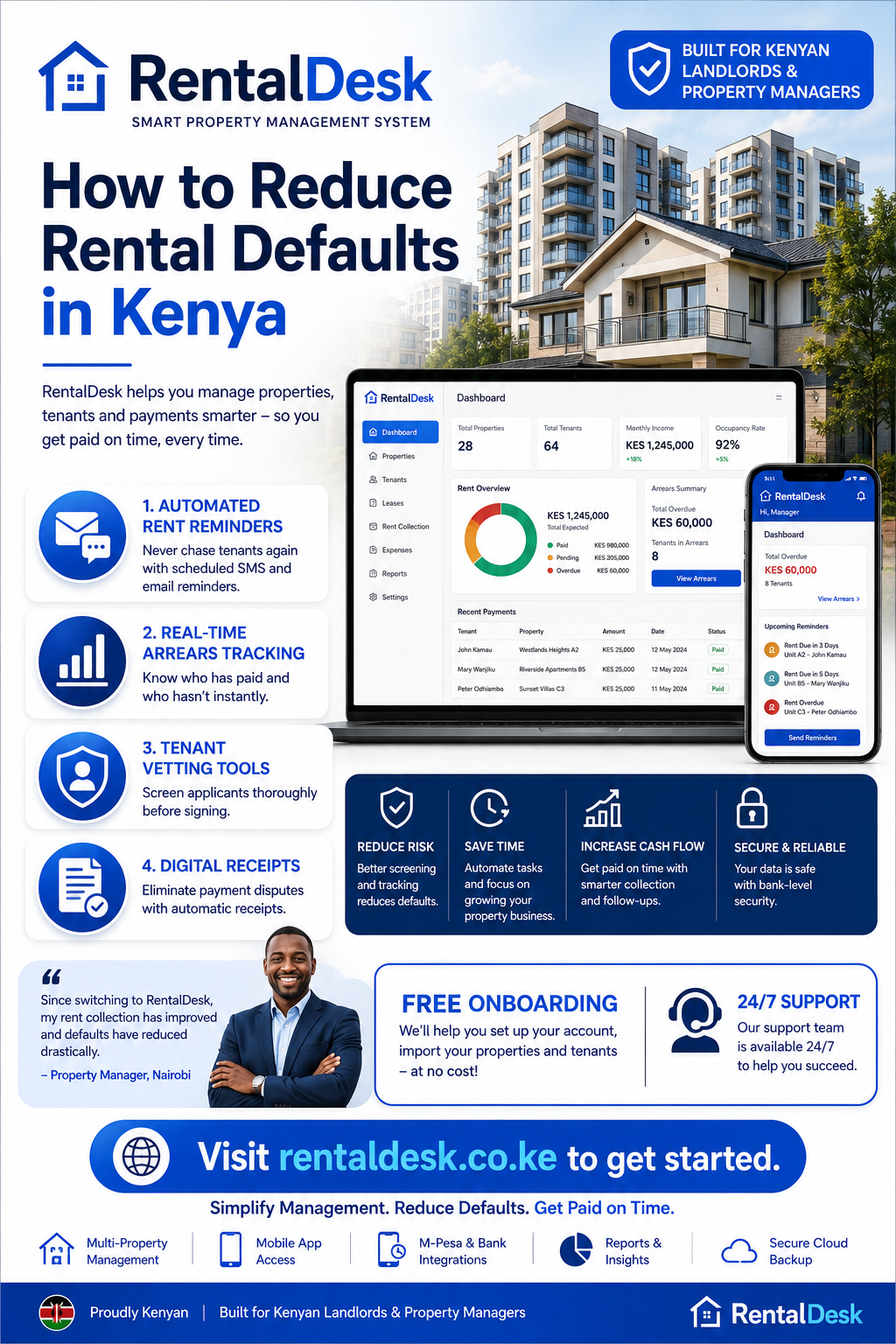
How to reduce rental defaults in Kenya is one of the most pressing questions facing landlords and property managers in today’s challenging rental market. Late payments and complete defaults have reached concerning levels—Nairobi County alone is owed over Sh300 million in rent arrears, with some cases dating back nearly 20 years . The financial impact is substantial, as late rent payments and vacancies can cost landlords up to 30% of expected rental income. RentalDesk provides a comprehensive solution that combines tenant vetting, automated rent collection, and proactive arrears management to significantly reduce rental defaults .
Why Reducing Rental Defaults in Kenya Matters
The how to reduce rental defaults in Kenya conversation is essential because rental income is the lifeblood of any property business. When tenants default, landlords face cascading challenges: missed mortgage payments, delayed maintenance, inability to fund property improvements, and increased stress. According to industry data, a single month of vacancy on a KShs. 25,000 unit costs KShs. 25,000 in lost income, not to mention the marketing and turnover costs associated with finding a new tenant.
The scale of the problem is alarming. In Nairobi’s county housing estates, some tenants have not paid rent for over a decade . One tenant reportedly racked up Sh425,000 in arrears for over 16 years on a house meant to cost Sh2,200 a month . Another, occupying a Sh900 monthly unit, hadn’t paid rent in 15 years, owing Sh151,000 . These extreme cases highlight how unchecked arrears can spiral out of control without proper systems.
The Root Causes of Rental Defaults
Understanding how to reduce rental defaults in Kenya begins with identifying why tenants default. Common causes include:
Financial Instability: Many tenants experience irregular income, especially those in the informal sector or gig economy. Without proper vetting, landlords may accept tenants who cannot afford the rent.
Forgetfulness: A significant portion of late payments are not intentional—tenants simply forget, or their payday doesn’t align with rent day . This is why automated rent reminders are so effective.
Disputes with Landlords: Maintenance issues, unclear billing, and poor communication can lead tenants to withhold rent deliberately.
Weak Record-Keeping: Without a system, landlords may not notice arrears until they become substantial. Manual processes often fail to flag late payments early .
Lack of Accountability: In properties where caretakers manage rent collection, weak oversight can lead to mismanagement of payments and increased defaults.
Prevention: Tenant Screening and Vetting
The most effective way to reduce rental defaults is to select reliable tenants from the outset . The how to reduce rental defaults in Kenya approach must start with thorough tenant screening.
Comprehensive Background Checks
Go beyond a basic ID check. Request employment verification, previous landlord references, and ideally, a credit report (if available and permissible) . This helps assess a tenant’s financial stability and payment history .
Proof of Income
Insist on recent pay slips or bank statements to confirm a stable income source that can comfortably cover the rent . For self-employed individuals, request business registration documents and a minimum of six months of transactional bank statements . While financial screening is becoming more common, landlords must be aware of Kenya’s Data Protection Act and handle sensitive documents responsibly .
Guarantors
For tenants with less established financial histories, consider requiring a guarantor who can cover the rent if the tenant defaults . Ensure the guarantor also undergoes a thorough vetting process and resides locally, making them easier to contact if needed .
Tenant Scoring Systems
Some platforms now offer tenant scoring systems that analyze multiple data points to generate a numerical score reflecting an applicant’s suitability . These systems evaluate payment reliability, creditworthiness, behavioral indicators, and verification results, helping landlords quickly identify low-risk tenants and reduce eviction rates by up to 40% .
Clear Lease Agreements
A well-drafted lease agreement is your legal backbone . The how to reduce rental defaults in Kenya process must include clear lease terms.
Detailed Payment Schedule
Clearly state the exact rent amount, due date, and acceptable payment methods .
Late Payment Penalties
Outline specific penalties for late payments, including the grace period (if any) and the charges incurred thereafter . Ensure these penalties are reasonable and legally enforceable .
Consequences of Default
Clearly explain the steps that will be taken in case of persistent non-payment, including legal action for eviction .
Utility Responsibilities
Specify who is responsible for paying utilities (water, electricity, service charges) to avoid disputes that could indirectly lead to rent payment delays .
Automated Rent Collection and Reminders
Technology is one of the most effective tools for reducing rental defaults . The how to reduce rental defaults in Kenya approach must leverage automation.
M-Pesa STK Push
RentalDesk supports M-Pesa STK Push, where tenants receive a pop-up on their phone to enter their PIN and complete payment instantly . This convenience eliminates excuses and encourages on-time payments.
Automated Rent Reminders
The fastest, cheapest lever a landlord has to reduce late payments is automated rent reminders—a scheduled nudge on the right channel, in the right tone, at the right time . RentalDesk sends reminders before and after due dates:
-
3 days before due: Friendly heads-up to prompt the tenant to move money into M-Pesa
-
On the due date: Neutral reminder with Paybill and account number
-
1 day after: Still neutral, but mentions late-fee terms
-
3 days after: Factual—”arrears” becomes the operative word
-
7 days after: Formal notice that becomes part of the paper trail
-
14 days after: Escalate—the system notifies you that this tenant needs a human conversation
Digital Receipts
RentalDesk automatically generates digital receipts immediately after payment, sent via SMS, WhatsApp, or email . This eliminates the “I paid” versus “I didn’t receive it” disputes and builds trust.
Multiple Payment Channels
RentalDesk supports M-Pesa Paybill, Till, and STK Push options, as well as bank transfers, providing flexible payment channels for tenants .
Proactive Arrears Management
The how to reduce rental defaults in Kenya approach must include early intervention.
Daily Review Routine
The strongest agencies do not wait until the last day of the month to understand rent performance. They review exceptions every day . A practical morning routine checks new payments, unmatched transactions, tenants due for reminders, overdue balances, vacant units, and maintenance issues . This routine keeps problems small and manageable.
Immediate Follow-Up
If rent is not paid by the due date, follow up immediately with a polite reminder. Don’t wait several days or weeks. The first 72 hours are critical—a quick phone call shows you are attentive and serious about the terms .
Structured Communication
If the first reminder doesn’t yield results, escalate with a formal written notice, reminding them of the lease agreement terms and consequences . Keep records of all communication .
Negotiate Payment Plans
For otherwise good tenants facing a temporary setback, consider negotiating a realistic payment plan . Get this agreement in writing, specifying the extra installments and the period. Crucially, ensure the tenant still pays the full current month’s rent in addition to the arrears installment. This prevents the debt from growing further.
Know When to Escalate
Understand your legal rights and the eviction process in Kenya. If all other efforts fail, be prepared to initiate legal proceedings promptly to minimize further losses .
Maintenance and Tenant Relations
The how to reduce rental defaults in Kenya approach recognizes that good tenant relations reduce defaults.
Prompt Maintenance
Respond quickly to maintenance requests. A well-maintained property and a responsive landlord encourage tenants to value their tenancy and pay rent on time . Delays in maintenance are a leading cause of tenant frustration and rent withholding.
Professional Communication
Maintain a professional but approachable attitude. This builds trust and encourages tenants to view you as a partner, not just a bill collector . Clear invoices, polite reminders, and easy payment methods signal that you run a serious operation .
Fair Rent Reviews
Give notice of rent reviews early and justify increases with market context where possible . Surprise hikes at signature time breed resentment and can trigger defaults.
How RentalDesk Helps Reduce Rental Defaults
RentalDesk is built specifically for the Kenyan market, making it the ideal how to reduce rental defaults in Kenya solution.
Automated Reminders
RentalDesk sends automated reminders via SMS and email before and after due dates. This significantly reduces follow-ups and excuses .
Real-Time Arrears Tracking
The system provides a real-time dashboard showing paid units, pending payments, overdue tenants, and monthly revenue totals . No more guessing who has paid.
Automated Receipts
Once payment is confirmed, tenants receive digital receipts automatically. This eliminates manual paperwork and disputes .
Payment Transparency
Tenants can view their invoice history, payment status, and outstanding balances at any time through the tenant portal . This transparency reduces disputes and encourages timely payments.
Maintenance Tracking
RentalDesk allows tenants to log maintenance issues online, with automatic assignment to technicians and status tracking . This reduces maintenance delays that can trigger defaults.
Multi-Property Management
For landlords with multiple properties, RentalDesk provides a unified dashboard showing rent collection status, arrears per location, and property performance across the entire portfolio .
Real-World Success Story
The how to reduce rental defaults in Kenya approach has delivered measurable results. One property management company took over a troubled property where debts were soaring 117% above the monthly rent . Through strategic planning, open communication, and unwavering dedication, they reduced the debt from Kshs 167,400 to Kshs 41,500—a 75% decrease . They also evicted 10 chronic defaulters who had become roadblocks to progress.
This success demonstrates that with the right strategies and tools, even the most challenging situations can be turned around.
- How to reduce rental defaults in Kenya
- How to reduce rental defaults in Kenya
- How to reduce rental defaults in Kenya
- How to reduce rental defaults in Kenya
- How to reduce rental defaults in Kenya
- How to reduce rental defaults in Kenya
- How to reduce rental defaults in Kenya
- How to reduce rental defaults in Kenya
- How to reduce rental defaults in Kenya
- How to reduce rental defaults in Kenya
- How to reduce rental defaults in Kenya