Excel vs Property Management Software: Which One Is Right for Your Rental Business?
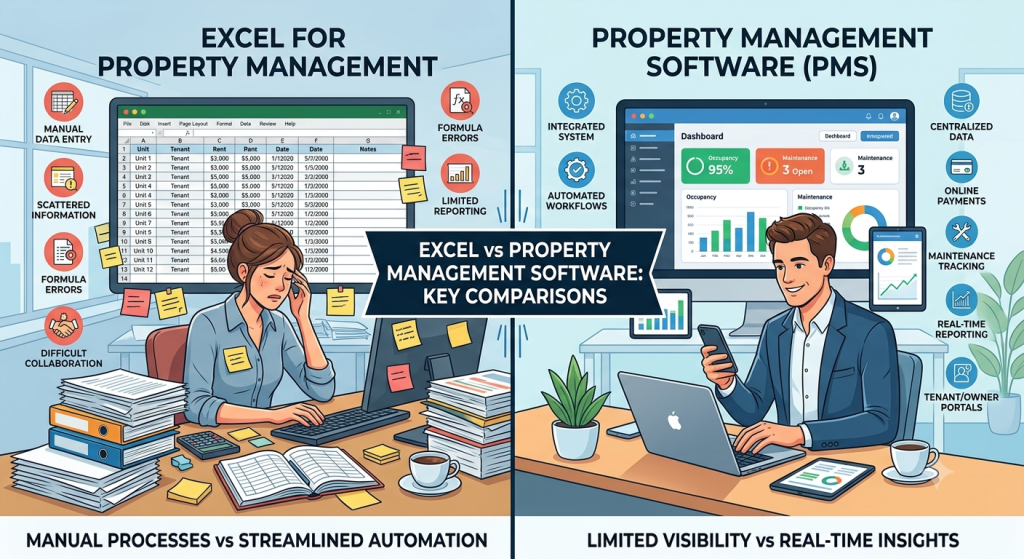
Choosing the right tool to manage rental properties is a crucial decision for landlords, property managers, and real estate investors. The debate around Excel vs Property Management Software has become increasingly relevant as property portfolios grow and management tasks become more complex. While Excel has long been a trusted solution for organizing property data, the comparison of Excel vs Property Management Software reveals significant differences in efficiency, automation, and scalability.
For many small landlords, Excel vs Property Management Software starts with cost. Excel is affordable, widely available, and familiar to most users. However, as businesses expand, Excel vs Property Management Software becomes less about price and more about saving time, reducing errors, and improving overall operations.
Understanding Excel vs Property Management Software is essential before investing in any property management solution. Spreadsheets can effectively track rent payments, expenses, and tenant details, but they often require manual updates and constant maintenance. This is where Excel vs Property Management Software highlights the advantages of automation, cloud accessibility, integrated accounting, and streamlined communication.
Another key aspect of Excel vs Property Management Software is data accuracy. Manual spreadsheet entries can lead to costly mistakes, whereas modern software automatically updates records, generates reports, and reduces repetitive tasks. As a result, Excel vs Property Management Software has become a common search for property professionals looking to improve productivity.
Security is another important consideration in Excel vs Property Management Software. While Excel files can be shared and stored locally, dedicated property management platforms typically provide encrypted cloud storage, automated backups, and secure user permissions. These capabilities make Excel vs Property Management Software an important comparison for businesses handling sensitive tenant and financial information.
As the real estate industry embraces digital transformation, Excel vs Property Management Software continues to shape how landlords manage their investments. Whether you oversee a single rental property or a large portfolio, evaluating Excel vs Property Management Software can help you identify the most efficient solution for your needs.
In this guide, we’ll provide a detailed comparison of Excel vs Property Management Software, exploring their features, advantages, limitations, costs, and ideal use cases. By the end, you’ll have a clear understanding of Excel vs Property Management Software and be able to choose the option that best supports your property management goals.
Why Excel Became the Default Tool for Property Management
Long before specialized rental management software became widely available, Excel was the go-to solution for landlords. It allowed users to organize property information into rows and columns, making it easier to keep track of tenants and rental income.
A typical landlord might create separate worksheets for:
- Tenant details
- Monthly rent payments
- Security deposits
- Maintenance expenses
- Utility bills
- Lease expiry dates
- Vacant units
- Annual income reports
For small portfolios, this approach works reasonably well.
Excel’s flexibility allows landlords to design spreadsheets that match their specific needs. Formulas can automatically calculate totals, balances, and outstanding rent. Conditional formatting can highlight overdue payments, while charts provide a visual overview of income trends.
Another reason Excel remains popular is that most people already know how to use it. There is little training required, and the software is included in many Microsoft Office subscriptions.
Because of these advantages, many landlords continue to use Excel even as their businesses expand.
The Problem with Growing Rental Portfolios
The challenge begins when your property portfolio grows beyond a handful of units.
Imagine managing:
- 10 apartments
- 50 apartments
- 150 apartments
- Multiple commercial buildings
- Several property managers
- Hundreds of tenants
Suddenly, the spreadsheet that once felt organized becomes difficult to maintain.
Instead of one workbook, you may have several:
- Rent Register.xlsx
- Tenant List.xlsx
- Expenses.xlsx
- Maintenance.xlsx
- Owner Reports.xlsx
Now imagine updating all of them every single day.
Every payment requires manual entry.
Every maintenance request needs to be recorded.
Every lease renewal must be updated.
Every monthly report requires checking formulas and reconciling figures.
The workload increases exponentially.
Many landlords spend several hours every week simply maintaining spreadsheets instead of focusing on growing their investment portfolio.
What Is Property Management Software?
Property management software is a specialized digital platform designed specifically for landlords, real estate companies, and property managers.
Unlike Excel, which is a general spreadsheet application, property management software automates nearly every aspect of rental operations.
Instead of creating formulas and manually entering data, users simply record transactions once, and the system updates related records automatically.
For example, when a tenant pays rent through M-Pesa:
- The payment is recorded automatically.
- The tenant’s balance is updated.
- A receipt is generated.
- Financial reports are updated.
- The landlord dashboard reflects the latest collections.
- Outstanding balances are recalculated.
This level of automation eliminates repetitive administrative work while improving accuracy.
Modern platforms such as RentalDesk are designed specifically for the Kenyan rental market, allowing landlords to manage residential apartments, commercial buildings, mixed-use developments, student housing, gated communities, and office spaces from one secure dashboard.
Excel vs Property Management Software: Understanding the Fundamental Difference
At first glance, Excel and property management software appear to accomplish similar goals. Both can store tenant information, record rent payments, and generate reports.
The difference lies in how they accomplish these tasks.
Excel is a spreadsheet application that depends entirely on manual setup and maintenance. Every formula, worksheet, report, and calculation must be created and managed by the user.
Property management software, on the other hand, is purpose-built for rental operations. It includes built-in workflows, automation, reporting tools, payment integrations, security controls, and user permissions designed specifically for landlords.
Think of it this way:
Using Excel to manage rental properties is like using a notebook to run an accounting department. It works—but only up to a point.
Property management software is like having a dedicated accounting, customer service, maintenance, and reporting team working together in one system.
As your rental business grows, this difference becomes increasingly significant.
Excel vs Property Management Software: Feature-by-Feature Comparison
1. Tenant Management
Excel allows landlords to store tenant names, phone numbers, ID numbers, lease dates, and payment history.
However, every update must be entered manually.
If a tenant changes their phone number or renews their lease, multiple worksheets often need updating.
Property management software centralizes all tenant information in one profile.
With RentalDesk, landlords can instantly access:
- Contact information
- Lease agreements
- Payment history
- Outstanding balances
- Maintenance requests
- Documents
- Communication records
Everything is connected, reducing duplication and saving valuable time.
2. Rent Collection
Tracking rent in Excel usually involves manually entering every payment received, checking bank statements or M-Pesa messages, calculating balances, and issuing receipts separately.
Property management software automates much of this process. Payments are linked directly to tenant accounts, balances are updated instantly, and digital receipts can be generated automatically. This not only reduces administrative work but also minimizes disputes over payment records.
3. Financial Reporting
Creating monthly income reports in Excel often requires sorting data, checking formulas, and reconciling multiple worksheets. A small formula error can produce inaccurate reports.
Dedicated property management software generates real-time financial reports with a few clicks. Landlords can instantly view rent collected, arrears, expenses, occupancy rates, and cash flow without rebuilding spreadsheets each month.
These insights help property owners make faster, more informed business decisions.
Excel vs Property Management Software: A Detailed Feature Comparison
When comparing Excel vs Property Management Software, it’s important to look beyond the initial cost. While Excel appears to be the cheaper option, the true cost of managing rental properties includes time, efficiency, accuracy, tenant satisfaction, and the ability to scale your business.
Let’s examine how these two solutions compare across the features that matter most to landlords and property managers.
1. Data Entry and Daily Operations
One of the biggest differences between Excel and property management software is the amount of manual work required.
With Excel, every rent payment, maintenance expense, tenant update, and lease renewal must be entered manually. Even a small portfolio can require dozens of entries every week. As the number of tenants grows, so does the risk of mistakes.
For example, if you manage 80 rental units and receive payments daily, you’ll need to:
- Open the spreadsheet.
- Locate the correct tenant.
- Update the payment amount.
- Adjust the outstanding balance.
- Record the payment date.
- Save the file.
Repeating this process multiple times a day is time-consuming and increases the likelihood of errors.
Property management software simplifies this process. Information entered once is automatically reflected throughout the system. Payments update tenant balances instantly, reports refresh automatically, and lease records remain synchronized.
Instead of spending hours maintaining spreadsheets, landlords can focus on growing their investments.
2. Rent Collection and Payment Tracking
Rent collection is the lifeblood of any rental business. Delayed or inaccurate tracking affects cash flow and can create unnecessary disputes.
Excel
Using Excel, landlords typically:
- Check bank statements manually.
- Review M-Pesa messages.
- Enter payments into spreadsheets.
- Calculate outstanding balances.
- Create receipts separately.
This process works for a few tenants but becomes difficult when managing larger portfolios.
Property Management Software
Modern property management software automates rent tracking.
Payments can be linked directly to tenant accounts, allowing landlords to:
- View paid and unpaid rent instantly.
- Track payment history.
- Generate receipts automatically.
- Monitor arrears in real time.
- Reduce payment disputes.
For Kenyan landlords, software that supports mobile money workflows makes rent collection even more efficient.
3. Lease Management
Lease agreements contain important information such as:
- Start dates
- End dates
- Rent amount
- Deposit details
- Renewal dates
- Special terms
With Excel, landlords often store this information in separate worksheets or folders.
Unfortunately, lease expiry dates are easy to overlook, resulting in missed renewal opportunities or expired agreements.
Property management software stores every lease digitally and can notify managers before leases expire, making renewals more organized and reducing administrative work.
4. Financial Reporting
Financial reporting is where the gap between Excel and property management software becomes most obvious.
In Excel, creating monthly reports often involves:
- Reviewing multiple worksheets.
- Checking formulas.
- Correcting calculation errors.
- Updating charts manually.
- Reconciling transactions.
Preparing reports for landlords or investors may take several hours each month.
Property management software generates reports instantly.
Examples include:
- Rent collection reports
- Income statements
- Expense summaries
- Occupancy reports
- Vacancy reports
- Tenant balances
- Arrears reports
- Cash flow reports
Instead of spending time creating reports, landlords can spend time analyzing them.
5. Maintenance Management
Property maintenance directly affects tenant satisfaction.
Excel allows landlords to record maintenance requests, but there is no structured workflow.
Requests can easily be forgotten or duplicated.
Dedicated property management software provides a centralized maintenance module where landlords can:
- Record maintenance requests.
- Assign technicians.
- Track progress.
- Record repair costs.
- Monitor completion dates.
- Keep a history of repairs for every unit.
This improves accountability and provides better service to tenants.
6. Multi-Property Management
Many landlords eventually expand beyond one building.
Managing multiple apartments using Excel often requires:
- Separate files.
- Separate worksheets.
- Separate reports.
- Manual consolidation.
As the portfolio grows, finding information becomes increasingly difficult.
Property management software allows users to manage:
- Residential apartments
- Commercial buildings
- Mixed-use developments
- Office blocks
- Student housing
- Individual rental units
—all from one centralized dashboard.
Whether you manage 20 units or 2,000, the workflow remains consistent.
7. Team Collaboration
Property management is rarely a one-person operation.
A typical business may involve:
- Property managers
- Accountants
- Maintenance officers
- Reception staff
- Building supervisors
Using Excel creates several challenges:
- Multiple file versions
- Accidental overwriting
- Lost updates
- Conflicting information
- Difficulty identifying who made changes
Cloud-based property management software solves these issues by allowing multiple users to work within the same system while maintaining accurate records and user permissions.
8. Data Security
Rental businesses store sensitive information, including:
- National ID numbers
- Phone numbers
- Email addresses
- Lease agreements
- Financial records
- Payment histories
Excel files are vulnerable to:
- Accidental deletion
- Hardware failure
- File corruption
- Unauthorized sharing
- Lost laptops
Many landlords discover the importance of backups only after losing years of records.
Professional property management software typically includes:
- Secure cloud storage
- Automatic backups
- User access controls
- Password protection
- Audit logs
- Encrypted data storage
These features significantly reduce the risk of data loss.
9. Business Growth and Scalability
One of the biggest disadvantages of Excel is that it doesn’t scale efficiently.
A spreadsheet that works perfectly for ten tenants may become difficult to manage with one hundred.
As portfolios expand, landlords often create:
- More worksheets
- More formulas
- More linked files
- More manual reports
Eventually, administration consumes more time than actual property management.
Property management software is designed to grow with your business.
Whether you acquire another apartment block or expand into commercial properties, the system can accommodate your growth without requiring a complete redesign of your workflow.
10. Decision-Making
Successful property management depends on accurate information.
Excel can provide insights—but only after significant manual effort.
Property management software provides real-time dashboards that help landlords answer important questions immediately:
- How much rent has been collected this month?
- Which tenants are in arrears?
- Which units are vacant?
- What are this month’s maintenance costs?
- Which properties generate the highest returns?
- Which leases expire next month?
Access to timely information enables faster and more informed business decisions.
The Hidden Costs of Using Excel
At first glance, Excel appears to be the more affordable solution because many landlords already have access to Microsoft Office.
However, focusing only on the software cost ignores several hidden expenses.
Lost Time
Time spent updating spreadsheets is time that could be used to:
- Acquire new properties.
- Improve tenant relationships.
- Reduce vacancies.
- Increase rental income.
- Plan future investments.
Even saving one or two hours each day can translate into hundreds of productive hours every year.
Human Error
Manual data entry inevitably leads to mistakes.
Examples include:
- Incorrect rent balances
- Duplicate entries
- Formula errors
- Missing payments
- Wrong tenant records
Correcting these mistakes often takes longer than preventing them.
Missed Payments
Without automated reminders or integrated payment tracking, landlords may overlook overdue accounts or delay following up with tenants.
This can negatively affect cash flow.
Reporting Delays
Preparing owner reports manually every month consumes valuable administrative time.
Automated reporting allows landlords to produce accurate statements in minutes instead of hours.
Poor Tenant Experience
Today’s tenants expect quick responses, digital records, and professional communication.
When landlords rely on manual spreadsheets, delays in confirming payments or resolving maintenance requests can reduce tenant satisfaction and retention
Why More Kenyan Landlords Are Moving Beyond Excel
The conversation around Excel vs Property Management Software is becoming increasingly important as Kenya’s real estate sector continues to evolve. Over the past decade, property owners and managers have experienced rapid growth in rental investments, making Excel vs Property Management Software a key consideration for improving efficiency and long-term business success.
For many landlords, Excel vs Property Management Software was once an easy decision because Excel offered a simple and affordable way to track rent, expenses, and tenant information. However, as property portfolios expand, Excel vs Property Management Software reveals the limitations of relying on manual spreadsheets for daily operations.
Today’s Kenyan landlords face higher tenant expectations, increasing compliance requirements, and the widespread adoption of mobile money payments. These changes have made Excel vs Property Management Software more relevant than ever, as modern software provides automation, real-time reporting, and seamless financial management that spreadsheets cannot easily match.
The growing interest in Excel vs Property Management Software is driven by the need to collect rent faster, reduce administrative workload, improve communication with tenants, and gain instant access to accurate financial reports. Rather than spending hours updating spreadsheets, landlords using dedicated systems can automate repetitive tasks and focus on growing their investments.
Another reason why Excel vs Property Management Software has become a popular topic is the demand for greater transparency. Property owners want clear financial insights, while tenants expect faster responses and more convenient payment options. Property management software helps meet these expectations through centralized data, automated notifications, and secure cloud-based access.
As businesses continue to scale, Excel vs Property Management Software demonstrates that spreadsheets are no longer sufficient for managing complex property operations. Instead of relying on manual calculations and disconnected records, landlords are adopting technology that supports smarter decision-making and operational efficiency.
Ultimately, Excel vs Property Management Software is no longer just a comparison between two tools—it represents the transition from traditional property management to a more modern, professional, and scalable approach. For Kenyan landlords looking to stay competitive, Excel vs Property Management Software clearly shows why investing in specialized software can improve productivity, enhance tenant satisfaction, reduce costly errors, and support sustainable business growth. As the industry continues to embrace digital transformation, Excel vs Property Management Software will remain a critical factor in helping property managers build efficient and future-ready businesses.
Benefits of Using Property Management Software Instead of Excel
Choosing between Excel vs Property Management Software isn’t just about replacing one tool with another—it’s about transforming how you manage your rental business. While Excel can help organize information, dedicated property management software streamlines daily operations, reduces manual work, and provides the insights needed to make better business decisions.
Here are some of the biggest advantages.
Save Hours Every Week
One of the most immediate benefits of property management software is the amount of time it saves.
Instead of manually updating spreadsheets, calculating balances, and preparing reports, landlords can automate routine tasks such as:
- Recording rent payments
- Generating invoices
- Issuing receipts
- Tracking tenant balances
- Monitoring lease expirations
- Creating financial reports
For landlords managing dozens or hundreds of units, this can save several hours every week.
Improve Accuracy
Manual data entry increases the likelihood of mistakes.
A simple typing error or incorrect formula in Excel can lead to:
- Incorrect rent balances
- Overstated income
- Missed payments
- Tenant disputes
- Inaccurate financial reports
Property management software minimizes these risks by automatically updating records and calculations, ensuring that your financial information remains accurate and consistent.
Better Cash Flow Management
Cash flow is critical in property management.
Dedicated software gives landlords real-time visibility into:
- Rent collected
- Outstanding balances
- Late payments
- Upcoming invoices
- Expected monthly income
Instead of waiting until the end of the month to understand your financial position, you always have access to up-to-date information.
Better Tenant Experience
Happy tenants are more likely to renew their leases and recommend your properties to others.
Property management software helps improve the tenant experience through:
- Faster payment confirmations
- Digital receipts
- Clear payment histories
- Timely communication
- Faster maintenance tracking
- Professional record keeping
These improvements build trust and reduce misunderstandings.
Easier Portfolio Growth
Many landlords start with one property but eventually expand.
As your portfolio grows, spreadsheets become increasingly difficult to maintain.
Property management software allows you to add:
- New properties
- Additional units
- More tenants
- More staff
- More owners
without redesigning your entire management system.
The software grows with your business.
Why RentalDesk Is the Smart Choice for Kenyan Landlords
RentalDesk is built specifically to address the challenges faced by landlords and property managers in Kenya. Instead of adapting a generic spreadsheet to fit your business, RentalDesk provides tools designed around the real workflows involved in managing rental properties.
Centralized Property Management
Manage all your properties from one secure dashboard.
Whether you own:
- Apartments
- Residential estates
- Commercial buildings
- Mixed-use developments
- Student hostels
- Office spaces
RentalDesk keeps everything organized in one place.
Simplified Tenant Management
Keep all tenant information in one profile, including:
- Contact details
- Lease information
- Payment history
- Security deposits
- Outstanding balances
- Maintenance requests
No more searching through multiple spreadsheets or folders.
Smart Rent Tracking
Monitor rent collections in real time.
Quickly identify:
- Paid tenants
- Outstanding balances
- Late payments
- Payment history
- Monthly collections
This gives you complete visibility into your rental income.
Professional Financial Reporting
Generate detailed reports with just a few clicks.
Reports can include:
- Income statements
- Expense reports
- Rent collection summaries
- Tenant balances
- Occupancy reports
- Vacancy reports
- Owner statements
These reports help landlords make informed financial decisions while reducing administrative work.
Cloud-Based Access
Unlike Excel files stored on one computer, RentalDesk is cloud-based.
This means you can securely access your property information from anywhere using:
- Desktop computers
- Laptops
- Tablets
- Smartphones
Whether you’re at the office, visiting a property, or travelling, your information is always available.
Secure Data Storage
RentalDesk protects your business information with secure cloud storage and regular backups.
Your tenant records, payment history, lease agreements, and financial reports remain protected even if your computer is damaged or lost.
Real-World Example: Excel vs Property Management Software
Imagine two landlords.
Landlord A Uses Excel
Every month they:
- Download bank statements.
- Review M-Pesa messages.
- Update multiple spreadsheets.
- Check formulas.
- Prepare owner reports manually.
- Search for lease expiry dates.
- Follow up with tenants individually.
This process consumes several hours every week.
Landlord B Uses RentalDesk
Their workflow looks very different.
They simply:
- Log into RentalDesk.
- View rent collections in real time.
- Identify overdue payments instantly.
- Generate financial reports.
- Review maintenance requests.
- Monitor occupancy.
The software performs the repetitive administrative work, allowing the landlord to focus on managing and growing the business.
Over the course of a year, the time savings can be substantial.
Excel vs Property Management Software: Which One Wins?
The answer depends on the size and goals of your rental business.
Excel May Be Enough If You:
- Own one or two rental units.
- Prefer manual record keeping.
- Have limited reporting needs.
- Don’t require automation.
- Manage everything yourself.
Property Management Software Is Better If You:
- Manage multiple properties.
- Have many tenants.
- Need faster rent tracking.
- Want professional reports.
- Work with a team.
- Plan to grow your portfolio.
- Want to reduce administrative work.
- Need better visibility into your finances.
For most growing landlords, the long-term benefits of property management software outweigh the short-term convenience of spreadsheets.
Frequently Asked Questions
Is Excel good for managing rental properties?
Excel can work well for landlords with a small number of rental units. However, as portfolios grow, manual data entry, reporting, and payment tracking become increasingly difficult to manage efficiently.
Why is property management software better than Excel?
Property management software automates many tasks that Excel requires users to perform manually, including rent tracking, reporting, tenant management, maintenance tracking, and financial analysis.
Can property management software replace Excel?
Yes. Most landlords can replace multiple spreadsheets with one centralized property management platform that stores tenant records, lease agreements, financial reports, maintenance requests, and payment history.
Is property management software suitable for small landlords?
Absolutely. Even landlords with a few rental units can benefit from better organization, automated reminders, and accurate financial records. As the portfolio grows, the software continues to scale without requiring major changes to existing workflows.
What are the disadvantages of using Excel for property management?
Common disadvantages include:
- Manual updates
- Formula errors
- Duplicate records
- Limited collaboration
- Weak security
- Poor scalability
- Time-consuming reporting
- No automation
How does RentalDesk help landlords?
RentalDesk helps landlords manage tenants, properties, rent collection, lease agreements, maintenance requests, expenses, and financial reports from one cloud-based platform designed for the Kenyan market.
The debate around Excel vs Property Management Software ultimately comes down to efficiency, accuracy, and long-term growth.
Excel remains a useful tool for simple record keeping, particularly for landlords with only a few rental units. However, as your portfolio expands, the limitations of spreadsheets become increasingly evident. Manual data entry, reporting delays, formula errors, and scattered records can consume valuable time and make property management more stressful than it needs to be.
Dedicated property management software provides a smarter way to manage rental properties. By automating routine tasks, centralizing information, and providing real-time insights, it helps landlords operate more professionally while improving the experience for tenants and property owners alike.
If you’re ready to move beyond spreadsheets and simplify your rental operations, RentalDesk offers an all-in-one property management solution built for the Kenyan market. From tenant management and rent tracking to financial reporting and maintenance management, RentalDesk gives you the tools to save time, reduce errors, and grow your rental business with confidence.