
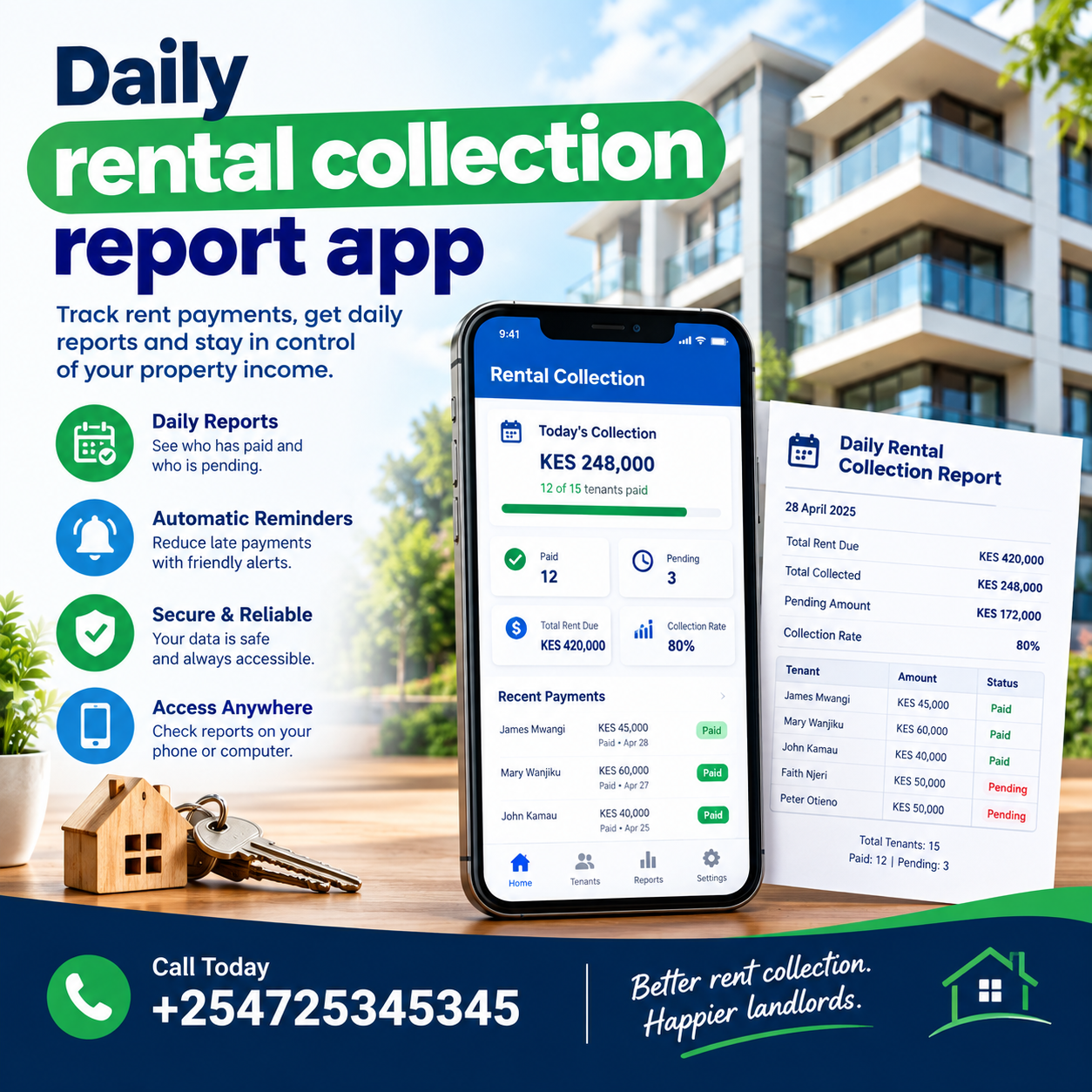
Daily rental collection report app technology has changed the first question every landlord asks in the morning. Instead of wondering whether rent moved yesterday, owners now open one screen and see exactly what arrived, from whom, and what is still out there. That single habit — checking today’s truth before the day begins — is quietly separating organized portfolios from anxious ones across Kenya.
The old way of knowing your collections was the month-end surprise. You waited for reports, chased caretakers for summaries, and discovered problems weeks after they started costing money. A daily rental collection report app inverts that entire timeline by bringing every payment to your attention the moment it lands.
This guide walks you through the complete picture in 2026. We cover what these apps actually do, the morning ritual that makes them powerful, and the anatomy of a daily report you can trust. We also cover exception-based reporting, multi-property roll-ups, caretaker accountability, and how daily reports connect to the reminders and statements covered across our other guides.
By the end, you will know exactly how to choose and run a daily rental collection report app across your portfolio. Whether you collect from one plot of bedsitters in Rongai or manage towers for other owners, the principle is identical. Money you can see daily is money you can manage daily.
And nothing makes rental income more visible than a purpose-built daily rental collection report app working quietly in the background. The timing could not be better for adoption: M-Pesa has digitized every payment, smartphones have reached every caretaker, and the apps themselves cost less per month than a single missed collection. Everything needed to run a disciplined daily rental collection report app is already in place — this guide simply shows you how to assemble it.
What a Daily Rental Collection Report App Really Is
A daily rental collection report app is a mobile or web tool that tracks rent payments as they happen and summarizes them into an automatic daily report. Each morning — or in real time — it shows what was collected, from which unit, through which channel, and what remains outstanding. Think of it as your portfolio’s daily newspaper, written by your own money.
The category matters because collections are naturally a daily rhythm, not a monthly event. Payments trickle in across the first week of every month, each one carrying information about a unit, a tenant, and a balance. A daily rental collection report app matches that rhythm instead of compressing everything into one month-end scramble.
It helps to position the category within the wider toolkit covered across our guides. Rent tracking follows balances over time, tenant management follows people, and reminder apps send the nudges. A daily rental collection report app specializes in the daily pulse — the today-view that drives action while action still matters.
The best platforms do not force a choice between rhythms. They capture daily detail and roll it up into the weekly and monthly views that planning requires. That layering is the design philosophy behind every serious daily rental collection report app on the market.
What the tool is not matters just as much. It is not a bookkeeping system, not a lease manager, and not a full accounting department. It is the daily window onto your income — and that focused role is what makes a daily rental collection report app so effective at its one job.
The Two-Minute Morning Ritual
The power of daily reporting lives in a ritual so small it survives even your busiest weeks. Two minutes each morning, with one screen, replaces the low-grade anxiety of not knowing. Here is what the ritual looks like in practice for a daily rental collection report app user.
Open the app and read three numbers first: collected today, collected this month, and units still outstanding. Those three figures tell you almost everything about the health of your income. Scan the detail beneath them only where something looks unusual.
Check any exception flags the app has raised — a mismatched amount, an unexpected payment, a unit that should have paid but has not. That scan is where a daily rental collection report app earns its keep, catching problems while they are still conversations. Act on anything that needs acting on: a friendly message to a quiet unit takes one minute today and saves a difficult conversation in three weeks.
Responding to the daily picture is the entire discipline — and the habit is what converts a daily rental collection report app from software into income protection. The ritual compounds over time: months of morning checks build an intuitive feel for your portfolio’s rhythm that no annual report can teach. That pattern sense is the hidden skill developed by every disciplined daily rental collection report app user.
The Anatomy of a Trustworthy Daily Report
Not all daily reports are equal, and knowing what a great one contains separates useful tools from toys. A trustworthy report is complete, dated, and built from records you did not have to curate. Here is the anatomy to demand from any daily rental collection report app you evaluate
The day’s headline comes first — total collected, number of payments, and outstanding unit count. Clarity in those three numbers is the signature of professional daily rental collection report app design. Beneath the headline sits the itemized detail.
Every transaction listed with tenant name, unit, amount, channel, and timestamp, so nothing hides inside an aggregate. Itemized transparency is what makes a daily rental collection report app report genuinely trustworthy. The month-to-date context belongs on the same screen: collections so far, percentage of expected rent received, and comparison against the same day last month.
That context turns a daily rental collection report app from a snapshot into a trend line. Outstanding balances complete the anatomy — units that have not paid, how much they owe, and how many days the balance has been running. A daily report without the outstanding view is only half a report — the full picture is what defines a complete daily rental collection report app.
Exception-Based Reporting: Let the App Watch So You Don’t Have To
The smartest daily reports do not demand equal attention every morning. Exception-based reporting means the app stays silent when everything is normal and speaks up only when something deserves your eyes. That design is the difference between a daily rental collection report app you rely on and one you learn to ignore.
Exceptions come in recognizable categories. A payment that does not match the expected rent for its unit, or one from a number or tenant that does not fit the records. A unit that historically pays on the second and has not paid by the fourth.
Each of these is a signal, and surfacing them is the core intelligence of a good daily rental collection report app. The psychology matters as much as the technology: reports that bury owners in identical daily detail train them to stop reading, which defeats the entire purpose. Exception focus is what keeps a daily rental collection report app genuinely used month after month.
Set your thresholds deliberately when you adopt. Decide what counts as normal for each unit, and let the system flag only the deviations. A tuned daily rental collection report app respects your attention — and attention is the scarcest resource in property management.
From One House to a Hundred: The Roll-Up
Daily reporting proves its value at every scale, but it transforms at portfolio scale. One building’s collections can live in a caretaker’s message; twenty buildings’ collections need a system. That is the threshold where a daily rental collection report app stops being convenient and becomes essential.
The roll-up works in layers. Each property reports its own daily collections, and the portfolio view consolidates them into one ranked picture. Drilling from the portfolio total down to any single unit takes two taps in a well-built daily rental collection report app.
Comparative insight arrives with the roll-up. Which building collects fastest each month, which one lags, and which units drag their averages — the answers become visible daily. That cross-property intelligence is the analytical gift of a daily rental collection report app running at scale.
The roll-up also serves managing agents directly. A daily digest per owner, generated automatically, replaces fragile spreadsheets and end-of-quarter reconstructions. Client trust compounds on the transparency that a daily rental collection report app delivers every single morning.
Caretaker Accountability Without Conflict
Daily collection reporting changes the caretaker relationship more than any other dynamic in property management. When collections are logged daily with names and timestamps, the numbers must add up — every day, for everyone. That structural honesty is the quiet power of a daily rental collection report app.
Handled well, the system protects honest caretakers most of all. Their collections carry attribution, so they cannot be falsely accused when balances move for legitimate reasons. Framed that way, good field staff become the strongest advocates of a daily rental collection report app.
The system also removes the caretaker from the middle of the money. With M-Pesa flowing directly to the owner’s account, the caretaker’s role becomes physical — showings, repairs, and reporting — rather than financial. That separation is the structural fix for the classic problems covered in our caretaker remittance guide, and a daily rental collection report app enforces it daily.
Cross-checking completes the accountability loop. Caretaker reports, payment records, and camera or meter patterns should agree, and disagreements surface within days instead of years. Redundant verification is the discipline that makes a daily rental collection report app trustworthy at the ground level.
Daily, Weekly, Monthly: Getting the Rhythm Right
Daily reporting works best inside a layered rhythm, not as a replacement for every other view. Each layer answers a different question. Here is how the rhythms divide the work in a well-run daily rental collection report app setup.
The daily layer answers “what happened today” — collections received, exceptions raised, and anything needing a same-day response. It is the action layer, and it takes two minutes. Speed of response is the entire value of the daily view inside a daily rental collection report app.
The weekly layer answers “how is the month shaping up.” Mid-month reviews catch units trending toward arrears while friendly intervention still works. That weekly scan is the planning layer of a daily rental collection report app routine.
The monthly layer answers “did the month close cleanly.” Reconciliation, statements, and the archive of the month’s daily reports become your permanent record. That closing discipline is what turns daily data into the evidence history that a daily rental collection report app builds automatically.
The layers reinforce each other. Months built from thirty daily snapshots are richer and more trustworthy than month-end estimates could ever be. That compounding quality is the structural advantage of running every rhythm through one daily rental collection report app.
The Connected Stack: Reports, Reminders, and Payments
A daily report is most powerful when it sits inside a connected flow. The modern stack runs report, reminder, payment, and reconciliation as one loop. Here is how the pieces connect in a mature daily rental collection report app ecosystem.
The morning report identifies who has not yet paid. Reminders fire to exactly those units — courteous, scheduled, and logged. That targeting is what makes the reminder layer inside a daily rental collection report app so efficient.
Payments then arrive through M-Pesa, reconciling themselves against the right tenant and unit automatically. The daily report updates within seconds of each payment landing. That immediacy is the heartbeat of a connected daily rental collection report app.
Receipts and statements flow from the same data. Every payment generates its proof, and month-end statements compile from the daily record without extra work. The one-loop design is what distinguishes an integrated daily rental collection report app from a standalone tracker.
One-tap payment prompts complete the loop in 2026. An overdue unit’s reminder can carry its own pay action, collapsing the distance between nudge and settlement. That compression is the newest capability arriving across the daily rental collection report app market.
Why 2026 Is the Breakout Year
Three forces are converging to make daily collection reporting mainstream this year. First, the data is already digital: M-Pesa has turned every rent payment into an instant, timestamped event that software can read the moment it happens. The raw material for a perfect daily rental collection report app report now exists by default.
Second, portfolio sizes have grown across the market. Owners who once managed three units now manage thirty, and memory-based tracking collapses long before that scale. Growth is the demand engine behind every daily rental collection report app adoption story this year.
Third, the professional bar keeps rising. Tenants, managers, and lenders all read responsiveness as competence, and daily visibility is visible professionalism. In that environment, a daily rental collection report app has become the marker of a serious operator.
Real Benefits for Landlords
The first benefit is early detection, plain and simple. A stopped payment appears in days instead of weeks, while a friendly message still solves it. That compressed detection window is the compounding advantage of a daily rental collection report app.
The second benefit is cash-flow confidence. Knowing collections to date lets you plan commitments around real money instead of optimistic guesses. Financial calm is the daily gift of a daily rental collection report app.
The third benefit is record strength. Daily archives become indisputable evidence in disputes, tax filings, and loan applications alike. Banks and accountants consistently favor clients whose daily rental collection report app histories span full years.
The fourth benefit is reclaimed evenings. Reconciliation sessions that once consumed the first week of every month shrink to two-minute morning glances. Hours returned are the invisible dividend of a daily rental collection report app running properly.
Benefits for Property Managers and Caretakers
Property managers gain a reporting engine that transforms client relationships. Daily digests per owner, generated automatically, replace month-end scrambles and defensive conversations. That consistency is what retains management clients on a daily rental collection report app for years.
Caretakers gain protection and dignity. Their logged collections cannot be questioned falsely, and their reliability becomes provable rather than presumed. Mutual protection is why field staff often become the loudest supporters of a daily rental collection report app.
Owners of managed properties gain truth at a distance. The daily picture reaches them wherever they are, verified by records rather than by intermediaries. That transparency is the trust foundation that a daily rental collection report app builds between every party in the chain.
Features to Demand in 2026
The market is growing quickly, and buyers should evaluate against a demanding checklist. The best daily rental collection report app platforms share a clear set of core capabilities. Use this section as your scorecard when comparing providers.
First, demand automatic M-Pesa reconciliation. Payments should match themselves to tenants and units without manual entry, because manual matching is where daily reporting dies. Automation is the beating heart of any serious daily rental collection report app.
Second, insist on scheduled delivery. A morning summary through SMS, WhatsApp, or email should arrive without you opening anything. Push-based reporting is what makes a daily rental collection report app effortless.
Third, expect exception flags with explanations, and fourth, look for multi-property roll-up with drill-down to any unit. Fifth, check that cash entries carry attribution and timestamps, so caretaker logging stays honest and verifiable. Those five together define a complete daily rental collection report app.
Sixth, confirm export and data ownership, because your records must remain portable at all times. Seventh, verify the practical basics — affordable phones, weak networks, and offline behavior that syncs when connectivity returns. Real-world resilience is what separates a professional daily rental collection report app from a demonstration.
Choosing the Right App
A structured selection process prevents regret in this fast-growing market. Start by listing your realities: unit count, payment mix, who logs cash, and where you want reports delivered. The right daily rental collection report app fits your operation, not the loudest advert.
Trial with your real data, without exception. Run one building’s actual collections through the app for a full week, including a cash day and an M-Pesa day. One honest cycle reveals more than any daily rental collection report app brochure ever will.
Test support deliberately. Send a pre-sale question and judge the speed, warmth, and competence of the reply. Responsive support is what keeps a daily rental collection report app serving you long after the purchase.
What It Costs in 2026
Pricing in this category is friendlier than most owners expect. Competition among Kenyan providers has kept costs low even as features multiply. Against one prevented arrears quarter, a daily rental collection report app subscription repays itself within the first billing cycle.
- Free tiers: suitable for landlords with up to about ten units
- Per-unit plans: commonly KSh 20–80 per unit monthly
- Flat monthly plans: roughly KSh 500–3,500 depending on features
- SMS report bundles: often a few shillings per daily summary
- Annual plans: usually 10–20 percent cheaper than monthly billing
Weigh the price against the full value stack: earlier arrears detection, caretaker accountability, saved evenings, and audit-ready records. Viewed that way, the true cost of a good daily rental collection report app approaches zero. The real question is how long you can afford to run your income on monthly guesswork.
Getting Started the Right Way
Adoption succeeds or fails in the first two weeks, so begin deliberately. Load one property completely — units, tenants, rent amounts, due dates, and collectors — before expanding. Clean setup is the foundation of every successful daily rental collection report app rollout.
Set your report rhythm next. Choose a morning delivery time that fits your day, and commit to the two-minute review ritual. Consistency in reading is what activates the full value of a daily rental collection report app.
Brief your collectors properly. Caretakers who log cash need training on timestamps and accuracy, and they need to hear clearly that the system protects them too. Buy-in from the ground is what makes a daily rental collection report app work in the field.
Then act on what you see. The first flagged arrears, the first mismatch, and the first clean month all deserve deliberate responses. Habits formed in month one determine whether a daily rental collection report app becomes your income’s daily heartbeat.
Common Mistakes to Avoid
The most common mistake is receiving daily reports and reading them weekly. Delay reintroduces exactly the blindness the tool exists to remove. Daily attention is the entire deal when adopting a daily rental collection report app.
The second mistake is sloppy cash logging. Missing timestamps and estimated amounts quietly corrupt the record you will one day depend on. Insist on same-day, accurate entries inside your daily rental collection report app.
The third mistake is ignoring the exception flags you paid for. The system signals, but a human must respond — technology supports judgment, it never replaces it. Active owners extract the full value of a daily rental collection report app; passive ones get half.
One bonus mistake deserves a warning: failing to update records when tenants move or rents change. Five minutes of monthly housekeeping keeps every daily report accurate. Fresh data is the maintenance that keeps a daily rental collection report app trustworthy.
The Road Ahead: 2027 and Beyond
The trajectory points toward reports that increasingly act on what they see. Predictive flags are arriving, warning which units will pay late before the due date based on learned patterns. The daily rental collection report app of 2027 will feel less like a report and more like an analyst.
Integration is deepening alongside it. Reports, reminders, one-tap payments, and statements are converging into single flows where the day’s picture and the day’s actions live together. The connected future is already visible across the daily rental collection report app market, and it will accelerate.
The message for today’s owner is simple. The tool that ends income uncertainty is affordable, local, and already sitting in your pocket. There has never been a better moment — in 2026 or beyond — to make a daily rental collection report app part of how you earn.
Frequently Asked Questions
What does a daily rental collection report app ctually do?
It tracks rent payments as they arrive and summarizes them into an automatic daily report — what was collected, from whom, for which unit, and what remains outstanding. Think of it as your portfolio’s daily newspaper, written by your own money. The daily rhythm is the defining feature of a daily rental collection report app.
How is it different from monthly rent tracking?
Monthly tracking tells you the story after it has happened, while a daily report tells you while it is happening. That difference is the intervention window — problems caught on day two stay conversations, while problems caught on day twenty-eight become disputes. Speed is the entire value of a daily rental collection report app.
Do I need it if my caretaker sends WhatsApp updates?
Informal updates work until they do not — messages get missed, numbers get rounded, and disputes have no record. An app structures the same information with timestamps, attribution, and automatic totals. Consistency and evidence are what a daily rental collection report app adds to the arrangement.
Does it work with cash payments, or only M-Pesa?
Both — caretakers log cash with amounts and timestamps, and those entries appear on the daily report clearly marked for verification. M-Pesa reconciles automatically where integration exists. Hybrid support is standard in a quality daily rental collection report app.
How many units do I need before it makes sense?
Even three units benefit, because one silent default is proportionally painful for a small portfolio. Free tiers make adoption easy at any size. The systems scale effortlessly as your portfolio grows through the daily rental collection report app category.
Will my caretaker feel spied on?
Handled well, the opposite happens — daily attribution protects honest caretakers from suspicion and rewards their reliability. Explain it as documentation that defends them, not surveillance that suspects them. Framing decides reception, and most field staff come to prefer a daily rental collection report app.
Can reports go to my landlord clients or accountant directly?
Yes — most platforms support scheduled delivery to additional recipients, with monthly compilations built automatically from the daily data. Share-ready reporting is a hallmark of professional daily rental collection report app platforms.
Where can I find verified tenants and landlord tools together?
Start with platforms that combine verified listings with landlord-friendly technology, such as rentaldesk.co.ke. Pairing the right tenants with disciplined daily reporting takes you from wondering about your income to knowing every shilling — every morning, from anywhere.