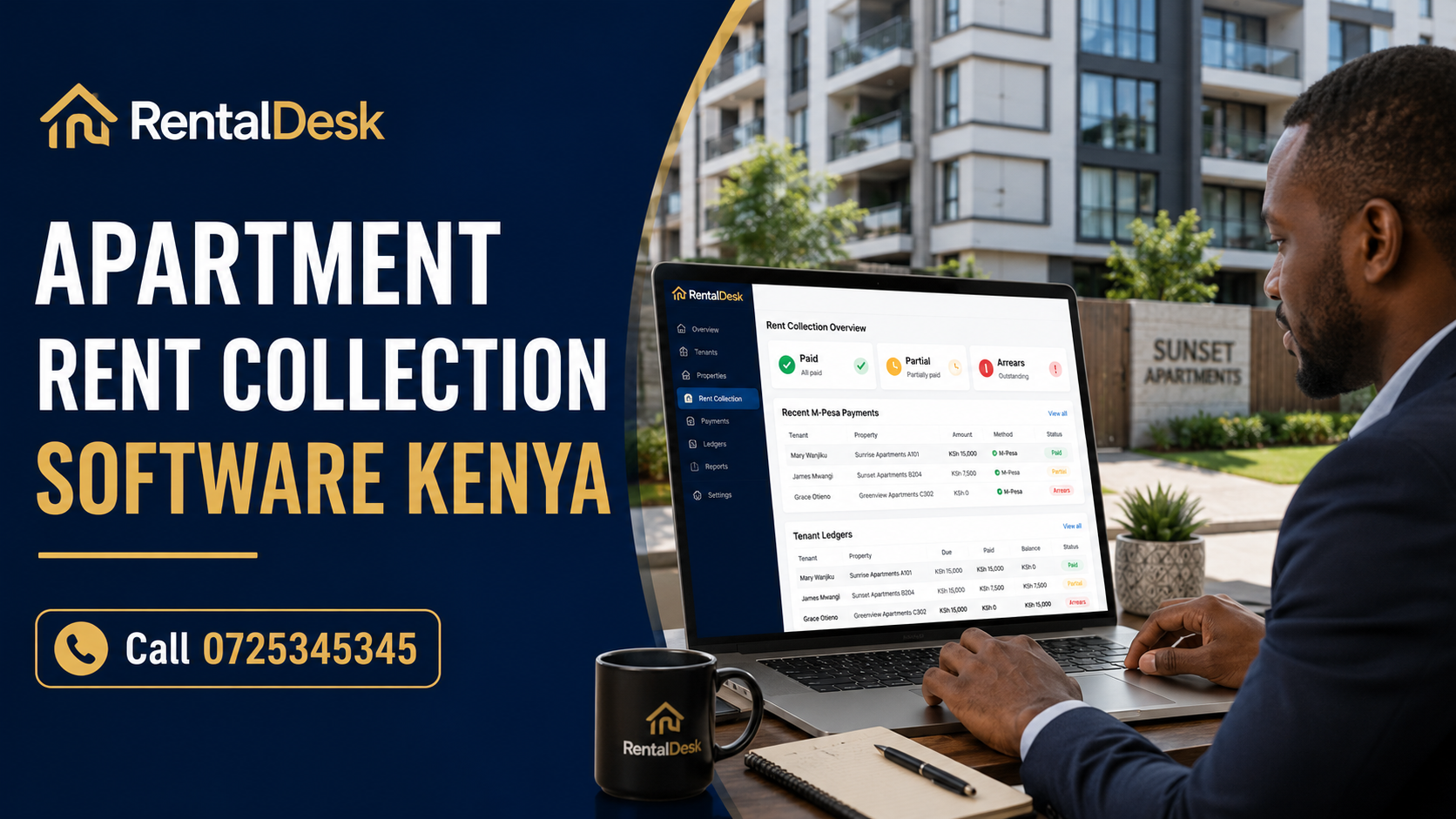
Apartment Rent Collection Software Kenya gives apartment owners, property managers, agents and caretakers a structured way to manage rental operations without depending on unmatched payments, partial rent and unclear tenant balances.
Rental income may look straightforward, but every payment creates a record that must be matched to the correct tenant, unit, invoice and month. The same business must also control deposits, leases, arrears, expenses, repairs, communication and owner reporting. When these records are separated, small errors become expensive disputes.
This guide explains how Apartment Rent Collection Software Kenya should work in a Kenyan rental business. It focuses on practical controls, M-Pesa reconciliation, automated billing and arrears visibility, and the questions a buyer should ask before implementation.
RentalDesk brings properties, units, tenants, billing, payments, maintenance and reports into one cloud workspace, helping teams replace fragmented records with one accountable operating process.
Useful Kenyan Digital Business Resources
- Apartment Rent Collection Software Kenya — Zama Systems
- Apartment Rent Collection Software Kenya — PRIM
- Apartment Rent Collection Software Kenya — Vega
- Apartment Rent Collection Software Kenya — SpaceKits
- Apartment Rent Collection Software Kenya — Awasam
- Apartment Rent Collection Software Kenya — Saseni
- Apartment Rent Collection Software Kenya — Pawa
- Apartment Rent Collection Software Kenya — PMS
- Apartment Rent Collection Software Kenya — TAS
- Apartment Rent Collection Software Kenya — Dereva
What Is Apartment Rent Collection Software Kenya?
Apartment Rent Collection Software Kenya is a digital platform for organizing the information and activities involved in managing rental property. It connects property records, individual units, tenant profiles, recurring charges, payment histories, outstanding balances, documents, maintenance work and management reports.
Instead of reconstructing the truth from separate messages and files, an authorized user can open the relevant tenant or property record and see a consistent history.
The important word is “management.” A basic spreadsheet may store figures, but it does not necessarily enforce responsibility, approvals, user permissions or repeatable workflows. Good software should show who created a charge, who recorded or approved a payment, when a balance changed and which supporting document explains an adjustment. That audit trail protects tenants, owners and property managers.
Why Kenyan Rental Operations Need Better Systems
Kenyan rental businesses receive payments through M-Pesa, bank transfers, cash and other approved channels. Tenants may pay the full amount, make a partial payment, combine rent with utilities or settle an old balance. A payment message alone does not explain how the money should be allocated. The management system must connect the transaction with the tenant ledger and preserve the reference for later verification.
Portfolios also become complex faster than owners expect. Five units can produce dozens of monthly entries once rent, water, electricity, deposits, penalties, repairs and expenses are included. Add a caretaker, accountant or agent and accountability becomes even more important.
Apartment Rent Collection Software Kenya should therefore be selected for operational clarity rather than only for the lowest subscription price.
Core Records the Software Must Maintain
- Property names, locations and ownership details
- Unit numbers, rent amounts, occupancy and status
- Tenant identity, contacts and emergency information
- Lease start dates, expiry dates and agreed charges
- Invoices, recurring bills and utility charges
- M-Pesa, bank, cash and adjustment records
- Deposits, arrears, credits and opening balances
- Maintenance requests, assignments and costs
- Receipts, statements and supporting documents
- User actions, approvals and audit history
These records should not exist as isolated modules. A tenant moving into a vacant unit should affect occupancy; a generated invoice should affect the tenant balance; a confirmed payment should reduce the balance; and an approved expense should appear in the correct property report. Connected records are what make software more dependable than a collection of spreadsheets.
How RentalDesk Supports the Workflow
RentalDesk is designed for Kenya-first rental operations. Users can organize multiple properties and units, register tenants, create charges, review balances and produce reports from one dashboard. The platform supports payment visibility and reconciliation workflows that are especially important where M-Pesa is a major collection channel.
Teams can review what has been paid, what is partial and what remains outstanding.
The system also helps separate roles. Owners may need portfolio reports, managers may handle tenants and billing, accountants may review financial records, and caretakers may work with maintenance items. Role-based access reduces the risk of every employee seeing or changing every record. Ask the RentalDesk team to demonstrate the exact permissions and approvals required by your organization.
M-Pesa Payments and Reconciliation
Mobile money convenience must be supported by disciplined reconciliation. A transaction should have an amount, reference, date, payer information and allocation. If a tenant pays from another person’s phone or uses an incorrect account reference, the payment may need review before it is applied. The software should preserve the original transaction information and record the person who resolved the exception.
Safaricom provides business payment and API options for organizations that want structured M-Pesa workflows. The exact integration depends on the landlord’s or agency’s business setup. Review the official Safaricom Daraja portal and ask RentalDesk to demonstrate the current supported process.
Never assume that every M-Pesa message is automatically matched correctly without appropriate identifiers and controls.
Billing, Partial Payments and Arrears
Monthly billing should be predictable. The platform should create rent and approved recurring charges using the correct unit and tenancy details. When a tenant makes a partial payment, the ledger should retain the unpaid balance rather than marking the month as fully settled. Managers need an arrears report that can be filtered by property, tenant, age and amount.
Arrears follow-up should remain professional and evidence-based. Staff should confirm the lease, invoices, payment history and approved adjustments before contacting a tenant. A clear statement reduces arguments because it shows how the balance was calculated. Software supports the process, but notices and recovery actions must still follow the applicable agreement and Kenyan law.
Tenant Data Protection and User Access
Rental records contain names, phone numbers, identification details, payment histories and sometimes documents. This information should only be collected for a legitimate purpose and accessed by authorized users. Kenya’s Office of the Data Protection Commissioner provides guidance on responsible processing of personal data.
Property businesses should review the ODPC resources and establish internal privacy procedures.
Use unique user accounts, strong passwords and role-based permissions. Do not share one administrator login among caretakers, agents and accountants. Remove access promptly when a team member leaves. Backups, activity history and controlled exports are also important because data protection includes availability and integrity, not only secrecy.
Reports Every Landlord Should Review
- Rent billed versus rent collected
- Paid, partially paid and unpaid tenants
- Arrears aging by tenant and property
- Vacant and occupied units
- Deposits and tenant credits
- Property income and expense summaries
- Maintenance status and repair costs
- Owner statements and portfolio performance
- Payment-method reconciliation
- User adjustments and audit activity
Reports are valuable only when source data is complete. Establish a monthly closing routine: reconcile collections, review unmatched payments, confirm adjustments, enter expenses, check vacancies and investigate unusual balances. Once the period is clean, owners can use the reports to make decisions about rent reviews, repairs, staffing and investment.
Implementation Plan
- List every active property and unit.
- Confirm current tenants, rents and lease dates.
- Prepare opening balances and arrears.
- Clean tenant names and phone numbers.
- Define payment and reconciliation rules.
- Choose user roles and approval permissions.
- Import or enter validated records.
- Test billing with a small property.
- Test full, partial and unmatched payments.
- Train staff using real operating scenarios.
- Compare system balances with existing records.
- Go live with a documented support process.
Do not migrate every spreadsheet without review. Old files often contain duplicate tenants, inactive units, unclear balances and inconsistent names. Data cleaning may take time, but it determines whether the new platform begins with reliable information. Keep a signed migration summary showing the opening position accepted by management.
Common Buying Mistakes
The first mistake is choosing from a feature list without testing the actual workflow. Ask the vendor to demonstrate one complete journey: create a property and unit, onboard a tenant, generate rent, record an M-Pesa payment, issue a receipt, process a partial payment, identify arrears and produce an owner report. A complete demonstration reveals gaps that isolated screenshots hide.
Other mistakes include ignoring user permissions, failing to plan migration, assuming every customization is included, and neglecting support arrangements. Confirm pricing, onboarding, training, data import, backups, integrations and support response expectations in writing. The best system is one the team can operate consistently after the sales demonstration ends.
Measuring Results After Adoption
Set measurable goals before going live. Useful indicators include the percentage of payments matched automatically, time required to close the month, number of unresolved tenant balances, arrears follow-up time, receipt delivery time, occupancy accuracy and number of manual adjustments. Compare results after thirty, sixty and ninety days.
Software should reduce avoidable administrative work while increasing visibility. It should not encourage staff to ignore unusual transactions. Strong teams use automation for repetitive processes and human review for exceptions. That combination creates speed without sacrificing control.
Frequently Asked Questions
Is Apartment Rent Collection Software Kenya suitable for a small portfolio?
Yes. Apartment Rent Collection Software Kenya can help even a small landlord maintain consistent tenant, payment and expense records. The value depends on choosing a package that matches the number of units and the required workflow.
Can RentalDesk manage several buildings?
RentalDesk is designed to organize multiple properties and units from one account. Confirm the appropriate plan, user limits and reporting structure during the demonstration.
Can tenants pay through M-Pesa?
RentalDesk supports Kenya-focused payment and reconciliation workflows. The available setup depends on the business payment channel and integration. Request a live demonstration using your intended M-Pesa process.
Does the system replace a lease agreement?
No. Software stores and operationalizes tenancy information, but it does not replace a properly prepared agreement or professional legal advice.
How long does implementation take?
The timeline depends on the number of properties, condition of existing data, integrations, training and approvals. A small clean portfolio can move faster than a large portfolio with disputed balances.
Can I access reports while travelling?
A cloud platform can be accessed through an internet-connected device subject to the user’s permissions and security controls. This is helpful for diaspora landlords and owners managing teams remotely.
A Practical 90-Day Optimization Routine
During the first month, management should concentrate on accuracy rather than advanced automation. Review every active tenant, recurring charge, opening balance and payment channel. Run weekly exception meetings to resolve unmatched payments, duplicate records and incorrect unit assignments.
Encourage users to report confusion early. Small corrections made during implementation prevent larger reporting problems later. Keep a written decision log for issues such as deposit treatment, partial-payment allocation, utility billing and approved waivers.
During the second month, use Apartment Rent Collection Software Kenya to standardize daily and weekly responsibilities. Decide who reviews new tenants, who confirms payments, who approves expenses, who closes maintenance work and who prepares owner reports.
Introduce dashboard reviews at predictable times. Staff should not wait until month-end to discover that transactions are missing. Supervisors can sample tenant ledgers and compare them with original payment evidence, invoices and supporting documents.
During the third month, management can evaluate performance and refine automation. Compare collection rates, arrears aging, receipt turnaround, reconciliation exceptions, vacancy information and reporting time against the original baseline.
Remove unnecessary duplicate spreadsheets only after the platform has proved dependable. Document the final operating procedure, provide refresher training and assign an internal system owner who will coordinate support requests and data-quality reviews.
Optimization is continuous. Rent amounts change, leases expire, tenants move, employees leave and new payment scenarios appear. Schedule quarterly reviews of permissions, workflows, integrations and reports. A disciplined review makes Apartment Rent Collection Software Kenya more valuable over time because the platform remains aligned with the real portfolio instead of becoming another outdated database.
Conclusion
Apartment Rent Collection Software Kenya should give a rental business one reliable view of properties, tenants, charges, payments, balances, expenses and operational activity. The goal is not simply to digitize old paperwork. It is to create a repeatable management process where every important figure can be explained and every user action can be traced.
Explore RentalDesk features, compare RentalDesk pricing, or request a demonstration through 0725345345. Use your own properties, payment examples and reporting needs during the demo so you can confirm that the platform supports the way your rental business actually operates.
Related RentalDesk and Kenyan Business Resources
RentalDesk Internal Guides
- Apartment Rent Collection Software Kenya — Rental Management Software for Small Landlords Kenya
- Apartment Rent Collection Software Kenya — Tenant Communication Software Kenya
- Apartment Rent Collection Software Kenya — Property Expense Tracking Software Kenya
- Apartment Rent Collection Software Kenya — Digital Rent Receipt Software Kenya
External Business Resources
- Apartment Rent Collection Software Kenya — Zama
- Apartment Rent Collection Software Kenya — PRIM
- Apartment Rent Collection Software Kenya — Vega
- Apartment Rent Collection Software Kenya — SpaceKits
- Apartment Rent Collection Software Kenya — Awasam
- Apartment Rent Collection Software Kenya — Saseni
- Apartment Rent Collection Software Kenya — Pawa
- Apartment Rent Collection Software Kenya — PMS
- Apartment Rent Collection Software Kenya — TAS
- Apartment Rent Collection Software Kenya — Dereva