
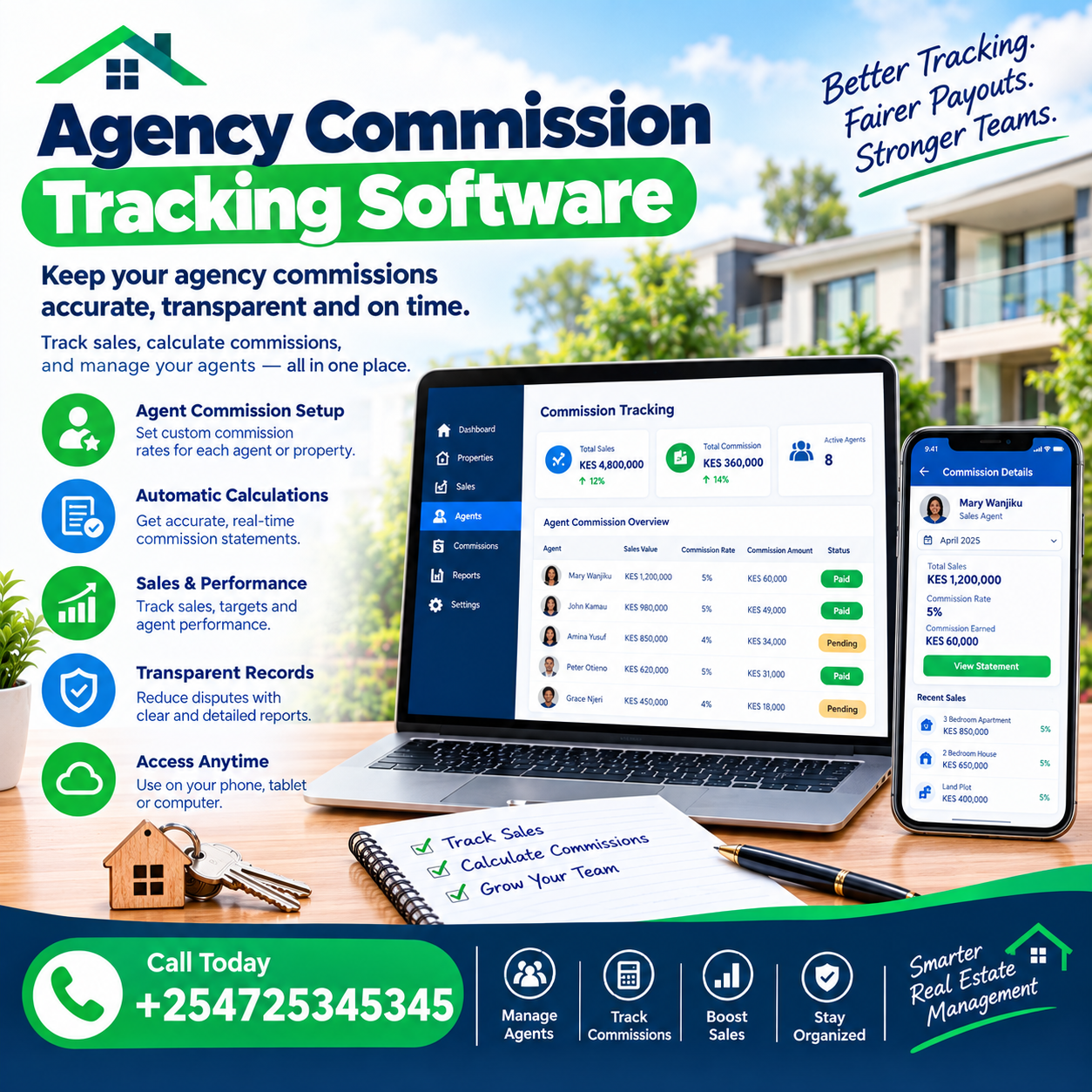
Agency commission tracking software is the tool that answers the question agencies rarely ask until the numbers go missing: exactly how much commission have we earned, invoiced, collected, and paid out? Agencies work hard to win mandates, place tenants, and close deals, yet the revenue those efforts generate often lives in loose spreadsheets, mental arithmetic, and whoever’s memory is longest. When that happens, earned income quietly leaks — and leaks of that kind compound across a year into sums nobody notices until a quiet month exposes them.
The uncomfortable truth in the agency business is that revenue and effort do not automatically connect. A unit gets placed, the rent starts flowing, and the commission the agency earned on that placement waits somewhere untracked. An agency commission tracking software platform ties every shilling of income back to the work that earned it, automatically and permanently.
This guide walks you through the complete category in 2026. We cover what commission tracking actually involves, how commissions go missing, and the record structure that stops the leaks. We also cover commission types, agent splits, dashboards, reconciliation, and the features worth demanding before you spend a single shilling.
By the end, you will be able to evaluate any agency commission tracking software option with the confidence of a finance director. Whether you run a two-agent letting office in Kilimani or a multi-branch firm collecting on hundreds of units, the principle never changes. Revenue you can see precisely is revenue you can protect, forecast, and grow — and nothing protects it better than purpose-built agency commission tracking software.
The timing matters because agencies are under pressure from both directions. Landlords now scrutinize value for commission, and margins feel tighter across the market, which makes earning and collecting every shilling owed more important than ever. In that environment, running your income on memory is a luxury no firm can afford, and agency commission tracking software is the affordable fix. The agencies that professionalize their revenue tracking first will quietly out-earn competitors doing the same volume of work.
What Is Agency Commission Tracking Software?
Agency commission tracking software is a system that records every commission your agency earns, tracks it from earned to invoiced to collected, and reconciles it against the work and the staff who generated it. It sits between your operations and your books, translating business activity into revenue truth. Think of it as the financial memory of everything your agency is owed.
The category matters because agency income is unusually fragmented. It arrives as management fees that recur monthly, lettings commissions that arrive once, and sales commissions that arrive months after the work was done. Tracking that mix manually is where agency commission tracking software earns its place — because no notebook holds three revenue rhythms reliably at once.
It helps to position the tool against its neighbors. Property agency software runs the operations — listings, tenants, maintenance, and remittances — while a CRM follows the deals. An agency commission tracking software platform follows the money those activities generate for you, the agency, which is a lens neither of the others holds.
The tool’s core loop is beautifully simple. Commission gets earned by an event, recorded against the unit and the client, tracked to collection, and reconciled into reports and payouts. That loop, running automatically, is the entire working definition of serious agency commission tracking software.
What it is not matters too. It is not a general accounting package, not a CRM, and not a remittance calculator for owner funds. It is the revenue command center for the agency’s own income — and that focused role defines every genuine agency commission tracking software platform on the market.
How Commissions Go Missing
Before the tool, understand the leak, because it has recognizable forms.
The first is the untracked earned commission — a placement happens, the fee was agreed verbally, and nobody records it anywhere. Months later, nobody remembers to invoice, and the income simply never arrives; this is the most common leak that agency commission tracking software closes.
The second leak is the uncollected invoice. A commission gets invoiced but never chased, and the client — often a landlord who trusts you — simply pays the things that follow up. Politeness at the collection stage costs agencies more than they will ever admit, which is why automated follow-up inside agency commission tracking software pays for itself so quickly.
The third leak is the mispriced agreement. One unit bills at the old rate, another was promised a discount that nobody logged, and a third carries a commission structure nobody can quite reconstruct. Ambiguity like that is the environment where agency commission tracking software becomes essential — because recorded terms are the only terms that get honored.
The fourth leak is the invisible split. An agent who generated a deal waits for their payout, and the waiting happens in an untracked ledger of promises. Unreconciled splits damage trust exactly where agencies can least afford it, which is the human cost that disciplined agency commission tracking software removes.
Who Needs It Most
Letting agencies collecting management fees benefit first. Their income recurs monthly across dozens or hundreds of units, and small errors per unit become large errors per year. Recurring revenue is exactly the structure that agency commission tracking software monitors best, down to the individual unit and month.
Sales-heavy agencies benefit differently but just as deeply. Their commissions are larger, later, and dependent on milestones, which makes them easy to lose track of between contract and payment. Deal-linked tracking is the specialty of agency commission tracking software in that environment.
Growing agencies form the third audience. The moment revenue passes from one person’s memory to a team’s responsibility, informal tracking collapses into disputes and gaps. Systems like these are what let an agency scale its income without scaling its financial risk — the structural promise of agency commission tracking software.
The Anatomy of a Commission Record
A trustworthy commission record carries six elements, and any tool you adopt should enforce all of them. The unit or deal it belongs to, the client who owes it, the agent who earned it, the agreed amount or rate, the trigger event, and the current status. That structure is the backbone of every serious agency commission tracking software deployment.
The trigger event deserves emphasis, because it defines when income becomes real. A letting commission triggers on move-in, a management fee triggers each month of the mandate, and a sales commission triggers on completion or deposit as the agreement states. Encoded triggers are what let agency commission tracking software record income automatically instead of relying on someone to remember.
Status tracking then walks the record through its life. Earned, invoiced, partially collected, collected, or disputed — each stage visible at a glance, with dates attached. Statuses like these are what turn a vague feeling of “we’re owed something” into the precise picture a agency commission tracking software delivers.
The record’s history completes the anatomy. Every adjustment, discount, note, and payment files against the commission permanently, so any future question ends in a document review instead of a debate. That evidentiary depth is the long-term value of agency commission tracking software records kept all year.
Why 2026 Is the Breakout Year
Three forces are converging to make 2026 the year revenue tracking goes mainstream across Kenyan agencies.
First, the data is digital by default — M-Pesa records, platform payments, and managed collections mean every shilling already arrives with a trail attached. The raw material for perfect agency commission tracking software records now exists without extra work.
Second, margins are under honest scrutiny. Owners are reviewing agency costs, which makes it vital for agencies to see their own revenue as clearly as their clients see their fees. Firms running agency commission tracking software enter those conversations with evidence rather than estimates.
Third, the tools have become radically affordable. Capabilities that once required finance staff now run from a phone for less than a single uncollected lettings fee. The price barrier around agency commission tracking software adoption has effectively disappeared.
The Commission Types: One System for Three Rhythms
Management fees are the steady engine. A percentage of collected rent, recurring monthly across the managed portfolio, small per unit but enormous in aggregate. Recording them per unit per month is the foundational job of agency commission tracking software, and it is also where most untracked drift lives.
Lettings commissions are the spikes. One-off fees on placements, earned the moment a tenant moves in and too often forgotten a week later. Trigger-based recording inside agency commission tracking software captures them at the moment they become real, which is precisely when memory is busiest.
Sales commissions are the long tail. Earned at milestones, paid after completion, and spread across months of work by agents who have already moved to the next deal. Milestone-linked tracking is what makes agency commission tracking software indispensable for sales teams, because the record outlives the memory.
One system holding all three rhythms gives the agency a complete revenue picture. Steady income, spikes, and long-tail earnings reconcile into the same reports, the same dashboards, and the same forecasts. That consolidation is the strategic value of running every commission type through agency commission tracking software.
Agent Splits and Team Payouts
Inside a team, every commission carries a second question: who earned what share. Splits between the agency and the agent, between listing and closing agents, and between offices all need recording at the moment of the deal. Split structures captured inside agency commission tracking software end the payout arguments before they exist.
The system then does the arithmetic forever. Each payout computes from recorded rules, accumulates as commissions collect, and settles on schedule without a spreadsheet in sight. Automated payout computation is the trust dividend of agency commission tracking software, and it compounds across every deal the team closes.
Attribution completes the layer. Every commission traces to the agent who generated it, which makes recognition accurate, coaching targeted, and commission disputes rare. Fair, evidence-based credit is the culture that disciplined agency commission tracking software builds inside an agency.
The Commission Dashboard
The dashboard is where the tool earns its keep daily, so know exactly what to demand. The headline view shows commission earned this month, collected this month, and outstanding — the three numbers that describe your revenue health instantly. That opening trio is the signature of a professional agency commission tracking software interface.
The aging view belongs beside the headline. Outstanding commissions ranked by how long they have been uncollected, oldest and largest first, so follow-up becomes a short ordered list. Prioritized receivables are the action arm of any agency commission tracking software.
Per-agent and per-client breakdowns complete the middle layer. Which agents generate the most collected commission, which clients carry the largest balances, and which commission types contribute what to the year. That layered analysis is the intelligence inside a mature agency commission tracking software.
Forecasting closes the dashboard. Recurring fees scheduled forward, deals pending completion, and collection patterns combine into forward views that support hiring and planning decisions. Revenue foresight like that is the management gift of running everything through agency commission tracking software.
Reconciliation: Proving the Numbers
Tracking without reconciliation is organized guessing, so the discipline deserves its own attention. Recorded commissions must match collected funds, and collected funds must match the M-Pesa and bank statements they arrived through. Automatic matching is the technical heart of serious agency commission tracking software.
In managed portfolios, the reconciliation reaches into collections themselves. When the agency collects rent on a client’s behalf, its management fee should compute, record, and reconcile inside the same flow. That one-flow design is what distinguishes integrated agency commission tracking software from a standalone tracker living beside the operations.
The habit compounds across the year. Monthly reconciliations produce books that are permanently trustworthy and accountant-ready, while annual reconstruction produces books that are permanently doubtful. That difference in credibility is the compliance dividend of consistent agency commission tracking software use.
Features to Demand in 2026
The market is growing quickly, so evaluate against a demanding checklist.
First, demand trigger-based recording, where commissions generate automatically from move-ins, monthly mandates, and deal milestones. Manual entry is where records die, and automation is the baseline of genuine agency commission tracking software.
Second, insist on status pipelines — earned, invoiced, collected — with aging views and automated follow-up on overdue amounts.
Third, look for native M-Pesa and bank reconciliation, so recorded commissions verify themselves against real money. Those two capabilities together define a mature agency commission tracking software platform.
Fourth, expect split management with automated agent payouts and full attribution. Fifth, confirm per-agent, per-client, and per-type reporting with exports your accountant accepts. Sixth, verify data portability in full, because your revenue records must always be yours to move. Breadth of that kind separates real agency commission tracking software from a spreadsheet with ambitions.
Finally, mind the practical basics. The tool must work on affordable phones, weak networks, and export completely whenever you ask. Usability and portability decide whether your agency commission tracking software becomes infrastructure or shelfware.
Choosing the Right Tool
Selection starts from your revenue mix rather than the loudest advert. An agency living on management fees needs different strengths from one living on sales commissions, and mixed firms need both. The right agency commission tracking software fits your income structure exactly.
Trial with real data, without exception. Load your actual open commissions, run one full cycle — a collection, a split, a reconciliation — and judge the tool on honest use. One real month reveals more than any demonstration of agency commission tracking software ever will.
What It Costs in 2026
Pricing in this category is friendlier than most agencies expect. Typical structures include free tiers for very small teams, per-user plans around KSh 300–1,000 monthly, and flat plans from roughly KSh 1,000–6,000 depending on features. Against a single recovered lettings commission, any agency commission tracking software repays itself immediately.
Weigh the price against the full value stack: recovered income, faster payouts, cleaner filings, and revenue foresight. Viewed that way, the true cost of good agency commission tracking software approaches zero. The real question is how many earned shillings you can afford to leave uncollected this year.
Getting Started the Right Way
Adoption succeeds or fails in the opening load, so begin deliberately. Enter every open commission — earned but uncollected, recurring but unreviewed — with honest amounts and dates. A truthful starting picture is what makes every report inside your agency commission tracking software trustworthy.
Then set the rules. Encode your standard commission structures, split percentages, and trigger events once, and let the system apply them automatically. Encoded terms are what turn agency commission tracking software from a ledger into a policy the whole agency follows.
Finally, set the rhythm. A weekly review of outstanding balances, a monthly reconciliation, and a quarterly forecast read keep the tool earning its place. That habit is what converts agency commission tracking software from software into revenue strategy.
Common Mistakes to Avoid
The most common mistake is recording commissions but never chasing the aged ones. A tracked receivable still needs follow-up, and the system’s value arrives only when someone works the list. Acting on the numbers is what separates users of agency commission tracking software from subscribers to one.
The second mistake is keeping commission terms verbal. Unrecorded rates and splits become disputes precisely when the agency can least afford them, usually after staff changes. Written, encoded terms are the protection that agency commission tracking software enforces from the first deal.
Real Scenarios from Real Agencies
Picture a letting agency in Nakuru with eighty managed units whose management fees lived in a caretaker’s arithmetic. After one quarter on a tracker, they discovered eleven units billing at outdated rates and three placements whose lettings fees were never invoiced at all. The recovered income covered years of their agency commission tracking software subscription.
Picture a sales team in Westlands paying agent splits from memory. Encoded splits ended the payout disputes within a month, and agents started competing for deals with confidence that every shilling would arrive on time. The morale dividend proved as valuable as the financial one — both products of agency commission tracking software.
Picture a two-person office in Kilimani preparing for its first external audit. Clean commission records, exported in one afternoon, turned the exercise from a feared ordeal into a formality. Credibility like that is the compounding return of agency commission tracking software kept faithfully.
Picture a growing agency in Kitengela adding its tenth landlord client. Because its revenue tracked itself, the directors could see exactly which mandates paid and which merely kept them busy — and priced the next ten accordingly. Revenue intelligence like that is the strategic edge of agency commission tracking software at growth stage.
The Road Ahead: 2027 and Beyond
The trajectory points toward revenue systems that increasingly advise. Prediction is arriving — tools that forecast next quarter’s collections from recorded mandates and pending deals. The agency commission tracking software of 2027 will feel less like a ledger and more like a finance partner.
Integration is deepening alongside it. Operations, collections, commissions, and payouts are converging into single flows where earning and getting paid travel together. The connected future is already visible across the agency commission tracking software market, and it will accelerate.
Frequently Asked Questions
What does agency commission tracking software actually do?
It records every commission your agency earns, tracks it from earned to invoiced to collected, and reconciles it against real payments and the agents who earned it. Think of it as the revenue command center for your agency’s own income. That end-to-end loop defines genuine agency commission tracking software.
How is it different from property agency software?
Agency software runs the operations — listings, tenants, maintenance, and owner remittances — while commission tracking follows the income those operations generate for the agency. Modern platforms increasingly bundle both layers, and the strongest agencies run them connected. Choose based on whether your blind spot is operations or revenue, or adopt agency commission tracking software inside a full suite.
Can it handle management fees, lettings fees, and sales commissions together?
Yes — the three rhythms are exactly what the category is built to unify, with recurring fees, trigger-based lettings fees, and milestone-linked sales commissions recorded in one system. Consolidated revenue truth is the core promise of agency commission tracking software.
How does it handle agent splits and payouts?
Split rules are recorded per deal, payouts compute automatically as commissions collect, and every agent’s earnings carry full attribution. That structure ends payout disputes and makes recognition accurate. Automated splits are a standard capability of mature agency commission tracking software.
Do small agencies really need it?
Small agencies arguably benefit most, because a single uncollected commission is proportionally painful and one person’s memory is the whole business’s memory. Free and low-cost tiers make adoption easy at any size. That staged path is behind every successful agency commission tracking software adoption story.
What happens to my records if I change platforms?
On reputable platforms, you can export everything — commissions, histories, splits, and reports — in standard formats, because your revenue data belongs to you. Confirm the export option before committing to any agency commission tracking software, and consider starting with platforms that combine verified listings, agency tools, and revenue tracking, such as rentaldesk.co.ke. Pairing real business with disciplined revenue tracking takes your agency from hoping you were paid fairly to knowing — commission by commission, month after month.