
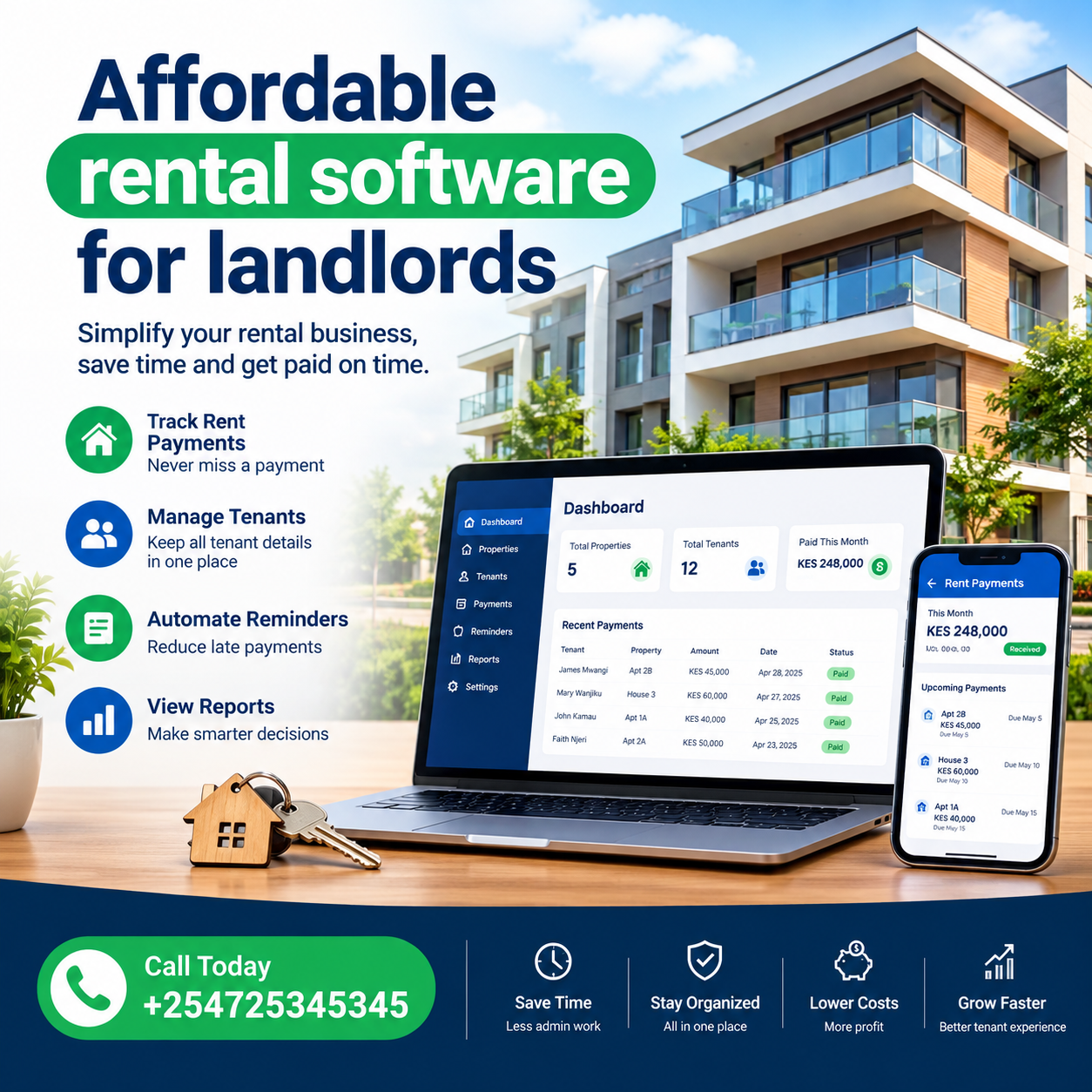
Affordable rental software for landlords is no longer a contradiction — it is the defining reality of Kenya’s property technology market in 2026. There was a time when serious software meant serious money, and small landlords managed on notebooks while the big players bought systems.
That era is over.
Today, the same capabilities that once required enterprise budgets — payment tracking, automated reminders, receipts, reports, and document storage — cost less per month than a single day of vacancy. The gap between what large agencies run and what a landlord with five bedsitters can afford has collapsed almost entirely.
This guide is your complete map of that new landscape. We cover what affordable actually means, what free tiers genuinely provide, which features deserve your shillings, and how to build a software stack on almost nothing.
We also cover the hidden costs of going too cheap, the arithmetic that proves the value, and the mistakes that waste money either way. By the end, you will know exactly how to choose affordable rental software for landlords that fits your budget and your portfolio.
Whether you own two units in Rongai or thirty across Nairobi, the principle never changes. You do not need a big budget to run your properties like a professional — you need the right tool at the right price. And in 2026, finding affordable rental software for landlords that delivers both is easier than it has ever been.
What “Affordable” Actually Means in 2026
Before comparing options, define the budget honestly.
In today’s Kenyan market, affordable rental software for landlords generally means tools priced from free up to a few thousand shillings per month, with most small landlords paying well under the cost of one SMS bundle habit.
The pricing models you will encounter look like this:
- Free tiers: genuine tools with limits, not just trials
- Per-unit plans: commonly KSh 20–100 per unit monthly
- Flat monthly plans: roughly KSh 500–5,000 depending on features
- Annual plans: usually 10–20 percent cheaper than monthly billing
Notice what is missing from that list: setup fees, installation visits, and contracts with lock-in clauses. The subscription model has made affordable rental software for landlords a month-to-month decision rather than a capital investment.
You can start free, upgrade when the portfolio demands it, and walk away if the tool disappoints. That flexibility is the defining feature of the modern market — and the reason waiting no longer makes sense.
Affordability also has a second dimension: time. A tool that costs nothing but consumes your evenings is not affordable in the way that matters. The true measure of affordable rental software for landlords is the combination of price, time saved, and income protected.
Why Prices Collapsed
Understanding why software became so cheap helps you judge which tools are genuinely good value. Three forces drove the collapse, and each one works in your favor.
First, cloud delivery eliminated the old costs.
Software no longer needs installation, servers, or support visits — it runs from the provider’s systems and reaches your phone directly. That shift is the technical foundation of every affordable rental software for landlords option on the market today.
Second, Kenya’s developers built for local realities from the start.
Homegrown products competed on price and fit, forcing the entire market’s costs downward while quality climbed upward. Competition like that is exactly what turned the category into affordable rental software for landlords rather than imported luxury.
Third, the addressable market grew.
With hundreds of thousands of small landlords as potential customers, providers could charge little per user and still build sustainable businesses. Volume economics is the quiet engine behind affordable rental software for landlords pricing across the board.
What Free Tiers Genuinely Provide
The word “free” deserves scrutiny, because free tiers vary enormously in generosity. The good news is that 2026’s free tiers are real tools, not marketing traps.
Here is what a strong free tier of affordable rental software for landlords typically includes. Basic payment tracking for a small number of units — often five to ten — with balances that update as you record payments. Manual receipting, tenant records, and simple reminders, enough to run a small portfolio with discipline.
Some platforms even include M-Pesa logging and statement generation at the free level, which would have been paid features two years ago. That generosity is the competitive reality shaping affordable rental software for landlords across the market.
What free tiers usually withhold is automation depth. Scheduled reminders, automatic M-Pesa reconciliation, multi-user access, and advanced reporting typically wait behind the first paid level. Knowing that boundary is the key to using free affordable rental software for landlords wisely.
The honest advice for small portfolios: start free and stay free as long as it serves you. There is no shame in a five-unit portfolio running entirely on a free tier — thousands of landlords do exactly that. The habit you build on free affordable rental software for landlords transfers perfectly when growth eventually demands more.
What Paid Tiers Add — and When They’re Worth It
The first paid level is where software stops being a ledger and starts being an employee. Knowing exactly what your shillings buy helps you time the upgrade correctly. These are the capabilities that typically unlock with the first paid level of affordable rental software for landlords.
Automatic M-Pesa reconciliation, where payments match themselves to tenants without manual entry — the single biggest time-saver in the entire category. Scheduled reminders and follow-ups that fire without you touching anything, which is where late payments quietly disappear.
Document storage, automated statements, and reports that your accountant can actually use. For most portfolios past ten units, that bundle defines genuinely affordable rental software for landlords at the paid level.
The timing question is easier than most owners think.
Upgrade when manual entry starts eating real evenings, or when a single forgotten follow-up costs more than a month of subscription. That threshold — not the sales page — is the correct trigger for paid affordable rental software for landlords.
Building a Budget Stack: The Layered Approach
You do not need one perfect tool — you need a small stack of affordable layers that cover your actual needs. The layered approach is how disciplined landlords get professional coverage on almost nothing. Here is the classic budget stack built from affordable rental software for landlords options at every level.
Layer one is a free tracking tool for payments and balances, which anchors everything else. Layer two is free WhatsApp Business for invoices, confirmations, and tenant communication, with saved templates doing the formatting work.
Layer three is your phone’s cloud storage for agreements, receipts, and condition photos, organized by tenant and unit. That three-layer stack costs zero shillings and already outperforms a notebook by every measure — the entry-level reality of affordable rental software for landlords in 2026.
Layer four arrives with your first subscription.
One consolidated platform that bundles tracking, reminders, receipts, and statements typically costs less than the layers it replaces. Consolidation is the moment a budget stack becomes genuinely affordable rental software for landlords infrastructure rather than a collection of workarounds.
The sequencing advice is simple.
Master the free layers first, because their disciplines — same-day recording, complete documentation, monthly reconciliation — make any paid tool ten times more valuable. Cheap tools plus good habits beat expensive tools plus chaos every single time, which is the deepest lesson in affordable rental software for landlords selection.
The Hidden Costs of Going Too Cheap
Affordability has a floor, and going below it costs more than it saves. The traps below catch owners who optimize for price alone. Knowing them protects both your money and your records.
Trap one is the abandoned tool.
A free app with a painful interface gets ignored by February, and ignored software protects nothing.Usability is a cost factor — the most usable affordable rental software for landlords option is always cheaper than the elegant one you never open.
Trap two is the data hostage.
Some ultra-cheap tools make exporting your records difficult or impossible, which turns your own history into leverage against you. Confirm the export door before adopting any affordable rental software for landlords, no matter how attractive the price.
Trap three is the shallow M-Pesa integration.
Tools that claim mobile money support but deliver manual entry force you back into the exact evening routine you were escaping. Integration depth is where affordable rental software for landlords separates genuinely from cosmetically.
Trap four is the vanished provider.
A tool with no company details, no update history, and no support channel may hold your records when it disappears. Provider credibility is a hidden line item in every affordable rental software for landlords decision — verify it before you upload a single record.
The Arithmetic That Proves the Value
The strongest argument for adoption is simple mathematics, so let us run it honestly.
Consider what one month of vacancy on a KSh 20,000 unit costs: twenty thousand shillings, permanently. Against that, even a paid plan at KSh 2,000 monthly is one-tenth of a single vacancy month. That ratio is the core economics of affordable rental software for landlords — the tools cost a fraction of the losses they prevent.
Now add the arrears dimension. Landlords who adopt structured tracking routinely recover thousands in balances that memory-based systems quietly lose. Over a year, recovered arrears alone typically exceed the cost of affordable rental software for landlords subscriptions many times over.
Add the time dimension last. Three evenings a month saved is thirty-six evenings a year — and evenings are worth more than their arithmetic suggests. Time returned is the dividend that makes affordable rental software for landlords feel free within the first month of real use.
The complete equation reads simply: small subscription, larger recovered income, and reclaimed hours. No other investment in a rental business offers that ratio. It is the arithmetic behind every recommendation in this guide to affordable rental software for landlords.
Features Worth Paying For — and Features You Can Skip
Not every feature deserves your money, and knowing the difference is how budgets stay honest. Here is the split that experience supports. Worth paying for, without hesitation: automatic M-Pesa reconciliation, scheduled reminders, instant receipts, and document storage.
These four directly protect income and time, which is why they define the paid tiers of serious affordable rental software for landlords. Worth paying for, at scale: multi-user access, owner reporting, and accountant-ready exports.
Once teams or accountants enter the picture, these become necessities rather than luxuries inside affordable rental software for landlords. Safe to skip, for now: analytics dashboards you will not read, integrations for systems you do not use, and premium tiers built for portfolios ten times your size.
Paying for unused capability is the most common waste in the category. Right-sizing is what keeps affordable rental software for landlords genuinely affordable rather than aspirationally so. The honest rule: buy for the portfolio you have, upgrade for the portfolio you get.
The Right Tool at Every Portfolio Size
Budget needs change as portfolios grow, so here is the size-by-size map. For one to five units, free tiers plus the WhatsApp layer cover everything a disciplined landlord needs.This is the sweet spot of free affordable rental software for landlords, and there is no urgency to spend.
For six to twenty units, the first paid level earns its keep through reconciliation and automated reminders. At this size, one prevented late month usually covers a full year of affordable rental software for landlords subscription.
For twenty to fifty units, consolidation matters more than any single feature. One platform replacing a patchwork of tools is the definition of efficient affordable rental software for landlords at mid-scale. Above fifty units, think in systems rather than tools.
Multi-user roles, owner reporting, and portfolio dashboards become the priorities, and our portfolio management guide covers that territory in depth. Even at that scale, the Kenyan market still delivers genuinely affordable rental software for landlords options — the collapse in pricing reaches every level.
How to Trial Smart
Trials are where money is saved or wasted, so run them deliberately. The disciplined trial takes one week and answers every question that matters. Here is the protocol for testing any affordable rental software for landlords candidate.
Load one real property with real tenants, real amounts, and real due dates — never demo data, because demos hide the friction you will actually feel. Send a real payment through, log a real expense, and trigger a real reminder. Then judge the experience on the actual phone you carry, not the one in the advertisement. One honest week of use reveals more than any affordable rental software for landlords sales page ever will.
Test support during the trial too. Message the provider a pre-sale question and judge the speed, warmth, and competence of the reply.Responsive support is the strongest predictor of long-term satisfaction with any affordable rental software for landlords you adopt.
Finally, test the exit before the entrance. Export everything you entered, open the file, and confirm your records came out whole. Data portability is the clause that keeps every affordable rental software for landlords relationship honest.
Common Budget Mistakes to Avoid
Mistake one is choosing on price alone. The cheapest tool that fails at reconciliation costs more than it saves, in both money and evenings. Value, not price, is the correct lens for affordable rental software for landlords decisions. Mistake two is paying for scale you do not have.
Premium tiers bought “for the future” sit unused while their features wait for portfolios that may take years to arrive. Right-sizing today is what keeps affordable rental software for landlords honest to its name. Mistake three is tool-hopping.
Switching platforms every quarter fragments records and builds no habit, which is worse than one imperfect tool used consistently. Commitment is the prerequisite for value in any affordable rental software for landlords you choose. Mistake four is neglecting the free disciplines.
No software fixes records that were never captured, and even the best tool inherits the habits of its user. The pairing of good tools and good habits is what makes affordable rental software for landlords deliver everything this guide promises.
Real Scenarios from Real Budgets
Picture a landlord in Nakuru with six bedsitters, running entirely on a free tracking tier and WhatsApp Business.
Payments get recorded same-day, reminders go out from saved templates, and her arrears have been near zero for a year. Her total software spend is zero shillings — the proof that affordable rental software for landlords can start at literally nothing.
Picture a young owner in Kitengela who crossed twenty units and finally subscribed to a consolidated platform. Automatic reconciliation returned three evenings a month, and the year-end accountant handoff took minutes instead of a weekend.
The subscription pays for itself in recovered time alone — the classic upgrade story of affordable rental software for landlords. Picture a diaspora owner in Birmingham managing eight units in Pipeline on a modest monthly plan.
Reconciled payments, automated statements, and document storage replaced a caretaker’s monthly word with daily evidence. Professional coverage at small-portfolio prices is exactly what affordable rental software for landlords delivers across the diaspora market.
The Road Ahead: 2027 and Beyond
The affordability trend has further to run.
Competition keeps pushing features down into free tiers, and intelligence keeps arriving at the paid level for the same or less money. The affordable rental software for landlords of 2027 will do more, cost the same or less, and demand less of your time than anything available today. The message for today’s landlord is simple.
The tools that were institutional five years ago now cost less than a family night out — and the free starting point costs nothing at all.There has never been a better moment to put affordable rental software for landlords to work on your income, whatever its size.
Frequently Asked Questions
Is there genuinely good free rental software?
Yes — 2026’s free tiers are real tools covering payment tracking, tenant records, receipts, and basic reminders for small portfolios. Start free and upgrade only when the portfolio demands automation. That staged path is the smartest way into affordable rental software for landlords.
How much should a small landlord budget per month?
Realistically, nothing at first — free layers cover five or so units well — and KSh 500–2,000 monthly once automation earns its keep. One prevented late month usually covers a full year of affordable rental software for landlords at that level.
What is the first paid feature worth buying?
Automatic M-Pesa reconciliation, without question — it is the single biggest time-saver in the category. Scheduled reminders come second, and together they define the entry paid tier of affordable rental software for landlords.
How do I avoid cheap tools that hold my data hostage?
Test the export function before you commit, and prefer providers with verifiable company details, update history, and responsive support. Data portability is the non-negotiable clause of any affordable rental software for landlords relationship.
Can I run my whole rental business for free?
Up to a small portfolio, honestly yes — free tracking, WhatsApp Business, and cloud storage cover the essentials with discipline. Growth eventually makes one consolidated subscription cheaper than the workarounds, which is the natural evolution of affordable rental software for landlords stacks.
Do cheaper tools compromise on security?
Reputable providers at every price point use encryption, backups, and access controls comparable to banking standards. Verify those basics rather than assuming price predicts safety, because security is a baseline of professional affordable rental software for landlords at every tier.
Is annual billing worth it?
Usually yes — annual plans typically run 10–20 percent cheaper, and they make sense once a tool has proven itself through a full trial. Never commit annually to affordable rental software for landlords you have not tested with real data first.
Where should I start if I want everything in one place?
Start with a platform that combines verified listings with the full landlord toolkit at free and low-cost tiers, such as rentaldesk.co.ke. One home for search, tenants, payments, and records is the simplest way to experience the best of affordable rental software for landlords — from filling your units to watching every shilling land, on almost any budget.