Best property management software Kenya is a search that returns dozens of options, each claiming to solve the same set of problems. The difficulty is not finding software. It is finding software that actually works in the Kenyan context. A platform built for the United States or the United Kingdom will handle rent collection and lease tracking, but it will not understand M-Pesa reconciliation, it will not generate eTIMS-compliant receipts, and it will not produce a rent register that the Kenya Revenue Authority expects to see.
The best property management software Kenya is the one that treats M-Pesa not as an optional integration but as the foundation of the entire system, and that treats KRA compliance not as an afterthought but as a native capability.
This guide explains what to look for, compares the leading platforms on the criteria that matter, and shows how RentalDesk addresses the specific realities of Kenyan rental management.
Why the Best Property Management Software Kenya Matters in 2026
The case for adopting the best property management software Kenya has become urgent because three forces have converged on Kenyan landlords and property managers.
The first is tenant expectation. Tenants now expect online receipts, mobile-based rent payments, maintenance responsiveness and financial accountability. A landlord still issuing handwritten receipts is competing against one issuing instant digital receipts from the same building.
The second is regulatory. The Kenya Revenue Authority launched the Electronic Rental Income Tax System in April 2025, and the Draft Income Tax (Residential Rental Income Tax) Regulations 2026 propose making registration on the platform mandatory for every landlord within the monthly rental income band. Taxpayers earning residential rental income between KES 288,000 and KES 15 million annually are required to pay monthly residential rental income tax of 7.5% of gross income. Accurate digital records are now a compliance requirement rather than an operational preference.
The third is operational. The majority of Kenyan property managers still use WhatsApp and Excel spreadsheets to manage their rentals, yet agencies using proper property management systems are growing at three times the rate of their competitors and collecting rent 40% faster. The decision to adopt the best property management software Kenya is therefore not about convenience. It is about competitive survival.
What the Best Property Management Software Kenya Should Actually Do
The market offers many tools that claim to manage rentals. A much smaller number connect collection, reconciliation, documentation and reporting in a way that actually reduces work. A genuine best property management software Kenya does six things.
It captures rent payments automatically through M-Pesa. It matches payments to the correct tenant and invoice without manual intervention. It tracks arrears with aging analysis. It generates invoices, reminders and receipts without human effort. It produces financial reports suitable for KRA filing. And it maintains a complete tenant and lease record.
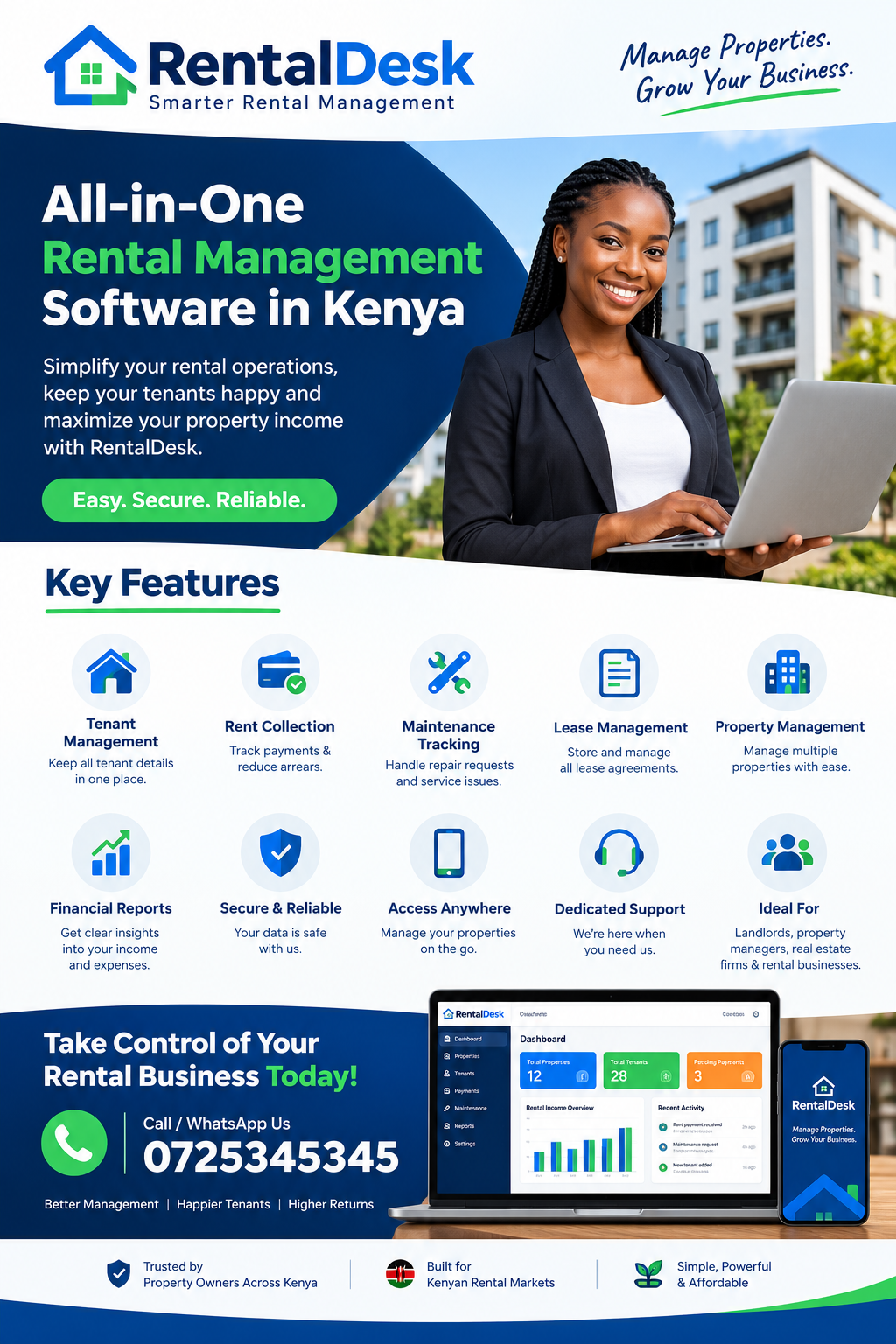
Systems that do only the first are payment recorders. Systems that do all six are operating systems. RentalDesk is built around the second model, giving landlords a unified dashboard to track rent, tenant activity, occupancy, arrears, expenses and M-Pesa payments for all properties in real time.
The Criteria That Separate the Best from the Rest
Choosing the best property management software Kenya requires a framework. The criteria below are the ones that actually determine whether a platform works in practice.
M-Pesa Integration: The Non-Negotiable Foundation
Over 90% of rent payments in urban Kenya now flow through M-Pesa, and Safaricom reported over 35 million active users processing more than KSh 35 trillion in transactions annually. Any best property management software Kenya that does not connect directly to Safaricom’s Daraja API is not automating collection. It is recording collection after the fact.
The integration must support Paybill and STK Push. It must capture the C2B callback containing the amount, phone number, account reference and transaction ID. And it must match the reference to the correct tenant and unit automatically, not queue every payment for manual review.
Reconciliation Depth: Partial Payments, Duplicates and Third-Party Payers
A platform that only handles full payments from the tenant’s own phone will fail on the first month that a spouse pays, or a tenant pays half now and half later. The best property management software Kenya must post partial payments against the open invoice and leave the balance visible, detect duplicates by transaction ID, and route third-party payments to a reconciliation queue with a full audit trail.
KRA and eRITS Readiness
The best property management software Kenya generates the records that KRA expects: a rent register showing every tenant, property and payment received in the period, eTIMS-compliant receipts, and the figures needed for monthly MRI filing. A platform that requires the landlord to reconstruct these records from bank statements and WhatsApp messages has not solved the compliance problem.
Arrears Aging and Recovery Workflow
A single arrears figure tells a landlord that something is wrong. An aging breakdown tells them where to act first. The best property management software Kenya categorises arrears into 1–7, 8–30, 31–60 and 60+ day buckets, and it connects the aging report to an escalation ladder that runs without manual intervention.
Role-Based Access and Data Protection
Tenant data is personal data under the Data Protection Act, 2019. The best property management software Kenya enforces role-based access so that caretakers, managers, accountants and landlords see only what their role requires. Every action is logged with a timestamp and user identification.
RentalDesk: Built for the Kenyan Market from Day One
RentalDesk is a cloud-based property management system built specifically for the Kenyan market by Zama Systems, with KES pricing and M-Pesa collection at its core. Unlike generic international software that lacks local context, RentalDesk is tailored to Kenyan workflows with M-Pesa integration, Kenyan Shilling support, local tax compliance, and workflows designed around how Kenyan landlords actually operate.
The platform serves individual landlords, real estate agencies, property management companies, estate and apartment managers, hostel operators and commercial property owners.
Automated M-Pesa Rent Collection
RentalDesk supports M-Pesa STK Push, where tenants receive a payment prompt on their phone when they click “Pay Rent” on their invoice. It also supports Paybill and Till integration, using Safaricom’s Daraja API with Instant Payment Notification callbacks for real-time payment capture. The platform extracts the amount, phone number, account reference and transaction ID, matches the reference to the correct tenant and unit, credits the account, generates a receipt and updates the dashboard in real time.
Automatic Bank Deposit Recording
RentalDesk extends beyond M-Pesa to integrate directly with APIs from Equity, KCB, Co-operative Bank, Stanbic and Standard Chartered. When tenants pay rent via bank transfer, the system captures the deposit and reconciles it against invoices without relying on SMS messages or manual statement downloads.
Arrears Tracking and Aging Analysis
RentalDesk provides automated arrears reports, aging analysis categorising balances by 1–7, 8–30, 31–60 and 60+ days, and payment behaviour analysis. The dashboard surfaces the 60+ day cases so landlords can act on what matters rather than treating every arrears case identically.
Tenant and Lease Management
The platform stores tenant profiles including names, contact details, National ID numbers, KRA PINs, lease agreements and payment history. Lease tracking features allow landlords to manage start and end dates, renewals and deposits, with automated alerts before lease expiry.
KRA-Ready Reporting
RentalDesk generates rent collection reports, income versus expense reports, arrears ageing reports and audit-ready financial statements from the same verified records used for daily operations. The figures that appear in a KRA return are the same figures that appear in the rent register and the payment ledger.
Pricing: The Best Property Management Software Kenya Should Be Accessible
RentalDesk offers tiered plans designed to match portfolio size and operational needs.
The Free Lite plan costs KES 0 forever, requires no card, and supports one property with up to five units and one account owner. It includes basic tenant records and invoices, balances and basic reports, and manual payment tracking. It does not include M-Pesa automation, SMS, bulk import, team accounts, advanced reports or priority support. When a landlord reaches the limit, they can upgrade to Starter without losing their records.
The Starter Plan costs KES 5,000 per month and supports up to 99 units. It includes M-Pesa collection and reconciliation, SMS reminders, bulk import, staff accounts and advanced reports. This is the plan for Kenyan property managers who need automated collection and follow-up.
The Estate Manager plan costs KES 9,500 per month and supports 100 to 999 units. It includes everything in Starter plus multi-property operations, role controls, advanced analytics, exports and priority support. This is built for agencies that need more operational control across teams and properties.
Quarterly billing includes 5% off and yearly billing includes 10% off the base monthly rate.
How RentalDesk Compares to Other Platforms
The Kenyan market includes several other platforms, each with different strengths. Pangoni offers an integrated marketplace and a free tier, and it matches the core M-Pesa auto-reconciliation and reporting functions. DigiTenant offers automated invoicing, payment tracking, a tenant portal and a pay-per-occupied-unit model where vacant units are free. Bomahut offers multi-property management, tenant tracking, financial reporting and SMS notifications. Nyumba Zetu is built for the Kenyan market with deep local integrations.
The best property management software Kenya for a particular landlord depends on portfolio size, business model, required features and budget. A landlord with five units may find the Free Lite plan sufficient. An agency managing 500 units across multiple owners needs the Estate Manager plan and the role-based access that comes with it. The platform that fits is the one that matches the operating model, not the one with the longest feature list.
What to Test Before Committing
Feature lists tell you what a product claims. Scenarios tell you what it does. Before selecting the best property management software Kenya, run six tests with your own data.
Test a part-payment against an existing invoice and confirm the balance remains visible. Test an M-Pesa payment with a mistyped reference and confirm the system surfaces it in a reconciliation queue rather than guessing. Test a month-end close and confirm the reports reconcile to the underlying payment records. Test the tenant view with an actual tenant and see whether they can find their balance without instruction. Test the caretaker view on a basic Android phone. And test the export — download everything and confirm it opens in a usable format.
Any platform that passes all six is worth serious consideration. Any platform that fails two or more will fail in production.
Common Mistakes When Choosing
The best property management software Kenya journey has predictable failure modes. Migrating unclean data — disputed balances, inconsistent tenant names, outdated phone numbers — transfers problems rather than solving them. Failing to standardise the account reference format means automatic matching will fail from the first payment. Skipping the pilot means configuration issues are discovered in production rather than in a controlled test. Choosing on price alone means selecting a system that displays balances without reconciling them, which is not a property management system at all.
How to Get Started
Implementing the best property management software Kenya is straightforward with RentalDesk .
Step 1: Sign up. Visit RentalDesk and create your account. Choose a plan that matches your portfolio size. The Free Lite plan supports one property with up to five units; Starter covers up to 99 units; Estate Manager supports 100–999 units.
Step 2: Set up properties and tenants. Add properties, units and tenant records, including lease agreements, rent amounts and payment schedules.
Step 3: Standardise the account reference. Decide on a format that identifies the property and the unit. For multi-property portfolios, use a prefix such as “KIL-A12” for Kilimani building A unit 12.
Step 4: Configure M-Pesa collection. Connect your Paybill so that payments reconcile automatically and receipts generate on receipt.
Step 5: Set the reminder ladder. Configure the timing and tone of reminders before and after the due date.
Step 6: Run a pilot cycle. Process one full billing period for a single property and count the manual interventions.
Step 7: Go live. Roll out to the full portfolio once the pilot validates the workflow, and review the exception queue each morning.
Frequently Asked Questions
What is the best property management software in Kenya?
The best property management software Kenya is the one that connects M-Pesa collection, reconciliation, arrears tracking and KRA-ready reporting in one platform. RentalDesk is built specifically for the Kenyan market and addresses these requirements natively.
Does RentalDesk support M-Pesa STK Push and Paybill?
Yes. RentalDesk supports M-Pesa STK Push, Paybill and Till integration, using Safaricom’s Daraja API with Instant Payment Notification callbacks for real-time payment capture.
How much does RentalDesk cost?
RentalDesk offers a Free Lite plan at KES 0 forever for one property with up to five units, a Starter Plan at KES 5,000 per month for up to 99 units, and an Estate Manager plan at KES 9,500 per month for 100–999 units. Quarterly billing includes 5% off and yearly billing includes 10% off.
Does RentalDesk generate KRA-ready reports?
Yes. RentalDesk generates rent registers, collection summaries, arrears ageing reports and financial statements from the same verified records used for daily operations, supporting MRI filing through eRITS.
Can RentalDesk handle multiple properties and multiple owners?
Yes. The Estate Manager plan supports multi-property operations, role controls and advanced analytics, making it suitable for agencies managing portfolios for multiple landlords.
Is RentalDesk suitable for diaspora landlords?
Yes. RentalDesk is cloud-based, allowing diaspora landlords to monitor rent collection, arrears, occupancy and maintenance from anywhere in the world.
- Best property management software Kenya
- Best property management software Kenya
- Best property management software Kenya
- Best property management software Kenya
- Best property management software Kenya
- Best property management software Kenya
- Best property management software Kenya
- Best property management software Kenya