
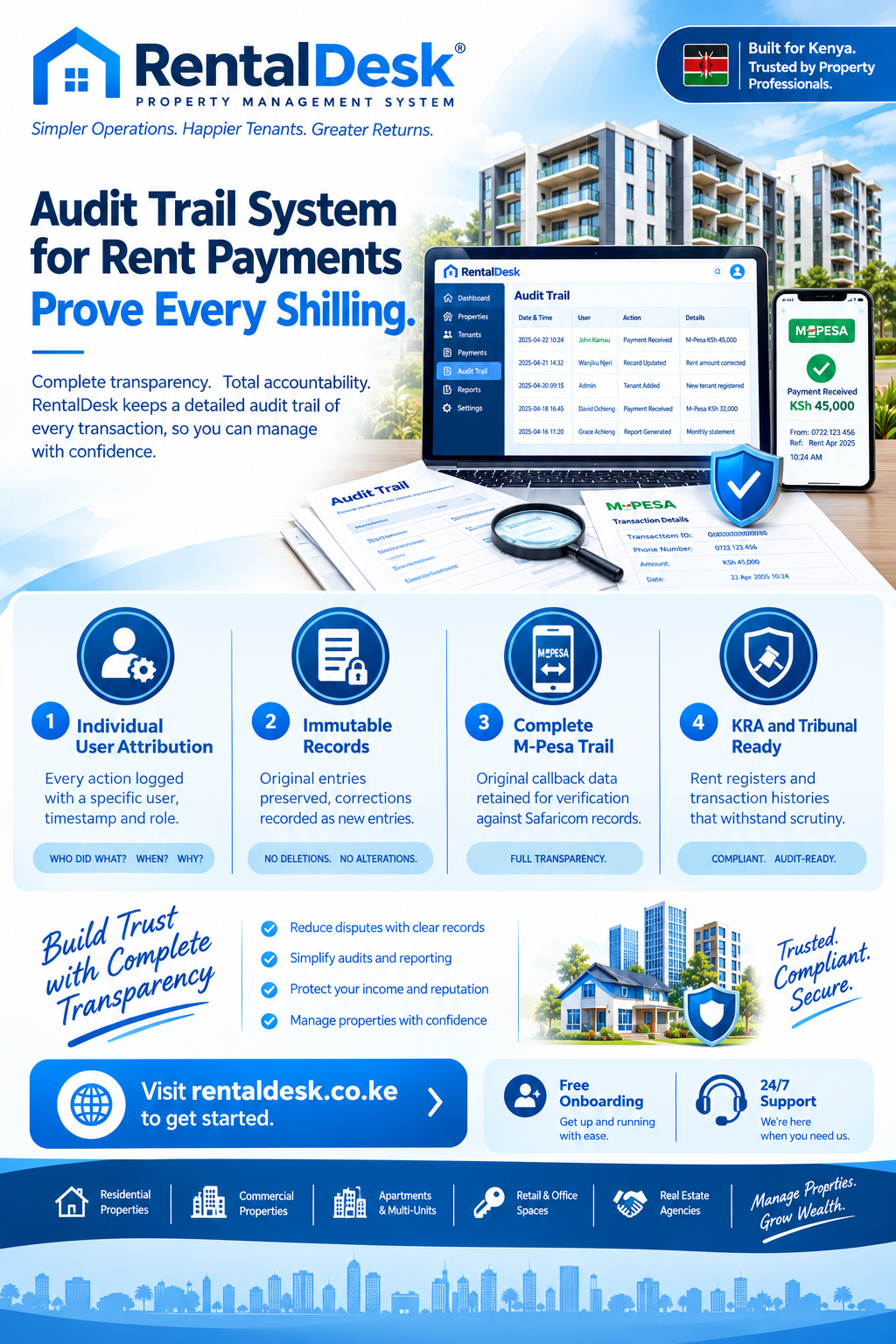
Audit trail system for rent payments is the record that answers the question every landlord eventually faces: prove it. Prove that rent was billed, prove that it was paid, prove who authorised the adjustment, prove when the receipt was issued, and prove that the figure in the ledger is the figure that actually moved through M-Pesa. In Kenyan rental management, this question arrives in several forms. A tenant disputes an arrears balance two years after the fact. A co-owner asks why the collection figure fell in August. A caretaker is accused of pocketing cash that was never banked. The Kenya Revenue Authority requests the rent register and the supporting transaction records. In every one of these situations, the landlord either has a complete, timestamped, unalterable record — or a collection of WhatsApp screenshots and a spreadsheet that anyone could have edited. A properly implemented audit trail system for rent payments is the difference between a defensible position and an indefensible one.
What an Audit Trail Actually Is
The audit trail system for rent payments conversation must begin with a definition, because the phrase is often used loosely to mean “we keep records.” Keeping records is not an audit trail. An audit trail is a chronological, tamper-evident record of every action taken on a financial transaction, including who performed the action, when, from where, and what changed.
Four properties distinguish an audit trail from ordinary record-keeping. Completeness means that every action is captured, including the ones that were later reversed. Attribution means that every action is tied to a specific user, not to a shared login or an unnamed administrator. Immutability means that the original record cannot be silently overwritten; corrections are recorded as new entries rather than replacements. And chronology means the sequence is preserved, so a reviewer can reconstruct the order in which events occurred.
In rental management, the events that must be captured include the invoice being raised, the payment being received, the payment being matched to a tenant, the receipt being issued, any adjustment being made, any write-off being approved, any deposit being applied, and any reversal being processed. Each of these is a point at which money or obligation changes hands, and each is a point at which an audit trail system for rent payments must leave a mark.
Why Kenyan Landlords Need an Audit Trail
The audit trail system for rent payments conversation has acquired urgency because three pressures have converged on Kenyan rental management.
The first is regulatory. The Kenya Revenue Authority launched the Electronic Rental Income Tax System in April 2025, and the Draft Income Tax (Residential Rental Income Tax) Regulations 2026 propose making registration on the platform mandatory for every landlord within the monthly rental income band. A person subject to residential rental income tax is required to keep records necessary for the determination and ascertainment of the tax in accordance with the Tax Procedure Act, 2015. The Commissioner may by notice require any person to produce books and records relating to the computation of the tax. A landlord who cannot produce a coherent, timestamped record of rent received is exposed to assessment on KRA’s own figures.
The second is legal. Deposit disputes, arrears claims, and eviction proceedings all turn on evidence. When a matter reaches the Rent Tribunal or the Small Claims Court, the landlord’s case depends on being able to show what was charged, what was paid, and when. In Calleja v Kariuki, the Small Claims Court confirmed that a tenancy deposit is refundable subject only to lawful deductions, and the landlord’s claim failed because the costs had not been substantiated. The lesson is that assertions without evidence do not survive tribunal scrutiny. An audit trail system for rent payments is the evidence.
The third is operational. An agency managing fifty buildings across multiple owners cannot rely on memory. Staff change, caretakers leave, and assignments are reassigned. When the person who recorded a cash receipt is no longer employed, the only thing that remains is the record. A landlord whose operations depend on individual memory loses the operational history every time a staff member moves on.
The Core Components of a Rent Payment Audit Trail
The audit trail system for rent payments conversation becomes concrete when we examine what the trail actually contains for a single payment.
The Invoice Record
The trail begins with the charge. The invoice records the amount, the due date, the billing period, the tenant, the unit, and any additional charges such as service charge or utilities. It records the user who generated it and the timestamp. If the invoice was generated automatically from the lease record, the trail records the rule that produced it. If it was generated manually, the trail records the manual entry. In either case, the charge is documented before any payment is received, and the chronology cannot be reconstructed after the fact.
The Payment Capture Record
When a tenant pays via M-Pesa Paybill, Safaricom fires a C2B callback containing the amount, phone number, account reference, transaction ID, and timestamp. The audit trail system for rent payments captures this callback in full, preserving the original transaction data exactly as received. This matters because the original data is what a reviewer can verify against Safaricom’s own records. A system that captures only the matched result, without the raw callback, cannot demonstrate that the match was correct.
The Matching Record
The matching record shows how the payment was attributed to a tenant and an invoice. If the match was automatic, the trail records the rule that matched it — an exact reference match, a fuzzy match with the variation noted, or a phone number match. If the match was manual, the trail records the user who made the match, when they made it, and what they matched it to. This is the point at which an audit trail system for rent payments earns its keep, because manual matches are where disputes originate.
The Allocation Record
The allocation record shows how the payment was applied across invoices. A payment of KSh 15,000 against a KSh 25,000 invoice produces an allocation of KSh 15,000 to that invoice and a balance of KSh 10,000 remaining. If the payment is allocated across multiple invoices, the trail records the allocation to each. The running balance after allocation is preserved, so a reviewer can see the position at every point in time.
The Receipt Record
The receipt record shows that the tenant was notified of the payment and the balance. It records the channel through which the receipt was delivered, the timestamp of delivery, and the content of the receipt. When a tenant claims they never received a receipt, the audit trail system for rent payments can demonstrate otherwise.
The Adjustment Record
The adjustment record is where most fraud and most disputes hide. Any change to a tenant balance after the initial posting — a late fee, a credit, a write-off, a correction, a deposit application — must be recorded with the reason, the amount, the user who authorised it, and the timestamp. A system that permits silent adjustment is not an audit trail. It is a spreadsheet with a login page.
Immutability: Why Corrections Are Recorded, Not Overwritten
The audit trail system for rent payments conversation must address immutability, because it is the property that most distinguishes a genuine audit trail from ordinary record-keeping.
In a spreadsheet, a wrong figure is simply overwritten. The original figure disappears. Nobody can tell whether the correction was legitimate or whether it was a deliberate manipulation. The spreadsheet shows the current state and nothing about how it got there.
In a proper audit trail system for rent payments, the original entry remains. The correction is recorded as a new entry that references the original and explains the change. The ledger shows both the original figure and the correction, with timestamps and user attribution for each. If a reviewer asks why a balance changed between March and April, the trail shows the adjustment, the reason, and the person who approved it.
This distinction matters enormously in dispute resolution. A landlord who can show that a correction was made by an authorised user on a specific date, for a documented reason, is in a defensible position. A landlord whose records show only the final figure has nothing to offer when challenged.
User Attribution and the Problem of Shared Logins
The audit trail system for rent payments conversation must address attribution, because an audit trail that records “admin” as the user for every action is not an audit trail. It is an anonymous log.
Kenyan property operations frequently rely on shared logins. The caretaker knows the manager’s password. The manager knows the accountant’s. This convenience destroys attribution. If a payment is reallocated and the trail shows “admin,” nobody can determine who did it, and the innocent are as exposed as the guilty.
A proper system assigns individual credentials to every user. Caretakers log in as themselves. Property managers log in as themselves. Accountants log in as themselves. Every action is attributed to the individual who performed it. Role-based access then determines what each user is permitted to do, so that a caretaker can record a cash receipt but cannot reallocate an M-Pesa transaction.
RentalDesk implements role-based access with individual credentials. Every action taken within the system is logged with a timestamp and user identification. When a dispute arises, the landlord can demonstrate who did what and when.
The Audit Trail and M-Pesa Reconciliation
The audit trail system for rent payments conversation cannot be separated from M-Pesa, because in Kenya the payment trail is largely an M-Pesa trail.
Every M-Pesa transaction carries a unique transaction ID, a timestamp, a sender phone number, an amount, and an account reference. When the system captures the C2B callback, it preserves all of these fields. This creates a direct link between the landlord’s ledger and Safaricom’s own records. If a dispute arises about whether a payment was made, the transaction ID can be verified against the M-Pesa statement.
RentalDesk captures M-Pesa payments through Safaricom’s Daraja API with Instant Payment Notification callbacks. The platform extracts the amount, phone number, account reference, and transaction ID, matches the reference to the correct tenant and unit, credits the tenant account, generates a receipt, and updates the dashboard in real time. The original callback data is preserved, which means the audit trail is anchored to the source of truth.
Handling Duplicates, Partial Payments, and Exceptions
The audit trail system for rent payments must handle exceptions, because exceptions are where the audit trail is most valuable and most likely to be tested.
Duplicates are detected by transaction ID and flagged rather than auto-posted. The trail records the flag, the review, and the resolution. If the duplicate was refunded, the refund is recorded. If it was credited to the next month, the credit is recorded. A reviewer can see exactly what happened and why.
Partial payments are posted against the open invoice with the balance left open. The trail records the partial amount, the invoice it was applied to, and the resulting balance. The next payment from the same tenant continues against the same invoice, and the trail records the sequence.
Third-party payments — where a spouse, parent, or employer pays on the tenant’s behalf — enter a reconciliation queue. The trail records the payer details, the review, and the attribution decision. If the payment was assigned to the wrong tenant and later corrected, both the original assignment and the correction are recorded.
The Audit Trail and KRA Compliance
The audit trail system for rent payments conversation has a compliance dimension that has become more important with the introduction of eRITS.
KRA expects landlords to maintain records necessary for the determination and ascertainment of the tax. In practice, this means a rent register showing every tenant, every property, and every payment received in the period. It means eTIMS-compliant receipts issued to tenants. It means lease agreements for the tenancies that generated the rent. And it means bank statements or M-Pesa transaction logs showing the rent received.
An audit trail that captures all of these records, timestamped and attributable, makes compliance a by-product of normal operations. The rent register is generated from the same verified records used for daily operations. The receipts are issued automatically. The transaction logs are preserved from the original callbacks. When KRA requests records, the landlord produces a complete file rather than reconstructing it from bank statements and WhatsApp messages.
The Audit Trail and Deposit Disputes
The audit trail system for rent payments conversation must address deposits, because deposit disputes are among the most common end-of-tenancy conflicts in Kenya.
A deposit dispute turns on evidence. The tenant claims the unit was left in good condition. The landlord claims it was damaged. The resolution depends on the move-in inspection record, the move-out inspection record, and the documented deductions with receipts attached.
An audit trail that includes the move-in inspection, the move-out inspection, the itemised settlement statement, and the evidence supporting each deduction gives the landlord a defensible position. The trail also records when the deposit was received, how it was held, and when it was refunded. If the tenant later claims the deposit was never returned, the trail shows the refund date and the transaction reference.
The Audit Trail and Multi-Owner Portfolios
The audit trail system for rent payments becomes more complex in multi-owner portfolios, because the record must show not only what happened but whose money was involved.
An agency managing properties for multiple landlords must be able to demonstrate that each owner’s funds were handled separately and correctly. The audit trail should show the payment being attributed to the correct tenant, the correct unit, the correct property, and the correct owner. If a payment is misattributed and later corrected, both the original attribution and the correction are recorded.
This matters for client money compliance. Under the Estate Agents Act, Cap 533, subsidiary legislation, an estate agent providing property management services is required to open a separate designated account where both the name of the company and the client appear as the identity. The audit trail demonstrates that the separation was maintained.
Common Mistakes in Building an Audit Trail
The audit trail system for rent payments journey has predictable failure modes.
Using shared logins. A shared login destroys attribution. Every action is recorded as “admin,” and the trail cannot identify who did what.
Overwriting entries instead of recording corrections. A system that permits silent overwriting is not an audit trail. The original entry must remain, and corrections must be recorded as new entries.
Recording only the final state. A ledger that shows only the current balance, without the transaction history, cannot demonstrate how the balance was reached. The trail must preserve the sequence.
Failing to preserve the original M-Pesa callback data. If the system records only the matched result, without the raw callback, the link to Safaricom’s records is lost.
Not logging the reason for adjustments. An adjustment without a documented reason is indistinguishable from an error or a manipulation. Every adjustment should record why it was made.
Ignoring access control. An audit trail that everyone can edit is not a trail. Role-based access determines who can do what, and the trail records who did it.
Failing to retain records. KRA can request records going back several years. A system that purges old records after twelve months is not suitable for compliance.
How RentalDesk Delivers a Rent Payment Audit Trail
RentalDesk is built specifically for the Kenyan market, and the audit trail is built into the platform architecture.
Individual user credentials. Every user has their own login, and every action is attributed to that user with a timestamp.
Role-based access. Caretakers, managers, accountants, and landlords see only what their role requires, and each role has defined permissions. A caretaker can record a cash receipt but cannot reallocate an M-Pesa transaction.
Immutable transaction records. The original M-Pesa callback data is preserved. Corrections are recorded as new entries rather than overwriting the original.
Complete reconciliation trail. Every payment, match, allocation, and adjustment is logged. The reconciliation queue records who resolved each exception and when.
Automatic receipting. Digital receipts are issued automatically once payment is verified, with the delivery channel and timestamp recorded.
Arrears and aging records. The aging report is generated from the transaction history, so every balance can be traced to the payments and charges that produced it.
KRA-ready outputs. The rent register, the collection summary, and the financial reports are generated from the same verified records used for daily operations.
Cloud-based retention. RentalDesk stores records securely in the cloud, with regular backups and role-controlled access.
How to Get Started
Implementing a proper audit trail system for rent payments is straightforward with RentalDesk .
Step 1: Sign up. Visit RentalDesk and create your account. Choose a plan that matches your portfolio size.
Step 2: Create individual user accounts. Issue separate credentials to every caretaker, manager, accountant, and landlord. Retire shared logins.
Step 3: Configure role-based permissions. Define what each role can see and do. Restrict financial adjustments to authorised users.
Step 4: Configure M-Pesa collection. Connect your Paybill so that payments are captured with the original callback data preserved.
Step 5: Configure receipting. Ensure receipts are issued automatically and the delivery is recorded against the tenant record.
Step 6: Run a pilot cycle. Process one full billing period and review the audit trail for a sample payment. Confirm that every step is recorded.
Step 7: Go live. Roll out to the full portfolio and review the audit trail during month-end close.
The Future of Rent Payment Auditing in Kenya
The audit trail system for rent payments landscape is moving toward greater digitisation and regulatory scrutiny. The eRITS platform integrates with eCitizen and GavaConnect, with future integration with Ardhisasa anticipated to boost compliance through geo-referencing and data verification of rental properties. KRA validation through eTIMS is making it harder for landlords to under-declare rental income. And the Data Protection Act, 2019, imposes obligations on how tenant and financial data is processed and retained.
The landlords who adopt a structured audit trail early will not simply have tidier records. They will have stronger positions in disputes, cleaner compliance filings, more credible owner reporting, and a property business that survives staff turnover without losing its operational memory.
RentalDesk provides the structured platform that makes an audit trail system for rent payments work in Kenya — not as a passive log, but as an active record that protects the landlord, satisfies the regulator, and resolves the disputes that inevitably arise.
- audit trail system for rent payments
- audit trail system for rent payments
- audit trail system for rent payments
- audit trail system for rent payments
- audit trail system for rent payments
- audit trail system for rent payments
- audit trail system for rent payments
- audit trail system for rent payments
- audit trail system for rent payments
- audit trail system for rent payments
- audit trail system for rent payments