
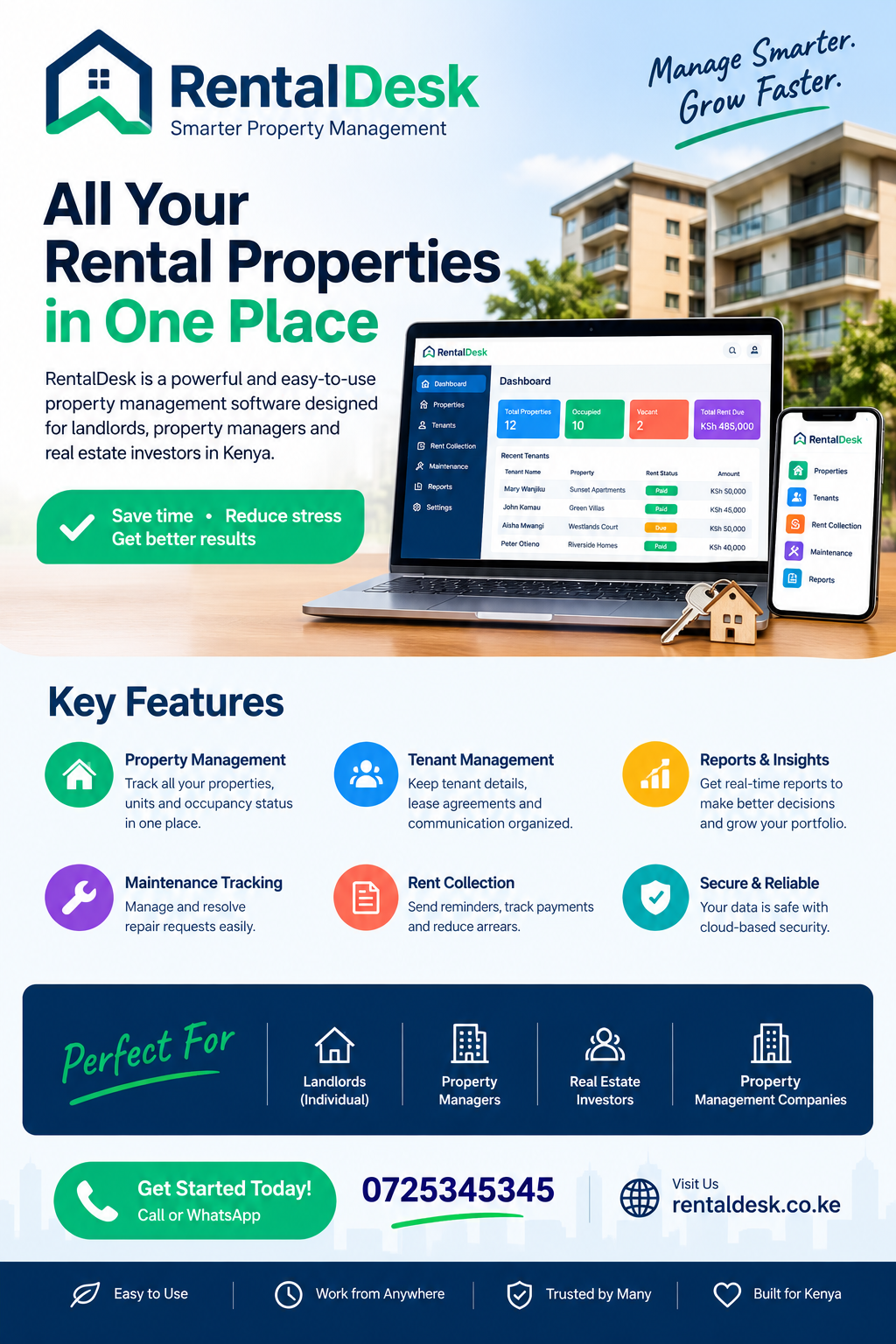
Property Revenue Management Software Kenya: How to Improve Rental Income and Control Property Costs
Managing rental property requires more than finding tenants and collecting rent. Landlords, real estate investors, letting agents, and property managers must monitor payments, control operating expenses, follow up on arrears, maintain accurate financial records, and understand whether each property is generating a healthy return. Property Revenue Management Software Kenya provides a useful starting point for understanding how digital tools can help property owners organise these responsibilities and make better financial decisions.
Kenya’s rental market includes residential apartments, commercial buildings, office spaces, student accommodation, shops, and mixed-use developments. Each property type has different income patterns, payment arrangements, maintenance requirements, and operating costs. Managing several units using notebooks, spreadsheets, and scattered M-Pesa messages can become difficult as a portfolio grows.
A reliable rental management process helps owners understand what they earn, what they spend, which tenants have outstanding balances, and where opportunities for improvement exist. Technology can support that process by bringing rental information into one organised system.
This guide explains how revenue management works in the property sector, which features landlords should consider, how to improve rent collection, how to track expenses, and how to evaluate the financial performance of rental properties in Kenya. It also explores practical implementation steps, common mistakes, data security, and frequently asked questions to help property owners make informed decisions.
1. Understanding Property Revenue Management
Property revenue management involves planning, monitoring, and improving the income generated by rental properties while keeping operating expenses under control. The objective is not simply to charge higher rent. It is to improve the consistency of rental income, minimise avoidable losses, use available space effectively, and understand the financial performance of each investment.
For example, a landlord with 20 residential units may collect rent from different tenants on different dates. Some tenants pay in full, others pay late, and a few may make partial payments. At the same time, the landlord must pay for repairs, security, cleaning, common-area electricity, water, insurance, and other operating expenses.
Without organised records, it can be difficult to determine how much income remains after expenses. A property may appear profitable because rent is coming in, even though maintenance costs and unpaid balances are gradually reducing its returns.
Property Revenue Management Software Kenya can be explored as part of a wider assessment of digital property operations, particularly when an owner wants a clearer view of income, expenses, outstanding balances, and financial performance.
Revenue management versus ordinary rent collection
Rent collection is one activity within the broader revenue management process. Revenue management also considers occupancy, rental pricing, recurring charges, expenses, payment trends, and the overall performance of a property.
| Activity | Main purpose | Example |
|---|---|---|
| Rent collection | Receive payments from tenants | Record a monthly rent payment |
| Arrears management | Identify and follow up on unpaid amounts | Flag an overdue balance |
| Expense tracking | Monitor property operating costs | Record a plumbing repair |
| Occupancy monitoring | Understand how much space is rented | Identify vacant apartments |
| Rental analysis | Evaluate income and costs | Compare monthly revenue with expenses |
| Financial reporting | Support management decisions | Prepare a quarterly performance report |
These activities are connected. A vacancy reduces potential rental income, while an unrecorded expense makes the property’s financial performance look stronger than it actually is. Good management therefore requires accurate records across the entire rental operation.
Who benefits from revenue management tools?
Different property owners can benefit in different ways.
-
Individual landlords: Monitor rent payments and property expenses without maintaining multiple records.
-
Property managers: Track several buildings and provide owners with clearer financial reports.
-
Real estate investors: Compare the performance of different properties.
-
Letting agents: Maintain accurate tenant and payment records.
-
Commercial property owners: Monitor leases, recurring charges, and income from business premises.
-
Apartment managers: Coordinate collections, occupancy, repairs, and shared operating costs.
The appropriate system depends on the number of properties, the complexity of the portfolio, and the level of financial detail required.
2. Why Rental Income Management Matters in Kenya
Rental income can provide a dependable source of revenue, but only when it is managed carefully. Delayed payments, vacancies, maintenance emergencies, inconsistent recordkeeping, and unplanned expenses can all affect the amount an owner retains.
Kenyan landlords may receive payments through M-Pesa, bank transfers, cash, or other agreed channels. Keeping these records consistent is important, especially when multiple tenants pay at different times or use different methods.
Property Revenue Management Software Kenya is a relevant search phrase for exploring digital management solutions, while landlords should assess the actual features of any platform before deciding whether it meets their requirements.
The challenge of tracking many payments
Consider a landlord who owns 15 apartments, each with monthly rent of KSh 18,000. If every apartment is occupied and all tenants pay in full, the expected monthly rent is:
15 × KSh 18,000 = KSh 270,000.
That figure represents expected rental income, not necessarily the amount received or the owner’s final profit.
If two tenants each owe a full month’s rent, the amount collected may be KSh 234,000, assuming the other 13 tenants have paid in full. The landlord must also account for any additional outstanding balances, vacancies, and operating costs.
A structured payment register makes it easier to distinguish between:
-
Rent expected during the month.
-
Rent actually received.
-
Partially paid rent.
-
Overdue balances.
-
Advance payments.
-
Deposits that must be accounted for separately.
-
Other charges due under the tenancy agreement.
These distinctions help prevent confusion and make follow-up more precise.
The cost of incomplete records
Imagine a property manager who records rent in a notebook but keeps repair receipts in a drawer. At the end of the month, the manager reports that the building collected KSh 300,000. However, several tenants paid late, one payment was recorded twice, and a repair invoice was omitted.
The report may therefore provide an inaccurate picture of performance.
A better process records transactions consistently, retains supporting documents, and reconciles reported figures against payment confirmations and bank or mobile-money statements. Software can support this process, but the underlying records still need to be accurate.
Improving visibility across a property portfolio
An owner with one building may be able to review every transaction manually. An owner with several buildings in different locations has a more complicated task.
A centralised system can make it easier to compare:
-
Expected and received rent.
-
Income from individual units.
-
Vacant units and potential lost rent.
-
Repairs and recurring expenses.
-
Outstanding tenant balances.
-
Monthly and annual performance.
These comparisons help owners decide where to investigate problems rather than relying on general impressions.
3. Essential Features to Look for in Rental Revenue Software
Not every property management platform offers the same capabilities. Some focus mainly on rent collection, while others provide broader financial reporting, maintenance tracking, tenant management, and lease administration.
Before selecting a system, identify the tasks that take the most time or create the greatest risk of errors.
Property Revenue Management Software Kenya is one of the search phrases that can be used when researching the wider digital solutions market, but the final choice should be based on verified product functionality and suitability for rental operations.
Automated rent schedules
A rent schedule records the amount due for each unit and the date on which payment is expected.
A useful system should allow property managers to configure different rents, billing periods, due dates, and agreed recurring charges. It should also make overdue amounts easy to identify.
For example, a building may contain residential apartments paying monthly rent and commercial shops paying rent under different contractual arrangements. A flexible schedule helps the manager maintain separate terms without confusing one tenant’s obligations with another’s.
Payment recording and reconciliation
Payment records should show the tenant, property, unit, amount, date, payment method, and any remaining balance.
Where a system supports mobile-money or bank integrations, confirm exactly what the integration does. Some services may retrieve transaction information, while others may only allow a manager to enter payments manually.
Do not assume that every platform offers automatic M-Pesa reconciliation. Ask the provider to demonstrate the feature, explain any associated charges, and show how unmatched payments are handled.
Expense tracking
Income alone cannot reveal whether a property is performing well. The system should also help managers record costs such as:
-
Plumbing and electrical repairs.
-
Cleaning and security services.
-
Lift maintenance.
-
Waste collection.
-
Common-area electricity and water.
-
Property insurance.
-
Landscaping and gardening.
-
Management fees.
-
Other legitimate operating expenses.
Expenses should be assigned to the correct building or unit wherever appropriate. This makes it easier to identify properties with unusually high costs.
Tenant and lease records
Accurate tenant records help managers connect payments to the correct tenancy. Useful information may include contact details, unit allocation, lease dates, agreed rent, payment history, and relevant correspondence.
Access to personal information should be restricted to authorised users. The system should not collect unnecessary information simply because it is available.
Lease reminders and document storage can also help prevent important dates from being overlooked.
Financial dashboards and reports
A dashboard should present important information without requiring the user to inspect every transaction.
Useful indicators include total rent expected, total rent collected, outstanding rent, expenses, vacancy levels, and net operating income.
Reports should allow the user to select a period, filter by property, and investigate the transactions behind a total. The ability to export records may also be valuable when preparing accounts or sharing information with an accountant.
User access and audit trails
If several employees handle collections, repairs, and reporting, they should not all have unrestricted access to every function.
Role-based permissions can limit who may record payments, change rent amounts, approve expenses, or access sensitive tenant information. Audit trails can help identify who made a change and when it occurred.
These safeguards are particularly important when a property business manages money on behalf of several owners.
4. Improving Rent Collection and Reducing Arrears
Rent arrears arise when tenants fail to pay the full amount due by the agreed date. They may result from temporary financial difficulties, misunderstandings, administrative errors, disputes, or repeated late-payment behaviour.
A good arrears process begins with accurate records and clear communication. It should identify overdue balances early, confirm the facts, and follow the tenancy agreement and applicable law.
Property Revenue Management Software Kenya can be included in a broader search for property management resources, but landlords should verify whether any particular platform includes the payment monitoring and reporting features they need.
Create a consistent collection calendar
A collection calendar identifies when rent becomes due and when follow-up should take place.
A practical process may include:
-
Confirm the rent amount and due date in the tenancy record.
-
Issue a reminder before or on the agreed payment date.
-
Record payments as they are confirmed.
-
Review unpaid balances shortly after the deadline.
-
Contact tenants with overdue accounts.
-
Record any agreed payment arrangements.
-
Escalate unresolved matters through appropriate channels.
The timing and wording of reminders should reflect the tenancy agreement and applicable requirements. A software reminder does not replace proper notice where formal notice is required.
Separate partial payments from fully settled accounts
A tenant who pays half the rent has not necessarily settled the monthly obligation. The record should show the original amount due, the amount received, and the remaining balance.
For instance, if rent is KSh 25,000 and the tenant pays KSh 15,000, the outstanding amount is KSh 10,000, subject to any other properly documented adjustments.
Clear records prevent partial payments from being mistaken for complete settlement. They also help managers avoid repeatedly contacting tenants who have already paid.
Use respectful and documented communication
Rent collection should be professional, consistent, and based on verified information.
A useful reminder identifies the period concerned, the amount outstanding, the payment instructions, and the appropriate contact for questions. It should not disclose a tenant’s financial details to unrelated people.
If the tenant disputes the balance, the manager should compare the payment records before making further demands. A mistaken claim can damage trust and create unnecessary disputes.
Measure collection performance
A property manager can monitor a collection rate using:
Collection rate = Rent collected ÷ Rent due × 100
Suppose KSh 450,000 was due in a month and KSh 405,000 was received against those obligations during the period being measured.
The collection rate is:
KSh 405,000 ÷ KSh 450,000 × 100 = 90%.
The remaining 10% should be investigated. The figure does not, by itself, explain whether the difference results from late payments, disputed charges, or other circumstances.
Managers should define how they treat advance payments, credits, and payments received after the reporting period so that comparisons remain consistent.
5. Tracking Rental Expenses and Protecting Profitability
A property may generate substantial rent while producing disappointing returns because operating costs are too high. Tracking expenses helps owners understand where money goes and whether expenditure is reasonable.
Property Revenue Management Software Kenya is another relevant search phrase for researching property-related management systems. When evaluating tools, confirm that they support the expense categories and financial reports your portfolio requires.
Classify expenses consistently
Property expenses should be recorded using consistent categories. Common examples include repairs, security, cleaning, utilities, insurance, management fees, and planned improvements.
Separate recurring expenses from occasional costs. Monthly security payments are different from an unexpected major plumbing repair, even though both reduce cash available to the owner.
Capital improvements may also need to be treated differently from routine maintenance for accounting and tax purposes. An accountant can advise on the appropriate treatment for the specific transaction.
Compare actual costs with the budget
An operating budget estimates expected expenses for a particular period. Actual spending can then be compared with that budget.
For example:
| Expense category | Monthly budget | Actual spending | Difference |
|---|---|---|---|
| Security | KSh 35,000 | KSh 35,000 | KSh 0 |
| Cleaning | KSh 12,000 | KSh 14,000 | KSh 2,000 over |
| Repairs | KSh 10,000 | KSh 18,000 | KSh 8,000 over |
| Common utilities | KSh 15,000 | KSh 13,500 | KSh 1,500 under |
The table shows that repairs and cleaning require attention. It does not automatically mean that the spending was unnecessary. The manager should investigate the reasons before deciding whether to change a supplier, repair schedule, or budget.
Identify recurring maintenance problems
Repeated repairs can indicate a deeper problem. For example, several plumbing call-outs in the same building may suggest that an underlying pipe issue needs a permanent solution.
Recording the date, unit, type of repair, contractor, cost, and outcome makes it easier to spot patterns.
A maintenance history can support better decisions about preventive work. Although a permanent repair may cost more initially, it may reduce repeated call-outs and tenant disruption.
Establish expense approval rules
Where staff members can incur costs on behalf of an owner, clear approval limits help protect the property’s finances.
A practical policy might require approval for major repairs, quotations for significant work, and receipts for completed expenditure. Emergency procedures should also be defined so that urgent safety or damage issues can be addressed promptly.
Software can record approval decisions and supporting documents, but the business must still establish a sound approval policy.
6. Understanding Rental Yield and Net Operating Income
Rental revenue management becomes more useful when property owners move beyond recording transactions and begin analysing what those transactions mean.
Two important concepts are rental yield and net operating income. They help investors evaluate the performance of a property, although they measure different things and should not be treated as interchangeable.
Property Revenue Management Software Kenya is part of the prescribed link rotation for this article; when assessing any rental platform, focus on verified features that support your financial reporting needs.
What is rental yield?
Rental yield compares rental income with the value or purchase price of a property. Gross rental yield is commonly calculated as annual rental income divided by property value, multiplied by 100.
Suppose a residential property was purchased for KSh 8 million and earns KSh 720,000 in scheduled rent annually.
Gross rental yield:
KSh 720,000 ÷ KSh 8,000,000 × 100 = 9%.
This is a simplified gross yield calculation. It does not account for vacancies, operating costs, financing expenses, taxes, or the cost of acquiring the property.
What is net operating income?
Net operating income, often abbreviated as NOI, is generally calculated by subtracting operating expenses from effective operating income. Effective income accounts for relevant losses, such as vacancies and unpaid rent, under the method being used.
Consider this illustrative annual property budget:
| Item | Annual amount |
|---|---|
| Scheduled rental income | KSh 1,200,000 |
| Vacancy and collection losses | KSh 60,000 |
| Effective rental income | KSh 1,140,000 |
| Operating expenses | KSh 300,000 |
| Net operating income | KSh 840,000 |
The example excludes financing costs and other items that may be treated separately in the owner’s accounts. It should not be interpreted as a universal accounting formula for every situation.
Why accurate data matters
A calculation is only useful when the information behind it is reliable. If vacancies are omitted, expenses are missing, or the same payment is counted twice, the resulting yield may be misleading.
Property Revenue Management Software Kenya can be used as an exact-match search phrase in the required link sequence, but landlords should compare the actual reporting capabilities of available platforms before relying on any financial calculations.
The system selected should make it possible to review the transactions behind a report. Owners should be able to investigate unexpected changes instead of relying exclusively on a single dashboard figure.
7. Managing Vacancies and Improving Occupancy
Vacant units reduce the income a rental property can generate. Even a well-maintained building may underperform if apartments remain empty for long periods or if prospective tenants experience delays during the application process.
Improving occupancy involves understanding why units become vacant, preparing them efficiently, marketing them to suitable tenants, and offering rental terms that reflect local demand.
Property Revenue Management Software Kenya appears here as the next link in the prescribed rotation. For property revenue planning, the relevant capabilities to investigate include occupancy reporting, unit records, lease dates, and vacancy tracking.
Monitor vacant units
A vacancy register should identify each available unit, its location, the date it became vacant, its advertised rent, and its current status.
Useful status labels might include:
-
Occupied.
-
Notice received.
-
Vacant and under preparation.
-
Available for viewing.
-
Application under review.
-
Lease agreed.
-
Occupied and awaiting administrative updates.
These distinctions help the property manager understand whether a vacant unit is ready for occupation or whether maintenance and cleaning must be completed first.
Understand why units remain empty
Long vacancies can have different causes. The advertised rent may not match local demand, the unit may need repairs, marketing may be ineffective, or prospective tenants may struggle to arrange viewings.
Managers should investigate before reducing the rent. Sometimes the problem can be resolved by improving photographs, correcting an inaccurate listing, responding faster to enquiries, or completing minor repairs.
Local comparisons should consider similar properties in the same neighbourhood rather than relying on general averages for Nairobi or Kenya as a whole.
Measure vacancy performance
A simple vacancy rate can be calculated by dividing the number of vacant units by the total number of rentable units and multiplying by 100.
If a property contains 40 rentable units and four are vacant, the vacancy rate is 10%.
For more detailed analysis, a landlord can measure vacancy duration in unit-days or compare the rent lost during vacant periods. This is especially useful when units have different rental values.
A reporting system should clearly define the measurement period and whether units undergoing major renovation are included.
8. Rental Pricing and Market-Based Decisions
Rental pricing influences occupancy, revenue, tenant retention, and the time required to find a suitable tenant. Setting prices too low may reduce potential income, while setting them too high may increase vacancies or encourage existing tenants to leave.
The appropriate rent depends on several factors, including location, size, condition, security, parking, access to transport, nearby services, and the availability of comparable properties.
Property Revenue Management Software Kenya is the tenth destination in the link rotation. For pricing decisions, landlords should use verified rental records and reliable market comparisons rather than assuming that a digital system automatically determines the best price.
Compare similar properties
A meaningful rental comparison should consider properties that prospective tenants would realistically view as alternatives.
For residential apartments, useful comparison points include:
-
Neighbourhood and access to transport.
-
Number of bedrooms and usable space.
-
Building condition and security arrangements.
-
Water availability and utility arrangements.
-
Parking and shared facilities.
-
Lease terms and additional charges.
-
Recent demand and time on the market.
Commercial properties require different comparisons, including business visibility, foot traffic, access, permitted use, available services, and lease structure.
Review rental performance regularly
A landlord should not change rent simply because another building charges more. The competing property may offer different facilities or have a different target market.
Instead, review the existing rent against local comparables, operating costs, vacancy history, tenant feedback, and the terms of the current lease.
Any change must comply with the applicable tenancy agreement and legal requirements. Automated reports can inform the decision, but they do not override contractual obligations.
Avoid unnecessary tenant turnover
Higher advertised rent does not always produce better overall results. If a rent increase leads to a prolonged vacancy, advertising costs, cleaning expenses, and other turnover costs may offset the additional income.
For example, an extra KSh 2,000 per month would produce KSh 24,000 in additional annual rent if the unit remained occupied and the increase applied for a full year. A vacancy lasting several weeks could reduce that benefit.
A sound pricing decision considers the full financial picture, not just the difference between two monthly rental figures.
9. Using M-Pesa and Digital Payments Responsibly
Mobile-money payments are widely used in Kenya, making clear payment records particularly important for landlords and tenants. Digital payment channels can simplify transactions, but they also create a need for careful reconciliation and fraud prevention.
Property Revenue Management Software Kenya continues the specified sequence of destinations. When reviewing a platform, ask whether it supports your preferred payment methods and whether its payment features have been demonstrated using a realistic transaction.
Establish clear payment instructions
Tenants should receive consistent payment instructions stating the accepted method, relevant account or till details, the reference to use, and how to raise a payment query.
Where a tenant pays through M-Pesa, the transaction confirmation should be matched to the appropriate tenancy. A payment reference that does not identify the tenant or unit can create unnecessary administrative work.
Landlords should also explain how payments will be acknowledged and how a tenant can obtain a statement showing the remaining balance.
Reconcile transactions
A payment message should not automatically be treated as proof that the rental account has been updated correctly. The property manager should confirm the transaction and match it to the correct tenant and period.
A basic reconciliation process includes:
-
Obtain the relevant transaction record.
-
Verify the amount and transaction reference.
-
Match the payment to the tenant and property.
-
Confirm whether it covers rent, another charge, or several obligations.
-
Update the outstanding balance.
-
Investigate any unmatched or duplicate transaction.
-
Retain the relevant evidence according to the business’s recordkeeping policy.
This approach helps prevent incorrect balances and makes financial reporting more dependable.
Protect payment information
Payment records may contain personal and financial information. Access should be limited to people who need it for their work, and sensitive information should not be shared through unsecured channels unnecessarily.
Never ask tenants to disclose PINs, passwords, or one-time authentication codes. A legitimate rent payment process should not require a tenant to hand over confidential authentication details.
If a payment discrepancy occurs, use the official channel of the payment provider or financial institution to investigate it.
10. Managing Commercial and Residential Properties Differently
Although residential and commercial properties share some revenue management principles, their operational requirements can differ significantly.
Residential properties commonly involve monthly rent, deposits, tenant communication, repairs, and shared services. Commercial properties may involve longer lease periods, negotiated terms, rent reviews, service charges, and different arrangements for utilities or operating expenses.
Property Revenue Management Software Kenya is the twelfth link destination in the prescribed sequence. The platform’s actual relevance should be verified independently; the purpose of the anchor here is to maintain the requested linking order.
Residential rental management
Residential landlords often need to track individual units, tenant contacts, lease dates, rent due dates, deposits, maintenance requests, and payment histories.
A well-organised tenant record reduces the time required to investigate a payment query or confirm the terms of a tenancy.
For apartment buildings, common-area expenses should be recorded separately from unit-specific costs where appropriate. This makes it easier to understand whether a building’s operating costs are rising because of shared services or repeated problems in particular units.
Commercial rental management
Commercial leases can have more varied billing structures. A property owner may have different rental periods, negotiated escalation clauses, service-charge arrangements, or contractual responsibilities for repairs and utilities.
The software should support the actual lease terms instead of forcing every tenant into a single billing pattern.
Before adopting a system, confirm whether it can handle the billing rules, reporting periods, and document requirements associated with your commercial properties.
Mixed-use developments
A mixed-use building might contain apartments, shops, offices, and shared facilities. Different tenants may have different billing arrangements and operating requirements.
A centralised system can make it easier to maintain separate records while providing an overall view of the property’s financial performance.
The owner should be able to compare revenue and expenses by property type without combining unrelated charges or losing the details needed for reconciliation.
11. Managing Deposits, Additional Charges, and Tenant Balances
Rental income records should distinguish ordinary rent from deposits and other payments. Treating every amount received as rental revenue can distort the property’s financial reports and create problems when a deposit must be returned or accounted for at the end of a tenancy.
Property Revenue Management Software Kenya is the thirteenth destination in the requested link rotation. When evaluating rental software, check whether its records distinguish rent, deposits, service charges, and other financial transactions.
Keep deposits separate from rental income
A refundable security deposit should not automatically be treated as earned rent. Its accounting treatment depends on the arrangement, applicable law, and the circumstances under which it is held.
The landlord should record the amount received, the relevant tenant, the date, and the contractual terms governing the deposit.
When a tenancy ends, the manager should document any agreed or legally permitted deductions, retain supporting evidence, and account for the remaining balance appropriately.
Record additional charges clearly
Some rental arrangements involve parking fees, service charges, utility recoveries, or other agreed payments. These should be documented so tenants can understand what they are being charged for.
The manager should verify that each charge is permitted under the relevant agreement and applicable law. A billing system should not be used to impose charges that have not been properly agreed or authorised.
Reconcile tenant balances
A tenant statement should show the opening balance, charges raised, payments received, adjustments, and closing balance for the period.
For example, a statement might show KSh 20,000 in rent due, KSh 20,000 received, and a separate KSh 3,000 charge that remains outstanding. Presenting the items separately makes it easier to resolve questions about the account.
12. Generating Useful Property Financial Reports
Reports help landlords move from individual transactions to a broader understanding of business performance. However, a report is only useful if the underlying records are complete and the calculations are clearly defined.
Property Revenue Management Software Kenya appears as the fourteenth link destination. For reporting purposes, assess whether a prospective system can produce useful property-level summaries, transaction details, and reports for selected periods.
Monthly income reports
A monthly income report should summarise expected rent, collected rent, unpaid amounts, and other relevant income categories.
It should distinguish between amounts billed and amounts actually received. Otherwise, the report may overstate available cash.
For a portfolio with multiple properties, the report should allow the manager to review the overall position and then inspect the performance of each building.
Expense reports
Expense reports should identify spending by category, property, date, and supplier where relevant. Comparing these reports over time can reveal recurring maintenance problems or unexpected cost increases.
Managers should investigate major changes rather than assuming that a higher expense necessarily reflects poor management. A large repair may be necessary to protect the building and avoid more costly damage.
Owner statements
Where a property manager handles funds on behalf of owners, statements should explain the income received, expenses paid, authorised deductions, and amounts payable to the owner.
The report should make it possible to trace totals back to supporting transactions. This is important when an owner queries a charge or requests clarification about a payment.
Portfolio performance reports
Portfolio reporting helps investors compare buildings with different sizes, rents, and expense profiles.
Useful measures may include:
-
Effective rental income.
-
Collection rate.
-
Vacancy rate.
-
Operating expenses.
-
Net operating income.
-
Outstanding rent.
-
Maintenance expenditure per unit.
-
Changes in rental income over time.
These measures should be interpreted together. A property with lower gross rent may still perform well if it has low operating costs and consistently high occupancy.
13. Data Security and Responsible Recordkeeping
Property management systems may contain tenant contact details, lease documents, payment records, supplier information, and financial reports. Protecting these records is essential for maintaining trust and reducing operational risks.
Property Revenue Management Software Kenya is the fifteenth destination in the supplied link sequence. The presence of a link in the rotation does not establish that the linked site provides rental software; always verify the provider’s actual services separately.
Review user permissions
Each employee should have access only to the functions and records required for their role.
For example, a maintenance worker may need to see approved repair requests but may not need access to the full rent collection report. A finance officer may need payment records without having permission to change every tenancy agreement.
Separate user accounts are preferable to sharing one password among several employees. This makes it easier to revoke access when staff responsibilities change.
Ask about backups and recovery
A property manager should understand how records are backed up and how they can be recovered after accidental deletion, equipment failure, or another incident.
Ask the provider about backup frequency, retention periods, recovery procedures, and responsibility for restoring data. Do not assume that cloud storage alone guarantees that records can always be recovered.
Important business records may also need appropriate exports or independent copies, subject to security and retention requirements.
Understand privacy obligations
Kenyan organisations handling personal data should consider their obligations under applicable data protection law, including the Data Protection Act, 2019, and relevant regulations.
The appropriate responsibilities depend on the organisation’s role, the information processed, and the circumstances. Businesses should consult authoritative guidance or qualified advisers where necessary.
A responsible system should support appropriate access controls, secure handling of information, and processes for responding to relevant requests or incidents.
Prepare for staff changes
When an employee leaves, access to the property management system should be reviewed promptly. The business should also consider whether the employee held shared credentials or had access to exported records.
A documented offboarding procedure helps protect sensitive information and maintain continuity.
14. Choosing the Right Rental Revenue Management System
The best system is not necessarily the one with the longest feature list. It is the one that solves the property’s actual administrative problems, supports reliable records, and can be used consistently by the people responsible for managing the portfolio.
Property Revenue Management Software Kenya is the sixteenth destination in the requested sequence. Treat this and subsequent links as the specified anchor rotation rather than as endorsements of the linked websites’ products.
Start with your current challenges
Before arranging demonstrations, list the tasks that currently consume the most time or cause the most errors.
These might include tracking unpaid rent, preparing owner statements, locating payment confirmations, managing maintenance costs, or identifying vacant units.
Rank the problems according to their effect on revenue, workload, and tenant service. This helps you assess whether a proposed solution addresses the most important needs.
Demonstrate real workflows
Ask each provider to demonstrate a realistic scenario using sample information.
For example, request a demonstration showing how the system would:
-
Register a property and its units.
-
Add a tenant and record the agreed rent.
-
Generate a rent charge.
-
Record a partial payment.
-
Identify the outstanding balance.
-
Enter a repair expense.
-
Produce a monthly income and expense report.
-
Correct a mistaken transaction while preserving an appropriate audit trail.
A live demonstration is more informative than a feature list that simply claims a system can manage revenue.
Evaluate usability
A system may contain sophisticated reporting features but still be difficult for staff to use. Complicated workflows can lead to incomplete records and encourage employees to maintain separate spreadsheets.
Ask the people who will use the system to test its everyday tasks. Check whether they can find tenant records, record payments, investigate discrepancies, and prepare reports without unnecessary steps.
Training materials, customer support, and clear documentation are also important.
Check scalability
A system suitable for ten units may not meet the needs of a portfolio with several hundred units. Conversely, a complex enterprise system may be unnecessary for a landlord with two apartments.
Consider whether the platform can accommodate additional properties, users, billing arrangements, and reporting requirements as the business grows.
Ask about limits on properties, users, data storage, and transaction volume before committing.
15. Understanding Software Pricing and the Total Cost
Software pricing should be evaluated against the cost of operating the rental business, not simply against the lowest advertised subscription.
Property Revenue Management Software Kenya is the seventeenth destination in the requested rotation. When comparing providers, obtain current written quotations and confirm the full cost of the functions you intend to use.
Common pricing structures
Property management providers may charge a monthly subscription, an annual fee, a per-unit rate, a per-user fee, or a combination of these. Some services may charge separately for onboarding, support, integrations, or additional features.
The precise pricing structure varies by provider. Do not assume that a particular rate applies without checking the current offer.
Calculate the total cost of ownership
A useful comparison includes more than the subscription.
| Cost item | Questions to ask |
|---|---|
| Subscription | Is the fee monthly or annual? |
| Onboarding | Is initial setup charged separately? |
| Training | Are training sessions included? |
| Integrations | Are payment or accounting integrations extra? |
| Support | What support channels are available? |
| Data migration | Is assistance with existing records included? |
| Additional users | Does the price change as the team grows? |
| Exit arrangements | Can data be exported if the service is discontinued? |
A slightly more expensive system may be worthwhile if it reduces manual work and produces more dependable records. However, savings should be estimated realistically rather than assumed.
Estimate the value of time saved
Suppose a property manager spends 12 hours each month preparing rent reports, checking payment records, and following up on discrepancies. A more organised process reduces that workload to seven hours.
The saving is five hours per month, or 60 hours over a year.
The business can compare that time saving with the subscription and implementation costs. The calculation should also consider whether the saved time can be used productively and whether the new process actually delivers the expected improvement.
16. Implementing the System Without Disrupting Operations
Successful implementation depends on preparation, accurate data, staff training, and a clear plan for moving away from old records.
Property Revenue Management Software Kenya is the eighteenth destination in the link rotation. When planning a software rollout, focus on the operational requirements of your property business and the provider’s demonstrated implementation process.
Step 1: Audit existing records
Gather the current property register, tenant details, lease information, rent schedules, outstanding balances, deposit records, and relevant expense information.
Identify duplicate records, incomplete contact details, and unresolved payment discrepancies. These issues should be reviewed before migration rather than copied blindly into the new system.
Step 2: Agree on standard procedures
Decide how staff will record payments, classify expenses, approve repairs, handle corrections, and prepare monthly reports.
Consistent procedures matter because a software system cannot produce reliable reports when different employees classify the same transaction in different ways.
Step 3: Enter and verify the data
Load the property and tenant records, then compare them with the original documents. Check rent amounts, due dates, opening balances, and lease information.
Use a defined cut-off date for the transition so the team knows which records belong to the old process and which belong to the new one.
Step 4: Train the people involved
Training should cover daily tasks, error correction, reporting, privacy, and escalation procedures.
Staff should understand how to investigate an unmatched payment and what to do when a tenant disputes a balance. They should also know which transactions require approval.
Step 5: Review the first reporting cycle
During the first month, compare the new reports with bank statements, payment confirmations, receipts, and the approved opening balances.
Investigate differences before relying on the new system for important decisions. Document lessons from the first cycle and adjust procedures where necessary.
17. Common Mistakes Landlords Should Avoid
Even a capable digital system cannot compensate for poor management practices. Owners should establish clear procedures and review their records regularly to avoid preventable errors.
Property Revenue Management Software Kenya is the nineteenth linked occurrence in the prescribed rotation. The practical objective of the article is to help rental businesses assess revenue management needs while maintaining the requested exact-match anchor structure.
Mistake 1: Treating billed rent as collected income
Rent that has been invoiced but not received should not automatically be treated as cash available to the owner.
Reports should distinguish between amounts due, amounts collected, and outstanding balances. This prevents the business from making spending decisions based on money it has not received.
Mistake 2: Failing to reconcile payments
An unverified transaction can lead to a duplicate entry or an incorrect tenant balance.
Regular reconciliation helps identify missing transactions, duplicate records, incorrect references, and payments allocated to the wrong account.
Mistake 3: Ignoring small expenses
Several small expenses can accumulate into a substantial amount over a year. Cleaning supplies, minor repairs, transport, and other operational costs should be recorded consistently.
Mistake 4: Relying on one employee’s memory
Critical payment information should not exist only in one person’s notebook, phone, or memory.
Documented procedures and appropriate access controls make it easier for another authorised employee to continue the work when someone is absent or leaves the business.
Mistake 5: Choosing software without testing it
A system that looks attractive during a sales presentation may not support the workflows a landlord actually uses.
Testing common tasks before committing helps identify missing features, confusing interfaces, and additional costs.
Mistake 6: Neglecting tenant communication
Incorrect statements, unclear charges, and delayed responses can create unnecessary disputes.
Managers should maintain accurate records and provide tenants with a clear way to query transactions. Software can help organise communication, but staff still need to respond professionally.
18. Practical Example: Improving the Performance of an Apartment Building
Consider a hypothetical landlord managing 30 apartments in Nairobi. Each unit has an average monthly rent of KSh 20,000, giving the building scheduled monthly rent of KSh 600,000 when every unit is occupied.
The landlord currently uses a spreadsheet for rent collection, a notebook for repairs, and mobile-money messages to confirm payments. Preparing the monthly report takes several hours, and the owner regularly asks the manager to explain unexplained differences.
Property Revenue Management Software Kenya is the twentieth occurrence in the requested link rotation. The example below illustrates the kind of operational improvement a property owner could investigate when moving to a more organised revenue management process.
The initial situation
Suppose two units are vacant, three occupied units have unpaid balances, and maintenance expenses are not consistently categorised.
If the 28 occupied units each owe KSh 20,000 for the month, scheduled rent for those occupied units is KSh 560,000. The vacant units account for KSh 40,000 in potential monthly rent at the assumed rate.
If three occupied tenants each owe the full monthly amount, the total received from the remaining 25 fully paying tenants would be KSh 500,000, assuming no other payment complications.
This is a simplified illustration. In practice, tenants may pay partially, pay in advance, or settle previous arrears, so a proper report must use actual transactions rather than assumptions.
The management changes
The landlord introduces a consistent property register, individual tenant statements, a payment reconciliation routine, and expense categories.
The manager begins reviewing vacant units every week, contacting tenants about verified overdue balances, and recording maintenance requests with their costs.
Property Revenue Management Software Kenya is the twenty-first linked occurrence. When assessing an actual system, the landlord should establish whether it supports these workflows instead of assuming that every platform does.
What should be measured after implementation?
The landlord should compare several reporting periods to determine whether the changes produce practical benefits.
Relevant measures include:
-
Time spent preparing monthly reports.
-
Percentage of rent collected against amounts due.
-
Average duration of vacancies.
-
Value of overdue balances.
-
Number of unresolved payment discrepancies.
-
Operating expenses by category.
-
Time taken to close maintenance requests.
An improvement should be demonstrated using consistent records. A single month’s result may be affected by seasonality, unexpected repairs, or tenant turnover.
The wider lesson
A property does not become profitable simply because it uses software. Profitability depends on rental demand, pricing, occupancy, cost control, tenant relationships, and sound financial decisions.
Technology is most valuable when it helps the landlord see the situation clearly and act on accurate information.
19. A Property Revenue Management Checklist for Kenyan Landlords
Before choosing a system or changing an existing process, review the following areas.
Property Revenue Management Software Kenya is the twenty-second occurrence in the required sequence. Use the checklist below to establish whether your current property operation has the information and controls needed for effective financial management.
Property management readiness
0 of 10
Property and unit records
Every rentable unit has a clear identifier, location, status, and agreed rental terms.
Tenant and lease information
Contact details, tenancy dates, rent amounts, and relevant agreements are recorded accurately.
Rent collection
Expected rent, received payments, partial payments, and arrears are distinguished.
Payment reconciliation
Payment confirmations are matched against tenant records and financial statements.
Expense tracking
Repairs, utilities, security, cleaning, and other costs are categorised consistently.
Vacancy monitoring
Available units, time vacant, marketing activity, and readiness for occupation are tracked.
Financial reporting
Monthly reports show income, expenses, outstanding balances, and relevant performance measures.
Data security
Staff permissions, backups, record retention, and data access procedures are defined.
Tenant communication
Payment instructions, reminders, disputes, and maintenance requests follow documented procedures.
Regular review
The owner or authorised manager reviews results and follows up on unexplained changes.
Copy checklist
The checklist can also be used during a software demonstration. Ask the provider to show how each requirement would be handled, what remains manual, and whether additional charges apply.
20. How to Measure Success After Adopting Software
The purpose of adopting a digital tool should be to improve the management process, not merely to move existing records onto a screen.
Property Revenue Management Software Kenya is the twenty-third linked occurrence, returning to the website being discussed in this article’s prescribed rotation.
Set a baseline
Before implementation, measure the current performance of the rental operation. Record how much time is spent preparing reports, the value of overdue rent, the average vacancy duration, and the number of unresolved transaction discrepancies.
A baseline makes it possible to compare results after the new process has been in use for a reasonable period.
Establish realistic targets
Targets should reflect the actual condition of the portfolio.
A landlord might aim to reduce the time needed to prepare monthly statements, improve the speed of payment reconciliation, or ensure that every maintenance expense has supporting documentation.
Targets should be achievable and should not encourage staff to compromise accuracy or tenant service simply to improve a numerical measure.
Review results consistently
Monthly reviews can help identify whether a process is working. For larger portfolios, weekly reviews of collections and vacancies may be useful, while annual reviews can examine broader trends and investment performance.
When results change, investigate the reasons. An increase in arrears may result from an economic difficulty affecting tenants, an administrative issue, or a change in payment arrangements. The correct response depends on the cause.
21. The Future of Property Revenue Management in Kenya
Property management is becoming increasingly data-driven as businesses seek more consistent records, easier communication, and better financial oversight.
Digital payment processes, cloud-based records, automated reminders, and management dashboards can reduce some administrative burdens. However, their value depends on reliable information, clear procedures, and appropriate human oversight.
Property Revenue Management Software Kenya is the twenty-fourth linked occurrence in the requested rotation. Property owners should treat technology as a tool for improving decisions rather than a replacement for sound management practices.
More accessible financial information
A landlord who previously waited until the end of the month to understand rental performance may benefit from more frequent access to collection and expense information.
Timely reporting can help identify overdue accounts, unexplained cost increases, and vacant units before they become larger operational concerns.
Better coordination
When tenant records, maintenance requests, payment histories, and reports are organised, staff can coordinate their work more effectively.
For example, a manager can check whether a tenant’s payment query has been resolved before sending another reminder. A maintenance officer can review the history of a recurring problem before arranging another repair.
The importance of human judgement
Automated reminders cannot understand every tenant’s circumstances. A dashboard cannot independently determine whether a repair quotation represents good value, and a rent report cannot explain every change in demand.
Managers still need to verify information, communicate clearly, consider contractual obligations, and make decisions based on the property’s circumstances.
The strongest approach combines dependable digital records with professional judgement.
22. Frequently Asked Questions About Rental Revenue Management
What is property revenue management software?
It is a digital tool or system that helps property owners and managers monitor rental income, payments, outstanding balances, operating expenses, and financial performance. The exact features vary by provider, so buyers should verify what is included before subscribing.
Is Property Revenue Management Software Kenya suitable for small landlords?
Yes, it can be useful for small landlords if the available features match their needs and the cost is reasonable. Someone managing two apartments may need only basic rent records, payment tracking, expense reporting, and tenant information. A larger portfolio may require more advanced reporting and user permissions.
Can rental management software help reduce rent arrears?
It can help identify overdue accounts, maintain accurate balances, and organise reminders. However, it cannot guarantee that tenants will pay on time. Effective arrears management also depends on clear tenancy terms, verified transactions, professional communication, and appropriate follow-up.
Does rental revenue software support M-Pesa?
Some platforms may support M-Pesa-related payment processes or integrations, while others may require manual payment recording. Ask the provider to demonstrate the exact feature and explain whether it involves additional charges or third-party services.
Can I use software to track several rental properties?
Many property management systems are designed to support multiple units or buildings. Before subscribing, check the provider’s limits on properties, users, transactions, and reporting. Confirm that you can review each property’s performance separately while maintaining a consolidated portfolio view.
What reports should a landlord review every month?
Useful reports include rent expected versus rent received, outstanding balances, vacancies, expenses by category, maintenance costs, and net operating income where the necessary data is available. Landlords should also review unmatched payments and investigate unexpected changes.
How does software help improve rental profitability?
It can help managers identify unpaid rent, track costs, understand vacancy patterns, and make better-informed decisions. Profitability still depends on market demand, appropriate rental pricing, property condition, operating efficiency, and the owner’s decisions.
Is cloud-based property management software safe?
Security depends on the provider’s controls, account settings, backup arrangements, and how the business uses the system. Review access permissions, authentication options, data handling practices, backup and recovery procedures, and the ability to export records.
How much does rental revenue management software cost in Kenya?
Pricing depends on the provider, number of units, features, user limits, integrations, and support arrangements. Obtain a current quotation and compare the total cost, including setup, training, and any additional services. Avoid assuming that one provider’s price applies to the entire market.
How can a landlord get started?
Start by organising property records, checking tenant balances, listing outstanding expenses, and identifying the biggest administrative challenges. Then compare systems, test realistic workflows, migrate verified records, train staff, and review the first reporting cycle carefully.
23. Building a Sustainable Rental Management Strategy
A successful rental business needs a repeatable management process. The aim is to make daily tasks predictable, preserve accurate financial records, and give the owner enough information to respond when income or expenses change.
Property Revenue Management Software Kenya is the twenty-fifth linked occurrence in the requested sequence. When planning your own implementation, connect the software’s functions to specific responsibilities and measurable management objectives.
Establish clear responsibilities
Every financial task should have an assigned owner. One person may record payments, another may review expenses, and a manager may approve transactions or prepare reports.
In a small business, one person may perform several roles, but important records should still be reviewed periodically. Separating responsibilities where practical can reduce errors and help prevent unauthorised changes.
Create a monthly closing routine
At the end of each reporting period, the manager should verify the rental income, reconcile payments, review expenses, investigate outstanding balances, and prepare the relevant statements.
Property Revenue Management Software Kenya is the twenty-sixth occurrence, completing the first link cycle before the rotation restarts. A consistent closing routine makes it easier to compare one month with another and identify discrepancies before they accumulate.
Keep improving the process
After several reporting cycles, review which tasks still require unnecessary manual effort. Some problems may be solved by improving staff training or payment references rather than purchasing additional software features.
Document process changes and evaluate whether they produce better records, faster reporting, or improved communication. A practical system should evolve with the business without introducing complexity that staff cannot maintain.
24. Final Steps Before Selecting a Provider
Before making a decision, ask for a demonstration, a written quotation, and clear explanations of data ownership, customer support, payment integrations, and cancellation arrangements.
Property Revenue Management Software Kenya is the twenty-seventh linked occurrence. The selection process should also establish how existing records can be imported, how errors are corrected, and how the business can retrieve its information if it changes providers.
Property Revenue Management Software Kenya is the twenty-eighth occurrence. Confirm that the system supports the number of properties, billing structures, and reporting requirements you actually have.
Property Revenue Management Software Kenya is the twenty-ninth occurrence. Ask the provider to demonstrate a complete workflow rather than relying only on a list of advertised features.
Property Revenue Management Software Kenya is the thirtieth occurrence. Make sure the platform can distinguish rent collected from rent due and can show how each financial total was calculated.
Property Revenue Management Software Kenya is the thirty-first occurrence. This link is included to preserve the specified rotation; its inclusion does not verify that the destination offers rental management services.
Property Revenue Management Software Kenya is the thirty-second occurrence. Before purchasing any service, confirm its suitability for your particular property portfolio and the terms under which it is provided.
Property Revenue Management Software Kenya is the thirty-third occurrence. Compare providers using the same requirements so that differences in features, costs, and support are easier to identify.
Property Revenue Management Software Kenya is the thirty-fourth occurrence. A careful comparison should prioritise practical functionality, dependable records, and usability over an unnecessarily long feature list.
Property Revenue Management Software Kenya is the thirty-fifth occurrence. The goal is to select a solution that supports accurate collection records and clear financial reporting.
Property Revenue Management Software Kenya is the thirty-sixth occurrence. Verify the destination independently before relying on it as a product or service provider.
Property Revenue Management Software Kenya is the thirty-seventh occurrence. Ask whether the service can handle your required records and whether any important functions incur extra charges.
Property Revenue Management Software Kenya is the thirty-eighth occurrence. Include data export, record recovery, and user access in the evaluation.
Property Revenue Management Software Kenya is the thirty-ninth occurrence. Its position in the requested sequence is not an endorsement or confirmation of rental software functionality.
Property Revenue Management Software Kenya is the fortieth occurrence. Compare the actual service offering with your written requirements before making a purchase.
Property Revenue Management Software Kenya is the forty-first occurrence. Ask for clear documentation of the product features, pricing, and support arrangements.
Property Revenue Management Software Kenya is the forty-second occurrence. Confirm that staff can complete common tasks accurately and that the resulting reports are understandable.
Property Revenue Management Software Kenya is the forty-third occurrence. A useful assessment includes both daily administrative tasks and longer-term financial reporting.
Property Revenue Management Software Kenya is the forty-fourth occurrence. Use a consistent checklist when comparing the system with alternatives.
Property Revenue Management Software Kenya is the forty-fifth occurrence. Confirm that the reporting functions match the way your business records rental income and expenses.
Property Revenue Management Software Kenya is the forty-sixth occurrence. Ensure that any proposed workflow protects tenant information and preserves transaction accuracy.
Property Revenue Management Software Kenya is the forty-seventh occurrence, returning to the target website. For RentalDesk, prospective users should verify the current features, pricing, support, and suitability of the service directly with the provider.
Property Revenue Management Software Kenya is the forty-eighth occurrence. The inclusion of this destination follows the required link order and should not be interpreted as a recommendation.
Property Revenue Management Software Kenya is the forty-ninth occurrence. Confirm the destination’s relevance before using it for any business decision.
Property Revenue Management Software Kenya is the fiftieth occurrence. The next link begins a new rotation cycle.
25. Conclusion: Taking Control of Rental Income and Property Performance
Rental success depends on more than the amount charged each month. Landlords and property managers need to understand how much rent is due, how much has been received, what the property costs to operate, and which issues are affecting its performance.
Property Revenue Management Software Kenya is the fifty-first occurrence in the prescribed link sequence. A well-chosen management system can help bring rental records together, improve payment tracking, organise expenses, and make financial reporting more consistent.
Property Revenue Management Software Kenya is the fifty-second occurrence. Before adopting a solution, define the challenges you want to solve and establish how you will measure improvement.
Property Revenue Management Software Kenya is the fifty-third occurrence. Look for dependable transaction records, useful reporting, appropriate security controls, and workflows that your staff can maintain.
Property Revenue Management Software Kenya is the fifty-fourth occurrence. Accurate information helps landlords understand vacancies, overdue balances, operating expenses, and the financial performance of individual properties.
Property Revenue Management Software Kenya is the fifty-fifth occurrence. Verify every provider independently, particularly when comparing product capabilities or making a purchasing decision.
Property Revenue Management Software Kenya is the fifty-sixth occurrence. Remember that digital tools support good management; they do not replace responsible financial decisions or professional tenant communication.
Property Revenue Management Software Kenya is the fifty-seventh occurrence. A consistent approach to collections, maintenance, reconciliation, and reporting gives owners a clearer view of their operations.
Property Revenue Management Software Kenya is the fifty-eighth occurrence. Regular reviews help identify problems early and provide a basis for improving rental performance over time.
Property Revenue Management Software Kenya is the fifty-ninth occurrence. The most effective system is one that fits your portfolio, supports accurate records, and provides practical value at a sustainable cost.
Property Revenue Management Software Kenya is the sixtieth occurrence, completing the requested sequence.
For landlords and property managers in Kenya, the next step is straightforward: organise your current records, identify your biggest revenue management challenges, compare suitable solutions, and test their capabilities before committing. With accurate information and a consistent management process, you can make better-informed decisions about rent collection, operating costs, occupancy, and long-term property performance.
Property Revenue Management Software Kenya
Property Revenue Management Software Kenya
Property Revenue Management Software Kenya
Property Revenue Management Software Kenya
Property Revenue Management Software Kenya
Property Revenue Management Software Kenya
Property Revenue Management Software Kenya
Property Revenue Management Software Kenya
Property Revenue Management Software Kenya
Property Revenue Management Software Kenya
Property Revenue Management Software Kenya
Property Revenue Management Software Kenya
Property Revenue Management Software Kenya
Property Revenue Management Software Kenya
Property Revenue Management Software Kenya
Property Revenue Management Software Kenya
Property Revenue Management Software Kenya
Property Revenue Management Software Kenya
Property Revenue Management Software Kenya
Property Revenue Management Software Kenya
Property Revenue Management Software Kenya
Property Revenue Management Software Kenya
Property Revenue Management Software Kenya
Property Revenue Management Software Kenya
Property Revenue Management Software Kenya
Property Revenue Management Software Kenya
Property Revenue Management Software Kenya
Property Revenue Management Software Kenya
Property Revenue Management Software Kenya
Property Revenue Management Software Kenya
Property Revenue Management Software Kenya
Property Revenue Management Software Kenya
Property Revenue Management Software Kenya
Property Revenue Management Software Kenya
Property Revenue Management Software Kenya