
Collect rent via bank transfer Kenya is the collection method a growing share of serious landlords are standardising on — rent moving directly from the tenant’s bank app into the landlord’s dedicated account, identified by reference, reconciled against statements, and provable to the shilling. While M-Pesa dominates Kenya’s small payments, the bank transfer has quietly become the professional landlord’s channel of choice for the monthly rent.
The reasons are structural. Bank transfers carry the tenant’s name, the exact amount, the date, and a reference — landing in an account whose statement is the landlord’s permanent record. No screens are shown at gates, no screenshots need verifying, and no reconciliation depends on anyone’s memory.
The method also scales differently from mobile money. A landlord collecting across several units or buildings finds that bank statements reconcile faster, bank records satisfy lenders more directly, and the money sits where it can earn, transfer, or serve a loan application without intermediate movement.
But bank transfers have their own discipline. Wrong references, late transfers, transferred-to-wrong-account errors, and the tenant who “did the transfer” without evidence all need procedures — and the landlord who runs collect rent via bank transfer Kenya practice without procedures inherits a different set of problems than the ones they escaped.
This guide covers the complete method: why bank transfers suit rent, how the channel compares with M-Pesa and paybills, the account structures to set up, the tenant habits to install, the verification and reconciliation routines, the procedures for the problems that arise, the records that hold everything together, and how bank-based collection serves loans, taxes, and growth.
Why Bank Transfers Suit Rent Collection
The Structural Advantages
The first advantage is the record. Every bank transfer arrives on the landlord’s statement with the sender’s name, the exact amount, the date, and the reference the tenant entered — a complete evidence trail created automatically, before any dispute or question ever arises. This is the foundational benefit of collect rent via bank transfer Kenya practice: the proof builds itself.
The second advantage is the amounts. Rent is a large, monthly, recurring payment — exactly the transaction size and rhythm where bank transfers operate at their best. Fees on transfers are modest or zero at many banks for this size, and the payment moves account-to-account without intermediaries.
The third advantage is the account position. Rent landing in a bank account is money already where loans, transfers, and investments need it to be — no cash-out steps, no agent float, no movement between channels. Landlords who standardise on collect rent via bank transfer Kenya collections describe the money flow as dramatically simpler at month-end.
The fourth advantage is the tenant experience. Kenya’s banking apps have made transfers a two-minute operation from any smartphone, and salaried tenants — the best tenant category — already live in their banking apps for salaries, bills, and savings. Asking them to pay rent there asks nothing new.
The fifth advantage is the audit trail’s weight. When a dispute, a tax query, or a loan application arrives, bank statements are the records every institution treats as authoritative. The landlord whose collections live on collect rent via bank transfer Kenya statements holds the strongest documentary position in every conversation.
The Honest Limitations
The method has limits to state plainly. Transfers can take hours to reflect, occasional delays stretch longer, and the tenant’s transfer can carry a wrong or missing reference that turns reconciliation into detective work. Bank apps also exclude some tenants — the informal-income tenant who lives entirely in M-Pesa.
None of these limits disqualifies the method; they define the procedures around it. Every credible collect rent via bank transfer Kenya operation runs the channel alongside mobile money, matching each tenant to the channel their life actually uses — and the professional structures in this guide handle both.
Bank Transfer vs M-Pesa vs Paybill: The Comparison
Where Each Channel Wins
M-Pesa wins on ubiquity and speed: every tenant has it, transfers reflect in minutes, and small or irregular payments move easily. The paybill wins on identification: payments land labelled with the payer’s account reference, reconciling automatically.
The bank transfer wins on record weight, account position, and large-payment economics: the statement is authoritative, the money is already banked, and the monthly rent moves at minimal cost. These are the three channels’ honest divisions of labour, and every mature collect rent via bank transfer Kenya operation uses them together rather than exclusively.
The Practical Reality
Most Kenyan landlords eventually run a mixed structure: bank transfers from salaried tenants, M-Pesa from informal-income tenants, and a paybill where scale justifies it. The mix is not a compromise — it is the market’s actual shape, and the landlord whose systems handle all three collects from everyone without friction.
Why the Bank Channel Grows With the Portfolio
The comparison shifts as the portfolio grows. A landlord with two units reconciles everything manually anyway; a landlord with twenty finds that bank statements, batch reconciliations, and account-to-account flows scale far better than gate-side mobile money. This is why collect rent via bank transfer Kenya adoption correlates directly with portfolio growth — the channel scales where the landlord’s workload concentrates.
Setting Up: The Structures That Make It Work
The Dedicated Rent Account
The foundation is account separation: a bank account holding only the property’s rent and paying only the property’s expenses. The dedicated account makes the property’s performance measurable, its statements clean, and its records loan-ready — three properties every landlord needs eventually.
Landlords who opened dedicated accounts describe the change as instant clarity: the property’s true income, its true costs, and its true surplus visible for the first time. This account is the financial foundation of every serious collect rent via bank transfer Kenya operation.
Account Details Shared Correctly
Tenants receive the account details in writing — bank, account name, account number, and the reference format — attached to the lease and the welcome message. The written detail prevents the transposed-digit errors that verbal sharing produces, and it gives every tenant a permanent reference for their banking app’s beneficiary list.
The reference format deserves its own definition: unit number plus month — “B4-Jan” — stated in the lease, taught at move-in, and repeated on every reminder. The reference is what makes the collect rent via bank transfer Kenya reconciliation automatic, and the habit is installed exactly once, at the tenancy’s opening.
Which Bank Matters Less Than the Structures
Landlords sometimes agonise over which bank — and the honest answer is that the structures matter more than the institution: a dedicated account, written details, defined references, and a reconciliation routine. Any of Kenya’s major banks serves collect rent via bank transfer Kenya practice well; the discipline around the account is what differentiates operations.
Standing Orders and Automation
The Tenant’s Standing Order
The strongest collection arrangement is the tenant’s standing order: rent transferring automatically on the due date, every month, without anyone remembering anything. Salaried tenants with stable leases are ideal candidates — the arrangement suits both parties and removes the collection conversation from the relationship entirely.
The collect rent via bank transfer Kenya operation built on standing orders describes collections as background process: the rent arrives, the reference identifies it, and the landlord’s involvement begins only where something deviates.
Reminders for the Rest
Tenants without standing orders run on reminders: a message before each due date stating the amount, the account, and the reference. The reminder habit takes minutes monthly and lifts on-time payment measurably — because most late payments are forgetfulness rather than refusal.
The Landlord’s Own Automation
The landlord’s side automates too: statement downloads scheduled, reconciliations run on a fixed monthly day, and alerts configured where the bank offers them. The automated collect rent via bank transfer Kenya routine is what keeps the method sustainable as the portfolio grows — because discipline that depends on memory eventually depends on nothing.
Verification and Reconciliation
The Daily or Weekly Check
Bank-based collections verify differently from gate-side payments: the landlord checks the account rather than anyone’s screen. A daily glance or a weekly review confirms what has landed, and the reference turns each incoming payment into an identified, attributable record.
This verification habit is the bank channel’s quiet luxury: the landlord who runs collect rent via bank transfer Kenya collections never faces the fake-confirmation problem that screen-based payment creates, because there is nothing to show — only something to land.
The Monthly Reconciliation
Once a month, the formal close: the statement downloaded, every incoming payment matched to its unit and tenant by reference, every unmatched item investigated, and the rent register updated. Fifteen minutes for a small portfolio, thirty for a larger one — and the month closes with every shilling accounted for.
The reconciliation is also where the channel’s problems surface early: the transfer with a missing reference, the payment from an unrecognised sender, the amount that doesn’t match. Caught at the monthly close, every collect rent via bank transfer Kenya anomaly resolves in days rather than accumulating into the disputes that unreconciled landlords inherit.
Unmatched Payments: The Procedure
The unmatched payment follows a short procedure: the sender’s name checked against the tenant list, the amount compared against the rent roll, and — where identification fails — a professional message asking the tenant to confirm their transfer details. Most mysteries resolve at the first message; the rest resolve at the statement’s sender details.
Handling the Problems That Arise
The Missing Reference
The transfer without a reference is the bank channel’s most common friction: the payment landed, the sender is identifiable, but the unit and month are not. The cure is preventive — the reference taught at move-in and repeated at reminders — and curative: the tenant asked to confirm what they transferred, matched against the statement’s details.
Landlords who enforce the reference habit strictly report unmatched payments becoming rare; landlords who tolerate missing references rebuild their collect rent via bank transfer Kenya reconciliation manually every month. The habit is the difference.
The Late Transfer
The transfer made after the due date follows the lease’s terms exactly as any late payment would: the grace period honoured where it exists, the late terms applied where they don’t, and the record updated. Bank transfers actually document lateness better than cash ever did — the statement’s dates are the arrears history, dispute-proof.
The Wrong Amount
The short transfer follows the same arithmetic: the payment recorded against the unit, the balance calculated, and the tenant informed factually with the figures. The statement makes these conversations brief — both parties are looking at the same number, and the balance is arithmetic rather than argument.
The Transferred-to-Wrong-Account Error
The tenant who transfers to the wrong account — an old landlord, a typo, their own other account — presents the channel’s genuinely awkward case: money that left the tenant without arriving. The professional response is factual: the statement shows no receipt, the tenant’s transfer evidence identifies where the money went, and the recall runs through the sending bank.
This case is where the landlord’s documentation matters most: the collect rent via bank transfer Kenya statement showing non-receipt is what keeps the landlord’s position clean while the tenant recovers their error — and the lease’s “payment is received when it lands in the landlord’s account” clause is what defines the moment of payment for both sides.
The “I Did the Transfer” Claim
The tenant who claims a transfer the statement doesn’t show follows the same professional path: the statement presented, the transfer evidence requested — the bank’s own confirmation, not a verbal claim — and the position held until evidence arrives. Transfers occasionally delay; claims without evidence are arrears. The landlord who runs collect rent via bank transfer Kenya practice holds this line comfortably, because the statement settles everything.
The Lease and the Payment Terms
The Clauses the Channel Needs
Bank-based collection writes its requirements into the lease: the account details as an annexure, the reference format stated, the due date defined, the moment of payment defined — when funds land in the landlord’s account, not when the tenant initiates — and the consequences of late or partial payment.
These clauses are what make every procedure in this guide enforceable: the landlord collecting under a professionally drafted collect rent via bank transfer Kenya lease argues every case from terms the tenant signed.
The Payment Is Received When It Lands
The “when is rent paid?” question deserves its clearest answer yet: rent is paid when it lands in the landlord’s account — not when the tenant initiates, not when the transfer is pending, and not when the evidence is promised. The clause protects both sides by making the moment objective, and it is the single most valuable term in a bank-based collection lease.
Combining Channels Without Confusion
One Register, Many Channels
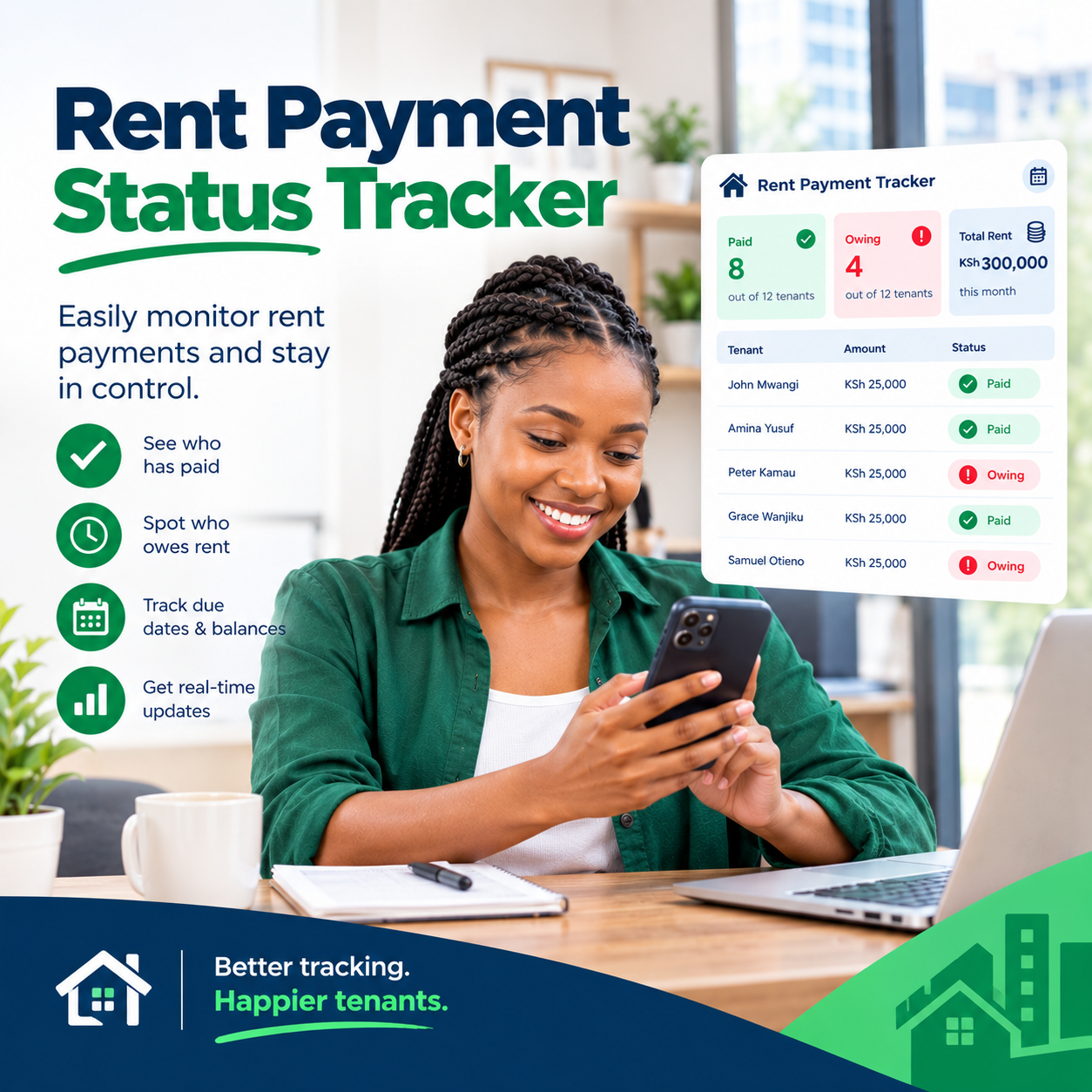
The multi-channel operation runs on one principle: channels vary, the register doesn’t. Every payment — bank transfer, M-Pesa, paybill — records into the same rent register against the same unit and tenant, and the monthly reconciliation covers all three sources together.
Landlords who unify their records across channels describe the same relief: the collect rent via bank transfer Kenya register becomes the property’s single payment truth, with each channel feeding it rather than competing with it.
Matching Tenants to Channels
The channel assignment follows the tenant’s reality: salaried tenants on bank transfers or standing orders, informal-income tenants on M-Pesa, and the portfolio’s larger operations adding a paybill for automatic identification. The assignment is stated in each lease, taught at move-in, and held consistently — the landlord who runs collect rent via bank transfer Kenya alongside the other channels without confusion is the one whose register never splits.
The Records That Hold It All Together
The Rent Register
Every unit, tenant, due date, and payment in one register — the operation’s source of truth, fed by bank statements, M-Pesa messages, and paybill reports alike. The register answers, at any moment, exactly who has paid, who owes, and what the month collected.
Digital registers reconcile against statements automatically where systems allow; the collect rent via bank transfer Kenya register is the first system a landlord installs, and every other habit depends on it.
The Statement Archive
Bank statements downloaded and archived monthly — the collection channel’s permanent evidence, growing into the property’s financial history. The archive is what every dispute, tax filing, and loan application draws from, and landlords who maintain it hold years of authoritative records within reach.
The Expense Side
The same dedicated account pays the property’s expenses, so its statement records both sides of the property’s money: rent in, costs out. The complete collect rent via bank transfer Kenya statement is the property’s financial autobiography — and it is the document every serious conversation about the property eventually requests.
Bank Statements as Financing Currency
The Loan Application Advantage
When the landlord applies for credit — a property loan, a development facility, a working-capital line — the bank statement is the first document every lender requests. The landlord whose rent collections live on statements presents years of verifiable income; the landlord whose collections live in cash presents reconstruction.
This financing advantage compounds with every year of clean statements, and it is among the strongest practical arguments for collect rent via bank transfer Kenya standardisation: the channel builds the borrower’s file automatically, month after month, without effort.
The Tax Season Advantage
The same statements serve tax season directly: income evidenced, expenses evidenced, and the annual return computed from records rather than reconstructed from memory. Landlords who file from collect rent via bank transfer Kenya statements report the season becoming routine — and the documented position holds under any query.
Diaspora and Absent Landlords
The Channel That Travels
For the diaspora landlord, the bank transfer holds a specific advantage: statements are accessible from anywhere, the account can be operated internationally, and the property’s money is visible without anyone on the ground. The absentee owner who standardises on collect rent via bank transfer Kenya collections holds the property’s financial truth in their own pocket, in their own timezone.
Combining With Local Structures
The diaspora operation combines the bank channel with local structures: a caretaker or agent handling the ground reality, their work verified through systems, and the rent flowing bank-ward rather than through any local float. This combination is what makes overseas ownership manageable — the collect rent via bank transfer Kenya account as the anchor, the local team as the hands, and the records as the trust between them.
Case Pattern: The Landlord Who Moved to the Bank
The pattern is clearest in a real-world shape. A Nakuru landlord with nine units — five salaried tenants, four informal-income — moved collections to a structured bank-first operation in one quarter.
The setup took two weekends: the dedicated account opened, the lease annexures updated with account details and references, the salaried tenants moved to standing orders, and the informal tenants kept on M-Pesa into the same register. The reconciliation day was fixed — the second of each month — and the statement became the routine’s anchor.
The first full quarter’s findings validated the move: collections arrived identified and on time, the standing-order tenants never needed a reminder, the one wrong-account error resolved within a week through the transfer evidence, and the month-end reconciliation dropped from an evening of phone calls to thirty minutes of statement matching.
The landlord’s summary captures the channel’s character: “M-Pesa collects from everyone; the bank statement convinces everyone.” Both truths together are what collect rent via bank transfer Kenya practice actually delivers — collection convenience at the gate replaced by documentary authority at the month.
Common Mistakes — and Their Cures
The mixed account is the first: rent flowing through personal accounts until the property’s performance becomes unmeasurable and unfinanceable. The cure is the dedicated account — the foundational structure of every professional collect rent via bank transfer Kenya operation.
The missing reference habit is the second: payments arriving unidentified until reconciliation becomes monthly detective work. The third is the unreconciled month — statements unread, gaps growing quietly, and the arrears forming that fifteen minutes would have caught.
The fourth is the informal moment-of-payment — the landlord accepting “I initiated it” as payment, which the lease’s landing clause should have settled permanently. The fifth is the single-channel rigidity — forcing bank transfers onto tenants whose lives run on M-Pesa, and losing collections to friction.
Each mistake is cured by the structures this guide describes, and each one, when left uncured, costs more than every structure combined. This arithmetic is why disciplined collect rent via bank transfer Kenya practice is the cheapest collection upgrade a landlord ever installs.
Frequently Asked Questions
Is bank transfer a good way to collect rent in Kenya?
Yes — for salaried tenants and larger portfolios, bank transfers offer the strongest records, the lowest friction at month-end, and the money already positioned for loans and investments. Most professional collect rent via bank transfer Kenya operations run the channel alongside M-Pesa, matching each tenant to the channel their life uses.
How do I set up rent collection through a bank account?
Open a dedicated rent account, share the details and reference format in writing attached to the lease, teach the reference habit at move-in, and run a fixed monthly reconciliation against statements. These four structures are the complete setup for collect rent via bank transfer Kenya practice.
What reference should tenants use when paying rent by bank transfer?
Unit number plus month — “B4-Jan” — stated in the lease, taught at move-in, and repeated on every reminder. The reference is what makes the collect rent via bank transfer Kenya reconciliation automatic, and enforcing it strictly is what keeps monthly matching effortless.
When is rent considered paid if the tenant initiates a transfer?
When the funds land in the landlord’s account — not when the tenant initiates or when the transfer is pending — and this moment belongs in the lease as a defined term. This clause is the most valuable single provision in any collect rent via bank transfer Kenya arrangement.
How do I verify a tenant’s bank transfer payment?
From your own statement: the payment either appears with the sender’s name, amount, and reference, or it does not — no tenant evidence is needed and no screen is ever shown. This verification independence is the core advantage of collect rent via bank transfer Kenya collections.
What do I do if a tenant transfers rent to the wrong account?
Present your statement showing non-receipt, request the tenant’s transfer evidence identifying where the money went, and support the recall through the sending bank — with rent remaining due until it lands in your account. The documented collect rent via bank transfer Kenya position keeps the landlord clean while the tenant recovers their error.
Can I use standing orders for rent collection?
Yes — and for salaried tenants on stable leases, they are the strongest arrangement: rent transfers automatically on the due date every month, and the collection conversation leaves the relationship entirely. The collect rent via bank transfer Kenya operation built on standing orders treats collections as background process.
How do bank transfers compare with M-Pesa for rent?
Bank transfers win on record weight, large-payment economics, and account position; M-Pesa wins on ubiquity, speed, and informal-income tenants. The professional answer uses both into one register, which is the practical shape of collect rent via bank transfer Kenya practice in the real market.
How do I reconcile bank rent payments each month?
Download the statement on a fixed day, match every incoming payment to its unit and tenant by reference, investigate unmatched items with a professional message, and update the rent register — fifteen to thirty minutes monthly. This reconciliation is the anchor habit of collect rent via bank transfer Kenya practice.
Do bank statements help with loan applications?
Decisively — statements of dedicated rent accounts are the first document every lender requests, and years of clean, verifiable rental income is the borrower’s file building itself automatically. This financing advantage compounds with every year of collect rent via bank transfer Kenya statements.
Is bank transfer collection suitable for diaspora landlords?
Yes — statements are accessible from anywhere, the account operates internationally, and the property’s money is visible without anyone on the ground, combined with local caretaking verified through systems. The collect rent via bank transfer Kenya account is the diaspora landlord’s financial anchor.
What lease clauses does bank-based collection need?
The account details as an annexure, the reference format, the due date, the moment-of-payment definition — rent is paid when it lands — and the late and partial payment consequences. These clauses make every collect rent via bank transfer Kenya procedure enforceable from the document the tenant signed.
Can one landlord run bank transfers and M-Pesa together?
Yes — channels vary, the register doesn’t: every payment from every channel records against the same unit and tenant, and the monthly reconciliation covers all sources together. The unified register is what keeps multi-channel collect rent via bank transfer Kenya operations free of confusion.
What is the biggest mistake landlords make with bank rent collection?
Running rent through a personal mixed account — which destroys the property’s measurable performance, weakens every loan application, and blends money that should never blend. The dedicated account is the foundational structure of every professional collect rent via bank transfer Kenya operation, and everything else builds on it.
How does bank collection scale as my portfolio grows?
Directly — statements, batch reconciliations, and account-to-account flows scale far better than gate-side collections, and the routines that serve nine units serve ninety unchanged. This scaling behaviour is why collect rent via bank transfer Kenya standardisation correlates directly with portfolio growth.