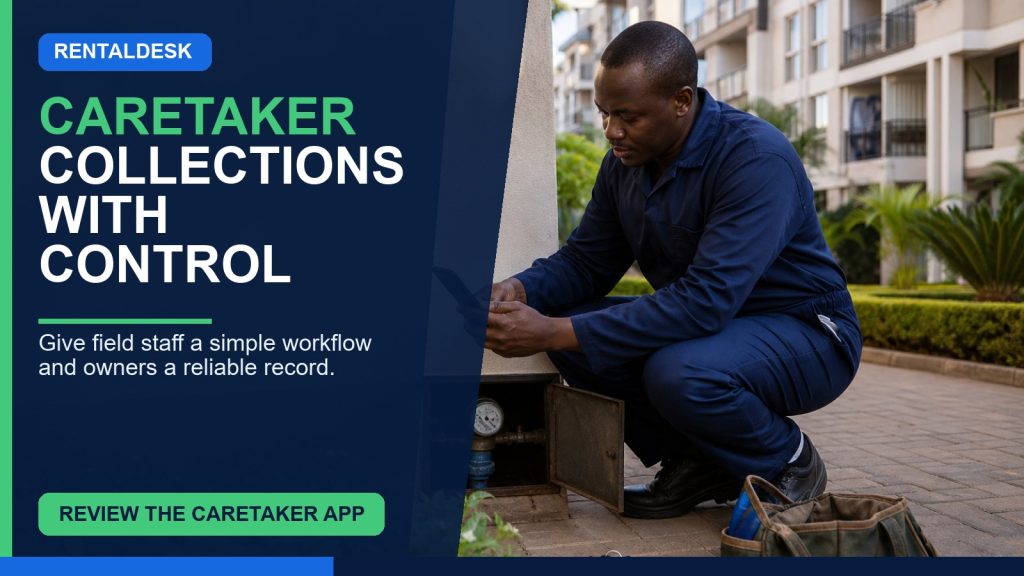
Caretaker management software is the digital system that connects property owners and managers with the caretakers who run their buildings on the ground — assigning tasks, receiving reports, logging maintenance, and keeping every property’s daily reality visible from anywhere. It exists to solve the oldest problem in property ownership: the person who knows what is happening at the property is not the person who owns it.
Every landlord with more than a few units eventually hires a caretaker — the watchman-turned-manager who opens gates, shows vacancies, receives parcels, reports leaks, and keeps tenants comfortable. The caretaker is the property’s eyes, hands, and voice.
But the caretaker is also the owner’s biggest blind spot. Whatever the caretaker reports is what the owner knows — and whatever the caretaker forgets, exaggerates, or handles informally simply never reaches the records at all.
Traditional caretaker management runs on phone calls, verbal reports, and trust. The owner calls to ask if the water pump was fixed; the caretaker says yes; and neither of them can prove anything a month later when the same pump fails again.
Caretaker management software replaces that arrangement with evidence: tasks assigned in writing, work confirmed with photos, issues reported the moment they appear, and every property activity recorded against a date and a name. The owner stops managing by telephone and starts managing by dashboard.
This guide covers the complete discipline: what caretaker management software actually is, the problems it solves, the features that matter, the daily workflows it creates, the benefits owners report, who needs it most, how it compares with WhatsApp and notebooks, how to choose and implement the right system, and what it returns on the investment.
Table of Contents
ToggleWhat Caretaker Management Software Actually Is
At its core, caretaker management software is a shared platform where the caretaker records property activity from their phone, and the owner or manager sees it live from theirs — two views of one truth, connected in real time.
The caretaker’s side is deliberately simple: today’s tasks, the issues they have reported, the maintenance they have logged, and the messages from their manager. A caretaker with basic smartphone skills records a day’s work in minutes.
The owner’s side is the command view: every property, every unit, every open issue, every completed task, and every expense — filterable by property, by date, and by status. The dashboard answers the questions phone calls used to ask.
Between the two sides runs the workflow engine: the owner assigns a task, the caretaker receives and completes it, the completion arrives with photos, and the record closes itself. This loop — assign, do, confirm — is the operational heart of caretaker management software.
The system also carries the property’s memory: every repair logged, every tenant issue recorded, every inspection photographed. When a dispute, a valuation, or a sale arrives, the property’s complete history is retrievable in minutes.
And because caretakers work where networks fail — gatehouses, basements, upcountry plots — genuine caretaker management software records offline and syncs automatically, so the record never depends on signal.
The Problem: Managing Caretakers Informally
What Informal Management Actually Looks Like
The informal version of caretaker management is universal in Kenya: instructions given verbally, progress reported verbally, and everything in between recorded nowhere. The owner rings when worried; the caretaker answers when reachable; and the truth lives in the gap between them.
The results are predictable. Tasks claimed but not done. Repairs reported late, after water damage has spread. Expenses described but never receipted. Tenants’ complaints relayed inaccurately or not at all. Every owner who has managed a caretaker by phone recognises this catalogue — and every one of its entries is a gap a proper caretaker management software system closes.
The Six Costs of Managing by Phone Call
The first cost is unverifiable work. “I checked the generator” is a sentence without a timestamp, a photo, or a witness — and unverifiable work drifts toward no work with remarkable speed. Owners who moved to structured caretaker management software reporting consistently describe the same discovery: the tasks they believed were being done and the tasks actually being done were different lists.
The second cost is late problem discovery. The caretaker who notices a ceiling stain on Monday and mentions it “when the boss calls” turns a small repair into a capital one. Issues reported the moment they appear — with photos — are issues caught while they are still cheap.
The third cost is expense opacity. Caretakers spend money: airtime, materials, small repairs, fundi payments. Without a record structure, every spend is a verbal claim — and verbal claims are where owner-caretaker trust quietly erodes, on both sides. A caretaker management software expense log with receipts attached ends the ambiguity permanently.
The fourth cost is tenant relationship blindness. The caretaker is the owner’s interface with tenants, but informal management means the owner never sees the complaints, the requests, or the patterns — until a tenant leaves and mentions everything at once.
The fifth cost is the single-person dependency. The caretaker who holds every key, every arrangement, and every piece of property knowledge in their head becomes irreplaceable — and irreplacable staff hold their employers hostage in ways nobody says aloud. Structured caretaker management software records make every arrangement transferable.
The sixth cost is remote blindness. Absentee landlords — in another town, abroad, or simply busy — suffer every cost above at double distance. The caretaker management software dashboard is specifically the remote owner’s cure: the property’s position delivered daily instead of discovered seasonally.
Core Features That Matter
Task Assignment and Confirmation
The foundational feature is the task loop: the owner or manager assigns work — clean the gutters, show unit B4, meet the plumber — and the caretaker receives it on their phone with its deadline and details. Completion is confirmed from the property, with photos, before the task closes.
The loop’s power is its closure: no task exists in limbo, because open tasks are visible to both sides until they are done. Owners running caretaker management software task loops report the same effect — the “I thought you were handling it” conversation disappears from the relationship entirely.
Issue and Incident Reporting
The caretaker’s reporting duty runs in the other direction: leaks, breakages, security concerns, tenant conflicts, and anything unusual — reported the moment they are seen, with photos and location. The reporting structure is what converts a caretaker from a respondent into a sensor.
Issues logged into caretaker management software arrive with their evidence attached, which is what makes them actionable: the owner sees the stain, not just hears about it, and decides with information instead of imagination.
Maintenance Logging and History
Every repair — who did it, what it cost, what was replaced — logged against the unit or system it touched. Over time the maintenance history becomes the property’s medical file: which water pump fails annually, which plumbing line recurs, which room consumes repairs.
The history is also where maintenance spending gets analysed: the owner reviewing a year of caretaker management software records sees exactly which repairs were urgent, which were preventive, and which were avoidable — the knowledge that turns next year’s budget from a guess into a plan.
Expense Recording With Receipts
The caretaker’s spending — materials, fundis, airtime, fuel — recorded per transaction with a photo of the receipt attached. Small expenses logged honestly in the moment end the monthly reconciliation argument that informal caretaker finance always eventually produces.
The expense log also builds the property’s true operating cost: owners who track caretaker spending through caretaker management software for a year finally know what their buildings actually cost to run — the figure every rent decision and investment decision depends on.
Tenant Request Management
Tenant complaints and requests flow through the same system: received by the caretaker, logged, actioned, and closed with their outcomes recorded. The tenant sees responsiveness; the owner sees the request trail; and the caretaker’s handling becomes visible rather than invisible.
This feature also protects the caretaker: tenants who claim requests were ignored meet the logged record, and tenants who never submitted requests meet the empty trail. Fair records protect the caretaker as much as the owner — a balance every good caretaker management software deployment maintains.
Inspection Checklists
Scheduled inspections — weekly rounds, monthly unit checks, seasonal reviews — run on checklists the caretaker completes from their phone: water tanks, security lights, gates, common areas, vacant units, each item confirmed or flagged with photos.
The checklist converts inspection from a habit into a record, and the record is what proves the property is being watched. Owners reviewing caretaker management software inspection histories can answer, at any time, exactly when the property was last properly checked.
Keys, Inventory and Supplies Tracking
Caretakers hold the property’s physical trust: keys, spare bulbs, cleaning supplies, tools, meter readings. The system tracks what the caretaker holds, what is issued, and what runs low — so keys stop disappearing and supplies stop evaporating.
Key tracking deserves special emphasis, because key control is property control: every key issued to a tenant, a fundi, or an agent recorded and returned through the same trail. Owners who manage keys through caretaker management software never repeat the lost-key rekeying expense that informal properties pay regularly.
Communication and Announcements
Messages between owner and caretaker live inside the system, beside the work they concern — announcements, instructions, and replies all attached to their context. The communication trail replaces the scattered WhatsApp history that nobody can reconstruct.
Attendance and Availability
For caretakers who work defined schedules, the system records check-ins and availability — so the owner knows the property is covered, and the caretaker’s reliability is documented fairly. Attendance records also protect caretakers in leave and payment conversations, which is why fair caretaker management software deployments are defended by caretakers themselves.
Multi-Property Dashboard
Owners with several buildings see every property side by side: open issues per building, tasks pending per caretaker, and the whole portfolio’s position on one screen. The multi-property view is where caretaker management software graduates from a single-caretaker tool into a portfolio management system.
Reporting and Exports
Monthly summaries — tasks completed, issues raised and closed, expenses incurred, inspections done — generated automatically for the owner’s files, the partners’ meetings, or the accountant’s records. Reports that build themselves get read; reports that require weekends get skipped.
The Daily and Weekly Workflows
The Caretaker’s Day
The system-shaped day begins with the task list: today’s assignments visible before the first gate opens. Through the day, activities are logged as they happen — the parcel received, the plumber supervised, the leak photographed, the tenant’s request recorded.
The day closes with the round: inspection checklist completed, open tasks updated, and anything unusual reported with its evidence. A caretaker management software day adds roughly ten minutes to the caretaker’s work — and converts all of it into record.
The Owner’s Day
The owner’s relationship with the system is shorter: a morning glance at the dashboard — overnight issues, completed tasks, anything flagged — and a decision or two where action is needed. The caretaker management software morning check replaces the “everything okay?” phone call that managed nothing.
The Weekly Review
Once a week, the owner reviews properly: the week’s expenses against receipts, the open issues aging past comfort, the inspections completed, and the tasks that slipped. Fifteen minutes of weekly review is the rhythm that keeps every caretaker management software deployment honest — because watched records stay accurate records.
The Monthly Close
Monthly, the summaries assemble themselves: the maintenance spend, the issue history, the property’s condition trail. The monthly close feeds the owner’s accounting, the partners’ reports, and the property’s growing institutional memory.
The Benefits Owners Report
The first benefit is verified work — the entire catalogue of claimed-but-unconfirmed tasks replaced by photo-backed completions. Owners consistently name this as the first change they noticed after adopting caretaker management software: the property’s work became visible, and visible work gets done.
The second is faster problem response. Issues reported with photos the hour they appear get decided the same day, and decisions made same-day prevent the damage escalation that delayed reporting causes. The repair-cost difference between caught-early and caught-late is the quietest large saving in property management.
The third is expense honesty. Receipts logged in the moment, spending visible weekly, and the monthly reconciliation reduced from an argument to a review — the caretaker management software expense discipline protects the owner’s money and the caretaker’s reputation simultaneously.
The fourth is tenant satisfaction. Requests logged, actioned, and closed visibly make tenants feel managed rather than tolerated — and satisfied tenants renew, pay promptly, and recommend the property. Owners who track tenant requests through caretaker management software report measurable improvements in retention and collections.
The fifth is remote confidence. The absentee owner’s daily dashboard delivers what site visits used to: the property’s true condition, witnessed by records rather than by reassurance. This benefit alone converts most remote owners to structured caretaker management software within their first month.
The sixth is institutional memory. Every repair, issue, expense, and inspection held permanently means the property’s knowledge survives caretaker changes, ownership changes, and the years between — an asset that appreciates the longer it runs.
Who Needs Caretaker Management Software Most
Landlords with multiple units across multiple buildings carry the clearest need: several caretakers, several properties, and one owner who cannot be everywhere. The multi-property dashboard of caretaker management software is built precisely for this shape.
Property management agencies need it structurally: caretakers deployed across client properties, owners expecting reports, and the agency’s reputation riding on every building’s upkeep. Agencies that run caretaker operations through structured caretaker management software systems win and keep client mandates on the strength of their reporting alone.
SACCOs, chamas, and investment groups with rental property need it urgently, because their properties are managed by committees and caretakers at distance — the exact configuration where informal management fails most expensively. Group-owned buildings on caretaker management software records give every member visibility the verbal report never could.
Schools, churches, and institutions with facilities staff complete the institutional tier: grounds kept, buildings maintained, and operations logged across large compounds. Facility teams running caretaker management software workflows report the same transformation as commercial landlords — work verified, costs visible, and maintenance planned.
Remote and diaspora landlords form the fastest-growing constituency: owners investing from abroad who need the property’s daily reality delivered reliably. For this group, structured caretaker management software is not an efficiency upgrade — it is the difference between owning property and worrying about it.
Caretaker Software vs WhatsApp, Notebooks and Phone Calls
WhatsApp is the modern halfway house, and it deserves honest assessment: it communicates brilliantly — photos fly, messages arrive — but it records nothing. Nothing reconciles, nothing closes, nothing attributes, and the important photo scrolls away beneath sixty others within a day.
Teams that try to manage caretakers through caretaker management software alternatives like group chats discover that communication and management are different jobs: chat coordinates the moment; the system manages the month.
The notebook fails earlier still: one book, one keeper, entries that cannot be shared or verified — and the whole record dies with the notebook or the caretaker who kept it.
Phone-call management is the baseline everything replaces: instructions and reports with no existence beyond the conversation. Every dispute that informal caretaker management produces traces to that absence — and none of it is fixable by calling more often.
The structured system wins on every dimension that matters: tasks assigned and closed, issues reported and resolved, expenses logged and reconciled, and every record attributed and searchable. The migration from chat-and-calls to caretaker management software is consistently described by owners as the moment caretaker management stopped being a hope and became a system.
How to Choose the Right System
Ease for the caretaker comes first, because the caretaker is the system’s daily user and its adoption gate. Hand the trial phone to your actual caretaker and watch a real task being completed — if it happens in under a minute, the system will survive; if it feels like paperwork, keep shopping. The caretaker management software products that thrive are designed for gatehouse thumbs, not office desks.
Offline capability must be tested in your property’s actual dead zones, not claimed in a brochure — because caretakers work exactly where networks fail. Photo attachment, task closure, and expense logging should all work without signal.
Owner-side depth is the second evaluation: the dashboard, the reports, the multi-property view, and the exports — tested against your real portfolio shape. The caretaker management software that serves the caretaker well but starves the owner is half a product.
Support and local understanding complete the checklist: response speed during the trial, familiarity with Kenyan property realities, and references from landlords at your scale whom you can call. And the exit test belongs in every evaluation: your property’s records must export completely, because they must outlive any software relationship.
Implementing Without Disrupting the Property
Begin with the task audit: list what your caretaker actually does daily and weekly — the rounds, the repairs, the tenant interface, the spending — because this list becomes the system’s configuration blueprint for your caretaker management software deployment.
Load the foundation carefully: the property or portfolio entered with its units, the caretaker with their login and role, the standing tasks and inspection checklists created, and the current keys and supplies registered. A day of setup gives the system its complete opening picture.
Launch with the two core loops — task assignment and issue reporting — and add expenses, inspections, and inventory as the habits hold. Train on real work: today’s actual rounds recorded through the system, not demonstration examples.
Frame the rollout truthfully to the caretaker: the system records their work fairly, protects them in disputes, documents their reliability, and ends the monthly money arguments. Caretakers who hear that framing — and then watch it prove true — become the system’s strongest users, which is the adoption pattern every successful caretaker management software deployment follows.
Supervise the first month closely: review entries daily, correct habits immediately, and make the system’s early experience responsive. The first thirty days set the record culture for years.
Costs and Return on Investment
Pricing follows recognisable models: modest monthly subscriptions per property or per user, tiered plans by portfolio size, and custom licensing for agencies and institutions. The caretaker management software subscription typically costs less than one avoided repair per year.
The return arrives through named channels: damage prevented through same-day reporting, expense honesty through receipted logs, tenant retention through visible responsiveness, and the owner hours returned by dashboards replacing phone-chasing.
Against these channels, farms of every size — one building or fifty — consistently find the system repaying itself within the first quarter. The caretaker management software comparison is never against zero but against the status quo’s invisible invoice: the unreported leak, the unreceipted spend, the lost keys, and the tenant who left without anyone knowing why.
Common Mistakes to Avoid
The first mistake is deploying the system onto the caretaker without the owner changing too — the dashboard installed but never opened, which teaches the caretaker that the records are theatre. The caretaker management software owner who reads daily and reviews weekly gets the records they deserve; the absent one gets silence.
The second is over-configuring — every module activated, every checklist itemised, until the caretaker’s ten minutes becomes an hour and the recording quietly stops. Start with the two core loops and grow into the rest.
The third is the blame-frame — presenting the system as surveillance rather than documentation. The caretaker who experiences caretaker management software as evidence in their favour adopts it; the one who experiences it as a trap routes around it, and the property loses either way.
The Future of Caretaker Management
The category is absorbing the wider property-technology wave: sensors reporting water and power status automatically, smart locks logging keyless entries, and maintenance histories feeding predictive schedules that flag the pump before it fails.
The deeper shift is integration: caretaker records feeding the owner’s accounting, the agent’s client reports, and the property’s valuation file from the same system. Buildings managed through caretaker management software today are building the documented histories that tomorrow’s buyers, lenders, and insurers will price.
Frequently Asked Questions
What is caretaker management software?
A shared platform connecting property owners with their caretakers: tasks assigned and confirmed with photos, issues reported the moment they appear, expenses logged with receipts, and every property activity recorded against a date and a name. A complete caretaker management software deployment turns caretaker management from phone calls into evidence.
Do caretakers need their own smartphones to use it?
Not necessarily — systems run on shared devices with individual logins, and the practical rule is one working phone per property rather than per person. Any genuine caretaker management software platform is designed to work on basic smartphones under real field conditions.
Does it work without internet at the property?
Yes — quality platforms record offline and sync automatically when signal returns, because caretakers work exactly where networks fail. Test the offline behaviour of any caretaker management software candidate in your property’s actual dead zones during the trial.
Can it track the caretaker’s spending and receipts?
Yes — every expense logged per transaction with a photo of the receipt attached, visible to the owner weekly and reconciled monthly. This single feature ends the owner-caretaker money ambiguity that informal arrangements always eventually produce, and it is among the highest-value capabilities in caretaker management software.
Can I manage several properties and caretakers from one account?
Yes — the multi-property dashboard shows every building, every caretaker, and every open issue side by side, with reports per property and totals across the portfolio. This is the core capability that makes caretaker management software a portfolio tool rather than a single-building app.
Will my caretaker resent being monitored?
Only where the system is framed as surveillance — and the honest framing is the opposite: the records document the caretaker’s work fairly, protect them in disputes, and settle money questions from evidence. Caretakers who experience caretaker management software as protection adopt it willingly and defend it loudly.
How is this different from just using WhatsApp with my caretaker?
WhatsApp communicates in the moment; it records nothing — no task closure, no expense reconciliation, no searchable history, and no attribution. A caretaker management software platform turns every message-worthy event into a structured record that manages the month, not just the minute.
How much does caretaker management software cost?
Modest monthly subscriptions per property or user, scaling by portfolio — typically less than one avoided repair per year. Owners who compare the caretaker management software subscription against the damage prevented and the hours returned rarely remain undecided for long.
How do I start using it with my current caretaker?
Audit what the caretaker actually does daily, load the property’s structure and standing tasks, launch with task assignment and issue reporting first, and train on real work rather than demonstrations. The caretaker management software deployments that succeed all follow that same short sequence.
What happens to my property’s records if I change systems?
They should export completely — histories, documents, and logs — because the property’s records must outlive any software relationship. Test the export during the trial of any caretaker management software platform, before the subscription rather than after.