
How to manage multiple landlords as agency in Kenya is the operational question that determines whether a property management business scales or collapses under its own weight. Running a small agency with three landlord clients is manageable on spreadsheets and WhatsApp. Running the same agency with thirty landlord clients, five hundred units, and properties spread across Nairobi, Mombasa, and Kisumu is a different business entirely.
The systems that worked at three clients actively sabotage the business at thirty. Records get mixed up, statements go missing, management fees are miscalculated, and a single misplaced receipt can erode the trust of a landlord whose portfolio represents a significant share of agency revenue. Understanding how to manage multiple landlords as agency in Kenya is therefore not about adding software to an existing process. It is about designing the operating model that makes scale possible.
Why Managing Multiple Landlords as an Agency in Kenya Matters
The case for mastering how to manage multiple landlords as agency in Kenya rests on the economics of agency leakage. Industry estimates suggest Kenyan agencies lose between 3% and 8% of rental income every year to leakage, missed rent, untracked deposits, and unreconciled M-Pesa payments. On a portfolio of KSh 12 million in annual rent, that is between KSh 360,000 and KSh 960,000 vanishing into the gaps. Every single year. Those figures are not abstract. They represent receipts that were never matched, deposits that were never refunded, units that were listed as vacant while occupied, and landlords who stopped receiving statements and started doubting the agency’s accounting.
The growth ceiling compounds the problem. An agency cannot take on 100 new units if its current system already buckles at 50. It cannot onboard a corporate client like a bank or NGO if it cannot generate proper monthly statements in PDF form. It cannot expand to Mombasa if its process relies on a single office collecting rent in cash. The decision to redesign the operating model for how to manage multiple landlords as agency in Kenya is therefore not about convenience. It is about unlocking a business that cannot previously be run.
The Owner-to-Property-to-Unit Hierarchy
The how to manage multiple landlords as agency in Kenya conversation must begin with data structure, because everything else depends on it. A landlord managing several of their own buildings has one beneficial owner, even if the properties differ. A managing agency represents unrelated clients whose instructions, agreements, fees, balances, and reports are not interchangeable.
Software for managing several landlord clients should therefore treat the owner as a core reporting and control dimension, not as a note attached to a property. A sound hierarchy establishes where information belongs before monthly transactions begin. The agency sits at the top. Below that, each owner or client. Below that, each property. Below that, each unit. Below that, each lease, and below that, each transaction or task.
Stable codes matter enormously. “Westlands Block A” should not appear elsewhere as “W’lands Apts” if those labels refer to the same asset. Duplicate codes undermine imports, filters, and reconciliations. The owner link should also be mandatory for each property; otherwise, a new building can appear in a consolidated total but disappear from a client report.
Why Separate Spreadsheets Break as the Agency Grows
The how to manage multiple landlords as agency in Kenya conversation must address the spreadsheet problem honestly. One workbook per client feels safe when an agency is small. Growth exposes the weakness of that arrangement. Staff copy tenant details into multiple files, property codes are written differently, and a receipt may be pasted into the wrong tab. A management-fee formula changed for one owner can be copied accidentally to another. Meanwhile, the director cannot see which client packs are ready without asking every accountant.
The issue is not that spreadsheets are inherently inaccurate. It is that they depend on people maintaining the same definitions, versions, and cut-off dates across disconnected files. A renamed attachment may hide which statement was approved. An accountant correcting a receipt after a report was circulated may have no reliable way to show the before-and-after position. When staff are absent or assignments change, knowledge of special formulas and unresolved balances can remain in personal notes. Professional software for professional agencies should reduce this fragmentation by giving each record a stable place and each exception an owner.
The Monthly Accounting Workflow for Multiple Landlords
The how to manage multiple landlords as agency in Kenya process must follow a disciplined monthly sequence rather than depend on whoever prepares a statement first. The workflow that works runs as follows.
Confirm billing. Review active leases, recurring charges, move-ins, exits, and approved changes before invoices are finalised. This prevents the common error of billing a tenant who vacated or missing a rent escalation that should have taken effect.
Capture collections. Import or enter receipts, then allocate them to the correct tenant, unit, property, and owner. Every receipt must have an unambiguous destination.
Isolate uncertainty. Keep a receipt with no reliable unit reference in an unapplied or exception queue. Do not guess merely to make a report balance. A payment that cannot be confidently attributed should remain visible as an exception until evidence supports an allocation.
Record approved property costs. Attach the expense to the correct property and reporting period, with supporting evidence and an approval where the agency’s policy requires it.
Calculate supported agency fees. Apply the documented agreement only after the eligible base and exceptions have been reviewed. A management fee applied to the wrong base is a source of dispute with every landlord it affects.
Reconcile owner balances. Compare opening position, billing, receipts, reversals, expenses, fees, and adjustments at one stated cut-off date. The reporting cut-off matters. An owner statement prepared on the third day of the next month should say which transactions were included.
Review and release. A second person resolves exceptions or approves their disclosure before the owner pack is issued. An adjustment should retain its date, reason, preparer, and approver. Replacing a wrong number without explaining the correction makes a polished report less dependable, not more.
Per-Landlord Reporting Without Rebuilding Every Statement
The how to manage multiple landlords as agency in Kenya conversation must address reporting, because per-landlord reporting is where trust is built or destroyed. A reusable owner pack should be generated from reviewed source records, not assembled by copying totals between spreadsheets.
A strong owner pack includes a financial summary showing the opening owner balance, amounts billed, collections, credits, approved property expenses, management fees, adjustments, and closing balance. Supporting schedules show arrears and transaction detail. Operational pages answer different questions and may cover occupancy, leases approaching expiry, unresolved maintenance, vacant units, and actions requiring the owner’s decision. Calling an occupancy summary a financial statement creates confusion. Keeping the two views distinct makes the pack easier to review.
Consistency should not prevent useful filtering. One owner may have apartments and another two office floors. The underlying definitions should remain the same even when their schedules contain different property types. A manager should be able to move from an agency total to an owner, property, unit, and source transaction without losing the reporting context. Any agency learning how to manage multiple landlords as agency in Kenya should treat the owner pack as the single most important deliverable.
Roles, Approvals, and Client Confidentiality
The how to manage multiple landlords as agency in Kenya conversation must address access control, because an agency holds data belonging to multiple landlords who may be competitors or simply unrelated. One accounting team may serve all clients while property managers are assigned to selected assets. That requires a role design based on duties and portfolios.
Directors may need consolidated dashboards. Accountants may post receipts and prepare statements. Property managers may update leases and maintenance records for assigned properties. Caretakers may need a narrow operational view. A client viewer, if available, should not automatically receive editing rights. Least-privilege access means giving a user what the role requires and reviewing that access when assignments change.
The practical questions to test are straightforward. Can a staff member assigned to Owner A search for Owner B? Who can change an owner-property link? Does a fee-rate change require approval? Is a role change recorded? Can exported reports be restricted consistently with the on-screen view? For any agency learning how to manage multiple landlords as agency in Kenya, these questions determine whether client confidentiality is protected by design or by luck.
Approval points should reflect risk. A routine task update may not need a director, while a change to an opening balance, management-fee rule, or owner assignment deserves stronger control. The agency should document these rules before configuring software so that technology follows governance rather than inventing it.
M-Pesa Reconciliation Across Multiple Landlord Portfolios
The how to manage multiple landlords as agency in Kenya conversation cannot be separated from M-Pesa, because roughly 78% of tenant payments in urban areas arrive through mobile money. The old way involves someone screenshotting payments, pasting them in a folder, manually updating a sheet, then chasing the landlord on WhatsApp to confirm the figure. With a proper system, every M-Pesa Paybill or Till transaction is automatically matched to the right tenant, the right unit, and the right landlord statement. No screenshots. No manual reconciliation.
RentalDesk connects to Safaricom’s Daraja API with Instant Payment Notification callbacks. When a tenant pays, the system extracts the amount, phone number, account reference, and transaction ID, matches the reference to the correct tenant and unit, credits the tenant account, generates a receipt, and updates the dashboard in real time. The payment flows through to the correct landlord’s records without manual intervention.
For an agency managing multiple landlords, the critical requirement is that the reconciliation logic preserves the owner boundary. A payment must be allocated not just to the right tenant but to the right owner. A how to manage multiple landlords as agency in Kenya system that reconciles payments to tenants but not to owners creates a reporting problem at month-end.
Bank Integration and Client Money Rules
The how to manage multiple landlords as agency in Kenya conversation must address bank reconciliation and client money rules. Commercial tenants, corporate leases, and diaspora landlords often pay by bank transfer. An agency that handles only M-Pesa creates a fragmented record that undermines every report generated from it.
RentalDesk integrates directly with APIs from Equity, KCB, Co-operative Bank, Stanbic, and Standard Chartered. Deposits are captured and reconciled against invoices without relying on SMS messages or manual statement downloads. This matters for agencies with mixed portfolios where some tenants pay via mobile money and others pay via bank.
Under the Estate Agents Act, Cap 533, subsidiary legislation, an estate agent who is providing property management services is required to open a separate designated account where both the name of the company and the client appear as the identity. An estate agent may keep one client account or several client accounts as he thinks necessary. The agency is liable to account to a client for interest received on moneys deposited in a client account. Any agency serious about how to manage multiple landlords as agency in Kenya must ensure that client money is held separately and accounted for correctly.
Implementing the Agency Operating Model
The how to manage multiple landlords as agency in Kenya process should follow a structured implementation path. Migration begins with decisions, not uploads.
Inventory everything. List every owner, management agreement, property, unit, active lease, user, and required monthly report. Identify duplicate codes, missing effective dates, and balances that cannot yet be supported.
Agree the target hierarchy and data dictionary. Define what each field means, how owners link to properties, and how properties link to units. Clean owners and property codes before tenant records.
Validate leases and opening balances. Load opening invoices and balances only after leases have been validated. Document whether a balance is a tenant receivable, owner balance, deposit reference, or another category. A single “balance” column is rarely sufficient.
Map users to roles and property assignments. Have responsible managers approve the access list before go-live.
Pilot one owner. Choose a portfolio that is representative but manageable. Process one complete reporting month in parallel with the existing method. Compare billing, allocations, expenses, fees, arrears, and closing owner balances. Resolve every unexplained variance and record approved differences.
Roll out in controlled batches. Each batch should have an owner, reconciliation deadline, issue log, and sign-off. This staged approach is how how to manage multiple landlords as agency in Kenya becomes a working operating model rather than a failed software project.
How RentalDesk Supports Agencies Managing Multiple Landlords
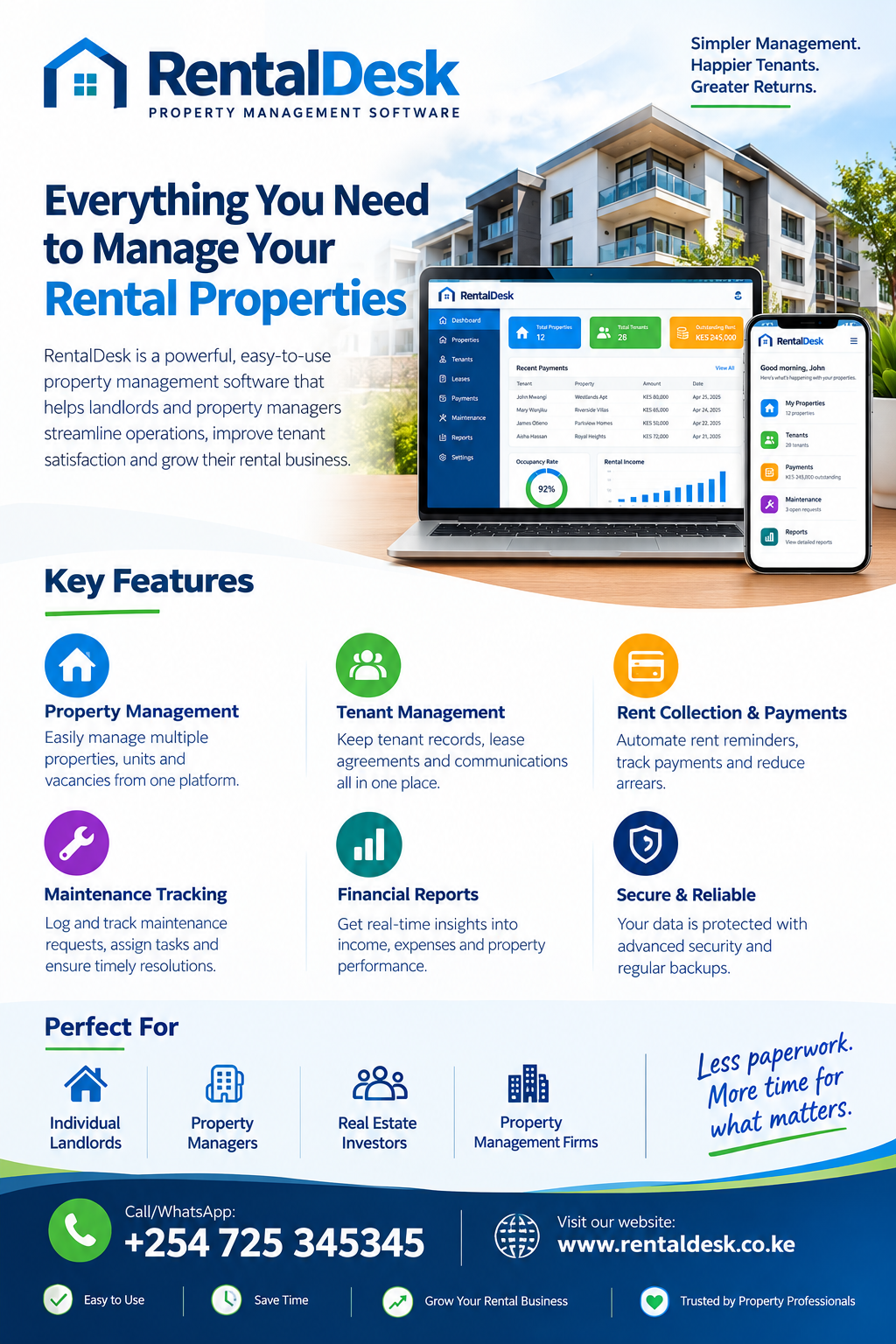
RentalDesk is built specifically for Kenyan property agencies, estate managers, and companies that manage properties for many landlords. The platform supports multi-owner reporting, staff roles, rent collection, arrears tracking, utility billing, maintenance records, and agency-level oversight from one dashboard.
Owner hierarchy. The system maintains a clear boundary around each owner’s records while giving authorised managers a consolidated view of the agency’s work. Every lease, charge, receipt, expense, task, and report has an unambiguous destination.
Per-owner statements. The agency can generate clean monthly statements for each landlord showing rent collected, arrears, fees, and net remittance. These statements are produced from the same verified records used for daily operations.
Role-based access. Property managers, accountants, caretakers, and client viewers each see only what their role requires. Every action is logged with a timestamp and user identification.
M-Pesa and bank reconciliation. Payments are captured and matched automatically, so the agency’s records reconcile without manual intervention.
Automated invoicing and reminders. Rent invoices are generated across all properties and all owners automatically, with reminders sent without human effort.
Arrears tracking. Arrears are categorised by age (1–7, 8–30, 31–60, 60+ days) with dashboard visibility by tenant, unit, property, and owner.
Reporting. Rent collection reports, income versus expense reports, owner statements, and audit-ready financial records are generated from the same verified ledger.
Common Mistakes Agencies Make
The how to manage multiple landlords as agency in Kenya journey has predictable failure modes. Running one spreadsheet per landlord is the first. The files do not talk to each other, and the director cannot see the agency-wide position without asking every accountant. Failing to define the owner hierarchy before migrating data is the second.
A property with no owner link disappears from client reports but remains in consolidated totals. Not separating client money is the third. The Estate Agents Act requires designated client accounts, and mixing client money with agency operating funds is both a compliance risk and a trust risk. Skipping the pilot is the fourth. Onboarding every owner at once means errors surface in live reporting. Failing to enforce role-based access is the fifth. Client confidentiality depends on access controls, not on good intentions.
The Future of Agency Property Management in Kenya
The how to manage multiple landlords as agency in Kenya landscape is moving in a clear direction. Government tax infrastructure is integrating with property management platforms, which means agency records will increasingly connect to landlord compliance reporting. The Estate Agents Registration Board continues to enforce licensing and accounting requirements. Digital platforms are making it easier for agencies to scale without adding administrative headcount.
The agencies that adopt a structured operating model early will not simply have tidier records. They will have lower leakage, faster reconciliation, stronger landlord relationships, and a business that can onboard a corporate client without rebuilding its systems. RentalDesk provides the structured platform that makes managing multiple landlords as an agency in Kenya work — not as a collection of spreadsheets held together by memory, but as a governed operating model with clear boundaries, automated reconciliation, and per-owner reporting that landlords can trust.
- How to manage multiple landlords as agency in Kenya
- How to manage multiple landlords as agency in Kenya
- How to manage multiple landlords as agency in Kenya
- How to manage multiple landlords as agency in Kenya
- How to manage multiple landlords as agency in Kenya
- How to manage multiple landlords as agency in Kenya
- How to manage multiple landlords as agency in Kenya
- How to manage multiple landlords as agency in Kenya