
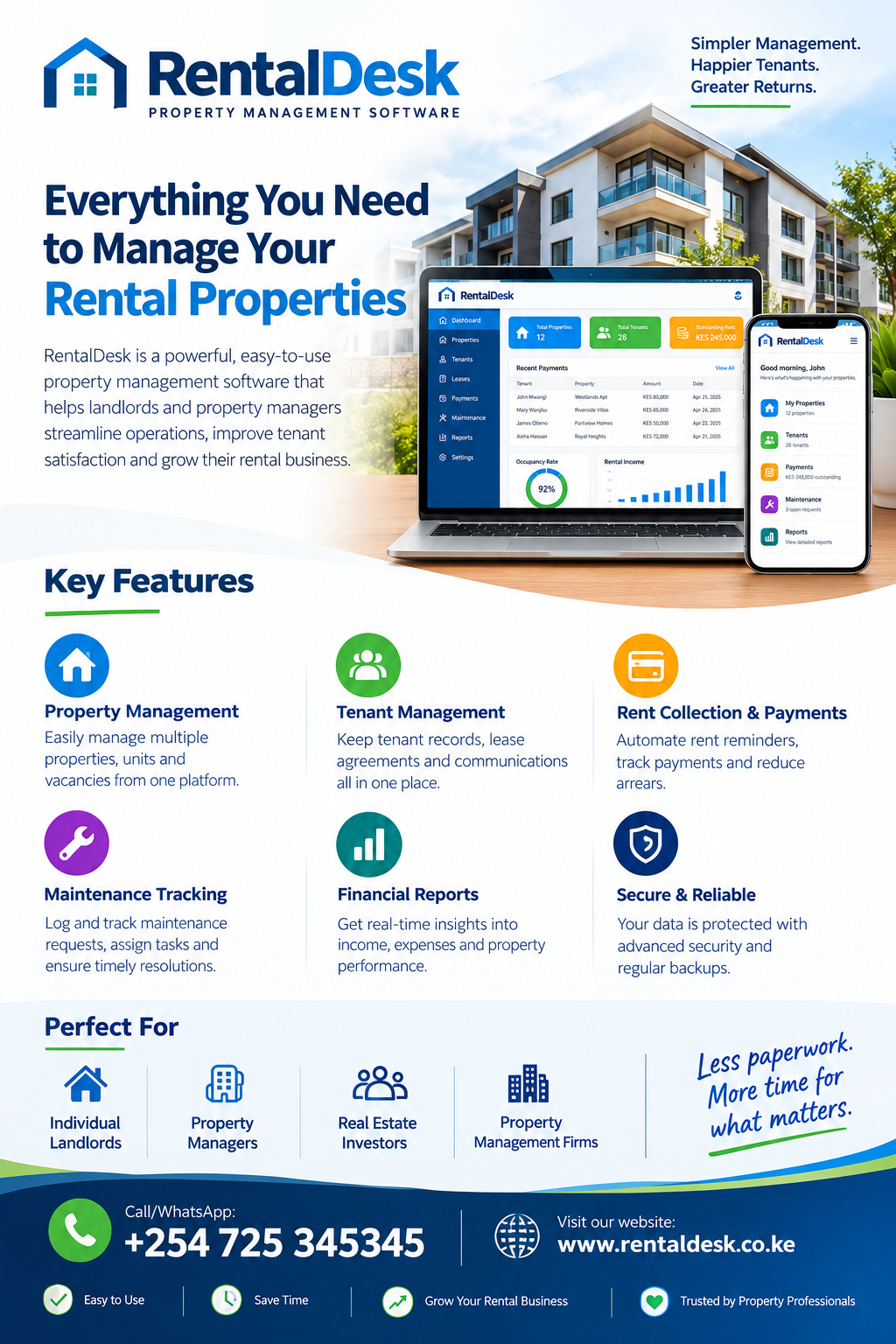
Property management software in kenya has become the operational backbone for landlords and property managers seeking to control arrears, automate M-Pesa collection, and maintain compliance with a rapidly digitising tax authority. The market has matured significantly. What was once a niche tool for large agencies is now a practical necessity for landlords managing everything from a single bedsitter in Umoja to a portfolio of mixed-use buildings in Westlands. The shift is driven by a simple fact: over 90% of rent payments in urban Kenya now flow through M-Pesa, yet a 2023-2024 Real Estate survey by the Kenya National Bureau of Statistics found that just 47.2 percent of real estate agents use rent collection software. That gap between how tenants pay and how landlords record what was paid is where money, time, and trust are lost.
Why Property Management Software in Kenya Matters Now
The conversation around property management software in kenya has acquired urgency because three forces have converged. The first is tenant expectation. Tenants now expect online receipts, mobile-based rent payments, maintenance responsiveness, and financial accountability. A landlord still issuing handwritten receipts is competing against one issuing instant digital receipts from the same building.
The second is regulatory. The Kenya Revenue Authority launched the Electronic Rental Income Tax System (eRITS) in April 2025, a digital platform designed to simplify rental income tax compliance for property owners and property managers. Taxpayers earning residential rental income between KES 288,000 and KES 15 million annually are required to pay monthly residential rental income tax of 7.5% of gross income. The introduction of eRITS does not change the compliance requirements, but it does change the mechanism. Accurate digital records are now a compliance requirement rather than an operational preference.
The third is operational. Manual systems cannot keep pace with growth. Industry data shows that the majority of Kenyan property managers still use WhatsApp and Excel spreadsheets to manage their rentals, yet the agencies using proper property management systems are growing at three times the rate of their competitors and collecting rent 40% faster. The decision to adopt property management software in kenya is therefore not about convenience. It is about competitive survival.
What Property Management Software in Kenya Should Actually Do
The market offers many tools that claim to manage rentals. A much smaller number connect collection, reconciliation, documentation, and reporting in a way that actually reduces work. A genuine property management software in kenya does six things. It captures rent payments automatically through M-Pesa. It matches payments to the correct tenant and invoice without manual intervention. It tracks arrears with aging analysis. It generates invoices, reminders, and receipts without human effort. It produces financial reports suitable for KRA filing. And it maintains a complete tenant and lease record.
Systems that do only the first are payment recorders. Systems that do all six are operating systems. RentalDesk is built around the second model, giving landlords a unified dashboard to track rent, tenant activity, occupancy, arrears, expenses, and M-Pesa payments for all properties in real time.
M-Pesa Integration: The Foundation of Property Management Software in Kenya
The property management software in kenya conversation cannot proceed without addressing M-Pesa, because in Kenya the payment rail determines what automation is possible. Safaricom reported over 35 million active M-Pesa users in Kenya as of 2025, processing more than KSh 35 trillion in transactions annually. Industry surveys consistently show that 80–90% of residential rent payments are made through M-Pesa.
RentalDesk integrates directly with Safaricom’s Daraja API. When a tenant pays via M-Pesa Paybill, the system captures the C2B callback, extracts the amount, phone number, account reference, and transaction ID, matches the reference to the correct tenant and unit, credits the tenant account, generates a receipt, and updates the dashboard in real time. The entire sequence completes in seconds, without manual intervention.
The platform also supports M-Pesa STK Push, which sends a payment prompt directly to the tenant’s phone. The tenant confirms the amount and enters their PIN. The payment completes without the tenant typing a Paybill number or an account reference at all. For landlords who want to understand how property management software in kenya actually improves collection, the STK Push integration is where the improvement begins.
Automatic Bank Deposit Reconciliation
A complete property management software in kenya should not treat M-Pesa as the only rail. Commercial tenants, corporate leases, and diaspora landlords often pay by bank transfer. RentalDesk integrates directly with APIs from top Kenyan banks including Equity, KCB, Co-operative Bank, Stanbic, and Standard Chartered. When tenants pay rent via bank transfer, the system captures the deposit and reconciles it against invoices.
This integration matters because it prevents the fragmentation that occurs when M-Pesa reconciliation and bank reconciliation live in separate processes. A single ledger that handles both rails is a single source of truth. Any landlord evaluating property management software in kenya should confirm that the platform supports both mobile money and bank reconciliation in the same system.
Partial Payments, Duplicates, and Third-Party Payments
The property management software in kenya conversation must address exceptions, because partial payments are a routine feature of the Kenyan rental market. Industry data shows that partial payments account for roughly 8–12% of all rent transactions in any given month.
RentalDesk posts partial payments against the open invoice and leaves the balance open for follow-up. The tenant is not treated as fully unpaid when they have paid part of the rent. Duplicate payments are detected by transaction ID and flagged for review rather than auto-posted. Third-party payments—where a spouse, parent, or employer pays on the tenant’s behalf—enter a reconciliation queue where authorised staff can assign the payment to the correct tenant with a full audit trail.
A property management software in kenya that does not handle these exceptions will either chase tenants who have paid or fail to chase tenants who have not. The exception process must be as structured as the routine process.
Automated Invoicing, Reminders, and Receipts
The property management software in kenya must extend beyond payment capture to the full billing cycle. RentalDesk generates recurring rent invoices automatically from the lease record and sends payment reminders before and after the due date.
The reminder ladder escalates predictably. A friendly heads-up before the due date. A neutral reminder on the day. A firmer message a day or two after. A factual reminder once the word “arrears” becomes appropriate. A formal notice at a defined threshold. Most arrears are recovered at the first polite reminder, because most late payments are not deliberate defaults.
Digital receipts are issued automatically once payment is verified, sent via SMS, WhatsApp, or email. The receipt includes the transaction ID, payment date and time, amount paid, and outstanding balance. This eliminates the “I paid” versus “I didn’t receive it” disputes that consume disproportionate time in manual operations.
Arrears Tracking and Aging Analysis
A property management software in kenya that does not track arrears properly is not managing arrears at all. RentalDesk provides automated arrears reports, aging analysis categorising balances by 1–7, 8–30, 31–60, and 60+ days, and payment behaviour analysis.
The aging breakdown is the core diagnostic. Arrears aged in buckets allow property teams to see which balances are still recoverable and which are bleeding out. Tenants slip into the next bucket without the property manager doing anything. The longer a balance sits unpaid, the lower the probability of full recovery. A well-designed RentalDesk surfaces this on the dashboard so landlords can act on what matters—cleaning up the 60+ day cases before they become write-offs.
Tenant and Lease Management
The property management software in kenya should provide comprehensive tenant and lease management. RentalDesk stores tenant profiles including names, contact details, National ID numbers, KRA PINs, lease agreements, and payment history. Lease tracking features allow landlords to manage start and end dates, renewals, and deposits, with automated alerts before lease expiry.
Document storage is equally important. The platform securely stores lease agreements, tenant ID copies, move-in and move-out inspection reports, and compliance certificates. This centralisation makes documents accessible when needed for audits, disputes, or regulatory inspections.
Maintenance Request Tracking
A property management software in kenya that handles only rent collection is solving half the problem. Maintenance is where tenant satisfaction is won or lost. RentalDesk allows tenants to submit maintenance requests through the tenant portal with photos and descriptions. Landlords can assign requests to vendors, track progress, approve quotations, and record completion with evidence.
This structured approach ensures no repair is forgotten and all costs are properly documented. For Kenyan properties facing aging infrastructure, water supply issues, and seasonal weather challenges, prompt maintenance is essential to preserve property value and tenant satisfaction.
Multi-Property Portfolio Management
For landlords with properties in different locations, the property management software in kenya must support multi-property management. RentalDesk provides a unified dashboard where landlords can view all properties at a glance, monitor rent collection per building, track occupancy and vacancies, compare revenue performance, and analyse arrears per location.
You can manage properties across Nairobi, Mombasa, Kisumu, Nakuru, Eldoret, Kiambu, and Kajiado from one centralised platform. The system groups properties by region, allowing landlords to compare performance across different markets.
KRA Compliance and eRITS Reporting
The property management software in kenya question has acquired a compliance dimension that did not exist a few years ago. The Draft Income Tax (Residential Rental Income Tax) Regulations 2026 propose making registration on eRITS mandatory for all landlords within the monthly rental income band. Landlords must submit a return and pay tax due on or before the 20th day of the month immediately following the month in which the rent was received.
RentalDesk generates KRA-ready reports that support MRI filing through eRITS. The platform tracks rental income, expenses, and arrears, providing the accurate records needed for monthly returns and avoiding penalties associated with inaccurate or late filings.
Pricing Considerations for Property Management Software in Kenya
The property management software in kenya market offers a range of pricing models. Tiered pricing by units is the most common. Per-unit pricing charges a set amount for every unit. Percentage-of-rent pricing takes a share of rent collected. One-off licences charge once for software installed on your own computer. Free tools cost nothing upfront but often limit units, users or features.
RentalDesk offers a Free Lite plan at KES 0 forever for one property with up to five units. The Starter Plan at KES 5,000 per month covers up to 99 units with M-Pesa collection and reconciliation, SMS reminders, bulk import, staff accounts, and advanced reports. The Estate Manager Plan at KES 9,500 per month supports 100–999 units with multi-property operations and role controls. Quarterly billing includes 5% off and yearly billing includes 10% off the base monthly rate.
The market range for property management software in Kenya runs from free for small portfolios to roughly KSh 1,500–12,000+ per month depending on units and features, plus quote-based enterprise plans.
The Financial Case for Property Management Software in Kenya
The property management software in kenya decision is ultimately an arithmetic question. A landlord managing 30 units who reconciles manually spends 4–6 hours per month on reconciliation alone. At 50 units, it becomes a half-day exercise that repeats monthly. An automated system reduces that to minutes.
The saving is not only time. One Lavington landlord managing 25 residential units reduced arrears from 35% to just 7% after implementing automated reminders and structured collection. A property management company in Nairobi took over a distressed property with a rent collection rate of 55%. After implementing automated M-Pesa reconciliation and arrears workflows, the collection rate improved to 94% within four months.
Common Implementation Mistakes
The property management software in kenya journey has predictable failure modes. Migrating unclean data—disputed balances, inconsistent tenant names, outdated phone numbers—transfers problems rather than solving them. Failing to standardise the account reference format means automatic matching will fail. Skipping the pilot means configuration issues are discovered in production rather than in a controlled test. Turning off the automatic stop means tenants who have paid receive reminders for rent they have already settled. Leaving the ledger disconnected means automation ends at the payment, and the manual work simply moves downstream.
How to Get Started with Property Management Software in Kenya
Implementing property management software in kenya is straightforward with RentalDesk .
Step 1: Sign up. Visit RentalDesk and create your account. Choose a plan that matches your portfolio size.
Step 2: Set up your properties and tenants. Add your properties, units, and tenants to the system. Include tenant contact details, lease agreements, rent amounts, and payment schedules.
Step 3: Standardise the account reference. Decide on a format that identifies the property and the unit. For multi-property portfolios, use a prefix: “KIL-A12” for Kilimani building A unit 12.
Step 4: Configure M-Pesa collection. Connect your Paybill to RentalDesk so that payments reconcile automatically.
Step 5: Set the reminder ladder. Configure the timing and tone of reminders before and after the due date.
Step 6: Run a pilot cycle. Process one full billing period for a single property and count the manual interventions.
Step 7: Go live. Roll out to the full portfolio once the pilot validates the workflow, and review the exception queue each morning.
The Future of Property Management Software in Kenya
The property management software in kenya landscape is moving in a clear direction. Government tax infrastructure is integrating with property management platforms. Standing order features allow tenants to authorise recurring payments directly from their mobile wallets. And the gap between collection, reconciliation, and compliance is closing.
The landlords who adopt property management software early will not simply have tidier records. They will have lower arrears, faster reconciliation, better tenant relationships, and a compliance position that withstands scrutiny.
RentalDesk provides the structured platform that makes property management software in Kenya work—not as a payment recorder, but as a complete operating system for the modern Kenyan landlord.