
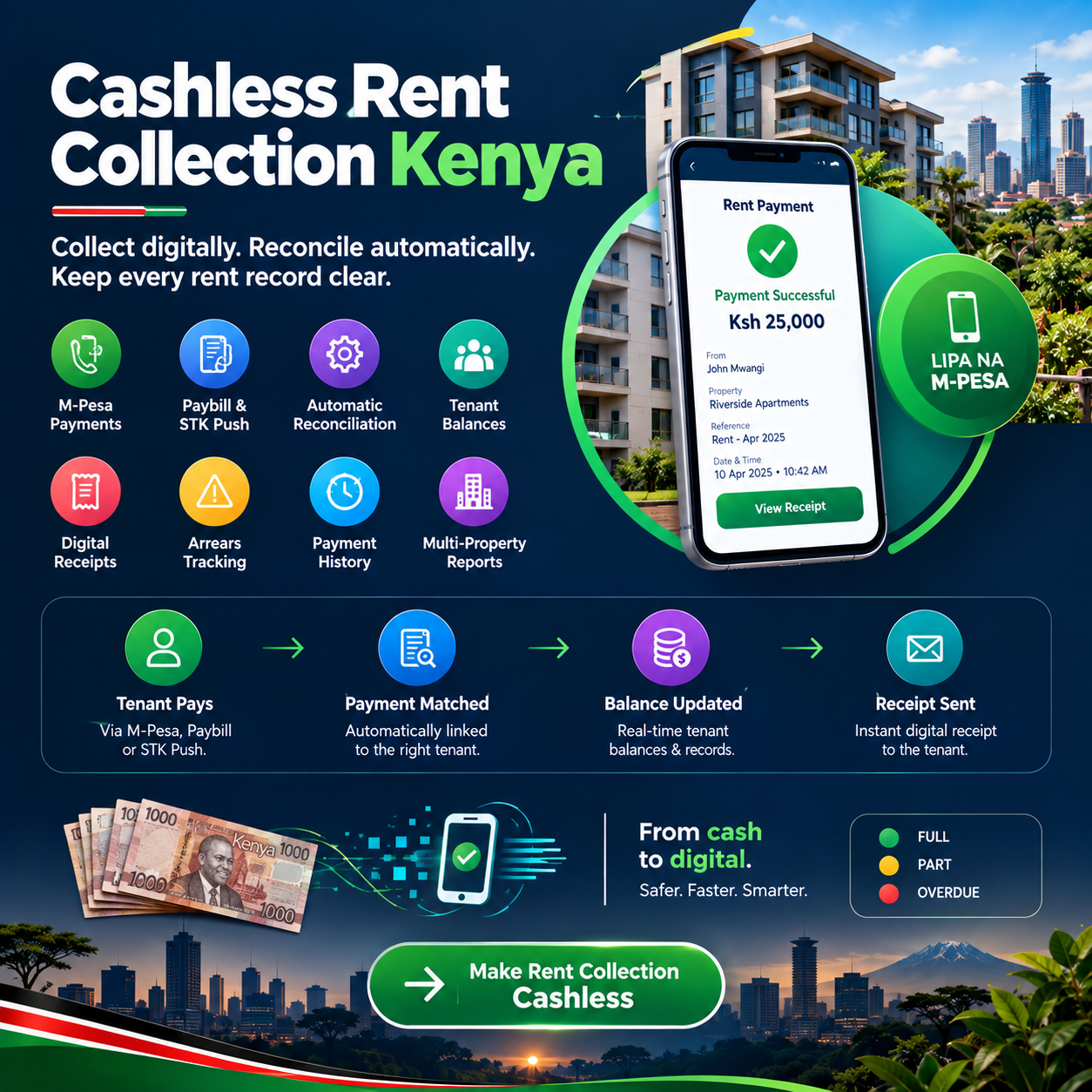
Cashless rent collection Kenya is the shift transforming how landlords receive income — from crumpled notes at the gate to clean digital payments that confirm themselves.
For generations, collecting rent in Kenya meant cash in hand, counted twice, written in a book, and carried home in a pocket.
In 2026, that entire ritual is optional, because the rails that replace it already reach every corner of the country.
The case for going cashless is no longer theoretical.
Mobile money penetration, bank integrations, and payment platforms have made digital rent faster, safer, and easier than cash for nearly every tenant and landlord.
This guide shows you exactly how to run cashless rent collection Kenya across your portfolio, step by step.
We cover the payment methods available, how to set them up, and how to migrate even the most cash-loyal tenants without losing anyone.
We also cover the benefits, the costs, the mistakes, and the security practices that keep your new system airtight.
By the end, you will have a complete blueprint for cashless rent collection Kenya that you can start implementing this week.
Whether you collect from three bedsitters or three hundred apartments, the same principles apply.
Cash has always been the riskiest part of the rental business — and 2026 is the year it finally becomes optional.
That freedom is the promise at the heart of cashless rent collection Kenya.
What Cashless Rent Collection Actually Means
Cashless rent collection Kenya means receiving every rent payment through digital channels — mobile money, bank transfer, or payment links — instead of physical cash.
No notes change hands, no receipt book gets filled, and no money travels in anyone’s pocket.
Every shilling moves through a system that records itself.
The channels are familiar to every Kenyan.
M-Pesa Paybill and Send Money, bank transfers, standing orders, and one-tap payment links all count as the cashless rent collection Kenya toolkit.
What unites them is a single property: each payment creates its own independent, timestamped record.
It helps to distinguish the payment method from the tracking layer.
Cashless collection is about how money moves; rent tracking software is about how payments are recorded, matched, and reported.
The two work best together, which is why most successful cashless rent collection Kenya setups pair a payment channel with a tracking platform.
The goal is simple and absolute: zero cash at the gate.
When every rent shilling flows through a verifiable channel, disputes shrink, theft becomes impossible, and your income becomes a live number instead of a monthly story.
That transformation is what running cashless rent collection Kenya properly delivers.
Why Cash Is the Weakest Link
Before building the cashless system, be honest about what cash costs you today.
The problems are consistent, documented, and entirely avoidable.
Naming them is how you design them out.
Problem one is leakage.
Every cash payment passes through human hands that can miscount, “borrow,” or simply report a smaller number.
Most cases of caretakers not remitting rent begin and end with cash, which is the strongest argument for cashless rent collection Kenya ever devised.
Problem two is the missing paper trail.
A cash payment with a handwritten receipt is one signature away from a dispute nobody can prove either way.
Digital payments end the “I paid” argument permanently, because the record lives at the payment provider — the evidentiary core of cashless rent collection Kenya.
Problem three is risk in transit.
Cash walks home with caretakers at night, sits in drawers, and disappears in robberies that take your tenant’s money with it.
Every month of cash is a month of exposure that cashless rent collection Kenya eliminates entirely.
Problem four is reconciliation pain.
Counting notes, matching names, and writing receipts consumes evenings and still produces errors.
Automation does in seconds what cash culture makes impossible.
Problem five is the tenant cash culture itself.
Tenants forget, delay, and claim payments that never happened, all because cash leaves no trace.
Removing cash removes the entire category of ambiguity — the foundational benefit of cashless rent collection Kenya.
Why 2026 Is the Tipping Point
Three forces have converged to make 2026 the year cashless collection becomes the norm rather than the exception.
Each one removes an old excuse.
Together, they make cashless rent collection Kenya the obvious default for every landlord.
First, mobile money is now truly universal.
M-Pesa reaches virtually every adult, works on every phone including basic handsets through its SIM-based toolkit, and operates everywhere from CBD towers to the deepest rural trading center.
There is no longer a reach argument against cashless rent collection Kenya.
Second, the landlord-side tools have matured.
Paybill accounts, till numbers, payment links, and tracking platforms now connect seamlessly, so payments reconcile themselves to the right unit automatically.
The technical barrier to cashless rent collection Kenya has collapsed to an afternoon of setup.
Third, tenants are ready and increasingly expect it.
The same renters who pay bills, school fees, and shopping digitally find cash-only rent arrangements quaint at best.
Meeting that expectation is the tenant-relations dividend of cashless rent collection Kenya done right.
The Payment Methods: Your Complete Menu
Building your system starts with knowing every rail available to you.
Each method suits different tenants, and the best setups combine two or three.
Here is the full cashless rent collection Kenya menu for 2026.
M-Pesa Paybill is the workhorse for larger landlords.
You register a Paybill number in your name or business name, tenants select it, enter their unit number as the account reference, and the money lands in your account labeled by unit.
The account reference is what makes cashless rent collection Kenya automatically reconcilable at scale.
M-Pesa Send Money to your personal line suits landlords with one or a few units.
It is instant, familiar to every tenant, and requires nothing but your phone number — the zero-setup entry point to cashless rent collection Kenya.
Pochi la Biashara offers a middle path: a business pocket inside your M-Pesa that separates rental income from personal money without formal registration.
Bank transfers and standing orders suit salaried tenants and larger amounts.
A standing order is the strongest tool in cashless rent collection Kenya, because the rent pays itself on the same date every month without anyone remembering anything.
Payment links are the modern addition.
A link inside an invoice or WhatsApp message takes the tenant from seeing the bill to paying it in one tap.
Click-to-pay is the fastest-growing layer of cashless rent collection Kenya and the natural partner to digital invoicing.
Agent and ATM deposits round out the menu for bank-based tenants.
A deposit slip photographed and sent to you keeps the record attached to the tenant even outside banking hours.
Coverage of every tenant type is what a complete cashless rent collection Kenya setup means in practice.
Setting Up Your Paybill: The Backbone
The Paybill is the backbone of cashless collection for any landlord beyond a handful of units, and setup is simpler than most owners expect.
Visit a Safaricom agent or the M-Pesa portal with your ID and, where applicable, your business registration documents, and apply for a Paybill number.
Most landlords complete the process within days, and the account lands ready to receive.
Once live, standardize how tenants use it.
Give every tenant three pieces of information in writing: the Paybill number, their unit or house number as the account reference, and the exact rent amount.
Clear written instructions are the operating manual of cashless rent collection Kenya.
Then test it before launching.
Have a trusted person pay a token amount using a unit number, and confirm the reference appears correctly in your statement.
The reference discipline is what transforms cashless rent collection Kenya from digital cash into a self-organizing ledger.
Publish the details everywhere.
Print the Paybill number and unit reference on the gate, inside each unit’s door, on every invoice, and in the tenancy agreement itself.
Visibility at the moment of payment is a quiet superpower of well-run cashless rent collection Kenya.
Migrating Your Tenants Without Losing Anyone
The technical setup takes days; the human transition takes a month of deliberate effort.
Tenants do not resist digital payment because it is hard — they resist change itself.
Handle the transition with that truth in mind, and cashless rent collection Kenya adoption becomes nearly frictionless.
Start with an announcement, delivered warmly and in person.
Explain the change as mutual protection: no more lost receipts, no more disputes, no more money walking home at night.
Framing determines reception, and tenants consistently welcome changes framed around cashless rent collection Kenya benefits for them.
Give a clear switch date with a grace period.
Thirty days’ notice, with the first digital month treated gently, converts even anxious tenants into cooperative ones.
Deadlines plus patience is the proven formula for cashless rent collection Kenya migration.
Make the first payment guided, not assumed.
Sit with each tenant — or have your caretaker do it — through their first Paybill payment, confirming the reference and showing them their confirmation message.
Ten successful guided payments create ten ambassadors for cashless rent collection Kenya.
Add a small incentive for the transition.
A receipt delivered instantly, priority maintenance requests, or even a modest discount for the first three digital months all work.
Reciprocity accelerates every cashless rent collection Kenya rollout.
Then enforce the line you drew.
After the grace period, cash stops being an option — politely, consistently, and without exception, because one exception recreates the old culture.
Consistency is what makes cashless rent collection Kenya permanent.
Handling the Holdouts
Every portfolio has one — the tenant who insists cash is king.
Treat holdouts as a solvable case, not a lost cause, because almost every one has a workable digital path.
The solutions below cover virtually every objection in cashless rent collection Kenya practice.
For the tenant without a smartphone, the answer is the SIM toolkit.
M-Pesa works on basic feature phones through the SIM menu, requiring no data and no app.
This single fact dissolves the most common objection to cashless rent collection Kenya in low-income units.
For the tenant without an M-Pesa line, registration takes minutes at any agent with an ID.
Walk them through it once, and the barrier is gone forever.
For the tenant who distrusts digital, start small and let evidence work.
Have them pay one month digitally, keep their confirmation message, and see how cleanly the receipt and record arrive.
Experience converts skeptics faster than any argument for cashless rent collection Kenya.
For the tenant who still refuses after genuine accommodation, the tenancy agreement is your framework.
Write the payment method into new agreements and renewals, making digital payment a term of tenancy.
Contractual clarity is the final anchor of cashless rent collection Kenya.
Closing the Loop: Receipts, Tracking, and Records
Collecting digitally is half the system; confirming and recording is the other half.
Every payment should trigger an acknowledgment, and every month should reconcile cleanly.
That closed loop is what elevates cashless rent collection Kenya from a payment method into a management system.
Send a receipt for every payment.
A simple message — amount, unit, period, date — costs nothing and builds enormous trust.
Instant receipts are the courtesy standard of professional cashless rent collection Kenya.
Pair the payment channel with a tracking platform.
The platform matches each payment to the right unit using the Paybill reference, updates balances, and flags whatever fails to arrive.
That automation is the reconciliation engine that makes cashless rent collection Kenya effortless at any scale.
Reconcile monthly with one equation.
Rent charged, rent received, and rent outstanding must agree — and when they do, your records are proven complete.
That five-minute check is the quality seal of cashless rent collection Kenya.
Archive everything.
Statements export from M-Pesa and your bank, receipts live in your platform, and one dated folder per month keeps you audit-ready forever.
Your tax filings, loan applications, and any future disputes all draw from the same clean archive — the long-term wealth hidden inside cashless rent collection Kenya.
What Tenants Gain
Tenants benefit more than they expect, and saying so out loud accelerates adoption.
Their payments become provable.
A confirmation message plus an instant receipt means no tenant can ever be falsely accused of arrears — dignity that every renter values, and the fairness foundation of cashless rent collection Kenya.
They stop carrying risk.
No more walking with rent money on dark evenings or storing it until the caretaker appears.
Safety is the benefit tenants mention first once they experience cashless rent collection Kenya.
They gain flexibility.
Paying from work, from upcountry, or at midnight becomes normal, because the payment point is wherever their phone is.
Freedom to pay from anywhere is the everyday luxury of cashless rent collection Kenya.
They build financial history too.
Regular digital payments through formal channels contribute to the records that banks and lenders increasingly recognize.
That quiet credit-building dividend grows more valuable every year for participants in cashless rent collection Kenya.
What Caretakers Gain
An honest caretaker is the biggest winner of all, and saying so is how you win their support.
Their collections become provable.
A caretaker who never touches cash can never be accused of stealing it, which ends the suspicion that poisons so many property jobs.
That protection is why good field staff become the loudest advocates of cashless rent collection Kenya.
Their work gets lighter.
No counting, no receipt books, no risky walks home with a month’s collections.
The job becomes what it should be: managing the property, not ferrying money.
Their standing rises too.
A caretaker attached to a professional, cashless operation is visibly part of a serious business, and recognition follows.
Dignity, safety, and lighter duties form the pitch that converts every caretaker into a partner in cashless rent collection Kenya.
Security Best Practices
Digital does not mean careless, and a few disciplines keep your system airtight.
Secure the foundation first: the SIM and accounts receiving rent.
A PIN-locked line, registered in your name, and monitored from a phone only you control is the perimeter fence of cashless rent collection Kenya.
Verify before you trust any payment claim.
A screenshot of a payment message is not a payment; the money must appear in your own statement or account before it counts.
Verifying at source is the golden rule of cashless rent collection Kenya.
Beware of the reversal trick.
Fraudsters pay, share the confirmation, and reverse the transaction before it settles — so confirm finality, especially on large or unusual payments.
Waiting for the money to actually land is basic hygiene in cashless rent collection Kenya.
Protect your tenants’ data as well.
Payment details, phone numbers, and records should never be shared, and old data should not outlive its purpose.
Responsible handling is part of the professionalism that cashless rent collection Kenya represents.
Watch for social engineering too.
No bank, no provider, and no agent needs your PIN, ever — and teaching that one line to your tenants protects them as much as you.
A portfolio educated about fraud is the hardest target in cashless rent collection Kenya.
Common Mistakes to Avoid
Mistake one is going cashless without updating agreements and instructions.
The change must appear in the tenancy terms, the invoice template, and the printed notices, or confusion will undo it.
Paperwork is part of cashless rent collection Kenya, not an afterthought.
Mistake two is skipping the reference discipline.
Payments without unit numbers become unlabeled money that someone must match by hand — recreating the reconciliation problem digitally.
The account reference is what makes cashless rent collection Kenya self-organizing.
Mistake three is accepting “I sent it” as proof.
Teach every tenant that the confirmation message plus your receipt together form the complete proof.
That standard protects both sides and keeps cashless rent collection Kenya records honest.
Mistake four is one-way communication during the switch.
Tenants who feel dictated to resent the change; tenants who feel guided embrace it.
The difference is a few conversations, and they are the cheapest investment in the whole cashless rent collection Kenya project.
Mistake five is abandoning the old channels completely overnight.
Keep the caretaker’s cash protocol alive for one defined grace month, then retire it formally.
Orderly retirement is what makes the transition to cashless rent collection Kenya permanent rather than partial.
Real Scenarios from Real Portfolios
Picture a landlord with twenty bedsitters in Pipeline who replaced the caretaker’s cash routine with a Paybill and unit references.
Within two months, his collections matched his expectations exactly for the first time in years, and the caretaker’s job became safer overnight.
His words: the money now announces itself.
Picture a diaspora owner in Toronto with apartments in Kasarani who once waited for monthly remittance stories.
With payments flowing directly to his Paybill and a platform reconciling every reference, he watches rent arrive from nine time zones away.
Distance stopped mattering the day he adopted cashless rent collection Kenya.
Picture a tenant in Kitengela who resisted the change for two cycles.
One guided payment later, she keeps every confirmation message and describes the instant receipts as “the first time rent ever felt fair.”
Her renewal was the easiest conversation the landlord has ever had.
These stories repeat across the country because the mechanics are universal.
Direct rails, clear references, and closed loops produce the same calm in every estate.
Cash never left because it was fought — it left because it became unnecessary.
What It Costs in 2026
The price of going cashless is the smallest line in your entire property budget.
The payment rails cost only standard transaction charges, most under ten shillings per payment.
Against a single prevented leak, cashless rent collection Kenya pays for itself in the first week.
The realistic cost picture:
- M-Pesa Paybill setup: free; standard transaction charges per payment apply
- Bank account and standing orders: free to minimal charges depending on your bank
- Payment links: free to small per-transaction fees depending on the provider
- Tracking platform (optional): free tiers available; paid plans roughly KSh 500–3,500 monthly
- Printed notices and instructions: a few hundred shillings, once
Weigh the total against what it replaces: lost collections, disputed receipts, and reconciliation evenings.
The math favors adoption at every portfolio size.
The only real investment is the transition month — and it pays dividends forever.
The Road Ahead: 2027 and Beyond
The trajectory points toward rent paying itself.
One-tap payments inside invoices are already spreading, and standing orders are being joined by smarter recurring options tied to platforms rather than banks alone.
Every removal of friction tightens the loop that cashless rent collection Kenya creates between due date and confirmed payment.
Integration is the deeper story.
Payment rails, tracking platforms, invoicing tools, and even credit systems are converging, so your clean digital rent history will increasingly count toward financing and formal recognition.
The data you build through cashless rent collection Kenya is becoming an asset in its own right.
The message for every landlord is simple.
The tool that ends cash chaos is already in your tenants’ pockets, free to start, and proven at every scale.
There has never been a better moment — in 2026 or beyond — to make cashless rent collection Kenya your permanent standard.
Frequently Asked Questions
What if my tenant doesn’t have a smartphone?
M-Pesa works on basic feature phones through the SIM toolkit — no data, no app, no smartphone required.
This covers virtually every tenant in the country, which is why smartphone ownership is not a barrier to cashless rent collection Kenya.
Demonstrate it once on their own phone and the objection disappears.
Can a tenant reverse an M-Pesa payment after sending it?
Reversals can be requested, which is why you confirm the money has actually settled in your account before issuing receipts or considering the rent paid.
The confirmation message proves a transfer was attempted; your statement proves it completed.
Checking finality is standard practice in cashless rent collection Kenya.
Do transaction charges make digital payment expensive?
Charges are modest — typically under ten shillings for most rent amounts — and many landlords agree with tenants on who bears them, or absorb them as a cost of clean records.
Compared to one lost cash payment, the entire year of charges is negligible.
Cost is the weakest argument against cashless rent collection Kenya.
How do I handle a tenant who insists on paying cash?
Accommodate genuinely first — show them the SIM-toolkit method, guide their first payment, and give a grace period.
If they still refuse, write the digital method into the tenancy agreement as the required payment channel, and apply it consistently at renewal.
Firm consistency is what completes the transition to cashless rent collection Kenya.
What stops my caretaker from collecting cash anyway?
Structure, not hope: publish the Paybill everywhere, instruct tenants in writing, define the caretaker’s role as non-financial, and require same-day logging with photo receipts if any cash ever appears.
Then audit against your account records, where any unlabeled money becomes visible immediately.
Systems, not suspicion, are what enforce cashless rent collection Kenya.
Which is better for a small landlord: Paybill or personal Send Money?
Personal Send Money works fine for one to five units, while a Paybill becomes worthwhile when unit references and cleaner records matter — usually beyond a handful of units.
Start where you are and graduate as you grow.
Both are legitimate entry points to cashless rent collection Kenya.
How do standing orders fit in?
They are the strongest tool of all for salaried tenants: the bank moves the rent on a fixed date automatically, and no reminder is ever needed.
Offer them wherever a tenant’s income is regular.
Set-and-forget is the highest form of cashless rent collection Kenya.
Do I still need receipts if payments are digital?
Yes — the payment proves money moved, while your receipt confirms it was accepted for the right unit and period.
The pair together is what makes records dispute-proof.
Instant receipts are the courtesy layer of professional cashless rent collection Kenya.
What about taxes — does going cashless attract more scrutiny?
Clean digital records make your income visible and your filings easier, which is a benefit rather than a burden when you are compliant.
Organized statements turn tax season into a filtering exercise instead of a reconstruction project.
Compliance readiness is one of the quiet advantages of cashless rent collection Kenya.
Where can I find verified tenants and landlord tools together?
Start with platforms that combine verified listings with landlord-friendly technology, such as rentaldesk.co.ke.
Pairing the right tenants with the clean rails of cashless rent collection Kenya takes you from chasing payments at the gate to watching every shilling arrive, labeled, receipted, and reconciled — automatically.