
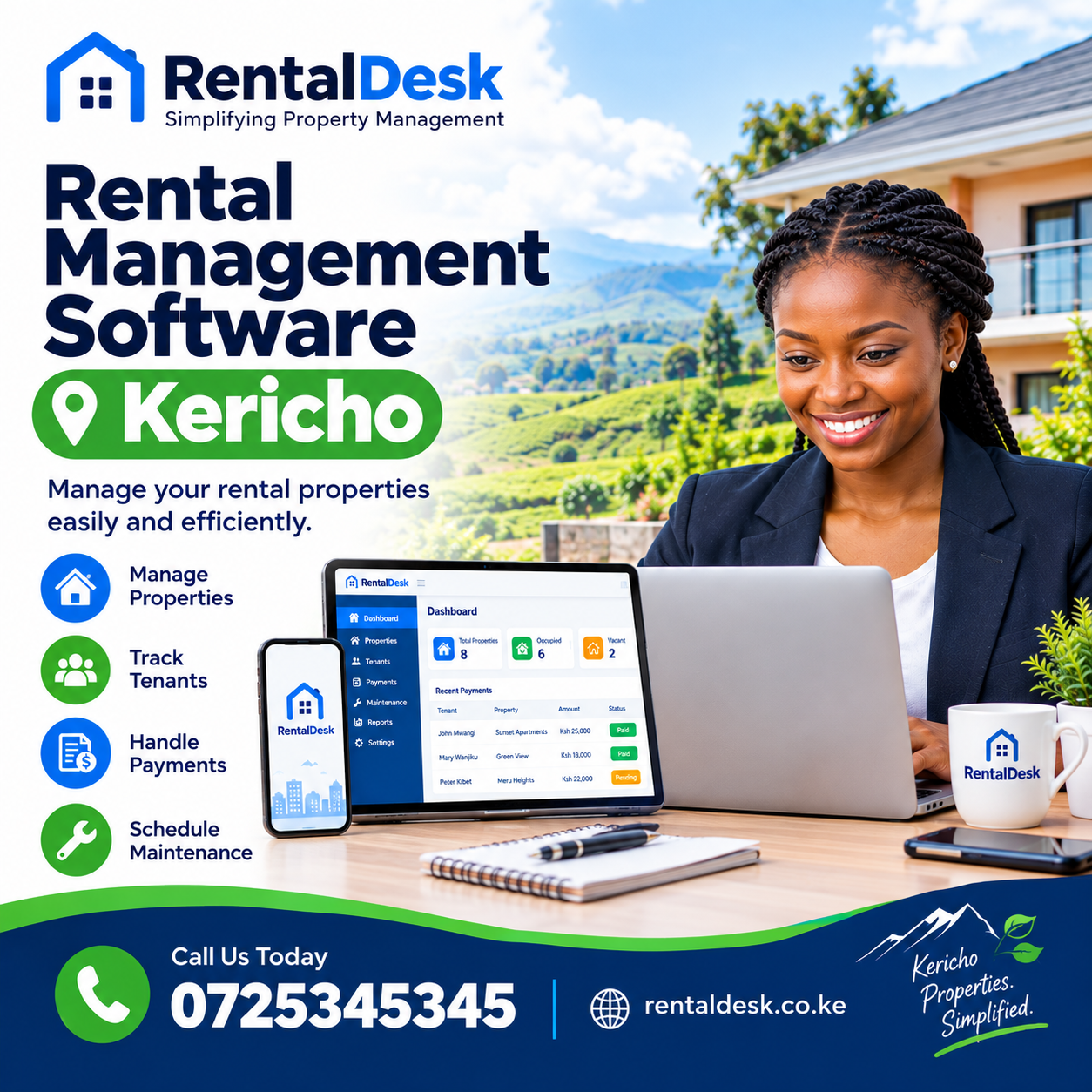
Rental Management Software Kericho: A Practical Guide for Landlords and Property Managers
Managing rental property in Kericho involves much more than collecting rent at the end of the month. Landlords and property managers have to keep tenant records, monitor occupied and vacant units, follow up on arrears, coordinate repairs, issue payment records, track expenses and prepare accurate reports. Rental Management Software Kericho can bring these activities into one organized system, making day-to-day property administration easier for landlords, agents and property management teams.
Kericho has a varied rental market that includes apartments, bedsitters, family houses, commercial premises and other accommodation options. Current property listings show rental activity in Kericho Town and surrounding areas, while property and housing organizations also operate in the county. For someone managing several units, relying entirely on notebooks, spreadsheets, WhatsApp conversations and separate payment records can become difficult as the portfolio grows.
This guide explains how Rental Management Software Kericho can support rental businesses, what features landlords should look for, how digital rent collection can improve record keeping, and how property managers can use technology to gain better visibility over their portfolios. It also covers tenant management, maintenance, vacancy tracking, financial reporting, security, implementation and common questions from landlords in Kericho.
What Is Rental Management Software?
At its simplest, Rental Management Software Kericho refers to a digital platform designed to help landlords and property managers organize the operational and financial tasks involved in managing rental property.
Instead of keeping tenant information in one notebook, payment information in a spreadsheet and maintenance requests in a phone, a centralized platform can bring these records together.
A typical rental management system may help with:
- Property and unit records
- Tenant registration
- Lease and tenancy information
- Rent collection
- Payment tracking
- Arrears monitoring
- Receipts
- Expense recording
- Maintenance requests
- Vacancy tracking
- Property reports
- Tenant communication
- Portfolio-level reporting
The value is not simply having software. The real benefit comes from having reliable information available when it is needed.
For example, if a landlord wants to know which units have outstanding rent, how much was collected during the month and which properties generated maintenance expenses, a centralized system can make that information easier to retrieve.
With Rental Management Software Kericho, the landlord can move from reactive administration to a more structured way of managing rental operations.
Why Rental Property Management Can Become Difficult
Managing one or two units may appear straightforward. The landlord knows the tenants personally, remembers when rent is due and can probably keep track of maintenance issues without a formal system.
The situation changes when the portfolio grows.
A landlord with 30, 50 or 100 units has many more records to maintain. Each tenant can have a different move-in date, payment history, lease arrangement and outstanding balance.
Property managers may also be handling properties belonging to several owners.
This creates several administrative challenges.
1. Keeping tenant information organized
Tenant information can include names, contacts, identification details, unit numbers, lease dates, rent amounts and payment histories.
If these details are scattered across paper files and phones, finding the right record can take unnecessary time.
A digital tenant database makes it easier to search for a tenant and review their relevant property information.
2. Tracking rent payments
Rent collection is one of the most important recurring activities in rental management.
A landlord needs to know:
- Who has paid
- Who has partially paid
- Who has not paid
- How much has been collected
- How much remains outstanding
- Which unit the payment belongs to
- Whether a receipt has been issued
Using Rental Management Software Kericho, property managers can organize these records within the same system used to manage tenants and units.
3. Monitoring maintenance
Maintenance requests can arrive through calls, text messages, WhatsApp and face-to-face conversations.
Without a proper tracking process, a repair request can easily be forgotten.
A centralized maintenance record can show the issue, affected unit, date reported, status, assigned technician and completion information.
4. Managing multiple properties
A property manager may oversee apartments in Kericho Town while also managing houses or commercial units in nearby locations.
Each property may have different tenants, expenses and payment records.
A centralized system can provide a portfolio-level view without requiring the manager to open several unrelated spreadsheets.
How Rental Management Software Kericho Helps Landlords in Kericho
The main reason landlords adopt rental management platforms is to make routine administration more organized.
A useful system should reduce unnecessary manual work while making important records easier to access.
For a landlord in Kericho, this may mean having one place to manage units, tenants, rent, expenses and maintenance.
Centralized property records
A property record can contain information about the building, individual units, rent amounts, occupancy status and other relevant details.
Instead of maintaining a separate document for each building, a landlord can organize properties within a structured portfolio.
Better tenant records
Tenant information can be connected to the unit they occupy.
This makes it easier to identify the person responsible for a particular unit and review their payment or tenancy history.
Easier rent follow-up
Outstanding balances can be identified more quickly when payment records are centralized.
A property manager does not have to manually compare several spreadsheets to determine who still owes rent.
Faster reporting
Monthly reporting becomes easier when transactions are already recorded digitally.
The manager can review collections, arrears, expenses and occupancy information without rebuilding the report from scratch.
Rent Collection and Payment Tracking
Rent collection is at the heart of most rental businesses.
A landlord needs an accurate record of money expected, money received and balances outstanding.
Rental Management Software Kericho can help structure this process by associating payments with the relevant tenant and property.
Recording payments
Every payment should ideally be connected to:
- Tenant
- Property
- Unit
- Date
- Amount
- Payment method
- Reference where applicable
This reduces confusion when a landlord receives many payments during the same period.
Tracking partial payments
Tenants do not always pay the full amount at once.
For example, a tenant with monthly rent of KSh 20,000 may pay KSh 12,000 first and KSh 8,000 later.
A good rental system should show the remaining balance instead of treating the first payment as a complete settlement.
Monitoring arrears
Arrears are easier to manage when the system clearly identifies overdue accounts.
The property manager can then prioritize follow-ups based on actual balances rather than relying on memory.
With Rental Management Software Kericho, rent collection records can become part of a broader property management workflow rather than an isolated accounting exercise.
M-Pesa and Digital Rent Collection in Kenya
Digital payments are an important part of Kenyan business operations.
Many tenants prefer convenient payment methods, while landlords need reliable records showing when and how payments were made.
A rental management platform that supports appropriate digital payment workflows can help connect payment activity with tenant accounts.
The exact payment integrations available will depend on the software provider, configuration and payment service used.
Property managers should therefore ask specific questions before selecting a platform.
For example:
- Does the system support M-Pesa-related workflows?
- Can payment references be recorded?
- Can payments be assigned to specific tenants?
- Can receipts be generated?
- Can partial payments be tracked?
- Can arrears be identified automatically?
- Can reports be exported?
The objective is not simply to accept digital payments. It is to make sure payment information becomes useful management data.
Tenant Management
Tenants are at the center of rental operations.
Good tenant management requires accurate records from application through move-in, occupancy, renewal and eventual move-out.
Rental Management Software Kericho can help property managers maintain structured tenant records throughout the tenancy lifecycle.
Tenant onboarding
When a tenant moves into a property, the manager may need to record:
- Full name
- Contact details
- Identification information
- Unit occupied
- Rent amount
- Deposit
- Lease start date
- Lease end date
- Emergency contact
- Payment information
Keeping this information in one location makes future administration easier.
Tenant history
A useful system can also maintain a history of payments, maintenance requests and other relevant activities.
This gives the manager a clearer picture of the tenancy relationship.
Lease renewal
Lease expiry dates should not be left to memory.
A rental platform can help managers identify upcoming renewals and begin the necessary communication early.
Vacancy Management
Vacant units represent lost rental income.
A landlord therefore needs an accurate view of which units are occupied and which are available.
Rental Management Software Kericho can provide an occupancy overview that helps property managers identify vacancies quickly.
A basic vacancy dashboard might categorize units as:
| Status | Meaning |
|---|---|
| Occupied | Tenant currently occupies the unit |
| Vacant | Unit has no current tenant |
| Reserved | Unit is being held for an incoming tenant |
| Under maintenance | Unit is temporarily unavailable |
| Notice given | Current tenant is preparing to leave |
This information can help the manager coordinate marketing, inspections and maintenance before the next tenant moves in.
Why vacancy tracking matters
Consider a property with 40 units.
If three units are vacant, the landlord needs to know how long they have been empty and whether there are outstanding repairs preventing occupancy.
A system can make this information visible without manually checking individual tenant files.
Property Maintenance Management
Maintenance is one of the most common operational challenges in rental property management.
Tenants expect reported issues to be handled promptly. Property owners want maintenance costs controlled and documented.
Rental Management Software Kericho can help create a structured maintenance workflow.
Recording maintenance requests
Each request can contain information such as:
- Tenant name
- Unit number
- Problem description
- Date reported
- Priority
- Assigned technician
- Estimated cost
- Completion date
- Final cost
- Status
This creates an audit trail.
Preventive maintenance
Rental management should not only focus on problems after they occur.
Property managers can also schedule regular checks for:
- Plumbing
- Electrical systems
- Water tanks
- Security systems
- Roofing
- Common areas
- Doors and windows
- Drainage
- Lighting
Preventive maintenance can help identify issues before they become more expensive problems.
Contractor management
If a landlord works with several fundis or contractors, recording maintenance assignments digitally can make it easier to see who handled a particular job and how much it cost.
Expense Management
Rental income is only one side of property management.
Landlords also have expenses related to repairs, cleaning, security, utilities, administration and other services.
Rental Management Software Kericho can help organize property-related expenses so that owners have a clearer picture of operating costs.
A useful expense record should show:
- Date
- Property
- Expense category
- Description
- Supplier or contractor
- Amount
- Payment status
- Supporting document where applicable
This information becomes valuable when reviewing the financial performance of a property.
Understanding property profitability
Suppose a property collects KSh 500,000 in rent during a month.
That figure alone does not show the property’s financial position.
If operating expenses are KSh 120,000, the owner needs to consider those costs when assessing the month’s performance.
Digital records make it easier to compare income against expenses.
Financial Reporting
Reports turn raw transactions into information that can support management decisions.
Rental Management Software Kericho can help landlords produce reports covering areas such as:
- Rent collected
- Rent outstanding
- Property expenses
- Occupancy
- Vacancies
- Tenant balances
- Maintenance costs
- Payment history
Monthly owner reports
Property managers working for property owners often need to provide periodic reports.
A monthly report can summarize:
- Opening balances
- Rent billed
- Rent collected
- Arrears
- Expenses
- Maintenance costs
- Other charges
- Closing balances
A consistent reporting format can improve communication between managers and owners.
Portfolio reporting
For landlords with multiple buildings, portfolio reporting provides a wider view.
Instead of reviewing properties individually, the owner can compare their overall collections, vacancies and expenses.
Managing Rental Properties Across Kericho
Kericho’s property market is not limited to one type of rental.
Available listings include different residential formats, while commercial property and other accommodation categories also exist in the county.
Rental Management Software Kericho can therefore be useful across different property portfolios, provided the system is configured around the actual needs of the business.
A landlord might manage:
- Bedsitters
- One-bedroom apartments
- Two-bedroom apartments
- Family houses
- Commercial units
- Shops
- Offices
- Mixed-use buildings
- Short-stay units
Each category may have different operational requirements.
For example, a residential apartment may focus heavily on rent and tenant records, while commercial units may require more attention to leases, service charges and business-related expenses.
Supporting Properties in Kericho Town and Surrounding Areas
Property management technology becomes especially useful when landlords do not live close to every property they own.
A landlord based in Nairobi, for example, may own rental units in Kericho.
Instead of traveling to check every record, the owner can use a centralized system to monitor important information remotely.
Rental Management Software Kericho can support this type of remote visibility when the platform provides appropriate dashboards and reporting.
The owner may want to know:
- Current occupancy
- Rent collected
- Outstanding balances
- Maintenance activity
- Recent expenses
- Vacant units
- Upcoming lease events
The property manager on the ground can handle daily activities while the owner maintains access to management information.
Why Spreadsheets May Become Difficult at Scale
Spreadsheets are useful for many small businesses.
A landlord with a few tenants may successfully track payments using Excel or Google Sheets.
The problem appears when the spreadsheet becomes the central system for a growing portfolio.
Common difficulties include:
- Duplicate entries
- Accidental deletions
- Formula errors
- Multiple versions of the same file
- Limited automation
- Difficult maintenance tracking
- Weak tenant communication records
- Manual arrears calculations
- Time-consuming monthly reporting
SaaS rental management platforms can provide structured workflows that are specifically designed around recurring property operations.
This does not mean every landlord must immediately abandon spreadsheets.
The decision should depend on portfolio size, operational complexity, reporting requirements and the amount of administrative work involved.
Choosing the Right Rental Management System
Choosing software requires more than looking at the number of features listed on a website.
The important question is whether the platform solves the actual problems faced by the property manager.
When evaluating Rental Management Software Kericho, consider the following areas.
1. Ease of use
A complicated platform can create new administrative problems.
The interface should be understandable to landlords, property managers and authorized staff.
2. Tenant management
The software should allow users to maintain accurate tenant records and connect them to specific units.
3. Rent tracking
Look for tools that can record rent billed, rent received, arrears and balances.
4. Maintenance
The system should provide a way to record, assign and monitor maintenance issues.
5. Reporting
Reports should answer practical questions without requiring extensive manual calculations.
6. Security
Property and tenant records are sensitive business information.
Ask how user access is controlled and how data is protected.
7. Backup and reliability
A landlord should understand how data is backed up and what happens if there is a technical problem.
8. Mobile accessibility
Property managers may not always be sitting in an office.
Mobile-friendly access can make routine administration more convenient.
Questions to Ask a Software Provider
Before subscribing, ask the provider to demonstrate the actual workflow.
Instead of asking only whether the software has a feature, ask them to show how it works.
For example:
- Show me how to add a new property.
- Show me how to create a tenant.
- Show me how to record rent.
- Show me how arrears appear.
- Show me how to record a maintenance request.
- Show me how I can see vacant units.
- Show me how reports are generated.
- Show me how users are added.
- Show me how data is backed up.
- Show me how I can access the system remotely.
This approach gives a more realistic understanding of the platform.
How to Implement Rental Software Successfully
Buying software is only the first step.
The landlord also needs a clear implementation process.
Rental Management Software Kericho becomes more useful when the property data entered into it is accurate and consistently maintained.
Step 1: List all properties
Create a complete list of buildings and units.
Step 2: Verify tenant records
Review current tenant information before importing or entering it.
Step 3: Confirm rent amounts
Check the rent assigned to each unit.
Step 4: Record opening balances
If tenants already have outstanding balances, make sure those balances are correctly documented.
Step 5: Enter expenses
Where relevant, establish opening expense records and categories.
Step 6: Train users
Staff should understand the basic workflow.
Step 7: Establish procedures
Decide who records payments, who handles maintenance and who reviews reports.
Step 8: Review regularly
Check records frequently to identify errors early.
Staff Roles and User Permissions
Not everyone managing a property portfolio needs access to every piece of information.
A property management platform may support different user roles.
For example:
| User | Possible responsibility |
|---|---|
| Owner | Portfolio and financial overview |
| Property manager | Daily property administration |
| Accountant | Financial transactions and reports |
| Maintenance officer | Repair requests and jobs |
| Reception/admin staff | Tenant records and communication |
The exact permissions depend on the platform.
Separating access by role can reduce unnecessary exposure of sensitive information and help create clearer accountability.
Improving Tenant Communication
Communication is an important part of rental management.
Tenants may need information about:
- Rent balances
- Payment confirmations
- Maintenance schedules
- Inspections
- Notices
- Lease renewals
- Building activities
Rental Management Software Kericho can become a central reference point for tenant information, although communication features differ between platforms.
The goal should be to make communication clear and traceable.
For example, if a tenant reports a leaking pipe, the manager should ideally be able to record the request and later confirm when it was resolved.
Property Inspections
Regular property inspections help landlords identify maintenance and occupancy issues.
An inspection workflow may record:
- Property
- Unit
- Inspection date
- Inspector
- Condition
- Issues found
- Photos or attachments where supported
- Recommended action
- Completion status
This information can be useful when comparing the condition of a unit over time.
A property manager can also use inspection records before and after a tenant moves out.
Managing Arrears More Effectively
Late rent can create serious cash-flow challenges for landlords.
The first step in managing arrears is knowing exactly what is outstanding.
Rental Management Software Kericho can support an organized arrears process when balances are properly recorded.
A useful workflow might include:
- Identify overdue account.
- Confirm the balance.
- Review payment history.
- Contact the tenant.
- Record the follow-up.
- Monitor promised payment dates.
- Update the account after payment.
- Escalate according to the landlord’s established procedures where necessary.
The software does not replace human judgment or legal processes. It helps keep the administrative record organized.
Rental Records and Accountability
Good records matter because rental management involves money, contracts and ongoing relationships.
If a tenant questions a balance, the landlord should be able to review the relevant transaction history.
If an owner asks why maintenance costs increased, the manager should be able to show recorded expenses and work orders.
If a unit becomes vacant, the manager should know when the previous tenancy ended and whether outstanding tasks remain.
Rental Management Software Kericho can help create a consistent digital trail across these activities.
Using Reports to Understand Property Performance
Reports can help landlords identify patterns.
For example, a property manager may discover that one building consistently experiences higher maintenance expenses than another.
Another property may have a recurring vacancy problem.
A third may have strong occupancy but unusually high arrears.
These patterns can prompt further investigation.
A landlord should avoid relying on one number alone.
Useful indicators can include:
- Occupancy rate
- Collection rate
- Total rent billed
- Total rent collected
- Outstanding rent
- Maintenance expenditure
- Operating expenses
- Vacancy duration
- Number of active tenants
The right indicators depend on the property portfolio.
Rental Management Software for Growing Portfolios
A landlord may start with five units and eventually acquire more properties.
Administrative systems that worked at five units may become inefficient at fifty.
Rental Management Software Kericho can support growth when the platform can handle additional properties, units, users and transactions without requiring the manager to rebuild the process every time the portfolio expands.
Scalability should therefore be part of the evaluation process.
Ask:
- How many properties can the system handle?
- How many users can access it?
- Can additional units be added easily?
- Can reports cover multiple properties?
- Can data be exported?
- Can the subscription grow with the business?
Security and Data Protection
Rental records contain personal and financial information.
A landlord should therefore treat data security as a business requirement.
When assessing Rental Management Software Kericho, ask about:
- Password protection
- User permissions
- Data backups
- Secure connections
- Account recovery
- Audit trails
- Data export
- Provider support
Also establish internal rules for staff access.
For example, employees should use individual accounts rather than sharing one password.
The Cost of Poor Rental Administration
The cost of poor administration is not always visible immediately.
A missed payment can become a larger arrears balance.
A forgotten maintenance request can become a bigger repair.
An inaccurate tenant record can cause confusion.
A missing expense receipt can make financial reporting difficult.
A vacant unit that is not identified quickly can result in lost income.
Using Rental Management Software Kericho can help landlords create systems that reduce these administrative gaps.
The software itself does not guarantee perfect management. The outcome still depends on accurate data, proper procedures and consistent use.
Common Mistakes When Adopting Rental Software
Technology works best when implementation is handled carefully.
Mistake 1: Entering inaccurate data
Incorrect opening balances or tenant information can make reports unreliable.
Mistake 2: Failing to train staff
A system is only useful when users know how to operate it.
Mistake 3: Recording some payments outside the system
If transactions are split between the software, notebooks and WhatsApp messages, the system will not provide a complete picture.
Mistake 4: Ignoring maintenance records
Maintenance should be tracked just as carefully as rent.
Mistake 5: Never reviewing reports
Reports are useful only when managers actually use them to monitor the portfolio.
Mistake 6: Giving everyone full access
User permissions should reflect responsibilities.
Rental Management Software and Property Managers
Property managers often manage properties on behalf of owners.
Their responsibilities may include rent collection, tenant communication, maintenance coordination and reporting.
Rental Management Software Kericho can support this work by creating a central record that both improves administration and makes owner reporting easier.
For a management company, standardized processes can also make it easier to onboard additional properties.
Instead of creating a new administrative method for every client, the company can use consistent workflows.
A Practical Example
Imagine a property manager in Kericho responsible for three apartment blocks with a combined 75 units.
Before adopting a centralized system, the manager uses:
- One spreadsheet for tenants
- A notebook for maintenance
- WhatsApp for tenant requests
- Bank and M-Pesa messages for payments
- Another spreadsheet for owner reports
At the end of the month, the manager has to reconcile these sources manually.
After implementing a centralized system, the manager can organize the workflow around:
- Property records
- Unit records
- Tenant records
- Rent schedules
- Payment records
- Maintenance requests
- Expenses
- Reports
The important difference is not simply that information is digital.
It is that the information is connected.
A payment belongs to a tenant.
The tenant belongs to a unit.
The unit belongs to a property.
The expense belongs to a property or maintenance job.
That relationship makes the data more useful.
How Landlords Can Prepare Before Switching Systems
Before adopting Rental Management Software Kericho, landlords should organize their existing information.
Create a checklist covering:
- Property names
- Unit numbers
- Tenant names
- Tenant contacts
- Current rent
- Deposit amounts
- Lease dates
- Outstanding balances
- Recent payments
- Current vacancies
- Maintenance issues
- Regular expenses
Review the information for duplicates and errors.
This preparation makes the transition easier.
What Makes a Rental Management Platform Useful?
The most useful platform is not necessarily the one with the longest feature list.
A landlord should focus on whether the software supports the actual workflow.
For example, if the biggest problem is rent collection, payment tracking and arrears visibility should receive significant attention.
If the biggest problem is maintenance, work-order tracking and contractor management may matter more.
If the landlord manages properties for multiple owners, reporting and portfolio separation may be particularly important.
Rental Management Software Kericho should therefore be evaluated according to the landlord’s specific operational needs.
Rental Management Software for Small Landlords
Small landlords sometimes assume software is only necessary for large property companies.
That is not always the case.
Even a landlord with a modest portfolio may benefit from organized records.
The key question is whether the administrative time and risk of manual management justify using a dedicated platform.
A landlord with ten units may already have:
- Ten tenant records
- Ten monthly rent transactions
- Several maintenance requests
- Multiple expense records
- Periodic vacancies
- Lease dates to monitor
The workload becomes recurring.
A structured system can make those recurring tasks easier to manage.
Rental Management Software for Property Companies
Larger property management companies typically have more complex workflows.
They may manage multiple properties for different owners, employ several staff members and process many transactions every month.
Rental Management Software Kericho can support centralized administration when the platform provides suitable portfolio, user and reporting capabilities.
Property companies should particularly examine:
- Multi-property management
- User permissions
- Owner statements
- Payment reconciliation
- Maintenance workflows
- Financial reporting
- Data export
- Customer support
Understanding Pricing
Software pricing varies between providers.
Some platforms charge per property, others per unit, user or subscription package. Some may offer different plans based on features.
Rather than choosing solely on the lowest monthly fee, landlords should consider the total value of the system.
Ask:
- What is included?
- Are there setup charges?
- Are additional users charged?
- Are integrations included?
- Is support included?
- Are reports included?
- Is data export available?
- What happens if the subscription changes?
The correct cost depends on the landlord’s portfolio and required features.
Measuring the Impact After Implementation
After implementing Rental Management Software Kericho, landlords should monitor whether the system is actually improving operations.
Useful questions include:
- Are rent records more accurate?
- Is it easier to identify arrears?
- Are maintenance requests being resolved faster?
- Can owners receive reports more easily?
- Are vacancies more visible?
- Has administrative work decreased?
- Are staff following the same procedures?
- Are fewer records being lost?
The goal should be measurable operational improvement rather than simply having another piece of software.
Kericho’s Rental Market Requires Organized Administration
The diversity of rental activity in Kericho means property managers may deal with different types of properties and tenants.
The County Government of Kericho’s published finance documents also distinguish rental housing across different zones, including references to Sigowet and Londiani Town.
That variation reinforces the importance of keeping property records organized by location and unit.
A manager handling several properties should be able to identify which property a tenant occupies, what rent applies, and what transactions have been recorded.
Rental Management Software Kericho can support this type of structured administration.
Questions to Ask Before Choosing Software
A demonstration should answer practical questions rather than simply showcase attractive screens.
Ask the provider:
Can I manage multiple properties?
This matters if your portfolio includes several buildings.
Can I manage individual units?
Unit-level management is important for apartment and multi-unit properties.
Can I track tenant balances?
The system should make it clear what each tenant owes.
Can I record maintenance?
Maintenance history is valuable for property operations.
Can I generate reports?
Reporting is essential for owners and managers.
Can I access the platform remotely?
Remote access can be useful when properties are spread across different locations.
Can I control staff permissions?
Different staff members may require different levels of access.
Can I export my data?
Data portability is worth discussing before subscribing.
Frequently Asked Questions
1. What is Rental Management Software Kericho?
It is a digital property management solution designed to help landlords and property managers organize rental activities such as tenant records, rent tracking, maintenance, expenses, vacancies and reporting.
2. Can rental software help landlords manage tenants?
Yes. Rental management platforms can maintain tenant profiles, connect tenants to specific units, record payment histories and help managers monitor tenancy information.
3. Can I use rental software for apartments in Kericho Town?
Yes, provided the selected platform supports the number and type of units being managed. It can be configured around apartment blocks, individual units, tenants and rent schedules.
4. Does rental software support M-Pesa?
Some systems provide M-Pesa-related integrations or workflows, but the exact functionality varies between providers. Landlords should confirm the specific payment features before subscribing.
5. Can software track rental arrears?
Many rental platforms provide tools for recording rent due, payments received and outstanding balances. This can make arrears follow-up more structured.
6. Can rental software manage property maintenance?
A suitable system may allow managers to record maintenance requests, assign jobs, monitor status and maintain a history of completed work.
7. Is rental management software useful for small landlords?
It can be useful when a landlord wants centralized records and more consistent administration. The value depends on portfolio size, workload and management requirements.
8. Can property managers use software for multiple landlords?
Some platforms support multiple properties and portfolios. Property managers should verify whether the system can separate properties, owners, users and reports according to their business structure.
9. How can rental software reduce administrative work?
It can reduce repetitive manual tasks by centralizing tenant records, payment information, maintenance requests, expenses and reports. The amount of time saved depends on how the platform is configured and used.
10. What should I check before buying rental software?
Check ease of use, tenant management, rent tracking, reporting, maintenance, security, user permissions, payment options, support, backups, scalability and pricing.
A Simple Rental Management Workflow for Landlords
A practical digital workflow can be organized into five stages.
Stage 1: Property setup
Create each property and add its individual units.
Stage 2: Tenant setup
Add current tenants and connect each tenant to the correct unit.
Stage 3: Rent management
Record expected rent, payments, balances and arrears.
Stage 4: Operations
Track maintenance, expenses, inspections and other property activities.
Stage 5: Reporting
Review collections, arrears, expenses, vacancies and other relevant indicators.
This structure gives the landlord a repeatable process.
Rental Management Software Kericho can be particularly useful when the same workflow needs to be repeated across several properties.
Why Accurate Records Matter
A rental business depends heavily on accurate information.
Consider three situations.
A tenant claims that they already paid rent.
An owner asks why maintenance expenses increased.
A manager wants to know which units are vacant.
In each case, the answer depends on reliable records.
Digital systems do not automatically make records accurate. Users still need to enter information correctly.
However, structured software can make consistent record keeping easier.
Moving From Manual to Digital Management
Landlords who currently use notebooks or spreadsheets do not need to digitize everything at once.
A phased approach can work.
Start with the most important information:
- Properties
- Units
- Tenants
- Rent
- Payments
- Arrears
Then introduce maintenance, expenses and advanced reporting.
This approach can make adoption less overwhelming.
Rental Management Software Kericho can become the central platform as more processes are gradually moved into the system.
Final Checklist for Kericho Landlords
Before selecting a rental management platform, review this checklist:
- Property records
- Unit records
- Tenant profiles
- Lease information
- Rent schedules
- Payment tracking
- Arrears management
- M-Pesa/payment workflow
- Receipts
- Expense tracking
- Maintenance management
- Vacancy management
- Inspection records
- Financial reports
- Owner reports
- User permissions
- Data security
- Backups
- Mobile accessibility
- Customer support
- Scalability
- Data export
A platform that covers the areas relevant to your business can help create a more consistent management process.
Conclusion
Rental property management requires accurate information, consistent follow-up and clear financial records. As a portfolio grows, relying on separate notebooks, spreadsheets, payment messages and informal maintenance records can make administration increasingly difficult.
Rental Management Software Kericho gives landlords and property managers a structured way to bring important activities together. Tenant management, rent collection, arrears monitoring, maintenance, expenses, vacancies and reporting can all become part of a connected workflow.
For landlords managing properties in Kericho Town and surrounding areas, the most important consideration is not simply whether software has many features. It is whether those features solve real operational problems.
A practical system should help the landlord know which units are occupied, which tenants have outstanding balances, what maintenance is pending, how much has been collected and what expenses have been incurred.
It should also make reporting easier and give authorized users access to the information they need.
Rental Management Software Kericho can therefore be viewed as an administrative tool for bringing rental operations into one organized environment. The right solution will depend on the size of the portfolio, property types, payment processes, reporting requirements and the landlord’s preferred workflow.
For landlords starting the transition from manual management, the best place to begin is with clean property and tenant records. From there, rent tracking, maintenance, expenses and reporting can be integrated into a repeatable process.
A well-organized rental management system does not replace the landlord or property manager. Instead, it gives them better access to the information required to manage properties consistently and keep the business organized.
Rental Management Software Kericho
Rental Management Software Kericho
Rental Management Software Kericho
Rental Management Software Kericho
Rental Management Software Kericho
Rental Management Software Kericho
Rental Management Software Kericho
Rental Management Software Kericho
Rental Management Software Kericho
Rental Management Software Kericho
Rental Management Software Kericho
Rental Management Software Kericho
Rental Management Software Kericho
Rental Management Software Kericho
Rental Management Software Kericho
Rental Management Software Kericho
Rental Management Software Kericho
Rental Management Software Kericho
Rental Management Software Kericho
Rental Management Software Kericho
Rental Management Software Kericho