
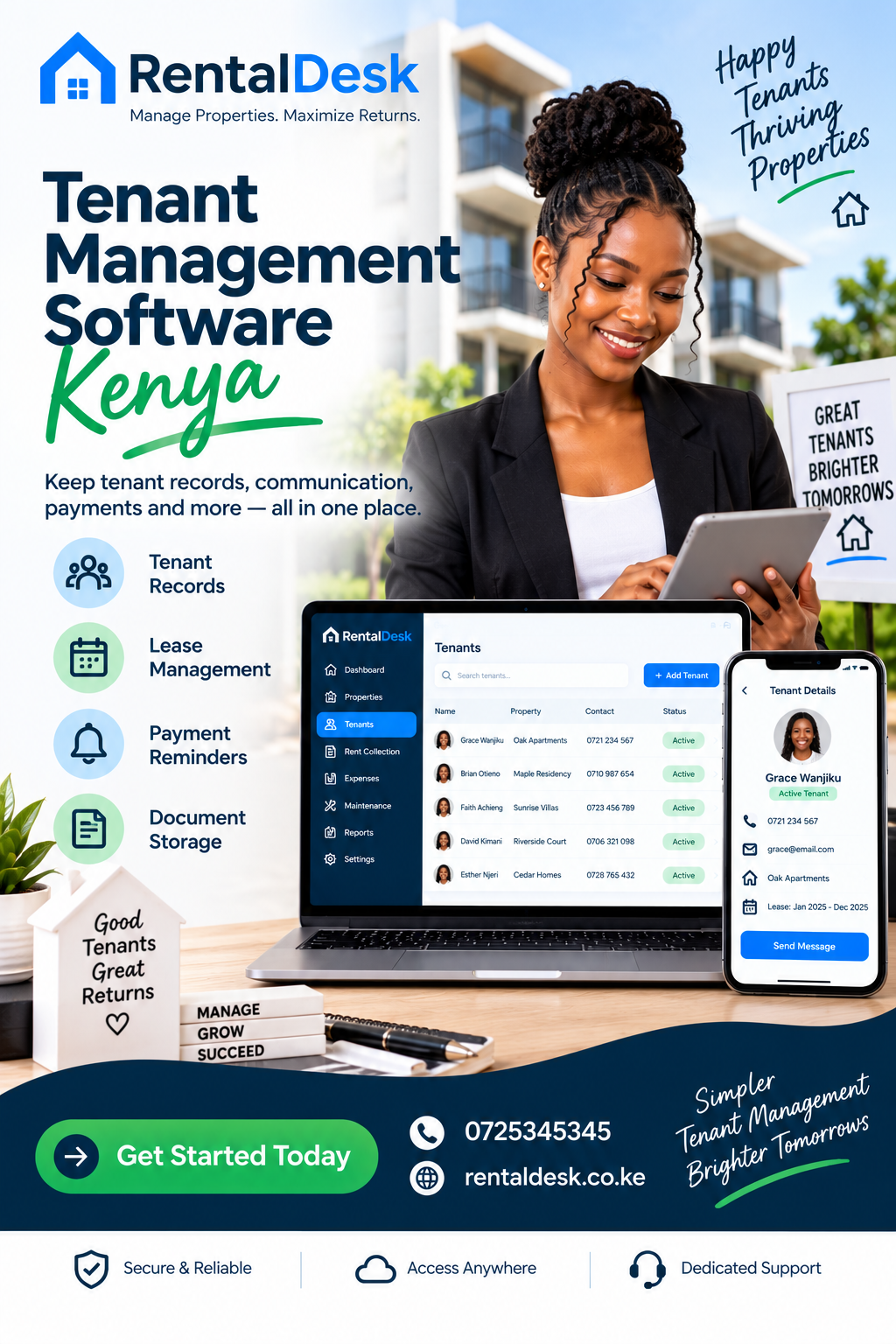
Tenant Management Software Kenya: Complete Guide for Landlords and Property Managers
Managing rental properties involves much more than collecting rent every month. Landlords and property managers have to keep track of tenant details, rental units, lease agreements, payments, deposits, maintenance requests, arrears and communication. Tenant Management Software Kenya provides a centralized way to organize these activities, making it easier for landlords, property managers and real estate businesses to maintain accurate records and manage growing rental portfolios.
A small landlord may initially manage tenants using notebooks, spreadsheets, receipts and phone messages. However, these methods become increasingly difficult when the number of tenants increases. Missing payment records, forgotten maintenance requests, outdated tenant information and untracked lease dates can create unnecessary administrative work.
This guide explains how tenant management software works, the features landlords should consider, how it can support rent collection and maintenance, and what Kenyan property owners should look for when choosing a digital rental management solution.
What Is Tenant Management Software?
Tenant Management Software Kenya is a digital system designed to help landlords and property managers organize information and activities relating to tenants and rental properties.
Instead of keeping tenant information in separate notebooks, spreadsheets and messaging conversations, a centralized system can bring important records together. Depending on the platform, a landlord may be able to create tenant profiles, assign tenants to specific units, record rent payments, monitor arrears, manage leases, track maintenance requests and generate reports.
The main purpose is to make tenant administration more organized and easier to monitor.
A tenant management platform can be useful for:
- Individual landlords
- Apartment managers
- Property management companies
- Residential property owners
- Commercial property managers
- Real estate agencies
- Owners with multiple rental properties
The specific features available will depend on the software provider, but the overall objective is to reduce fragmented record keeping.
Why Tenant Management Matters
Tenant Management Software Kenya can become particularly valuable as a rental portfolio grows. A landlord with two units may remember most tenant details without assistance. A landlord managing 50, 100 or several hundred units cannot reasonably depend on memory or scattered paper records.
Tenant management covers many different activities. The landlord needs to know who occupies each unit, how much rent is expected, whether the tenant has paid, whether there are outstanding balances, when the lease expires and whether there are unresolved maintenance issues.
Without a structured system, these details can become disconnected.
A centralized approach makes it easier to understand the status of individual tenants and the wider property portfolio.
The Problem With Scattered Records
Many rental businesses use a combination of:
- Excel spreadsheets
- Paper receipts
- Bank statements
- M-Pesa messages
- WhatsApp conversations
- Physical lease files
- Handwritten maintenance notes
Each tool may serve a purpose, but using many disconnected systems creates additional administrative work.
Tenant Management Software Kenya can bring many of these processes into one digital workflow, depending on the capabilities of the selected platform.
The benefit is not simply having fewer files. It is having information that can be connected.
For example, a tenant record can be associated with a specific property, unit, lease and payment history. This gives the property manager a clearer picture of the tenant’s account.
Centralizing Tenant Records
Tenant Management Software Kenya allows landlords to organize tenant information in a structured format rather than relying on scattered documents.
A typical tenant profile may contain:
| Tenant information | Purpose |
|---|---|
| Full name | Identifies the tenant |
| Phone number | Communication |
| Email address | Notices and correspondence |
| Property | Identifies the building |
| Unit number | Identifies the occupied space |
| Monthly rent | Records agreed rent |
| Deposit | Tracks deposit information |
| Lease dates | Tracks tenancy period |
| Payment history | Reviews transactions |
| Outstanding balance | Monitors arrears |
Not every system will collect or store the same information. Property managers should configure records according to their operational requirements and applicable data protection obligations.
The important point is that the information should be easy to retrieve when needed.
Managing Properties and Rental Units
Tenant Management Software Kenya can help connect tenants to the properties and units they occupy.
For example, a property company could organize its portfolio into:
- Apartment Block A
- Apartment Block B
- Commercial Building C
- Residential Houses D
Within each property, individual units can be listed and assigned to tenants.
This structure helps property managers distinguish between an occupied apartment, a vacant apartment and an apartment undergoing maintenance.
It also reduces confusion when several properties have similar unit numbers.
Unit-Level Information
A good property management workflow should make it easy to answer questions such as:
- Who occupies Unit A12?
- How much rent does Unit A12 generate?
- Is the tenant up to date?
- When does the lease expire?
- Has the tenant reported maintenance issues?
- Is the unit currently occupied?
Tenant Management Software Kenya can help organize these details when the platform supports property and unit management.
Tenant Onboarding
Tenant onboarding is the process of moving a new tenant from application and approval into an active tenancy.
This can involve collecting relevant tenant information, recording the agreed rent, assigning a unit, recording the deposit and capturing lease information.
Tenant Management Software Kenya can make onboarding more structured by providing a consistent place to capture the information required by the property manager.
A standardized process reduces the likelihood of forgetting important details.
A typical onboarding checklist may include:
- Tenant identification information
- Contact details
- Rental unit
- Monthly rent
- Deposit amount
- Lease start date
- Lease expiry date
- Relevant documents
- Initial payment
- Move-in information
The exact checklist should be adapted to the property business.
Rent Tracking
Rent collection is one of the most important responsibilities in property management.
Tenant Management Software Kenya can help landlords maintain a clear record of expected rent and recorded payments.
For example, if a tenant’s monthly rent is KSh 20,000 and they pay KSh 15,000, the landlord needs to know that KSh 5,000 remains outstanding.
When calculations are performed manually, mistakes can occur, particularly when partial payments happen regularly.
A structured tenant account can make the financial position easier to understand.
Tracking Partial Payments
Partial rent payments can complicate manual records.
A tenant might make several payments during the month. Without a centralized record, the landlord may need to manually add each transaction before determining the remaining balance.
Tenant Management Software Kenya can help organize payment records when the platform supports transaction tracking.
The system may show the original amount due, payments received and remaining balance, giving the property manager a clearer account history.
Managing Rent Arrears
Rent arrears occur when a tenant has an unpaid balance after the required payment date.
Tenant Management Software Kenya can help landlords identify tenants with outstanding balances and organize arrears information.
An arrears report may show:
- Tenant name
- Property
- Unit
- Expected rent
- Amount paid
- Outstanding amount
- Payment date
- Arrears status
This allows property managers to prioritize follow-ups based on accurate account information.
Rather than discovering arrears after several months, a landlord can monitor outstanding balances as part of routine property administration.
M-Pesa and Rental Payments in Kenya
Mobile money is an important part of the Kenyan payments environment, and many tenants use M-Pesa for everyday transactions.
Tenant Management Software Kenya can help property businesses organize payment information when the chosen platform supports appropriate digital payment functionality.
A landlord may receive several payments in a short period. The challenge is not only receiving the money but also identifying which tenant and unit the payment belongs to and how it should be reflected in the tenant’s account.
Payment integration or structured payment recording can reduce manual reconciliation.
Why Payment Reconciliation Matters
Suppose a property manager receives ten payments on the same day.
The manager may need to establish:
- Who paid?
- How much did they pay?
- Which unit is involved?
- Which month does the payment cover?
- Is there an outstanding balance?
Tenant Management Software Kenya can support this process when payment records are linked to tenant accounts.
The exact automation available depends on the platform and its payment integrations.
Security Deposit Management
Deposits should be tracked separately from ordinary rental income.
Tenant Management Software Kenya can help property managers maintain organized deposit records throughout the tenancy.
A deposit record may include:
- Tenant name
- Unit
- Deposit amount
- Date received
- Current status
- Relevant deductions
- Refund information
Accurate records become particularly useful when a tenant moves out and the property manager needs to review the account.
Keeping deposit information in the same tenant profile can also make it easier to review the full tenancy history.
Lease Management
Lease information should be readily accessible.
Tenant Management Software Kenya can help landlords organize lease details alongside tenant and property information.
Useful lease records may include:
- Start date
- Expiry date
- Rent amount
- Deposit
- Unit
- Tenant
- Renewal status
- Relevant documents
A centralized system reduces the need to search through physical files whenever a manager needs to confirm lease information.
Lease Expiry Monitoring
Lease expiry dates can easily be forgotten when they are written in notebooks or stored in different files.
Tenant Management Software Kenya can help property managers monitor lease information and identify agreements approaching their expiry dates where the software provides reminders or reporting.
This can support better planning around renewals, vacancies and tenant communication.
Tenant Communication
Communication is a major part of tenant management.
Tenants may need information about:
- Rent
- Payment confirmations
- Maintenance
- Inspections
- Property notices
- Lease matters
- Outstanding balances
- Building activities
Tenant Management Software Kenya can help centralize tenant-related information so staff can access the relevant account when responding to questions.
Software does not eliminate the need for personal communication. Instead, it can help ensure that the employee handling a tenant’s request has access to the correct information.
Maintenance Request Management
Maintenance problems can quickly affect tenant satisfaction.
A tenant might report:
- Plumbing problems
- Electrical faults
- Water leaks
- Damaged doors
- Broken fixtures
- Drainage issues
- Security-related repairs
Tenant Management Software Kenya can help property managers record maintenance requests and associate them with the correct tenant and unit when maintenance functionality is available.
A useful maintenance record can include:
- Date reported
- Tenant
- Property
- Unit
- Problem description
- Assigned technician
- Estimated cost
- Status
- Completion date
This provides a history that can be reviewed later.
Tracking Maintenance Costs
Maintenance is not only a tenant service issue. It is also a property expense.
Tenant Management Software Kenya can help managers maintain better records of maintenance activities and associated costs when those features are available.
For example, a manager could review how much has been spent repairing plumbing issues in a particular property over a specific period.
This information may help property owners identify recurring problems and plan maintenance budgets.
Tenant Documents
Rental businesses deal with many documents.
These may include:
- Lease agreements
- Tenant identification documents
- Inspection reports
- Notices
- Payment records
- Maintenance documentation
- Correspondence
Tenant Management Software Kenya can help organize tenant-related documents where the platform provides document management capabilities.
Digital organization can reduce the time spent searching through physical files.
However, landlords should also consider access controls, backups and appropriate handling of personal information.
Tenant Inspection Records
Property inspections can be important during move-in, routine maintenance and move-out.
Tenant Management Software Kenya can help property managers organize inspection information when the software provides inspection or property management features.
An inspection record can document the condition of:
- Walls
- Floors
- Doors
- Windows
- Plumbing fixtures
- Electrical fixtures
- Appliances
- Other relevant property components
Keeping inspection records can provide useful historical information for property management.
Vacancy Management
Vacant properties require attention because they do not generate rent while remaining part of the owner’s portfolio.
Tenant Management Software Kenya can help property managers monitor unit occupancy and vacancy information when the platform supports these functions.
A vacancy workflow might show:
- Unit became vacant
- Previous tenant moved out
- Inspection completed
- Repairs required
- Unit prepared
- Unit available
- New tenant assigned
This creates greater visibility over the transition between tenants.
Managing Multiple Properties
A landlord may own several properties in different areas.
Tenant Management Software Kenya can be useful for organizing tenant information across a growing portfolio when the platform supports multiple-property management.
For example, one landlord could manage apartments in Nairobi, rental houses in Kiambu and commercial units in another location.
Without centralized organization, each property may end up using separate spreadsheets and records.
A portfolio-level system can provide a more consistent management structure.
Reporting for Property Owners
Property owners need information to understand how their rental businesses are performing.
Tenant Management Software Kenya can help produce useful information when reporting functionality is available.
Possible reports include:
- Rent collected
- Outstanding rent
- Occupancy
- Vacancies
- Tenant lists
- Lease expiries
- Maintenance requests
- Payment histories
Reports can reduce the need to manually compile information from several sources.
Tenant Management for Apartment Buildings
Apartment buildings often have many tenants occupying similar units.
Tenant Management Software Kenya can help property managers organize tenant information at the building and unit level.
For example, a manager may need to see all tenants in one apartment block while also being able to open an individual tenant account.
This combination of portfolio-level and tenant-level information is useful for property managers dealing with high volumes of records.
Tenant Management for Small Landlords
Not every rental business has hundreds of units.
A landlord with five or ten units may still benefit from organized records.
Tenant Management Software Kenya can help smaller landlords establish structured processes before their portfolios become difficult to manage manually.
Starting with digital records can also make future expansion easier.
The goal is not necessarily to introduce complicated technology. It is to make everyday administration more consistent.
Tenant Management for Property Management Companies
Property management companies often manage properties on behalf of different owners.
Tenant Management Software Kenya can help create separation between properties while maintaining centralized tenant information.
A property manager may need to know:
- Which owner owns a property
- Which tenants occupy the units
- How much rent is expected
- How much has been collected
- What maintenance is pending
- Which units are vacant
A centralized system can make these relationships easier to manage.
Tenant Management for Commercial Properties
Tenant management also applies to commercial spaces.
Shops, offices, warehouses and other commercial premises may have multiple occupants and lease arrangements.
Tenant Management Software Kenya can support commercial tenant administration when the selected platform is designed for the relevant property types.
Commercial property managers should pay attention to lease structures, billing requirements and reporting needs because these may differ from residential rentals.
Tenant Management and Customer Service
A tenant’s experience is influenced by how quickly and accurately the property manager responds.
Tenant Management Software Kenya can help staff access tenant records when responding to enquiries.
For example, a tenant who asks about an outstanding balance should not necessarily have to wait while staff search through several spreadsheets.
The ability to retrieve the correct account information quickly can make communication more organized.
Automating Repetitive Tasks
Property management contains many repetitive activities.
These include:
- Recording payments
- Checking balances
- Updating tenant records
- Preparing reports
- Following up on outstanding amounts
- Monitoring lease dates
- Tracking maintenance
Tenant Management Software Kenya can automate or simplify some of these activities depending on the software’s features.
Automation should be viewed as a way of reducing repetitive administrative work rather than removing the need for human oversight.
Choosing the Right Software
The best software for one property manager may not be suitable for another.
Before choosing a platform, identify the actual problems affecting the business.
Tenant Management Software Kenya should be evaluated against those operational requirements rather than simply comparing the number of features advertised.
Ask:
- How many properties do we manage?
- How many tenants do we have?
- How are payments currently recorded?
- How are arrears monitored?
- How are maintenance requests handled?
- How are leases stored?
- What reports are required?
- How many employees need access?
The answers provide a basis for comparing different platforms.
Features to Look For
A tenant management system should ideally support the core tasks required by the rental business.
Tenant Management Software Kenya can be assessed using a checklist covering tenant records, property management, rent tracking, maintenance, reporting and communication.
Important features may include:
Tenant Database
The system should make it easy to create and update tenant profiles.
Property and Unit Management
Managers should be able to organize buildings and individual rental units.
Rent Tracking
The system should provide a clear record of expected and received rent.
Arrears Management
Outstanding balances should be easy to identify.
Lease Management
Lease dates and related information should be accessible.
Maintenance Management
Reported problems should be tracked from submission through completion.
Reporting
Managers should be able to generate useful operational reports.
Questions to Ask Before Buying Software
Before subscribing, landlords should ask practical questions.
Tenant Management Software Kenya should be evaluated based on the way the rental business actually operates.
Useful questions include:
- Can it manage multiple properties?
- Can tenants be assigned to specific units?
- Can rent payments be recorded?
- Can arrears be tracked?
- Does it support relevant M-Pesa workflows?
- Can leases be monitored?
- Can maintenance requests be recorded?
- Are reports available?
- Can different staff members have different permissions?
- What support is provided?
- How is data protected?
- Can information be exported if required?
These questions can help property managers avoid choosing software based solely on promotional claims.
Data Security and Tenant Information
Tenant records may contain personal and financial information.
Tenant Management Software Kenya should therefore be evaluated not only for convenience but also for its approach to data security and access control.
Property managers should understand:
- Who can access tenant information
- How user accounts are protected
- Whether permissions can be customized
- How backups are handled
- How documents are stored
- What happens when an employee leaves
- Whether records can be exported
Landlords should also establish internal procedures for handling personal information responsibly.
Cloud-Based Tenant Management
Cloud-based software can allow authorized users to access rental information through supported internet-connected devices.
Tenant Management Software Kenya can be useful for property managers who move between different properties and need access to information outside a traditional office environment.
However, cloud accessibility should be considered alongside security and user permissions.
A property manager should know exactly who has access to the system and what each user is allowed to do.
Tenant Move-In Management
Moving a new tenant into a property involves several steps.
Tenant Management Software Kenya can help structure move-in information where the relevant functionality is available.
A move-in process may include:
- Confirming tenant information
- Confirming the assigned unit
- Recording the lease
- Recording the deposit
- Recording initial rent
- Conducting an inspection
- Recording meter readings where relevant
- Issuing keys or access information
Having a clear record can make future reference easier.
Tenant Move-Out Management
The move-out process also involves multiple administrative steps.
Tenant Management Software Kenya can help property managers organize move-out information where the software supports the process.
A typical workflow may include:
- Recording notice
- Confirming departure date
- Inspecting the unit
- Checking outstanding rent
- Reviewing other charges
- Recording property condition
- Processing deposit information
- Updating the unit status
Once the tenant leaves, the unit can be marked for maintenance, cleaning, inspection or re-letting as appropriate.
Managing Tenant Arrears More Effectively
Arrears should be treated as an ongoing management process rather than a problem discovered at the end of the year.
Tenant Management Software Kenya can help managers maintain visibility over outstanding balances.
A useful arrears workflow may involve:
Payment due → Payment recorded → Balance calculated → Arrears identified → Follow-up → Payment received → Account updated
The specific follow-up process should comply with applicable tenancy agreements and Kenyan legal requirements.
Tenant Management and Property Maintenance
Tenant records and maintenance records are closely connected.
When a tenant reports a problem, the property manager needs to know the tenant’s unit and the history of previous maintenance work.
Tenant Management Software Kenya can connect these records when the platform supports integrated maintenance management.
This can help identify recurring issues.
For example, if the same plumbing problem has been reported several times in one unit, the property owner may decide that a more permanent repair is required instead of repeatedly paying for temporary fixes.
Using Reports to Understand Rental Operations
Reports allow property managers to move beyond individual tenant accounts and look at the portfolio as a whole.
Tenant Management Software Kenya can provide a central source for operational information when suitable reporting features are included.
A property owner might review:
- Total expected rent
- Total collected rent
- Outstanding balances
- Number of occupied units
- Number of vacant units
- Maintenance requests
- Lease expiries
This can make regular property reviews more structured.
Common Tenant Management Mistakes
Software does not automatically solve poor processes.
Property managers should avoid several common mistakes.
Keeping Incomplete Records
If tenant information is missing, the system cannot provide a complete picture.
Failing to Update Accounts
Records should be updated when payments, tenant details or tenancy circumstances change.
Ignoring Maintenance Requests
A request should not disappear simply because it was received through a different communication channel.
Giving All Staff Unlimited Access
Access should be appropriate to each employee’s role.
Not Training Employees
Staff need to understand how and when the system should be used.
Tenant Management Software Kenya is most effective when supported by clear procedures and consistent staff usage.
How to Move From Spreadsheets to Software
Moving from spreadsheets to a dedicated system requires planning.
Tenant Management Software Kenya can become easier to adopt when the transition is handled systematically.
Step 1: Review Existing Records
List all current tenants, properties, units, rent amounts, deposits, leases and outstanding balances.
Step 2: Clean the Data
Remove duplicate or outdated information.
Step 3: Organize Properties
Create the relevant property and unit structure.
Step 4: Add Tenants
Create accurate tenant profiles.
Step 5: Add Financial Information
Record appropriate balances and payment information.
Step 6: Train Users
Teach staff how to perform routine activities.
Step 7: Establish Procedures
Decide how payments, maintenance requests, documents and tenant communication will be recorded going forward.
What Does Tenant Management Software Cost?
Pricing varies considerably between software providers.
Tenant Management Software Kenya should therefore be compared according to the overall value and functionality required rather than price alone.
Pricing may depend on factors such as:
- Number of properties
- Number of units
- Number of users
- Available features
- Payment integrations
- Support
- Data migration
- Setup
- Reporting
A lower subscription price is not necessarily cheaper in practice if employees spend significant time performing tasks manually.
Scalability for Growing Rental Businesses
A rental business may start with a few units and eventually grow into a substantial portfolio.
Tenant Management Software Kenya should be capable of supporting the business’s current needs while providing room for growth where possible.
Before choosing a system, consider what will happen if:
- The number of tenants doubles
- More properties are added
- More employees need access
- More payment transactions are processed
- Additional reporting is required
Scalability can prevent a business from having to replace its system every time the portfolio expands.
Measuring the Value of Tenant Management Software
The value of software should be measured through practical improvements.
Tenant Management Software Kenya should make everyday property administration easier to manage and monitor.
Property managers can ask:
- Can we find tenant information faster?
- Are payment records more accurate?
- Can we identify arrears sooner?
- Are maintenance requests being tracked?
- Are reports easier to prepare?
- Are lease dates easier to monitor?
- Are staff spending less time on repetitive administration?
These questions help determine whether the software is actually improving operations.
A Practical Tenant Management Workflow
A well-organized rental process can follow a simple sequence:
Tenant onboarding → Unit allocation → Lease recording → Rent invoicing → Payment recording → Arrears monitoring → Maintenance management → Lease renewal or move-out → Reporting
Tenant Management Software Kenya can bring many of these activities together when the platform supports the relevant functions.
This is especially useful for property managers who currently rely on several disconnected tools.
Frequently Asked Questions
What is tenant management software?
Tenant Management Software Kenya is software that helps landlords and property managers organize tenant information, rental units, rent records, leases, maintenance and other tenancy-related activities.
Can tenant management software track rent?
Yes. Many rental management systems provide rent tracking features that allow landlords to record expected rent, received payments and outstanding balances.
Can it help with rent arrears?
Yes. Where arrears management is available, the system can help identify tenants with unpaid balances and organize information needed for follow-up.
Can landlords manage M-Pesa payments?
Some platforms provide M-Pesa integrations or payment-related workflows. The specific functionality should be confirmed with the software provider before subscribing.
Is tenant management software suitable for small landlords?
Yes. Small landlords can use digital tenant records to organize rent, leases, deposits and maintenance. A structured system can also make portfolio growth easier to manage.
Can property managers manage multiple buildings?
Many property management platforms support multiple properties and units. The exact number and functionality vary by provider.
Can tenant management software track maintenance?
Many platforms provide maintenance management features that allow reported issues to be recorded, assigned and monitored.
What should I consider before choosing a system?
Consider tenant management, rent collection, arrears, lease management, maintenance, reporting, payment options, security, support, usability and scalability.
Final Practical Checklist for Choosing a System
Before implementing a rental management platform, property owners can use the following checklist:
- Tenant profiles
- Property management
- Unit management
- Rent tracking
- Arrears monitoring
- Deposit records
- Lease tracking
- Maintenance management
- Payment recording
- M-Pesa compatibility where required
- Tenant communication
- Document management
- Reporting
- User permissions
- Data security
- Backup procedures
- Customer support
- Scalability
Tenant Management Software Kenya should ultimately be selected based on how well it addresses the actual administrative needs of the rental business.
A landlord managing a small number of units may prioritize simplicity and affordability. A property management company handling hundreds of tenants may need advanced reporting, multiple-user access, automated workflows and broader property management capabilities.
The important thing is to identify the operational problems first and then evaluate software against those problems.
Tenant Management Software Kenya can provide the foundation for more organized tenant administration when it combines accurate tenant records, property information, payment tracking, maintenance management and useful reporting in one system.
For Kenyan landlords and property managers, the move from manual records to a centralized digital process can make everyday rental administration more structured. The right system can help reduce repetitive work, improve visibility over tenant accounts and make important property information easier to access when decisions need to be made.