
How to choose property management software in Kenya is a process decision as much as a product decision, and it is the single most important technology investment a landlord or property manager will make. Buyers usually make the same mistake, and it is not choosing the wrong product—it is choosing before knowing what they need it to do. The pattern goes like this: a landlord has a bad month, searches online, watches three demos, likes the one with the best dashboard, signs up, and discovers in month four that it cannot handle part-payments the way their tenants actually pay. Nothing in that sequence is unreasonable.
Demos are designed to impress, and a landlord under pressure has no written standard to judge them against. This guide exists to give you that standard. It is about the process of choosing a how to choose property management software in Kenya rather than a tour of features, because the selection process is where the outcome is actually decided.
Before You Look at Anything, Write Down What You Have
Selection goes wrong at the start, when landlords begin with vendors rather than with their own situation. Spend two hours documenting what you actually run. It is the highest-value time in the entire how to choose property management software in Kenya process.
Portfolio shape. How many properties, how many units each, how geographically spread, and who owns what.
Tenure mix. Long-term residential, commercial, short-let, or a combination. Each has different requirements, and a how to choose property management software in Kenya built for residential will handle commercial leases poorly.
Payment reality. How rent actually arrives today, in what proportions, and how often payments come in without a usable reference. An estimated 85% of rent payments in urban Kenya are made through M-Pesa, so M-Pesa integration is non-negotiable .
Charge structure. Rent, water, garbage, service charge, parking, and whether utilities are metered or apportioned.
Lease terms. Deposit months, notice periods, escalation clauses, and whether these vary across tenancies.
Who does the work. You, a caretaker, an agent, a family member, or some combination, and what device each of them uses.
Where records live now. Spreadsheets, a notebook, WhatsApp threads, an agent’s system, or nowhere. That last one determines your migration effort, and landlords consistently underestimate it. Nothing about choosing a how to choose property management software in Kenya matters if you cannot get your existing balances into it accurately .
Turning That Into a Requirements List
The document you produce next is what makes vendor conversations productive instead of impressionistic. Split it into three tiers, and be honest about which is which.
Must have. Without this, the product is unusable for you. Typically: automated payment matching, part-payment handling, tenant statements, arrears ageing and full data export.
Should have. Significantly better with it. Metered water billing, caretaker mobile access, document storage, owner reporting.
Nice to have. Genuinely optional. Dashboards, mobile apps, integrations you will not use in year one.
Most landlords write everything as must-have, which makes the list useless for comparison. Force yourself to a maximum of eight must-haves. Then add the constraints, which vendors rarely ask about. Budget ceiling, number of users, whether your caretaker has a smartphone, and whether you need a how to choose property management software in Kenya that works on poor connectivity. Write the deal-breakers explicitly. No export rights is a deal-breaker. Payments only by manual entry is a deal-breaker for anyone with more than eight units .
The Six Scenarios That Expose a Weak Product
Feature lists tell you what a product claims. Scenarios tell you what it does. Insist on running these live in every demo. The strongest how to choose property management software in Kenya evaluations test real workflows, not marketing bullet points.
Scenario one: the part-payment. A tenant owes 32,000 in rent plus 2,400 in water and pays 20,000 with no instruction. Watch what the system does with it and whether you can configure the allocation differently.
Scenario two: the unreferenced payment. A payment arrives with no unit code. Where does it land, how does it surface, and how many clicks to assign it?
Scenario three: the move-out. A tenant leaves owing rent, with a deposit held and damage to deduct. Can the system produce one itemised settlement statement with evidence attached?
Scenario four: the meter anomaly. A reading implies triple normal consumption. Does the system flag it before invoicing, or bill it and leave you to handle the complaint?
Scenario five: the maintenance chain. A tenant reports a leak, the caretaker is assigned, a plumber attends, cost is recorded and the tenant confirms. Watch the whole chain on the devices each person would use.
Scenario six: the co-owner statement. A property owned by three siblings needs a statement per owner showing their share.
Any how to choose property management software in Kenya that handles all six cleanly is worth serious consideration. One that stumbles on two or more will stumble in your second quarter .
Running a Trial That Tells You Something
Most trials waste their value because landlords poke at sample data rather than testing with their own. The how to choose property management software in Kenya process must include a rigorous trial with real data.
Load real data. Two months of your actual payments, your actual tenants, your actual messy references. Sample data proves nothing because it was designed to work.
Reconcile a full month end to end. This is the single most informative thing you can do, and it takes an afternoon.
Count the manual interventions. How many payments needed hand-matching, how many charges needed correcting, how many things you could not do without support. That number predicts your monthly workload with any how to choose property management software in Kenya far better than any feature list.
Test the tenant view with actual tenants. Give three of them access with no instruction and watch. If they cannot find their balance unaided, you will still be answering balance queries by phone.
Test the caretaker view on the caretaker’s own phone. A maintenance interface that needs a laptop will be abandoned by someone who works on their feet.
Test support during the trial deliberately. Send a question at 7pm on a Saturday and see what happens.
Test the export. Download everything, open it, and check it is usable. A how to choose property management software in Kenya whose export produces an unreadable file has export in name only .
Reading Pricing Honestly
Headline pricing tells you little, and the gap between quoted and actual cost catches most buyers. The how to choose property management software in Kenya process must include a thorough pricing analysis.
Property management software in Kenya ranges from free for small portfolios to roughly KSh 1,500–12,000+ per month depending on units and features, plus quote-based enterprise plans . Here are the structures to understand:
Per-unit per-month. The common structure and usually fairest below fifty units. Confirm whether vacant units are billed, because some vendors charge for them and some do not.
Flat subscription banded by size. Check where the bands sit relative to your growth plans, since crossing a band can double your cost overnight.
Percentage of collections. This scales with your revenue rather than with the work performed, and over a decade the compounding is substantial.
Transaction fees on rent collections. Layered on the mobile money tariff. Calculate this annually against your real volume rather than accepting the per-transaction figure.
SMS costs. The line most often missed. Invoices, reminders, receipts and notices across twenty tenants monthly is a real recurring number.
Ask explicitly about setup fees, data migration charges, training, additional user seats for caretakers and agents, per-report export charges and support tiers. Get the quote all-in and in writing, covering year one and year two, because introductory pricing that doubles at renewal is common. Then compare against your alternative honestly. One deposit dispute lost for want of records, or one quarter at sixty per cent collection, typically exceeds a year of subscription to any how to choose property management software in Kenya you are considering .
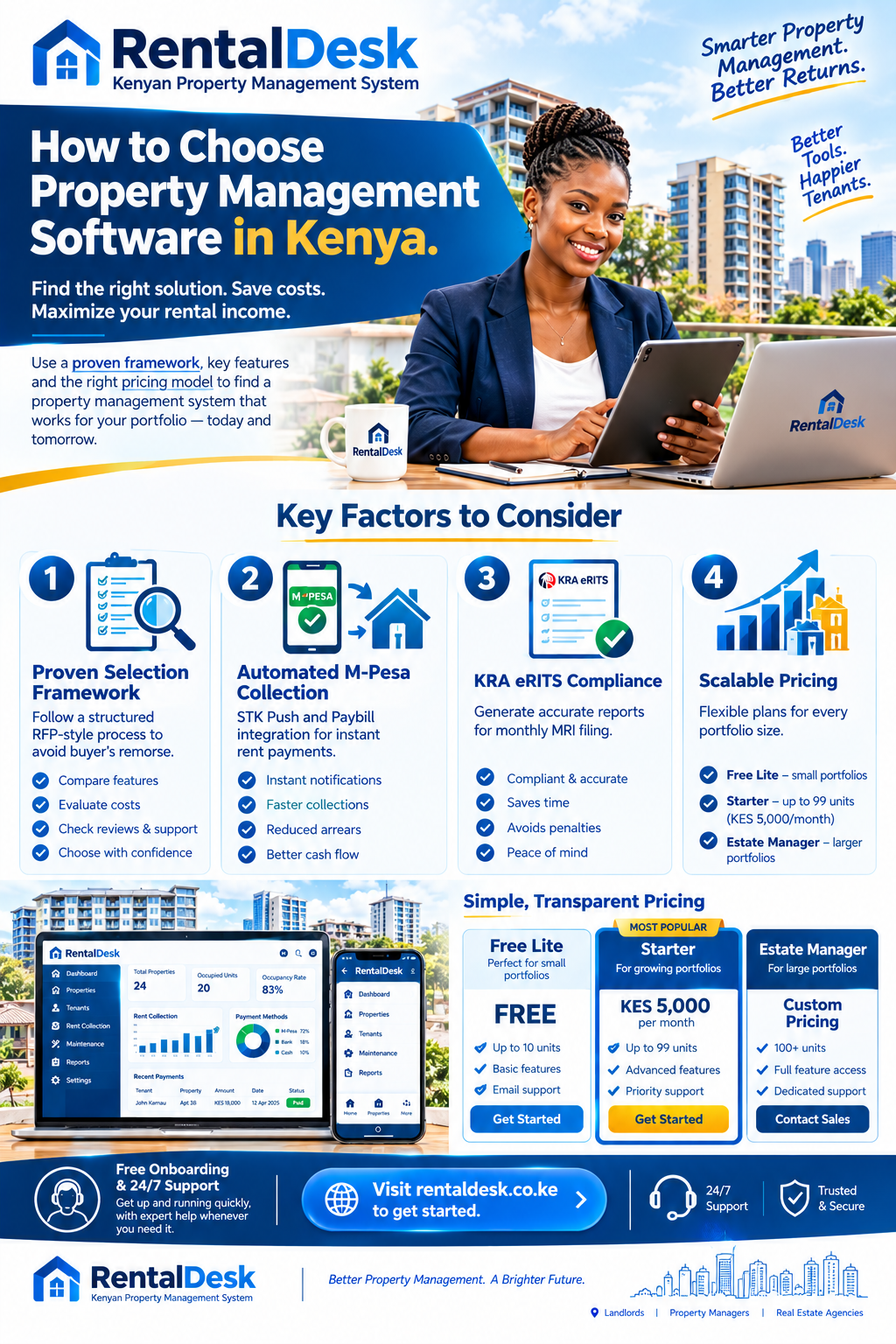
RentalDesk pricing starts with a Free Lite plan at KES 0 forever for one property with up to five units, Starter at KES 5,000/month for up to 99 units with M-Pesa collection and reconciliation, and Estate Manager at KES 9,500/month for 100–999 units with multi-property operations and role controls. Quarterly billing includes 5% off and yearly billing includes 10% off the base monthly rate .
The Questions Vendors Would Rather You Skipped
Every category has questions that separate serious providers from the rest. The how to choose property management software in Kenya evaluation must include these.
Where is our data hosted, and can we export all of it at any time in a standard format? Get the answer in writing and test it during the trial.
What happens to our data if you cease operating? Vagueness here is informative.
Are you registered with the Office of the Data Protection Commissioner? Under the Data Protection Act, 2019, you are a data controller holding tenant identity and financial information .
How many landlords in Kenya currently use this, and can we speak to two with portfolios like ours? Reluctance is a signal, and any how to choose property management software in Kenya with real customers will offer references readily.
What was your last significant outage and how long did it last? Everyone has one. Only some will tell you.
Is your M-Pesa integration live API, statement upload, or manual entry? These are three products sold under one phrase.
When you release an update, do we get a choice about when? Forced updates that change workflows mid-month are disruptive.
Has a restore from backup ever actually been tested? Untested backups are a hope rather than a control.
What is the notice period to cancel, and is there a minimum term? Annual lock-ins are common and worth knowing about before you sign for a how to choose property management software in Kenya you have used for three weeks .
Key Features to Prioritise
When evaluating how to choose property management software in Kenya, these are the features that separate useful tools from ones that will collect digital dust.
M-Pesa and Mobile Money Integration
This is non-negotiable for any system operating in Kenya. The platform should connect to your M-Pesa Paybill or Till number and automatically match incoming payments to the correct tenant and unit. Look for real-time payment notifications, automated receipt generation via SMS, and the ability to handle partial payments and overpayments. An estimated 85% of rent payments in urban Kenya are made through M-Pesa, so this feature alone can save you hours every month .
Tenant and Lease Management
The system should maintain a complete digital profile for each tenant: personal details, lease terms, payment history, deposit records, and communication logs. You should be able to track lease start and end dates, set up renewal reminders, and store scanned copies of ID documents and lease agreements. Good tenant management also includes a move-in and move-out workflow that captures the state of the unit at each transition .
Automated Rent Collection and Receipts
Beyond just receiving M-Pesa payments, the platform should automate the entire collection cycle. This includes generating and sending invoices before rent is due, sending payment reminders to tenants who have not paid, issuing digital receipts immediately upon payment, and flagging accounts that are in arrears. Automated collection has been shown to improve on-time payment rates by 15-25% compared to manual follow-up .
Financial Reporting and Tax Compliance
Your system should generate income statements, rent roll reports, arrears reports, and expense summaries without requiring you to export data to Excel. For KRA compliance, the platform should produce reports that align with rental income tax filing requirements and support eTIMS documentation. The Kenya Revenue Authority launched the Electronic Rental Income Tax System (eRITS) in April 2025, designed to simplify rental income tax compliance for property owners and property managers . eRITS is designed to be fully integrated with existing rental property management systems, creating a seamless digital ecosystem for rental income tax compliance .
Maintenance Request Tracking
Tenants should be able to submit maintenance requests through the platform, and you should be able to track each request from submission through assignment to completion. This creates an audit trail and ensures nothing falls through the cracks—a common complaint among tenants when maintenance is managed through informal WhatsApp messages .
Multi-Property and Portfolio Management
If you manage more than one building, the platform should let you view all properties from a single dashboard while keeping each property’s data separate and independently reportable. Portfolio-level analytics—total occupancy, aggregate income, comparative performance across buildings—help you make strategic decisions about your real estate investments .
Cloud Access for Diaspora Landlords
Kenya’s diaspora community is a significant investor in rental property. An estimated 40% of diaspora remittances are directed toward real estate, according to Central Bank of Kenya data. Cloud-based platforms allow these investors to monitor their properties in real time from anywhere in the world, receive automated reports, and communicate with tenants or property managers without relying solely on phone calls and screenshots .
Migration Without Losing Your History
Migration is where good decisions go wrong, because landlords treat it as a data transfer rather than as a reconciliation exercise.
Step one: agree your opening balances. Every tenant balance must be a figure both parties accept before it enters the new system. Disputed balances are the trap. A contested figure loaded into a system becomes permanent, and you will be arguing about it in two years. Resolve them now, in writing .
Step two: clean your tenant data. Unit numbers, tenant names, phone contacts, and balances should be checked before the system becomes the main working tool.
Step three: define user roles. Decide who can create, approve, edit, refund, export, and view sensitive records.
Step four: configure payment and reconciliation rules. Set up M-Pesa Paybill or STK Push for rent collection.
Step five: test with a small property first. Load real data, reconcile a full month, and count manual interventions.
Step six: train users. Train caretakers using real daily tasks rather than theory alone.
How RentalDesk Fits the Selection Criteria
RentalDesk is built specifically for the Kenyan rental market, addressing the unique challenges of M-Pesa reconciliation, multi-property management, and KRA compliance. The platform combines rent tracking, tenant management, arrears visibility, digital receipts, maintenance records, expense tracking, and landlord reports into one centralized system .
M-Pesa Integration
RentalDesk integrates directly with M-Pesa through STK Push, Paybill, and Till options. When a tenant pays, the system extracts the amount, phone number, account reference, and transaction ID, matches the account reference to the correct tenant and unit, credits the tenant account, generates a receipt, and updates the dashboard in real-time .
Tenant and Lease Management
RentalDesk stores tenant profiles, lease details, start and end dates, and automates lease tracking to avoid missed renewals. The platform supports digital lease storage, renewal alerts, and complete communication history .
Financial Reporting
RentalDesk generates real-time reports including rent collection summaries, outstanding arrears, expense reports, and landlord and tenant statements. These reports are suitable for KRA filing and audit purposes .
Maintenance Tracking
RentalDesk allows tenants to submit maintenance requests through the tenant portal with photos, assigns tasks to vendors, tracks progress, and records costs. This structured approach ensures no repair is forgotten and all costs are properly documented .
Cloud-Based Access
RentalDesk is cloud-based, allowing landlords to access property data from anywhere—on desktop or mobile—with secure data storage and backups .
Scalable Pricing
RentalDesk offers a Free Lite plan for small portfolios, Starter at KES 5,000/month for up to 99 units, and Estate Manager at KES 9,500/month for 100–999 units. Quarterly and yearly billing options provide additional savings .
Real-World Impact: What Good Software Delivers
The how to choose property management software in Kenya process delivers measurable results when done properly. One Nairobi agency using a well-implemented system boosted occupancy from 78% to 94% in six months. A Mombasa agency reduced vacancy from 18% to 6%, resulting in an extra KSh 3.2 million annual revenue from the same buildings. Agencies that adopt integrated systems see a 20-30% lift in gross rental income within the first year.
One property management company took over a troubled property where debts were soaring 117% above the monthly rent. Through strategic planning, open communication, and unwavering dedication, they reduced the debt from Kshs 167,400 to Kshs 41,500—a 75% decrease. In another case, a Lavington landlord managing 25 residential units reduced arrears from 35% to just 7%—an 80% reduction—after implementing automated reminders. This translated to a KES 280,000 monthly reduction in outstanding rent and a KES 3.36 million annual improvement in cash flow.
These results come from choosing software based on a structured evaluation, not on which demo looked best.
The Future of Property Management Software in Kenya
The how to choose property management software in Kenya landscape is evolving rapidly. With the Kenya Revenue Authority’s eRITS system now operational and requiring landlords to file monthly MRI returns, accurate rent tracking is no longer just about protecting cash flow—it is about tax compliance. Landlords who maintain accurate digital records will be better positioned to demonstrate their income and avoid penalties.
Modern property management software is moving beyond basic payment tracking to become complete property management operating systems. Features like AI-powered tenant screening, automated marketing to fill vacancies, and integrated maintenance workflows are becoming standard.
For Kenyan landlords, the choice is clear: follow a structured selection process, test with real data, and choose software that fits your actual portfolio, not the vendor’s demo script.
- How to choose property management software in Kenya
- How to choose property management software in Kenya
- How to choose property management software in Kenya
- How to choose property management software in Kenya
- How to choose property management software in Kenya
- How to choose property management software in Kenya
- How to choose property management software in Kenya
- How to choose property management software in Kenya
- How to choose property management software in Kenya
- How to choose property management software in Kenya
- How to choose property management software in Kenya
- How to choose property management software in Kenya
- How to choose property management software in Kenya
- How to choose property management software in Kenya