
Property Maintenance Software Kenya: Complete Guide for Smarter Property Management
Managing repairs across rental houses, apartments, commercial buildings and estates can quickly become complicated when maintenance requests are handled through notebooks, phone calls, spreadsheets and scattered WhatsApp conversations. Property Maintenance Software Kenya gives landlords and property managers a structured way to record repair requests, assign work, monitor progress, document completed jobs and maintain a reliable history for every property. This guide explains how digital maintenance management works, why it matters for Kenyan rental businesses, which features to look for, and how a platform such as RentalDesk can connect maintenance with tenants, properties, expenses and wider rental operations.
Property maintenance is not simply about fixing a leaking tap after a tenant complains. Effective maintenance includes preventive inspections, emergency repairs, contractor coordination, quotations, approvals, materials, labour, tenant communication, completion confirmation and historical records. When these activities are managed informally, property managers can struggle to know which jobs are open, who is responsible, how much a repair has cost or whether a recurring problem has already been addressed.
For a landlord with a few units, manual maintenance may appear manageable. However, the administrative burden increases as the number of properties and tenants grows. A manager overseeing several apartment blocks may receive dozens of requests in a month, ranging from plumbing and electrical faults to broken doors, water problems, painting, cleaning and security-related issues. A digital workflow makes it easier to separate urgent requests from routine work and ensure that every issue has an identifiable status.
This makes Property Maintenance Software Kenya relevant to landlords, property managers, caretakers, estate management companies, real estate investors and teams responsible for residential or commercial rental properties. The objective is not simply to digitize paperwork. The real objective is to create a repeatable maintenance process that improves accountability, response times, cost visibility and tenant service.
What Is Property Maintenance Software?
At its core, Property Maintenance Software Kenya is a digital system for organizing and monitoring maintenance activities associated with rental properties. Instead of keeping repair information in separate notebooks, emails, spreadsheets or personal phones, the property team can maintain a centralized record for each maintenance request.
A typical maintenance record can include the property name, unit number, tenant, issue description, priority, date reported, person responsible, contractor, status, expected completion date, costs, notes and completion details. Depending on the platform, supporting documentation can also be maintained alongside the request.
For Kenyan landlords, Property Maintenance Software Kenya can become part of a wider property management workflow. A maintenance request can be associated with a specific property and tenant, allowing management to understand not only what needs repair but also where the problem occurred and what action was taken.
A basic workflow may follow these stages:
- Tenant or caretaker reports an issue.
- The request is recorded.
- The problem is categorized.
- The urgency is assessed.
- A staff member or contractor is assigned.
- Work is scheduled.
- Materials and labour are recorded.
- The repair is completed.
- Completion is confirmed.
- The maintenance record remains available for future reference.
This process provides more visibility than simply receiving a message that says, “The sink is leaking.”
Why Maintenance Management Matters for Kenyan Landlords
Maintenance has a direct effect on tenant experience, property condition and operating costs. A small plumbing issue can become a larger repair when it is ignored. A broken security light can create unnecessary risk. A leaking roof can damage ceilings, walls, furniture or electrical installations if the problem is not addressed quickly.
A good Property Maintenance Software Kenya workflow allows managers to identify problems before they disappear into a backlog. Instead of depending on memory, managers can view outstanding requests and determine which ones require immediate attention.
For landlords with multiple properties, Property Maintenance Software Kenya also provides an opportunity to standardize maintenance procedures. Every property can follow the same basic reporting, assignment and closure process while still allowing different teams or contractors to handle different buildings.
This consistency matters because property maintenance involves many small decisions. Who should respond? Is the problem urgent? Does it require a quotation? Has the tenant been informed? Was the repair completed? Was the cost recorded? Is the same fault happening repeatedly?
A centralized system helps make these questions easier to answer.
The Problems With Manual Maintenance Tracking
Manual maintenance management is common among small landlords. A tenant sends a WhatsApp message, the landlord calls a plumber, the plumber sends a quotation, payment is made through mobile money, and the entire history remains scattered across several conversations.
The problem becomes more serious when several employees are involved. A caretaker may know about a repair that the property manager has not recorded. A contractor may say a job is complete while the tenant believes the issue remains unresolved. An owner may later ask for a maintenance cost breakdown that requires searching through months of messages.
Using Property Maintenance Software Kenya can reduce this fragmentation by creating a central maintenance record. Requests can be tracked according to status rather than relying on individual staff members to remember what remains outstanding.
For larger portfolios, Property Maintenance Software Kenya can also make it easier to distinguish between open, assigned, in-progress, completed and closed requests. This provides management with a clearer operational picture.
Manual systems also make historical analysis difficult. If a unit has experienced the same plumbing problem five times, the information may be buried in old messages. With a digital history, management can identify recurring faults and investigate whether a more permanent solution is appropriate.
Tenant Maintenance Requests
Tenants are often the first people to notice property problems. They may report leaking taps, blocked drains, faulty sockets, broken locks, damaged doors, water shortages or other issues.
A structured Property Maintenance Software Kenya system gives these reports a defined place in the management process. Instead of treating every message as an isolated conversation, the manager can turn the issue into a trackable request.
For example, a tenant in Apartment B12 might report a leaking bathroom pipe. The request can be associated with Apartment B12 and the relevant property. The manager can then assign the issue to a plumber, monitor progress and close the request after confirmation.
With Property Maintenance Software Kenya, the property team can also build a history of requests associated with individual units. This history may help identify recurring problems, high-maintenance units or building-wide issues.
The goal is not to make tenants fill out complicated forms. The reporting process should be simple enough that a tenant or caretaker can communicate the problem clearly while giving the management team enough information to take action.
Categorizing Maintenance Requests
Not every maintenance request has the same urgency. A broken light bulb is different from a major water leak. A cosmetic painting request is different from an electrical fault.
A practical Property Maintenance Software Kenya process should allow maintenance issues to be categorized. Useful categories may include plumbing, electrical, carpentry, painting, appliances, water systems, security, cleaning, structural issues and general repairs.
Priority levels can also help. A simple system may use categories such as emergency, high priority, normal and low priority.
For instance, a major water leak affecting several apartments could be treated as an emergency. A broken cabinet handle might be normal priority. A request for repainting a non-critical area could be scheduled as routine work.
Using Property Maintenance Software Kenya makes these distinctions easier to record consistently. The maintenance team can then organize its workload according to urgency rather than handling requests solely in the order in which messages arrive.
Clear categorization also improves reporting. Managers can see whether plumbing issues are increasing, whether electrical repairs are consuming more resources or whether particular properties generate unusually high maintenance activity.
Assigning Staff and Contractors
A maintenance request has little value if nobody is responsible for resolving it. Assignment is therefore an important part of maintenance management.
With Property Maintenance Software Kenya, managers can associate a repair with a caretaker, technician, employee or external contractor. This creates accountability because the request has an identifiable owner.
Suppose an apartment block has a plumbing issue. The property manager can assign the request to the preferred plumber, provide the relevant details and monitor the repair until completion.
Property Maintenance Software Kenya can also help property managers coordinate several contractors. A landlord might have separate electricians, plumbers, painters and general repair technicians. Maintaining a history of their work can make future coordination easier.
Contractor management should not only focus on assigning jobs. Managers may also want to maintain basic information about the work performed, costs incurred, quotations received and completion status.
Over time, this creates a more useful maintenance record and makes it easier to review recurring contractor activity.
Maintenance Quotations and Approvals
Some repairs are inexpensive and can be handled immediately. Others may require significant expenditure. A property management team should therefore have a process for reviewing larger maintenance costs.
A structured Property Maintenance Software Kenya workflow can help separate minor repairs from jobs that require quotation or approval.
For example, replacing a damaged tap may not require multiple quotations. Replacing a roof section could be a much larger project requiring inspection, quotation, approval and documented completion.
Property Maintenance Software Kenya can support the idea of approval controls by keeping maintenance information organized before work proceeds. This is particularly useful when a property manager is acting on behalf of an owner.
Clear approval procedures reduce misunderstandings. The landlord can know what work was proposed, why it was necessary and what amount was approved.
This does not mean every maintenance decision needs a long administrative process. The objective is proportional control: urgent repairs should be handled quickly, while significant expenses should receive appropriate review.
Tracking Maintenance Costs
Maintenance affects rental property profitability. If repair costs are not properly recorded, a landlord may have difficulty determining the true operating performance of a property.
Using Property Maintenance Software Kenya can help connect maintenance activity with financial records. Managers can record the nature of a repair and the associated costs so that maintenance expenditure becomes part of the property’s broader financial picture.
For example, suppose an apartment building generates strong rental income but experiences repeated plumbing repairs. Looking only at rent collection may make the property appear highly profitable. Once maintenance expenses are included, the financial picture may be different.
Property Maintenance Software Kenya can therefore support better management decisions by helping owners understand where maintenance money is being spent.
Cost tracking can also be broken down into categories such as labour, materials, contractor fees, transport, emergency repairs and routine servicing. This gives management a more useful view than a single annual maintenance figure.
Preventive Maintenance Versus Reactive Repairs
Reactive maintenance happens after something breaks. Preventive maintenance involves planned activities intended to reduce the likelihood of failures.
A property manager using Property Maintenance Software Kenya can organize maintenance records around both approaches. Reactive requests can be logged when tenants report faults, while routine inspections and servicing can be planned separately.
Preventive maintenance may be particularly useful for properties with pumps, generators, lifts, water tanks, gates, electrical systems and shared facilities.
For example, instead of waiting for a water pump to fail, management can schedule inspections and servicing according to the equipment’s requirements. Instead of waiting for common-area lighting to fail repeatedly, the team can inspect the installation and identify underlying problems.
Property Maintenance Software Kenya helps make maintenance more proactive when the system is used consistently. The goal is to reduce avoidable emergencies and protect the long-term condition of the property.
Maintenance History for Every Property
A property’s maintenance history is valuable because buildings have patterns. Some problems occur once. Others recur because of age, construction quality, usage or unresolved underlying causes.
With Property Maintenance Software Kenya, a manager can maintain a history of repairs connected to properties and units. This information can become useful when planning budgets, evaluating contractors or deciding whether a recurring problem requires a capital improvement.
For example, if a particular apartment repeatedly experiences drainage problems, the maintenance history may show that temporary repairs have not solved the underlying issue.
Property Maintenance Software Kenya can also help owners understand how maintenance needs change over time. Older properties may require more frequent repairs, while newer properties may initially require fewer interventions.
Historical records are particularly valuable when properties change managers. Instead of starting from zero, the new manager can review existing maintenance information and understand previous problems.
Maintenance and Tenant Satisfaction
Tenants generally expect reported problems to receive a reasonable response. Delayed repairs can affect the tenant’s perception of the landlord and the overall quality of the property.
A useful Property Maintenance Software Kenya system helps property teams monitor maintenance requests rather than allowing them to disappear into conversations.
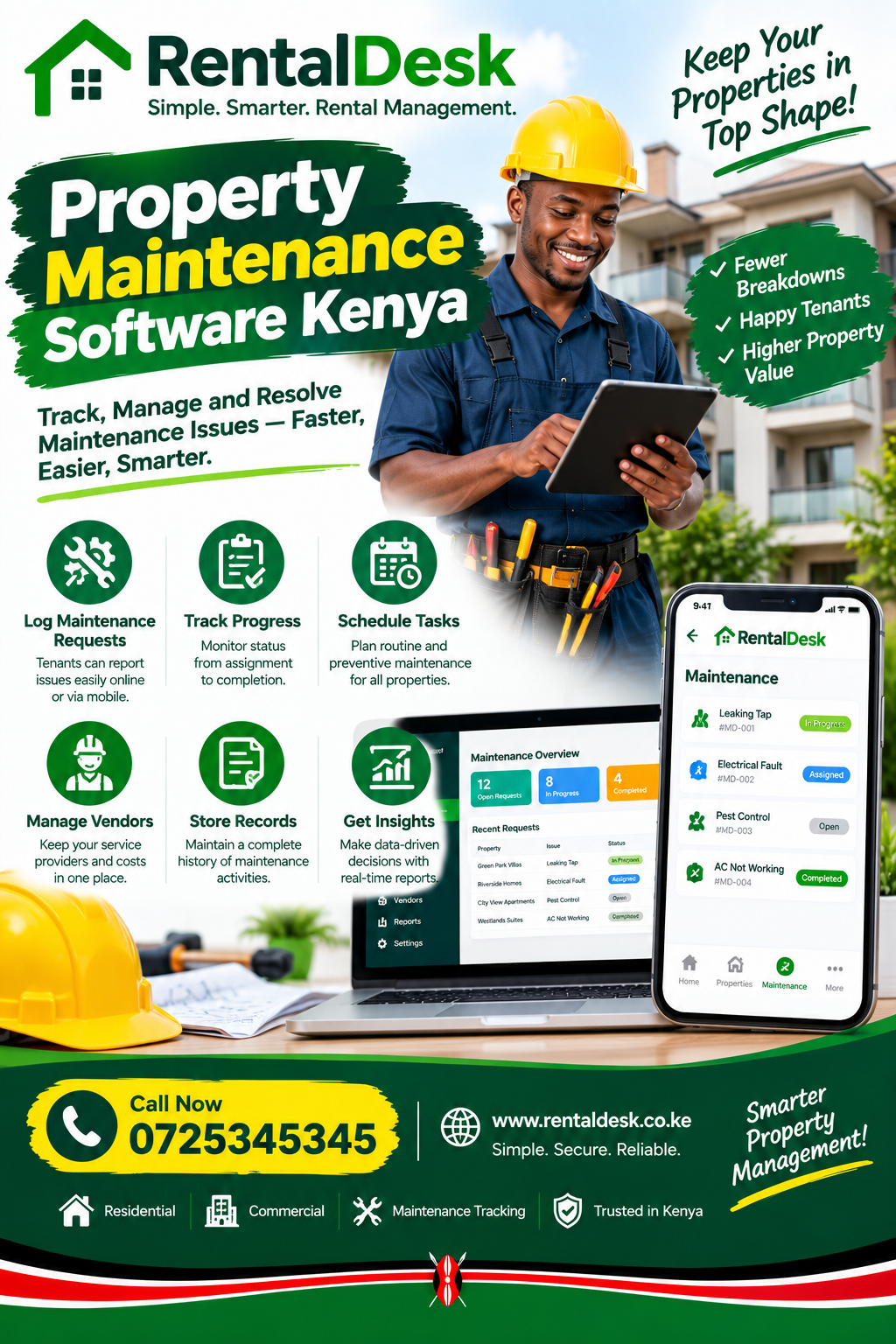
RentalDesk currently provides a maintenance request workflow where tenants can submit requests and property managers can monitor progress and status updates. The platform also keeps maintenance action records, supporting accountability and follow-up.
For landlords, Property Maintenance Software Kenya can therefore support a more professional tenant service process. When tenants know that requests are being recorded and followed up, communication can become clearer.
The software does not replace good customer service. A manager still needs to communicate, assess the problem correctly and arrange the necessary work. The system simply provides a more reliable operational structure.
Maintenance Across Multiple Properties
Managing one building is different from managing ten properties spread across different locations. The larger the portfolio, the more difficult it becomes to rely on memory and personal communication.
A centralized Property Maintenance Software Kenya platform can help managers organize requests across multiple buildings. Each maintenance issue can be associated with its relevant property and unit.
This makes portfolio-level monitoring possible. A manager might review all outstanding repairs and identify which properties require attention.
Property Maintenance Software Kenya can also support standardization across properties. For example, the same categories and priority rules can be used across several apartment blocks.
Standardization becomes especially useful for property management companies managing properties on behalf of multiple owners. Each owner’s property may have different contractors, budgets or approval procedures, but the underlying workflow can remain consistent.
Emergency Maintenance Management
Emergencies require a different approach from routine maintenance. Water leaks, serious electrical faults, security failures and other urgent problems can require immediate action.
A well-designed Property Maintenance Software Kenya process should make it possible to identify urgent requests quickly. Priority information helps managers distinguish emergencies from routine tasks.
For example, if a major pipe bursts in a building, waiting several days for the request to move through a normal queue would be inappropriate. The issue should be escalated immediately.
Property Maintenance Software Kenya can help maintain a record of what happened, who was contacted, what action was taken and when the problem was resolved.
After an emergency, the record can also be useful for reviewing the incident. Management can ask whether the cause was identified, whether preventive action is necessary and whether the repair should be classified as a recurring risk.
Maintenance for Apartments
Apartment buildings often generate a high volume of maintenance requests because many households share infrastructure.
With Property Maintenance Software Kenya, apartment managers can track requests according to individual units as well as shared facilities.
Private-unit issues may include plumbing, electrical faults, doors, windows and fixtures. Common-area issues may involve lifts, lighting, water systems, gates, drainage, security installations or cleaning.
Property Maintenance Software Kenya can help separate these responsibilities by maintaining clear records for the location and nature of each issue.
This becomes increasingly important as an apartment portfolio grows. A manager responsible for 20 units can remember more than someone responsible for 500 units. Digital records become an operational necessity rather than merely an optional convenience.
Maintenance for Commercial Properties
Commercial properties have different maintenance requirements from residential units. Offices, retail shops, warehouses and mixed-use properties may have specialized equipment, common areas and business tenants.
A suitable Property Maintenance Software Kenya workflow can help commercial property managers record issues and coordinate contractors without relying exclusively on informal communication.
For example, a retail tenant may report a faulty electrical installation that affects business operations. The manager needs to know when the problem was reported, who was assigned, whether a quotation was required and when the repair was completed.
Property Maintenance Software Kenya can also help maintain maintenance histories for commercial units. This is useful when landlords need to understand recurring costs or prepare property-level reports.
The exact workflow will depend on the building, tenant agreements and management arrangements, but the principle remains the same: every maintenance issue should have a clear record and responsible action.
Maintenance Expense Control
Uncontrolled maintenance spending can reduce rental returns. The problem is not necessarily that maintenance is expensive; rather, it can be difficult to know whether expenses are necessary, recurring or properly approved.
A structured Property Maintenance Software Kenya process can improve visibility into maintenance expenses by connecting work requests with cost information.
For example, if a manager notices repeated repairs to the same water pump, the maintenance history can prompt a comparison between continuing repairs and replacing the equipment.
Property Maintenance Software Kenya can also help management review expenditure by property, category or period. This makes maintenance budgeting more evidence-based.
Cost control should not mean choosing the cheapest repair every time. A low-cost temporary repair may become expensive if it has to be repeated every few weeks. The objective is to understand total cost and choose appropriate solutions.
Maintenance Budgets
Landlords can benefit from establishing realistic maintenance budgets based on historical property performance and expected requirements.
Using Property Maintenance Software Kenya, managers can analyze previous maintenance activity and use that information when planning future expenditure.
A budget can include routine servicing, minor repairs, emergency allowances and larger planned maintenance projects.
Property Maintenance Software Kenya can support the reporting process by making maintenance activity easier to organize. If a property consistently exceeds its maintenance budget, management can investigate the reason.
The cause might be an aging building, recurring plumbing failures, poor workmanship, tenant misuse, inadequate preventive maintenance or a contractor issue. Without records, these causes can be difficult to distinguish.
Budgeting therefore works best when it is connected to actual maintenance history rather than being based entirely on guesswork.
Managing Maintenance Contractors
Contractors are an important part of rental property operations. Many landlords depend on plumbers, electricians, painters, masons, carpenters, cleaners and specialized technicians.
A Property Maintenance Software Kenya system can help organize work assigned to these service providers. Each job can be associated with the relevant contractor and property.
Over time, managers can build a record of completed work and associated costs. This information can help when evaluating contractor performance.
Property Maintenance Software Kenya can also reduce confusion when multiple contractors are working on different properties. The manager can identify which person is responsible for each open request.
Good contractor management should include clear job descriptions, agreed costs where appropriate, completion confirmation and documentation. The software is useful because it keeps those details in one operational context.
Maintenance and Property Value
Property maintenance is not only an expense. It can also protect the condition and usability of an investment.
A well-maintained building can be easier to operate, market and retain tenants in. Delayed maintenance can allow minor issues to become larger problems.
With Property Maintenance Software Kenya, landlords can develop a clearer maintenance history that supports long-term property decisions.
For example, repeated roof repairs may indicate that a larger roof replacement should be considered. Frequent painting may indicate moisture problems rather than ordinary wear. Recurring electrical faults may suggest that an inspection of the underlying installation is needed.
Property Maintenance Software Kenya helps management move from isolated repair decisions toward a broader view of property condition.
This does not mean software can determine the technical solution. Qualified professionals should assess specialist issues. The system provides the operational record needed to coordinate and document the work.
Maintenance and Rental Property Accounting
Maintenance records become more useful when they connect with the financial side of property management.
A Property Maintenance Software Kenya workflow can provide information about the work performed, while connected financial records can show the associated expenditure.
This connection helps landlords understand property profitability. Rental income alone does not provide a complete picture.
Property Maintenance Software Kenya can support a wider property management approach in which rent collection, tenant information, expenses and maintenance are managed as related activities.
For example, if a property has high rental income but unusually high maintenance costs, the owner can investigate the reasons. The answer may be recurring repairs, aging infrastructure, poor contractor performance or a need for planned capital improvements.
The important point is that maintenance should not exist as an isolated administrative activity.
Mobile and Cloud-Based Maintenance Management
Property managers are often not sitting in an office. They may be visiting buildings, inspecting units, meeting contractors or responding to tenant concerns.
A Property Maintenance Software Kenya platform with web or mobile-responsive access can make maintenance information available while managers are away from their desks.
RentalDesk states that its platform is accessible through secure web browsers and a mobile-responsive interface, alongside maintenance management and other property-management features.
Property Maintenance Software Kenya can therefore be useful for teams that need to review requests while moving between properties.
The advantage of cloud-based access is not simply convenience. It can reduce dependence on one physical computer or paper file and make information easier to access across a distributed property operation.
Maintenance Reports for Landlords
Property owners need information that supports decisions. A maintenance report can show the number of requests, outstanding jobs, completed repairs, categories of work and associated expenditure.
Using Property Maintenance Software Kenya, managers can organize maintenance information into a format that is easier to review.
For an owner living outside Kenya, clear reporting can be particularly important. The owner may not visit the property frequently and therefore needs reliable operational information from the management team.
Property Maintenance Software Kenya can fit into a broader property management reporting process where maintenance is viewed alongside rent, expenses, occupancy and tenant information.
The purpose of reporting is not to create paperwork for its own sake. Good reports should answer practical questions: What is still unresolved? What has been spent? Which properties have the most repairs? Are there recurring issues? Which work requires management attention?
Choosing the Right Maintenance Software in Kenya
Not every software platform will be suitable for every landlord. The right solution depends on the number of properties, number of units, staffing structure, maintenance volume and broader property-management requirements.
When evaluating Property Maintenance Software Kenya, landlords should ask whether the platform can handle the actual workflow of their business.
Important questions include:
- Can tenants submit maintenance requests?
- Can managers assign requests?
- Can request status be monitored?
- Can completed work remain in history?
- Can maintenance be associated with properties and units?
- Can expenses be recorded?
- Can the platform support multiple properties?
- Can different staff members have appropriate access?
- Can maintenance information connect with wider property reports?
- Is the interface practical for everyday use?
A system may have many features but still be unsuitable if it makes routine work unnecessarily complicated.
Property Maintenance Software Kenya should therefore be evaluated based on usability as well as feature lists. The people who will actually use the system should be involved in the evaluation.
How RentalDesk Supports Maintenance Management
RentalDesk positions its platform as a cloud-based property management solution for landlords, property managers and real estate teams. Its documented core features include tenant management, rent invoicing, M-Pesa rent payment automation, payment reconciliation, financial reports, maintenance management, tenant communication and multi-property dashboards.
For maintenance specifically, RentalDesk documents a workflow where tenants can submit repair requests, managers can monitor status updates, and maintenance actions remain recorded for accountability.
This makes Property Maintenance Software Kenya useful when maintenance needs to be considered alongside other rental activities rather than managed as a completely separate system.
The wider value of Property Maintenance Software Kenya comes from connecting operational information. A property manager can manage tenants, billing, payments, maintenance and reporting within a broader rental-management environment.
RentalDesk’s own maintenance guidance also emphasizes repair requests, urgency classification, contractor assignment, quotation controls, labour and material costs, tenant communication, completion records, recurring faults, preventive maintenance and owner reporting.
Implementing a Maintenance Software System
Buying software is only the beginning. A landlord or property management company also needs a practical implementation process.
Start by documenting how maintenance currently works. How do tenants report problems? Who receives the request? Who approves expenditure? Who contacts contractors? How is completion confirmed? Where are invoices and receipts stored?
Then configure the Property Maintenance Software Kenya workflow around those actual processes.
Next, establish standard categories and priorities. Staff should know what qualifies as an emergency, what requires approval and what can be handled as routine work.
Training is also important. A system will not improve maintenance if staff continue keeping the real records in private WhatsApp chats and notebooks.
Property Maintenance Software Kenya should become the operational source of truth for maintenance requests. Staff can still communicate by phone or messaging when necessary, but the final status and important details should be captured in the system.
Best Practices for Property Maintenance
Several practical habits can make a maintenance management system more effective.
First, record every request. Even small repairs can become useful historical information.
Second, assign responsibility clearly. Every open request should have someone responsible for follow-up.
Third, prioritize emergencies. A major water leak should not sit in the same queue as a cosmetic repair.
Fourth, document completion. Record what was done, when it was completed and any relevant cost.
Fifth, review recurring problems. Repeated repairs may indicate that a permanent solution is more economical.
Sixth, connect maintenance with financial records. Owners should be able to understand how repairs affect property performance.
A well-managed Property Maintenance Software Kenya workflow supports these habits by making information visible.
Another important practice is to review open requests regularly. Weekly reviews can help managers identify jobs that have remained unresolved for too long.
Property Maintenance Software Kenya becomes most valuable when it is used consistently rather than only when management needs a report.
Common Maintenance Mistakes to Avoid
One common mistake is treating WhatsApp as the complete maintenance system. Messaging applications can be useful for communication, but conversations are not necessarily structured maintenance records.
Another mistake is failing to record completion. A contractor may say the job is finished, but without confirmation the manager may not know whether the tenant’s issue was actually resolved.
A third mistake is ignoring recurring problems. Repeated repairs should trigger investigation.
A fourth mistake is failing to distinguish maintenance costs from other property expenses.
A fifth mistake is allowing too many people to make changes without clear responsibility.
Using Property Maintenance Software Kenya can help establish a consistent workflow, but the management team must still follow defined procedures.
Similarly, Property Maintenance Software Kenya should not be treated as a substitute for qualified technical assessment. Software organizes information; plumbers, electricians, engineers and other specialists remain responsible for professional technical work.
Maintenance KPIs Property Managers Should Monitor
Property managers can use maintenance data to monitor performance. Useful indicators include the number of open requests, average response time, average completion time, emergency repairs, recurring faults and maintenance spending.
A Property Maintenance Software Kenya system can make these indicators easier to organize because requests are stored digitally.
For example, if one property has a much higher number of plumbing requests than similar properties, management can investigate. If many requests remain open for long periods, staffing or contractor capacity may need attention.
Property Maintenance Software Kenya can also help identify maintenance categories that consume the largest share of expenditure.
The objective is not to turn every property manager into a data analyst. A few meaningful indicators can provide useful operational insight.
Data Security and Staff Access
Maintenance records may contain tenant names, contact details, property information, contractor details and financial information. Access should therefore be managed responsibly.
When evaluating Property Maintenance Software Kenya, landlords should consider user permissions, account security, backups, data handling and access controls.
Different staff members may require different levels of access. A caretaker may need to manage requests, while an owner may primarily need reports.
Property Maintenance Software Kenya should support a sensible access model where users can perform their duties without receiving unnecessary access to unrelated information.
RentalDesk describes role-based access and secure platform access among its broader service approach, while its service documentation outlines security and availability considerations.
Property managers should also review applicable Kenyan data-protection requirements and maintain appropriate internal procedures for handling tenant information.
How Maintenance Software Helps Diaspora Landlords
Kenyan landlords living abroad may face an additional challenge: managing properties without being physically present.
A Property Maintenance Software Kenya system can give remote owners better visibility into the maintenance side of their investment.
Instead of depending entirely on occasional phone updates, an owner can receive structured information about requests, work completed and property expenses through the management process.
Property Maintenance Software Kenya can therefore support accountability between property owners and local managers.
This is particularly useful when a landlord owns properties in Nairobi, Mombasa, Kisumu, Nakuru, Kiambu or other counties while living in another country.
The software does not eliminate the need for a trustworthy caretaker or property manager. Rather, it creates better records that make remote oversight easier.
Maintenance for Growing Rental Portfolios
A landlord may begin with one property and gradually acquire more units. Processes that work for five units may become difficult at fifty or five hundred units.
This is where Property Maintenance Software Kenya can support scalability. A centralized workflow allows the management team to keep using defined processes as the portfolio expands.
As the portfolio grows, maintenance becomes a coordination problem. There may be multiple properties, caretakers, contractors, owners and tenant requests.
Property Maintenance Software Kenya can help management maintain visibility across those moving parts.
The best time to establish good records is before the portfolio becomes difficult to control. Waiting until maintenance requests are already overwhelming can make implementation more disruptive.
The Future of Digital Property Maintenance
Property management in Kenya is increasingly moving toward connected digital workflows. Modern platforms combine property records, tenants, billing, payments, maintenance and reporting instead of forcing managers to use separate systems for every task.
A Property Maintenance Software Kenya solution fits within this broader movement toward centralized rental operations.
For landlords, the benefit is operational clarity. For tenants, the benefit can be better communication and follow-up. For property managers, the benefit is reduced administrative fragmentation.
Property Maintenance Software Kenya will continue to be valuable as rental portfolios become more complex and owners demand clearer information about property performance.
The key is to choose a system that supports real workflows rather than simply offering a long list of features.
Frequently Asked Questions
1. What is Property Maintenance Software Kenya?
Property Maintenance Software Kenya refers to digital software used to organize, assign, monitor and document maintenance activities for rental properties in Kenya. It can support tenant repair requests, work assignments, status tracking, maintenance history and related reporting.
2. Can small landlords use property maintenance software?
Yes. Property Maintenance Software Kenya can be useful even for smaller portfolios because it creates organized records from the beginning. A small landlord may not need every advanced feature, but having a consistent maintenance process can make future growth easier.
3. Can tenants submit maintenance requests?
Many modern property management platforms support tenant maintenance requests. RentalDesk documents a feature that allows tenants to submit repair and maintenance requests while managers monitor their status.
4. Can maintenance costs be tracked?
Yes. Property Maintenance Software Kenya can form part of a wider property management workflow in which maintenance activity is connected with property expenses and financial reporting. RentalDesk’s documented platform features include financial reports, expense-related management and maintenance functionality.
5. Does maintenance software replace contractors?
No. Software does not replace plumbers, electricians, technicians, engineers or other professionals. Property Maintenance Software Kenya helps organize their work, assignments, progress and records, while qualified contractors perform the actual technical work.
6. Is maintenance software useful for multiple properties?
Yes. Property Maintenance Software Kenya is particularly valuable for managers handling multiple buildings because requests can be organized according to property, unit, status and responsibility.
7. What maintenance problems can be tracked?
Common examples include plumbing, electrical faults, broken doors, damaged fixtures, water issues, leaking roofs, cleaning problems and security-related repairs. The categories should reflect the actual needs of each property.
8. Can software support preventive maintenance?
Yes. A good Property Maintenance Software Kenya workflow can support planned inspections and servicing alongside reactive repair requests. Preventive maintenance is useful for equipment and systems that require periodic attention.
9. Why is maintenance history important?
Maintenance history helps landlords identify recurring problems, understand expenditure patterns and make better long-term property decisions. Property Maintenance Software Kenya can help keep this history organized instead of leaving it across scattered messages and paper records.
10. How should a landlord choose maintenance software?
Start with the actual workflow. Property Maintenance Software Kenya should be evaluated based on request management, assignment, status tracking, property and unit records, reporting, expense visibility, usability, security and the ability to integrate with wider rental operations.
Conclusion
Property maintenance is one of the most important operational responsibilities for Kenyan landlords and property managers. Repairs affect tenant satisfaction, operating costs, property condition and long-term investment performance. When requests are managed through scattered messages and paper records, it becomes difficult to know what is outstanding, who is responsible and how much has been spent.
A structured digital workflow changes that. Property Maintenance Software Kenya can help turn maintenance requests into organized, trackable tasks with clear ownership, status updates and historical records.
For growing rental businesses, the value extends beyond individual repairs. Property Maintenance Software Kenya can help management understand recurring problems, monitor contractors, review costs, plan preventive maintenance and produce clearer reports for property owners.
RentalDesk’s documented maintenance functionality allows tenants to submit requests while managers monitor progress and retain maintenance records. Its wider platform connects maintenance with property, tenant, billing, payment and reporting functions.
Ultimately, the right system should make property maintenance easier to control without making everyday work unnecessarily complicated. Landlords should look for a platform that fits their portfolio, staff structure and operational needs.
When maintenance records are organized, responsibilities are clear and completed work is documented, property managers can spend less time searching through old messages and more time managing the property itself. For Kenyan rental businesses seeking a more systematic approach, Property Maintenance Software Kenya can be an important part of building a reliable, scalable property management operation.