
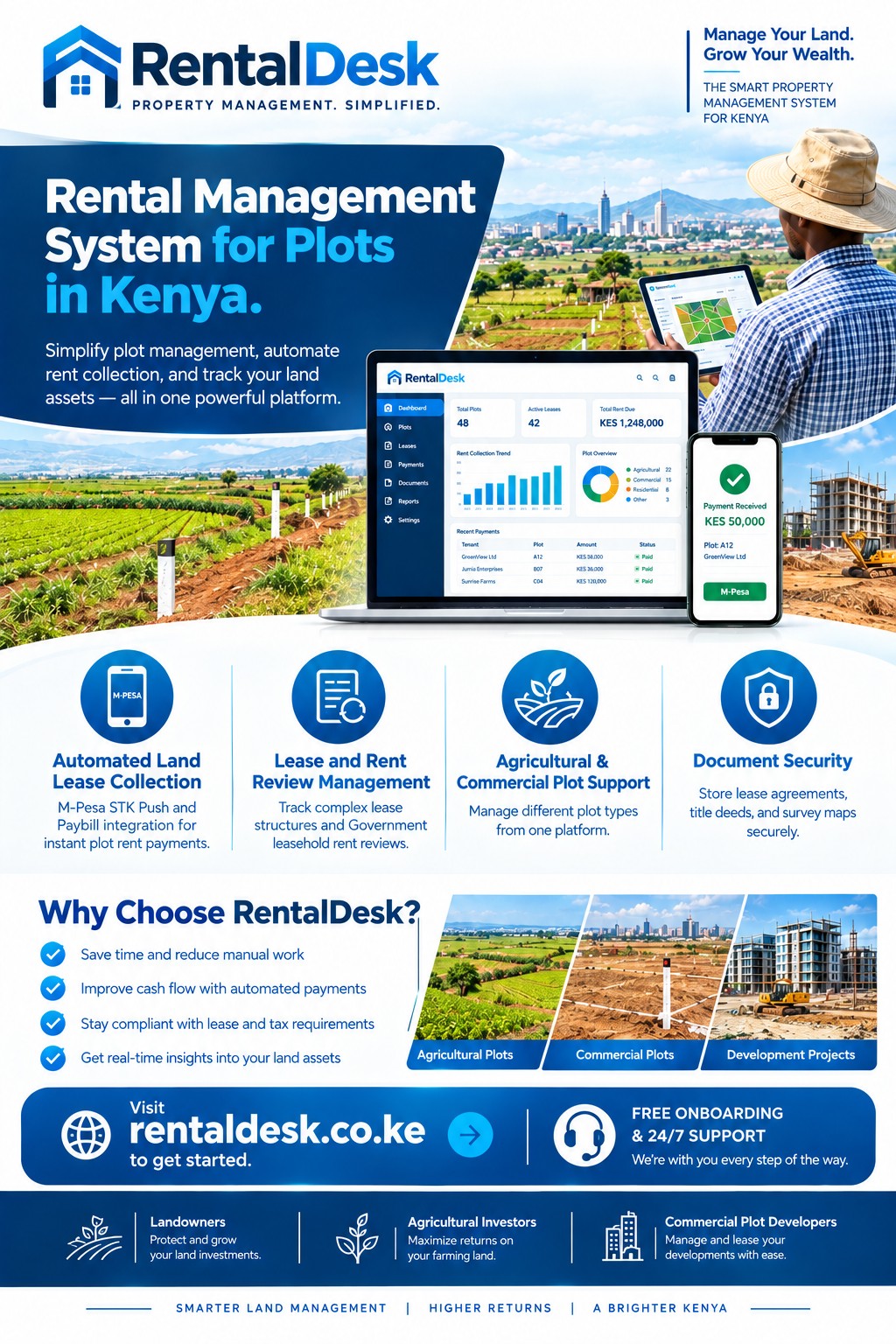
Rental management system for plots in Kenya has become an essential tool for landowners, agricultural investors, and commercial property developers managing the country’s diverse and valuable land assets. Unlike built-up properties, plot rentals—whether agricultural land, commercial plots, or vacant development sites—present unique challenges: irregular payment cycles, leasehold rent reviews, service charge complexities, and the constant risk of encroachment or land grabbing [3†L5-L7].
With land rentals ranging from KES 35,000 per month for compact yards in Embakasi to over KES 120M per month for prime acreage in Karen [5†L5-L6], the financial stakes are significant. Yet, many landowners still manage these valuable assets using manual methods—notebooks, WhatsApp messages, and scattered lease documents. RentalDesk provides a comprehensive, cloud-based rental management system for plots in Kenya, helping landowners automate lease payment collection, track multiple land leases, manage agricultural and commercial plot rentals, and maintain secure digital records of all land transactions from one centralized platform.
Why a Rental Management System for Plots in Kenya Matters
The rental management system for plots in Kenya conversation is increasingly important as land remains one of Kenya’s most valuable and sought-after assets. From agricultural land in Kitengela and Ruiru to commercial plots in Nairobi’s industrial areas and prime residential land in Karen, the land rental market is diverse and lucrative [5†L39-L41]. However, managing land rentals manually creates significant risks. Stories of land grabbing, illegal construction on vacant plots, and property encroachment are common [3†L12-L13]. A landowner leasing an acre of agricultural land or a commercial plot needs reliable records of who is leasing the land, what has been paid, what remains outstanding, and when the lease is due for renewal [3†L9-L10]. Without a structured system, these valuable records are easily lost, and disputes become difficult to resolve.
Manual land rental management is particularly risky for absentee landlords and diaspora landowners. For vacant land, the risks are different—land grabbing, illegal construction by squatters, and boundary encroachment by neighbors are common threats [3†L5-L7]. Visible boundary markers, regular inspection visits, and maintaining good relationships with neighboring landowners all help protect vacant land [3†L7-L9]. A proper rental management system for plots in Kenya solves these problems by providing a centralized platform where all land lease data is connected. Lease payments update tenant balances, lease renewal dates trigger alerts, and reports help landowners understand portfolio performance across different land parcels. RentalDesk is specifically designed to support land and plot rentals, making it the preferred choice for landowners and agricultural investors seeking reliable rental management for plots in Kenya.
Key Challenges in Plot Rental Management
The rental management system for plots in Kenya must address several specific challenges that landowners and plot managers face daily:
Irregular Payment Cycles and Arrears
Unlike residential rentals with predictable monthly payments, plot rentals often involve irregular payment cycles. Some agricultural land leases are paid annually or seasonally, while commercial plot leases may have quarterly or bi-annual payment schedules. Without a system, tracking these varied payment cycles is challenging, and arrears can accumulate unnoticed.
Complex Lease Structures
Land leases in Kenya can be complex. For instance, under the Government Land Act cap 280, rents on Government leaseholds are revised after every ten years [2†L13-L14]. Lease documents should include a rent review clause, allowing for review at stated periods [2†L15-L16]. Additionally, lessees are usually liable for the payment of all outgoings on the property [2†L12-L13]. Tracking these complex lease terms manually is error-prone.
Leasehold Rent Reviews
Government leaseholds and some private land leases include rent review clauses that trigger periodic increases. Landowners must track when these reviews are due and apply the correct increases. Without a system, landowners may miss review dates or fail to apply increases correctly, losing significant rental income.
Service Charges and Outgoings
Beyond basic rent, plot tenants may be liable for rates, property taxes, and other outgoings [2†L11-L13]. Managing these additional charges across multiple plots without a system is time-consuming and prone to errors. In some cases, county governments have launched digital platforms to help with payment of property rates and rent [1†L46-L48], but landowners still need an internal system to track what tenants owe.
Encroachment and Land Grabbing Risks
Vacant plots are particularly vulnerable to encroachment and land grabbing [3†L5-L7]. Without regular inspections and clear records of lease agreements, landowners may lose valuable land to squatters or illegal constructions. A rental management system helps landowners maintain clear documentation of who is leasing the land, for what purpose, and for how long.
M-Pesa Reconciliation
Like built-up properties, many plot tenants now pay rent via M-Pesa. With M-Pesa handling over 90% of rent payments in Kenya, landowners must reconcile payments from multiple tenants, some paying annually and others monthly. Manual reconciliation—checking M-Pesa messages and matching them to tenant records—takes hours and creates opportunities for errors.
How RentalDesk Simplifies Plot Rental Management
RentalDesk is built specifically for the Kenyan market, making it the ideal rental management system for plots in Kenya. Here is how the platform transforms plot and land rental operations:
Automated Land Lease Payment Collection
The rental management system for plots in Kenya must include automated payment collection. RentalDesk supports M-Pesa STK Push, Paybill, and Till options, allowing plot tenants to pay rent instantly, whether they are leasing agricultural land, a commercial plot, or a residential building plot.
When a tenant pays via M-Pesa Paybill, the system extracts the amount, phone number, account reference, and transaction ID, matches the account reference to the correct tenant and plot, credits the tenant account, generates a receipt, and updates the dashboard in real-time. This eliminates manual reconciliation and reduces errors.
M-Pesa STK Push allows plot tenants to pay rent directly from their phones with a single confirmation pop-up—no wrong numbers, no delays, no confusion. This is particularly valuable for agricultural tenants who may be in remote areas without easy access to banking services.
Paybill Integration enables landowners to collect rent through a designated Paybill number whose account-number field identifies the tenant and plot. The moment a payment arrives, Safaricom fires a C2B callback containing the amount, phone number, and account number, enabling automatic reconciliation.
Land Lease Management and Rent Reviews
The rental management system for plots in Kenya should provide comprehensive lease management. RentalDesk allows landowners to:
-
Upload and store lease agreements digitally
-
Track lease start dates, expiry dates, and renewal deadlines
-
Monitor rent review clauses and schedule increases
-
Manage security deposits and payment terms
-
Track Government leasehold rent review dates
-
Handle different payment cycles (monthly, quarterly, annual)
-
Receive automated alerts before lease expiry
For landowners managing multiple plots with different lease terms and rent review schedules, this automation ensures that no lease expires without notice and all rent increases are applied correctly. Under the Government Land Act, rents on Government leaseholds are revised after every ten years [2†L13-L14], and RentalDesk helps landowners track these critical review dates.
Agricultural and Commercial Plot Management
The rental management system for plots in Kenya must handle different plot types. RentalDesk allows landowners to categorize plots by type:
-
Agricultural land (farmland, crop land, grazing land)
-
Commercial plots (retail, industrial, mixed-use)
-
Residential building plots
-
Vacant development land
-
Government leasehold land
Each plot type can have different lease structures, payment cycles, and service charge obligations. This categorization helps landowners understand portfolio performance across different land segments. Agricultural land in areas like Kitengela and Ruiru may have different rental dynamics compared to commercial plots in Nairobi’s industrial areas [5†L39-L41].
Service Charge and Outgoings Tracking
The rental management system for plots in Kenya should handle service charges and outgoings. RentalDesk allows landowners to:
-
Track property rates and land rent payments to county governments
-
Record outgoings such as land rates, property taxes, and levies
-
Allocate outgoings to specific tenants where applicable
-
Generate transparent invoices with all charges itemized
Under standard land leases, the lessee is usually liable for the payment of all outgoings on the property [2†L12-L13]. RentalDesk helps landowners track these charges and bill tenants accurately.
Real-Time Arrears Tracking
The rental management system for plots in Kenya should provide real-time arrears visibility. RentalDesk enables landowners to instantly see:
-
Total rent expected for the period
-
Total rent collected
-
Outstanding balances by tenant and plot
-
Total arrears aging (30, 60, 90+ days, or by payment cycle)
-
Payment behavior analysis
With land portfolios where monthly rental income can run into millions of shillings, this visibility is essential for maintaining cash flow and identifying at-risk tenants early. For agricultural land with annual payments, arrears tracking helps landowners identify tenants who have not paid their annual rent on time.
Automated Rent Invoicing and Escalations
The rental management system for plots in Kenya should automate invoicing and escalations. RentalDesk automatically:
-
Generates recurring rent invoices based on lease terms and payment cycles
-
Applies rent review increases automatically
-
Calculates VAT where applicable
-
Sends payment reminders before and after due dates
-
Issues digital receipts immediately after payment
This automation ensures that all tenants receive accurate, professional invoices on time and that rent increases are applied consistently. For Government leaseholds with ten-year rent reviews, the system can schedule these reviews and apply increases automatically.
Multi-Plot Portfolio Management
For landowners with plots in different locations, the rental management system for plots in Kenya must support multi-property management. RentalDesk provides a unified dashboard where landowners can:
-
View all plots at a glance
-
Monitor rent collection per plot
-
Track occupancy and lease status
-
Compare revenue performance
-
Analyze arrears per location
-
Generate plot-specific reports
You can manage plots across Nairobi, Kiambu, Nakuru, Mombasa, Eldoret, Kisumu, and other key locations from one centralized platform [5†L39-L41].
Lease Renewal and Rent Review Alerts
The rental management system for plots in Kenya should provide automated alerts. RentalDesk sends notifications for:
-
Lease expiry dates
-
Rent review dates
-
Government leasehold rent review schedules (every ten years)
-
Payment due dates
-
Annual rent review dates
This ensures that landowners never miss critical deadlines that could result in lost rental income or legal complications.
Document Management and Security
The rental management system for plots in Kenya should include secure document storage. RentalDesk allows landowners to store:
-
Lease agreements and renewals
-
Tenant ID and KRA PIN copies
-
Land title deed copies
-
Survey maps and boundary documents
-
Inspection reports
-
Compliance and licensing documents
This centralizes all important documents, making them accessible when needed for audits, disputes, or regulatory inspections. For vacant land, maintaining clear records of lease agreements and boundaries helps protect against encroachment and land grabbing [3†L5-L7].
Landlord and Tenant Portals
The rental management system for plots in Kenya should provide self-service portals. RentalDesk offers:
Tenant Portal: Tenants can view invoices and payment history, download receipts, see outstanding balances, and submit inquiries.
Landlord Portal: Landowners can view rent collected, expenses, lease status, arrears, and payment histories for their plots.
This transparency improves trust and reduces the number of inquiries landowners receive, which is particularly valuable for diaspora landowners managing plots from abroad.
Why Landowners Need a Specialised Rental Management System for Plots
The rental management system for plots in Kenya offered by RentalDesk delivers numerous benefits specifically for land and plot owners:
Protection Against Encroachment
For vacant land, the risks of land grabbing, illegal construction, and boundary encroachment are significant [3†L5-L7]. A rental management system helps landowners maintain clear records of who is leasing the land, for what purpose, and for how long. This documentation is essential for legal protection.
Professional Landlord-Tenant Relationships
Plot tenants—whether agricultural farmers, commercial developers, or individuals leasing building plots—expect professional service. A specialised system helps landowners meet these expectations and build long-term tenant relationships.
Reduced Arrears
With automated reminders and real-time visibility into overdue accounts, landowners can reduce arrears significantly. Agricultural tenants, in particular, may have seasonal income and benefit from timely reminders.
Accurate Financial Records
Manual accounting for land rentals is prone to errors that affect profitability and compliance. RentalDesk automates calculations, reducing errors and ensuring accurate financial records for tax compliance and investor reporting.
Scalability
Whether you manage one plot or fifty, RentalDesk scales with your portfolio. As you acquire new land, you can add it to the system without increasing manual work.
Diaspora Landlord Support
For landowners living abroad, managing plots in Kenya is challenging. A rental management system provides complete visibility into land leases, payments, and maintenance, allowing landowners to manage their plots from anywhere in the world [3†L5-L7].
How to Choose the Best Rental Management System for Plots in Kenya
When selecting rental management system for plots in Kenya, consider these factors:
Land Lease Support: Does the software handle different plot types—agricultural, commercial, residential, vacant—and complex lease structures? This is essential for land rentals.
Payment Cycle Flexibility: Can the software handle irregular payment cycles—monthly, quarterly, bi-annual, annual?
Rent Review Tracking: Does the software track rent review dates and apply increases automatically?
M-Pesa Integration: Does the software automatically reconcile M-Pesa payments? With over 90% of rent payments in Kenya happening via M-Pesa, this is non-negotiable.
Outgoings Tracking: Can the software track and bill for property rates, taxes, and other outgoings?
Multi-Plot Management: Does the software support multiple plots from one dashboard?
Document Storage: Does the software provide secure storage for lease agreements, title deeds, and survey maps?
Local Support: Is there local support available when you need help?
RentalDesk meets all these criteria, making it the ideal choice for landowners seeking reliable rental management for plots in Kenya.
How to Get Started with a Rental Management System for Plots in Kenya
Implementing rental management system for plots in Kenya is straightforward with RentalDesk :
Step 1: Sign Up for RentalDesk
Visit RentalDesk and create your account. Choose a plan that matches your plot portfolio size and management needs.
Step 2: Set Up Your Plots
Add your land parcels, plots, and tenants to the system. Categorize plots by type—agricultural land, commercial plot, residential building plot, vacant development land—and include all relevant details.
Step 3: Configure Lease Terms
Set up lease terms for each plot. Define rent amounts, payment cycles (monthly, quarterly, annual), rent review dates, and escalation rates.
Step 4: Set Up Outgoings Tracking
Configure outgoings categories such as property rates, land rent to county governments, and other levies.
Step 5: Configure M-Pesa Payment Collection
Set up M-Pesa Paybill or STK Push for rent collection. RentalDesk provides step-by-step guidance for this process. This enables automatic reconciliation from day one.
Step 6: Upload Lease Documents
Upload lease agreements, title deeds, survey maps, and other important documents to the system for secure storage.
Step 7: Train Your Team
Provide training to property managers, caretakers, and finance staff. RentalDesk offers free onboarding support to ensure a smooth transition.
Step 8: Go Live
Start using RentalDesk for all your plot rental management needs. The platform will begin tracking rent collections, lease renewals, rent reviews, and generating reports immediately.
- Rental management system for plots in Kenya
- Rental management system for plots in Kenya
- Rental management system for plots in Kenya
- Rental management system for plots in Kenya
- Rental management system for plots in Kenya
- Rental management system for plots in Kenya
- Rental management system for plots in Kenya