Landlord Software vs Manual Bookkeeping: Which Is Better for Modern Property Management?
Managing rental properties involves much more than collecting rent. Landlords must keep accurate financial records, monitor expenses, track tenant payments, prepare reports, and stay compliant with tax regulations. For years, many landlords relied on notebooks, spreadsheets, and paper files to manage their finances. However, technology has transformed property management, making digital solutions more accessible than ever.
This has led to one important question: Landlord Software vs Manual Bookkeeping—which approach is better for today’s landlords?
The answer depends on factors such as portfolio size, budget, efficiency requirements, and long-term business goals. While manual bookkeeping may work for landlords with only one or two rental units, landlord software provides automation, accuracy, and scalability that manual methods simply cannot match.
In this comprehensive guide, we’ll compare Landlord Software vs Manual Bookkeeping across every important aspect to help you choose the best option for your rental business.
What Is Manual Bookkeeping?
Manual bookkeeping refers to recording all rental income, expenses, and financial transactions by hand or using simple spreadsheet software like Excel.
Typical manual bookkeeping includes:
- Writing rent payments in notebooks
- Recording expenses in exercise books
- Creating Excel spreadsheets
- Keeping paper receipts
- Calculating balances manually
- Preparing reports by hand
Many landlords start this way because it costs very little.
However, as the number of properties grows, manual bookkeeping becomes increasingly difficult.
This is why many landlords begin comparing Landlord Software vs Manual Bookkeeping as their businesses expand.
What Is Landlord Software?
Landlord software is a digital property management solution designed specifically for landlords and property managers.
Instead of relying on notebooks or spreadsheets, everything is stored securely in one centralized system.
A modern landlord software solution can manage:
- Tenant records
- Property information
- Rent collection
- Payment tracking
- Expense management
- Maintenance requests
- Financial reports
- Lease management
- Vacancy tracking
- Tenant communication
Unlike manual methods, landlord software automates repetitive tasks, reduces errors, and provides real-time access to financial information.
This is one of the biggest reasons why the debate around Landlord Software vs Manual Bookkeeping continues to grow among property owners.
Why the Comparison Matters
Whether you own one apartment or hundreds of rental units, bookkeeping determines the financial health of your investment.
Poor bookkeeping can lead to:
- Lost income
- Missing receipts
- Tax problems
- Tenant disputes
- Incorrect balances
- Cash flow issues
- Delayed decisions
Choosing between Landlord Software vs Manual Bookkeeping is therefore not simply about convenience—it is about protecting your investment and improving profitability.
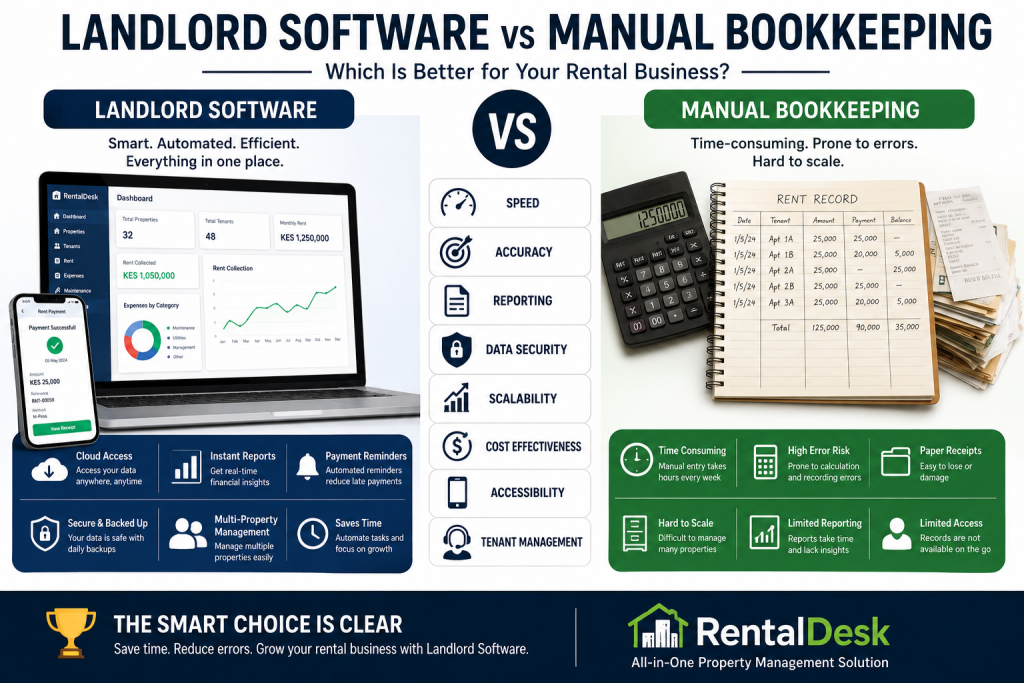
Landlord Software vs Manual Bookkeeping: Key Differences
| Feature | Landlord Software | Manual Bookkeeping |
|---|---|---|
| Speed | Automated | Manual |
| Accuracy | High | Depends on user |
| Reports | Instant | Time-consuming |
| Rent Tracking | Automatic | Manual |
| Expense Tracking | Automated | Manual |
| Data Backup | Cloud-based | Paper files or local computer |
| Security | Encrypted | Can be lost or damaged |
| Scalability | Excellent | Poor |
| Multi-user Access | Yes | Limited |
| Mobile Access | Yes | Usually No |
This comparison clearly illustrates why many landlords are moving from manual systems to digital solutions.
When evaluating Landlord Software vs Manual Bookkeeping, efficiency is often the deciding factor.
Accuracy: Which Method Wins?
Bookkeeping mistakes can be expensive.
A single error can result in:
- Incorrect rent balances
- Missed payments
- Wrong financial reports
- Tax filing mistakes
- Tenant disputes
Manual bookkeeping depends entirely on human accuracy.
Common manual bookkeeping errors include:
- Typing incorrect figures
- Forgetting transactions
- Duplicate entries
- Misplaced receipts
- Incorrect calculations
Landlord software significantly reduces these risks by automating calculations and storing every transaction digitally.
Whenever landlords compare Landlord Software vs Manual Bookkeeping, accuracy is one of the strongest arguments in favor of software.
Time Savings
Time is one of the most valuable resources for any landlord.
Consider a landlord managing:
- 40 tenants
- Monthly rent collection
- Expense tracking
- Utility payments
- Maintenance invoices
With manual bookkeeping, each month may require several hours of updating spreadsheets, checking balances, and preparing reports.
Landlord software automates many of these tasks.
Instead of manually entering every payment, the system records transactions automatically and generates updated reports within seconds.
This dramatic reduction in administrative work explains why many property managers prefer Landlord Software vs Manual Bookkeeping when seeking greater efficiency.
Managing Multiple Properties
Managing one rental house manually may be manageable.
Managing:
- 10 apartments
- 50 units
- 100 tenants
- Multiple buildings
is a completely different challenge.
Manual bookkeeping becomes increasingly difficult because landlords must maintain separate records for each property.
Challenges include:
- Finding tenant records
- Updating balances
- Tracking overdue rent
- Monitoring maintenance expenses
- Preparing consolidated reports
Landlord software solves these problems by organizing all properties within a single dashboard.
Whether managing five units or five hundred, landlords can instantly access financial information, occupancy reports, and tenant histories.
This scalability is another reason why Landlord Software vs Manual Bookkeeping often favors software for growing rental businesses.
Rent Collection and Payment Tracking
One of the biggest differences in Landlord Software vs Manual Bookkeeping is how rent payments are tracked.
With manual bookkeeping, landlords typically:
- Check bank statements
- Record payments manually
- Update tenant balances
- Calculate arrears
- Follow up on late payments
This process can be slow and prone to errors.
Landlord software streamlines rent collection by:
- Recording payments automatically
- Updating tenant balances in real time
- Identifying overdue accounts
- Sending payment reminders
- Generating rent collection reports
The result is improved cash flow and less time spent chasing payments.
Expense Management
Rental properties generate many different expenses, including:
- Repairs
- Maintenance
- Cleaning
- Utilities
- Security
- Insurance
- Property improvements
- Contractor payments
With manual bookkeeping, organizing these expenses often means sorting through receipts and updating spreadsheets line by line.
Landlord software categorizes expenses automatically, making it easier to:
- Monitor spending
- Compare monthly costs
- Identify unnecessary expenses
- Prepare financial statements
- Simplify tax reporting
For landlords looking to improve financial visibility, Landlord Software vs Manual Bookkeeping clearly highlights the benefits of digital expense management.
Financial Reporting Made Simple
Generating reports manually can take hours or even days, especially for landlords with multiple properties.
Landlord software can produce reports such as:
- Income statements
- Expense summaries
- Profit and loss reports
- Rent arrears reports
- Occupancy reports
- Cash flow statements
- Property performance reports
These reports are available within seconds, allowing landlords to make informed decisions quickly.
When comparing Landlord Software vs Manual Bookkeeping, automated reporting is one of the most valuable advantages offered by software.
Landlord Software vs Manual Bookkeeping: Data Security and Record Keeping
One aspect that is often overlooked in the Landlord Software vs Manual Bookkeeping debate is data security. Financial records are among the most valuable assets of any rental business. Losing them can lead to financial losses, legal issues, and difficulties during tax filing.
With manual bookkeeping, records are vulnerable to:
- Fire damage
- Water damage
- Theft
- Misplaced files
- Accidental deletion of spreadsheets
- Computer hardware failure
Imagine years of rent records stored in one notebook or on a single laptop that suddenly crashes. Recovering that information may be impossible.
Modern landlord software stores data securely in the cloud with regular backups. Even if your computer is damaged or lost, your records remain accessible by simply logging into your account from another device.
This level of protection is a major reason why many landlords choose Landlord Software vs Manual Bookkeeping in favor of digital solutions.
Tax Preparation
Tax season can be stressful for landlords who rely on manual bookkeeping.
They often spend days or even weeks:
- Searching for receipts
- Organizing invoices
- Calculating deductible expenses
- Reconciling rent payments
- Preparing financial summaries
Errors during tax preparation may result in penalties or unnecessary tax payments.
Landlord software simplifies this process by keeping every transaction categorized throughout the year. When tax time arrives, reports can be generated within minutes.
Typical tax reports include:
- Annual rental income
- Maintenance expenses
- Property operating costs
- Insurance expenses
- Utility expenses
- Contractor payments
Instead of scrambling to organize paperwork, landlords using software can focus on reviewing their reports.
This is another area where Landlord Software vs Manual Bookkeeping demonstrates a clear advantage for software users.
Tenant Communication
Successful property management depends on effective communication.
Manual bookkeeping usually requires landlords to maintain separate records for:
- Phone numbers
- Email addresses
- Lease documents
- Payment history
- Maintenance requests
This scattered information makes communication more difficult.
Landlord software stores all tenant information in one centralized database.
Benefits include:
- Quick access to tenant profiles
- Payment history at a glance
- Lease expiry reminders
- Maintenance tracking
- Digital communication logs
Having all information in one place saves time and improves tenant satisfaction.
This is another important consideration when evaluating Landlord Software vs Manual Bookkeeping.
Maintenance Tracking
Maintenance plays a significant role in protecting rental property value.
With manual bookkeeping, maintenance requests may be written in notebooks, saved in text messages, or remembered from phone calls.
This approach often leads to:
- Forgotten repairs
- Delayed maintenance
- Unhappy tenants
- Higher repair costs
Landlord software centralizes maintenance management by allowing landlords to:
- Record maintenance requests
- Assign contractors
- Track repair progress
- Store invoices
- Monitor maintenance costs
This organized approach improves property management and helps maintain tenant trust.
When comparing Landlord Software vs Manual Bookkeeping, maintenance management is another clear advantage of software.
Monitoring Rental Income
Knowing exactly how much income each property generates is essential for making sound investment decisions.
Manual bookkeeping requires landlords to manually calculate:
- Monthly income
- Annual income
- Outstanding balances
- Property profitability
These calculations consume valuable time and increase the likelihood of mistakes.
Landlord software automatically generates income summaries that allow landlords to:
- Compare properties
- Monitor cash flow
- Identify underperforming units
- Track rental growth over time
Access to real-time financial information enables better business decisions.
For this reason, many investors prefer Landlord Software vs Manual Bookkeeping when managing multiple rental properties.
Cost Comparison
Many landlords assume manual bookkeeping is cheaper because it does not require software subscriptions.
However, this assumption does not consider hidden costs.
Hidden Costs of Manual Bookkeeping
- Hours spent updating records
- Printing expenses
- Filing cabinets
- Storage space
- Human errors
- Missed rent payments
- Lost receipts
- Duplicate work
These costs accumulate over time.
Costs of Landlord Software
Landlord software generally involves:
- Monthly subscription
- Annual subscription
- Initial setup
- Staff training
Although software has an upfront cost, it often delivers long-term savings by reducing manual work and improving financial accuracy.
When looking beyond the initial investment, Landlord Software vs Manual Bookkeeping often shows that software provides better value for growing landlords.
Scalability
A bookkeeping method that works for two rental units may fail completely when managing fifty.
Manual bookkeeping becomes increasingly difficult as rental portfolios expand.
Challenges include:
- More paperwork
- Larger spreadsheets
- Increased risk of errors
- Longer reporting times
- Difficulty locating information
Landlord software is designed to scale effortlessly.
Whether managing:
- Five apartments
- Fifty apartments
- Hundreds of rental units
the system remains organized and efficient.
This flexibility is one of the strongest reasons landlords eventually transition from manual systems.
The discussion around Landlord Software vs Manual Bookkeeping often ends with scalability becoming the deciding factor.
Accessibility
Today’s landlords are constantly on the move.
They may need to access financial information while:
- Visiting properties
- Meeting tenants
- Traveling
- Working remotely
Manual bookkeeping usually requires physical access to files or a specific computer.
Landlord software, on the other hand, allows secure access from:
- Smartphones
- Tablets
- Laptops
- Desktop computers
This convenience enables landlords to respond quickly to tenant inquiries and monitor their business from anywhere.
Accessibility is another reason why Landlord Software vs Manual Bookkeeping increasingly favors cloud-based property management solutions.
Compliance and Audit Readiness
Keeping accurate records is essential for audits, financial reviews, and regulatory compliance.
Manual bookkeeping often results in:
- Missing receipts
- Inconsistent entries
- Incomplete documentation
- Difficulty tracing transactions
Landlord software creates a digital trail for every transaction, making it much easier to:
- Verify payments
- Review expenses
- Produce financial records
- Support compliance requirements
For landlords managing larger portfolios or working with accountants, this feature provides significant peace of mind.
As rental businesses become more complex, Landlord Software vs Manual Bookkeeping clearly demonstrates the benefits of having organized, searchable, and audit-ready records.
Making Better Business Decisions
Reliable data is the foundation of smart decision-making.
With manual bookkeeping, landlords may struggle to answer questions like:
- Which property generates the highest profit?
- Which tenants consistently pay late?
- How much was spent on maintenance last quarter?
- What is the average monthly rental income?
Landlord software provides dashboards and reports that answer these questions instantly.
By using accurate, real-time data, landlords can:
- Increase profitability
- Reduce unnecessary expenses
- Plan future investments
- Improve cash flow management
- Identify trends before they become problems
This ability to make informed decisions is one of the most compelling arguments in the Landlord Software vs Manual Bookkeeping comparison.
Case Study: From Manual Records to Digital Success
James is a landlord in Nairobi who owns 35 rental units spread across three apartment buildings. For several years, he managed his properties using notebooks, printed receipts, and Excel spreadsheets. Initially, this system worked because he had only a handful of tenants. However, as his portfolio grew, the limitations of manual bookkeeping became increasingly apparent.
Some of the challenges James faced included:
- Missing rent payment records
- Lost maintenance receipts
- Difficulty calculating monthly profits
- Delayed financial reporting
- Forgotten lease renewal dates
- Time-consuming rent reconciliation
- Frequent tenant disputes over payment records
After evaluating Landlord Software vs Manual Bookkeeping, James decided to implement landlord software.
Within six months, he experienced remarkable improvements:
- Rent collection efficiency increased significantly.
- Late payments were identified immediately.
- Financial reports were generated in seconds.
- Maintenance requests were tracked digitally.
- Monthly bookkeeping time was reduced by over 70%.
- Tax preparation became much easier.
- Tenant satisfaction improved because issues were resolved faster.
James realized that investing in software wasn’t simply purchasing technology—it was investing in the future growth of his rental business. His experience demonstrates why many landlords ultimately choose Landlord Software vs Manual Bookkeeping in favor of digital property management.
Common Myths About Landlord Software
Many landlords hesitate to adopt software because of common misconceptions. Let’s address some of them.
Myth 1: Manual Bookkeeping Is Always Cheaper
While notebooks and spreadsheets have little upfront cost, they consume valuable time and increase the likelihood of costly mistakes. Over time, the hidden costs of manual bookkeeping often exceed the subscription cost of landlord software.
Myth 2: Software Is Only for Large Property Managers
Modern landlord software is designed for landlords of all sizes. Whether you own one rental house or hundreds of apartments, digital tools can simplify your operations.
This is why the conversation around Landlord Software vs Manual Bookkeeping is relevant even for first-time landlords.
Myth 3: Software Is Difficult to Learn
Most modern landlord software features intuitive dashboards, user-friendly interfaces, and onboarding support. Many users become comfortable with the system after only a few days.
Myth 4: Excel Is Good Enough
Excel is a powerful spreadsheet tool, but it is not a complete property management solution. It lacks features such as:
- Automated rent reminders
- Tenant profiles
- Maintenance management
- Lease tracking
- Integrated reporting
- Secure cloud backups
When comparing Landlord Software vs Manual Bookkeeping, spreadsheets often fall short as rental businesses expand.
When Manual Bookkeeping May Still Work
Despite the many advantages of landlord software, manual bookkeeping can still be suitable in certain situations.
It may be appropriate if you:
- Own only one rental property
- Have very few financial transactions
- Are just starting your rental business
- Do not require advanced reporting
- Have enough time to manage records manually
However, once your portfolio begins to grow, transitioning to software becomes increasingly beneficial.
When Landlord Software Is the Better Choice
Landlord software is the ideal solution if you:
- Manage multiple properties
- Have several tenants
- Need accurate financial reports
- Want automated rent tracking
- Plan to grow your investment portfolio
- Need secure cloud storage
- Work with accountants
- Want to reduce administrative work
In these situations, Landlord Software vs Manual Bookkeeping clearly favors landlord software.
Why RentalDesk Is the Smart Choice for Landlords
If you’re looking for a modern property management solution, RentalDesk provides everything landlords need to streamline operations and improve profitability.
With RentalDesk, you can:
- Track rent payments in real time
- Monitor tenant balances
- Manage multiple properties
- Record expenses
- Generate financial reports instantly
- Track rent arrears
- Store tenant records securely
- Monitor occupancy rates
- Manage leases
- Access your data from anywhere
Instead of juggling notebooks and spreadsheets, RentalDesk gives you one centralized platform for all your property management needs.
If you’re deciding between Landlord Software vs Manual Bookkeeping, RentalDesk helps eliminate repetitive manual work while improving accuracy and efficiency.
Frequently Asked Questions
Is landlord software better than manual bookkeeping?
For most landlords, yes. Landlord software improves accuracy, automates repetitive tasks, reduces paperwork, and provides real-time financial reporting. This makes Landlord Software vs Manual Bookkeeping an easy decision for growing rental businesses.
Can small landlords benefit from landlord software?
Absolutely. Even landlords with a few rental units can save time, improve record keeping, and reduce errors by using landlord software.
Is manual bookkeeping still relevant?
Yes, but mainly for landlords with very small portfolios. As rental businesses grow, manual bookkeeping becomes increasingly inefficient compared to landlord software.
Does landlord software improve rent collection?
Yes. Most landlord software solutions automatically track payments, calculate outstanding balances, and help landlords identify overdue accounts quickly.
Can landlord software simplify tax preparation?
Yes. By organizing income and expenses throughout the year, landlord software makes tax reporting Landlord Software vs Manual Bookkeeping
The comparison between Landlord Software vs Manual Bookkeeping ultimately comes down to efficiency, accuracy, and long-term growth.
Manual bookkeeping may be enough for landlords with only one or two rental properties, but it becomes increasingly difficult as portfolios expand. Paper records, spreadsheets, and manual calculations create unnecessary risks and consume valuable time.
Landlord software, on the other hand, automates routine tasks, improves financial accuracy, secures important records, and provides instant access to reports that support better decision-making.
For landlords who want to save time, reduce errors, improve cash flow, and scale their businesses confidently, landlord software is the clear winner. The choice between Landlord Software vs Manual Bookkeeping is no longer just about convenience—it’s about building a more efficient, profitable, and future-ready rental business.
Get Started with RentalDesk Today
Are you ready to replace time-consuming spreadsheets and paper records with a smarter property management solution?
RentalDesk helps landlords and property managers:
- Automate rent collection
- Track tenant payments
- Manage multiple properties
- Monitor expenses
- Generate professional reports
- Reduce rent arrears
- Improve operational efficiency
Whether you own a single rental unit or a large property portfolio, RentalDesk provides the tools you need to manage your business with confidence.
Start your digital property management journey with RentalDesk today and experience the difference that modern landlord software can make.