Property Portfolio Monitoring System – Complete Guide for Property Owners and Managers
Managing a single rental property is relatively straightforward, but overseeing multiple residential apartments, commercial buildings, gated communities, office complexes, mixed-use developments, and real estate investments requires a far more advanced approach. As property portfolios expand, managers and investors need complete visibility into financial performance, occupancy rates, maintenance activities, lease renewals, tenant information, operational costs, and investment returns across all properties.
Traditional management methods that rely on spreadsheets, manual reports, paper records, and disconnected software often become inefficient as portfolios grow. Information becomes scattered across different systems, making it difficult to monitor performance accurately or identify opportunities for improvement. Without centralized visibility, property owners may overlook declining occupancy, delayed rent collections, increasing maintenance expenses, or underperforming investments until financial performance has already been affected.
A Property Portfolio Monitoring System provides a centralized platform that enables landlords, property management companies, real estate investors, developers, estate managers, and housing organizations to monitor every property within their portfolio from a single dashboard.
Instead of reviewing each property independently, decision-makers gain complete visibility across the entire portfolio.
Occupancy performance.
Rental income.
Lease activity.
Tenant management.
Maintenance requests.
Service charge collections.
Financial reporting.
Cash flow.
Property profitability.
Investment performance.
All these operational metrics become available in real time.
Modern property management depends upon data-driven decision-making.
Managers need to understand which properties generate the highest returns.
Which buildings experience frequent maintenance issues.
Which locations maintain the highest occupancy.
Which tenants consistently pay on time.
Which investments require operational improvements.
A Property Portfolio Monitoring System transforms large volumes of operational data into meaningful business intelligence that supports strategic decision-making.
Automation plays a critical role in portfolio monitoring.
Instead of manually compiling reports from multiple locations, the system continuously updates dashboards as rent payments are received, leases are renewed, maintenance requests are completed, expenses are recorded, and occupancy changes occur.
Managers spend less time preparing reports and more time improving property performance.
The software also strengthens communication between property owners and management teams.
Owners gain secure access to portfolio dashboards that display real-time financial information without waiting for monthly reports.
Investment decisions become more informed because reliable information remains continuously available.
Scalability is another important advantage.
Whether managing five apartments or several thousand rental units distributed across multiple counties in Kenya, a Property Portfolio Monitoring System provides consistent oversight without increasing administrative complexity.
As Kenya’s property sector continues expanding, professional portfolio management has become increasingly important.
Property management companies, developers, institutional investors, SACCOs, REITs, landlords, and commercial property owners require centralized technology capable of supporting sustainable portfolio growth while improving operational efficiency.
A Property Portfolio Monitoring System provides this capability by integrating operational management, financial reporting, occupancy monitoring, maintenance tracking, lease administration, tenant management, and investment analytics into one intelligent platform.
The result is stronger financial control, better operational visibility, improved investment performance, and more informed long-term decision-making.
Table of Contents
- Understanding Property Portfolio Monitoring System
- Why Portfolio Monitoring Matters
- Core Features of Property Portfolio Monitoring System
- Centralized Property Performance Monitoring
- Financial and Revenue Monitoring
- Maintenance and Operational Oversight
- Investment Analysis and Portfolio Growth
- Challenges of Traditional Portfolio Management
Understanding Property Portfolio Monitoring System
Managing multiple properties requires far more than collecting rent and maintaining buildings.
Property managers must monitor occupancy levels, lease renewals, tenant performance, maintenance activities, operating expenses, rental income, service charge collections, vendor performance, compliance requirements, and investment returns simultaneously.
A Property Portfolio Monitoring System centralizes these activities into one integrated management platform.
Instead of switching between multiple spreadsheets and software systems, managers access every property through one dashboard.
The system continuously consolidates operational and financial information from every managed property.
Rental collections update automatically.
Occupancy changes appear instantly.
Maintenance requests synchronize in real time.
Lease activities remain current.
Financial dashboards refresh continuously.
Property owners and managers therefore maintain complete visibility across the portfolio regardless of its size.
Historical information also remains accessible.
Managers can compare monthly performance, evaluate annual trends, analyze occupancy changes, review maintenance history, and monitor long-term investment growth using accurate historical data.
Why Portfolio Monitoring Matters
Property investments perform best when managers have complete operational visibility.
Without centralized monitoring, organizations often discover financial problems too late.
Vacancies increase unnoticed.
Maintenance costs rise gradually.
Rental arrears accumulate.
Lease renewals decline.
Operating expenses exceed budgets.
A Property Portfolio Monitoring System enables proactive management by providing continuous access to key operational indicators.
Managers can immediately identify declining occupancy, delayed rent collections, unusual maintenance costs, or changing revenue trends.
Early intervention improves profitability while reducing operational risks.
The software also supports stronger communication between investors, landlords, accountants, and management teams by providing standardized reports and centralized dashboards.
Core Features of Property Portfolio Monitoring System
Professional portfolio monitoring platforms provide numerous integrated capabilities.
Portfolio dashboards.
Occupancy monitoring.
Rental income reporting.
Lease management.
Tenant administration.
Maintenance tracking.
Expense monitoring.
Cash flow analysis.
Service charge reporting.
Investment analytics.
Owner reporting.
Property comparisons.
Performance dashboards.
Historical reporting.
Business intelligence.
Property Portfolio Monitoring System combines these capabilities into one centralized environment that simplifies large-scale property management.
Centralized Property Performance Monitoring
Portfolio performance depends upon accurate information.
Managers require continuous visibility into every property without manually reviewing individual reports.
Property Portfolio Monitoring System provides centralized dashboards displaying occupancy rates, rental collections, lease activity, tenant status, maintenance requests, service charge collections, and operational performance across every managed property.
Properties can be compared easily using standardized performance indicators.
Managers identify high-performing assets, operational challenges, and improvement opportunities much more quickly.
Real-time monitoring supports informed operational decisions while improving overall portfolio management.
Financial and Revenue Monitoring
Financial performance remains one of the most important responsibilities within property management.
Managers must understand rental income, outstanding balances, operating expenses, maintenance costs, cash flow, and property profitability.
Property Portfolio Monitoring System continuously analyzes financial information while generating automated reports and interactive dashboards.
Revenue performance becomes immediately visible.
Cash flow improves through better monitoring.
Financial reporting becomes more accurate.
Managers gain complete visibility into portfolio profitability without manually compiling financial information.
Maintenance and Operational Oversight
Maintenance directly influences tenant satisfaction and property value.
Large portfolios generate significant maintenance activity that must be coordinated efficiently.
Property Portfolio Monitoring System enables managers to monitor maintenance requests, work orders, contractor performance, maintenance costs, completion times, and recurring issues from one centralized platform.
Operational oversight improves because managers receive continuous updates regarding maintenance performance throughout the portfolio.
Historical records also simplify budgeting and long-term maintenance planning.
Investment Analysis and Portfolio Growth
Successful property investors require accurate information when making expansion decisions.
Historical performance, occupancy trends, rental growth, maintenance costs, and profitability all influence investment planning.
Property Portfolio Monitoring System provides comprehensive portfolio analytics that help investors compare assets, identify underperforming properties, evaluate market trends, and allocate capital more effectively.
Organizations gain stronger confidence because investment decisions rely upon measurable operational and financial data.
Challenges of Traditional Portfolio Management
Many property managers continue relying on spreadsheets, paper files, disconnected accounting software, and manually prepared reports.
Although manageable for small portfolios, these methods become increasingly inefficient as property numbers increase.
Information becomes fragmented.
Reports become inconsistent.
Manual calculations introduce errors.
Financial visibility declines.
Decision-making slows.
Operational risks increase.
Property Portfolio Monitoring System eliminates these limitations by centralizing operational information, automating reporting, improving data accuracy, strengthening financial visibility, and supporting scalable portfolio management.
For landlords, estate managers, property management companies, commercial property owners, developers, and real estate investors throughout Kenya, implementing a Property Portfolio Monitoring System provides the operational intelligence needed to improve performance, maximize profitability, strengthen investment oversight, and support sustainable long-term portfolio growth.
Benefits for Property Managers
Managing multiple residential, commercial, and mixed-use properties requires constant oversight of financial performance, occupancy, maintenance, tenant satisfaction, lease administration, and operational efficiency. As property portfolios continue expanding across Kenya, relying on spreadsheets and manual reporting makes it increasingly difficult to maintain complete visibility over daily operations.
A Property Portfolio Monitoring System provides property managers with a centralized platform that brings every property together into one intelligent management environment.
One of the greatest advantages is complete portfolio visibility. Rather than reviewing separate reports for each apartment, office building, shopping complex, or estate, managers can access a consolidated dashboard displaying occupancy rates, rental collections, maintenance activities, lease renewals, service charge collections, tenant statistics, and financial performance across the entire portfolio.
This centralized visibility enables faster decision-making. Managers can immediately identify properties experiencing declining occupancy, increasing maintenance costs, delayed rent collections, or operational challenges. Instead of discovering these issues weeks later during manual reporting, corrective actions can be implemented immediately.
Operational efficiency also improves significantly. Preparing portfolio reports manually often requires gathering information from multiple accounting systems, spreadsheets, maintenance records, tenant databases, and banking platforms. Property Portfolio Monitoring System automates this reporting process by continuously synchronizing operational and financial information into centralized dashboards.
Another important benefit is improved resource allocation. Property managers can compare staffing requirements, maintenance workloads, contractor performance, operational expenses, and occupancy trends across different properties. Resources can then be allocated more effectively to maximize operational efficiency while controlling costs.
Communication with property owners also becomes much more transparent. Owners receive accurate performance reports that provide complete visibility into rental income, vacancies, maintenance expenditure, lease performance, and investment returns. This strengthens trust while reducing time spent preparing manual reports.
The software also supports stronger strategic planning. Historical portfolio information helps managers identify long-term occupancy trends, evaluate marketing performance, forecast maintenance requirements, and prepare annual operational budgets using reliable historical data.
As property portfolios continue expanding, Property Portfolio Monitoring System provides the scalability required to manage hundreds or even thousands of rental units without significantly increasing administrative complexity.
For professional property management companies throughout Kenya, these capabilities improve efficiency, strengthen client relationships, increase accountability, and support sustainable portfolio growth.
Benefits for Property Owners and Real Estate Investors
Property ownership represents a long-term financial investment.
Maximizing investment returns requires continuous visibility into operational performance.
Property owners need accurate information regarding rental income, occupancy rates, lease renewals, maintenance expenditure, cash flow, operating expenses, and overall portfolio profitability.
Property Portfolio Monitoring System provides this information through centralized dashboards and automated reporting.
One of the most significant benefits is investment transparency. Property owners no longer depend solely on monthly reports prepared manually by property managers. Instead, portfolio performance remains available in real time through secure online dashboards.
Revenue performance becomes easier to monitor. Owners can compare rental income across multiple buildings, evaluate occupancy trends, review historical growth, identify underperforming assets, and monitor overall portfolio profitability using consistent financial metrics.
Cash flow management also improves considerably. Continuous monitoring of rent collections, service charges, outstanding balances, and operating expenses allows owners to forecast income more accurately while planning future investments and maintenance projects.
Multi-property investors benefit particularly because Property Portfolio Monitoring System consolidates financial and operational information from numerous locations into one management platform. Portfolio comparisons become simple, enabling investors to identify the strongest-performing assets while determining where operational improvements are required.
Risk management also becomes stronger. Declining occupancy, increasing maintenance costs, delayed rent collections, or abnormal expenditure patterns become visible much earlier, allowing investors to respond before financial performance deteriorates.
These capabilities provide investors throughout Kenya with better financial visibility while supporting long-term portfolio expansion and sustainable investment growth.
Benefits for Finance Teams and Asset Managers
Finance professionals require accurate information to support accounting, budgeting, auditing, forecasting, and financial reporting.
Traditional property accounting often involves repetitive manual calculations, spreadsheet consolidation, payment reconciliation, and report preparation.
These activities consume considerable administrative time.
Property Portfolio Monitoring System automates much of this financial reporting process.
Rental collections update automatically.
Operating expenses synchronize continuously.
Maintenance costs remain current.
Portfolio dashboards refresh in real time.
Finance teams gain immediate access to reliable financial information.
Budget preparation becomes more accurate because historical operating data remains easily accessible.
Revenue forecasting improves through detailed occupancy analysis and long-term rental performance reporting.
The software also simplifies audit preparation by maintaining complete financial records and detailed transaction histories.
Financial consistency improves because standardized reporting eliminates discrepancies between individual properties.
Asset managers similarly benefit from improved portfolio visibility.
Investment performance becomes measurable.
Property comparisons become straightforward.
Capital improvement planning becomes data-driven.
Resource allocation becomes more efficient.
These capabilities help finance professionals spend less time producing reports and more time supporting strategic business decisions.
Improving Portfolio Performance Through Business Intelligence
Modern property management increasingly depends upon actionable business intelligence rather than static reports.
Raw operational data alone provides limited value.
Managers require meaningful insights that support better decision-making.
Property Portfolio Monitoring System transforms operational information into interactive dashboards, analytical reports, performance indicators, occupancy analytics, revenue comparisons, maintenance statistics, and investment summaries.
Managers can identify seasonal occupancy patterns.
Compare property profitability.
Evaluate lease renewal performance.
Analyze maintenance expenditure.
Measure service charge collections.
Monitor tenant payment behaviour.
These insights enable organizations to improve operational performance continuously.
Predictive reporting also strengthens planning.
Historical information supports occupancy forecasting, revenue projections, maintenance budgeting, staffing requirements, and investment planning.
Automated alerts notify managers whenever significant operational changes occur.
Vacancy increases.
Revenue declines.
Maintenance costs exceed budgets.
Collection performance deteriorates.
Managers receive immediate notifications that support proactive intervention.
By transforming operational information into strategic intelligence, Property Portfolio Monitoring System enables organizations to maximize portfolio performance while improving financial outcomes.
Compliance, Governance, and Operational Accountability
Professional property management requires accurate records, transparent reporting, and strong governance practices.
Property owners, investors, auditors, lenders, accountants, and regulators all depend upon reliable operational information.
Property Portfolio Monitoring System strengthens governance by maintaining centralized records across every managed property.
Every lease.
Every rent payment.
Every maintenance request.
Every expense.
Every service charge.
Every operational update.
All activities remain securely documented.
Audit trails improve accountability by recording system activities and operational changes.
Standardized reporting ensures financial information remains consistent across the entire portfolio.
Internal controls become stronger because operational information is continuously monitored and verified.
Organizations also improve compliance by maintaining complete historical documentation that supports audits, dispute resolution, owner reporting, and financial reviews.
For property management companies operating throughout Kenya, these governance capabilities strengthen credibility while reducing operational risk.
Why RentalDesk Is the Ideal Solution
RentalDesk is designed specifically to help landlords, property management companies, estate managers, developers, commercial property owners, and real estate investors manage growing portfolios efficiently through centralized property management technology.
A Property Portfolio Monitoring System becomes significantly more valuable when integrated with tenant management, lease administration, rent collection, M-Pesa payment automation, maintenance management, accounting, owner reporting, and financial analytics.
RentalDesk combines all these capabilities within one intelligent property management platform.
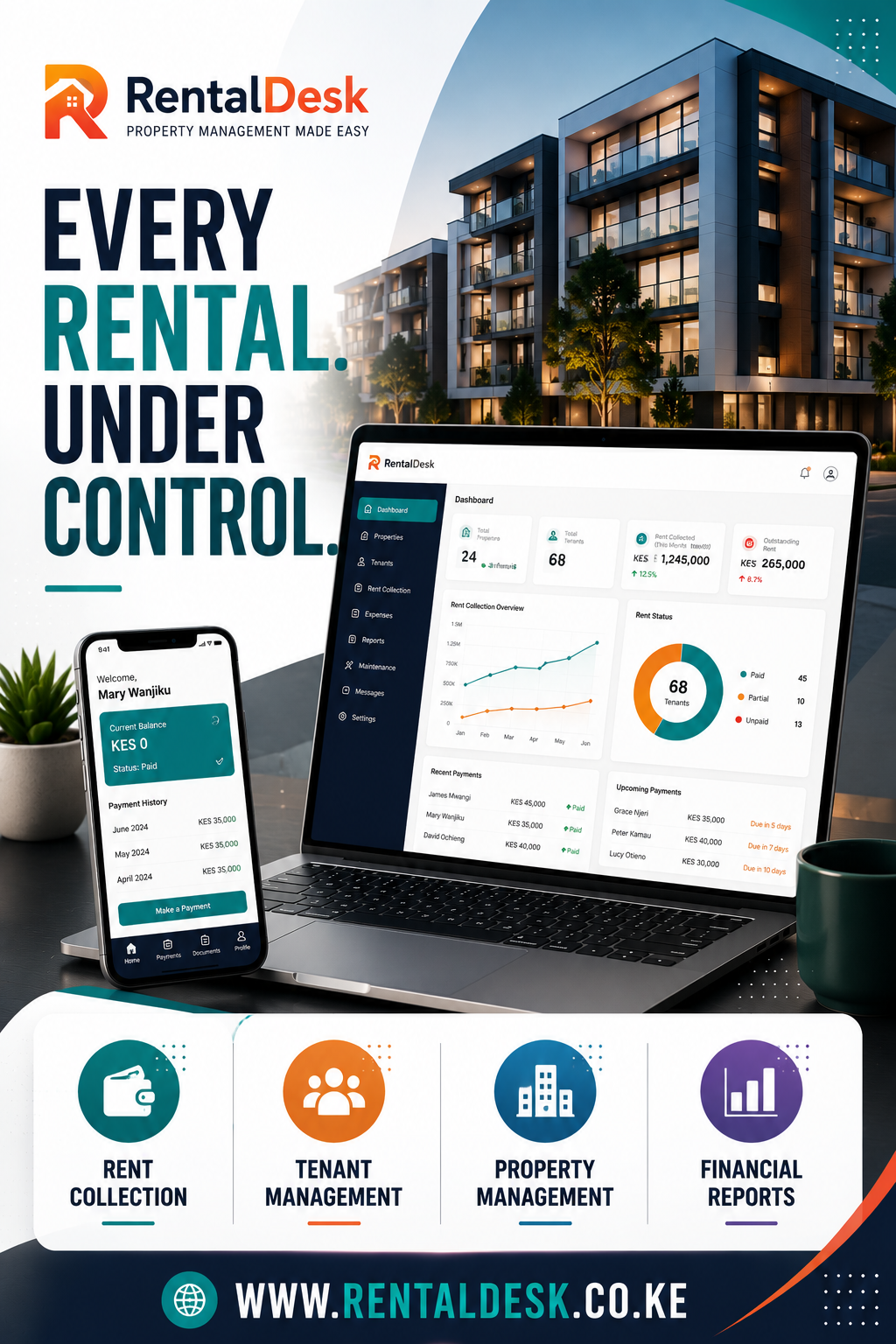
Managers receive centralized portfolio dashboards that provide complete visibility into occupancy, rental income, service charges, maintenance activities, lease performance, financial reporting, tenant information, and operational analytics.
Property owners gain secure access to real-time portfolio information while finance teams benefit from automated reporting and comprehensive financial visibility.
RentalDesk supports residential apartments, commercial buildings, mixed-use developments, office complexes, student accommodation, gated communities, shopping centres, and multi-property investment portfolios throughout Kenya.
By centralizing operational management and portfolio analytics, RentalDesk helps organizations improve efficiency, strengthen investment oversight, reduce administrative workloads, enhance reporting accuracy, and support long-term portfolio growth.
Future Trends
Property portfolio management continues evolving alongside advances in artificial intelligence, cloud computing, predictive analytics, automation, and business intelligence technologies.
Future Property Portfolio Monitoring System platforms will provide even greater analytical capabilities.
Artificial intelligence will assist with occupancy forecasting, maintenance prediction, revenue optimization, lease renewal recommendations, and investment analysis.
Cloud-based portfolio management will provide secure real-time access from any location.
Interactive dashboards will continue becoming more sophisticated while supporting deeper operational insights.
Predictive analytics will enable managers to identify future risks before they affect portfolio performance.
As Kenya’s real estate market continues expanding, organizations adopting intelligent portfolio management technologies will maintain stronger competitive advantages while improving long-term investment returns.
Getting Started
Implementing a Property Portfolio Monitoring System begins with evaluating existing portfolio management processes and identifying opportunities for greater visibility and automation.
Organizations should review rent collection procedures, occupancy monitoring, maintenance management, lease administration, financial reporting, owner communication, and operational workflows.
The next step involves consolidating property information into one centralized management platform.
Performance indicators should then be established for occupancy, rental income, maintenance costs, service charge collections, cash flow, and portfolio profitability.
Employee training ensures managers, accountants, administrators, and property owners fully understand how to interpret dashboards and analytical reports.
RentalDesk provides implementation support including portfolio setup, tenant migration, lease configuration, financial reporting, M-Pesa integration, maintenance management, owner reporting, analytics dashboards, and ongoing technical assistance.
By implementing a Property Portfolio Monitoring System, landlords and property management companies throughout Kenya can improve operational visibility, strengthen financial control, increase portfolio profitability, simplify management processes, and establish a scalable foundation for long-term investment success.