
Property Management Software Kenya is changing how landlords, property managers, real estate agencies and estate administrators manage rental properties.
Managing rentals with notebooks, spreadsheets, WhatsApp conversations and separate M-Pesa messages may work when you have only a few tenants. As the portfolio grows, however, keeping track of rent, arrears, leases, deposits, expenses, maintenance and tenant balances becomes much more difficult.
A modern Property Management Software Kenya solution brings these activities together in one centralized system.
Instead of asking:
- Who has paid rent?
- Who still owes?
- Which M-Pesa payment belongs to which tenant?
- Which leases are about to expire?
- Which units are vacant?
- Which tenant has an outstanding utility bill?
- How much did each property collect this month?
you can view structured rental records from one platform.
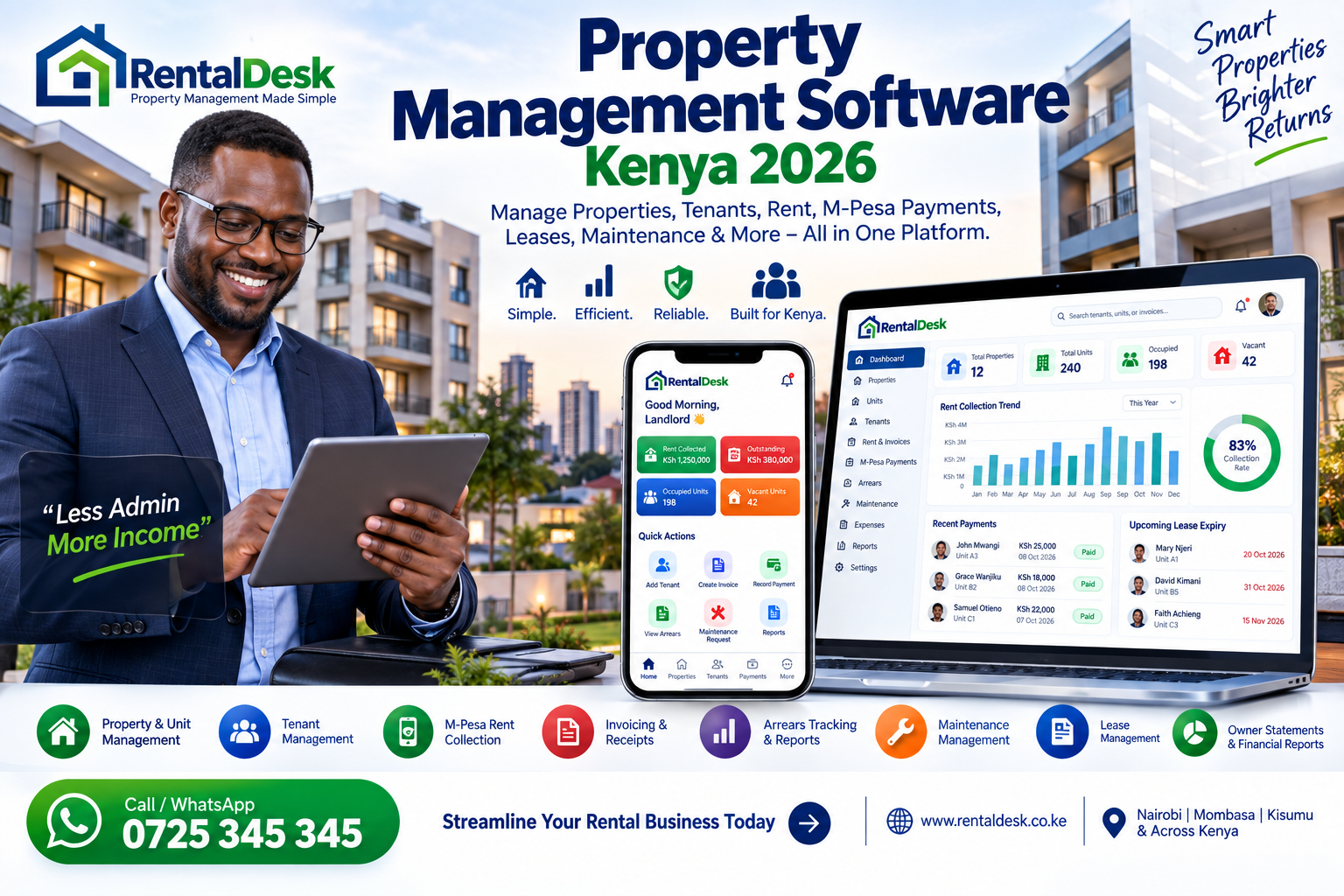
RentalDesk is built around practical Kenyan rental-management workflows, including property and unit records, tenants, billing, payments, arrears and reporting.
 What Is Property Management Software Kenya?
Property Management Software Kenya is a digital system designed to help landlords and property managers manage rental properties more efficiently.
Instead of keeping separate files for properties, tenants, payments and reports, the information is organized in one system.
A complete property-management platform may include:
- Property management
- Unit management
- Tenant records
- Lease management
- Rent invoicing
- M-Pesa rent payments
- Payment reconciliation
- Digital receipts
- Arrears management
- Utility billing
- Maintenance tracking
- Expense management
- Owner statements
- Financial reports
- Occupancy reports
- User permissions
- Audit records
RentalDesk’s existing Kenya pages already emphasize M-Pesa, rent invoicing, tenants, arrears, utilities, maintenance, owner statements and financial reporting as important local workflows. RentalDesk
Why Property Management Software Kenya Is Important
Kenyan rental businesses increasingly deal with large amounts of information.
Consider a property manager handling:
10 properties
with:
20 units per property
That means:
200 rental units
If each tenant pays once per month, the manager may need to process hundreds of rent payments, invoices and receipts every month.
Now add:
- Partial payments
- Late payments
- Deposits
- Water bills
- Electricity bills
- Service charges
- Maintenance expenses
- Vacant units
- Lease renewals
- Owner reports
Manual record keeping quickly becomes difficult.
This is why a structured Property Management Software Kenya platform becomes increasingly valuable as a portfolio grows.
Problems With Managing Rental Properties Manually
1. M-Pesa Payments Become Difficult to Reconcile
A tenant may send money using:
- Their own phone
- Their spouse’s number
- An employee’s number
- A relative’s phone
The property manager then has to determine which tenant the payment belongs to.
When hundreds of transactions are involved, manual matching can consume significant time.
2. Excel Files Become Complicated
Spreadsheets are powerful tools.
But problems arise when different employees have different copies.
For example:
Rent Register.xlsx
Rent Register Updated.xlsx
Rent Register New.xlsx
Rent Register Final.xlsx
Rent Register Final 2.xlsx
Which is correct?
A centralized Property Management Software Kenya platform provides one current source of rental information.
3. Arrears Are Difficult to Track
A landlord needs to know:
- Who has paid completely
- Who has paid partially
- Who has not paid
- How long rent has been outstanding
- The tenant’s current balance
Without a structured tenant ledger, arrears follow-up can become confusing.
4. Receipts Take Too Much Time
Preparing receipts manually for dozens or hundreds of tenants creates unnecessary administrative work.
Digital property systems can create more structured payment histories and receipts.
5. Lease Expiry Dates Are Forgotten
A property manager may have hundreds of leases ending at different times.
Without reminders or organized lease records, renewals can be missed.
Property Management Software Kenya With M-Pesa
One of the most important requirements for Kenyan landlords is payment management.
M-Pesa is commonly used for rental payments, making M-Pesa-oriented workflows particularly important for Kenyan property systems.
A Property Management Software Kenya with M-Pesa should help the property manager understand what each payment means.
The system should answer:
Who paid?
How much?
Which property?
Which unit?
Which invoice?
What balance remains?
RentalDesk’s current property-management content specifically positions M-Pesa payment tracking and reconciliation as part of the Kenyan rental workflow. RentalDesk
M-Pesa Rent Collection Software Kenya
Receiving money is only the first part of rent collection.
The real management problem is reconciliation.
Suppose monthly rent is:
KSh 25,000
A tenant first pays:
KSh 15,000
and later pays:
KSh 10,000
The system should make it clear that:
Invoice: KSh 25,000
Payment 1: KSh 15,000
Balance: KSh 10,000
Payment 2: KSh 10,000
Final balance: KSh 0
That is more useful than simply seeing two M-Pesa transactions.
Property and Unit Management
A strong Property Management Software Kenya should let landlords organize properties logically.
For example:
Property: Greenview Apartments
Units:
- A1
- A2
- A3
- A4
Each unit may have information such as:
- Unit type
- Monthly rent
- Occupancy status
- Tenant
- Deposit
- Utility information
- Lease dates
This allows managers to see their portfolio clearly.
Tenant Management Software Kenya
Tenant information should not be scattered between filing cabinets, WhatsApp and Excel.
A structured tenant record may include:
- Tenant name
- Phone number
- ID details
- Property
- Unit
- Monthly rent
- Deposit
- Lease
- Payment history
- Outstanding balance
A Property Management Software Kenya platform connects tenant information with rental transactions.
Automated Rent Invoicing
Generating rental invoices manually every month can consume significant time.
Imagine managing 300 units.
Creating 300 individual invoices manually is unnecessary when the system can organize recurring rental billing.
Invoices may include:
- Monthly rent
- Service charge
- Water
- Electricity
- Parking
- Other agreed charges
The resulting invoice becomes part of the tenant’s ledger.
Arrears Management
Rent arrears are one of the biggest concerns for landlords.
Good Property Management Software Kenya should quickly identify tenants who owe money.
Useful arrears information includes:
- Tenant
- Unit
- Amount billed
- Amount paid
- Outstanding balance
- Number of overdue days
Managers can then prioritize follow-up instead of reviewing every tenant manually.
Partial Rent Payments
Not every tenant pays the full amount at once.
Some tenants make:
- Partial payments
- Multiple payments
- Advance payments
- Late payments
A proper rental system should accommodate these situations without losing the financial history.
Digital Tenant Statements
Tenant statements help resolve disputes.
Instead of debating whether a payment was made, the property manager can review the transaction history.
A statement may show:
- Opening balance
- Rent invoices
- Utility charges
- Payments
- Credits
- Adjustments
- Closing balance
This makes rental accounting more transparent.
Lease Management
Lease administration becomes increasingly difficult as the number of units grows.
A Property Management Software Kenya system can organize:
- Lease start date
- Lease end date
- Rent amount
- Deposit
- Tenant
- Unit
- Renewal information
This helps property managers prepare for renewals before leases expire.
Vacant Unit Management
Every vacant unit represents potential lost rental income.
A property-management dashboard should help managers identify:
- Occupied units
- Vacant units
- Reserved units
- Units undergoing maintenance
Managers can then prioritize marketing and tenant onboarding.
Utility Billing
Many Kenyan rental properties also charge tenants for utilities.
These may include:
- Water
- Electricity
- Garbage
- Security
- Service charges
For properties using meters, the system may also maintain meter readings and calculate consumption according to configured rules.
Maintenance Management
Property management is not only about collecting rent.
Buildings require ongoing maintenance.
Typical maintenance requests include:
- Plumbing problems
- Electrical faults
- Broken doors
- Roof leaks
- Water problems
- Painting
- Drainage issues
A structured Property Management Software Kenya platform can help keep maintenance information associated with the correct property or unit.
Expense Management
Landlords also need visibility into property expenses.
Examples include:
- Repairs
- Cleaning
- Security
- Electricity
- Water
- Management expenses
- Contractor payments
Tracking income without expenses gives an incomplete picture of property performance.
Owner Statements
Professional property managers often manage properties on behalf of different owners.
Each owner needs clear information showing:
- Rent collected
- Expenses
- Arrears
- Occupancy
- Management charges
- Net amount due
Owner reporting is therefore an important feature when choosing Property Management Software Kenya.
Financial Reports for Property Managers
Reports convert transaction data into useful management information.
Important reports may include:
Rent Collection Report
Shows rent collected during a selected period.
Arrears Report
Shows outstanding balances.
Occupancy Report
Shows occupied and vacant units.
Tenant Statement
Shows activity for a particular tenant.
Expense Report
Shows property expenses.
Property Performance Report
Helps compare different buildings.
Owner Statement
Summarizes activity belonging to a specific owner.
Property Management Software Kenya for Landlords
A landlord managing 10 units does not necessarily need the same complexity as a company managing 2,000 units.
Small landlords may primarily need:
- Tenants
- Rent invoices
- M-Pesa payments
- Receipts
- Arrears
- Reports
The software should remain simple enough to be useful.
Property Management Software Kenya for Property Managers
Professional managers typically need additional features.
These may include:
- Multiple properties
- Multiple owners
- Staff users
- Permissions
- Owner statements
- Portfolio reports
- Maintenance
- Expense management
- Audit controls
This is where centralized software becomes especially useful.
Property Management Software Kenya for Real Estate Agencies
Real estate agencies managing rentals need visibility across different clients and locations.
The platform should allow organized management of:
- Residential properties
- Commercial properties
- Apartments
- Shops
- Offices
- Warehouses
- Mixed-use developments
Property Management Software Kenya for Apartments
Apartment blocks may require management of:
- Units
- Tenants
- Rent
- Water
- Parking
- Service charges
- Maintenance
- Deposits
RentalDesk can centralize these activities.
Property Management Software Kenya for Commercial Property
Commercial property management can involve:
- Shops
- Offices
- Warehouses
- Godowns
- Business parks
The billing structure may be more complex than residential rentals, making proper financial records even more important.
Property Management Software Kenya for Hostels
Hostel managers need to track:
- Rooms
- Occupancy
- Students or tenants
- Payments
- Utilities
- Deposits
- Vacancies
Digital records make it easier to understand room availability and balances.
Property Management Software Kenya vs Excel
| Excel | Property Management Software |
|---|---|
| Manual rent tracking | Structured tenant ledger |
| Different file versions | Centralized database |
| Manual arrears checks | Organized arrears reports |
| Manual receipts | Structured payment records |
| Separate tenant records | Integrated profiles |
| Difficult portfolio reporting | Centralized reporting |
Excel remains useful for analysis and exports.
The difference is that property-management software is designed around the rental workflow itself.
Property Management Software Kenya vs Manual Management
Manual processes may work for a small number of units.
But as a business grows, the manager may spend too much time performing repetitive tasks.
Software helps centralize:
Property → Unit → Tenant → Invoice → Payment → Balance → Report
This relationship is extremely important.
Cloud Property Management Software Kenya
Cloud-based property software allows authorized users to access information through the internet.
Potential advantages include:
- Access from different locations
- Easier collaboration
- Centralized information
- Reduced dependence on one office computer
Security and access controls should still be evaluated carefully.
Property Management Software Nairobi
Nairobi contains many different rental markets, from apartments and bedsitters to commercial offices and gated developments.
Property managers operating in areas such as:
- Westlands
- Kilimani
- Kileleshwa
- Lavington
- Karen
- Runda
- Kasarani
- Embakasi
- Ruaka
may have very different portfolios, but the core management requirements remain similar.
Property Management Software Kiambu
Kiambu County has rapidly growing residential rental areas.
Property owners in:
- Kiambu
- Ruiru
- Juja
- Thika
- Kikuyu
- Ruaka
can use digital systems to organize growing portfolios.
Property Management Software Mombasa
Coastal property managers may manage:
- Apartments
- Commercial units
- Holiday rentals
- Residential estates
Centralized rental records become especially important where owners are not physically located near their properties.
Property Management Software Nakuru
Growing rental portfolios in Nakuru may also benefit from structured tenant and rent management.
The same applies to property managers in:
- Kisumu
- Eldoret
- Naivasha
- Machakos
- Nyeri
- Meru
A cloud system can support portfolios spread across multiple locations.
Multi-Property Management Software Kenya
A property company may manage:
Property A – Nairobi
Property B – Kiambu
Property C – Nakuru
Property D – Mombasa
Managers need both:
Individual property performance
and:
Combined portfolio performance
A good Property Management Software Kenya solution should help provide both views.
Multi-User Property Management Software
Larger businesses often have several employees.
For example:
Administrator
Controls system settings.
Property Manager
Manages tenants and properties.
Accountant
Handles financial records.
Maintenance Team
Handles property repairs.
Management
Reviews reports.
The system should provide appropriate permissions rather than sharing one password.
Audit Trails and Accountability
Rental records occasionally need correction.
A system should help the organization understand what happened.
This may include:
- Who created a record
- Who changed information
- When the change occurred
- What was updated
Audit controls become more important as staff numbers increase.
How to Choose the Best Property Management Software Kenya
Do not select software based only on screenshots.
Use actual rental scenarios.
1. Test Tenant Registration
Can your staff create tenants easily?
2. Test Rent Billing
Create a real monthly rental invoice.
3. Test M-Pesa Payments
Demonstrate how a payment is matched.
4. Test Partial Payments
Pay only part of an invoice.
Check what happens.
5. Test Arrears
Can staff quickly identify outstanding tenants?
6. Test Corrections
What happens when money is allocated incorrectly?
7. Test Reports
Generate the reports your owners normally request.
8. Test Data Export
Confirm whether records can be exported when necessary.
Property Management Software Pricing Kenya
Price should not be considered alone.
The cheapest system may become expensive if staff still perform most work manually.
Compare:
- Number of units
- Number of users
- Setup fees
- Monthly fees
- Annual fees
- M-Pesa integration
- Training
- Data migration
- Support
- Custom development
PMS already has an indexed guide specifically targeting property management software pricing Kenya, which would make a useful supporting internal resource rather than repeating the entire pricing topic here. PMS.co.ke
How to Move From Excel to Property Management Software Kenya
Migration should be planned carefully.
Step 1: Confirm Properties
Verify all buildings and units.
Step 2: Confirm Active Tenants
Remove duplicates and former tenants where appropriate.
Step 3: Verify Monthly Rent
Ensure the rent amount for each unit is accurate.
Step 4: Confirm Opening Balances
Arrears and advance payments must be correct.
Step 5: Verify Deposits
Confirm tenant deposits.
Step 6: Review Leases
Check lease start and end dates.
Step 7: Import Records
Only verified data should be transferred.
Step 8: Reconcile
Compare the new system with your previous records.
Step 9: Train Staff
Everyone should understand the workflow.
Step 10: Go Live
Choose a clear date from which RentalDesk becomes the official operational record.
Why Data Migration Matters
Bad data remains bad data even after moving it into modern software.
Before migration:
- Remove duplicates
- Correct tenant names
- Verify arrears
- Confirm active leases
- Reconcile payments
- Confirm unit occupancy
Clean opening information produces better reports.
Why Consider RentalDesk Property Management Software Kenya?
RentalDesk is designed around practical rental workflows for Kenyan landlords and property managers.
Its existing published content emphasizes:
- Property and unit management
- Tenant records
- Rent invoicing
- M-Pesa payments
- Arrears
- Utilities
- Maintenance
- Expenses
- Owner statements
- Reporting
- Multiple users
- Audit controls RentalDesk
The right way to evaluate RentalDesk is to request a demonstration using your actual properties and rental scenarios.
Do not test only perfect transactions.
Test difficult ones too:
- Partial rent
- Advance rent
- Wrong payment reference
- Tenant moving out
- Opening arrears
- Lease renewal
- Utility adjustment
- Payment correction
A good system should handle real rental operations, not only ideal examples.
Frequently Asked Questions About Property Management Software Kenya
What is Property Management Software Kenya?
Property Management Software Kenya is software designed to help Kenyan landlords and property managers manage units, tenants, rent payments, arrears, leases, expenses and reports digitally.
Which is the best Property Management Software Kenya?
The right platform depends on your portfolio size, rent-collection workflow, M-Pesa requirements, reports, users and budget. Test shortlisted systems using your actual rental processes.
Can property management software collect rent through M-Pesa?
Some Kenyan platforms support M-Pesa-oriented payment and reconciliation workflows. Confirm the exact integration and reconciliation process during the demonstration.
Can property management software track rent arrears?
Yes. Arrears management is a core function of many rental-management systems.
Can I manage several properties?
Yes. Multi-property systems can organize multiple buildings and units within one platform.
Can I manage commercial properties?
Yes, provided the platform supports the billing and reporting requirements of commercial rentals.
Can RentalDesk manage apartments?
RentalDesk is designed for property and rental management and can be used for apartment and multi-unit rental workflows.
Can RentalDesk track partial rent payments?
A rental-management platform should maintain invoices, payments and remaining balances. Test your specific partial-payment scenario during the RentalDesk demonstration.
Can I migrate from Excel?
Yes. Existing records can be moved into a property-management system, but they should first be cleaned and reconciled.
Does property management software replace accountants?
No. Software organizes transactions and reports, while accounting and professional financial responsibilities may still require qualified personnel depending on the business.
Can tenants receive statements?
A tenant ledger can provide structured transaction histories that can be used for statements.
Can property managers generate owner reports?
Owner reporting is an important requirement for professional property-management businesses.
- Property Management Software Kenya → RentalDesk
- Property Management System Kenya → PMS Kenya
- Business Management Software Kenya → Vega
- Software Development Company Kenya → Zama Systems
- Salon Management Software Kenya → Prim
- Chama Management System Kenya → TAS
- Billing and Payment Solutions Kenya → Pawa
- Wi-Fi and Internet Solutions Kenya → Spacekits
- IT and Biometric Solutions Kenya → ZES
Start Using Property Management Software Kenya
Managing rental properties should not require dozens of spreadsheets, notebooks and endless phone calls.
The right Property Management Software Kenya solution gives landlords and property managers one structured place to manage:
- Properties
- Units
- Tenants
- Rent
- M-Pesa payments
- Arrears
- Leases
- Utilities
- Maintenance
- Expenses
- Reports
RentalDesk helps bring these important rental operations together.
Whether you manage 10 units, 100 units or a growing multi-property portfolio, the goal is the same:
Know what has been billed, what has been paid, what remains outstanding and how each property is performing.
RentalDesk – Property Management Software Kenya
Call/WhatsApp: 0725 345 345
Book a demonstration and test RentalDesk using your actual rental-management workflow.