
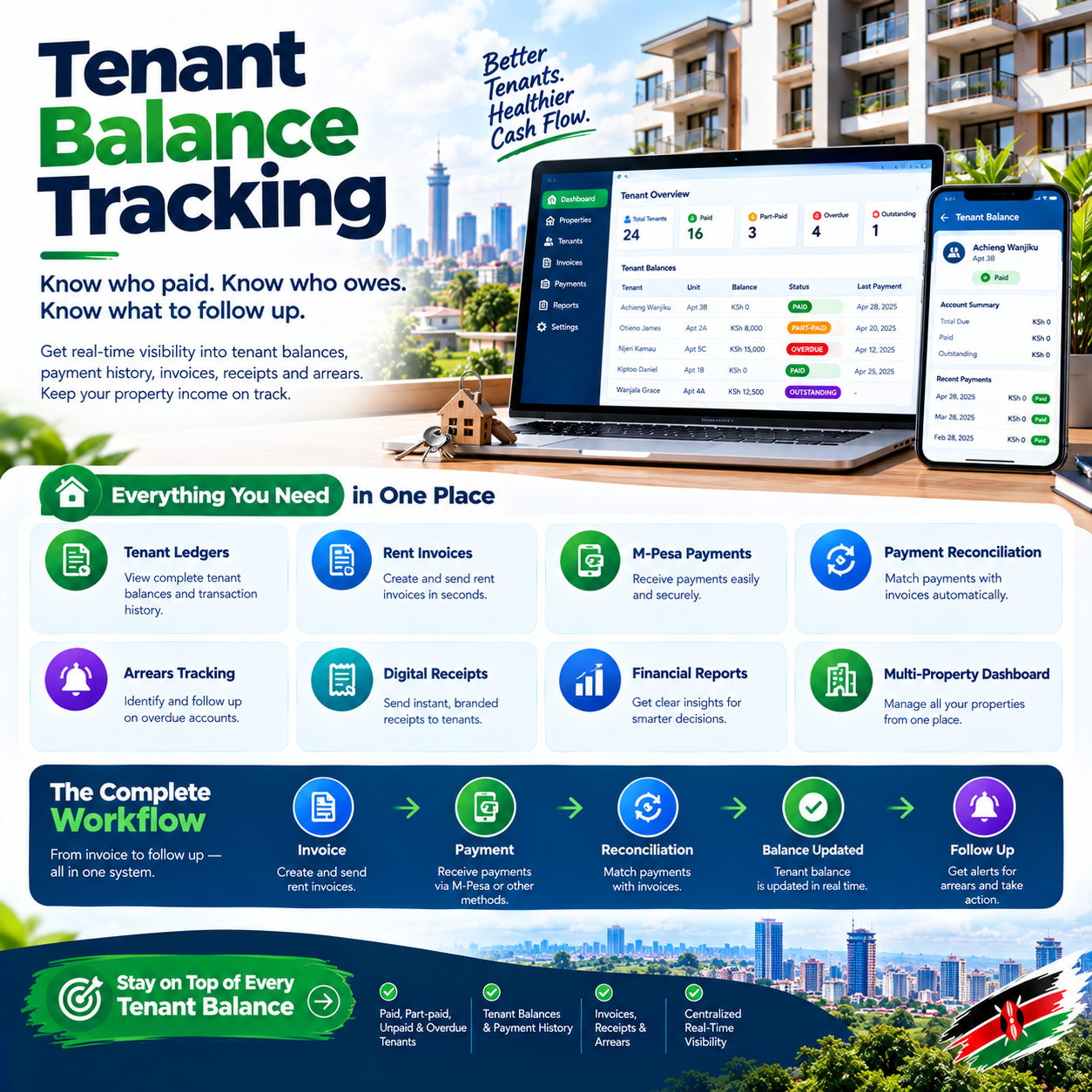
Tenant balance tracking is the discipline that tells you, at any moment, exactly who owes what across your entire portfolio.
It answers the three questions every owner eventually asks: who owes, how much, and since when.
In 2026, the landlords winning at this are not the ones with the best memory but the ones with the best systems.
Every shilling of rental income begins life as a balance sitting on a tenant’s account.
When balances are tracked loosely, income leaks quietly through forgotten arrears, unrecorded part-payments, and well-meaning guesswork.
A structured approach to tenant balance tracking stops those leaks before they begin.
This guide walks you through everything the discipline involves, from the mechanics of accounts to the tools that automate them.
We cover the features worth demanding in 2026, realistic costs, and the record-corrupting mistakes to avoid.
By the end, you will be ready to run tenant balance tracking across your portfolio with total confidence.
Whether you manage three bedsitters or three hundred apartments, the principle never changes.
A balance you can see clearly is a balance you can collect politely and promptly.
That visibility is precisely what modern tenant balance tracking delivers, month after month.
The good news is that the discipline has never been easier or more affordable to adopt.
Tools built for the Kenyan market now run the entire process from the phone in your pocket.
The sections ahead show you exactly how to put tenant balance tracking to work for your income.
What Tenant Balance Tracking Actually Means
At its simplest, tenant balance tracking means keeping a live, dated record of what every tenant owes at every moment.
Each account opens the month with rent due, and every payment received reduces that figure.
What remains — positive, zero, or in credit — is the balance, and the balance is the truth of your income.
A proper balance record holds more than a single number.
It captures the rent charged, the payments received, the dates of both, and any adjustments along the way.
That detail is what turns tenant balance tracking from a rough estimate into a defensible record.
It helps to distinguish balances from arrears, because the two words are often used interchangeably.
A balance is the current state of an account, while arrears describe amounts overdue against agreed dates.
Good tenant balance tracking holds both views — the account state and the time-based picture — in one place.
The discipline also extends beyond rent alone.
Water, garbage, service charges, and damage costs can all live on the same account when the tenancy agrees it.
Complete tenant balance tracking therefore reflects a tenant’s true total position, not just the headline rent.
Why Balances Go Wrong Without a System
Balances rarely fail loudly; they fail quietly, one unrecorded detail at a time.
A tenant pays half the rent, and the caretaker notes the event but not the figure.
Within two months, tenant balance tracking by memory has produced three versions of the same truth.
Part-payments are the classic corruptors of informal records.
Without a running account, a part-payment either disappears entirely or wrongly wipes out the whole month.
Either outcome distorts the very numbers tenant balance tracking exists to protect.
Deposits, water bills, and deductions add further layers of confusion.
When they sit outside the main record, nobody can state a tenant’s true position without an argument.
A structured tenant balance tracking system absorbs all of it into one clear figure.
Why 2026 Is the Breakout Year
Three forces are converging to make 2026 the year balance discipline goes digital nationwide.
Each one strengthens the case for adopting tenant balance tracking this year rather than someday.
Together, they mark a turning point for how rental income is managed across the country.
First, M-Pesa has made every rent payment digital, timestamped, and matchable to an account automatically.
The raw data for perfect balances now exists the moment money moves.
Modern tenant balance tracking simply organizes that stream into figures you can trust.
Second, portfolios have grown, and memory-based records collapse somewhere around thirty units.
Third, tenants now expect clear statements of what they owe and what they have paid.
Professional tenant balance tracking meets that expectation by default.
How It Works: The Monthly Mechanics
The mechanics of tenant balance tracking follow a simple loop that repeats every month.
Rent is charged to each account on its due date, creating a new balance.
Payments arrive and reduce the balance, with every change recorded in sequence.
Part-payments reduce the balance without clearing it, leaving the remainder visible and collectable.
Credits such as deposits applied or goodwill adjustments post directly to the account.
A well-designed tenant balance tracking system posts all of it automatically.
The running history matters as much as the current figure.
Every charge, payment, and adjustment stays attached to the account with its date and reference.
That history is what makes tenant balance tracking evidence-ready at any moment.
The loop closes with communication.
Statements drawn from the account show tenants exactly where they stand, in black and white.
Transparency like this is why tenant balance tracking prevents disputes instead of merely recording them.
The Anatomy of a Healthy Tenant Account
Every healthy account in tenant balance tracking shares the same anatomy.
It shows the tenant, the unit, and the agreed rent as its foundation.
On top sit the dated entries: charges posted, payments received, and adjustments applied.
The current balance sits at the top, impossible to miss.
Beneath it, the history tells the story of how that figure was reached.
Clarity of that kind is the hallmark of serious tenant balance tracking.
Aging information completes the picture.
Knowing that a balance is forty days old changes the urgency of the follow-up.
Age-aware records are what elevate tenant balance tracking from bookkeeping to management.
Must-Have Features to Demand in 2026
The market is growing quickly, and 2026 buyers should evaluate tools against a demanding checklist.
The best tenant balance tracking platforms share a clear set of core capabilities.
Use this section as your scorecard when comparing providers.
First, demand automatic posting of charges and payments.
Rent charges should hit accounts on schedule, and M-Pesa payments should reduce balances without manual entry.
Automation is the beating heart of reliable tenant balance tracking.
Second, insist on part-payment handling that keeps remainders visible and dated.
Partial payments are exactly where informal records fail, so make the feature non-negotiable.
Third, expect account statements that tenants can receive on request or on schedule.
Self-service transparency is a signature of mature tenant balance tracking platforms.
Fourth, look for aging views that sort balances by how long they have been outstanding.
Aging turns tenant balance tracking from a snapshot into a prioritized action list.
Fifth, check export and reporting, because your accountant needs clean figures at year-end.
Finally, mind the practical basics.
The best tenant balance tracking tools work on affordable phones, weak networks, and without thick manuals.
Usability decides whether the system runs all year or dies by March.
The M-Pesa Connection
Kenya’s mobile money rails are the reason balance discipline works so beautifully here.
Payments arrive with amounts, references, and timestamps that software can match to the right account instantly.
That instant matching is what keeps tenant balance tracking accurate to the minute.
Cash still matters in many estates, and good platforms handle it honestly.
Caretakers log cash with amounts and timestamps, and the entry posts to the account clearly marked for verification.
Bank transfers deserve the same treatment.
Direct deposits should be matchable against accounts and appear in the same history as every other payment.
Unified records across M-Pesa, cash, and bank are what make tenant balance tracking complete.
How Aging Reports Drive Collections
An aging report is the action arm of tenant balance tracking.
It ranks outstanding balances by how long they have run, oldest and largest first.
Follow-up becomes a short, ordered list instead of a vague worry.
The report also reveals patterns worth acting on.
Accounts that drift late every second month look identical to honest forgetters in a notebook, but not on an aging view.
Pattern visibility is one of the quiet superpowers of tenant balance tracking.
Deposits, Credits, and Adjustments Done Right
Deposits deserve careful handling inside tenant balance tracking.
The deposit held should sit visibly on the account, not in a separate memory.
When it is applied at move-out, the deduction posts with its reason and date.
The same rigor applies to credits and adjustments.
Goodwill reductions, water refunds, and damage charges all belong on the account, each with its story.
Complete adjustment handling is what makes tenant balance tracking the single truth of a tenancy.
Talking About Balances Without Conflict
Numbers only help when they lead to calm conversations.
The right way to raise a balance is factual and forward-looking: here is the account, here is the remainder, and here is how we settle it.
Records replace accusations, and both sides keep their dignity.
Timing matters as much as tone.
A conversation anchored to the account — same figures, same dates — removes the “he said, she said” entirely.
Tenants respond differently when the facts are visible and shared.
Put every agreed resolution back on the account.
A payment plan becomes dated entries, not a verbal hope.
What is written on the account is what both parties will remember.
Real Benefits for Landlords
The first benefit is arrears that never surprise you.
Balances update as money moves, so a stopped payment shows up in days rather than weeks.
Early visibility is the compounding advantage of daily tenant balance tracking.
The second benefit is dispute-proofing.
When every charge and payment sits on a dated account, arguments end before they start.
Evidence is the quiet armor built by consistent tenant balance tracking.
The third benefit is faster, calmer collections.
A clearly visible remainder invites a polite reminder today instead of a confrontation next month.
Cash flow smooths out remarkably under disciplined tenant balance tracking.
The fourth benefit is financial credibility.
Clean account histories export into accountant-ready summaries and impress lenders who ask for income evidence.
Few habits strengthen a landlord’s standing like organized tenant balance tracking.
Benefits for Property Managers and Caretakers
Property managers juggle many owners, and one fuzzy account can damage a hard-won client relationship.
Shared tenant balance tracking keeps every client portfolio transparent simultaneously.
Monthly reports build themselves from the accounts instead of from memory.
Caretakers gain just as much.
Their collections post with attribution, protecting them from suspicion when balances move for honest reasons.
Balances as Evidence: When Disputes Arise
Most tenancy disputes reduce to one question: what does the account say?
A dated record of charges and payments answers it in seconds.
Tribunals, mediators, and even family elders all respond to documents rather than volume.
The account also protects tenants from false claims.
A tenant with a complete record of payments cannot be accused of arrears that never existed.
Fair documentation is a two-way shield.
This is why record discipline pays even in good years.
The account you maintain in peaceful months becomes the evidence you rely on in difficult ones.
No landlord ever regrets having kept it.
Balance Tracking vs. the Other Tools
Readers of our earlier guides often ask how this discipline relates to the wider software family.
Rent tracking follows payments, invoicing tools generate documents, and reminder apps send the nudges.
Tenant balance tracking is the account layer underneath all of them.
The categories converge in practice, because most modern platforms bundle several functions.
What matters is that the account — the single truth of who owes what — stays accurate whatever tools sit on top.
Anchor your stack on solid tenant balance tracking and everything else gets easier.
Real Scenarios from Real Portfolios
Picture a landlord with fifteen units in Kasarani whose balances once lived in a caretaker’s notebook.
Now every part-payment posts to the right account, and each remainder shows with its age.
His arrears fell by half within one quarter of starting proper tenant balance tracking.
Picture a caretaker in Embakasi managing three buildings for absentee owners.
Each collection he logs updates the account instantly, and month-end statements compile themselves.
The owners saw the transparency and expanded his scope — trust built on tenant balance tracking.
Picture a tenant in Kilimani preparing to move out after three years.
Her account shows every payment and every charge, so the deposit conversation takes one meeting, not three.
A clean ending like that is the everyday outcome of disciplined tenant balance tracking.
Choosing the Right Tool
A structured selection process prevents regret in this fast-growing market.
Start by listing your realities: unit count, payment mix, who posts cash, and how tenants want their statements.
The right tenant balance tracking tool fits your operation, not the loudest advert.
Trial with your real data before paying anything.
Run one building’s actual month through the system, including a part-payment and a cash day.
One honest week of testing reveals more than any tenant balance tracking brochure ever will.
What It Costs in 2026
Pricing in this category is friendlier than most owners expect.
Competition among Kenyan providers has kept costs low even as features multiply.
Against recovered arrears and saved evenings, tenant balance tracking repays itself within the first billing cycle.
Typical pricing structures heading into 2026 look like this:
- Free tiers: ideal for landlords with up to about ten units
- Per-unit plans: commonly KSh 20–80 per unit monthly
- Flat monthly plans: roughly KSh 500–3,500 depending on features
- Annual plans: usually 10–20 percent cheaper than monthly billing
Weigh the price against the full value stack: earlier arrears detection, dispute protection, and audit-ready records.
Viewed that way, the true cost of good tenant balance tracking approaches zero.
The real question is how long you can afford to run your income on memory.
Getting Started the Right Way
Adoption succeeds or fails in the first two weeks, so begin deliberately.
Open accounts for one property completely — tenants, rent amounts, due dates, and existing balances — before expanding.
Accurate opening balances are the foundation of honest tenant balance tracking.
Agree the opening figures with each tenant in writing wherever possible.
A balance confirmed at the start becomes a baseline nobody can dispute later.
From that clean start, tenant balance tracking maintains the truth automatically.
Common Mistakes to Avoid
The most common mistake is letting opening balances be guesses.
An unverified starting figure quietly poisons every account that follows.
Confirm the books before trusting any tenant balance tracking output.
The second mistake is recording payments without dates or references.
An undated entry is a rumor, not a record.
Discipline about details is what keeps tenant balance tracking credible.
The third mistake is ignoring small remainders.
Tiny balances feel uncollectable, but they teach accounts to drift and tenants to underpay.
Consistency about small figures is the secret strength of tenant balance tracking.
The Road Ahead: 2027 and Beyond
The trajectory of this technology points somewhere exciting.
Accounts are becoming interactive, letting tenants view balances, query entries, and settle remainders from their own phones.
Self-service is the next frontier of tenant balance tracking.
Intelligence is arriving just behind it.
Systems are learning payment patterns, predicting which accounts will drift, and suggesting the best moment for a friendly reminder.
Predictive balance intelligence will make the tenant balance tracking of 2027 smarter than any human ledger.
Frequently Asked Questions
What does tenant balance tracking actually mean?
It means keeping a live, dated record of what every tenant owes after every charge and payment.
A proper tenant balance tracking system shows the current figure, the history behind it, and how old any debt is.
Think of it as the account book of your entire portfolio, always current.
How is it different from rent tracking?
Rent tracking follows payments and arrears, while balance tracking maintains the account underneath them.
In practice most platforms bundle both, so your payments and accounts stay in sync.
Choose based on whether you need the account depth that full tenant balance tracking provides.
Can it handle part-payments, deposits, and other charges?
Yes — handling part-payments, deposits, and adjustments correctly is the defining test of the category.
Payments reduce the balance without clearing it, deposits post as credits when applied, and extra charges sit alongside rent.
The account always shows exactly what remains and why.
Do I need it for a small portfolio?
Even three units benefit, because one fuzzy account distorts a small income badly.
Free and low-cost tiers make adoption easy at any size.
Habits built small scale beautifully later.
What if my current records are already messy?
Most landlords begin with a cleanup, reconciling each tenant’s true position before going live.
Agree opening balances in writing and start fresh from a confirmed date.
From there, the system keeps the truth automatically.
Can tenants see their own balances?
On good platforms, yes — tenants receive statements or app access showing charges, payments, and the running balance.
Shared visibility builds trust and reduces repetitive questions.
Transparency is a feature, not a risk.
How often should I review balances?
Daily is ideal during the first week of the month, when most payments arrive.
Even a weekly review works, because the records never sleep between your visits.
The point is responding to what the accounts show, promptly and politely.
What happens when a tenant leaves with a balance?
The account gives you the complete story, which is the entire point of the discipline.
Deposit deductions apply against documented figures, and any remainder is enforceable with evidence.
You negotiate from records, not from memory.
Where can I find rentals and landlord tools together?
Start with platforms that combine verified listings with landlord-friendly technology, such as rentaldesk.co.ke.
Pairing the right tenants with consistent tenant balance tracking takes you from filling units to collecting every shilling you are owed.