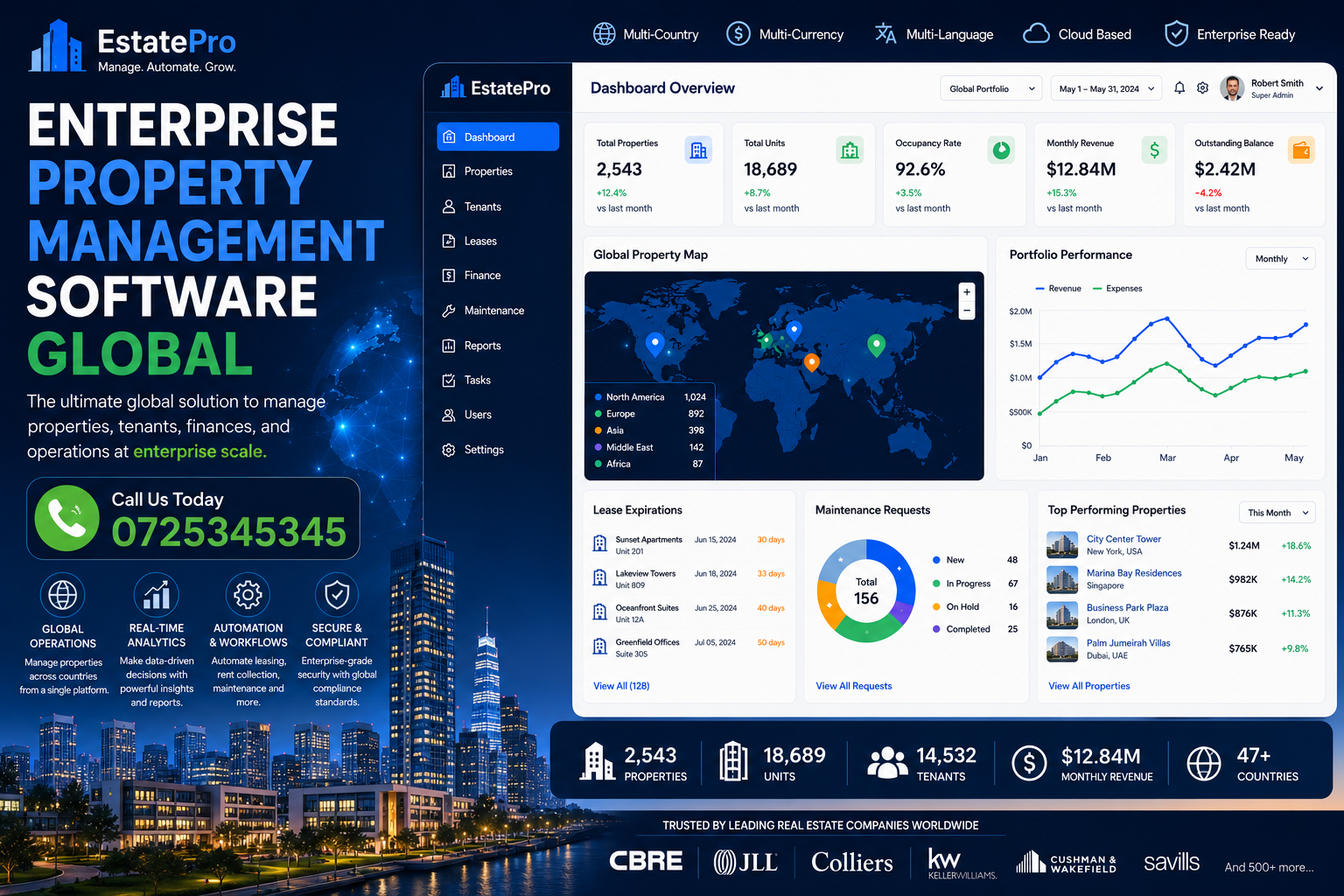
global real estate industry is expanding faster than ever before. Investors, property managers, real estate firms, and multinational housing organizations are increasingly managing properties across multiple countries and regions. This rapid international growth has created demand for intelligent digital infrastructure capable of handling complex operations beyond local markets.
A cross-border property management system is the ultimate solution for managing international real estate portfolios efficiently. It allows businesses to centralize operations, automate workflows, streamline tenant communication, manage multiple currencies, and maintain compliance across different countries—all within one secure platform.
As global property investments continue to rise, companies need scalable systems that can support international growth without operational chaos. A modern cross-border property management platform delivers the technology required to simplify global real estate management while improving profitability and efficiency.
What is a Cross-Border Property Management System?
A cross-border property management system is a cloud-based real estate software platform designed specifically for managing properties located in different countries or regions.
Unlike traditional local property software, cross-border systems support:
- Multi-country property portfolios
- International tenant management
- Multi-currency transactions
- Global compliance management
- Regional tax configurations
- Cross-border financial reporting
The platform acts as a centralized real estate operating system for international operations.
Why Cross-Border Property Management Matters
Real estate is no longer limited by geography. Investors today own:
- Residential apartments in multiple countries
- Commercial buildings across regions
- International Airbnb portfolios
- Global rental assets
Managing these properties manually creates major challenges such as:
- Currency conversion issues
- Communication delays
- Different legal requirements
- Scattered financial systems
- Inefficient reporting processes
A cross-border property management system eliminates these problems by providing one unified digital environment.
Core Features of a Cross-Border Property Management System
1. Multi-Country Property Management
The system allows organizations to manage properties located in:
- Different countries
- Multiple cities
- Various legal jurisdictions
Everything is controlled from one dashboard.
2. Multi-Currency Payment Processing
One of the most important features is global payment support.
The platform enables:
- Currency conversion
- International payment gateways
- Automated invoicing
- Cross-border rent collection
Supported currencies may include:
- USD
- EUR
- GBP
- KES
- AED
- ZAR
This simplifies international financial operations.
3. Global Tenant Management
Tenant records are centralized globally.
Managers can track:
- Lease agreements
- Payment history
- Tenant communication
- Maintenance requests
This creates consistency across all locations.
4. International Lease Management
A cross-border property management system automates:
- Lease generation
- E-signatures
- Renewal reminders
- Country-specific contract templates
This reduces administrative workload significantly.
5. Cloud-Based Accessibility
Cloud infrastructure enables:
- Remote access worldwide
- Real-time synchronization
- Automatic updates
- Secure backups
Managers can operate properties globally from any device.
6. Cross-Border Financial Reporting
Financial analytics become centralized and intelligent.
Reports include:
- Revenue by country
- Property profitability
- Occupancy rates
- Tax summaries
- Global cash flow reports
7. Maintenance & Vendor Coordination
International maintenance operations are streamlined through:
- Work order automation
- Vendor assignment
- Repair tracking
- Cost monitoring
This improves operational efficiency globally.
8. Multi-Language Support
Global systems support multiple languages to improve usability for:
- International teams
- Tenants
- Vendors
- Regional offices
Benefits of a Cross-Border Property Management System
1. Centralized Global Operations
Organizations manage worldwide assets from one unified platform.
This eliminates fragmented systems and disconnected workflows.
2. Increased Operational Efficiency
Automation reduces repetitive tasks such as:
- Rent reminders
- Invoice generation
- Lease renewals
- Maintenance scheduling
This saves time and operational costs.
3. Better Financial Visibility
Executives gain real-time visibility into:
- Global income
- Expenses
- Asset performance
- Investment returns
4. Easier International Expansion
Companies can add new countries and properties without rebuilding infrastructure.
5. Enhanced Tenant Experience
Tenants enjoy:
- Online payments
- Faster communication
- Self-service portals
- Real-time support
This improves retention rates.
Technology Behind Cross-Border Property Management Systems
Modern systems are built using advanced technologies such as:
- Cloud computing
- AI-powered analytics
- Microservices architecture
- Secure APIs
- Big data processing
These technologies ensure scalability and global reliability.
AI-Powered Cross-Border Property Management
Artificial intelligence is transforming global real estate operations.
Predictive Analytics
AI can predict:
- Vacancy risks
- Maintenance issues
- Rental pricing trends
- Market demand changes
Automated Tenant Screening
AI evaluates tenant applications based on:
- Risk analysis
- Payment behavior
- Identity verification
- Fraud detection
Smart Property Insights
Managers receive recommendations on:
- Investment opportunities
- Cost optimization
- Occupancy improvement
- Revenue growth strategies
Cross-Border Compliance Management
Managing properties internationally requires compliance with different laws.
A cross-border property management system helps organizations comply with:
- Regional tenancy laws
- International tax regulations
- Data protection standards
- Financial reporting requirements
Security in Global Property Systems
Security is critical in international real estate operations.
Enterprise-level systems include:
- Data encryption
- Multi-factor authentication
- Role-based access control
- Audit logs
- Secure cloud storage
This protects sensitive tenant and financial information.
Cross-Border Property Management
for Different Industries
Residential Real Estate
Manage apartments, rental homes, and housing projects globally.
Commercial Real Estate
Operate office buildings, malls, and retail properties internationally.
Hospitality & Short-Term Rentals
Handle:
- Hotels
- Vacation rentals
- Airbnb portfolios
- Serviced apartments
Student Housing
Manage international student accommodation across universities and countries.
Mobile Property Management Experience
Modern platforms are mobile-first.
Tenant Mobile Features
- Rent payment
- Maintenance requests
- Lease access
- Notifications
Manager Mobile Features
- Portfolio monitoring
- Real-time alerts
- Financial dashboards
- Team coordination
Integration Capabilities
A modern cross-border property management system integrates with:
- Accounting software
- ERP systems
- CRM platforms
- Banking systems
- Smart building IoT devices
This creates a fully connected real estate ecosystem.
Cross-Border Automation Workflows
Automation drives operational excellence.
Automated Rent Collection Workflow
- Invoice generation
- Tenant notification
- Payment processing
- Receipt issuance
- Financial synchronization
Maintenance Automation Workflow
- Tenant submits request
- Vendor assignment
- Work tracking
- Completion verification
- Cost reporting
Real Estate Analytics & Business Intelligence
Advanced dashboards provide real-time insights.
Portfolio Performance Tracking
Monitor:
- Occupancy trends
- Revenue growth
- Regional profitability
- Asset performance
ROI Optimization
Organizations can improve investment decisions using analytics.
ROI=Net ProfitInvestment Cost×100ROI = \frac{\text{Net Profit}}{\text{Investment Cost}} \times 100
Competitive Advantages of Cross-Border Property Management Systems
Businesses using modern global systems gain:
- Faster scaling
- Better operational visibility
- Lower administrative costs
- Improved tenant experiences
- Stronger investment intelligence
Challenges Solved by Cross-Border Property Software
Currency Complexity
Automated conversion and international payment handling simplify global transactions.
Fragmented Operations
One centralized platform replaces multiple disconnected systems.
Communication Delays
Real-time messaging and notifications improve coordination globally.
Compliance Risks
Built-in legal and tax configurations reduce regulatory challenges.
Future of Cross-Border Property Management
The future of global real estate technology includes:
- AI-driven automation
- Blockchain leasing systems
- Smart building integration
- Predictive maintenance
- Fully autonomous property operations
The industry is moving toward intelligent real estate ecosystems.
SEO Keyword Cluster
Primary Keyword
- cross-border property management system
Secondary Keywords
- global property management software
- international real estate platform
- multi-country property management
- cloud-based property management system
- international rental management software
- enterprise real estate SaaS
- global tenant management system
Frequently Asked Questions (FAQ)
What is a cross-border property management system?
It is a software platform designed to manage international real estate portfolios across multiple countries and currencies.
Why do global real estate companies need cross-border systems?
They simplify international operations, automate workflows, and centralize financial and tenant management.
Can the system support multiple currencies?
Yes. Modern platforms support global currencies and automated conversion.
Is cloud-based property management secure?
Yes. Enterprise platforms use encryption, secure cloud infrastructure, and advanced authentication systems.
Can I manage properties from different countries in one dashboard?
Yes. Cross-border systems are designed for centralized international property management.
Conclusion
A cross-border property management system is the future of global real estate operations. As international property portfolios continue to expand, organizations require scalable technology capable of managing properties, tenants, finances, and compliance across borders.
Modern cloud-based platforms provide the automation, intelligence, and scalability needed to streamline operations while maximizing profitability and growth.
Businesses that adopt advanced cross-border property management software gain a powerful competitive advantage in the rapidly evolving global real estate market.