Rental Property Software Machakos: How Landlords Can Simplify Rent Collection and Property Management
Managing rental properties in Machakos County requires more than finding tenants and collecting monthly rent. Landlords and property managers must monitor occupied units, maintain accurate tenant records, follow up on outstanding payments, handle maintenance requests, manage utility bills and prepare financial reports. As rental portfolios grow, these responsibilities can become difficult to coordinate using notebooks, spreadsheets and separate payment records. Rental Property Software Machakos offers a practical approach to organizing these activities through a centralized digital management system. For landlords operating in Machakos Town, Athi River, Mlolongo, Syokimau, Mavoko, Kangundo and surrounding areas, adopting structured rental management processes can improve financial visibility and reduce unnecessary administrative work. This guide explains the features, benefits and considerations that landlords should understand when choosing a digital rental management solution.
Machakos has different types of rental properties, ranging from residential apartments and bedsitters to family houses, commercial premises and furnished accommodation. Each property type comes with different management responsibilities. A landlord managing several apartments may need to track dozens of monthly payments, while a property agency overseeing buildings for different owners must maintain accurate records for every landlord.
The challenge is not necessarily the number of properties alone. It is the amount of information that must be recorded, updated and retrieved every day. When payment details are scattered across M-Pesa messages, bank statements, handwritten receipts and spreadsheets, it becomes harder to establish an accurate financial position.
A properly configured rental management platform brings these records together. Instead of checking several sources to understand what happened during the month, property managers can work from connected property, tenant, invoice and payment records.
This makes Rental Property Software Machakos relevant to landlords who want a more organized way to manage their rental businesses while maintaining control over collections, expenses and tenant relationships.
1. Understanding the Rental Property Management Environment in Machakos
Machakos County has a diverse property environment. Residential developments, commercial buildings and rental apartments serve people with different housing and business requirements.
Areas such as Athi River and Mlolongo have rental activity influenced by their proximity to Nairobi, industrial establishments and transport connections. Syokimau and Mavoko have residential developments that attract households looking for different housing arrangements. Machakos Town also supports residential and commercial rental businesses serving local residents, professionals and entrepreneurs.
These differences affect how properties should be managed.
A landlord with a single residential building might prioritize monthly rent collection, tenant communication and maintenance. A property management agency may need additional controls for owner statements, management fees, staff permissions and reporting across multiple buildings.
Using Rental Property Software Machakos allows property owners to approach these responsibilities through organized digital records rather than depending entirely on manual processes.
Different property types require different management processes
Common rental property categories include:
-
Residential apartments with multiple independent units.
-
Bedsitters and single-room rental buildings.
-
Two-bedroom and three-bedroom family apartments.
-
Standalone rental houses.
-
Commercial shops and business premises.
-
Office spaces and mixed-use buildings.
-
Furnished apartments and short-stay accommodation.
-
Student accommodation and hostels.
Each category has different billing and operational requirements.
For example, an apartment building may have a standard monthly rent schedule, while commercial premises may operate under longer lease agreements. Furnished accommodation may require booking records, guest information and shorter payment cycles.
A digital management system helps property managers maintain separate records for these arrangements without losing sight of the overall portfolio.
The challenge of managing growing rental portfolios
Manual systems can work when a landlord has only a few tenants. However, the amount of administrative work increases as the portfolio grows.
Consider a landlord with three buildings containing a combined 45 rental units. Each month, the landlord must establish which tenants have paid, identify partial payments, follow up on arrears, issue receipts, record expenses and prepare financial summaries.
If the landlord uses separate spreadsheets for every building, the process becomes repetitive.
A centralized system can make these activities easier to coordinate. Rental Property Software Machakos gives property owners a useful way to think about connecting the information that would otherwise remain scattered across different records.
2. Why Landlords in Machakos Are Moving Towards Digital Rental Management
Property management involves continuous administrative work. Even when tenants pay on time, landlords still need to maintain records, respond to questions and monitor the condition of their buildings.
Digital rental management addresses these responsibilities by creating a structured environment for property information.
Reducing dependence on handwritten records
Handwritten rent books can become difficult to maintain when several people participate in property operations.
A caretaker might receive payment confirmation from a tenant, while the landlord records the same payment in another book. If one entry is missed, the two records may show different balances.
Digital records reduce this duplication by allowing payments and tenant information to be associated with the correct property and rental unit.
Improving access to payment information
Landlords frequently need answers to straightforward questions:
-
Which tenants have paid this month?
-
Who has made a partial payment?
-
Which accounts are overdue?
-
How much rent has been collected?
-
Which payments require confirmation?
-
Which tenants need follow-up?
A centralized dashboard can make this information easier to retrieve.
With Rental Property Software Machakos, the objective is to make daily rental operations more structured, allowing landlords to spend less time searching through separate records.
Supporting better financial decisions
Rental income is a business resource. Property owners need to understand how much money is coming in and how much is being spent.
Accurate records help landlords evaluate:
-
Monthly rental income.
-
Outstanding tenant balances.
-
Maintenance expenses.
-
Utility collections.
-
Management fees.
-
Property operating costs.
-
Owner payouts.
-
Overall property performance.
When these figures are recorded consistently, landlords can make decisions based on actual financial information rather than estimates.
Managing properties remotely
Some property owners do not live near their rental buildings. A landlord may own an apartment in Athi River while living in Nairobi or another county.
Depending entirely on a caretaker to provide updates can create information gaps.
A cloud-based platform provides access to relevant property records without requiring the owner to visit the building whenever they need a financial update. Rental Property Software Machakos represents the type of organized approach that can support property owners with geographically separated responsibilities.
3. Centralized Property and Unit Management
Property records form the foundation of effective rental administration. Before tracking rent or preparing reports, landlords need an accurate record of every building and its individual units.
A centralized property management workspace helps establish this structure.
Recording individual rental properties
Each building should have its own identifiable record.
Useful property information includes:
-
Property name.
-
Physical location.
-
Property category.
-
Number of rental units.
-
Property owner.
-
Management contact.
-
Billing arrangements.
-
Relevant documents.
-
Operational status.
This information becomes particularly important for property agencies managing several buildings on behalf of different landlords.
For instance, a property manager handling apartments in Machakos Town, Mlolongo and Syokimau should be able to distinguish the buildings and review their performance separately.
Organizing rental units
Every property should have an organized list of units.
A unit record may contain:
-
Unit number or name.
-
Floor or building section.
-
Monthly rent.
-
Occupancy status.
-
Assigned tenant.
-
Deposit amount.
-
Billing frequency.
-
Utility arrangements.
This structure makes it easier to establish which units are occupied, vacant or undergoing maintenance.
It also reduces confusion when tenants move between units.
Monitoring vacancies
Vacant units represent potential rental income that is not currently being collected.
Without a clear occupancy record, a landlord may struggle to identify which apartments are available or whether a tenant has completed the move-out process.
A property management platform can help distinguish occupied units from vacant ones and organize available-unit listings.
Using Rental Property Software Machakos as part of the wider digital property management conversation highlights the importance of having organized records for each operational unit, rather than treating an entire building as one financial record.
4. Tenant Management and Digital Tenant Records
Tenants are central to every rental business. Maintaining accurate information about them supports billing, communication, lease administration and dispute resolution.
A tenant management system creates an organized record for each person occupying a rental unit.
What should a tenant record contain?
A comprehensive tenant profile may include:
| Information | Management purpose |
|---|---|
| Full name | Identifying the tenant |
| Phone number | Communication and reminders |
| Email address | Digital correspondence |
| Assigned unit | Confirming occupancy |
| Lease start date | Tracking tenancy |
| Lease end date | Monitoring expiry |
| Monthly rent | Billing accuracy |
| Deposit details | Deposit accountability |
| Payment history | Reviewing collections |
| Outstanding balance | Monitoring arrears |
Maintaining these records in one place helps property managers answer tenant-related questions more efficiently.
Managing tenant movement
Tenant movement is a regular part of rental operations.
When a tenant moves out, the landlord may need to confirm the final rent balance, inspect the unit, assess utility charges, review the deposit and record the date the property becomes available.
A digital tenant management process can connect these activities to the relevant unit.
This reduces the risk of leaving an old tenant attached to an active rental account.
Improving tenant communication
Good communication helps prevent misunderstandings.
Tenants should receive clear information about rent due dates, payment confirmations, maintenance arrangements and other property-related matters.
Rental Property Software Machakos can be understood within this broader objective of maintaining structured information and making important property records easier to manage.
5. Automated Rent Invoicing and Billing
Rent invoicing is one of the most important activities in property management. Every billing period, landlords must establish how much each tenant owes and communicate the amount clearly.
When invoices are prepared manually, the process can consume considerable time.
Why automated rent invoices matter
An automated invoicing process can help landlords:
-
Create recurring rent invoices.
-
Apply the correct rental amount.
-
Include approved additional charges.
-
Set payment due dates.
-
Track invoice status.
-
Identify overdue accounts.
-
Maintain a billing history.
This gives property managers a consistent way to administer monthly rent.
Managing different rent arrangements
Not all tenants pay the same amount.
A commercial tenant may pay a different rent from a residential tenant in the same building. Some agreements may also include additional service charges or different billing arrangements.
The system should therefore support property-specific and unit-specific billing records.
For example:
| Unit | Monthly rent | Billing frequency |
|---|---|---|
| Apartment A1 | KSh 12,000 | Monthly |
| Apartment A2 | KSh 15,000 | Monthly |
| Apartment B1 | KSh 18,000 | Monthly |
| Commercial C1 | KSh 30,000 | Monthly |
These figures are illustrative, not quoted Machakos market rates.
A structured billing system helps ensure that every tenant receives the correct invoice.
Tracking invoice status
An invoice should not simply be marked as paid because a tenant says they have made a transfer.
The payment needs to be confirmed and associated with the correct tenant and billing record.
Using Rental Property Software Machakos illustrates how connected billing and payment records can help property managers maintain a clearer picture of rental income.
6. M-Pesa Rent Collection and Payment Reconciliation
M-Pesa plays an important role in everyday payments in Kenya. Many tenants prefer mobile payments because they can complete transactions without visiting a landlord’s office.
However, receiving money and accurately recording it are two different tasks.
A landlord may receive several payments within a short period. If tenants use inconsistent payment descriptions, identifying the correct rental account can become difficult.
Making rent collection more organized
A digital rental management platform can support configured M-Pesa payment workflows.
Depending on the integration and account setup, the process may involve:
-
Configuring Paybill or Till details.
-
Providing tenants with payment references.
-
Receiving payment transaction information.
-
Matching transactions to tenant records.
-
Updating the relevant invoice.
-
Recording the payment.
-
Generating or maintaining receipt information.
Understanding payment reconciliation
Reconciliation means checking whether recorded payments agree with the transactions received through the relevant payment channel.
For example, suppose a property has ten tenants who collectively owe KSh 150,000 in monthly rent.
The property manager receives several M-Pesa transactions. Some tenants pay the full amount, while others pay partially.
The manager must establish:
-
Which tenant made each payment.
-
Whether the transaction amount is correct.
-
Whether the invoice has been settled.
-
Whether any balance remains.
-
Whether an unexpected payment needs investigation.
Rental Property Software Machakos is particularly relevant when discussing the importance of connecting payment information to individual tenant accounts.
Handling unmatched transactions
An unmatched payment should not automatically be assigned to a tenant without verification.
The transaction might have an incorrect reference, belong to another property or represent a different payment.
A reconciliation workflow allows the manager to review unclear transactions before assigning them.
RentalDesk supports M-Pesa payment tracking, reconciliation workflows and review of unmatched transactions. Automatic matching depends on the configured payment integration and the quality of payment references.
This distinction is important because good financial management requires verification, not simply automation.
7. Arrears Tracking and Late Rent Follow-Ups
Rent arrears are among the most common administrative challenges faced by landlords.
A tenant may pay late, make a partial payment or forget to settle an outstanding amount. Without accurate records, landlords can struggle to identify the actual balance.
Why landlords need an arrears management process
An effective arrears process helps property managers identify:
-
Tenants who have paid in full.
-
Tenants who have made partial payments.
-
Tenants who have not paid.
-
Overdue invoices.
-
Outstanding balances.
-
Previous follow-up actions.
-
Payment commitments.
This information allows landlords to prioritize follow-ups.
Example of an arrears report
| Tenant | Monthly rent | Amount paid | Outstanding |
|---|---|---|---|
| Tenant A | KSh 12,000 | KSh 12,000 | KSh 0 |
| Tenant B | KSh 15,000 | KSh 10,000 | KSh 5,000 |
| Tenant C | KSh 18,000 | KSh 0 | KSh 18,000 |
| Tenant D | KSh 14,000 | KSh 14,000 | KSh 0 |
These are hypothetical figures.
An arrears report helps a landlord distinguish between accounts requiring immediate attention and those that are already settled.
Establishing consistent follow-up procedures
A useful follow-up process should include:
-
Confirming the invoice due date.
-
Checking the tenant’s payment history.
-
Verifying whether a payment is pending reconciliation.
-
Sending a polite reminder.
-
Recording any communication.
-
Updating the account after payment.
-
Escalating unresolved cases appropriately.
Rental Property Software Machakos supports the broader idea of using organized digital processes to reduce dependence on memory and scattered payment records.
8. Lease Management and Rental Agreement Administration
A tenancy agreement establishes the relationship between a landlord and a tenant. It outlines the conditions under which a rental unit is occupied and the responsibilities of each party.
Poor lease administration can create avoidable problems, especially when a property manager handles several tenants with different agreement dates.
Keeping lease information organized
A lease management system should help landlords maintain records such as:
-
Tenant and landlord details.
-
Property and unit identification.
-
Lease commencement date.
-
Lease expiry date.
-
Monthly rental amount.
-
Security deposit.
-
Payment conditions.
-
Renewal arrangements.
-
Notice requirements.
-
Special tenancy conditions.
Keeping this information connected to the tenant’s profile makes it easier to retrieve the correct agreement when questions arise.
Monitoring lease expiry dates
A tenant’s agreement may expire while the tenant continues occupying the property. If the landlord does not monitor expiry dates, renewal discussions may happen too late.
Digital lease records make it easier to identify agreements approaching their expiry dates.
Property managers can use this information to contact tenants, discuss renewal arrangements and update the relevant records.
Recording changes to tenancy terms
Rental amounts and other tenancy conditions may change following an agreed arrangement.
Every approved change should be documented with the appropriate effective date.
For example, if a tenant’s monthly rent changes from KSh 15,000 to KSh 17,000, the property manager should ensure that future invoices use the updated amount while historical transactions remain available.
Rental Property Software Machakos is relevant to landlords looking for a more organized approach to lease administration and tenant records.
Managing tenant exits
When a tenant leaves, the landlord should follow a consistent exit procedure.
This may involve:
-
Confirming the tenant’s notice.
-
Reviewing the outstanding rent balance.
-
Recording the final payment.
-
Checking utility charges.
-
Inspecting the rental unit.
-
Recording any agreed deductions.
-
Reviewing the security deposit.
-
Updating the occupancy status.
A documented process helps reduce disagreements and makes it easier to prepare the unit for another tenant.
9. Security Deposit Tracking and Accountability
Security deposits require careful administration because they represent money held under the terms of a tenancy agreement.
A landlord should know how much each tenant paid, whether any approved deductions have been made and what amount remains refundable.
Why deposit records matter
When deposit information is kept in notebooks or mixed with ordinary rental income, misunderstandings can arise.
A property manager may struggle to distinguish:
-
Deposits received.
-
Deposits awaiting confirmation.
-
Deposits transferred between accounts.
-
Approved deductions.
-
Deposit refunds.
-
Outstanding deposit balances.
Digital records make these transactions easier to review.
Maintaining a deposit history
Each tenant should have a deposit record linked to their tenancy.
For example, a tenant occupying an apartment may pay a deposit equivalent to one month’s rent.
The landlord records the amount received, the transaction date and the payment reference. When the tenant moves out, the landlord can review the record before processing any applicable refund.
The system should not automatically treat a deposit as ordinary rent income.
It should also allow the landlord to document deductions and their supporting reasons.
Avoiding deposit disputes
A clear deposit management process benefits both landlords and tenants.
Property managers should retain relevant payment evidence, inspection records and written communication.
Using Rental Property Software Machakos as a reference point for digital administration highlights how important it is to preserve a complete history of financial transactions associated with each tenancy.
10. Utility Billing for Water, Electricity and Other Services
Many rental properties have utility arrangements that require separate monitoring.
Some buildings have individual water meters, while others use shared water systems. Electricity may be billed directly by a utility provider or managed through a property-specific arrangement.
Property managers need a reliable method of recording these charges.
Managing water consumption
Where tenants are billed according to water consumption, managers need to record meter readings consistently.
The process may include:
-
Identifying the relevant meter.
-
Recording the previous reading.
-
Capturing the current reading.
-
Calculating consumption.
-
Applying the approved billing rate.
-
Generating the tenant’s utility charge.
-
Recording payment.
A digital system can help maintain historical readings and identify unusual changes in consumption.
Managing electricity charges
Rental properties may have different electricity arrangements.
Some tenants have individual prepaid meters. Others may receive bills through a shared arrangement.
Where electricity is billed through the landlord, the calculation method should be clearly communicated and consistently applied.
Managing service charges
Apartment buildings and managed residential developments may have additional charges for shared services.
Examples include:
-
Cleaning.
-
Security.
-
Common-area lighting.
-
Garbage collection.
-
Shared water services.
-
Compound maintenance.
-
Common facility upkeep.
Property managers should distinguish these charges from ordinary rent.
Rental Property Software Machakos reflects the value of bringing different property-related billing records into one organized management process.
Why utility records should be linked to tenants
When utility information is maintained separately, landlords may struggle to establish which tenant owes a particular amount.
Connecting utility invoices to tenant accounts provides better visibility into total outstanding balances.
It also makes it easier to prepare a complete tenant statement.
11. Maintenance Management and Property Repairs
Maintaining rental buildings is essential for protecting property value and supporting tenant satisfaction.
A leaking pipe, damaged electrical fitting, broken door or faulty water pump can affect several occupants if it is not addressed promptly.
However, maintenance management becomes difficult when requests are communicated informally and repair expenses are not documented.
Creating a structured maintenance process
An organized maintenance workflow should record:
-
The tenant or caretaker reporting the issue.
-
The property and affected unit.
-
The date the issue was reported.
-
The nature of the problem.
-
The urgency of the repair.
-
The assigned technician or contractor.
-
The estimated repair cost.
-
The work completion date.
-
The final expense.
-
Confirmation that the issue has been resolved.
This creates an operational history for every property.
Categorizing maintenance requests
Not every repair requires the same response time.
Property managers can classify requests according to their urgency.
| Category | Example | Suggested response |
|---|---|---|
| Emergency | Major water leak | Immediate attention |
| Urgent | Faulty electrical fitting | Prompt assessment |
| Routine | Loose cabinet handle | Scheduled repair |
| Preventive | Water tank inspection | Planned maintenance |
These categories are illustrative and should be adapted to the building’s circumstances.
Monitoring maintenance costs
Repair expenses should be recorded against the appropriate property.
For example, if a landlord manages three buildings and spends KSh 8,000 repairing plumbing in one building, the expense should not become mixed with repair costs for the other properties.
This improves property-level financial reporting.
Keeping tenants informed
Tenants appreciate receiving updates about reported issues.
Property managers should acknowledge requests, communicate expected repair arrangements and confirm when work has been completed.
RentalDesk includes maintenance request workflows that help teams track reported issues and their progress.
Rental Property Software Machakos fits into the wider discussion of organized service records, where requests, responsibilities and completion details should be documented rather than left to informal conversations.
12. Landlord Statements and Property Financial Reporting
Property owners need more than a total rent collection figure.
They need to understand how much each property generates, which expenses have been incurred and what amount is available for distribution.
This is particularly important for property management agencies handling buildings on behalf of multiple landlords.
What should a landlord statement contain?
A useful owner statement may include:
-
Opening balance.
-
Rent billed.
-
Rent collected.
-
Outstanding tenant balances.
-
Utility collections.
-
Maintenance expenses.
-
Approved deductions.
-
Management fees.
-
Other applicable expenses.
-
Net amount payable.
-
Closing balance.
The exact format depends on the management agreement and accounting arrangements.
Separating property finances
Imagine an agency manages four properties for three different owners.
The agency receives rent on behalf of each owner and pays approved operating expenses.
Without separate records, it can become difficult to determine which funds belong to which property.
A centralized rental platform helps maintain connections between payments, invoices, expenses and owner accounts.
Preparing monthly financial reports
Property managers should establish a consistent reporting schedule.
Monthly reports may cover:
-
Total rent invoiced.
-
Total rent collected.
-
Outstanding arrears.
-
Property expenses.
-
Utility collections.
-
Vacant units.
-
Maintenance activities.
-
Owner balances.
Using Rental Property Software Machakos within this discussion emphasizes the importance of accurate business records and structured reporting for rental operations.
Understanding property performance
Financial reporting helps landlords evaluate the performance of individual properties.
A building with high occupancy may still have weak financial performance if rent collection is inconsistent or maintenance costs are poorly controlled.
Similarly, a property with fewer units may perform well if expenses are managed carefully.
Reports allow owners to investigate these differences using recorded information.
13. Tenant and Landlord Portals
Communication between landlords, property managers and tenants often involves repeated requests for information.
Tenants may ask for payment confirmations, outstanding balances or copies of invoices. Landlords may request collection reports or details about maintenance expenditure.
Digital portals can make some of this information easier to access.
Benefits of a tenant portal
Depending on the available permissions and configured features, tenants may be able to view:
-
Their profile details.
-
Current rent invoices.
-
Outstanding balances.
-
Payment history.
-
Receipts.
-
Relevant statements.
-
Payment instructions.
-
Maintenance requests.
This reduces the need for tenants to contact management for every basic account inquiry.
Benefits of a landlord portal
A landlord portal can provide owners with access to selected property information.
For example, a landlord may need to review:
-
Occupancy information.
-
Tenant records.
-
Rental income.
-
Outstanding balances.
-
Expenses.
-
Maintenance updates.
-
Financial statements.
The property management agency remains responsible for administering the portfolio while giving owners visibility into the information relevant to them.
Managing access carefully
Portals should use appropriate permissions.
A tenant should only access information relating to their tenancy. A landlord should only see information authorized for their properties.
Rental Property Software Machakos is relevant to this discussion because organized digital access can make rental administration more transparent without giving every user unrestricted access to financial records.
14. Managing Multiple Rental Properties From One Dashboard
A landlord who owns several buildings needs a way to review the entire portfolio without losing the details of individual properties.
A multi-property dashboard makes this possible by presenting key information in a centralized workspace.
What should the dashboard display?
Useful dashboard information includes:
-
Total properties.
-
Total rental units.
-
Occupied units.
-
Vacant units.
-
Monthly rent billed.
-
Rent collected.
-
Outstanding balances.
-
Recent payments.
-
Maintenance requests.
-
Important alerts.
These figures should be supported by underlying transaction records.
Comparing property performance
Suppose a property manager oversees apartments in Machakos Town, Mlolongo and Athi River.
The manager may want to understand which building has the highest outstanding rent or which property has recorded the greatest maintenance expenditure.
A dashboard allows the manager to move from a general portfolio overview to the relevant property records.
Reducing repetitive administrative work
Without centralized management, staff may need to open several spreadsheets and compare their contents manually.
This creates unnecessary work and increases the possibility of mistakes.
A connected workspace provides a more consistent process.
Rental Property Software Machakos highlights the importance of structured information for landlords who want to understand their portfolios without relying on disconnected records.
15. Property Management for Rental Agencies in Machakos
Individual landlords are not the only people who benefit from digital rental management. Property agencies also need reliable systems for administering properties on behalf of clients.
An agency may manage several buildings, coordinate caretakers, communicate with tenants, collect rent and prepare financial statements for different owners.
These responsibilities require clear procedures and accountability.
Managing different landlords
Each landlord should have a separate owner record containing relevant contact information, property assignments and management arrangements.
The agency should be able to identify which buildings belong to each owner and which transactions relate to those properties.
This becomes especially important when an agency handles collections for multiple clients.
Coordinating property management staff
Some agencies employ:
-
Property managers.
-
Accountants.
-
Caretakers.
-
Maintenance coordinators.
-
Leasing agents.
-
Customer support personnel.
Each employee has different responsibilities.
A caretaker may need to report a maintenance issue without accessing the agency’s complete financial records. An accountant may need access to payment and expense information but not every administrative setting.
Role-based access helps maintain these boundaries.
Improving agency accountability
Agencies must be able to explain how rental income was received, how expenses were recorded and how owner balances were calculated.
A structured management platform supports this by connecting operational and financial records.
For agencies seeking Rental Property Software Machakos, the ability to administer several owners and properties through organized records is an important consideration.
16. How Rental Management Software Helps Reduce Human Errors
Human errors can affect any business that handles frequent transactions.
In rental management, even a small recording mistake can create confusion about a tenant’s outstanding balance or a landlord’s expected income.
Common mistakes include:
-
Recording payments against the wrong tenant.
-
Entering incorrect rental amounts.
-
Forgetting to update tenant details.
-
Duplicating expense entries.
-
Missing rent invoices.
-
Recording payments twice.
-
Failing to account for partial payments.
-
Confusing deposits with rental income.
Using validation and connected records
Digital systems can reduce some of these mistakes through structured data entry and linked records.
For example, a payment recorded against a specific tenant and invoice is easier to trace than an entry written in an unidentified cashbook.
However, software does not eliminate every possibility of human error.
Property managers must still verify information, review unusual transactions and maintain proper approval procedures.
Establishing financial controls
Good rental management should include regular checks.
A manager can review:
-
Payments received.
-
Invoices generated.
-
Unmatched transactions.
-
Manual adjustments.
-
Expense entries.
-
Outstanding tenant balances.
-
Owner statement totals.
These checks help identify inconsistencies before they affect monthly reporting.
Rental Property Software Machakos is useful in understanding how connected records can improve accountability and reduce unnecessary duplication in rental administration.
17. Mobile Access for Landlords and Property Managers
Property management does not always happen inside an office.
A landlord may be inspecting a building, meeting a contractor or visiting a different property when a tenant makes a payment.
A mobile-accessible management platform makes it easier to review relevant information while away from a computer.
Managing rental operations remotely
Depending on the platform and user permissions, mobile access can help property managers:
-
Review tenant information.
-
Check rental balances.
-
Monitor recent payments.
-
View property records.
-
Review maintenance requests.
-
Check invoices.
-
Access reports.
-
Communicate with tenants.
This is particularly useful for landlords managing properties in different parts of Machakos County.
Supporting caretakers in the field
Caretakers are often the first people to receive information about problems within rental buildings.
They may be responsible for reporting water shortages, damaged doors, faulty lights or other maintenance concerns.
A digital system can provide a more organized way to communicate these issues to management.
Maintaining information security
Mobile convenience should not come at the expense of security.
Property managers should use strong passwords, avoid sharing login credentials and ensure that staff members have access only to information relevant to their responsibilities.
Rental Property Software Machakos illustrates the value of making essential business information accessible while maintaining proper administrative controls.
18. Document Management for Rental Properties
Rental businesses generate many documents over time.
These may include tenancy agreements, identification records, payment receipts, property ownership documents, inspection reports and maintenance quotations.
When documents are stored in different physical locations or personal phones, retrieving them can become difficult.
Why centralized document storage matters
A document management system helps property managers associate files with the appropriate records.
For example:
| Document | Associated record |
|---|---|
| Tenancy agreement | Tenant and unit |
| Rent receipt | Payment |
| Inspection report | Property or unit |
| Repair quotation | Maintenance request |
| Owner statement | Landlord |
| Utility record | Property or tenant |
| Move-out report | Previous tenancy |
This makes it easier to retrieve documents when required.
Maintaining historical information
A tenant may move out, but the landlord may still need access to the previous tenancy records.
Similarly, an old maintenance quotation may help explain why a particular expense was approved.
Historical records should remain organized even after a tenant or property record becomes inactive.
Protecting sensitive documents
Rental documents may contain personal and financial information.
Property managers should consider:
-
Access restrictions.
-
Secure login procedures.
-
Backup arrangements.
-
Appropriate retention periods.
-
Controlled document sharing.
-
Proper disposal of records that are no longer required.
Rental Property Software Machakos can help landlords think beyond basic rent collection and consider the wider administrative records required to operate a rental business.
19. Rental Property Listings and Vacancy Management
Vacant units need attention because they do not generate the expected rental income while they remain unoccupied.
Landlords therefore need a process for identifying available units, advertising vacancies and managing prospective tenant enquiries.
Maintaining accurate vacancy information
A property manager should know:
-
Which units are available.
-
When each unit became vacant.
-
The expected rental amount.
-
The unit’s condition.
-
Whether repairs are required.
-
Whether viewing appointments are scheduled.
-
Whether an application has been received.
This prevents prospective tenants from being given inaccurate information.
Improving the tenant acquisition process
A simple rental enquiry process may involve:
-
Publishing the available unit.
-
Receiving an enquiry.
-
Recording the prospective tenant’s details.
-
Arranging a viewing.
-
Reviewing the application.
-
Confirming the agreed tenancy terms.
-
Creating the tenant record.
-
Assigning the unit.
Keeping these steps organized makes it easier to follow up with prospective tenants.
Reducing the period between tenancies
A landlord cannot control every reason a tenant may leave. However, good vacancy management helps reduce administrative delays.
When a tenant gives notice, the manager can begin planning the inspection, repairs and advertising process.
This can help prepare the property for its next occupant.
For landlords seeking Rental Property Software Machakos, vacancy tracking is an important part of evaluating whether a platform supports the full rental lifecycle rather than just monthly collections.
20. Accounting and Financial Management for Rental Businesses
Rental income must be recorded accurately.
Landlords who operate several properties may receive money from rent, deposits, utility charges and other approved payments. They may also incur expenses relating to repairs, cleaning, security and general building operations.
Separating these transactions is essential.
Recording rental income correctly
Every payment should be associated with its purpose.
For example, a tenant may make the following payments:
-
Monthly rent.
-
Water charges.
-
Electricity charges.
-
Service charges.
-
Other agreed fees.
These amounts should not automatically be combined into one unidentified payment record.
Proper classification makes financial reporting more meaningful.
Recording property expenses
Expenses should be supported by relevant information, including:
-
Expense category.
-
Property concerned.
-
Payment date.
-
Amount paid.
-
Supplier or contractor.
-
Description.
-
Supporting receipt or document.
This helps property owners understand where rental income is being used.
Understanding property profitability
A landlord should distinguish between money collected and money retained after operating costs.
For example, a property may collect KSh 180,000 in rent during a month but incur expenses for plumbing, security and cleaning.
The amount collected is not necessarily the amount available for distribution to the owner.
Financial reports should present income and expenses clearly.
Supporting accounting processes
RentalDesk includes accounting and financial reporting workflows such as ledgers, journals, trial balance and profit-and-loss reporting.
The appropriate configuration should reflect the property’s accounting requirements and the landlord’s reporting arrangements.
Rental Property Software Machakos fits the wider need for consistent financial records and better visibility into rental business performance.
21. Security, User Permissions and Audit Trails
Rental management systems contain sensitive information.
Tenant contact details, payment histories, rental agreements and owner statements should not be accessible to every person who works at a property.
Security must therefore be part of the selection process.
Role-based access control
Different users should have different permissions.
For example:
| User | Typical responsibility |
|---|---|
| Administrator | Overall system administration |
| Property manager | Property and tenant operations |
| Accountant | Financial records and reports |
| Caretaker | Assigned operational tasks |
| Landlord | Authorized property information |
| Tenant | Own tenancy information |
The exact permissions depend on the software configuration.
Understanding audit logs
An audit trail helps establish what actions have been performed within a system.
This can be useful when investigating:
-
Changes to tenant details.
-
Payment adjustments.
-
Updated rent amounts.
-
Changes in user access.
-
Financial record modifications.
-
Approval activities.
An audit trail does not replace responsible management, but it improves the ability to review important actions.
Good security practices for landlords
Property managers should:
-
Use strong, unique passwords.
-
Avoid sharing staff accounts.
-
Remove access when employees leave.
-
Review permissions periodically.
-
Use available security controls.
-
Keep appropriate backups.
-
Avoid sharing confidential documents through unsecured channels.
These practices help protect the information used to administer the rental business.
22. Choosing the Right Rental Management System in Machakos
Not every software platform is suitable for every landlord.
Some systems focus mainly on rent collection, while others support tenant records, financial reporting, maintenance, utilities and multi-property administration.
The right choice depends on the actual requirements of the property business.
Evaluate the features you need
Before subscribing, prepare a list of the activities you want to manage.
Consider whether the system supports:
-
Property and unit records.
-
Tenant profiles.
-
Lease management.
-
Automated rent invoices.
-
M-Pesa payment workflows.
-
Payment reconciliation.
-
Arrears tracking.
-
Utility billing.
-
Maintenance requests.
-
Deposit tracking.
-
Landlord statements.
-
Financial reports.
-
Document storage.
-
User permissions.
-
Mobile access.
A landlord with a few residential units may not require every advanced feature immediately.
An agency managing several buildings may need a wider range of operational and financial tools.
Check how M-Pesa integration works
Do not assume that every platform advertising M-Pesa support provides the same functionality.
Ask questions such as:
-
Does the system support Paybill or Till workflows?
-
Can tenants pay using configured payment references?
-
How are transactions matched to tenant records?
-
Can partial payments be recorded?
-
How are unmatched transactions handled?
-
Can payment receipts be generated?
-
What configuration is required?
These questions help establish whether the payment workflow matches your actual collection process.
Evaluate usability
The software should be understandable to the people who will use it.
A system with extensive features may still be unsuitable if staff members cannot operate it confidently.
Request a demonstration and ask to see everyday activities, including:
-
Adding a property.
-
Creating a rental unit.
-
Registering a tenant.
-
Generating a rent invoice.
-
Recording a payment.
-
Reviewing arrears.
-
Preparing a landlord statement.
Understand pricing and setup costs
Software pricing can vary depending on the subscription plan, number of units, users and included services.
Ask whether the quoted price covers:
-
The subscription.
-
Data migration.
-
Initial configuration.
-
User training.
-
Payment integration.
-
Technical support.
-
Additional modules.
-
Future upgrades.
Also establish whether setup charges are separate from recurring subscription fees.
Rental Property Software Machakos should be evaluated against the landlord’s actual operational requirements, rather than selected solely because of a low advertised subscription price.
23. Why RentalDesk Is Relevant to Property Owners in Machakos
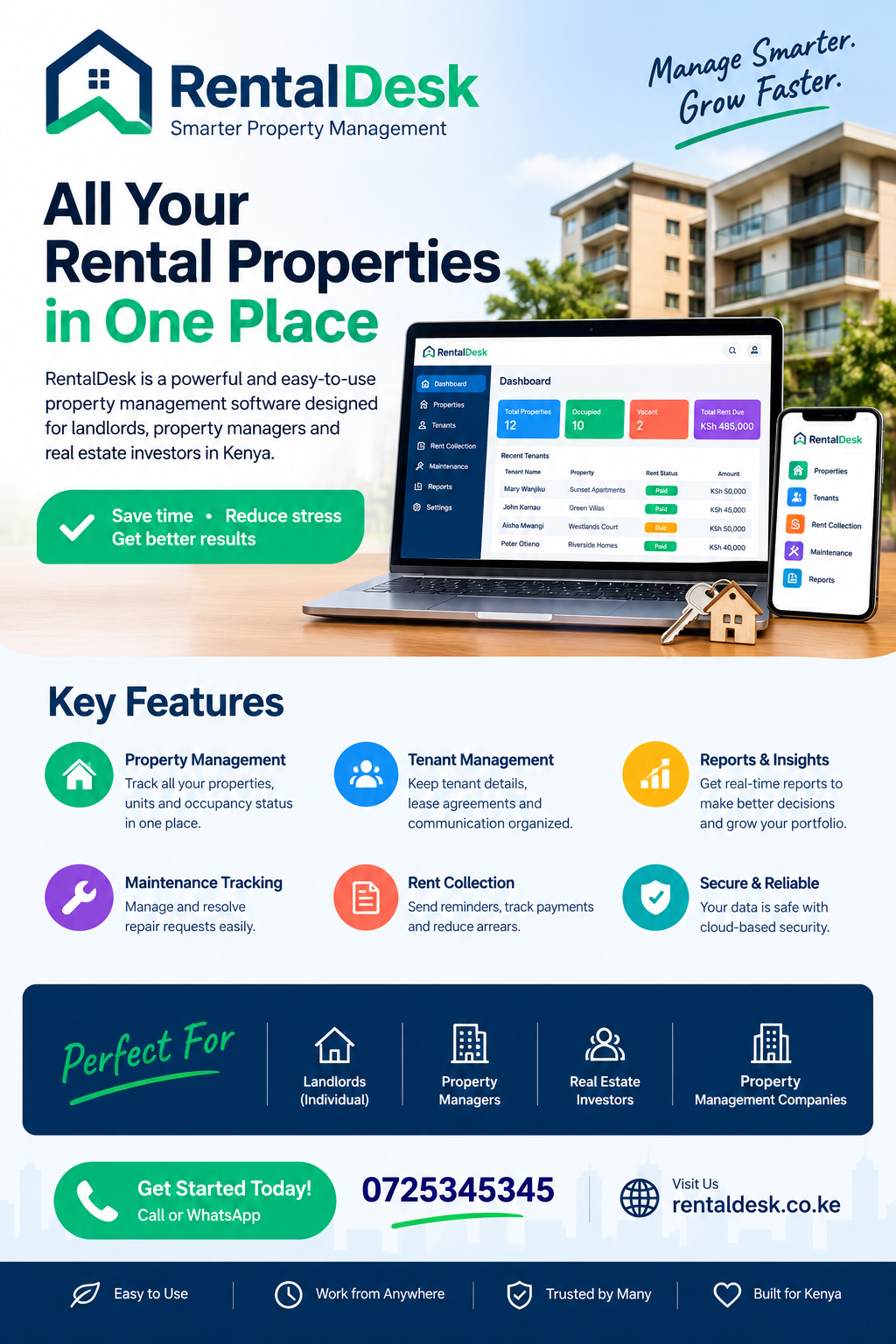
RentalDesk is designed around rental administration, with features that cover the main activities involved in managing properties, tenants, billing and financial records.
Its platform brings several rental workflows into one management environment.
Property and unit management
Landlords can organize buildings, rental units, occupancy information and rental amounts.
This is useful when a property owner manages several buildings and needs to distinguish the performance of each one.
Tenant and lease management
Tenant records can contain contact details, assigned units, lease dates, rental terms and payment history.
Keeping this information connected helps managers maintain more consistent tenancy records.
Rent invoicing and collection
RentalDesk supports rent invoicing and M-Pesa payment workflows.
Property managers can use billing records to monitor expected collections and review which tenants have paid, made partial payments or remain outstanding.
Reconciliation and arrears tracking
Payment reconciliation is important because not every incoming transaction can be identified immediately.
RentalDesk provides workflows for reviewing unmatched transactions and checking payment allocation.
Arrears tracking also gives property managers a way to identify accounts requiring follow-up.
Maintenance and utility management
The platform includes maintenance request workflows and utility billing features.
This helps landlords consider property operations beyond the collection of rent.
Owner statements and financial reporting
Property management agencies need to report rental income, expenses, outstanding balances and other relevant financial information to property owners.
RentalDesk supports owner reporting and accounting workflows that help organize these records.
Tenant and landlord portals
The platform also includes portal functionality for controlled access to relevant tenant and landlord information.
This can reduce repetitive information requests and improve communication between the different parties.
For landlords considering Rental Property Software Machakos, these capabilities provide a useful starting point for assessing how much of the rental management process can be organized in one workspace.
More information is available through the RentalDesk features guide and the RentalDesk official website.
24. Practical Example: Managing an Apartment Building in Machakos
Consider a landlord who owns an apartment building in Machakos Town with 30 residential units.
The landlord has one caretaker and works with an accountant who assists with monthly financial reporting.
Before adopting a centralized management process, the landlord relies on a notebook, M-Pesa messages and spreadsheets.
The caretaker records tenant complaints, the landlord follows up on payments and the accountant prepares a monthly summary from the available records.
This arrangement can become difficult when the number of transactions increases.
Step 1: Register the property
The landlord creates a property record containing the building name, location and relevant details.
The building is then divided into 30 identifiable rental units.
Each unit receives a rental amount and occupancy status.
Step 2: Register the tenants
The landlord adds the details of current tenants.
Every tenant is assigned to the correct unit, and the relevant lease information is recorded.
This creates a clear relationship between tenants and the units they occupy.
Step 3: Configure monthly billing
The property manager establishes the rental amounts and billing dates for each unit.
Invoices can then be generated according to the configured billing schedule.
Step 4: Organize M-Pesa payments
The landlord configures the appropriate payment workflow.
Tenants receive the relevant payment instructions, and incoming transactions are reviewed and matched against the correct accounts.
Step 5: Monitor outstanding rent
At the end of the billing period, the manager reviews the collection report.
The report identifies fully paid accounts, partial payments and overdue balances.
This makes it easier to organize follow-ups.
Step 6: Record maintenance requests
A tenant reports a leaking kitchen pipe.
The caretaker records the issue, and the manager assigns a plumber.
The repair cost is documented against the relevant property.
Step 7: Prepare the owner’s report
The accountant reviews collections, outstanding rent and expenses.
The landlord receives a more organized financial summary showing the property’s performance.
This example demonstrates how Rental Property Software Machakos can be considered within a complete rental administration process rather than as a tool for rent collection alone.
25. Practical Example: Managing Properties Across Different Machakos Locations
Now consider a property agency that manages three rental buildings:
-
A residential apartment building in Athi River.
-
A collection of rental houses in Machakos Town.
-
A mixed-use building in Mlolongo.
Each property has different rental arrangements.
The Athi River building contains apartments with monthly rent invoices. The Machakos Town properties include family houses with different lease dates. The Mlolongo property has commercial tenants with individual rental agreements.
The problem with separate records
If the agency uses a different spreadsheet for every property, it may struggle to prepare consolidated reports.
The manager must collect information from several sources before establishing total monthly collections.
There may also be inconsistencies in how staff members record expenses and payments.
How a centralized system helps
A centralized rental management platform allows the agency to organize all three properties in one portfolio.
The manager can review the complete portfolio while still accessing the detailed records of each building.
The agency can also maintain separate owner statements where the properties belong to different landlords.
Why this matters for property agencies
As an agency expands, it needs consistent processes that can be followed by different employees.
A standardized system helps ensure that staff members use similar methods to record tenants, payments, invoices and expenses.
Rental Property Software Machakos is relevant to agencies that want to establish this type of organized portfolio management process.
26. Common Mistakes Landlords Should Avoid When Managing Rentals
Even experienced landlords can develop administrative habits that make rental operations unnecessarily difficult.
Recognizing these mistakes can help property owners improve their management procedures.
Mistake 1: Depending entirely on memory
A landlord may remember that a tenant promised to pay rent on a certain date.
However, without a written record, it becomes difficult to establish what was agreed.
Record important communication and follow-up actions.
Mistake 2: Mixing personal and rental finances
Rental income should be properly recorded and distinguished from unrelated personal transactions.
Property expenses should also be documented so that the landlord can understand the financial position of each building.
Mistake 3: Failing to reconcile payments
An M-Pesa message is evidence of a transaction, but the property manager must still ensure that the payment has been assigned to the correct account.
Unmatched transactions should be reviewed rather than ignored.
Mistake 4: Ignoring partial payments
Some tenants pay rent in instalments.
The property manager should record the amount received and the remaining balance accurately.
Otherwise, the landlord may incorrectly consider an account fully settled.
Mistake 5: Delaying maintenance
Small maintenance problems can become more expensive if they are ignored.
Landlords should establish a process for reporting, prioritizing and tracking repairs.
Mistake 6: Failing to monitor lease expiry
Lease dates should be recorded and reviewed regularly.
This gives landlords time to discuss renewals and plan for potential vacancies.
Mistake 7: Failing to prepare owner statements
Property owners who use management agencies should receive understandable financial reports.
These reports should explain collections, expenses, balances and applicable management fees.
Mistake 8: Choosing software without testing it
A system may advertise many features but still fail to match the landlord’s preferred workflow.
Request a demonstration and test the functions that matter most.
Avoiding these mistakes is an important part of using Rental Property Software Machakos effectively and establishing reliable property administration practices.
27. How to Move From Spreadsheets to Digital Rental Management
Many landlords already have tenant information stored in Excel files, notebooks or paper documents.
Moving to a digital system requires preparation to ensure that the information transferred is accurate.
A rushed migration can introduce old mistakes into the new system.
Step 1: Collect existing property records
Start by identifying every property and rental unit.
Prepare a list containing:
-
Property names.
-
Unit numbers.
-
Current occupancy.
-
Monthly rent.
-
Tenant names.
-
Lease dates.
-
Deposit information.
Step 2: Review tenant information
Check whether tenant contact details are current.
Remove duplicate entries and confirm that every tenant is assigned to the correct unit.
Step 3: Confirm opening balances
This is one of the most important steps.
Review the payment history of every tenant and establish the actual outstanding balance before migration.
Do not automatically use an old spreadsheet balance without verification.
Step 4: Organize supporting documents
Collect relevant tenancy agreements, payment records and property documents.
Associate the documents with the correct properties or tenants.
Step 5: Configure billing arrangements
Confirm rental amounts, due dates and approved additional charges.
Where tenants have different arrangements, ensure that the correct terms are applied to each account.
Step 6: Test the payment workflow
Before using live payment processes, verify that the relevant payment references and reconciliation procedures are working as expected.
Step 7: Train the users
Property managers, accountants and caretakers should understand the responsibilities assigned to them.
Training should cover the functions each person will actually use.
Step 8: Review the first reporting cycle
After the first billing period, compare the system records with available bank and M-Pesa information.
Correct discrepancies and establish a consistent review routine.
Following these steps makes the transition to Rental Property Software Machakos more manageable because the new system begins with better-quality information.
28. Understanding the Cost of Rental Management Software
Software is an operating expense, so landlords should consider its cost alongside the administrative work it supports.
The cheapest subscription is not necessarily the most suitable option, particularly for agencies with several properties and multiple employees.
Factors that influence software costs
Pricing may depend on:
-
Number of rental units.
-
Number of properties.
-
Number of users.
-
Available modules.
-
Payment integrations.
-
Data migration requirements.
-
Training arrangements.
-
Technical support.
-
Customization requirements.
Some platforms offer different subscription tiers, while others charge separately for setup and additional services.
Comparing software with manual administration
A landlord should consider the time spent preparing invoices, updating payment records, following up on arrears and preparing statements.
Other considerations include the cost of correcting financial mistakes and the administrative burden of maintaining multiple spreadsheets.
Software can help organize these tasks, but the actual savings depend on the property portfolio and how effectively the platform is implemented.
Questions to ask before subscribing
Before committing to a system, ask:
-
What is the monthly or annual subscription?
-
Are there limits on the number of units?
-
How many staff accounts are included?
-
Are M-Pesa integrations included?
-
Is data migration available?
-
Does the provider offer training?
-
Are reports included in the subscription?
-
What support is available?
-
Are there additional setup charges?
-
Can the system accommodate future growth?
A landlord should obtain a clear quotation rather than assume that every advertised feature is included in the subscription.
Rental Property Software Machakos should therefore be assessed according to the value of its features, the size of the portfolio and the actual cost of operating the platform.
29. Improving Tenant Retention Through Better Property Management
Finding new tenants takes time and effort. Landlords must advertise vacancies, arrange viewings, review applications and prepare rental agreements.
Retaining responsible tenants can therefore contribute to more stable rental operations.
Although software cannot guarantee that a tenant will remain in a property, better administration can improve the overall tenancy experience.
Providing accurate payment information
Tenants should be able to establish how much they owe and whether their payments have been received.
Clear invoices and payment records help reduce misunderstandings.
Responding to maintenance requests
Unresolved maintenance problems can affect a tenant’s experience.
Property managers should acknowledge reported problems and communicate the expected response.
A maintenance tracking system helps prevent requests from being forgotten.
Communicating important updates
Landlords may need to inform tenants about:
-
Rent payment arrangements.
-
Scheduled maintenance.
-
Water interruptions.
-
Building security.
-
Shared facility maintenance.
-
Lease renewals.
-
Utility billing changes.
Consistent communication helps tenants understand what is happening within their building.
Maintaining professional records
When payment and tenancy information is properly maintained, property managers can handle tenant inquiries with greater confidence.
Rental Property Software Machakos supports the wider goal of making property administration more organized and creating a better experience for both tenants and landlords.
30. Managing Short-Stay and Furnished Rental Properties
Not every rental property operates through traditional long-term tenancy agreements.
Some property owners manage furnished apartments, serviced accommodation and short-stay rental units.
These arrangements introduce additional management responsibilities.
Managing bookings
Short-stay accommodation may require records of:
-
Guest information.
-
Booking dates.
-
Check-in times.
-
Check-out dates.
-
Payment status.
-
Unit availability.
-
Booking charges.
-
Relevant communication.
These details differ from the records required for a tenant with a long-term residential agreement.
Monitoring unit availability
A furnished apartment should not be allocated to different guests for overlapping periods.
A booking calendar can help property managers monitor reservations and identify available dates.
Recording guest payments
Payment records should be linked to the appropriate booking.
The manager should distinguish between confirmed payments, pending amounts and any applicable refunds.
Coordinating cleaning and maintenance
Between bookings, the unit may require cleaning, laundry, inspection or repairs.
These activities should be scheduled so that the property is ready for the next guest.
RentalDesk includes serviced-stay and booking workflows alongside its traditional rental management functions.
Landlords considering Rental Property Software Machakos should establish whether the system supports their particular accommodation model before subscribing.
31. The Importance of Accurate Rental Data
Software is only useful when the information entered into it is reliable.
Incorrect tenant details, outdated rent amounts and inaccurate opening balances can affect reports and financial decisions.
Data accuracy should therefore be treated as an ongoing responsibility.
Keeping tenant information updated
Whenever a tenant changes their contact information, the relevant record should be updated.
Property managers should also record changes in tenancy status and unit allocation.
Reviewing rental amounts
A property’s rental amounts should reflect the current agreements.
Where a change has been approved, the system should be updated using the appropriate effective date.
Historical invoices should remain available for reference.
Checking payment records
Managers should periodically compare recorded collections with the relevant M-Pesa or bank information.
This helps identify missing entries, duplicate records and transactions requiring further investigation.
Reviewing property expenses
Every expense should be assigned to the correct property.
Where possible, supporting documentation should be attached.
Establishing regular data reviews
A monthly review can cover:
-
Active tenants.
-
Vacant units.
-
Outstanding balances.
-
Expiring leases.
-
Recent payments.
-
Unmatched transactions.
-
Maintenance requests.
-
Property expenses.
Using Rental Property Software Machakos effectively requires more than purchasing a subscription. It also requires consistent data management practices.
32. Rental Property Management in Machakos: Understanding Local Operational Needs
Property management requirements can vary between locations and building types.
A landlord operating in Machakos Town may have different administrative needs from a property manager handling several apartment blocks in Athi River.
The software selected should be flexible enough to support these differences.
Machakos Town
Residential and commercial landlords in Machakos Town may manage apartments, rental houses, shops and office premises.
Important management requirements include tenant registration, rent billing, maintenance tracking and financial reporting.
Athi River
Property owners operating in Athi River may manage residential developments serving households working or conducting business in the wider industrial and commercial area.
Managing several units requires clear occupancy information and reliable payment tracking.
Mlolongo
Mlolongo has residential and commercial property requirements.
Landlords may need to manage different rental arrangements within the same building or across multiple properties.
Syokimau
Property managers handling residential developments in Syokimau may need structured tenant administration, maintenance coordination and service charge records.
Mavoko
Mavoko includes different residential and commercial property settings.
A landlord should select management processes according to the actual building and tenant arrangements.
Kangundo and surrounding areas
Smaller property portfolios may still benefit from organized tenant records, payment histories and maintenance documentation.
The number of units should not be the only consideration when deciding whether to digitize property management.
The important question is whether manual processes are making administration difficult.
Rental Property Software Machakos reflects the need to consider local property operations when selecting a management approach.
33. How Landlords Can Measure the Performance of Their Rental Properties
Property owners need measurable information to understand whether their investments are performing as expected.
A property management system can help maintain the records required for performance analysis.
Occupancy rate
Occupancy rate indicates the proportion of rental units currently occupied.
It can be calculated using:
For example, a building with 24 occupied units out of 30 has an occupancy rate of 80%.
This calculation provides a basic view of how much of the available rental space is occupied.
Rent collection rate
The rent collection rate compares the amount collected with the amount billed.
If a landlord invoices KSh 200,000 and collects KSh 180,000, the collection rate is 90%.
This calculation should be interpreted carefully where there are adjustments, credits or different billing periods.
Outstanding rent
Outstanding rent represents unpaid amounts associated with tenant invoices.
Property managers should review the age of outstanding balances and identify accounts requiring follow-up.
Maintenance expenditure
Tracking repair costs helps landlords identify recurring problems.
For example, repeated plumbing expenses may indicate that a building requires a more comprehensive inspection.
Net operating performance
Landlords should compare rental income with relevant operating expenses.
This helps establish whether a property is generating sufficient income to support its operating requirements.
Accurate information from Rental Property Software Machakos can support these calculations when the underlying property, invoice and expense records are properly maintained.
34. The Role of Automation in Modern Rental Administration
Automation can reduce repetitive work, but it should be applied to processes that are sufficiently predictable and well defined.
In rental management, recurring invoices, payment notifications and reporting are examples of activities that can benefit from automation.
Automating recurring invoices
Instead of creating every monthly rent invoice manually, landlords can configure recurring billing arrangements.
The system then generates invoices according to the established schedule.
Property managers should still review billing arrangements whenever a tenancy changes.
Automating payment notifications
Where supported and configured, payment notifications can help tenants and managers receive timely information.
For example, a tenant may receive a payment confirmation after a transaction has been successfully recorded.
Automating overdue reminders
A configured reminder process can help identify accounts that require attention.
However, reminders should use accurate invoice information and appropriate communication language.
Automating management reports
Regular reports can help property managers review collections and outstanding balances without preparing every summary from scratch.
Maintaining human oversight
Automation should not remove the need for responsible decision-making.
Unmatched payments, disputed charges and unusual adjustments still require human review.
A system should make important tasks easier to complete while ensuring that sensitive actions remain subject to suitable controls.
Rental Property Software Machakos is particularly relevant when considering how automation can improve consistency across routine rental operations.
35. Preparing Your Rental Business for Future Growth
A landlord may begin with one building and eventually acquire additional rental properties.
Similarly, a small property management agency may gradually take on more clients.
The management process should be capable of supporting this growth.
Establishing standard operating procedures
Standard procedures help ensure that important activities are handled consistently.
These procedures may cover:
-
Tenant registration.
-
Rent invoicing.
-
Payment reconciliation.
-
Arrears follow-up.
-
Lease renewals.
-
Property inspections.
-
Maintenance approvals.
-
Expense recording.
-
Owner reporting.
Organizing property records from the beginning
Even when managing a small portfolio, landlords should use consistent property names, unit numbers and tenant references.
This makes it easier to maintain the records as the business expands.
Planning staff responsibilities
As a property business grows, different employees may take responsibility for finance, maintenance, tenant communication and general administration.
The system should support appropriate user permissions and clear accountability.
Evaluating future software requirements
A growing landlord may eventually need additional functionality such as advanced accounting, multiple property dashboards, owner portals and more detailed reports.
Choosing a platform that supports the relevant growth requirements can reduce the need for disruptive changes later.
Rental Property Software Machakos is a useful consideration for landlords who want to build structured management practices as their rental portfolios develop.
36. Rental Management and Compliance Considerations in Kenya
Property owners should understand that digital management does not replace their legal and administrative responsibilities.
A rental management platform helps organize information, but landlords must still ensure that their rental arrangements comply with applicable Kenyan requirements.
Maintaining proper tenancy agreements
Landlords should use appropriate tenancy agreements that clearly explain the terms of occupation.
These should address relevant matters such as:
-
Rental amounts.
-
Payment dates.
-
Security deposits.
-
Utility arrangements.
-
Responsibilities for maintenance.
-
Notice requirements.
-
Lease duration.
-
Conditions for ending the tenancy.
The agreement should reflect the actual arrangement between the parties.
Maintaining accurate financial records
Rental businesses should maintain records of income, expenses and relevant transactions.
Property owners should establish appropriate accounting and tax procedures and seek professional advice where necessary.
Protecting tenant information
Tenant records should be handled responsibly.
Property managers should consider the requirements of Kenya’s Data Protection Act, 2019, and applicable regulations when collecting, storing, accessing and sharing personal information.
Relevant considerations include:
-
Collecting information for legitimate purposes.
-
Restricting access to authorized users.
-
Protecting personal records.
-
Avoiding unnecessary disclosure.
-
Maintaining appropriate security arrangements.
Keeping important property documents
Property owners should maintain relevant ownership, tenancy, payment and maintenance records.
Digital storage can support document organization, but important documents should still be retained according to applicable legal and business requirements.
Rental Property Software Machakos can support administrative organization, but the landlord remains responsible for complying with applicable laws and maintaining accurate records.
37. How to Introduce Rental Management Software to Your Staff
Purchasing software is only one part of digitizing a rental business.
Employees and other authorized users must understand how the system fits into their daily responsibilities.
A property manager who continues maintaining separate, inconsistent records may reduce the benefits of adopting a centralized platform.
Start with the most important processes
Introduce the system using essential activities first.
These normally include:
-
Property registration.
-
Unit registration.
-
Tenant records.
-
Rent invoicing.
-
Payment recording.
-
Arrears monitoring.
-
Basic financial reporting.
Once staff members are comfortable with these functions, additional workflows can be introduced.
Give every user clear responsibilities
The landlord or agency administrator should define who is responsible for each task.
For example:
-
Caretakers report occupancy and maintenance issues.
-
Accountants review payments and financial reports.
-
Property managers oversee tenants and leases.
-
Administrators manage system access and configuration.
This reduces confusion and duplication.
Provide practical training
Training should involve real examples of everyday rental operations.
Staff members should learn how to find a tenant, review an invoice, record a payment and identify an outstanding balance.
Monitor adoption
During the first few months, management should review whether staff members are using the system consistently.
Identify processes that are still being handled manually and determine whether additional training or configuration is required.
Rental Property Software Machakos becomes more useful when everyone involved understands their responsibilities and follows the same management procedures.
38. What to Look for During a RentalDesk Demonstration
A demonstration allows landlords to see how a platform works before committing to it.
Rather than focusing only on the appearance of the dashboard, ask the provider to demonstrate actual rental management activities.
Test property registration
Ask to see how a new building is created and how its units are organized.
Check whether the system can distinguish between occupied, vacant and unavailable units.
Test tenant registration
Ask how tenant information is entered and connected to a particular rental unit.
Check whether lease details, payment history and contact information are accessible from the tenant record.
Test rent invoicing
Ask how recurring invoices are configured.
Find out how the system handles different rental amounts and additional charges.
Test payment reconciliation
This is particularly important for Kenyan landlords.
Ask to see how M-Pesa transactions are reviewed and assigned to tenant accounts.
Find out what happens when a transaction cannot be matched automatically.
Test arrears reporting
Ask the provider to demonstrate how the system identifies fully paid, partially paid and overdue tenants.
Test owner statements
If you manage properties for other landlords, ask to see how collections and expenses are reflected in owner reports.
Test staff permissions
Ask whether caretakers, accountants and property managers can be given different levels of access.
A demonstration should answer practical questions about how the software will support your actual business.
You can explore Rental Property Software Machakos by reviewing RentalDesk’s property management workflows and requesting a guided demonstration.
39. The Long-Term Value of Organized Rental Management
The value of digital property management should not be measured only by the time saved when preparing monthly invoices.
A well-organized rental business benefits from having reliable records throughout the property lifecycle.
Better financial visibility
When rent invoices, payments and expenses are connected, landlords can understand their financial position more clearly.
This makes it easier to identify collection problems and investigate unusual expenditure.
Improved tenant administration
Centralized tenant records make it easier to follow tenancy changes and maintain accurate communication histories.
More consistent property maintenance
Documented maintenance requests help managers identify outstanding repairs and review previous work.
Improved landlord reporting
Agencies can prepare more organized owner statements using recorded financial information.
Better operational accountability
Role-based access and available audit records help managers review important activities.
Support for business expansion
A structured platform provides a consistent foundation for managing additional properties and users.
For landlords planning to professionalize their operations, Rental Property Software Machakos represents an important step in considering how rental administration can move beyond notebooks and disconnected spreadsheets.
40. Getting Started With Digital Rental Management
Landlords do not need to digitize every activity at once.
A gradual approach can make the transition easier, particularly when moving from paper records or spreadsheets.
Begin with a property assessment
Identify the number of properties and rental units you manage.
Establish the number of active tenants and the management responsibilities involved.
Identify your biggest administrative challenges
Consider the activities that currently consume the most time.
For one landlord, this might be tracking M-Pesa payments. For another, it might be preparing landlord statements or monitoring maintenance requests.
Prioritize the processes that need improvement.
Explore the available software
Review the features, pricing and support arrangements of the platform.
A demonstration should show how the system handles your actual rental management requirements.
Prepare your existing records
Organize property information, tenant details, leases, opening balances and relevant documents.
Confirm the accuracy of these records before importing them.
Configure your rental operations
Set up the relevant properties, units, billing schedules and user permissions.
Test the payment process before using it for regular collections.
Monitor the results
After implementation, review whether the system is improving record accuracy, payment visibility and reporting.
Make adjustments where necessary.
Rental Property Software Machakos gives landlords a starting point for exploring a more centralized approach to rental administration through RentalDesk.
41. Frequently Asked Questions About Rental Property Management Software in Machakos
1. What is rental property management software?
Rental property management software is a digital platform that helps landlords and property managers organize rental operations.
It can include features for managing properties, registering tenants, preparing invoices, tracking rent payments, monitoring arrears, managing leases and generating financial reports.
Instead of relying on separate spreadsheets and handwritten records, landlords can maintain connected information in one workspace.
2. Can landlords in Machakos use RentalDesk to manage multiple buildings?
Yes. RentalDesk supports multi-property management.
Landlords and property agencies can organize different properties and their individual units within a centralized management environment.
This makes it easier to review property information, occupancy, tenant records, invoices and collections.
3. Does RentalDesk support M-Pesa rent collection?
RentalDesk supports M-Pesa collection workflows, including configured Paybill, Till and STK-related processes.
The platform supports payment tracking and reconciliation, helping property managers connect transactions to the appropriate tenant and invoice.
Automatic matching depends on the configured integration and payment references. Unmatched or unclear transactions can be reviewed before allocation.
4. Can I manage tenants and tenancy agreements digitally?
Yes. Tenant and lease management features help landlords organize tenant profiles, contact information, assigned units, rental amounts, lease dates and relevant tenancy information.
This makes it easier to monitor active tenancies and retrieve historical records.
5. Can rental management software track partial rent payments?
Yes. RentalDesk supports tracking paid, part-paid and outstanding tenant accounts.
When a tenant pays only part of the amount invoiced, the remaining balance can be monitored through the relevant payment and arrears records.
This helps property managers avoid treating incomplete payments as fully settled accounts.
6. Can I manage water and electricity charges?
RentalDesk includes utility management workflows for handling utility accounts, readings, charges and related payments.
The appropriate configuration depends on the property’s utility arrangements.
For example, a building with individual water meters may require different billing procedures from a building with shared water charges.
7. Is rental management software suitable for small landlords?
Yes. A small landlord can benefit from organized tenant records, rent invoices, payment histories and financial reporting.
However, the landlord should compare subscription costs and available features with the actual size of the property portfolio.
A smaller portfolio may require fewer advanced functions than a property management agency.
8. Can property managers prepare landlord statements?
Yes. RentalDesk supports owner reporting workflows.
These help property management agencies organize collections, expenses, fees, outstanding balances and payouts for property owners.
The information should be reviewed to ensure that the statements reflect the relevant management agreements and recorded transactions.
9. Can tenants access their payment information?
RentalDesk includes tenant portal functionality that can provide controlled access to relevant account information.
Depending on the configured permissions, tenants may be able to review invoices, balances, receipts, statements and maintenance updates.
This can reduce repeated requests for basic payment information.
10. How do I get started with RentalDesk in Machakos?
Start by reviewing the RentalDesk website and available features.
You can explore the demonstration environment to understand how properties, tenants, invoices, payments and reports are managed.
If you need assistance with implementation, you can request guided setup to discuss your property portfolio, data migration, configuration and training requirements.
For landlords considering Rental Property Software Machakos, starting with a demonstration is a practical way to establish whether the platform meets their operational needs.
42. Final Recommendations for Landlords and Property Managers in Machakos
Managing rental properties successfully requires more than collecting monthly rent. Landlords must maintain accurate financial records, communicate with tenants, monitor maintenance, manage tenancy agreements and understand the performance of their investments.
As rental portfolios grow, these responsibilities become increasingly difficult to coordinate manually.
A digital rental management platform provides an opportunity to bring these activities together.
For landlords in Machakos, the most important considerations when selecting a platform include:
-
Accurate rent collection: Ensure payments are recorded against the correct tenants and rental units.
-
M-Pesa support: Choose a platform that accommodates Kenyan payment workflows.
-
Tenant management: Maintain accurate tenant profiles and tenancy histories.
-
Lease administration: Monitor tenancy agreements, renewals and move-outs.
-
Arrears management: Identify overdue and partially paid accounts.
-
Utility billing: Organize water, electricity and service charges.
-
Maintenance tracking: Document repair requests and expenses.
-
Financial reporting: Prepare clear collection reports and landlord statements.
-
Security: Control access to sensitive property and financial information.
-
Scalability: Choose a solution that can support additional buildings and rental units.
A landlord should also evaluate the provider’s support, implementation process, pricing and available training before making a decision.
Rental Property Software Machakos is relevant to property owners who want to move towards more organized rental operations and improve their visibility into daily property activities.
Conclusion: Make Rental Property Management Easier With RentalDesk
The rental property business in Machakos requires organized administration, reliable financial records and effective tenant communication. Whether you manage a few residential units or oversee several buildings for different property owners, having accurate information is essential.
Manual processes can make it difficult to monitor rent payments, reconcile M-Pesa transactions, track arrears, manage lease agreements and prepare financial reports. As the number of tenants increases, these challenges can affect the efficiency of the entire rental business.
Adopting Rental Property Software Machakos provides an opportunity to approach these responsibilities through a more structured digital management process.
RentalDesk brings together important rental management functions, including property and unit management, tenant records, automated invoicing, payment tracking, reconciliation, arrears management, utility billing, maintenance requests and landlord reporting.
The platform is designed around Kenyan rental operations, making its M-Pesa workflows particularly relevant to landlords and property agencies that depend on mobile payments.
Property owners can also benefit from connected tenant records, lease administration, financial reports and controlled access for different users.
The best starting point is to identify the administrative challenges affecting your rental business and explore how a centralized management system can address them.
If you manage apartments, residential houses, commercial premises or furnished accommodation in Machakos County, consider exploring RentalDesk.
Visit rentaldesk.co.ke to explore its features, review the demonstration and discover how a more organized rental management process can support your property business.
Better records, clearer collections and organized property operations provide a stronger foundation for managing rental investments.