
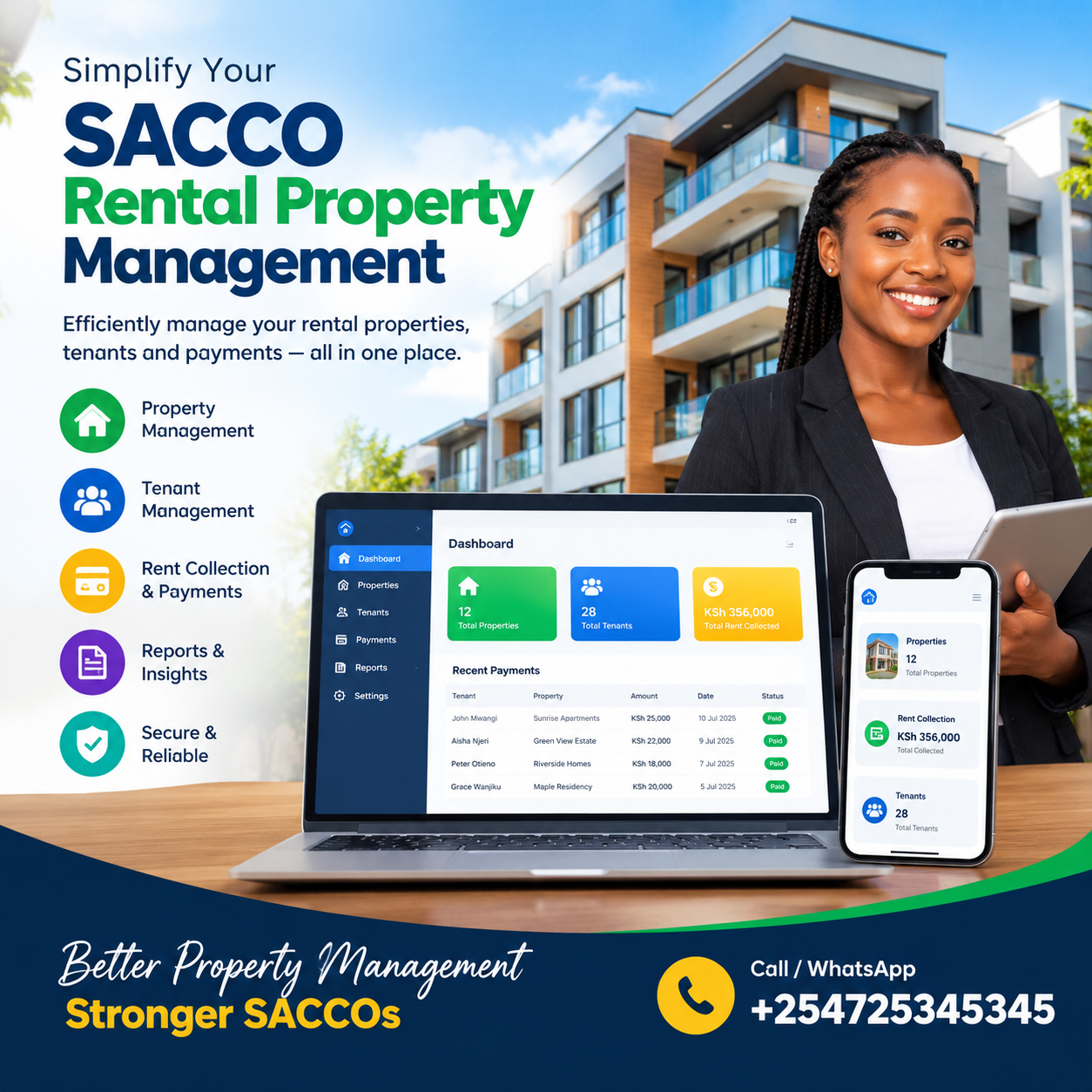
Sacco rental property management is the discipline of running income-earning property owned by a savings and credit cooperative — assets bought with members’ savings, held in the society’s name, and managed under some of the most demanding accountability standards in Kenyan finance. When a SACCO buys a rental block, the purchase is the easy half; what follows is a regulated institution managing tenants, maintenance, income, and member expectations simultaneously.
The stakes differ from every other landlord category. A private landlord answers to themselves. A chama answers to its members. A SACCO answers to members, a board, a supervisory committee, and SASRA where it is deposit-taking — every layer expecting documented, reconciled, auditable property performance.
That layered accountability is why sacco rental property management succeeds or fails on systems. The SACCOs that run rental investments well treat them as regulated business lines: dedicated accounts, professional tenancy frameworks, board-level reporting, and audits that pass on first presentation. The ones that struggle run them like side ventures — and the gaps surface eventually at exactly the wrong meeting.
This guide covers the complete discipline: why SACCOs invest in rental property, the governance that must surround it, the financial structures that keep members’ money clean, the tenancy and maintenance operations, the reporting cadence boards and members expect, the regulatory and tax obligations, and the systems that make all of it auditable from day one.
Why SACCOs Invest in Rental Property
The Income Diversification Case
SACCOs traditionally earn from interest on loans. Rental property adds a second income stream that behaves differently: steady, contract-based, and uncorrelated with members’ borrowing cycles. Boards pursuing sacco rental property management investments are usually seeking exactly that stability.
Rental income also hedges the SACCO’s structural risk: when lending slows — elections, droughts, rate changes — rent continues. Boards that diversify into property report smoother income curves across economic cycles, which is precisely what prudence requires of institutions holding members’ savings.
The Asset Appreciation Case
Property appreciates while it earns: the rental block purchased in a growing town compounds both an income stream and a capital asset. For SACCOs building long-term institutional value, few investments combine the two as directly.
The appreciation also serves the balance sheet: a documented, income-producing property strengthens the institution’s capital position — a fact regulators and raters read directly from sacco rental property management records.
The Member-Visibility Case
Rental property is the investment members can see: the block in town, the plaza with the society’s name, the units members walk past monthly. That visibility builds confidence in the institution — provided the management matches the visibility, which is exactly what disciplined sacco rental property management systems deliver.
The Risks Boards Must Price First
The same visibility cuts both ways: every vacancy, repair, and arrears case is witnessed by members. Boards should price the risks honestly before purchase — management burden, liquidity lock-up, and the reputational weight of visible imperfection — and only proceed where the management capacity exists. This honesty is the first discipline of sacco rental property management.
Governance: The Structure That Must Surround the Asset
Board Approval and Mandates
Property acquisition and management sit at the top of the board’s authority ladder, and the mandate should be explicit: purchase approvals minuted, management responsibilities assigned, spending limits defined, and reporting requirements set.
Every subsequent sacco rental property management action traces back to that mandate — and audits test the tracing first.
The Management Committee
Boards typically delegate operations to a property committee: three to five members with defined duties — oversight of tenancies, maintenance approvals within limits, and monthly reporting to the board. The committee’s authority, like the board’s, must be written: what it may decide alone, and what returns to the board.
The committee model works when its reporting is systematic; it fails when reporting is occasional. The sacco rental property management institutions that succeed run committee reporting as a fixed monthly rhythm, not a meeting-to-meeting improvisation.
Separation of Duties
The governance principle that protects SACCOs most is separation: the officer who collects rent should not be the officer who approves maintenance, and neither should reconcile the accounts alone. Every sacco rental property management control in this guide assumes this separation — because institutions that concentrate duties create the exposures audits find.
The Supervisory Committee’s Role
The supervisory committee’s statutory duty extends to property: verifying that rental income is complete, expenses are supported, and the asset is preserved. Committees that review property records quarterly — reconciliations, registers, and compliance calendars — discharge that duty from evidence rather than assurance.
The Financial Structures That Keep Members’ Money Clean
Dedicated Accounts
The property’s income and expenses flow through dedicated accounts — never blended with loan book or share capital movements. The account structure is the first financial control: it makes the property’s performance measurable as a business line.
The Rental Income Ledger
Every rent payment, deposit, and penalty recorded against its unit, tenant, and period — with the ledger reconciled to bank and to the tenancy register monthly. The three-way reconciliation (bank, ledger, register) is the integrity test every audit of sacco rental property management applies first.
The Expense Discipline
Every expense carries its receipt, its approving decision, and its category — with quotations above thresholds and evidence attached per job. The expense file is where the supervisory committee and external auditors test the institution’s controls, and institutions with disciplined sacco rental property management expense records pass those tests as retrievals.
The Maintenance Reserve
A reserve funded from rental income — typically ten percent — covers repairs and capital works without touching members’ share capital. The reserve’s funding and usage should be board-visible, with its balance reported in every property report.
The Depreciation and Valuation Discipline
The property’s book value follows accounting standards — depreciation per policy, revaluations documented where undertaken — because the balance sheet presentation is what the annual audit and any regulator’s review examine. Institutions that maintain sacco rental property management valuation discipline present clean financials every year-end.
The Distribution Policy
Where rental income distributes to members — as rebates or dividends — the policy belongs in writing: net income, reserves, and the allocation formula approved by the board and disclosed to members. Each distribution backed by a statement computing it from the audited records.
Tenancy Operations: Running the Units Professionally
The Tenancy Register
Every unit, tenant, lease, deposit, and payment history in one register — the SACCO’s rental source of truth. The register answers, at any committee or board meeting, exactly which units are occupied, paying, or in arrears.
Leases and Screening
Standard leases drafted once, applied to every unit, with screening criteria applied identically to every applicant. Consistency is the SACCO’s legal and reputational protection: every tenancy on identical documented terms means every dispute settles by the same rules.
Move-In and Move-Out Discipline
Every tenancy documented at both ends: condition photographs, inventories, deposit receipts at move-in; inspections, itemised deductions, and settlements at exit. This lifecycle documentation is what makes sacco rental property management deposit disputes rare — and winnable when they occur.
Arrears Management
Arrears follow the documented ladder — reminders, follow-ups, payment plans, and the legal escalation the lease provides — applied consistently by named officers. SACCO arrears carry institutional weight: tenants who fall behind a SACCO meet the same professional process they would meet from a bank.
Vacancy and Re-Letting
Vacancies tracked formally: unit status, marketing, showing records, and re-letting timelines. SACCOs that manage vacancy as a measured metric reduce it — because responsibility for empty units is visible rather than assumed.
Maintenance and Capital Works
The Request-to-Resolution Flow
Maintenance runs as a documented flow: request logged, urgency assessed, quotation rule applied, approval per the committee’s limits, execution with photographs, payment with invoice, and the unit’s history updated. The flow is what keeps sacco rental property management maintenance spending defensible at every level of review.
Preventive Scheduling
The preventive calendar — gutters before rains, plumbing inspections, security checks, painting rotation — scheduled from the records. Preventive discipline is what keeps a SACCO’s building an asset rather than a liability accreting silently.
Capital Works and Board Approval
Major works — roofing, structural repairs, expansions — follow the board’s approval path: proposals with quotations, funding plans against the reserve, and execution reporting. The capital works file is what auditors and valuers review when the property’s condition and value are tested.
The Contractor Register
Vetted contractors with documented engagements, pricing history, and performance records. SACCOs that maintain a contractor register spend less and face fewer disputes — because repeat vendors perform under the knowledge that records follow them.
Reporting: The Cadence Boards and Members Expect
The Monthly Property Report
The committee’s monthly report to the board: collections versus schedule, arrears with actions, expenses with evidence, occupancy, and the maintenance position. The report is the governance heartbeat of sacco rental property management — thirty minutes of board time that keeps the asset accountable.
The Quarterly Supervisory Review
The supervisory committee’s quarterly verification: reconciliations tested, registers sampled, compliance dates checked, and findings documented. This rhythm is what converts the supervisory duty from annual assurance into continuous verification.
The Annual Members’ Report
The AGM deserves its complete property pack: full-year income and expenses, occupancy and arrears history, maintenance and capital works performed, valuation position, and the distribution or reinvestment proposal. SACCOs that present professional sacco rental property management packs report the same effect: property questions at the AGM move from suspicion to strategy.
The Dashboard Layer
Between formal reports, the officers’ working view: live collections, arrears lists, maintenance queues, and compliance dates — visible to authorised officers continuously. The dashboard layer is what makes the formal reports assemble themselves rather than consume weekends.
Regulatory, Tax and Compliance Obligations
SASRA and Prudential Expectations
Deposit-taking SACCOs hold property under prudential standards: asset classification, valuation expectations, and reporting duties that treat investment property as a regulated holding. Boards should confirm their property’s treatment with their compliance function — because sacco rental property management obligations at the regulated tier differ from the non-deposit-taking context.
Rental Income Tax
The SACCO’s rental income attracts the applicable rental income tax regime, with returns and payments assigned to named officers on the compliance calendar. Non-deposit-taking societies face their own obligations under cooperative and tax law — and both categories protect themselves the same way: documented, calendared, evidenced.
County and Statutory Obligations
Land rates, permits, and any statutory levies the property attracts belong in the same calendar with receipts filed. The complete obligation picture is part of the property’s standing file — and part of what every audit reviews.
Insurance
The building’s insurance — fire, structural, public liability — carried continuously, with renewals on the calendar and certificates in the property file. The insurance file is what claims and audits both read first.
Employment Obligations
Caretakers and staff employed for the property carry the full statutory load: NSSF, SHIF, housing levy, and PAYE where thresholds apply — computed and remitted per current law. SACCOs that run their property payroll through structured sacco rental property management records hold the audit position informal employment never has.
The Systems That Make It All Auditable
The Central Property Register
One system holding every layer: units, tenants, leases, payments, expenses, maintenance, documents, and the compliance calendar — accessible to authorised officers with individual logins. The central register is what converts sacco rental property management from documentation into infrastructure.
Individual Logins and Attribution
Every officer records as themselves; every entry carries its author; every approval traceable to its name. This attribution layer is what supervisory committees and auditors verify first — and what informal record keeping structurally cannot provide.
Document Attachment
Every lease, receipt, invoice, photograph, and certificate attached to its record — so any unit’s, tenancy’s, or expense’s complete file is one retrieval away. The attachment discipline is what makes audits file retrievals rather than reconstructions.
Automated Statements and Reports
Monthly board reports, quarterly supervisory packs, and the annual members’ report generated from the live records rather than assembled by hand. The sacco rental property management reporting layer is where the system repays its cost — because reports that build themselves get produced, and reports that require weekends eventually stop being produced.
The Exit Test
Before committing to any platform, the export capability gets tested: every record, document, and history exportable completely, because the SACCO’s property history must outlive any software relationship. The exit test is the final verification of sacco rental property management system selection.
A Case Pattern: The Society That Got It Right
The pattern is clearest in a real-world shape. A teachers’ SACCO purchased a twelve-unit block in a growing town — its first rental investment, bought from fifteen years of mortgage-financed savings discipline.
The board began with governance: the acquisition minuted, a property committee constituted with written limits, and the management mandate defining every officer’s duties. The property’s accounts opened dedicated, with dual controls and the rental ledger separated from the loan book from the first day.
The tenancy framework followed: standard leases, uniform screening, and the lifecycle documentation — photographs, inventories, deposits — applied to every unit without exception. Collections ran through the society’s paybill with unit references, receipts automatic, and the three-way reconciliation monthly.
The first year’s tests arrived predictably: one tenant dispute, resolved from the move-in file in one meeting; one roof repair, executed through the quotation and approval flow with evidence attached. Each test passed because the sacco rental property management structure had been built before the tests arrived.
The AGM presented the society’s first property pack: collections at ninety-seven percent, expenses fully evidenced, the reserve funded, and a first distribution approved from the audited records. The members’ questions were about the second property — not the first one’s integrity. That shift in question type is the entire value of disciplined sacco rental property management practice, delivered in one meeting.
Common Failure Patterns — and Their Cures
The blended account is the first: rental income moving through the loan book until the property’s performance is unmeasurable. The cure is dedicated accounts from day one.
The committee without limits is the second: spending authority undefined until a large invoice tests it. The third is the undocumented tenancy — leases on memory, deposits in cash — until the first dispute finds no file.
The fourth is the maintenance improvisation — repairs from whoever answers the phone, priced by relationship, recorded nowhere. The fifth is the reporting gap — committees operating for quarters without board reporting until a supervisory review surfaces the silence.
Each pattern is cured by the structures this guide describes — and each one, when left uncured, costs more than every structure combined. This arithmetic is why disciplined sacco rental property management practice is the cheapest governance a SACCO’s property can buy.
The ROI for SACCOs
The returns run through every layer the property touches. Collections lifted by professional tenancy discipline — several points that compound annually. Maintenance spending verified and preventive — reducing the capital damage that deferred repairs cause.
Audit and supervisory costs reduced — because reviews that retrieve take hours, and reviews that reconstruct take weeks. Member confidence strengthened — the visible asset performing visibly. And financing access eased: the SACCO whose property records are institutional quality borrows against the asset on terms the undocumented holding never sees.
Across every channel, the system’s cost is trivial against a single prevented dispute, a single clean audit, or a single year’s improved collections — which is why disciplined sacco rental property management practice is among the highest-return governance investments a SACCO makes.
Choosing the SACCO’s Property System
The selection criteria follow the institution’s layered accountability: multi-officer access with individual logins, three-way reconciliation, document attachment, automated reporting at every cadence, and the audit trail behind every entry.
The platform should also handle the compliance calendar — tax, rates, insurance, statutory filings — with alerts per obligation. And it should pass the exit test: complete export, because the property’s history is the institution’s long-term legal evidence.
SACCOs evaluating systems should trial with real tenancies and real officers, because the system that handles the institution’s actual governance complexity is the only one worth its subscription — the final selection principle of sacco rental property management practice.
Frequently Asked Questions
Can a SACCO own and manage rental property in Kenya?
Yes — SACCOs commonly hold investment property as a diversification of institutional income, with the acquisition approved by the board and managed under the society’s governance structures. The discipline that makes it successful is structured sacco rental property management practice: dedicated accounts, documented tenancies, and board-level reporting.
How should a SACCO account for rental income?
Through dedicated accounts and a rental ledger reconciled three ways monthly — bank to ledger to tenancy register — with every payment traceable and every receipt automatic. This three-way reconciliation is the integrity test every audit of sacco rental property management applies first.
What governance should surround a SACCO’s rental property?
A board mandate minuted at acquisition, a property committee with written spending limits, separation of duties across collection, approval, and reconciliation, and supervisory committee verification quarterly. This layered structure is the standard of professional sacco rental property management practice.
How is rental income from a SACCO property taxed?
Under the applicable rental income tax regime, with returns and payments assigned to named officers on the compliance calendar — alongside county rates, permits, and any statutory levies the property attracts. Compliance handled through structured sacco rental property management records avoids the penalties that informal practice accumulates silently.
How do SACCOs report property performance to members?
Through the annual AGM pack — full-year income and expenses, occupancy and arrears, maintenance and capital works, valuation position, and the distribution proposal — backed by monthly board reports and quarterly supervisory reviews throughout the year. This cadence is the reporting standard of mature sacco rental property management practice.
How should maintenance spending be controlled?
Through the documented flow: requests logged, quotations above thresholds, approvals per the committee’s limits, execution with photographs, and invoices reconciled to payments — with a maintenance reserve funded from income rather than share capital. This flow is what keeps sacco rental property management maintenance defensible at every level of review.
Can the same system manage multiple SACCO properties?
Yes — portfolio registers hold every property, unit, and obligation together, with per-property reporting for committees and consolidated totals for boards and AGMs. Institutions scaling on structured sacco rental property management systems report the second property costing almost nothing administratively.
How do SACCOs handle property staff and caretakers?
Under full employment obligations — NSSF, SHIF, housing levy, and PAYE where applicable — with duties defined, reporting through the records, and the strict rule that staff collect nothing: rent always flows through traceable channels. This is the employment standard of sacco rental property management practice.
What happens when a SACCO property system needs to change?
The records export completely — every lease, ledger, document, and history — because the institution’s property evidence must outlive any software relationship. The exit test belongs in every sacco rental property management selection, before subscription rather than after.
What is the single most important habit for SACCO property governance?
The monthly three-way reconciliation reviewed by the committee and reported to the board — one sitting where collections, expenses, and registers are verified against reality. Every strong sacco rental property management institution runs on that one habit, extended across the year’s governance calendar.
How does property management affect a SACCO’s audit outcomes?
Directly — auditors test the property line first through reconciliations, registers, and evidence, and institutions with complete records pass as file retrievals while undocumented ones reconstruct under pressure. The maintained sacco rental property management system is, in practice, the audit outcome’s foundation.
Can the property committee approve maintenance without board meetings?
Yes — within written limits the board defines: emergencies to a stated amount, routine repairs to a per-job ceiling, and everything larger returning to the board with quotations. This approval ladder is what makes sacco rental property management both fast in emergencies and clean in audits.
How do SACCOs price rent on their investment property?
From market evidence — comparable units in the neighbourhood let at verifiable rates — reviewed periodically against occupancy and arrears data the register holds. Institutions that price from records fill faster and collect better than institutions that price from expectation, which is the pricing discipline of sacco rental property management practice.
What should a SACCO do before buying its first rental property?
Build the governance first: the board mandate, the committee with written limits, the dedicated accounts, the tenancy framework, and the records system — then buy. The institutions that install sacco rental property management structures before acquisition avoid the year-one chaos that unplanned purchases inherit with the keys.
How does disciplined property management strengthen the SACCO’s balance sheet?
Through three channels: the income stream documented and growing, the asset’s value evidenced by records and valuations, and the institution’s governance quality demonstrated to regulators, raters, and lenders. The maintained sacco rental property management file is what converts a purchased building into a bankable, reportable, income-producing institutional asset.