
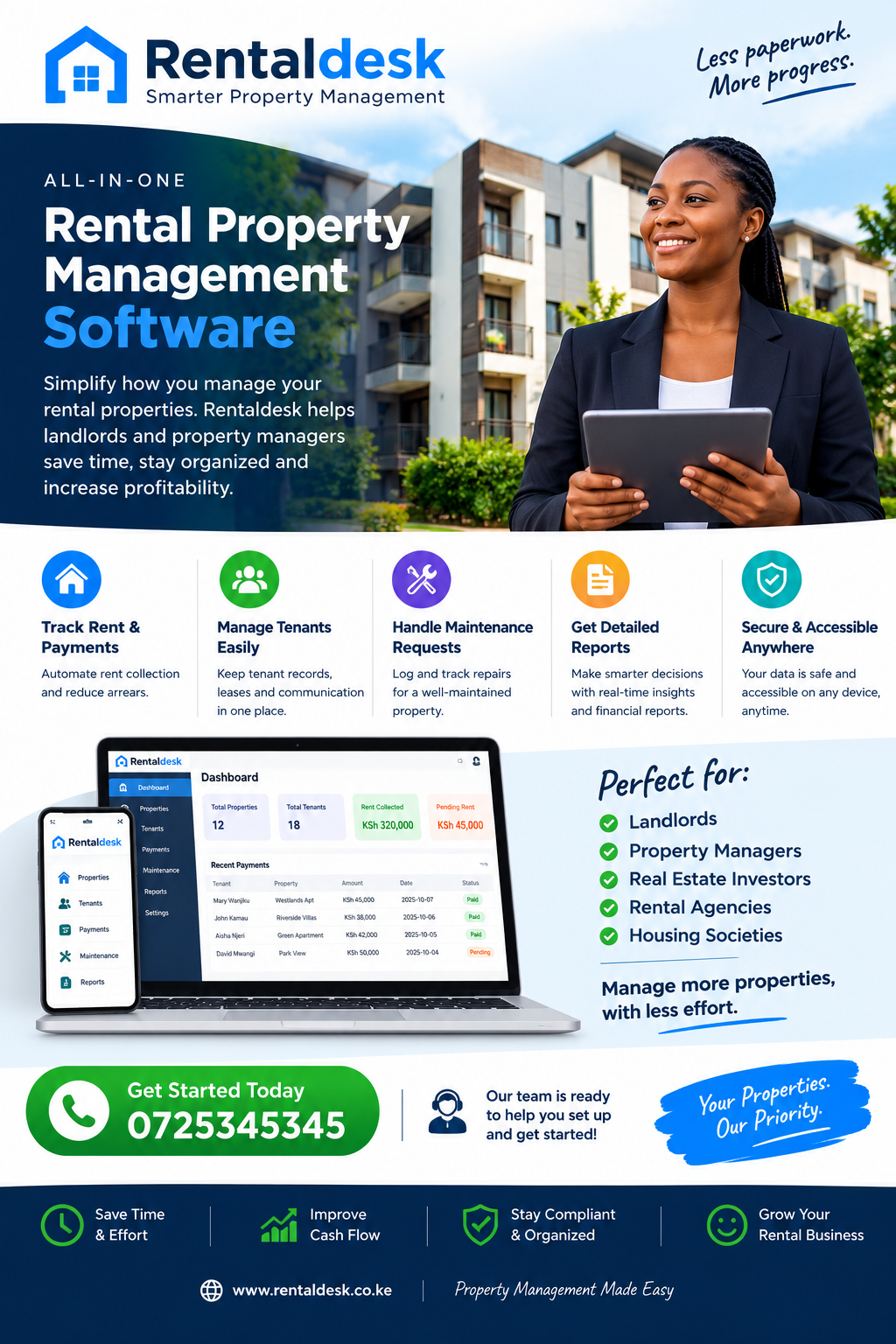
Utility Billing Software Kenya: A Complete Guide for Landlords and Property Managers
Managing water, electricity, garbage, security, internet and other shared property expenses can become complicated when several tenants occupy the same building. Utility Billing Software Kenya gives landlords, property managers and rental agencies a structured way to record utility usage, calculate charges, generate invoices and keep payment records connected to the right tenants and units.
For a small apartment block, manual calculations may seem manageable. Once the number of units grows, however, spreadsheets, notebooks, meter-reading photos and M-Pesa messages can quickly become difficult to reconcile. This guide explains what utility billing software does, why it matters in the Kenyan rental market, which features to look for, how meter-based billing works, how to reduce billing disputes and how a platform such as RentalDesk can fit into a wider property management workflow. RentalDesk currently describes its utility module as supporting utility accounts, meter readings, imports, templates, invoice generation, utility payments and reconciliation.
What Is Utility Billing Software?
At its simplest, Utility Billing Software Kenya refers to software designed to help property owners and managers calculate and collect charges associated with utilities and shared services.
These charges can include:
- Water consumption
- Electricity consumption
- Garbage collection
- Security services
- Internet
- Cleaning
- Common-area electricity
- Shared water bills
- Service charges
- Other recurring property expenses
The exact billing model depends on the property. Some landlords use individual meters, while others divide a shared bill between several units. Some charges are fixed every month, while others depend on consumption.
A good utility billing system brings these calculations into a consistent workflow. Instead of calculating everything separately and then manually transferring figures into tenant invoices, the manager can maintain utility records alongside property, unit, tenant and payment information.
For Kenyan landlords, Utility Billing Software Kenya can therefore become part of a broader rental management process rather than being treated as an isolated accounting tool.
Why Utility Billing Has Become a Major Property Management Task
Utility billing is often underestimated because the amounts involved may be smaller than monthly rent. The administrative workload, however, can still be significant.
Imagine a building with 80 units. Each unit has a water meter. At the end of the billing period, someone needs to collect 80 readings, determine consumption, apply the correct rate, prepare bills, communicate balances and follow up on unpaid amounts.
Now add electricity, garbage collection and other shared services.
A process that looked simple at 10 units can become a major administrative responsibility at 80 or 200 units.
Using Utility Billing Software Kenya can help create a repeatable process where the property manager knows what was measured, what was charged, what was invoiced and what has been paid.
The biggest benefit is not simply faster calculations. It is better control over the entire billing trail.
Common Utility Billing Problems Faced by Kenyan Landlords
Before choosing software, it helps to understand the problems that the system is expected to solve.
Manual meter-reading errors
Meter readings are commonly written down manually or stored in notebooks, WhatsApp conversations or spreadsheets. A single wrong digit can produce an incorrect bill.
If the mistake is not identified immediately, the tenant may dispute the charge after receiving the invoice.
Difficult consumption calculations
Water and electricity bills are not always based on a simple fixed amount. When a property uses sub-metering, the manager needs to compare the current reading with the previous reading and calculate consumption.
A reliable Utility Billing Software Kenya solution can make this process more structured.
Delayed tenant invoices
When utility calculations are performed manually, billing may happen days after the meter readings are collected. That delay makes it harder for tenants to understand what they owe and why.
Poor payment tracking
A tenant might pay rent but leave a utility balance outstanding. If both payments are recorded manually, the manager may struggle to identify exactly what remains unpaid.
Shared utility disputes
Some buildings have shared water or electricity costs. Managers need a clear method for determining how the bill is allocated.
If tenants do not understand the calculation, disputes become more likely.
Limited historical records
A notebook can show a current reading. It is much harder to use a notebook to analyse consumption over twelve or twenty-four months.
Digital records make it easier to identify trends and investigate unusual charges.
How Utility Billing Software Works
The basic process behind Utility Billing Software Kenya can be broken into several stages.
1. Create the property and units
The first step is to establish the building structure.
The system should identify:
- Property
- Building or block
- Floor
- Unit
- Tenant
- Meter
- Utility type
This creates a foundation for accurate billing.
2. Set up utility accounts
Each property can have one or more utility accounts. For example, an apartment building might have a water account and an electricity account.
A manager can then associate the relevant utility with the appropriate units.
3. Record previous readings
The previous reading is important because it provides the starting point for calculating consumption.
For example:
Previous water reading: 1,240 cubic metres
Current water reading: 1,275 cubic metres
Consumption:
1,275 − 1,240 = 35 cubic metres
The billing rate can then be applied according to the property’s billing arrangement.
4. Record current readings
Current readings can be entered manually or imported where the software supports imports.
RentalDesk says its utility feature supports recording and importing meter readings, along with templates and utility billing workflows.
5. Calculate charges
The software uses the property’s configured billing method to determine the amount payable.
Depending on the property, this could be:
- Consumption-based billing
- Fixed charges
- Shared billing
- Service charges
- A combination of charges
6. Generate invoices
The resulting charges can be included in an invoice or billing record.
This is where Utility Billing Software Kenya becomes especially useful. The utility calculation does not remain as an isolated spreadsheet figure; it becomes part of the tenant’s financial record.
7. Track payments
After the invoice is issued, the manager needs to know whether the tenant has paid.
A complete rental system can connect utility charges with payment records and tenant balances.
8. Reconcile outstanding balances
Finally, the manager should be able to identify:
- Fully paid accounts
- Part-paid accounts
- Unpaid accounts
- Overpayments
- Unmatched payments
- Outstanding balances
This closes the billing cycle.
Key Features to Look for in Utility Billing Software Kenya
Not every property requires the same features. However, several capabilities should be considered before selecting a system.
Meter reading management
The software should allow the manager to record readings for individual units and utilities.
A useful Utility Billing Software Kenya platform should also make it possible to identify the relevant period and compare current readings with previous readings.
Utility account management
The property may have several utility accounts. The software should make it easy to organise those accounts and associate them with the right property or units.
Automated invoice generation
Manual invoice preparation is one of the areas where administrative mistakes can occur.
Automated billing can help ensure that charges follow the same process every billing cycle.
Payment tracking
A utility invoice is only useful if the manager can determine what happened after it was issued.
The system should make it possible to connect invoices with payments and outstanding balances.
Reconciliation
Reconciliation is particularly important when payments arrive through multiple channels.
A Kenyan property may receive:
- M-Pesa payments
- Bank transfers
- Cash
- Other approved payment methods
RentalDesk describes its broader platform as supporting M-Pesa, bank transfers and cash workflows, with payment reconciliation connected to tenant ledgers.
Tenant statements
Tenants may request a statement showing what they were billed and what they have paid.
A good system should make this information accessible without forcing the property manager to search through multiple spreadsheets.
Reporting
Managers need more than individual invoices.
Reports can help answer questions such as:
- How much utility revenue was billed this month?
- How much remains unpaid?
- Which units have unusual consumption?
- Which properties generate the highest utility charges?
- Which tenants have recurring outstanding balances?
Water Billing for Rental Properties
Water is one of the most common utilities that landlords need to manage.
In a building with individual water meters, the manager can calculate consumption for each unit.
Consider an example.
A tenant’s previous reading is 320.
The current reading is 334.
Consumption is:
334 − 320 = 14 units.
If the agreed billing rate is KSh 100 per unit, the consumption charge is KSh 1,400.
The actual rate and billing arrangement should always reflect the property’s applicable agreement and operating model.
A system should preserve both the reading and the resulting charge so that the tenant can understand how the amount was calculated.
That transparency is an important reason why Utility Billing Software Kenya can be more useful than a basic spreadsheet.
Electricity Billing and Sub-Metering
Electricity billing can be more complicated than water because properties may use different arrangements.
Some buildings have individual electricity meters. Others use sub-metering. Some landlords may also need to allocate common-area electricity separately.
The billing system therefore needs to reflect the property’s actual setup rather than applying one generic calculation to every unit.
With Utility Billing Software Kenya, managers can organise electricity-related records, readings and charges in a consistent workflow.
For example, a commercial building may have shops with different operating hours and electricity consumption levels. A simple equal split may not accurately reflect usage where individual metering exists.
A consumption-based approach can provide a clearer connection between usage and the amount billed.
Fixed Utility Charges
Not every utility needs a meter.
A landlord may charge a fixed monthly amount for:
- Garbage collection
- Security
- Common-area cleaning
- Internet
- Landscaping
- Other agreed services
For these situations, Utility Billing Software Kenya should support recurring or fixed charges where appropriate.
The key is consistency.
If a KSh 500 garbage charge applies to every unit, the manager should not have to manually type KSh 500 into every invoice each month.
Shared Utility Billing
Shared utility billing is another common challenge.
Suppose an apartment block receives one water bill for the entire building. The manager then needs to distribute the cost among the occupied units.
There are different ways to allocate shared expenses, including:
- Equal division
- Allocation based on unit size
- Allocation based on occupancy
- Meter-based allocation
- A property-specific formula
The correct method depends on the property’s agreements and applicable rules.
The software should make the selected method clear and preserve the calculation.
This makes Utility Billing Software Kenya particularly valuable for properties where several tenants contribute toward shared costs.
Combining Rent and Utility Charges
One of the biggest advantages of an integrated rental platform is the ability to manage rent and utilities within the same tenant account.
Consider a tenant who owes:
| Charge | Amount |
|---|---|
| Monthly rent | KSh 25,000 |
| Water | KSh 1,200 |
| Electricity | KSh 2,000 |
| Garbage | KSh 500 |
| Total | KSh 28,700 |
Instead of maintaining one spreadsheet for rent and another for utilities, an integrated system can provide a more complete picture of the tenant’s account.
This is where Utility Billing Software Kenya can support better financial visibility.
The manager can see the total amount billed, payments received and remaining balance.
M-Pesa and Utility Payments in Kenya
M-Pesa is an important part of payment workflows for many Kenyan businesses and rental properties.
When tenants pay electronically, the property manager still needs to ensure that the payment is matched to the correct account.
The process can become difficult when a manager receives many payments and manually checks transaction messages.
An integrated Utility Billing Software Kenya platform can help connect payment information with tenant records where supported by the payment workflow.
RentalDesk positions M-Pesa collection and reconciliation as central components of its Kenya-focused rental workflow. Its published workflow describes matching incoming payments to tenant and unit records and updating balances and arrears visibility.
This does not remove the need for proper reconciliation. Instead, it gives the property manager a structured environment in which payments can be reviewed.
Reducing Utility Billing Disputes
Billing disputes are not always caused by dishonest tenants or landlords.
Sometimes the problem is simply that the calculation is unclear.
A tenant may ask:
Why is my water bill higher this month?
If the manager has no clear record, answering the question may require searching through old messages.
With Utility Billing Software Kenya, the manager can maintain a clearer billing trail.
A good dispute-resolution process should show:
- Previous meter reading
- Current meter reading
- Consumption
- Rate
- Resulting charge
- Invoice date
- Payment history
- Outstanding amount
Clear records make conversations easier.
They also help managers identify genuine mistakes before they become larger disputes.
Utility Billing for Apartment Buildings
Apartment buildings are one of the strongest use cases for utility billing software.
A property manager may have dozens or hundreds of units, each with its own tenant and billing history.
Using Utility Billing Software Kenya can help centralise the information needed to manage those units.
For example, a manager can organise:
- Unit numbers
- Occupancy status
- Tenant names
- Meter information
- Previous readings
- Current readings
- Utility charges
- Rent invoices
- Payments
- Balances
This reduces the amount of information that needs to be maintained separately.
Utility Billing for Commercial Properties
Commercial buildings can have even more complex utility arrangements.
A building may contain:
- Shops
- Offices
- Restaurants
- Clinics
- Salons
- Small businesses
- Warehouses
Each tenant may have different operating hours and consumption patterns.
A restaurant, for example, may use significantly more water than a small office.
For such properties, Utility Billing Software Kenya can help managers maintain separate tenant and unit records while keeping the broader property financial information organised.
The software does not determine what a landlord should charge. Rather, it helps implement the property’s established billing rules consistently.
Utility Billing for Student Hostels
Student hostels often have frequent tenant turnover and many occupants sharing facilities.
A hostel may need to manage:
- Water
- Electricity
- Internet
- Cleaning
- Security
- Shared services
A manual system becomes harder to manage when tenants change regularly.
With Utility Billing Software Kenya, the property manager can maintain billing records alongside occupancy and tenant information.
The exact setup should reflect the hostel’s tenancy agreements and billing arrangements.
Utility Billing for Gated Communities and Estates
Large estates may have shared services such as:
- Security
- Garbage collection
- Landscaping
- Water
- Common-area electricity
- Cleaning
- Maintenance
These expenses need to be allocated and communicated properly.
A centralised Utility Billing Software Kenya workflow can help managers maintain records for multiple units while keeping charges traceable.
For estate administrators, the ability to produce reports can also be important because residents may want to understand how shared charges were calculated.
Utility Billing and Tenant Transparency
Good billing is not only about collecting money.
It is also about helping tenants understand what they are paying for.
A tenant should ideally be able to see:
- Billing period
- Utility type
- Previous reading
- Current reading
- Consumption
- Rate
- Charge
- Payment
- Balance
This information can improve trust.
A Utility Billing Software Kenya solution that connects billing, tenant records and payment history gives the manager a stronger foundation for answering questions quickly.
RentalDesk’s tenant portal, for example, is designed to let tenants view relevant invoices, payments, balances, statements and support requests.
Utility Billing and Financial Reporting
Utility billing should eventually feed into financial reporting.
A property manager may want to know the total amount billed for utilities during a particular month and compare that figure with collections.
For example:
| Metric | January | February | March |
|---|---|---|---|
| Utility billed | KSh 180,000 | KSh 192,000 | KSh 205,000 |
| Utility collected | KSh 168,000 | KSh 185,000 | KSh 199,000 |
| Outstanding | KSh 12,000 | KSh 7,000 | KSh 6,000 |
The value of this report is not just the numbers. It is the ability to identify trends.
If outstanding utility balances continue increasing, management can investigate the cause.
If consumption suddenly changes, the manager can investigate possible meter issues, leaks or changes in occupancy.
This makes Utility Billing Software Kenya useful for operational decision-making rather than simply invoice generation.
Detecting Unusual Consumption
A sudden increase in consumption deserves attention.
Suppose a unit normally consumes between 10 and 15 units of water each month but suddenly records 50 units.
Possible explanations could include:
- A leak
- A faulty meter
- A change in occupancy
- A genuine increase in usage
- An incorrect reading
Software cannot automatically determine the cause in every situation, but it can make unusual records easier to identify.
With Utility Billing Software Kenya, historical readings can provide the information needed to investigate unusual changes.
The manager can compare current figures with previous billing periods instead of relying on memory.
The Importance of Accurate Meter Records
A billing system is only as reliable as the information entered into it.
Property managers should establish a consistent meter-reading procedure.
A useful process may include:
- Record the reading on a fixed date.
- Confirm the unit number.
- Confirm the meter number.
- Capture a photo where appropriate.
- Enter the reading promptly.
- Check for unusual changes.
- Generate the billing record.
- Review exceptions before invoices are issued.
This workflow can make Utility Billing Software Kenya much more effective because the software becomes part of a controlled operational process rather than a place to store inaccurate data.
Mobile Access for Property Managers
Property managers are not always sitting in an office.
A caretaker may need to record meter readings while walking through a building. An agent may be visiting a property in another part of Nairobi. A manager may need to check an invoice while travelling between properties.
Mobile access can therefore be valuable.
RentalDesk states that its platform provides mobile access to areas including utilities, tenants, properties, invoices, payments, reports and portals.
For a Utility Billing Software Kenya solution, mobile accessibility can reduce the delay between collecting information and updating the system.
Utility Billing and Property Management
Utility billing should not exist in isolation.
The most useful workflow connects it with other property management functions.
For example:
Property → Unit → Tenant → Lease → Meter → Utility Charge → Invoice → Payment → Balance → Report
This creates a connected record.
RentalDesk’s broader platform includes property and unit management, tenant management, leases, invoicing, payments, utilities, maintenance, owner statements and reporting.
That makes Utility Billing Software Kenya particularly relevant for managers who want to move beyond standalone spreadsheets.
Utility Billing and Lease Information
A tenant’s billing should be connected to the correct tenancy period.
Suppose a tenant moves into a unit halfway through a month. The manager may need to determine which charges belong to that tenant and which belong to the previous occupant.
Lease records provide important context.
RentalDesk describes its lease-management workflow as connecting lease dates, rent frequency, deposits and tenancy status with invoices, balances and reports.
With Utility Billing Software Kenya, connecting billing records to tenant and lease information can make changes in occupancy easier to manage.
Handling Vacant Units
Vacant units should not automatically be treated the same way as occupied units.
Some property expenses may continue regardless of occupancy. Others may be usage-based.
A billing system should allow the manager to identify the unit’s status and apply the property’s established billing rules.
RentalDesk’s property and unit management tools include occupied, vacant, listed and inactive unit statuses.
This is another reason Utility Billing Software Kenya should ideally connect utility records with property and occupancy information.
Utility Billing and Property Owners
Property management agencies often manage properties on behalf of landlords.
The property owner may want to know:
- Utility income
- Utility expenses
- Outstanding balances
- Tenant payments
- Property performance
A good system can reduce the amount of manual reporting required.
RentalDesk’s landlord portal is designed to give property owners controlled visibility into properties, tenants, payments, invoices, expenses and reports.
This makes Utility Billing Software Kenya relevant to agencies that need better communication between managers and owners.
How to Choose the Right Utility Billing Software
Choosing software should not be based on the number of features listed on a website.
The better question is:
Can this system handle the actual billing workflow of my property?
Use the following checklist.
1. Does it support your utility types?
Check whether it can handle the utilities you actually bill.
2. Can it manage multiple properties?
If you expect to grow, multi-property capability can prevent another software migration later.
3. Can it store meter readings?
This is essential for consumption-based billing.
4. Can it generate invoices?
Billing should move smoothly from readings to tenant charges.
5. Can it track payments?
You should be able to identify paid, part-paid and unpaid accounts.
6. Does it support Kenyan payment workflows?
For many local property managers, M-Pesa integration and reconciliation are important considerations.
7. Does it provide reports?
You should be able to review historical and current billing information.
8. Is it easy for your team to use?
A technically powerful system is not useful if caretakers and administrators cannot operate it confidently.
9. Can it scale?
Think about where your property business will be in two or three years.
10. Is support available?
Local support can be valuable when dealing with billing, tenant records and payment workflows.
Questions to Ask Before Buying
Before adopting Utility Billing Software Kenya, ask the vendor specific questions instead of relying on generic promises.
For example:
- How are meter readings recorded?
- Can readings be imported?
- Can I bill water and electricity separately?
- Can I add fixed charges?
- Can I combine utility charges with rent invoices?
- How are partial payments handled?
- Can I see unpaid utility balances?
- Can tenants access statements?
- Can I manage several properties?
- Can different staff members have different permissions?
- Can I export reports?
- How does M-Pesa reconciliation work?
- What happens if a payment cannot be matched?
- Can I access the system from a phone?
- How is my data protected?
- What support is provided during setup?
The answers should be specific to the product rather than vague statements about automation.
Common Mistakes to Avoid
Even with good software, poor processes can create billing problems.
Mistake 1: Entering readings without checking the unit
Always verify that the reading belongs to the correct unit and meter.
Mistake 2: Ignoring abnormal readings
A large jump should be investigated rather than automatically billed.
Mistake 3: Mixing tenant accounts
Every payment should be allocated to the correct tenant and unit.
Mistake 4: Changing rates without documentation
Keep a record of the billing rules and effective dates.
Mistake 5: Relying entirely on manual calculations
Manual calculations increase the risk of arithmetic and transcription mistakes.
Mistake 6: Failing to reconcile payments
An invoice marked as paid without matching evidence can create accounting problems.
Mistake 7: Giving everyone unrestricted access
Staff should only have access to information required for their responsibilities.
Mistake 8: Ignoring historical data
Previous readings are valuable when investigating disputes and unusual consumption.
Mistake 9: Treating utilities as separate from property accounting
Utility charges affect the property’s financial performance and should be reflected in broader reporting.
Mistake 10: Choosing software based only on price
A cheaper system may become expensive if it creates additional manual work.
How RentalDesk Fits the Utility Billing Workflow
RentalDesk positions itself as a Kenya-focused rental management platform rather than a standalone utility calculator.
Its published utility feature includes utility accounts, meter readings, imports, templates, invoice generation, utility payments and tracking of overdue amounts and allocation issues.
The wider platform includes tenant records, leases, invoices, payments, property management, maintenance, owner reporting, accounting and tenant portals.
For a landlord who wants utility billing connected to the rest of the rental operation, Utility Billing Software Kenya can therefore be evaluated as part of a larger property-management workflow.
The advantage of this approach is that a utility charge can remain connected to the property, unit and tenant that generated it.
A Practical Monthly Utility Billing Workflow
A property manager can establish a monthly routine around Utility Billing Software Kenya.
Week 1: Prepare the billing cycle
Confirm:
- Active tenants
- Vacant units
- Utility accounts
- Billing rates
- New move-ins
- Move-outs
- Lease changes
Week 2: Collect readings
Record current meter readings for applicable units.
Where possible, verify unusual readings before continuing.
Week 3: Generate bills
Calculate consumption and generate utility charges.
Review exceptions before sending invoices.
Week 4: Reconcile payments
Review:
- Paid accounts
- Part-paid accounts
- Unpaid accounts
- Unmatched payments
- Outstanding balances
Then follow up with tenants according to the property’s normal communication process.
This creates a predictable monthly cycle.
Measuring the Success of Your Utility Billing Process
A property manager should evaluate more than whether invoices were generated.
Useful operational measures include:
- Time taken to complete monthly billing
- Number of billing corrections
- Number of disputed invoices
- Outstanding utility balances
- Unmatched payments
- Number of missing meter readings
- Average time to resolve billing queries
The purpose of Utility Billing Software Kenya is not simply to produce more invoices. It should help the manager improve the quality and reliability of the entire billing process.
Utility Billing Software and Data Security
Property management systems contain sensitive business information.
Records may include:
- Tenant names
- Phone numbers
- Payment information
- Lease details
- Property information
- Financial records
- Utility consumption
Managers should therefore ask about access control, backups, audit trails and user permissions.
RentalDesk highlights secure audit trails and role-based access as part of its broader platform.
With Utility Billing Software Kenya, security should be considered alongside convenience.
What Does Utility Billing Software Cost?
There is no single price that applies to every property.
Software pricing may depend on:
- Number of units
- Number of properties
- Number of users
- Features
- Payment integrations
- Reporting requirements
- Support
- Billing frequency
RentalDesk currently publishes KES-based plans, including a Free Lite option for small portfolios and paid plans for larger operational requirements.
When comparing Utility Billing Software Kenya solutions, do not compare only the monthly subscription.
Calculate the wider business value.
For example, consider the time currently spent on:
- Meter calculations
- Invoice preparation
- Payment reconciliation
- Tenant queries
- Arrears follow-up
- Monthly reports
- Correcting spreadsheet errors
If software significantly reduces these administrative tasks, the value may extend beyond the software subscription itself.
Is Utility Billing Software Suitable for Small Landlords?
Yes, but the answer depends on the landlord’s portfolio.
A landlord with three units may find manual billing manageable.
A landlord with 30, 50 or 100 units has a different administrative challenge.
The important consideration is not simply the number of properties. It is the complexity of the workflow.
Even a small property may benefit from digital records if it has:
- Metered water
- Sub-metered electricity
- Multiple shared services
- Frequent tenant changes
- Several payment channels
- A need for detailed statements
A scalable Utility Billing Software Kenya platform allows landlords to start with their current needs and expand as the portfolio grows.
Utility Billing for Property Management Companies
Property management companies have a stronger need for centralisation because they may handle properties belonging to different landlords.
The manager must keep each property financially separate while still operating from one system.
A suitable platform should support:
- Multiple landlords
- Multiple properties
- Different units
- Tenant records
- Separate billing
- Payment allocation
- Owner reporting
- Staff permissions
RentalDesk’s broader platform is designed for multi-property operations and controlled landlord visibility.
For such agencies, Utility Billing Software Kenya can become part of a larger operational system.
The Role of Automation
Automation is useful when it removes repetitive work without removing human oversight.
For example, software can automate:
- Recurring invoices
- Utility calculations
- Payment matching
- Balance updates
- Notifications
- Reports
But managers should still review exceptions.
An unusually high reading should be investigated.
An unmatched payment should be reviewed.
A disputed invoice should be checked against the source records.
This balance between automation and review is important when implementing Utility Billing Software Kenya.
Improving Tenant Communication
Billing becomes easier when tenants know what to expect.
Property managers can establish a clear communication process:
- Explain how utilities are charged.
- Explain the billing period.
- Provide invoices consistently.
- Make payment instructions clear.
- Provide receipts or payment confirmation.
- Allow tenants to review balances.
- Respond promptly to disputes.
RentalDesk supports communication workflows involving SMS, email, WhatsApp templates and notifications.
This can complement Utility Billing Software Kenya by connecting billing information with tenant communication.
A Simple Example for a Nairobi Apartment
Consider a 40-unit apartment building in Nairobi.
Each unit has a water meter. The building also charges a fixed garbage fee and a shared security fee.
The manager previously used a spreadsheet.
Every month, the manager:
- Collected 40 readings
- Calculated consumption
- Entered figures into Excel
- Calculated water charges
- Added garbage charges
- Added security
- Prepared tenant invoices
- Checked M-Pesa payments
- Updated balances
The process took several days.
After implementing Utility Billing Software Kenya, the manager could structure the workflow around property, unit, tenant, utility and payment records.
The important improvement is not simply speed.
The manager has a clearer audit trail and can answer questions about individual bills without searching through multiple disconnected files.
A Simple Example for a Commercial Building
Imagine a commercial property with 20 shops.
The manager needs to bill:
- Rent
- Electricity
- Water
- Garbage
- Security
Different shops have different consumption patterns.
With Utility Billing Software Kenya, the manager can keep the charges connected to the relevant tenant and unit records.
The property owner can then review reports while the tenant can receive a clearer invoice.
This approach becomes increasingly valuable as the portfolio grows.
How to Implement a New Billing System
Moving from spreadsheets to software should be planned carefully.
Step 1: Clean your existing records
Remove duplicate tenants and outdated units.
Step 2: Confirm meter information
Check that meter numbers correspond to the correct units.
Step 3: Confirm billing rules
Document rates, fixed charges and allocation methods.
Step 4: Import historical information
Where supported, bring relevant tenant, property and billing data into the new system.
Step 5: Test one billing cycle
Do not immediately rely on the system for every property without testing.
Step 6: Train staff
Caretakers, property managers and finance staff should understand their responsibilities.
Step 7: Review the first bills
Check calculations before finalising the first production billing cycle.
Step 8: Establish a monthly process
Create a standard routine for readings, billing, invoicing and reconciliation.
With Utility Billing Software Kenya, the implementation process should focus on making the software reflect the actual property’s workflow.
Why Accurate Records Matter More as a Portfolio Grows
A landlord with five units can often remember details personally.
A company managing 500 units cannot depend on memory.
At that scale, the system becomes the source of operational truth.
Property managers need to know:
- Who occupies each unit
- Which meter belongs to each unit
- What the previous reading was
- What the current reading is
- What was billed
- What was paid
- What remains outstanding
That is the central value of Utility Billing Software Kenya.
It transforms scattered records into structured information that can be searched, reviewed and reported.
Utility Billing and Arrears Management
Utility balances can become difficult to track when they are separated from rent records.
A tenant might be fully paid on rent but still owe water and electricity charges.
If the property manager only looks at rent arrears, the utility balance can remain unnoticed.
An integrated Utility Billing Software Kenya workflow can provide a more complete picture of the tenant’s account.
This is especially useful where utilities are billed monthly alongside rent.
Utility Billing and Owner Reporting
Property owners want to understand how their assets are performing.
Reports can help show:
- Total rent billed
- Total rent collected
- Utility charges
- Utility payments
- Expenses
- Outstanding balances
- Property profitability
RentalDesk describes owner reporting and landlord portal functionality that connects properties, tenants, payments, invoices, expenses and reports.
For agencies, Utility Billing Software Kenya can therefore be part of a broader owner-reporting process.
What Makes a Good Utility Billing System?
A good system should combine five qualities.
Accuracy
Calculations and records should be consistent.
Transparency
Managers should be able to explain how charges were produced.
Integration
Utilities should connect with tenant, property and payment information.
Usability
Staff should be able to use the system without unnecessary complexity.
Scalability
The system should remain useful as the property portfolio expands.
A platform that combines these qualities can make Utility Billing Software Kenya more valuable than a standalone calculator.
Frequently Asked Questions
1. What is utility billing software?
Utility billing software is a digital system used to record utility consumption, calculate charges, generate invoices and track payments for properties. It can be used for water, electricity, garbage, security and other recurring property-related services.
2. Who needs utility billing software in Kenya?
Landlords, property managers, estate administrators, apartment managers, commercial property owners, student hostel operators and rental agencies can benefit from utility billing software when they need to manage recurring or consumption-based charges.
3. Can utility billing software calculate water bills?
Yes. A suitable system can record previous and current meter readings, calculate consumption and apply the relevant billing method. The exact calculation depends on the property’s agreed billing structure.
4. Can electricity be included in rental utility billing?
Yes. Electricity can be managed where the property uses individual meters, sub-metering or another documented allocation method. The system should be configured according to the property’s actual billing arrangement.
5. Can M-Pesa payments be connected to utility billing?
Some rental management platforms support M-Pesa workflows and payment reconciliation. RentalDesk, for example, describes M-Pesa collection and reconciliation as part of its Kenya-focused rental management workflow.
6. Can tenants receive utility invoices?
Yes. Depending on the platform, utility charges can be included in invoices or tenant-facing billing records. Tenant portals can also provide access to balances, invoices and statements.
7. Is utility billing software useful for apartment buildings?
Yes. Apartment buildings with many units can benefit significantly because meter readings, tenant records, charges and payments become difficult to manage manually as the number of units increases.
8. Can utility billing software manage multiple properties?
Many modern rental management platforms support multiple properties. RentalDesk describes multi-property management as part of its platform, allowing managers to organise properties, units, tenants, billing and reporting from a central system.
9. Does utility billing software replace accounting software?
Not necessarily. Some rental platforms include accounting features, while others focus primarily on billing. Property managers should determine whether the software provides the accounting reports and integrations their business requires.
10. How should I choose utility billing software?
Compare meter-reading features, billing methods, invoicing, payment reconciliation, M-Pesa support, reporting, tenant access, security, user permissions, mobile access, scalability and customer support. Most importantly, test whether the system can reproduce your actual property billing workflow.
Final Thoughts
Utility billing is a small part of property management that can create disproportionately large administrative problems when handled manually. Meter readings, consumption calculations, shared charges, invoices and payments all need to remain connected if landlords want reliable records.
The right Utility Billing Software Kenya solution can bring these tasks into one organised workflow. Instead of moving information between notebooks, spreadsheets, payment messages and separate invoices, property managers can create a clearer connection between properties, units, tenants, utility usage, charges and payments.
For Kenyan landlords and property managers, the strongest solution is not necessarily the one with the longest feature list. It is the one that fits the property’s billing rules, supports local payment workflows, provides useful records and remains simple enough for the team to use consistently.
Before making a decision, map your current process from meter reading to payment reconciliation. Identify where errors, delays and disputes occur. Then compare software based on how effectively it solves those specific problems.
As a rental portfolio grows, organised billing becomes increasingly important. A structured digital process can help managers spend less time calculating figures and searching for records and more time managing properties, tenants and the financial performance of the portfolio.
Utility Billing Software Kenya
Utility Billing Software Kenya
Utility Billing Software Kenya
Utility Billing Software Kenya
Utility Billing Software Kenya
Utility Billing Software Kenya
Utility Billing Software Kenya
Utility Billing Software Kenya
Utility Billing Software Kenya
Utility Billing Software Kenya
Utility Billing Software Kenya
Utility Billing Software Kenya
Utility Billing Software Kenya
Utility Billing Software Kenya
Utility Billing Software Kenya
Utility Billing Software Kenya
Utility Billing Software Kenya
Utility Billing Software Kenya
Utility Billing Software Kenya
Utility Billing Software Kenya