
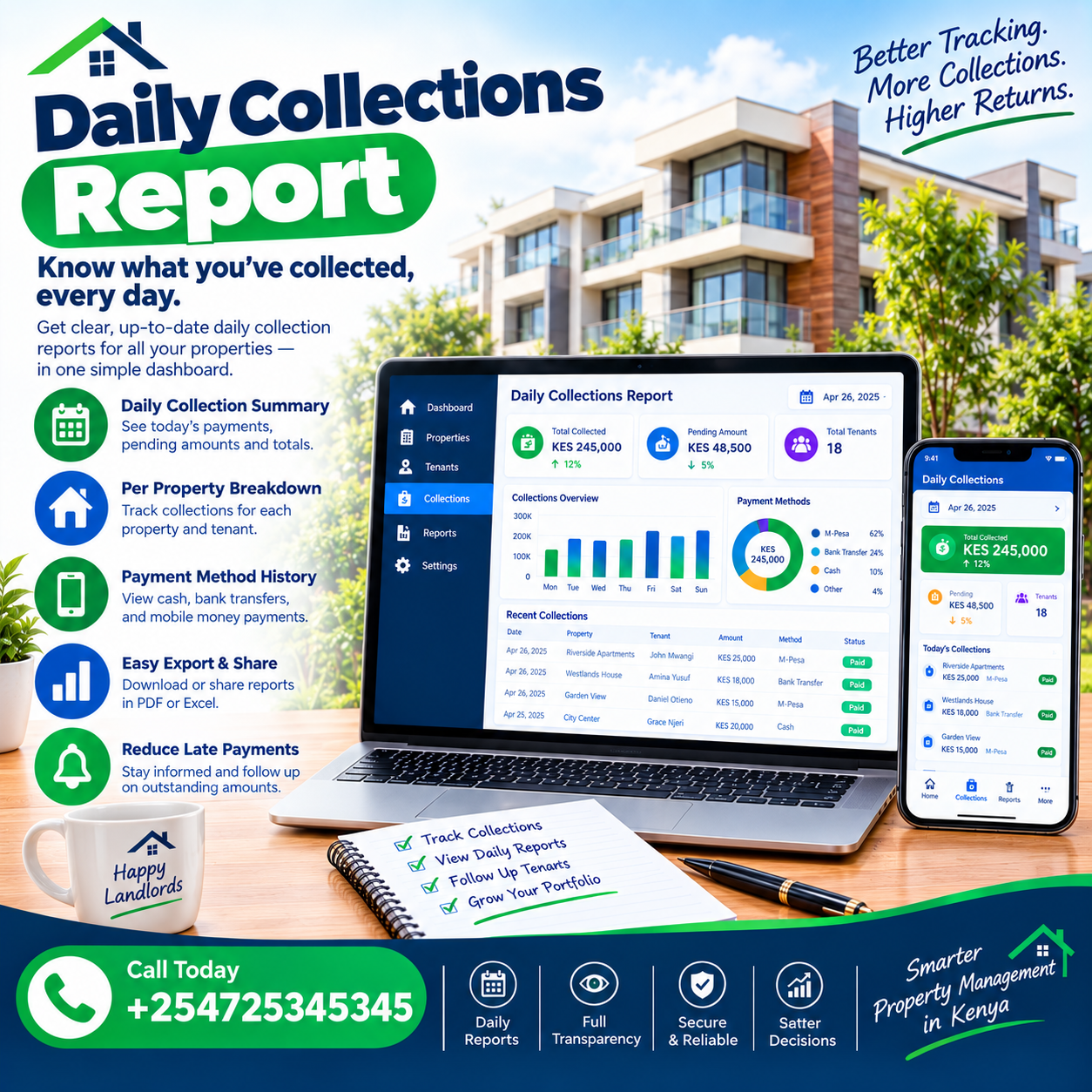
A daily collections report is the single page that tells a landlord, in under two minutes, exactly how much rent arrived today, from which units, and what is still outstanding. It is the smallest document in property management and, shilling for shilling, the one with the highest return. Most income problems in Kenyan rentals are not collection problems at all — they are visibility problems, and this one page ends them.
The old way of knowing your collections was the month-end surprise. You waited for figures, chased caretakers for summaries, and discovered shortfalls weeks after they started costing money. A daily collections report inverts that entire timeline by bringing every payment to your attention the moment it lands.
This guide covers the complete practice from first page to permanent archive. We define what the report contains, give you a template you can copy today, and explain every line item in plain language. We also cover the reading ritual, exception entries, the weekly and monthly rollups, and how agencies use the same document to keep owner clients for years.
By the end, you will be able to produce a daily collections report that fits your portfolio exactly. Whether you collect from four bedsitters in Rongai or four hundred apartments across Nairobi, the discipline is identical. Only the volumes change, and the format absorbs them without complaint.
The timing could not be better, because the pieces have finally converged. M-Pesa digitized the payments, platforms now assemble the report automatically, and delivery to your phone costs nothing. Everything needed to run a professional daily collections report is affordable, local, and proven — what remains is the habit, and installing that habit is exactly what this guide does.
What Is a Daily Collections Report?
A daily collections report is a one-page summary of a single day’s rent activity across your entire portfolio: payments received, units still outstanding, and anything unusual that needs attention. It answers three questions completely — what came in today, from which units, and what remains — and it answers them in numbers rather than in somebody’s recollection. Think of it as your portfolio’s daily newspaper, written by your own money.
The report is distinct from the neighbors in your document family. The statement covers a month, the dashboard shows a standing picture, and the receipt proves one transaction. A daily collections report is the narrative of one day — and the daily rhythm is precisely what makes it powerful where the others are periodic.
Its power comes from brevity married to completeness. Every unit appears, every payment is itemized, and nothing hides inside an aggregate figure that smooths over a missing tenant. That total visibility in two minutes of reading is the defining trait of a genuine daily collections report.
What it is not matters just as much. It is not a ledger, not an accounting system, and not a lease record — it sits above all of those and reads from them. It is the daily window onto your income, and the discipline of producing one is what defines a serious daily collections report practice.
Why Daily Beats Monthly
Problems in rent age badly, and speed of sight is the whole cure. An account spotted on day two receives a friendly message, while the same account spotted on day twenty-eight receives a confrontation. Early sight of that kind is the core advantage of a daily collections report over any month-end summary.
Daily reporting also transforms caretaker accountability. When collections must add up every day, discrepancies surface within twenty-four hours instead of festering for a month. Honest caretakers benefit most of all, because the daily collections report protects them from suspicion whenever balances move for legitimate reasons.
Cash-flow confidence completes the case. Knowing collections to date lets you plan school fees, loan installments, and repairs around real money instead of optimistic guesses. And months of daily reading compound into pattern knowledge that no annual report can teach — the quiet intelligence built by a daily collections report habit.
There is also a negotiation dimension to daily sight. Discussions with tenants, caretakers, and even buyers of your property all change character when your figures are current, dated, and provable. That evidentiary posture is the quiet authority built by a sustained daily collections report practice.
Who Produces It, Who Receives It
The report has producers and recipients, and clarity about both keeps the practice honest. Self-managing landlords produce their own, caretakers produce for their owners, and agents produce for client landlords whose properties they run. In every arrangement, the person who depends on the money should be a named recipient of the daily collections report — not just the person who compiled it.
The recipient rule matters more than it sounds. When only the caretaker sees the figures, the owner learns about the portfolio through summaries of summaries, and every layer adds rounding and optimism. Direct delivery of the daily collections report to the owner’s own phone closes that distance permanently.
Frequency follows the month’s shape. Daily during the first week — when most payments arrive or fail to — then two or three times weekly for the rest of the cycle keeps the rhythm sustainable. Consistency of that schedule is what turns the document from an occasional effort into a genuine daily collections report practice.
The Anatomy: What Goes in the Report
The headline opens the page. Total collected today, total collected this month to date, and the count of units still outstanding — three numbers that summarize everything instantly. Clarity in that opening trio is the signature of a professional daily collections report.
The itemized detail follows. Every payment listed with tenant name, unit, amount, payment channel, and time, so nothing hides inside a total. Itemized transparency is what makes a daily collections report trustworthy rather than merely tidy.
The outstanding list completes the core. Units that have not yet paid this month, the amounts they owe, and how many days each balance has been running. A report without that list is only half a report — the full picture is what defines a complete daily collections report.
Exceptions and notes close the page. Mismatched amounts, unfamiliar senders, cash entries pending verification, and any unit with a story worth one line. That exception layer is what elevates a daily collections report from arithmetic into management.
The Template: Copy and Use This Today
You can build your first report tonight with a pen and one page. The structure below is deliberately simple, and it works identically on paper, in a spreadsheet, or inside a platform. Anyone can run a daily collections report from this skeleton starting tomorrow morning.
Daily Collections Report — [Date] — Prepared by [Name]
- Collected today: KSh [amount] from [number] payments
- Month to date: KSh [amount] of KSh [expected] — [percentage]%
- Payments received today: Unit [no.] — Tenant [name] — KSh [amount] — [M-Pesa/cash] — Ref [code]
- Outstanding units: Unit [no.] — KSh [amount] owed — [days] outstanding
- Exceptions: [blank reference / wrong amount / duplicate — describe]
- Notes: [repairs affecting access, tenant messages, promised dates]
Adjust the fields to your portfolio, not the other way around. The template’s job is to force completeness — every unit accounted for, every payment carrying its evidence, every gap visible in writing. Once the structure is habit, your daily collections report takes ten minutes a day and saves hours at month-end.
The Line Items, Explained
The month-to-date health ratio is the report’s most important line. Expected rent for the month beside collected rent to date gives you a percentage that says more than any paragraph. That single figure is the health reading at the top of every serious daily collections report.
Payment entries must carry their evidence. An M-Pesa confirmation code, a receipt number, or a photographed cash record attached to each entry turns the report from a claim into proof. Evidence-first entries are what make a daily collections report dispute-proof months later.
Cash deserves its own flag. Cash entries should be marked clearly for verification until they are confirmed against receipts and the caretaker’s records. That honesty marker is what keeps the numbers in your daily collections report permanently credible.
The outstanding list carries its own clocks. Each unpaid unit should show how many days its balance has run, because age changes both urgency and tone. Dated outstanding entries are what make the follow-up section of your daily collections report actionable rather than decorative.
The Two-Minute Ritual
A report only pays when someone reads it, and the reading works best as a tiny fixed ritual. Read the three headline numbers first, scan the outstanding list second, and act on anything red third. That sequence is the daily core of the daily collections report habit.
Acting is the step that earns the money. One courteous message to a unit three days late takes a minute today and prevents a difficult conversation in week six. Same-day response is the discipline that makes a daily collections report pay for itself every single month.
The ritual compounds over weeks. Months of daily reading build an intuitive feel for your portfolio’s rhythm — who pays early, who drifts, which weeks run light. That pattern sense is the hidden skill developed by every disciplined daily collections report reader.
Exceptions: The Entries That Need Words
Some payments refuse to fit, and the report must hold them honestly. A blank reference, an amount that matches no unit, a sender nobody recognizes, or a duplicate all belong in the exceptions section. A visible holding place — never silent omission — is the standard of a trustworthy daily collections report.
Never guess an exception into place. Assigning a mystery payment to a unit because it “probably was them” creates two wrong records instead of one right one. The ask-don’t-assume rule is what separates accurate daily collections report practice from future disputes.
Resolve exceptions within a day. One courteous message stating the amount and date resolves most cases within the hour, and the resolution completes the record. Prompt closure is what keeps the exception section of your daily collections report short rather than accumulating.
The Ledger Beneath the Report
The daily page is the visible layer; the ledger is the permanent record beneath it. Every entry on any report should trace back to a complete ledger record — tenant, unit, amount, date, method, and reference. That connection is what turns a stack of daily collections report pages into a financial system rather than a collection of notes.
The ledger answers what the daily page cannot. Questions about a specific tenant’s history, a unit’s performance across months, or a dispute’s full story live in the ledger, not the daily page. That depth is why every professional running a daily collections report also maintains the records beneath it.
Software connects the two layers automatically. Modern platforms write every payment into the ledger as it arrives, and the daily report simply reads from that ledger each morning. That architecture is what makes a platform-generated daily collections report both effortless and permanently reliable.
One Report or Several: Portfolios with Multiple Properties
A common question deserves a clear answer: one report for everything, or one per property? Below ten units, a single combined page keeps life simple; above that, per-property reports prevent busy buildings from drowning out quiet ones. That structural choice is the first design decision in any daily collections report rollout at scale.
Per-property reports also serve multi-property owners emotionally. Seeing each building stand on its own page makes problems and successes impossible to hide inside a blended total. That per-asset clarity is the management advantage of running a daily collections report per property at scale.
Family and group ownership benefit from the same structure. Co-owners who receive the same per-property figures argue less and decide faster, because everyone reads identical numbers. Shared sight like that is the partnership dividend of a daily collections report held in common.
For Agencies: The Daily Report as Owner Reporting
For managing agents, the daily report becomes a client-retention engine. A short daily or every-other-day digest per owner — collections, vacancies, exceptions — replaces fragile month-end reconstructions. Owner clients who receive a daily collections report feel managed in a way monthly calls never achieve.
Automation carries the load. Platforms generate per-owner digests from live records, so every client’s report goes out on schedule without anyone compiling by hand. That automation is what makes the daily collections report sustainable across dozens of client portfolios at once.
The commercial effect compounds. Owners who see the machinery working daily rarely negotiate fees, rarely entertain competitors, and refer other landlords. Retention of that kind is the documented dividend of agencies that standardize on the daily collections report as client communication.
The daily report also becomes the agency’s daily discipline. Compiling it forces a morning review of every portfolio, which catches problems while the agency can still fix them quietly. That internal mirror is the operational bonus hiding inside every serious daily collections report practice.
Building Yours: Three Levels
Level one is paper, and it is genuinely respectable for small portfolios. A grid with units down the side and days across the top, marked as money moves, is a functioning report for up to ten units. Discipline makes even a handwritten daily collections report trustworthy.
Level two is the spreadsheet. One row per unit, columns for rent due, amounts received by day, and a computed month-to-date total, with filters for outstanding units. For portfolios up to about twenty units, a well-built sheet is the most practical daily collections report available at zero cost.
Level three is the platform. Software reconciles M-Pesa payments automatically, updates the report in real time, and pushes it to your phone without you opening anything. At that level, the daily collections report maintains itself, and your role shifts from compiler to decision-maker.
The upgrade between levels follows a predictable trigger. When manual compilation starts eating real evenings, or when one missed entry costs a disputed month, the next level has earned itself. That threshold — not the sales page — is the correct moment to move your daily collections report onto a full platform.
Features to Demand if You Choose Software
First, demand automatic M-Pesa reconciliation with real-time updates. A report that assembles itself from live payments beats one you must feed by hand every evening. That automation is the baseline of any serious daily collections report platform.
Second, expect alerts that find you. Red units, mismatched payments, and quiet days should surface through SMS, WhatsApp, or push notifications without opening the app. A daily collections report that comes to you is worth ten that wait to be checked.
Third, verify drill-down and export. Every headline number should open into the payments behind it, and your complete report history should export in standard formats whenever you ask. Transparency from summary to source, with data ownership, is the mark of a professional daily collections report tool.
Fourth, look for recipient management. Multiple owners, accountants, and partners should each receive tailored reports on schedule, from the same live data. That distribution depth is what turns a daily collections report tool into an owner-communication system.
Delivery Channels: Where the Report Travels
WhatsApp is the everyday champion. A morning summary message — headline numbers, outstanding units, exceptions — reaches owners and landlords inside the app they already check constantly. Automated WhatsApp delivery is the workhorse of the modern daily collections report.
SMS remains the universal fallback. It reaches every phone ever made, which makes it the guarantee that no recipient is ever left outside the loop. Good platforms treat SMS as the safety layer of daily collections report distribution.
Email and dashboards complete the set. Email carries the formal, archived copy, while the live dashboard serves the readers who prefer to check rather than receive. Multi-channel delivery is the accessibility standard of a complete daily collections report system.
For Caretakers: Filling the Report Honestly
The caretaker is often the report’s first author, so the filling discipline matters. Entries go in the same day they happen, with amounts exact, codes attached, and no rounding “for simplicity.” Same-day accuracy is the first commandment of a daily collections report filled in the field.
Training is short but essential. Caretakers need ten minutes on payment codes, timestamps, and the exceptions section — and they need to hear clearly why the discipline protects them. Attribution on every entry is what turns the daily collections report into the caretaker’s defense rather than their surveillance.
Frame the report as mutual protection and mean it. A caretaker whose collections are documented cannot be falsely accused, and whose reports carry photos cannot be blamed for surprises. Framed that way, honest field staff become the strongest supporters of the daily collections report they help produce.
The Archive: Reports as Permanent Records
Individual daily pages are moments; the archive is the asset. Every report filed — digitally or physically — compounds into a dated, searchable history of your income. That archive is the long-term value hiding inside every daily collections report you produce.
The archive answers questions the moment cannot. “What was collected in March last year?” and “When did Unit 4 last miss a month?” become lookups rather than investigations. Answering power of that kind is what makes a year of daily collections report archives genuinely strategic.
Keep the archive disciplined and simple. One folder per month, consistent file names, and a backup that lives outside your phone protect years of work in minutes. Those habits are the preservation layer beneath every serious daily collections report practice.
Tax Season and the Daily Report
Tax time is where daily discipline pays its most visible dividend. Under Kenya’s flat residential regime, gross receipts computed from complete records make monthly filings a minutes-long exercise. That readiness is the compliance dividend of maintaining daily collections report pages all year.
Under the standard regime, the same records pair with expense documentation to establish accurate positions. Rates and thresholds shift with Finance Acts, so confirm current figures with KRA or a professional — but the records beneath them never stop being valuable. Well-kept pages are the foundation our rental income tax guide describes, and a daily collections report routine produces them automatically.
Filing confidence is the deeper benefit. Landlords with organized daily records approach the revenue authority from strength, while reconstructed figures invite exactly the questions nobody wants. That posture difference is the hidden return on a year of daily collections report discipline.
Lending, Credit, and Proving Your Income
Banks read daily records as credibility. When you apply for a loan against rental income, twelve months of dated, reconciled collections pages speak louder than any verbal estimate. Documented history of that kind is the borrowing power built by a daily collections report archive.
The same evidence serves partnerships. Investment chamas, family co-ownership, and joint ventures all run better when every partner sees the same daily figures. Shared proof of that kind is the trust infrastructure beneath every daily collections report circulated to stakeholders.
Even everyday leverage flows from the archive. Rent reviews, agent negotiations, and purchase decisions all improve when your income picture is dated and exact. That negotiating strength is the practical dividend of sustaining a daily collections report across years of ownership.
Starting a New Portfolio the Right Way
New acquisitions should enter the reporting system on day one. The first month of ownership sets the data baseline, and a portfolio that begins tracked stays tracked. That first-week discipline is the easiest moment to establish a daily collections report for a newly acquired property.
For inherited or pre-occupied properties, start with a confirmed snapshot. Agree each tenant’s true position in writing — balances, deposits, and payment habits — before the first report fires. A truthful opening is what makes every future daily collections report for that portfolio trustworthy.
Then let the rhythm carry it. Daily pages, weekly reviews, and monthly reconciliations turn a new property into a known property within one cycle. That settling period is when a daily collections report earns the confidence of both owner and tenants.
Common Mistakes to Avoid
The most common mistake is producing the report but not reading it. A page that opens weekly provides a fraction of its value, because the advantage lives in daily sight. Daily attention is the entire deal in running a daily collections report well.
The second mistake is feeding it guessed figures. Estimated amounts and unverified cash entries poison every number on the page, and the report then lies with confidence. Truth-first entries are the foundational rule of any daily collections report worth its name.
The third mistake is letting exceptions age. An unresolved entry is a small task today and a large dispute next month, and the queue only works when someone works it. Prompt rhythm is the maintenance that keeps a daily collections report permanently credible.
Real Scenarios from Real Portfolios
Picture a landlord in Nakuru with fifteen units whose status once lived in a caretaker’s memory. Her daily pages revealed two units marked occupied that had quietly emptied weeks earlier, and both were re-let within the month. The recovered income paid for years of the platform producing her daily collections report.
Picture a diaspora owner in Birmingham whose Kitengela block once ran on monthly verbal summaries. His report now lands every morning with exact figures from the previous day, and the numbers on his screen match the ground for the first time in years. Confidence at that distance is the everyday export of a daily collections report run properly.
Picture a caretaker in Embakasi coordinating collections for an absentee owner. His same-day entries and clean codes made his reliability provable rather than presumed, and the owner expanded his scope within a year. Recognition like that is the human dividend of a daily collections report filled with pride.
Picture a young landlord in Kasarani whose spreadsheet finally strained at twenty units. She moved to a platform when a single missed entry cost a disputed month, and the subscription repaid itself that same cycle. Her upgrade story is the standard path behind every professional daily collections report in serious use today.
The Road Ahead: 2027 and Beyond
The trajectory points toward reports that increasingly act on what they show. Prediction is arriving — systems learning each unit’s payment pattern and flagging likely shortfalls before due dates. The daily collections report of 2027 will feel less like a page and more like an analyst.
Integration is deepening alongside it. Reports, reminders, one-tap payments, and statements are converging into single flows where seeing and doing live together. That connected future is already visible across the daily collections report market, and it will accelerate.
Frequently Asked Questions
What is a daily collections report, in simple terms?
It is a one-page summary of a single day’s rent activity — payments received with their details, units still outstanding, and any exceptions that need attention. Think of it as your portfolio’s daily newspaper, written by your own money. That day-level completeness defines a genuine daily collections report.
How often should I produce and read it?
Daily during the first week of the month when most payments arrive or fail to, then two or three times weekly for the rest of the cycle. Consistency matters far more than intensity, and the ritual takes two minutes once the format is habit. That rhythm is what turns the daily collections report into a compounding asset.
Can I run one without software?
Yes — the template in this guide works on paper for portfolios up to about ten units, and a spreadsheet scales it to around twenty with filters and formulas. Platforms earn their place when you want automatic M-Pesa updates, alerts, and zero manual compilation. That three-level path is the standard journey behind every professional daily collections report practice.
What do I do about exceptions on the report?
Hold them visibly in the exceptions section, resolve them within a day through one courteous message, and never assign a mystery payment on a guess. Prompt, documented resolution is what keeps the queue short and the records clean. That discipline is the maintenance behind every credible daily collections report.
Does the daily report help at tax time?
Yes — complete daily records make monthly filings faster under the flat regime and support accurate positions under the standard one, while organized pages impress both accountants and the revenue authority. Rates and thresholds change with Finance Acts, so confirm current figures with KRA or a professional. The records themselves, produced continuously by a daily collections report routine, remain valuable regardless of how the rules shift.
How do I choose between one combined report and one per property?
Below ten units, a single combined page keeps life simple; above that, per-property reports prevent busy buildings from hiding quiet ones and give multi-property owners real per-asset clarity. Family and group co-ownership especially benefit from per-property figures. That structural choice should match your portfolio — and it is the first design decision in any daily collections report rollout at scale.
How is this different from the daily collections report app guides on this site?
Those guides evaluate the software that produces the report automatically, while this one teaches the document and discipline itself — the template, the line items, the recipients, and the routine. Read together, they cover both the tool and the craft. The strongest operations pair an app with a real understanding of what every daily collections report should contain.
Where should I start if I want everything in one place?
Start with a platform that combines verified listings with daily reporting, such as rentaldesk.co.ke. Pairing the right tenants with a disciplined daily collections report routine takes you from wondering about your income to knowing it — every shilling, every unit, every morning.