
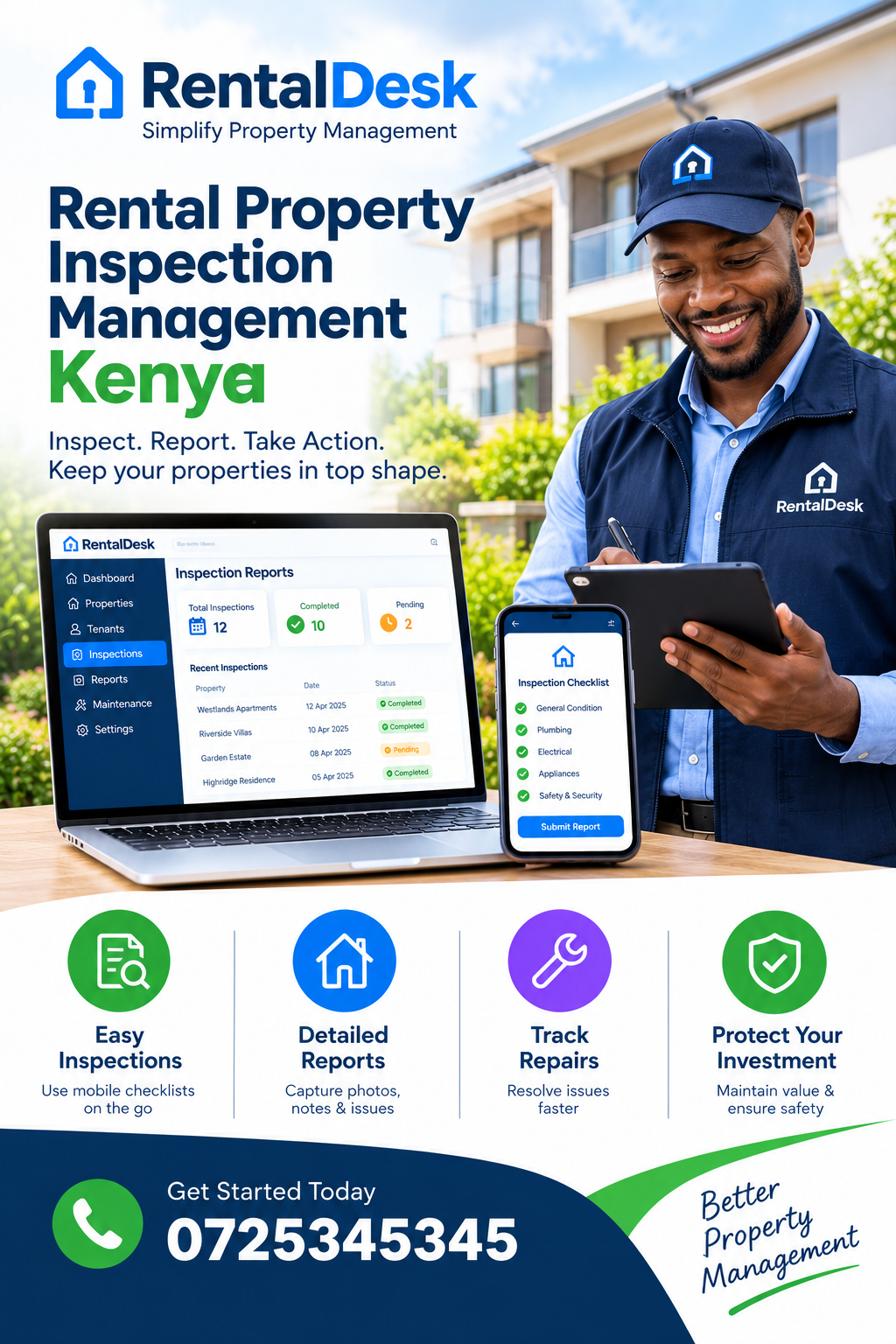
Property inspections are easy to underestimate until a landlord discovers a leak after a tenant has moved out, a property manager cannot prove when damage occurred, or maintenance teams are working from incomplete notes. Rental Property Inspection Management Kenya gives landlords, agents, and property managers a structured way to plan inspections, capture findings, assign corrective work, and keep a reliable record of property condition. For Kenyan rental businesses managing apartments, houses, student accommodation, or mixed portfolios, this approach can reduce missed issues and make inspection decisions easier to defend.
A good inspection process is not simply about walking through rooms with a checklist. It connects the condition of a unit to tenancy records, maintenance requests, photos, follow-up tasks, and management reports. That connection matters because property condition changes over time. A useful system helps a manager compare an earlier inspection with a later one, identify recurring problems, and determine which issues need immediate attention.
This guide explains what modern inspection management should cover, how software can improve the process, what Kenyan landlords should look for when selecting a solution, and how to introduce a consistent inspection routine without creating unnecessary administrative work.
Table of Contents
ToggleWhat is rental property inspection management?
For businesses building a repeatable inspection process, Rental Property Inspection Management Kenya provides a useful framework for organizing property condition information.
Rental property inspection management is the organized process of scheduling, conducting, recording, reviewing, and following up on inspections across rental properties. Rental Property Inspection Management Kenya turns that process into a repeatable workflow rather than a collection of paper forms, WhatsApp messages, photographs, and spreadsheets.
An inspection normally records the condition of rooms, fixtures, appliances, walls, floors, plumbing points, electrical fittings, external areas, and other assets relevant to a particular property. The inspection may happen before a tenant moves in, during a tenancy, after a reported problem, at a routine interval, or when a tenant moves out.
The important part is what happens after information is collected. If an inspection identifies a leaking tap, cracked tile, broken lock, damp wall, or damaged cabinet, someone must decide what happens next. A strong workflow connects the finding to a priority, responsible person, due date, and completion record.
Why inspection records matter
Inspection records create a timeline for property condition. A manager can see what was reported at handover, what changed during occupation, and what was repaired later. This is useful for routine maintenance planning and for discussions with owners, tenants, contractors, and property staff.
For a portfolio with many units, consistent records are even more valuable. A manager may remember the general condition of a building but struggle to remember which apartment had a damaged door, which unit needed repainting, or when a plumbing issue was last checked. Digital records reduce dependence on memory.
Why Kenyan landlords need a better inspection workflow
A consistent Rental Property Inspection Management Kenya process can also help managers standardize inspections across different buildings and teams.
Property managers in Kenya often coordinate inspections across multiple buildings and locations. Travel time, tenant availability, maintenance delays, incomplete notes, and scattered communication can make manual inspection processes difficult to control. Rental Property Inspection Management Kenya can provide a central workflow for planning inspections and tracking the results.
M-Pesa and other digital payment tools have improved the way many rental businesses handle collections, but property operations involve more than rent. A landlord also needs visibility into the physical condition of buildings, outstanding repairs, contractor activity, tenant reports, and recurring maintenance costs. Inspection information helps connect these operational areas.
Consider a manager with several apartment blocks in Nairobi. A spreadsheet might show that an inspection was scheduled, but it may not show the exact condition of each room, the photos taken, the issue priority, or whether the resulting repair was completed. A dedicated workflow can keep those details together.
The same challenge appears in smaller portfolios. Managing twenty units manually may seem straightforward until inspections, vacancies, repairs, and tenant communication start happening at the same time. A consistent inspection process becomes a practical control mechanism rather than an administrative luxury.
Key benefits of digital inspection management
The operational value of Rental Property Inspection Management Kenya becomes clearer when inspection records are connected to the decisions that follow.
1. Centralized property condition records
A central Rental Property Inspection Management Kenya record makes it easier to understand the condition of each rental unit over time.
Rental Property Inspection Management Kenya can give managers one place to store inspection information for units, buildings, and other rental assets. Instead of searching through folders or chat histories, staff can work from a structured property record.
Centralization also makes handovers easier. If one property officer leaves and another takes over, the new officer can review prior inspection records rather than reconstructing the history from memory.
2. Better inspection scheduling
Good Rental Property Inspection Management Kenya scheduling helps prevent routine checks from being lost among other property-management tasks.
Inspections are more useful when they happen at the right time. A system can help managers organize routine inspections, move-in checks, move-out checks, follow-up visits, and inspections triggered by maintenance concerns. Rental Property Inspection Management Kenya supports this kind of organized scheduling.
A schedule should account for the type of property, tenancy status, previous findings, and the urgency of unresolved issues. Not every unit needs the same inspection frequency, so managers should be able to adapt the process to their portfolio.
3. Faster issue identification
A well-designed Rental Property Inspection Management Kenya checklist can guide inspectors through important areas without making the visit unnecessarily slow.
An inspection checklist can guide staff through the same important areas every time. This reduces the risk of overlooking basic items such as water fittings, locks, windows, lighting, walls, floors, sanitation areas, and visible signs of moisture.
With Rental Property Inspection Management Kenya, inspection findings can be captured while the inspector is on site. That is more practical than taking handwritten notes and trying to enter them into a spreadsheet days later.
4. Clear maintenance follow-up
The connection between inspection and maintenance is central to effective Rental Property Inspection Management Kenya.
Finding a problem is only the first step. A cracked pipe connection or faulty electrical fitting remains a management problem until someone acts on it. Inspection software can connect findings to maintenance tasks so that issues have owners and deadlines.
This connection is one of the most useful parts of Rental Property Inspection Management Kenya. It turns an inspection from a passive report into an operational trigger. Managers can identify what needs attention, assign work, monitor progress, and confirm completion.
5. Better communication with property owners
Structured Rental Property Inspection Management Kenya reports can make owner updates clearer and more evidence-based.
Property owners want to know whether their assets are being maintained. A clear inspection record can help a manager explain why a repair was recommended, what condition was observed, and what action followed.
Reports can be particularly useful for owners who do not live near their properties. Instead of relying on informal updates, they can receive structured information about property condition and outstanding work.
What features should rental inspection software include?
When comparing Rental Property Inspection Management Kenya platforms, focus on how the features work together rather than counting features individually.
The right features depend on portfolio size and operating model, but a practical inspection platform should support the full inspection lifecycle. Rental Property Inspection Management Kenya is most useful when it covers preparation, field capture, review, action, and reporting rather than just storing a checklist.
Digital inspection checklists
A strong Rental Property Inspection Management Kenya checklist should be easy to complete and detailed enough to produce useful records.
Checklists create consistency. A manager can create sections for bedrooms, bathrooms, kitchens, living areas, external areas, common facilities, utilities, safety-related observations, and property-specific assets. Staff then follow the same basic structure during each visit.
Checklists should still allow notes. A rigid form can be just as frustrating as paper if it cannot capture unusual findings. The best workflow combines standard questions with flexible comments and evidence.
Photo and evidence capture
Evidence capture is an important part of Rental Property Inspection Management Kenya because condition findings are often easier to understand visually.
Photos can provide useful visual context for inspection findings. A written note such as “wall damaged” is less informative than a dated image connected to the relevant unit and inspection record. Rental Property Inspection Management Kenya can support evidence-based inspection documentation when image capture is part of the workflow.
Managers should establish sensible rules for photographs. Images should be relevant to the property condition being recorded, stored securely, and organized so staff can identify the unit and inspection date without confusion.
Condition ratings
Consistent ratings make Rental Property Inspection Management Kenya records easier to compare across units and inspection dates.
Condition ratings can help managers prioritize work. For example, a portfolio may use categories such as good, acceptable, needs attention, and urgent. The exact labels are less important than using them consistently.
A rating system becomes more useful when combined with notes and recommended action. A manager should be able to understand why an item received a particular rating and what should happen next.
Maintenance task creation
A mature Rental Property Inspection Management Kenya workflow should make it easy to turn an inspection finding into a trackable action.
An inspection finding should not disappear into a report. Rental Property Inspection Management Kenya can be integrated into a workflow where a finding becomes a maintenance task, with a responsible person and completion status.
For example, an inspector may identify water staining under a kitchen sink. The manager can create a plumbing task, assign it to the relevant technician, record the work completed, and retain the inspection evidence for future reference.
Inspection history
Historical information is one of the reasons Rental Property Inspection Management Kenya becomes more valuable as a portfolio grows.
Historical records help managers identify patterns. If the same unit repeatedly develops dampness, a recurring plumbing problem may require a different response from repeatedly sending someone to perform minor repairs.
With Rental Property Inspection Management Kenya, managers can compare inspection records over time and ask practical questions: Is the same defect recurring? Are certain units producing more maintenance work? Are common-area problems increasing? Which repairs remain open for too long?
Reporting and dashboards
Managers can use Rental Property Inspection Management Kenya dashboards to move quickly from portfolio-level visibility to individual inspection details.
Reports turn inspection data into management information. A manager may need a list of overdue inspections, unresolved findings, high-priority issues, recently completed repairs, or properties with repeated defects.
A useful Rental Property Inspection Management Kenya dashboard should help staff move from overview to detail. If a building shows several unresolved issues, the manager should be able to open the relevant inspection records and see what requires action.
Move-in inspections and tenant handover
A well-planned Rental Property Inspection Management Kenya process creates a consistent baseline for each new tenancy.
The beginning of a tenancy is an important point for establishing property condition. A move-in inspection should document the state of the unit before or around the time a tenant takes possession, according to the manager’s agreed process.
A structured Rental Property Inspection Management Kenya workflow can make handover records more complete by covering the same areas across different units. It can capture observations about walls, flooring, doors, windows, plumbing fixtures, electrical fittings, appliances, and other relevant items.
The purpose is not to create an unnecessarily complicated form. The objective is to establish a clear baseline. A good baseline makes later inspections easier to interpret because the manager can compare current condition with earlier records.
A practical move-in checklist
A basic checklist may include:
- Room condition
- Paintwork
- Flooring
- Doors and locks
- Windows
- Lighting
- Water fittings
- Sanitary facilities
- Kitchen fixtures
- Appliances where applicable
- Meters
- Exterior areas
- Existing defects
Property-specific items can be added for furnished apartments or specialized accommodation.
The tenant communication process should also be clear. If the tenant is expected to identify pre-existing issues, the manager should explain how and when to report them. Clear communication at handover can reduce confusion later.
Routine inspections during a tenancy
Routine inspections are intended to provide visibility into property condition while a tenancy is active. They should be planned carefully, communicated appropriately, and conducted according to the property manager’s procedures and applicable requirements.
Rental Property Inspection Management Kenya helps managers maintain a history of these visits rather than treating every inspection as a separate event. A recurring schedule can make it easier to identify units that need attention and prevent inspections from being forgotten.
Routine inspections should focus on observable property condition and maintenance needs. They should not become an excuse for unnecessary interference with a tenant’s use of the home. Professionalism matters because inspection quality depends partly on trust and cooperation.
Move-out inspections and vacancy preparation
For vacancy preparation, Rental Property Inspection Management Kenya can help turn condition observations into an organized readiness plan.
When a tenant leaves, the property often needs a detailed condition review before it is prepared for the next occupant. The manager may need to identify cleaning requirements, repairs, replacements, painting, plumbing work, or other tasks.
A well-organized Rental Property Inspection Management Kenya process can connect the move-out inspection to vacancy preparation. Findings can become a work list, allowing the manager to track what must be completed before the unit is marketed or handed over.
This is also where historical records become valuable. Comparing the move-out condition with the move-in baseline can help the manager investigate differences objectively rather than relying on memory.
Managing maintenance issues discovered during inspections
The effectiveness of Rental Property Inspection Management Kenya depends heavily on what happens after an issue is recorded.
Inspection management and maintenance management work best together. An inspection identifies a condition; maintenance resolves it. When those processes are separated, issues can be forgotten between the inspection report and the repair queue.
With Rental Property Inspection Management Kenya, a manager can structure the handoff between inspection and maintenance. Each finding can have a category, priority, assigned person, status, and completion note. This creates accountability without requiring staff to maintain several unrelated lists.
Prioritizing inspection findings
Not every finding deserves the same response time. A loose cabinet handle may be routine, while a serious water leak can require immediate attention. A simple priority framework helps staff allocate resources appropriately.
One practical approach is to classify findings as emergency, high, normal, or monitoring. The labels should match the organization’s actual response process. The goal is to ensure that urgency is visible rather than buried in a long inspection report.
Tracking contractors
Some property managers use external plumbers, electricians, cleaners, painters, technicians, or other service providers. Inspection records can provide a clear description of the issue before a contractor is assigned.
A Rental Property Inspection Management Kenya workflow can also help managers record completion details. This is useful when an owner asks what was repaired, when it was completed, and whether a recurring problem has been addressed before.
Inspection management for apartment buildings
For multi-unit buildings, Rental Property Inspection Management Kenya should make it possible to distinguish individual units from shared facilities.
Apartment blocks create a different operational challenge because managers may need to inspect individual units and shared areas. Common spaces such as staircases, corridors, parking areas, gates, waste areas, water systems, and shared facilities can generate their own maintenance findings.
Rental Property Inspection Management Kenya can help separate unit inspections from common-area inspections while keeping both within the same property portfolio. This distinction makes reporting clearer and helps managers see where maintenance demand is concentrated.
For large buildings, inspection templates can be standardized while allowing building-specific sections. That balance is useful because every property has different equipment, layouts, and operating procedures.
Inspection management for landlords with multiple properties
A scalable Rental Property Inspection Management Kenya workflow can help a landlord maintain consistent records as the portfolio expands.
A landlord with several properties may not need the same depth of workflow as a large agency, but consistency is still valuable. Without a central record, information can become fragmented between spreadsheets, notebooks, email, and messaging applications.
Rental Property Inspection Management Kenya can give a multi-property landlord a structured way to record inspection dates, findings, photos, repairs, and follow-up actions. The result is better visibility across the portfolio without requiring every task to be handled manually.
The most useful system is usually one that fits the landlord’s real process. A small portfolio should not be burdened with complicated procedures that staff will not maintain. Simplicity and consistency are more important than a long feature list.
Inspection reports for property owners
Property owners often want concise information rather than raw inspection data. A useful report can summarize the property inspected, date, major findings, recommended actions, open maintenance items, and completion status.
Rental Property Inspection Management Kenya can support a reporting workflow that turns detailed inspection records into information owners can understand. This is especially helpful for absentee owners who depend on a property manager to keep them informed.
Reports should distinguish observations from recommendations. “Paint is peeling in the bedroom” is an observation. “Repaint the bedroom before the next tenancy” is a recommendation. Keeping the two separate makes reports easier to interpret.
How inspection software improves accountability
Manual processes often create uncertainty about responsibility. A manager may know that a repair was mentioned but not who was supposed to arrange it. A structured Rental Property Inspection Management Kenya process can assign responsibility at the point when an issue is identified.
Accountability does not mean adding bureaucracy. It means making the next action visible. A task with an owner and status is easier to manage than a note in a group conversation.
Managers can also use completion records to review operational performance. If repairs regularly remain open for long periods, the business can investigate whether the cause is contractor availability, approval delays, communication problems, or insufficient prioritization.
Mobile inspections in the field
Property inspections happen away from the office, so mobile usability matters. Inspectors should be able to access the relevant property record, complete a checklist, capture notes, and record findings without creating a second round of data entry later.
A mobile-friendly Rental Property Inspection Management Kenya workflow can reduce the gap between what an inspector sees and what the management office knows. Timely data is particularly valuable when a finding needs prompt maintenance attention.
Managers should test the workflow under realistic conditions. Consider network availability, device screens, photo uploads, battery usage, and the amount of typing required. A system that works well in a demonstration but is frustrating in the field may not be adopted consistently.
Data organization and property records
Inspection information becomes much more useful when it is connected to the correct property, building, unit, tenant record where appropriate, and maintenance history. Good data organization prevents staff from having to guess which unit a photograph or note belongs to.
Rental Property Inspection Management Kenya should therefore be evaluated not only as an inspection checklist but as part of the wider property management record. The value increases when inspection history can be understood alongside other operational information.
A practical naming and classification system also matters. Properties, buildings, units, inspection types, issue categories, and statuses should use consistent labels. This makes searching and reporting easier as the portfolio grows.
Security and access control
Property data can contain sensitive operational information, so managers should pay attention to account security, user permissions, backups, and access controls when selecting software. Not every employee needs access to every administrative function.
For Rental Property Inspection Management Kenya, ask how different user roles work. An inspector may need to complete inspections, while a manager may need to approve maintenance actions and an owner may only need access to selected reports.
Businesses should also have clear internal rules for passwords, account sharing, device access, and handling photographs. Software is only one part of information security; staff practices matter as well.
Choosing the right inspection management system in Kenya
Choosing software should begin with the actual inspection process, not with a feature list. Before comparing platforms, write down how inspections currently happen, where delays occur, what information is often missed, and which reports managers need.
Then assess whether Rental Property Inspection Management Kenya supports those needs without adding unnecessary complexity. A useful evaluation should include scheduling, mobile use, checklists, photos, issue tracking, maintenance follow-up, reporting, user roles, and data management.
Questions to ask a software provider
Ask practical questions such as:
- Can inspection templates be customized for different property types?
- Can staff complete inspections from a phone?
- Can photos and notes be attached to specific findings?
- Can findings create or connect to maintenance tasks?
- Can managers see overdue inspections and unresolved issues?
- Can inspection history be searched by property or unit?
- Can different users have different permissions?
- Can reports be generated for owners and managers?
- What happens to data when a user leaves the organization?
- Is training available for staff who will use the system?
These questions help move the evaluation from marketing language to operational suitability.
Common mistakes to avoid
Relying entirely on spreadsheets
Spreadsheets can be useful for small tasks, but they become difficult to control when many inspections, images, properties, and maintenance actions are involved. The issue is not that spreadsheets are always bad; it is that they are often asked to perform the role of a workflow system.
Recording findings without follow-up
A detailed inspection report has limited value if nobody tracks the resulting work. Rental Property Inspection Management Kenya should be part of a process that connects findings to action.
Using different checklists for every inspector
Flexibility is useful, but completely different inspection methods make portfolio-level reporting difficult. Standardize the core checklist and allow sensible property-specific additions.
Ignoring historical information
A single inspection tells you about one point in time. The real operational value appears when managers can compare records and identify changes or recurring defects. Rental Property Inspection Management Kenya should therefore support inspection history rather than only current reports.
Choosing software based only on price
A low-cost tool may become expensive if staff avoid using it, information has to be entered twice, or managers cannot retrieve the reports they need. Evaluate total operational value rather than subscription cost alone.
A practical inspection workflow for Kenyan rental businesses
A simple workflow can be organized into eight stages:
- Schedule the inspection based on property and tenancy needs.
- Notify the relevant people and prepare the inspection checklist.
- Visit the property and record condition findings.
- Capture relevant photos and notes.
- Review findings and assign priorities.
- Create maintenance or follow-up actions.
- Track completion and record what was done.
- Keep the inspection report for future comparison and management reporting.
Rental Property Inspection Management Kenya can support this sequence when the software is configured around the organization’s actual operating procedures.
Measuring inspection performance
Once a process is digital, managers can track operational measures. Useful indicators may include inspection completion rate, number of overdue inspections, number of open findings, average time to close an issue, recurring defects, and maintenance workload by property.
These measures should be used for improvement rather than for creating unnecessary pressure on staff. If one property has many findings, the goal is to understand why. It could reflect older buildings, higher occupancy, deferred maintenance, or simply more thorough inspections.
A Rental Property Inspection Management Kenya reporting process can make these patterns easier to see and discuss during management reviews.
How inspections can support preventive maintenance
Preventive maintenance is easier when managers know what is happening before a minor defect becomes a major repair. Inspection findings can reveal early warning signs such as moisture, corrosion, worn fittings, loose fixtures, damaged seals, or deteriorating surfaces.
With Rental Property Inspection Management Kenya, managers can use inspection history to identify assets or areas that repeatedly need attention. This can inform maintenance planning and budgeting.
Preventive maintenance does not mean repairing everything immediately. It means making informed decisions about when to inspect, monitor, service, repair, or replace an asset based on condition and business priorities.
Cost considerations
The business case for Rental Property Inspection Management Kenya should include the cost of manual administration and delayed follow-up, not only the software subscription.
The cost of inspection management should be evaluated against the operational problems it is intended to solve. Consider staff time, travel, repeat visits, missed defects, delayed repairs, poor reporting, and administrative effort when assessing the value of software.
A Rental Property Inspection Management Kenya solution should be judged by whether it improves the workflow enough to justify its cost. For some businesses, the main benefit may be time saved. For others, the bigger value may be better maintenance coordination or clearer owner reporting.
Before adopting a system, identify a few measurable objectives. For example, a manager might aim to reduce overdue inspections, improve maintenance follow-up, or shorten the time needed to produce owner reports.
Getting staff to adopt the system
Technology only helps when people use it consistently. Training should focus on the real tasks staff perform: opening an inspection, selecting the correct property, completing the checklist, recording a finding, attaching evidence, and closing the workflow.
Keep the first version simple. Too many mandatory fields can make inspections slow and encourage staff to bypass the system. Rental Property Inspection Management Kenya should make the correct process easier than the old manual process.
Managers should review early inspection records for quality. If staff repeatedly leave important fields blank or categorize findings differently, adjust the checklist and provide targeted guidance.
Rental inspection management for Nairobi and other Kenyan markets
The same inspection principles can apply across Nairobi, Mombasa, Kisumu, Nakuru, Eldoret, Kiambu, and other rental markets, although property types and operational conditions vary. A platform should allow managers to adapt workflows to local portfolios rather than forcing every business into one template.
For a Rental Property Inspection Management Kenya strategy to work across multiple locations, property identification and reporting need to remain consistent. Managers should be able to distinguish buildings and units while still seeing portfolio-level trends.
Location can also influence scheduling. A manager responsible for properties in different areas may want to group inspections geographically to reduce unnecessary travel, while urgent maintenance findings may need action regardless of location.
Practical example: a three-building portfolio
Imagine a property manager overseeing three apartment buildings with a mix of occupied and vacant units. At the start of the month, several routine inspections are due. One building also has two unresolved plumbing findings from the previous month.
Using Rental Property Inspection Management Kenya, the manager can review the inspection schedule, complete the new visits, attach evidence to findings, and see the older plumbing issues on the same operational dashboard. A supervisor can then assign follow-up tasks and review which items remain open.
At month end, the manager can summarize inspections completed, outstanding defects, major maintenance actions, and issues requiring owner attention. The value comes from the connected workflow, not merely from having a digital checklist.
Practical example: a landlord preparing a vacant unit
A landlord receives notice that a tenant is leaving. Instead of waiting until the property is empty and then starting from scratch, the landlord can plan a move-out inspection, document the condition, and create a preparation list.
If Rental Property Inspection Management Kenya is connected to maintenance tasks, the manager can assign painting, plumbing, electrical, cleaning, or repair work as required. Once work is complete, the record can show what was done before the next tenant moves in.
This approach can shorten the gap between vacancy and readiness because the work list is based on documented findings rather than informal recollection.
Building a strong inspection policy
Software should support a clear inspection policy. The policy should explain inspection types, responsibilities, documentation standards, escalation procedures, and how findings are closed.
A business using Rental Property Inspection Management Kenya can translate the policy into templates and workflows. This creates a repeatable standard even when different employees conduct inspections.
The policy should also be reviewed periodically. If staff discover that a checklist is missing important property-specific items, update it. If certain fields never influence a decision, consider simplifying them.
The future of property inspection operations
Inspection management is moving toward more connected property operations. Managers increasingly expect information from inspections to flow into maintenance, reporting, tenant service, and asset management rather than remain in isolated documents.
For Kenyan rental businesses, Rental Property Inspection Management Kenya can form part of that connected approach by creating a reliable condition record that supports day-to-day decisions.
The strongest workflows will remain practical. Automation should remove repetitive administrative work while leaving managers in control of decisions that require context, judgment, and communication.
Frequently asked questions
What does rental property inspection management software do?
Rental Property Inspection Management Kenya software helps organize inspection scheduling, checklists, property condition records, photos, findings, follow-up actions, maintenance tasks, and reports. The exact features depend on the platform.
Why should a landlord digitize property inspections?
Digital records make inspection information easier to organize, search, compare, and share. They can also reduce duplicated data entry and make maintenance follow-up more visible.
Can inspection software be used for apartment buildings?
Yes. A suitable system can support inspections at unit level as well as common-area checks. Managers should look for flexible property and inspection structures.
Can photos be included in inspection records?
Many modern systems support photos or other evidence. Managers should check how images are stored, organized, accessed, and protected before choosing a platform.
How often should rental properties be inspected?
There is no single schedule that fits every property. Frequency depends on the property, tenancy arrangements, management policy, and applicable requirements. The important point is to have a clear, consistently applied process.
Can inspection findings create maintenance tasks?
They can when the software supports an integrated workflow. This is useful because a defect can move directly from inspection into assignment, tracking, and completion.
Is mobile access important for property inspectors?
Yes. Inspectors usually work on site, so a mobile-friendly process can reduce paper notes and later data entry. Test the system in realistic field conditions before adoption.
What should Kenyan landlords consider when choosing inspection software?
Look at usability, mobile access, checklists, photo capture, maintenance follow-up, reporting, user permissions, property history, data security, training, and the overall fit with the landlord’s workflow.
Can inspection records help with owner reporting?
Yes. Structured records can provide evidence for property condition updates, maintenance recommendations, completed repairs, and outstanding issues, making owner communication more consistent.
What is the biggest benefit of a structured inspection process?
The biggest benefit is continuity. A structured process turns individual inspections into a property history that can support maintenance decisions, accountability, reporting, and long-term asset care.
Conclusion
Rental Property Inspection Management Kenya can help turn rental inspections into a consistent operational process. Rental inspections should produce more than a completed checklist. They should give managers a reliable picture of property condition and a clear path from finding to action. For landlords and property managers handling multiple units, a structured digital workflow can make that process easier to control and easier to review.
Rental Property Inspection Management Kenya is particularly valuable when it connects scheduling, inspection forms, evidence, maintenance follow-up, historical records, and reporting in one practical process. The goal is not to digitize paperwork for its own sake. The goal is to help property teams notice issues earlier, respond consistently, and maintain a clear operational record.
For a Kenyan rental business considering software, start with the problems you want to solve. Map the current inspection process, identify the points where information gets lost, define the reports managers need, and choose a system that staff can realistically use. A simple workflow used consistently will usually deliver more value than a complicated system that nobody wants to open.