
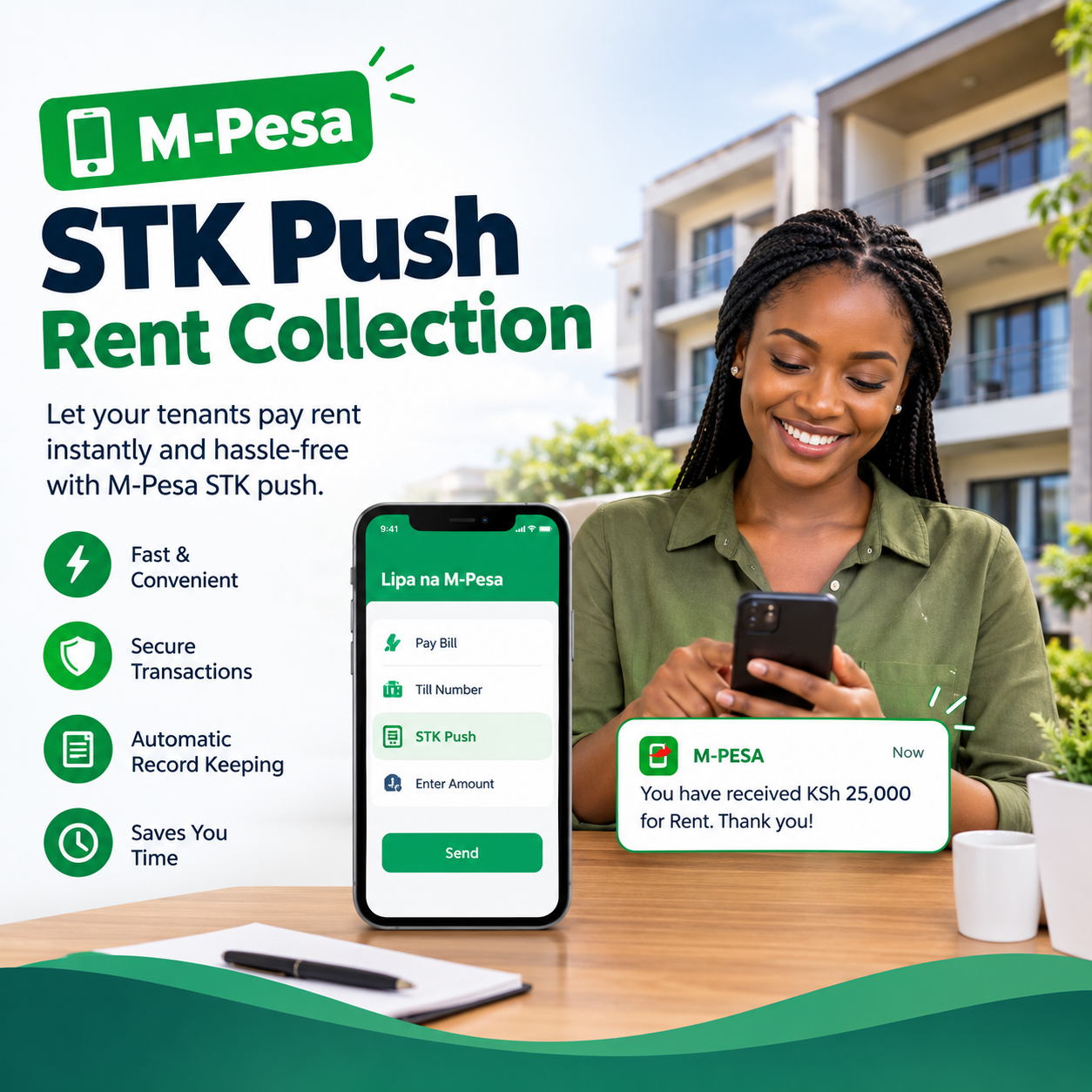
M-Pesa STK push rent collection is the collection method where the landlord’s platform sends a payment prompt directly to the tenant’s phone, the tenant confirms with their PIN, and the rent lands — matched, receipted, and reconciled — without anyone typing a Paybill number.
You have already experienced the mechanic if you have ever bought anything online in Kenya: the popup appears, names the amount, and waits for one decision. Applied to rent, that mechanic becomes a complete collection workflow, and understanding the whole loop — not just the tap — is what separates landlords who collect brilliantly from those who collect hopefully.
This guide is the complete workflow guide to M-Pesa STK push rent collection in 2026. We cover how the prompt fits into the full cycle from invoice to reconciliation, what each stage demands from your platform, and where the method’s limits genuinely lie. We also cover tenants without prompts, dismissed payments, insufficient balances, and the evaluation questions that expose weak implementations before you spend anything.
By the end, you will be able to run and evaluate M-Pesa STK push rent collection like a professional operator. Whether you collect from six bedsitters in Rongai or six hundred apartments across Nairobi, the loop is identical. Only the volumes change — and the loop handles those without complaint, which is the quiet promise of well-built M-Pesa STK push rent collection.
Where STK Push Sits in the Collection Loop
Rent collection is a loop, and M-Pesa STK push rent collection is one stage of it executed brilliantly. The loop runs: charge posted, invoice delivered, payment prompted, payment confirmed, status updated, receipt issued, and record reconciled. The prompt stage is where tenants act — and because it is the stage where humans meet the system, its design determines whether the whole loop feels effortless or exhausting.
Upstream of the prompt sits billing. The platform posts the month’s charge to each account and delivers the invoice, ideally carrying a pay button that triggers the prompt directly. That button-to-prompt connection is what turns ordinary billing into genuine M-Pesa STK push rent collection.
Downstream of the prompt sits reconciliation. The moment the tenant confirms, the payment carries its amount and unit inside the transaction itself, so matching requires no detective work. That built-in certainty is what makes M-Pesa STK push rent collection the cleanest data source in the entire collection stack.
The complete loop, working together, is the real product. Charge, prompt, confirmation, receipt, and reconciliation happen as one continuous flow with no gaps where errors breed. That seamlessness is the standard a mature M-Pesa STK push rent collection implementation holds.
What Happens at Each Stage
Stage one is the charge. Rent posts to each unit’s account on its due date, creating the balance the prompt will settle. Accurate charging is the foundation of any M-Pesa STK push rent collection flow, because a prompt carrying the wrong amount undermines everything after it.
Stage two is the invoice or reminder. The platform delivers the bill — with payment instructions or a pay button — so the tenant knows what is owed before anything lands on their screen. Prompt-based M-Pesa STK push rent collection works best when the prompt confirms a debt the tenant already understands.
Stage three is the prompt itself. The platform triggers the request through official business channels, and the tenant’s phone displays the merchant name and exact amount before asking for the PIN. That pre-PIN transparency is the security signature of genuine M-Pesa STK push rent collection.
Stage four is the decision. The tenant confirms, dismisses, or fails on balance — and each outcome follows its own honest path through the system. Handling all three outcomes gracefully is the design test of a mature M-Pesa STK push rent collection platform.
Stage five is the settlement. Confirmed payments move from wallet to account instantly, statuses flip on the dashboard, and receipts reach both parties within minutes. That instant closure is the payoff stage of the whole M-Pesa STK push rent collection loop.
Stage six is reconciliation and the archive. Because the prompt carried its own data, matching is trivial, and the record joins a permanent, searchable history. Every completed cycle strengthens the evidentiary depth of your M-Pesa STK push rent collection system.
The Three Outcomes: Confirmed, Dismissed, Failed
Outcome one is confirmation, and it is the happy path. The tenant enters the PIN, money moves, and both parties receive their proof within seconds. Every completed prompt is the moment M-Pesa STK push rent collection earns its reputation.
Outcome two is dismissal, and it deserves gentle handling. Tenants dismiss prompts for harmless reasons — mid-meeting, mid-commute, or simply wanting a moment to think. A dismissed prompt should re-prompt politely later or convert to a reminder, never a penalty, which is the etiquette built into quality M-Pesa STK push rent collection.
Outcome three is failure on balance, and honesty is the only policy. Insufficient funds produce a clean failure: nothing moves, nothing is charged, and the status stays accurate. Graceful failure handling is what keeps a M-Pesa STK push rent collection system trustworthy through tenants’ real financial lives.
The tracker behind the prompt watches all three outcomes. Confirmation counts, dismissal patterns, and repeat failures become visible data rather than invisible frustration. That outcome intelligence is the management layer inside serious M-Pesa STK push rent collection.
What the Prompt Cannot Do
Honesty about limits makes this guide trustworthy, so name them clearly. The prompt is a payment mechanic, not a collection strategy — it moves money beautifully but does not decide who gets prompted or when. Judgment about timing, tone, and tenant circumstances remains yours in any M-Pesa STK push rent collection system.
The prompt also depends on registered channels. Only businesses registered with the mobile money provider can trigger prompts, which is why landlords access the capability through platforms that have completed that work. That dependency is a structural fact of M-Pesa STK push rent collection, not a limitation you can negotiate away.
And prompts require reachable phones with active lines. Feature phones are covered, but numbers that are off, changed, or abandoned break the loop silently. Phone hygiene is the unglamorous maintenance that every M-Pesa STK push rent collection system requires.
Naming the limits is not a criticism but a calibration. The prompt is the best payment mechanic ever deployed to Kenyan rent — and it works best inside a complete platform that handles everything around it. That partnership view is the correct way to buy M-Pesa STK push rent collection.
Tenants Without Prompts: The Inclusive Collection Desk
Some tenants will not be reachable by prompt — shared phones, feature phones without the feature, or simple preference — and inclusive systems plan for them. Fallbacks include Paybill instructions inside the same invoice, cash protocols with same-day logging, and SMS-delivered payment details. Every complete M-Pesa STK push rent collection platform therefore offers prompts as the highway, not the only road.
The unified ledger is what makes the fallbacks honest. Whether money arrives by prompt, Paybill, or cash, it lands in the same reconciled record with the same status trail. One source of truth across channels is the completeness standard of mature M-Pesa STK push rent collection.
Test the fallbacks during evaluation. Ask every provider what happens for the tenant who cannot receive a prompt, and judge the specificity of the answer. Vague answers on fallbacks are the clearest signal of shallow M-Pesa STK push rent collection implementations.
Why 2026 Is the Breakout Year
Three forces have converged to make this the year prompt-based collection goes mainstream. First, official business channels have opened to platforms of every size, so the capability is no longer corporate-exclusive. That accessibility is what put M-Pesa STK push rent collection within every landlord’s reach.
Second, tenant behavior is fully trained. A generation that taps to pay for shopping, rides, and bills needs zero education to confirm rent the same way. That behavioral readiness is the adoption engine behind M-Pesa STK push rent collection this year.
Third, competition has made the loop the product. Providers now sell the complete cycle — prompt, confirmation, receipt, reconciliation — rather than a feature on a page. That whole-loop selling is what separates serious M-Pesa STK push rent collection platforms from gimmicks.
Security: What Tenants Must Know
The prompt is safe because of what it removes. The PIN is entered only into the official prompt on the tenant’s own phone, and money moves directly to the registered account. No landlord, agent, or platform ever needs a tenant’s PIN — and any request for one is fraud, full stop.
Genuine prompts display the merchant and the exact amount before the PIN step. Tenants should verify both before confirming, every single time, as a standing habit. That verify-first reflex is the personal security layer inside every M-Pesa STK push rent collection system.
Dismissing a prompt is always safe. If a prompt names an amount or a merchant you did not expect, dismiss it and ask your landlord directly — nothing is lost by caution. Teaching that reflex protects every M-Pesa STK push rent collection portfolio from impersonation attempts.
Features to Demand in 2026
Evaluate any platform against this checklist before committing. First, demand prompts that trigger directly from invoices and reminders, because a pay flow buried in menus defeats its own purpose. That one-tap initiation is the entry ticket for serious M-Pesa STK push rent collection.
Second, expect automatic status updates and instant receipts the moment a prompt confirms. Third, look for graceful handling of all three outcomes — confirm, dismiss, and fail — with polite re-prompting rather than penalties. Fourth, confirm one unified ledger where prompt payments join Paybill, cash, and bank records. Those capabilities together define mature M-Pesa STK push rent collection.
Fifth, verify the inclusive fallbacks for tenants the prompt cannot reach. Sixth, test the export door — complete payment history in standard formats, whenever you ask. Seventh, confirm outcome analytics: confirmation rates, dismissal patterns, and repeat failures visible on your dashboard. Breadth of that kind separates real M-Pesa STK push rent collection from a payment button with a website.
Choosing Your Platform
Selection starts from your realities rather than the loudest advert. Portfolio size, tenant phone mix, and your current collection friction should shape the choice. The right M-Pesa STK push rent collection platform fits your operation exactly.
Trial with real money, without exception. Send one real prompt to your own number, confirm it, watch the receipt land, and export the record — all before paying anything. One true cycle tells you more about M-Pesa STK push rent collection than a month of demonstrations.
What It Costs
The capability rides inside platform plans rather than standing alone. Free tiers cover small portfolios with basic flows, per-unit plans commonly run KSh 20–100 monthly, and full platforms range from roughly KSh 500–5,000 depending on scale. Standard M-Pesa transaction charges apply to every collection exactly as they always have, so confirm current rates and read M-Pesa STK push rent collection quotes with that split in mind.
Weigh the price against the loop’s value honestly. Faster collections, fewer wrong-number payments, automatic receipts, and reconciliation that does itself all flow from one stage done perfectly. Viewed that way, the true cost of running M-Pesa STK push rent collection approaches zero within the first cycle.
Getting Started the Right Way
Begin with one supervised test. Send a prompt to yourself, confirm it, and watch every downstream stage — status, receipt, reconciliation — complete in front of you. That personal rehearsal is the foundation of every successful M-Pesa STK push rent collection rollout.
Then introduce it to tenants warmly. A short message explaining the one-tap payment, the PIN-safety rule, and the instant receipt sets exactly the right tone. Tenants consistently welcome well-explained M-Pesa STK push rent collection as a gift rather than a policy.
Then watch the first month closely. Note confirmation rates, dismissals, and any tenants the prompt misses, and activate the fallbacks deliberately. That supervised cycle is what turns any M-Pesa STK push rent collection rollout into a permanent system.
Common Mistakes to Avoid
The most common mistake is over-prompting. Repeated requests train tenants to dismiss, and a dismissed habit is hard to rebuild — so let reminders escalate politely instead. Courtesy of that kind is what keeps M-Pesa STK push rent collection trusted for years.
The second mistake is treating the prompt as the whole system. A tap-to-pay without underlying records — invoices, balances, history — is just a faster way to collect confusion. Anchor the mechanic inside a complete platform, and M-Pesa STK push rent collection becomes infrastructure rather than a gadget.
Real Scenarios from Real Portfolios
Picture a landlord in Nakuru with fourteen bedsitters whose payments once arrived via six different habits. After moving to prompt-based collection, most rent landed within forty-eight hours of the invoice, and wrong-number payments disappeared entirely. The reclaimed month-ends alone covered years of her M-Pesa STK push rent collection subscription.
Picture a diaspora owner in Atlanta whose Kilimani tenants once paid through a caretaker’s hands. Prompts now fire from her platform, confirmations reach both sides instantly, and her reconciliation happens itself across the time difference. Collections at that distance are the everyday export of M-Pesa STK push rent collection.
Picture a tenant in Kitengela paying from a matatu at 7 a.m. The prompt names her unit and exact amount, she confirms with one tap, and her receipt lands before she reaches town. That frictionless moment is the tenant-side experience of M-Pesa STK push rent collection done right.
Picture a caretaker in Embakasi whose cash collections once invited suspicion. With prompts carrying most payments directly, his remaining cash duties are logged same-day with photos, and his reliability is provable rather than presumed. The dignity dividend is the human side of M-Pesa STK push rent collection.
The Road Ahead: 2027 and Beyond
The trajectory points toward prompts that anticipate rather than respond. Prediction is arriving — systems learning each tenant’s payday and timing prompts for maximum confirmation rates. The M-Pesa STK push rent collection of 2027 will feel less like a request and more like a well-timed courtesy.
Integration is deepening alongside it. Prompts, statuses, receipts, and statements are converging into single flows where the entire collection loop travels together. That connected future is already visible across the M-Pesa STK push rent collection market, and it will accelerate.
Frequently Asked Questions
What is M-Pesa STK push rent collection, in simple terms?
It is a collection workflow where the landlord’s platform sends a payment prompt to the tenant’s phone, the tenant confirms with their PIN, and the rent lands — matched, receipted, and reconciled — without anyone typing payment details. Think of it as the checkout experience of online shopping, applied to rent. That prompt-driven loop defines genuine M-Pesa STK push rent collection.
How is this different from tenants paying through a Paybill number?
A Paybill asks the tenant to initiate and type everything manually, while a prompt carries the amount and account inside itself so the tenant only confirms. The difference is the six manual steps and six error chances removed from every payment. That error elimination is the core advantage of M-Pesa STK push rent collection.
What happens when a tenant dismisses the prompt or has no balance?
Dismissals re-prompt politely later or convert to reminders, and balance failures complete cleanly with nothing lost and nothing charged — both outcomes recorded honestly. Nothing is lost until the PIN is entered and confirmed, so mistakes cost nothing. That graceful handling is built into mature M-Pesa STK push rent collection.
Does it work for tenants on feature phones?
Yes — the mechanism lives in the SIM toolkit itself, so prompts reach ordinary feature phones just as easily as smartphones, with SMS fallbacks for anyone the prompt cannot reach. Universal reach is one of its quiet strengths. That inclusiveness is standard in complete M-Pesa STK push rent collection platforms.
Is it safe for tenants?
Yes — the PIN is entered only into the official prompt on the tenant’s own phone, genuine prompts display the merchant and exact amount before asking anything, and dismissing an unexpected prompt is always safe. No one ever needs a tenant’s PIN for any legitimate purpose. Those safeguards are the security architecture of M-Pesa STK push rent collection.
How is this different from the general STK push article I have read elsewhere?
The earlier guide explains the payment mechanic — what the prompt is and why tenants and landlords love it — while this one covers the collection workflow around it: the full loop, the three outcomes, the fallbacks, and buyer evaluation. Read together, they cover both the mechanic and the machinery of M-Pesa STK push rent collection.
Where should I start if I want everything in one place?
Start with a platform that combines verified listings with prompt-based collection, such as rentaldesk.co.ke. Pairing the right tenants with a demonstrated M-Pesa STK push rent collection loop takes you from hoping rent lands to watching it close — prompt by prompt, month after month.