
Tenant Rent Payment Tracking Software Kenya: A Complete Guide for Landlords and Property Managers
Managing rent becomes considerably more difficult when tenant payments are spread across M-Pesa messages, bank statements, notebooks, spreadsheets, receipts, and conversations. Tenant Rent Payment Tracking Software Kenya provides a structured way to connect tenants, units, invoices, payments, balances, and arrears so landlords and property managers can work from one reliable record. This guide explains what rent payment tracking software does, why it matters in Kenya, the features to look for, how M-Pesa reconciliation works, how to manage partial payments and arrears, and how to choose a system that fits your rental operation.
For a landlord with five units, manual tracking may initially seem manageable. For a property manager handling dozens or hundreds of units, however, manually comparing payment messages against tenant ledgers can consume hours and create opportunities for errors. Tenant Rent Payment Tracking Software Kenya can help turn a fragmented rent collection process into a repeatable workflow.
The goal is not simply to record that money was received. A useful system should answer several questions quickly: Which tenant paid? Which unit does the payment belong to? Which invoice did it settle? Was the payment full or partial? What balance remains? Is the tenant overdue? How much has the property collected this month? Which payments still need reconciliation?
For Kenyan landlords and agencies, these questions are especially relevant because M-Pesa is an important part of everyday payment activity. A strong rental platform therefore needs to connect digital payments with tenant records rather than treating every transaction as an isolated entry.
What Is Tenant Rent Payment Tracking Software?
Tenant Rent Payment Tracking Software Kenya refers to software designed to record, organize, reconcile, and report tenant rent payments. Instead of maintaining separate records for tenants, invoices, receipts, and payments, the system connects these elements.
A typical workflow looks like this:
- A property and unit are created.
- A tenant is assigned to the unit.
- The monthly rent invoice is generated.
- The tenant makes a payment.
- The payment is captured or recorded.
- The payment is matched to the tenant and invoice.
- The tenant balance is updated.
- Any remaining amount is identified as outstanding.
- Reports show collection performance and arrears.
Tenant Rent Payment Tracking Software Kenya is therefore more than a digital notebook. It creates a relationship between the expected rent and the money actually received.
This distinction matters. Suppose a tenant owes KSh 20,000 and sends KSh 12,000. A simple transaction register might show that KSh 12,000 was received. A proper rent tracking system should also show that KSh 8,000 remains outstanding.
That difference becomes increasingly important as the portfolio grows.
Why Accurate Rent Payment Tracking Matters
Tenant Rent Payment Tracking Software Kenya helps property teams move from payment recording to payment accountability.
Accurate tracking supports several areas of rental operations.
1. Better visibility
Property managers should not have to open several spreadsheets or scroll through hundreds of messages to determine the current rent position. A centralized dashboard can show paid, part-paid, unpaid, and overdue accounts.
2. Faster follow-up
Tenant Rent Payment Tracking Software Kenya makes it easier to identify tenants who require follow-up. Instead of waiting until the end of the month, managers can review outstanding balances as they develop.
3. Fewer reconciliation errors
When payments are manually copied between systems, mistakes can occur. A payment may be allocated to the wrong tenant, entered twice, or left unmatched.
4. Better landlord reporting
Property owners need confidence that collection reports accurately reflect what has been received. Connected tenant ledgers and payment records make reporting easier to verify.
5. Stronger cash-flow visibility
A rental business depends heavily on predictable collections. Knowing how much has been received and how much remains outstanding helps landlords make better financial decisions.
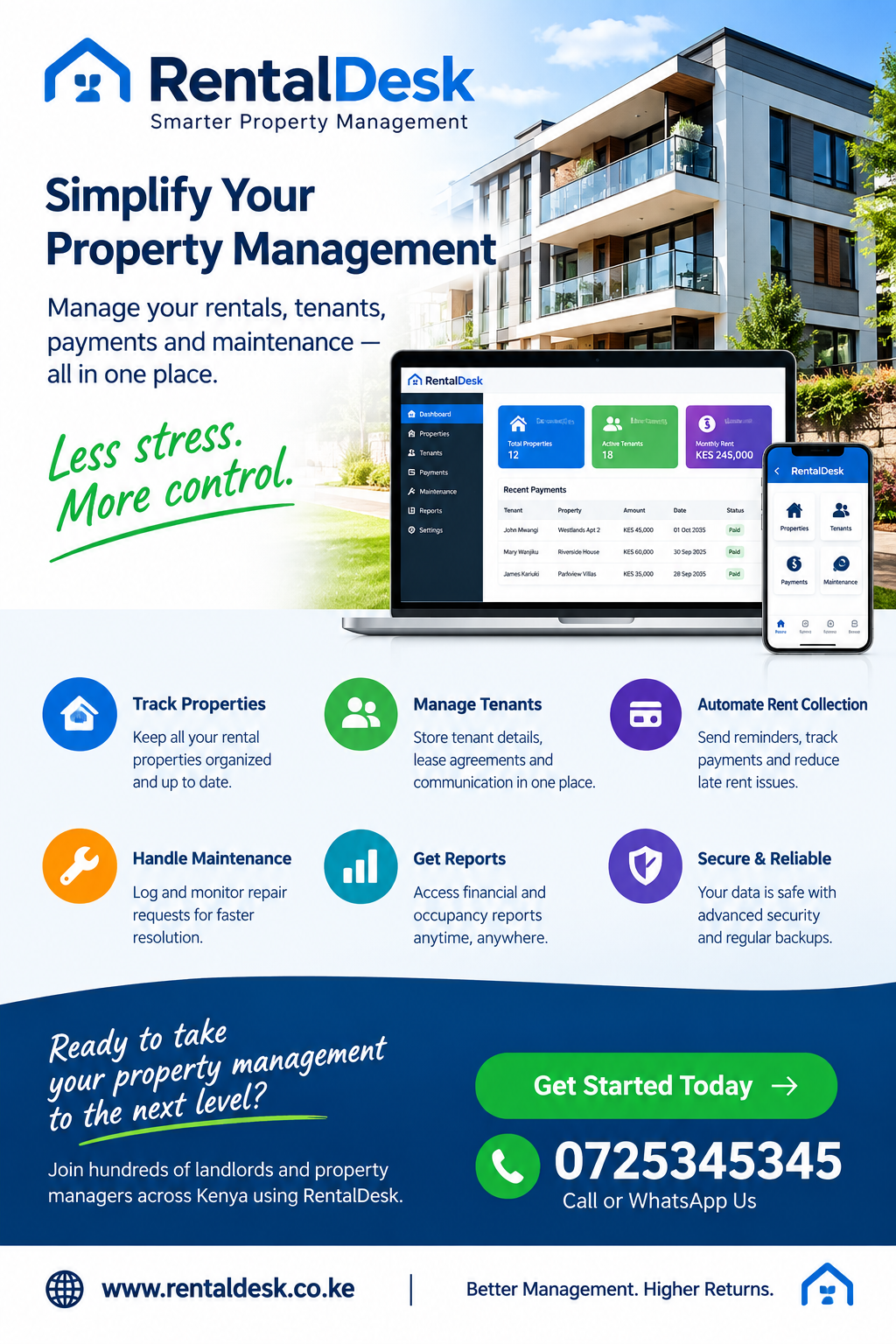
RentalDesk describes its workflow around properties, units, tenants, invoices, payments, balances, and reports, with M-Pesa collection and reconciliation built into the rental operation.
The Problem With Manual Rent Payment Tracking
Tenant Rent Payment Tracking Software Kenya becomes particularly valuable when a landlord starts experiencing the limitations of manual records.
A spreadsheet can be useful. It is inexpensive, familiar, and flexible. The problem is that spreadsheets do not automatically solve the operational complexity surrounding rent.
Consider a property with 60 units.
Every month, the manager may need to:
- Generate rent charges.
- Monitor payments.
- Match M-Pesa references.
- Record cash or bank payments.
- Update tenant balances.
- Identify partial payments.
- Follow up on arrears.
- Produce receipts.
- Prepare owner reports.
- Check disputed transactions.
- Track payment dates.
- Correct data-entry errors.
Doing all of this manually increases administrative pressure.
Tenant Rent Payment Tracking Software Kenya can centralize these activities so that the team is not constantly switching between different records.
Common manual tracking problems
| Manual problem | Possible consequence |
|---|---|
| Duplicate payment entries | Incorrect tenant balance |
| Missing payment references | Difficult reconciliation |
| Outdated spreadsheets | Incorrect arrears information |
| Manual calculations | Arithmetic errors |
| Scattered receipts | Poor payment history |
| Delayed updates | Late follow-up |
| Multiple versions of files | Conflicting information |
| Unmatched payments | Unclear account ownership |
The larger the property portfolio, the more difficult these problems become to control.
How M-Pesa Changes Rent Collection in Kenya
Tenant Rent Payment Tracking Software Kenya needs to account for the way Kenyan tenants commonly make payments.
M-Pesa can make rent collection convenient, but receiving a mobile payment is only the first step. Property managers still need to determine which tenant made the payment, which account should receive it, what invoice it covers, and whether the payment settles the balance.
RentalDesk positions M-Pesa as a central part of its rent collection workflow, including payment capture, tenant matching, reconciliation, balance updates, receipts, and collection reporting.
A practical M-Pesa workflow can look like this:
Tenant → M-Pesa payment → Payment reference → Tenant matching → Invoice allocation → Balance update → Receipt → Reporting
Tenant Rent Payment Tracking Software Kenya helps make this chain more structured.
Without a connected system, the manager may receive the M-Pesa notification, copy the transaction into Excel, search for the tenant, calculate the remaining balance, and later update a separate report.
That process is manageable at a small scale but increasingly difficult as transaction volumes increase.
What Should a Rent Payment Tracking System Record?
Tenant Rent Payment Tracking Software Kenya should provide a complete payment history rather than merely displaying a total amount.
Useful records include:
- Tenant name
- Tenant contact details
- Property
- Building
- Unit
- Lease information
- Monthly rent
- Invoice number
- Invoice date
- Due date
- Payment date
- Payment amount
- Payment method
- M-Pesa reference
- Bank reference where applicable
- Outstanding amount
- Arrears
- Receipt information
- Payment status
The more connected these records are, the easier it becomes to investigate a payment question.
For example, if a tenant claims to have paid KSh 15,000, the manager should be able to locate the transaction, identify the tenant, see the applicable invoice, and determine whether the account is now settled.
Tenant Rent Payment Tracking Software Kenya supports this broader concept of keeping payment information connected to the underlying rental account.
Full Payments, Partial Payments and Overpayments
One of the most important features of Tenant Rent Payment Tracking Software Kenya is the ability to distinguish different payment situations.
Full payment
If monthly rent is KSh 25,000 and the tenant pays KSh 25,000, the invoice can be marked as settled.
Partial payment
If the tenant pays KSh 15,000, the system should show:
- Rent charged: KSh 25,000
- Amount paid: KSh 15,000
- Remaining balance: KSh 10,000
The tenant should remain visible as part-paid or outstanding until the remaining amount is settled or properly adjusted.
Overpayment
If a tenant pays more than the current invoice, the additional amount needs to be visible and handled according to the property’s accounting rules.
Tenant Rent Payment Tracking Software Kenya should make these scenarios visible instead of forcing the property manager to calculate them manually.
RentalDesk specifically states that its system can show part-paid tenants and update remaining balances, while unmatched or unclear M-Pesa transactions can be reviewed through reconciliation workflows.
Managing Rent Arrears More Effectively
Tenant Rent Payment Tracking Software Kenya becomes particularly useful when a property manager needs to control arrears.
Arrears are not simply a financial figure. They are an operational task.
A useful arrears workflow should show:
- Who owes money.
- How much they owe.
- Which invoice is overdue.
- How long the balance has remained unpaid.
- Whether the tenant has made a partial payment.
- Whether a follow-up has been made.
- What action should happen next.
RentalDesk’s arrears workflow is designed around tenant balances, overdue invoices, part-paid rent, promises to pay, notices, and follow-up lists.
This allows the manager to prioritize work.
For example:
| Tenant | Monthly Rent | Paid | Balance | Status |
|---|---|---|---|---|
| Tenant A | KSh 20,000 | KSh 20,000 | KSh 0 | Paid |
| Tenant B | KSh 20,000 | KSh 12,000 | KSh 8,000 | Part-paid |
| Tenant C | KSh 20,000 | KSh 0 | KSh 20,000 | Unpaid |
| Tenant D | KSh 25,000 | KSh 25,000 | KSh 0 | Paid |
The advantage is obvious: the manager can immediately focus on Tenants B and C.
Why Tenant Balances Need to Be Current
Tenant Rent Payment Tracking Software Kenya is useful when tenant balances are treated as live operational information.
An outdated balance can lead to several problems.
A tenant may be contacted about rent they already paid. A landlord may receive an incorrect arrears report. A payment may be allocated to the wrong account. Staff may make decisions based on yesterday’s information.
Current balances reduce these problems.
The ideal workflow connects invoices and payments directly so that every confirmed payment changes the tenant’s outstanding position.
That means the manager can answer questions such as:
- What does this tenant owe right now?
- What did they pay last month?
- Which invoices remain open?
- When was the last payment?
- How much has the tenant paid this year?
Tenant Rent Payment Tracking Software Kenya can represent the broader principle that financial records should be structured around individual accounts rather than isolated transactions.
Automated Rent Invoicing
A payment tracking system works best when the amount expected from the tenant is clearly defined.
Tenant Rent Payment Tracking Software Kenya can support this by connecting rent invoicing with payment tracking.
Instead of asking, “How much should this tenant have paid?”, the system can start with the invoice.
For example:
Expected: KSh 18,000
Paid: KSh 18,000
Outstanding: KSh 0
Or:
Expected: KSh 18,000
Paid: KSh 10,000
Outstanding: KSh 8,000
This creates a clearer audit trail.
RentalDesk lists automated rent invoicing, recurring billing, due-date reminders, payment tracking, and arrears visibility among its features.
Payment Reconciliation Explained
Tenant Rent Payment Tracking Software Kenya should include reconciliation because receiving money and correctly allocating money are two different tasks.
Reconciliation means comparing incoming payment information against expected tenant accounts and confirming that the transaction has been assigned correctly.
Suppose a property receives 40 M-Pesa transactions in one afternoon. The manager needs to know:
- Which tenant made each payment?
- What unit do they occupy?
- What amount was received?
- What invoice does it settle?
- Is the transaction duplicated?
- Is the payment reference valid?
- Is there any unexplained balance?
A reconciliation queue can help staff review exceptions rather than manually checking every normal transaction.
Tenant Rent Payment Tracking Software Kenya is relevant to this principle because financial control depends on knowing where every transaction belongs.
RentalDesk states that its bank and M-Pesa reconciliation workflow supports payment matching, exception review, unmatched transactions, and accountable payment allocation.
Tenant Statements and Payment History
A strong tenant statement provides a chronological view of the account.
Tenant Rent Payment Tracking Software Kenya can help organize information around invoices, payments, credits, balances, and outstanding amounts.
A typical statement might show:
| Date | Description | Charge | Payment | Balance |
|---|---|---|---|---|
| 1 Oct | October rent | KSh 20,000 | — | KSh 20,000 |
| 3 Oct | M-Pesa payment | — | KSh 15,000 | KSh 5,000 |
| 8 Oct | M-Pesa payment | — | KSh 5,000 | KSh 0 |
This type of history is useful when a tenant asks for clarification or when an agency prepares a landlord report.
It also creates a clearer record than relying on screenshots of mobile messages.
Tenant Portals and Self-Service
Tenant Rent Payment Tracking Software Kenya can also support a tenant-facing approach where renters have controlled access to their own financial information.
A tenant portal can allow renters to view:
- Current balance
- Invoices
- Receipts
- Payment history
- Statements
- Profile details
- Support requests
RentalDesk’s tenant portal is designed around tenant access to balances, invoices, receipts, statements, profiles, and support requests.
This can reduce repetitive questions such as:
“How much do I owe?”
“Did you receive my payment?”
“Can you send my receipt?”
“Which month is outstanding?”
Instead of requiring staff to answer every request manually, the tenant can access the appropriate information directly.
Reports for Landlords and Property Managers
Tenant Rent Payment Tracking Software Kenya becomes especially useful when rent information needs to be turned into management reports.
Useful reports may include:
- Rent collected by property
- Rent collected by unit
- Outstanding rent
- Tenant arrears
- Payment history
- Monthly collection summaries
- Owner statements
- Unmatched payments
- Part-paid accounts
- Occupancy information
RentalDesk’s feature set includes financial reports, property analytics, owner statements, payment history, arrears reporting, and multi-property dashboards.
For a property manager handling several buildings, this can make a major difference.
Instead of manually combining spreadsheets for each property, the manager can use a centralized system to review the portfolio.
Multi-Property Rent Tracking
Tenant Rent Payment Tracking Software Kenya is particularly relevant for agencies managing more than one property.
Imagine an agency managing:
- Apartment Block A
- Apartment Block B
- Retail Centre C
- Residential Estate D
Each property has different tenants, units, rent amounts, and payment activity.
A centralized platform can allow management to view the individual properties while also providing portfolio-level visibility.
The manager might want to know:
Total expected rent: KSh 4,500,000
Collected: KSh 4,050,000
Outstanding: KSh 450,000
The next question is not simply “How much is outstanding?” It is “Where is the outstanding amount?”
A property-level dashboard can help identify which buildings or units require attention.
RentalDesk describes multi-property dashboards and support for agencies managing multiple landlords and many units.
Mobile Access for Property Teams
Property management is not always performed from an office.
Tenant Rent Payment Tracking Software Kenya can fit into a broader mobile-first workflow where managers, caretakers, and field teams need access to current rental information while moving between properties.
Mobile access can be useful for:
- Checking a tenant balance.
- Confirming a payment.
- Reviewing an invoice.
- Checking an arrears list.
- Recording a payment.
- Viewing property information.
- Responding to a tenant request.
RentalDesk describes its platform as mobile ready, allowing field teams to work with rental operations from different devices.
The goal is simple: property information should be available where the work happens.
Roles and Access Control
Tenant Rent Payment Tracking Software Kenya is also relevant to the wider principle of structured access.
A property management company may have:
- Property managers
- Accountants
- Caretakers
- Leasing staff
- Administrators
- Directors
- External property owners
These users do not necessarily need identical access.
An accountant may need payment and financial information. A caretaker may need tenant and maintenance information without having unrestricted financial privileges.
Role-based permissions help organizations control what different users can see or change.
RentalDesk states that its platform supports role-based access for operational teams and provides audit visibility.
Tenant Rent Payment Tracking Software Kenya and RentalDesk
Tenant Rent Payment Tracking Software Kenya is best understood as part of a complete rental operations workflow rather than a standalone payment register.
RentalDesk connects:
Properties → Units → Tenants → Leases → Invoices → Payments → Balances → Arrears → Reports
This structure matters because rent collection is connected to everything else in the rental business.
A payment belongs to a tenant.
The tenant belongs to a unit.
The unit belongs to a property.
The payment settles an invoice.
The invoice affects the tenant’s balance.
The balance affects arrears reporting.
The collection affects property income.
The property income contributes to owner reporting.
Once these relationships are connected, financial information becomes more useful.
Practical Example: A 20-Unit Property
Consider a landlord with 20 apartments charging an average of KSh 18,000 per month.
Expected monthly rent is:
20 × KSh 18,000 = KSh 360,000
During the month, the landlord receives:
- 14 full payments
- 3 partial payments
- 2 unpaid accounts
- 1 payment requiring reconciliation
Without a structured system, the landlord may need to compare M-Pesa messages against a spreadsheet and calculate the outstanding balances.
Tenant Rent Payment Tracking Software Kenya can help turn this into a dashboard-driven workflow.
The manager can identify:
- Fully paid tenants
- Part-paid tenants
- Unpaid tenants
- Unmatched transactions
- Total collected
- Total outstanding
The practical benefit is not simply having more software. It is reducing uncertainty.
Practical Example: Managing Partial Rent
Suppose a tenant’s rent is KSh 30,000.
On the due date, the tenant pays KSh 20,000.
The account should not be treated as fully paid.
Tenant Rent Payment Tracking Software Kenya can help maintain the distinction between the original charge and the amount received.
The remaining KSh 10,000 should remain visible.
When another KSh 10,000 is received, the account can be settled.
This prevents a common manual-record problem: entering a payment but forgetting to update the outstanding balance.
Practical Example: Unmatched M-Pesa Payment
Suppose an M-Pesa transaction arrives without an obvious tenant reference.
Instead of immediately assigning it to a tenant based on guesswork, Tenant Rent Payment Tracking Software Kenya can support a controlled review process.
The payment can remain available for reconciliation until the correct tenant or account is confirmed.
This is important because incorrect allocation can create problems in two accounts at the same time.
One tenant may incorrectly appear paid while another appears overdue.
A reconciliation process protects the integrity of the tenant ledger.
Choosing the Right Rent Payment Tracking Software
When comparing systems, do not focus only on the number of features.
Tenant Rent Payment Tracking Software Kenya should solve the actual problems your property team faces.
Consider these questions.
Does it support your payment methods?
If most tenants use M-Pesa, the platform should provide a practical M-Pesa workflow.
Can it handle partial payments?
This is essential for accurate balances.
Does it support reconciliation?
Receiving money is not enough. The system needs to help identify where each payment belongs.
Can it manage multiple properties?
This matters for agencies and growing landlords.
Can tenants access their information?
A tenant portal may reduce unnecessary administrative communication.
Can owners receive clear reports?
Landlords need transparent reporting on collections, expenses, and balances.
Does it provide role-based access?
Different employees should have appropriate permissions.
Is it easy to use?
A technically powerful system is of limited value if staff cannot use it consistently.
Common Mistakes When Selecting Rental Software
Some landlords make the mistake of choosing a system based only on the promise of automated payments.
Tenant Rent Payment Tracking Software Kenya should be evaluated as part of the complete rental workflow.
Avoid systems that:
- Track payments but not invoices.
- Record tenants without proper unit relationships.
- Cannot handle partial payments.
- Have weak reporting.
- Make reconciliation difficult.
- Provide poor access control.
- Do not support your preferred payment channels.
- Make exporting data unnecessarily difficult.
- Require excessive technical knowledge.
The best system should make ordinary rental work easier.
Why Spreadsheets Become Difficult at Scale
Tenant Rent Payment Tracking Software Kenya can replace some of the repetitive work associated with spreadsheet-based rent management.
Spreadsheets are useful for many business activities, but rental portfolios have relationships that become increasingly difficult to maintain manually.
One workbook may contain tenants.
Another may contain payments.
Another may contain arrears.
Another may contain property information.
Another may be used for landlord reports.
The danger is that these files can drift apart.
A payment may be updated in one location but not another.
A tenant may move units while an old record remains active.
A rent increase may be reflected in one sheet but not the next.
Tenant Rent Payment Tracking Software Kenya can help centralize these relationships.
Automating Rent Reminders
Late rent requires timely communication.
Tenant Rent Payment Tracking Software Kenya can support a workflow where payment status leads to reminders and follow-up actions.
A sensible reminder process might be:
- Invoice generated.
- Tenant receives payment information.
- Due date approaches.
- Payment is received.
- Account becomes paid.
If payment does not arrive:
- Account is flagged.
- Reminder is sent.
- Follow-up is recorded.
- Escalation occurs if appropriate.
Automation does not remove the need for human judgment. It reduces the chance that routine follow-ups are forgotten.
RentalDesk lists smart notifications and alerts for rent confirmations, overdue alerts, and other operational communication.
Using Rent Data for Better Property Decisions
Tenant Rent Payment Tracking Software Kenya can provide more value when payment information is used to understand property performance.
A landlord can look beyond total rent collected and examine:
- Collection rates
- Persistent arrears
- Vacancy
- Payment patterns
- Property income
- Outstanding balances
- Unit-level performance
Suppose two buildings each have 30 units.
Building A consistently collects most of its expected rent early in the month.
Building B has repeated partial payments and long-running arrears.
The difference may require operational attention.
Payment data can therefore become a management tool rather than simply an accounting record.
Tenant Communication and Payment Transparency
Good payment tracking can improve communication between landlords and tenants.
Tenant Rent Payment Tracking Software Kenya can help create a shared understanding of what has been billed and what has been paid.
If a tenant disputes a balance, the manager can review:
- Invoice
- Payment
- Date
- Amount
- Reference
- Receipt
- Outstanding balance
This is much better than trying to reconstruct the account from old messages.
Clear records can reduce avoidable disputes and help staff respond consistently.
Security and Auditability
Rent records contain important financial and personal information.
Tenant Rent Payment Tracking Software Kenya should therefore be assessed for access controls, record visibility, and auditability.
Property businesses should consider:
- Who can view tenant information?
- Who can change payment records?
- Can staff access be controlled?
- Can important changes be traced?
- Are owner records separated appropriately?
- Can information be exported when needed?
RentalDesk describes role-based permissions and audit visibility as part of its platform approach.
Security should be treated as an operational requirement, not an optional extra.
Pricing Considerations
The cost of rental software should be evaluated against the administrative work it replaces.
Tenant Rent Payment Tracking Software Kenya should be judged by the total value of the workflow.
Consider:
- Number of units
- Number of properties
- Number of users
- Payment volume
- M-Pesa requirements
- Reporting requirements
- Tenant portal needs
- Support requirements
- Automation requirements
RentalDesk currently lists a free entry-level plan for a small portfolio and paid plans with higher unit limits and additional capabilities. Because pricing can change, landlords should verify the current plan and included features before making a purchasing decision.
The cheapest system is not necessarily the most economical if it leaves staff performing substantial manual work.
How to Implement a Rent Tracking System
Moving from spreadsheets to software should be handled carefully.
Tenant Rent Payment Tracking Software Kenya can support a structured implementation approach.
Step 1: Organize property information
Prepare:
- Property names
- Buildings
- Units
- Rent amounts
- Occupancy status
Step 2: Clean tenant records
Check:
- Names
- Contacts
- Unit assignments
- Lease information
- Current balances
Step 3: Confirm outstanding balances
Before going live, verify who owes money and how much.
Step 4: Configure invoices
Set rent amounts and billing schedules.
Step 5: Configure payment workflows
Set up M-Pesa, bank, cash, or other supported payment processes.
Step 6: Test reconciliation
Use sample transactions to ensure payments are allocated correctly.
Step 7: Train staff
Show staff how to:
- Record payments
- Review balances
- Reconcile transactions
- Follow up arrears
- Produce reports
Step 8: Monitor the first billing cycle
Review the first month carefully and correct workflow issues early.
What a Good Daily Workflow Looks Like
Tenant Rent Payment Tracking Software Kenya should help create a simple daily operating rhythm.
A property manager can begin the day by reviewing:
- New payments.
- Unmatched transactions.
- Part-paid tenants.
- Overdue accounts.
- Follow-up tasks.
- Payment exceptions.
- Reporting requirements.
This is more effective than waiting until the end of the month to discover problems.
The manager should be able to answer:
Who paid?
Who owes?
Which payments need attention?
What needs to happen next?
That is the operational purpose of payment tracking.
Benefits for Individual Landlords
Tenant Rent Payment Tracking Software Kenya is not only relevant to large property agencies.
An individual landlord with several units can benefit from:
- Organized tenant records
- Clear payment history
- Automated invoicing
- M-Pesa payment tracking
- Arrears visibility
- Digital receipts
- Property reports
- Reduced spreadsheet work
As the portfolio grows, having an organized system from the beginning can make expansion easier.
Benefits for Property Management Companies
For agencies, the benefits extend beyond rent collection.
Tenant Rent Payment Tracking Software Kenya can support the coordination of tenants, landlords, staff, properties, payments, and reports.
An agency may manage properties for several owners.
Each owner expects accurate reporting.
Each tenant expects accurate balances.
Staff need controlled access.
Management needs portfolio-level visibility.
A connected platform can provide a common operational foundation.
Benefits for Landlords Working With Caretakers
Caretakers often interact directly with tenants and may be involved in payment-related communication.
Tenant Rent Payment Tracking Software Kenya can help property owners give staff access to the information they need without necessarily exposing every administrative function.
For example, a caretaker may need to view tenant status or follow up on an outstanding account, while financial adjustments remain restricted to authorized users.
This separation can improve accountability.
RentalDesk’s Kenya-Focused Approach
RentalDesk presents itself as a Kenya-focused rental management platform built around local rental operations, including M-Pesa, KES pricing, payment reconciliation, rent tracking, tenant management, and reporting.
Tenant Rent Payment Tracking Software Kenya therefore fits a search intent where landlords are not merely looking for generic accounting software. They need a system that understands rental operations.
That includes the relationship between:
- Tenants
- Units
- Rent
- M-Pesa
- Invoices
- Balances
- Arrears
- Receipts
- Owners
- Reports
Frequently Asked Questions
1. What is Tenant Rent Payment Tracking Software Kenya?
Tenant Rent Payment Tracking Software Kenya is software designed to help landlords and property managers record tenant payments, match transactions to accounts, track balances, identify arrears, and produce rent collection reports.
2. Can rent tracking software work with M-Pesa?
Yes. M-Pesa can be incorporated into a rental payment workflow so that transactions can be captured, matched, reconciled, and reflected in tenant balances. RentalDesk specifically positions M-Pesa collection and reconciliation as core rental workflows.
3. Can the system track partial rent payments?
Yes. A suitable system should distinguish between fully paid, partially paid, unpaid, and overdue accounts. RentalDesk states that part payments can reduce the outstanding balance while leaving the account visible as part-paid until the remaining amount is settled.
4. Can landlords track rent arrears?
Yes. Tenant Rent Payment Tracking Software Kenya can help landlords identify overdue invoices, outstanding balances, part-paid accounts, and follow-up requirements.
RentalDesk’s arrears feature specifically provides visibility into balances by tenant, unit, property, and period.
5. Can tenants view their payment history?
Yes, where the selected platform provides a tenant portal. RentalDesk’s tenant portal is designed to allow tenants to view balances, invoices, payments, receipts, statements, and support requests.
6. Is rent payment software useful for small landlords?
Yes. A small landlord can use it to maintain accurate records from the beginning. It becomes particularly valuable as the number of units, tenants, transactions, or properties increases.
7. Can rental software replace Excel?
For many rental operations, it can replace spreadsheets used for tenant balances, payment tracking, arrears, invoicing, and reporting. The right decision depends on the landlord’s workflow and requirements. RentalDesk explicitly positions its platform as an alternative to notebook and spreadsheet-based rental management.
8. Can software track bank and cash payments as well as M-Pesa?
A suitable rental platform should support the payment channels relevant to the property. RentalDesk describes workflows for M-Pesa, bank transfers, cash receipts, and payment reconciliation.
9. What should landlords check before buying rental software?
Check M-Pesa support, payment reconciliation, partial payments, tenant balances, invoicing, arrears, reports, tenant portals, user permissions, mobile access, data export, support, and pricing.
10. Why is payment reconciliation important?
Reconciliation confirms that received money has been allocated to the correct tenant, unit, and invoice. It reduces the risk of incorrect balances and helps identify unmatched or duplicate transactions.
Final Thoughts
Tenant Rent Payment Tracking Software Kenya is most valuable when it turns rent collection into a controlled, transparent process rather than simply adding another place to record payments.
For Kenyan landlords and property managers, the strongest workflow connects rent invoices, M-Pesa payments, tenant ledgers, balances, receipts, arrears, reconciliation, and reporting.
A good system should make it easy to answer three questions every day:
Who has paid?
Who still owes?
What needs to be followed up?
When those answers are available without searching through notebooks, spreadsheets, messages, and separate payment records, rental operations become easier to manage.
Tenant Rent Payment Tracking Software Kenya can also contribute to better landlord communication because accurate records make it easier to explain balances, verify transactions, and prepare reports.
The broader lesson is that rent tracking should not be treated as an isolated accounting task. It is part of the entire property management cycle.
Properties create units.
Units have tenants.
Tenants receive invoices.
Invoices create expected balances.
Payments reduce those balances.
Unpaid amounts become arrears.
Collections contribute to property income.
Property income feeds management and owner reports.
Connecting these steps gives landlords a much clearer view of their rental business.
For property owners who are still relying heavily on spreadsheets, manual calculations, or scattered M-Pesa messages, moving toward a centralized rental management platform can be a practical next step. RentalDesk is specifically positioned around this workflow, with property and unit management, tenant records, rent invoicing, M-Pesa collection, payment reconciliation, arrears tracking, tenant portals, owner statements, and reporting available within the broader rental operation.
The right solution should ultimately save administrative time, improve payment visibility, reduce avoidable reconciliation errors, and give landlords confidence that the numbers they see reflect what is actually happening across their properties.
For Kenyan rental businesses, that clarity can make the difference between simply collecting rent and properly managing the financial performance of a property portfolio.
Tenant Rent Payment Tracking Software Kenya should therefore be evaluated not just as a software category, but as a complete operational tool for making tenant payments, balances, arrears, and rental income easier to understand and manage.